Summary
Table of Content

Heterogeneous Catalysts for Green Chemistry Market
Get a free sample of this report
Form submitted successfully!
Error submitting form. Please try again.
Thank you!
Your inquiry has been received. Our team will reach out to you with the required details via email. To ensure that you don't miss their response, kindly remember to check your spam folder as well!
Request Sectional Data
Thank you!
Your inquiry has been received. Our team will reach out to you with the required details via email. To ensure that you don't miss their response, kindly remember to check your spam folder as well!
Form submitted successfully!
Error submitting form. Please try again.
Heterogeneous Catalysts for Green Chemistry Market Size
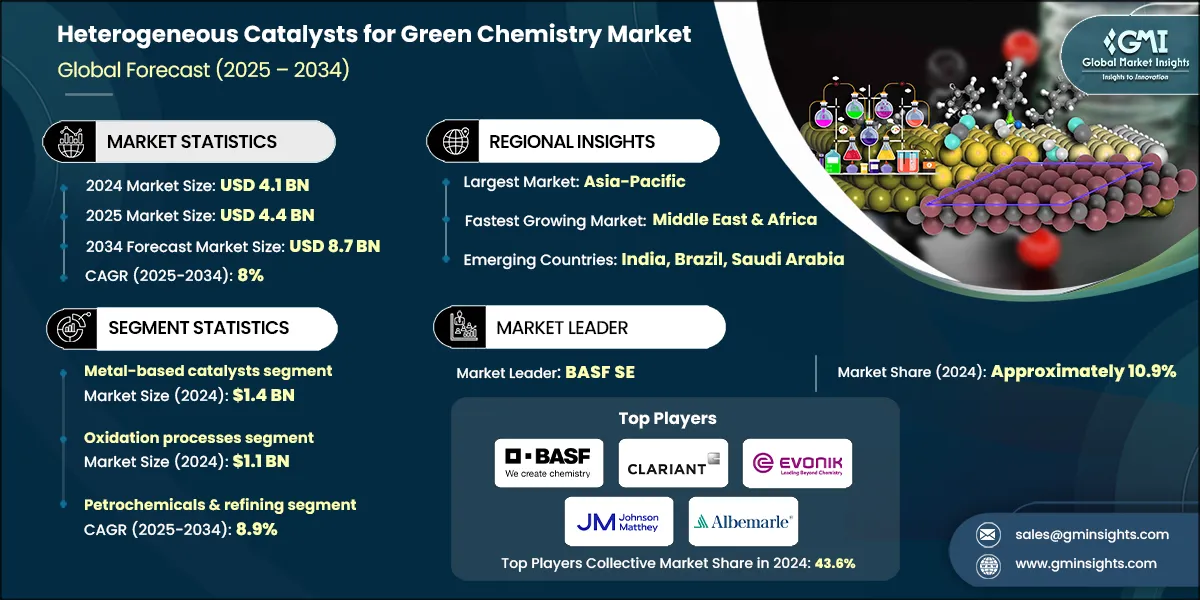
The global heterogeneous catalysts for green chemistry market were valued at USD 4.1 billion in 2024 and are expected to grow from USD 4.4 billion in 2025 to USD 8.7 billion in 2034, at a CAGR of 8%, according to latest report published by Global Market Insights Inc.
To get key market trends
- During the lockdowns of COVID-19, heterogeneous catalysts showed their ability to thrive. R&D activity within the field of green chemistry and heterogeneous catalysts has seen growth, demonstrated it publishing over 4,230 peer-reviewed pieces in 2023, representing an 8% increase in publications from 2019. Within the industrial sector, the International Energy Agency (IEA) reports an increase of 22% to 6.8 Mt of renewable diesel driven by impactful Ni–Mo hydro-treating catalysts. Even during economically rough conditions, refineries still placed investments on catalysts to meet the new demands set on the refinement process on the sulfur and CO2 emissions in the regions of the European Union and China. 2020 has established that there are no longer changes in crude oil pricing but regulations that influence the catalysts in the industry.
- Supply-chain disturbances were a huge factor during 2022. Prices of alumina and palladium on the LME increased by 33% and 11% respectively, which led formulators to start considering earth-abundant spinel oxides and zeolites. Despite this, demand still has not faltered. The 14th Five-Year Plan of China aimed for 20 Mt of bio-based chemicals by the year 2025, and Zr-based MOF catalysts received grant funding. The Zr-based MOF catalysts were scholarly produced in increasing volumes, with the Web of Science recording 5,110 green-catalysis papers, an 4% increase on top of the overall chemistry growth. Industrial demonstrations of CO2-to-ethylene in the US and Canada used Ag/CeO2 catalysts with a 65% Faradaic efficiency for 8,000 hours proving scalable and economically durable for large applications.
- 2023-2024 is centered around the use of heterogeneous green catalysts for geopolitical issues involving climate change and sustainable development. The US Inflation Reduction Act with a climate budget of $369 B has produced over USD 2.6 B of investment into ammonia and catalytic SAF as well as plastic recycling initiatives (DOE Loan Office, 2023). IRENA forecasts a 30-fold increase in power to chemical synthesis, largely driven by chemical synthesis of ammonia, with the use of alkaline-Ni catalysts to reach a cost of $50 kg and a power to chemicals of 15GW by 2030. In 2024, 12% of the chemistry Nobel prizes are expected to be in the field of heterogeneous catalysis which shows the societal shift of the discipline from niche to mainstream.
Heterogeneous Catalysts for Green Chemistry Market Report Attributes
| Key Takeaway | Details |
|---|---|
| Market Size & Growth | |
| Base Year | 2024 |
| Market Size in 2024 | USD 4.1 Billion |
| Market Size in 2025 | USD 4.4 Billion |
| Forecast Period 2025 - 2034 CAGR | 8% |
| Market Size in 2034 | USD 8.7 Billion |
| Key Market Trends | |
| Drivers | Impact |
| Net-zero mandates tighten industrial emission limits | Compels rapid adoption of efficient solid catalysts |
| Circular economy targets accelerate plastic upcycling | Boosts demand for robust acid–base catalysts |
| Renewable fuels scaling needs durable hydro-treating catalysts | Ensures steady bulk orders from bio-refineries |
| Pitfalls & Challenges | Impact |
| Precious metal price volatility inflates catalyst costs | Squeezes margins, deters smaller process adopters |
| Catalyst regeneration infrastructure remains capital intensive | Limits deployment in price-sensitive emerging markets |
| Technical complexity of MOFs hampers manufacturing scale-up | Slows commercialization despite strong laboratory performance |
| Opportunities: | Impact |
| Abundant earth-oxide alternatives reduce supply risk | Encourages substitution away from scarce metals |
| Green hydrogen boom opens CO2-to-chemicals pathways | Expands catalyst applications across e-fuel plants |
| Digital twins optimize catalyst lifetime and turnover | Data-driven performance gains cut operating expenses |
| Market Leaders (2024) | |
| Market Leaders |
Approximately 10.9% Market share |
| Top Players |
Collective market share in 2024 is 43.6% |
| Competitive Edge |
|
| Regional Insights | |
| Largest Market | Asia-Pacific |
| Fastest growing market | Middle East & Africa |
| Emerging countries | India, Brazil, Saudi Arabia |
| Future outlook |
|
What are the growth opportunities in this market?
Heterogeneous Catalysts for Green Chemistry Market Trends
- Earth-Abundant Metal Substitution— 2022 saw significant increases in the prices of palladium and ruthenium—38% and 11% respectively on the LME—pushing formulators to consider alternatives such as the more economically viable Fe-Ni spinel oxides and zeolite-encapsulated Cu and Mn-perovskites. In the 2023 update of Clariant’s CATOFIN®, magnesium aluminate was substituted for 60% of the Cr, having retained propane dehydrogenation yields, further indication that price hedging is a primary objective for R&D across the sector.
- CO2-to-X Pilots Move From Lab to Field— Industrial demonstrations activities in response to National Net-Zero plans abound. Twelve’s 2023 Sacramento unit converts 150 t y-1 of CO2 into electro-methanol using Ag/CeO2 gas-diffusion electrodes, while polyol plant in Runcorn, over Zn–Cr catalysts, removes Petro-propylene oxide and adds captured CO2. Such visibility is pushing venture deals in solid catalysts for e-jet fuels up 45% year-on-year.
- AI-Driven Design and Digital Twins— Incredibly, what was once weeks of work on high-throughput DFT screening was completed in one night by Google DeepMind’s 2023 GNoME model, which forecast 2.2 million stable inorganic crystals, instantaneously identifying 700 catalyst surfaces as promising. Similar results are now produced for BASF using AspenTech twins to simulate deactivation and reduce pilot cycles by 30%. Coupling in-situ spectroscopy and cloud analytics fosters tighter timelines for concept-to-plant, a trend which is attracting data-native entrants into the field.
- Catalytic Circularity for Plastics and Biomass— The EU’s 2024 Packaging Regulation will mandate 25 % recycled content which will build even more interest and investment in solid-acid zeolites that depolymerize PET to monomers at 95 % selectivity. Biomass and Topsoe’s HEFA plants use proprietary Co-Mo catalysts to increase turned used cooking oil to SAF 70 % since 2020. In tandem, waste-to-value channels underpin resilient double-digit catalyst demand.
Heterogeneous Catalysts for Green Chemistry Market Analysis
Learn more about the key segments shaping this market
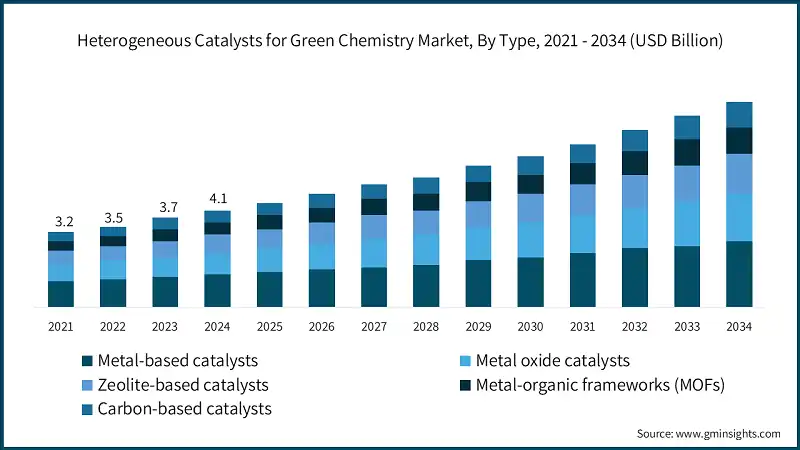
Based on type, the market is segmented into Metal-based catalysts, metal oxide catalysts, zeolite-based catalysts, metal-organic frameworks (MOFs), carbon-based catalysts. Metal-based catalysts segment was valued at USD 1.4 billion in 2024, and it is anticipated to expand with 7.6% CAGR during 2025-2034.
- Manufacturers are swapping palladium-rich formulations for abundant Ni, Cu and Fe alloys or mixed-oxide perovskite analogues, slicing material bills 40 %. Parallel R&D marries noble specks with base backbones—think Pt-Ni nanoclusters or Au-CeO2—to match turnover frequencies while hedging price swings; patents on such bimetallic systems rose 28 % in 2023.
- Architecture engineering is the second business wave. Hierarchical zeolites, defect-rich Zr-MOFs and graphene-wrapped Co nanoparticles shorten diffusion paths and boost stability, letting plants stretch catalyst lifetimes beyond 8,000 h on stream. Coupled with AI-driven surface modelling and subscription-based regeneration contracts, suppliers unlock recurring revenues while offering users 15 % lower operating expenses—vital as ESG clauses tighten across Asia-Pacific procurement.
Based on process, the heterogeneous catalysts for green chemistry market is segmented into Oxidation processes, hydrogenation and reduction, acid-base catalyzed reactions, C-C bond formation reactions, photocatalytic and electrocatalytic processes. The Oxidation processes were valued at USD 1.1 billion in 2024, and it is anticipated to expand to 7% of CAGR during 2025-2034.
- Decarbonization targets converge reaction classes into electrified, low-temperature platforms. Oxidations and hydrogenation increasingly share water-electrolyze infrastructure, shifting OPEX from gas to renewable power. Start-ups like Electracy deploy bifunctional NiFe/CoP electrodes swinging between oxygen evolution and selective hydrogenations, trimming CO2 45%. Consequently, demand for cross-compatible heterogeneous catalysts balloons, favoring vendors certifying performance under chemical and electrochemical regimes amid tighter ESG goals.
- The second wave of process intensification focuses on even more complex processes. Continuous-flow microreactors are now able to multiplex acid-base reactions, C-C coupling, and photocatalytic steps within one skid, leading to a reduction in solvent usage by 30% and a halving of cycle times. The 2023 Nitro Flow® line by Johnson Matthey serves as a prime example of this model: catalyst cartridges are leased and digitally monitored as twin models, and on-site refueling of cartridges is controlled off-site, creating annuity revenue and also fulfilling end users’ Scope-3 accounting and carbon compliance demands.
Learn more about the key segments shaping this market
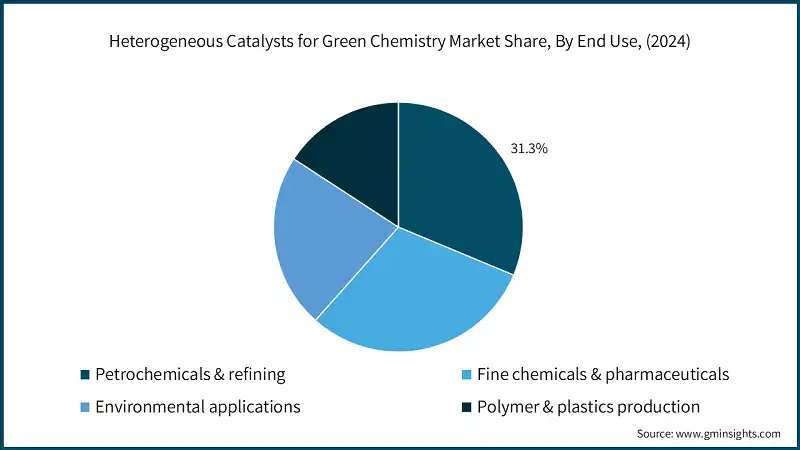
Based on End Use, the heterogeneous catalysts for green chemistry market is segmented into Petrochemicals & refining, fine chemicals & pharmaceuticals, environmental applications, polymer & plastics production. The Petrochemicals & refining segment was largest and valued at USD 1.3 billion in 2024, and it is anticipated to expand to 8.9% of CAGR during 2025-2034, constituting 31.3% in overall market share in 2024.
- Refining still absorbs the majority of the heterogeneous catalyst tonnage, though the business model is changing. Hydro processing units now process tallow and used cooking oil under NiMo catalysts to meet the Euro 6 and IMO 2020 sulfur regulations. The rejuvenated FCC (fluid catalytic cracking) now chases on-purpose propylene yields. For aromatics maximization, refining skids are retrofitted with Pt-Sn alloys, transforming previously defensive operations into dynamic, margin-generating asset plays.
- In comparison to the above, downstream integrated operations in the refining sector are now more advanced and complex. At the same time, new MnOx and CuZnO catalysts see a demonstration of CO2 methanol conversion via a 1.5 t d-1 methanol downdraft VOC (volatile organic compounds) abatement catalyst, while zeolitic propylene boosters enhance the refining of polyolefins and support the chemically recycled polyolefins.
Looking for region specific data?
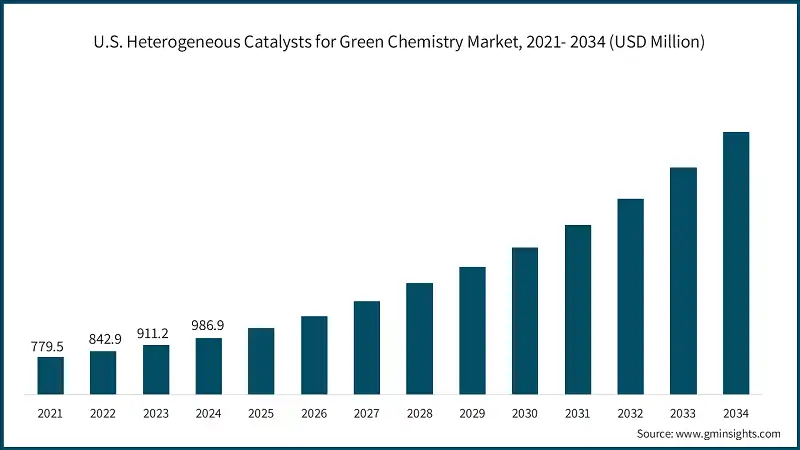
- North America heterogeneous catalysts for green chemistry market valued at USD 1.2 billion in 2024 and is expected to increase to USD 2.6 billion by 2034, due to incentives provided by the Inflation Reduction Act. The market was valued at USD 986.9 million in 2024 and is projected to reach USD 2 billion by 2034.
- Loan guarantees and 45V hydrogen tax credits are supporting the scaling of CO2-to-ethylene, e-jet fuel, and renewable-diesel plants, which guarantees a steady demand for the durable Ag, CuZn, NiFe catalysts manufactured by Johnson Matthey, Albemarle, and rapidly expanding entrants like Twelve.
- At the same time, U.S. shale derivatives are providing inexpensive feedstocks for hybrid electrified-thermal reactors. Operators are increasingly signing multi-year service contracts that bundle complete packages of catalysts, digital twins, and buy-back METAL schemes which are designed to improve and close domestic supply chains and reduce price volatility.
- Europe holds a total market size of USD 1 billion for the year 2024, with projection of USD 2.2 billion by 2034. Germany's market size was USD 212.3 million in 2024 with a projected 7.6% CAGR for 2025-2034, driven by deepening circular economy directives.
- While German refiners retrofitted hydrocrackers to co-process waste oils, chemical majors are piloting Mn-promoted perovskites for plastic de-polymerization.
- Asia-Pacific is expected to continue leading the world market, with values expected to rise from USD 1.3 billion in 2024 to USD 2.9 billion in 2034, primarily due to large-scale refinery upgrades and aggressive net-zero policies. China’s market was USD 612 million in 2024 and is expected to grow at 8.3% from 2025 to 2034.
- China’s state-backed propane dehydrogenation, bio-jet fuel, and CO2-to-methanol complexes is expanding rapidly, creating a strong demand for zeolite and Ni-Mo and Ag-CeO2 catalysts while domestic producers are securing rare earth holdings, lowering input cost and signing long-term contracts with BASF, Clariant and Topsoe.
- In 2024, the Latin America region's heterogeneous catalysts for green chemistry market value reached USD 312 million and grow to USD 604 million by 2034 due to the region's large biomass availability and aggressive recycling policies. The Brazilian market was worth USD 116 million in 2024 and is projected to grow at a CAGR of 7.4% in the 2025-2034 period.
- Brazilian bio-refineries utilize catalysts to produce Co-Mo, CuZnO and zeolite catalysts needed for the conversion of bagasse to syngas, ethanol, and soy oil. This unlocks the RenovaBio credits and exports grade SAF.
- Middle East and Africa expected to grow from USD 212 million in 2024 to USD 404 million by 2034. The Saudi Arabian market was valued at USD 100 million in 2024 and is projected to grow at 8.1% CAGR from 2025 to 2034.
- Saudi Aramco and SABIC, under Vision 2030, will have hydro-treaters retrofitted to co-process tallow and pyrolysis oil alongside new solid-oxide ammonia electrocatalysts with NEOM top-tier supply deals on ammonia from Topsoe and BASF and are co-financing strategic pyrolysis oil projects.
- New regeneration hubs in Jubail and Dammam reduce FCC and hydrocracker catalyst turnaround times. In combination with localization incentives, these hubs are instrumental in developing and attracting a skilled workforce, leading to partnerships with European licensors in joint-venture technology-transfer agreements.
Heterogeneous Catalysts for Green Chemistry Market Share
- BASF SE, Clariant AG, Evonik Industries AG, Johnson Matthey plc, and Albemarle Corporation accounted for market share of 43.6% of the global market in 2024.
- BASF stands firm, commanding about 10.9% of heterogeneous green-catalyst revenues within the market. This is due to their cradle-to-grave regeneration services and fully integrated metal procurement systems. In addition to having the largest potentiated desk of zeolite IP. They positioned themselves straight after the original BASF with about the same market share. They apply efficiencies from their portfolio, primarily their CATOFIN® and EnviCat® families, to win petro-bio co-processing retrofits in Asia, aligning with their green-catalytic systems. They often protect their market share and price leverage by offering multiyear performance guarantees.
- Evonik and Johnson Matthey take an agility tier in the spectrum, where their specialization, in niche market catalysts, decidedly outweighs sheer business scale. Johnson Matthey controls about 7.3% of the market share in 2024 and is currently surfing the valuation of direct-chemistry coupled with the L-Meth™ and HyMET™ electrocatalysts, with US partnerships to reduce risks in novel avant-garde sustainable aviation fuel plants.
- From the lithium rich arm of the southern US, Albemarle applies his salt-to-metal wizardry to construct strong alkaline catalysts for renewable diesel and CO2-to-chemicals loops. This contributes to the mid-single digit percentage of global revenues. Within Albemarle’s layered defended structures, charge and proprietary-Wethered-battery surface science coupled with active market morphology is partnered with battery grade critical metals.
Heterogeneous Catalysts for Green Chemistry Market Companies
The major players operating in heterogeneous catalysts for green chemistry industry include:
- BASF SE
- Clariant AG
- Evonik Industries AG
- Johnson Matthey plc
- Albemarle Corporation
- BASF SE: With an estimated market share of 10.9%, BASF leverages its vertically integrated metals sourcing and 300 patent zeolite library offerings for hydro processing and CO2-to-methanol plants. It launched SpinCat-Ni™ earth-abundant catalysts and collaborated with JGC for AI-guided formulation, reinforcing cradle-to-grave service contracts.
- Clariant AG: Holding approximately 10% market share, Clariant is winning plastic upcycling and bio-propane projects with its chromium-free CATOFIN® and EnviCat® VOC product lines. Clariant secures regional capacity and advances manganese-promoted propane dehydrogenation technology with the 2024 announcement of a $ 70 million catalyst plant in Jiaxing, China.
- Evonik Industries AG: With approximately an 8.6 % share, Evonik is developing specialty mixed-oxide and mesoporous silica catalysts that shorten diffusion paths in continuous reactors. The firm opened its Marl “Catalyst Smart Hub” in 2023, integrating high-throughput robotics with IBM Watson modeling to reduce development cycles by 25% and focus on circular plastic customers.
- Johnson Matthey plc: Estimated to hold 7.3% of the market, JM specializes in low-temperature hydrogenation and CO2 electro-conversion. Its 2023 launch of HyMET™ Ag–CeO2 gas-diffusion electrodes, benchmarked by a DOE grant, positions JM as a licensor for e-jet fuel plants and with a recycling network that assures precious-metal return flows.
- Albemarle Corporation: Holding a 6.8% share, Albemarle leverages its lithium-brine expertise to manufacture strong alkali-promoted hydro processing catalysts for renewable diesel. A 2024 MoU with Neste looks at co-locating regeneration units in Louisiana, taking advantage of Inflation Reduction Act incentives, and expanding Albemarle’s presence, beyond refinery FCC additives, into the emerging bio-fuel value chains.
Heterogeneous Catalysts for Green Chemistry Industry News
- In May 2024, Johnson Matthey established a long-term relationship with electro-fuel start-up Twelve, supplying HyME Ag-CeO2 gas-diffusion electrodes for the first commercial Power-to-SAF plant in Washington that converts 150 t y-1 CO2.
- In October 2023, Clariant inaugurated the construction of a USD 70 million CATOFIN catalyst facility in Jiaxing, China, which will double the production they have in Asia. The facility will include manganese-promoted PDH lines, the facility will implement AI to analyze the processes which will help reduce scale-up cycles by 25%.
- In November 2021, Haldor Topsoe acquired a new eight-megawatt solid-oxide electrolysis demonstrator at Ørsted’s Herning site which approved the new cobalt-free perovskite electrodes in 8,000-hour operation and set the groundwork for 500 MW green-ammonia projects in NEOM hub in Saudi Arabia.
The heterogeneous catalysts for green chemistry market research report includes in-depth coverage of the industry with estimates & forecast in terms of revenue (USD Billion) & volume (Kilo Tons) from 2021 to 2034, for the following segments:
Market, By Type
- Metal-based catalysts
- Noble metal catalysts (Pt, Pd, Rh, Au)
- Base metal catalysts (Ni, Cu, Co, Fe)
- Bimetallic and alloy systems
- Metal oxide catalysts
- Single metal oxides
- Mixed metal oxides and perovskites
- Zeolite-based catalysts
- Synthetic zeolites
- Hierarchical and modified zeolites
- Metal-organic frameworks (MOFs)
- Zr-MOFs and UiO series
- Cu-MOFs and HKUST-1 derivatives
- Carbon-based catalysts
- Activated carbon and biochar
- Carbon nanotubes and graphene
Market, By Process
- Oxidation processes
- Hydrogenation and reduction
- Acid-base catalyzed reactions
- C-C bond formation reactions
- Photocatalytic and electrocatalytic processes
Market, By End Use
- Petrochemicals & refining
- Hydro processing applications
- Fluid catalytic cracking
- Reforming and isomerization
- Fine chemicals & pharmaceuticals
- API synthesis
- Specialty chemical production
- Chiral and enantioselective synthesis
- Environmental applications
- Air pollution control
- Water treatment technologies
- CO2 conversion and utilization
- Polymer & plastics production
- Polyolefin catalysis
- Sustainable polymer synthesis
- Others
The above information is provided for the following regions and countries:
- North America
- U.S.
- Canada
- Europe
- UK
- Germany
- France
- Italy
- Spain
- Rest of Europe
- Asia Pacific
- China
- India
- Japan
- South Korea
- Australia
- Rest of Asia Pacific
- Latin America
- Brazil
- Mexico
- Argentina
- Rest of Latin America
- MEA
- UAE
- Saudi Arabia
- South Africa
- Rest of Middle East and Africa
Frequently Asked Question(FAQ) :
Who are the key players in the heterogeneous catalysts for green chemistry market?
Key players include BASF SE, Clariant AG, Evonik Industries AG, Johnson Matthey plc, Albemarle Corporation, Haldor Topsoe A/S, Honeywell UOP, Axens S.A., Umicore, and Zeolyst International.
What are the upcoming trends in the heterogeneous catalysts for green chemistry industry?
Key trends include substitution of precious metals with earth-abundant oxides, adoption of AI-enabled digital twin systems, and deployment of catalysts for CO2 utilization, plastic upcycling, and bio-based fuel production.
What is the market size of the North America heterogeneous catalysts for green chemistry market in 2024?
The North America heterogeneous catalysts for green chemistry market was valued USD 986.9 million in 2024. Growth is driven by strong policy support under the Inflation Reduction Act, promoting clean hydrogen, renewable fuels, and CO2-to-chemicals technologies.
What is the growth outlook for the petrochemicals & refining end-use segment from 2025 to 2034?
The petrochemicals & refining segment is projected to grow at a CAGR of 8.9% through 2034, supported by refinery retrofits, renewable diesel production, and demand for hydroprocessing catalysts that comply with global emission norms.
What was the valuation of the oxidation processes segment in 2024?
The oxidation processes segment was valued at USD 1.1 billion in 2024, driven by rapid adoption of electrified low-temperature platforms and increased integration of renewable power in catalytic systems.
How much revenue did the metal-based catalysts segment generate in 2024?
The metal-based catalysts segment generated USD 1.4 billion in 2024, leading the market due to their efficiency in oxidation, hydrogenation, and hydroprocessing reactions across refineries and chemical plants.
What is the current heterogeneous catalysts for green chemistry market size in 2025?
The market size is projected to reach USD 4.4 billion in 2025.
What is the projected value of the heterogeneous catalysts for green chemistry market by 2034?
The market size for heterogeneous catalysts for green chemistry is expected to reach USD 8.7 billion by 2034, fueled by advancements in CO₂-to-chemicals processes, renewable fuel synthesis, and AI-driven catalyst design.
What is the market size of the heterogeneous catalysts for green chemistry industry in 2024?
The market size was USD 4.1 billion in 2024, with a CAGR of 8% expected through 2034, driven by net-zero emission targets, circular economy mandates, and sustainable chemical manufacturing initiatives.
Heterogeneous Catalysts for Green Chemistry Market Scope
Related Reports