Summary
Table of Content

Heavy Duty Gas Turbine Market
Get a free sample of this report
Form submitted successfully!
Error submitting form. Please try again.
Thank you!
Your inquiry has been received. Our team will reach out to you with the required details via email. To ensure that you don't miss their response, kindly remember to check your spam folder as well!
Request Sectional Data
Thank you!
Your inquiry has been received. Our team will reach out to you with the required details via email. To ensure that you don't miss their response, kindly remember to check your spam folder as well!
Form submitted successfully!
Error submitting form. Please try again.
Heavy Duty Gas Turbine Market Size
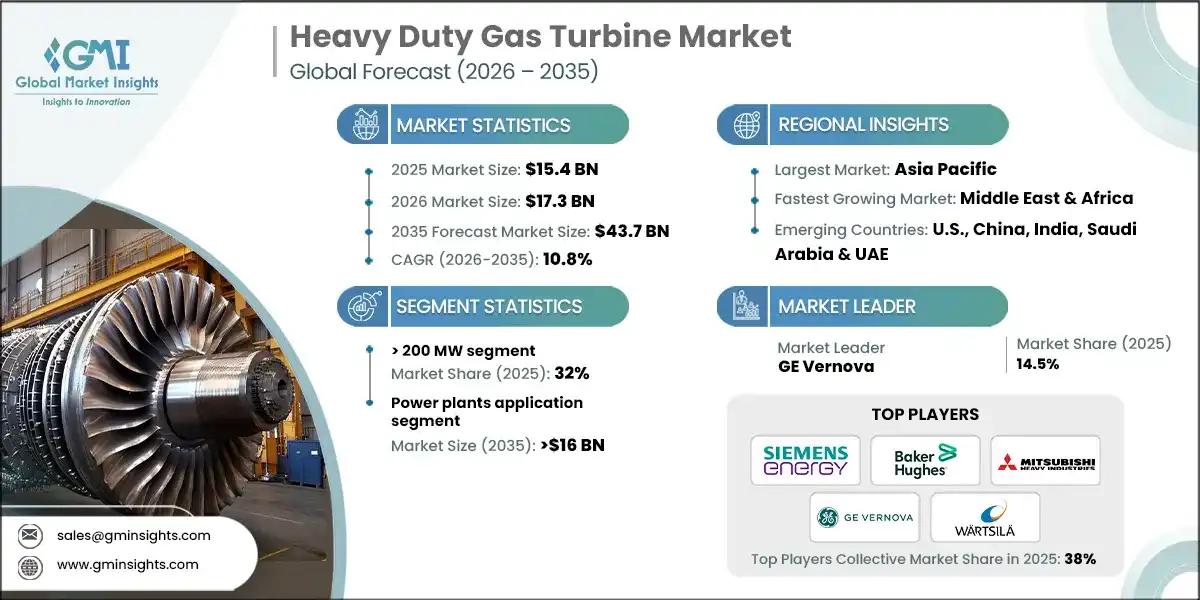
According to a recent study by Global Market Insights Inc., the heavy duty gas turbine market was estimated at USD 15.4 billion in 2025. The market is expected to grow from USD 17.3 billion in 2026 to USD 43.7 billion by 2035, at a CAGR of 10.8%.
To get key market trends
- The growing demand for electricity & the transition toward cleaner energy sources in line with ongoing advancements in turbine efficiency will accelerate industry growth. Governments and utilities are increasingly prioritizing gas-fired power generation owing to its strategic role as a transitional fuel, particularly in regions shifting away from coal.
- Heavy duty gas turbine technology embodies a sophisticated integration of engineering advancements and operational methodologies aimed at delivering reliable, high-performance power generation. These systems are designed to achieve exceptional thermal efficiency through optimized combustion processes, advanced cooling mechanisms, and precision in aerodynamics.
- They maintain operational stability under extreme conditions while offering flexibility to adapt to varying load demands and grid requirements. Furthermore, these gas turbines support compatibility with diverse fuel options, reinforcing their role in sustainable energy strategies. This combination of efficiency, adaptability, and fuel versatility positions these turbines as a critical component in modern power infrastructure, thereby accelerating business outlook.
- For citation, in November 2025, Bharat Heavy Electricals Limited (BHEL) emerged as the successful bidder for NTPC’s 3×800 MW Telangana Stage II supercritical thermal power plant contract, securing the main plant package which includes design, engineering, supply, erection and commissioning work, strengthening its long-standing partnership with power utility.
- The heavy duty gas turbine market was valued at USD 10.8 billion in 2022 and grew at a CAGR of approximately 5% through 2025. Growing environmental awareness along with the rising preference for cleaner energy solutions will proliferate the business landscape.
- The growing global energy demand coupled with rising investments in natural gas exploration and trade will drive business potential. Additionally, the increasing adoption of microgrids and initiatives aimed at lowering the capital costs of large-scale thermal power plants will stimulate the demand for these systems.
- Gas turbines operate by mixing it with fuel, compressing air, and igniting the blend to generate high-temperature, high-pressure gases. This expansion drives the turbine blades, delivering substantial power output along with superior efficiency and reliability. Designed for versatility, these turbines primarily utilize natural gas, enabling them to adapt seamlessly to evolving global energy landscapes.
- For instance, in August 2025, Larsen & Toubro secured a USD 1.8 billion contract from Adani Power to build eight 800 MW power plant units. This significant infrastructure project involves the supply and installation of high-capacity systems across multiple sites, highlighting its expertise in large-scale power plant construction and reinforcing its role in advancing energy infrastructure.
Heavy Duty Gas Turbine Market Report Attributes
| Key Takeaway | Details |
|---|---|
| Market Size & Growth | |
| Base Year | 2025 |
| Market Size in 2025 | USD 15.4 Billion |
| Market Size in 2026 | USD 17.3 Billion |
| Forecast Period 2026 - 2035 CAGR | 10.8% |
| Market Size in 2035 | USD 43.7 Billion |
| Key Market Trends | |
| Drivers | Impact |
| Stringent government norms to limit carbon emissions | Regulations enforcing lower carbon emissions push industries to adopt efficient heavy-duty gas turbines, reducing environmental impact and ensuring compliance. |
| Large scale integration of renewable energy | Increasing renewable energy sources require flexible gas turbines to balance grid variability, supporting stable and reliable power supply. |
| Growing focus on decentralized generation technologies | Decentralized power systems drive demand for compact, efficient heavy-duty gas turbines, enabling localized electricity generation and reducing transmission losses. |
| Pitfalls & Challenges | Impact |
| Cost competitiveness | High capital and maintenance costs of gas turbines limit adoption, making them less competitive compared to cheaper energy alternatives. |
| Opportunities: | Impact |
| Technological advancements | Innovations in efficiency, materials, and digital monitoring enhance turbine performance, attracting investments and expanding market potential globally. |
| Hybrid energy systems integration | Combining gas turbines with renewable energy sources offers flexible, low-emission solutions, boosting adoption in modern power infrastructures. |
| Retrofit and modernization projects | Upgrading aging power plants with advanced gas turbines improves efficiency, extends operational life, and creates significant growth opportunities. |
| Emerging markets expansion | Growing industrialization and energy demand in developing regions present opportunities for deploying gas turbines for reliable power generation. |
| Market Leaders (2025) | |
| Market Leaders |
14.5% market share |
| Top Players |
|
| Competitive Edge |
|
| Regional Insights | |
| Largest Market | Asia Pacific |
| Fastest Growing Market | Middle East & Africa |
| Emerging Country | U.S., China, India, Saudi Arabia & UAE |
| Future outlook |
|
What are the growth opportunities in this market?
Heavy Duty Gas Turbine Market Trends
- Governments are tightening environmental rules to curb carbon output, pushing power producers to prioritize technologies that deliver measurable reductions without sacrificing reliability or cost control. These turbines are moving into a compliance-first design paradigm, where low-NOx combustion systems, optimized turbine firing temperatures, and advanced thermal management work in concert to minimize greenhouse gas footprints.
- Policy frameworks that include emissions caps, performance standards, and mandatory reporting are accelerating adoption of retrofits and upgrades, prompting operators to deploy dry low emission combustors, improved fuel staging, and digital controls that monitor and tune combustion dynamics in real time, which in turn will stimulate business dynamics.
- Rapid growth in wind and solar capacity is transforming grid operations, introducing variability that requires fast, dependable response from dispatchable assets. These turbines fill that need through flexible operating profiles, high ramp rates, and superior part-load efficiency, enabling smooth balancing when renewable output surges, offering the significant opportunities for business expansion.
- For instance, In July 2025, GE Vernova’s JV with Harbin Electric Corporation signed a 25 year service agreement for two 9HA.01 heavy-duty gas turbines at the Huizhou Daya Bay Integrated Energy Station. These dual-fuel turbines started operations in July 2024 and deliver 1.34 GW , reducing CO2 emissions by ~2.5 million tons annually.
- The integration of renewables at scale is also changing the economics and engineering of turbine fleets. Plants that historically ran steady baseload cycles now face more dynamic duty profiles, which demand materials and coatings with improved resistance to thermal fatigue, hot-corrosion, and oxidation during frequent startups and shutdowns.
- Decentralized generation is gaining momentum, driven by the desire for resilient local power, reduced transmission dependence, and tailored energy solutions for industrial clusters, campuses, and urban districts. Furthermore, heavy-duty gas turbines are increasingly deployed in modular configurations that support combined heat and power, district energy, and microgrid architectures.
- Decentralization also reshapes operational practices, pushing owners toward digital twins, remote monitoring, and automated dispatch that harmonizes on-site generation with local load profiles, storage systems, and demand-side management. Moreover, its ability to optimize turbine cycling, peak shaving, and thermal delivery, reducing fuel costs and supporting continuous uptime will enhance the business momentum.
- For citation, in June 2024, Siemens Energy secured a USD 1.5 billion contract with China Energy International to deliver HL class heavy-duty gas turbines and steam generators for two combined cycle power plants, Taiba 2 and Qassim 2 in Saudi Arabia. The order includes a 25 year maintenance agreement and supports Saudi Vision 2030 by replacing oil-fired plants with high-efficiency infrastructure.
- Accelerated industrial growth across sectors including aviation, oil & gas, and mining is driving a sharp increase in energy demand. These industries rely on heavy-duty equipment and continuous production cycles, making dependable and efficient power generation an operational necessity.
- Metropolitan regions are witnessing surging electricity consumption driven by commercial complexes, transportation networks, and residential developments. The need for uninterrupted power supply in these densely populated areas is prompting utilities to invest in advanced turbine technologies that can integrate with smart grids and distributed generation systems.
Heavy Duty Gas Turbine Market Analysis
Learn more about the key segments shaping this market
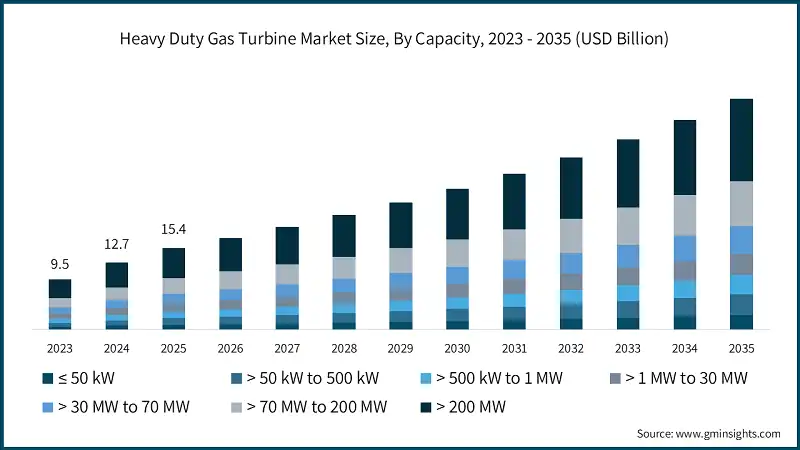
- Based on capacity, the industry is segmented into ≤ 50 kW, > 50 kW to 500 kW,> 500 kW to 1 MW, > 1 MW to 30 MW, > 30 MW to 70 MW, > 70 MW to 200 MW and > 200 MW. The > 200 MW heavy duty gas turbine market holds a share of about 32% in 2025 and is projected to grow at a rate of over 10.5% through 2035.
- The industry market is driven by rising electricity demand, efficiency mandates, and decarbonization. Emerging trends include hydrogen co-firing, carbon capture readiness, materials, digital twins, and AI-based monitoring. Utilities prioritize flexible, fast-ramping units, higher combined-cycle efficiencies, optimization, and fuel flexibility to ensure reliability and lower emissions.
- For instance, in February 2024, Mitsubishi Power received an order in February 2024 to supply the M701JAC gas turbine in a 600 MW combined-cycle plant. This follows previous turbines in Navoi 1 and 2. Commercial operation is expected in 2026, with co-generation of industrial steam and district heat.
- The ≤ 50 kW heavy-duty gas turbine segment is set to exceed USD 2.5 billion by 2035. These units support decentralized power, backup, and CHP applications requiring compact, reliable systems. Key trends include microturbine adoption, hydrogen and biogas compatibility, improved thermal efficiency, low-NOx combustion, digital control systems, and integration with hybrid renewable setups to enhance resilience and operational flexibility.
- The >50 kW to 500 kW heavy-duty gas turbines address medium-scale industrial power, commercial facilities, and utility support roles. Current trends emphasize modular designs, fast-start capability, higher part-load efficiency, advanced materials, low-emission combustion, hybridization with batteries, and digital automation to meet reliability, efficiency, and evolving sustainability requirements.
- The > 500 kW to 1 MW segment was valued at USD 1.2 billion in 2025. They serve industrial, commercial, and distributed power applications requiring reliable mid-range generation. Demand centers on efficiency, durability, and fuel flexibility, with units supporting combined heat and power, fast ramping, and seamless grid integration while addressing emissions standards and operational cost pressures across diverse energy environments.
- The > 1 MW to 30 MW rated turbines serve industrial, commercial, and distributed power needs with flexible, efficient generation. Demand is driven by CHP, peak shaving, and standby applications. Key focuses include fuel flexibility, low emissions, digital controls, fast start/stop capability, and integration with renewables to enhance reliability and operational performance.
- The > 30 MW to 70 MW heavy-duty gas turbine industry caters to mid-sized power plants, industrial complexes, and CHP systems. Demand is driven by efficiency, reliability, and flexibility requirements. Focus areas include advanced combustion, emissions reduction, digital control systems, fuel adaptability, and fast start/stop capability to support grid stability and evolving energy transition goals.
- The >70 MW to 200 MW heavy duty gas turbine market supports large industrial facilities and medium-scale utility generation requiring stable, high-output power. Market growth is driven by replacement of aging assets, higher efficiency thresholds, and operational flexibility. Systems are increasingly deployed for load balancing, cycling operations, and supporting intermittent power sources.
Learn more about the key segments shaping this market
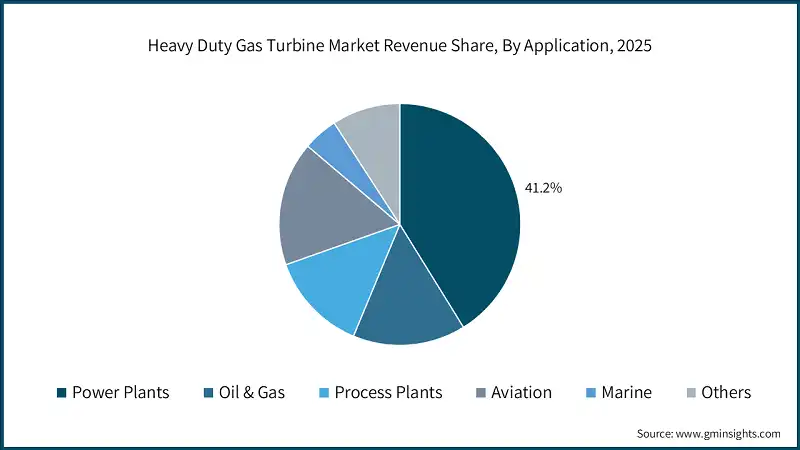
- Based on application, the industry is bifurcated into power plants, oil & gas, process plants, aviation, marine and others. The power plants application holds a share of 41.2% in 2025 and is set to reach over USD 16 billion by 2035.
- The market focuses on large-scale electricity generation with high-capacity and durable turbine systems. The demand is driven by efficiency improvements, grid reliability, and environmental regulations. Key features include advanced combustion, emissions control, and integration in combined-cycle configurations, enabling cost-effective & flexible power production, supporting evolving energy transition objectives.
- Oil & gas heavy duty gas turbine market was estimated at USD 2.3 billion in 2025. The industry supports upstream, midstream, and downstream operations through mechanical drive and power generation. Demand is driven by high load factors, remote deployment, and harsh operating conditions. Operators prioritize reliability, long maintenance intervals, efficiency under continuous duty, and compliance with tightening emissions standards.
- For instance, in May 2025, Ansaldo Energia partnered with Çal k Holding to sign an EPC contract for the 1000 MW Tiszaújváros CCGT plant in Hungary. The consortium will build and maintain hydrogen ready gas turbines at the former power plant site to support grid stability and renewables integration.
- The process plants application is set to grow at a rate of 10% from 2026 to 2035. The industry caters to industries such as chemicals, petrochemicals, and refineries, providing reliable power and mechanical drive solutions. Demand focuses on high efficiency, continuous operation, and fuel flexibility. Key trends include emissions reduction, digital monitoring, predictive maintenance, and integration with combined heat and power systems for optimized performance.
- The aviation heavy duty gas turbine market serves aircraft propulsion, auxiliary power units, and military applications. Growth is driven by the need for high thrust-to-weight ratios, fuel efficiency, reliability, and low emissions. Emerging trends include hybrid-electric integration, advanced materials, additive manufacturing, and digital engine monitoring to enhance performance, reduce maintenance, and improve operational efficiency.
- The marine heavy duty gas turbine market provides high-power propulsion and onboard electricity for naval vessels, commercial ships, and offshore platforms. Demand emphasizes compact, reliable, and fuel-efficient systems. Key trends include LNG and hydrogen fuel compatibility, advanced materials for corrosion resistance, digital performance monitoring, and integration with hybrid propulsion to enhance operational efficiency and sustainability.
Looking for region specific data?
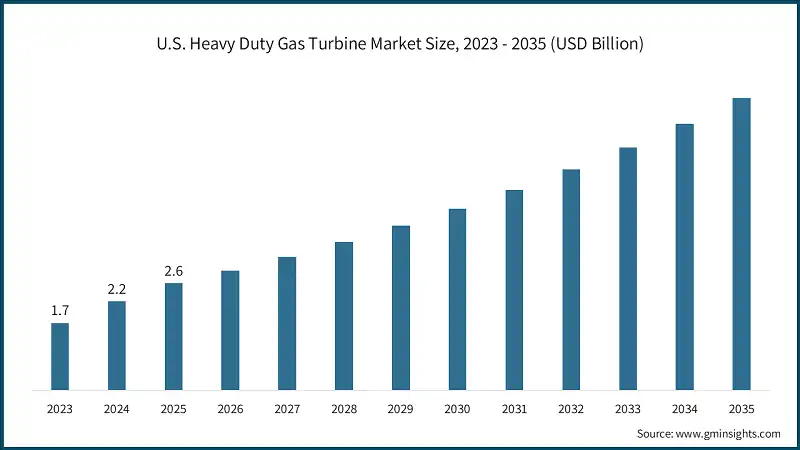
- The U.S. dominated the heavy duty gas turbine market in North America with around 74% share in 2025 and generated USD 2.6 billion in revenue. The industry is expanding owing to growing electricity demand, grid modernization, and decarbonization efforts. Key drivers include high-efficiency combined cycle plants, flexible operation, and stringent emissions standards. Emerging trends feature hydrogen blending, advanced digital controls, predictive maintenance, and fuel flexibility, supporting reliable, low-emission, and cost-effective power generation.
- The North America heavy duty gas turbine industry is projected to surge USD 8.5 billion by 2035. The market is driven by rising power demand, industrial growth, and decarbonization initiatives. Utilities and industries prioritize efficiency, reliability, and low emissions. Key trends include hydrogen and renewable fuel integration, advanced digital monitoring, predictive maintenance, and combined-cycle adoption, enabling flexible, cost-effective, and environmentally sustainable power generation.
- For illustration, in August 2025, Plant Yates initiated the installation of three M501JAC heavy-duty gas turbines for a simple-cycle expansion, adding 1,300 MW of peaking capacity. This upgrade enhances grid reliability during peak demand and represents the fleet’s first natural gas turbine addition in more than ten years.
- The Europe heavy duty gas turbine market is set to grow at a rate of over 8.5% by 2035. The industry is fueled by stringent emissions regulations, renewable integration, and the transition to low-carbon energy. The demand focuses on high efficiency, flexibility, and reliability for power generation and industrial applications. Key trends include hydrogen blending, digital optimization, predictive maintenance, and combined-cycle systems to support resilient energy infrastructure.
- Asia Pacific heavy duty gas turbine market will gain an appreciable momentum on account of rapid industrialization, urbanization, and growing electricity demand. Focus areas include high-efficiency power generation, fuel flexibility, and reliable industrial applications. Emerging trends feature hydrogen co-firing, digital monitoring, predictive maintenance, and combined-cycle integration, supporting sustainable, cost-effective, and resilient energy infrastructure across the region.
- For illustration, in March 2025, South Korea’s Doosan Enerbility secured an EPC contract worth around USD 200 million with Qatar Electricity & Water Co. to construct a 500 MW single cycle peak gas power plant in Ras Abu Fontas. Scheduled for commissioning in January 2027, the project will feature two F-class gas turbine units, enhancing Qatar’s peak power generation capacity.
- The Middle East & Africa accounts for about 18% of the heavy duty gas turbine industry in 2025. Rapidly expanding industrial and energy infrastructure will augment the industry landscape. Demand emphasizes high efficiency, durability, and fuel flexibility for power generation and oil & gas applications. Emerging trends include hydrogen co-firing, digital performance monitoring, predictive maintenance, and integration with combined-cycle and renewable energy solutions.
- For instance, in May 2025, Ansaldo Energia won a contract to deliver turbines for the Al Dhafra power plant in the UAE. Scheduled to become operational in 2027, this combined cycle gas turbine (CCGT) facility will operate alongside one of the world’s largest solar PV parks, integrating conventional and renewable energy to enhance power generation efficiency and support sustainable energy goals.
- Increasing electricity demand along with robust industrial growth will propel the Latin America heavy duty gas turbine industry. Focus areas include reliable, efficient power generation and industrial applications. Key trends feature fuel flexibility, digital monitoring, predictive maintenance, emissions reduction, and integration with combined-cycle and renewable systems, supporting cost-effective, resilient, and environmentally sustainable energy infrastructure.
Heavy Duty Gas Turbine Market Share
- The top 5 players in heavy duty gas turbine industry are Siemens Energy, Baker Hughes, Mitsubishi Heavy Industries, GE Vernova, and Wärtsilä contribute around 38% of the market share in 2025. The growth is accelerated by rising demand for efficient & flexible power generation, increasing penetration of renewable energy, and strict environmental regulations aimed at cutting emissions. The accelerating focus on decarbonization and energy transition is driving the adoption of advanced turbine technologies that deliver higher efficiency and reduced carbon footprints.
- The industry is capital-intensive, technology-driven, and highly competitive, characterized by long project lifecycles and stringent performance requirements. Growth is influenced by energy demand, efficiency standards, and decarbonization goals. The market emphasizes innovation, fuel flexibility, emissions control, and digital solutions, catering to wide tandem of sectors.
- Baker Hughes provided integrated gas turbine solutions designed to maximize efficiency, enhance fuel flexibility, and reduce emissions. Its portfolio featured advanced turbine configurations tailored for industrial and power generation applications, supported by digital monitoring platforms that enabled predictive maintenance and optimized operational performance.
- Siemens Energy delivered advanced gas turbine technologies engineered for high efficiency and minimal emissions. Its portfolio included turbines capable of operating on hydrogen and other sustainable fuels, complemented by digital platforms for real-time performance optimization.
- GE Vernova specialized in heavy-duty gas turbine systems engineered to integrate seamlessly with renewable energy and hybrid configurations. These turbines featured advanced high-efficiency combustion technology, digital twin capabilities, and IoT-enabled platforms for predictive analytics.
- Mitsubishi Heavy Industries offered a robust portfolio of heavy-duty gas turbines engineered for exceptional performance and operational flexibility. These solutions incorporated advanced cooling technologies, low-NOx combustion systems, and hydrogen-ready designs to support evolving decarbonization goals.
- Wärtsilä offered heavy-duty gas turbine solutions engineered for large-scale and hybrid power systems. The company emphasized modular configurations, rapid start-up capability, and seamless integration with renewable energy sources. Combining advanced mechanical design with smart technologies, Wärtsilä provided energy management platforms to optimize performance and enhance reliability.
Heavy Duty Gas Turbine Market Companies
- Siemens Energy posted revenues of USD 69.2 billion for fiscal year 2025, driven by its broad global footprint in the energy sector. The company delivered robust profitability, supported by disciplined cost controls and strong operational efficiency. These results reinforce Siemens Energy’s ability to sustain earnings and deliver consistent performance amid dynamic market conditions.
- GE Vernova delivered approximately USD 27.1 billion in revenue during the first nine months of 2025, reflecting strong performance across its diversified portfolio. The Power segment accounted for USD 14 billion, while the Wind and Electrification segments contributed USD 6.7 billion and USD 6.8 billion, respectively. This balanced distribution highlights the company’s scale and strategic breadth across its core business units.
- Mitsubishi Heavy Industries recorded USD 13.6 billion in revenues and a net profit of USD 750 million for the first half of 2025, demonstrating strong financial performance and underscoring the company’s significant operational scale and profitability during this period.
Major players operating in the heavy duty gas turbine industry are:
- Ansaldo Energia
- Baker Hughes
- Boldrocchi
- Bharat Heavy Electricals
- Capstone Green Energy
- Centrax Gas Turbines
- Destinus Energy
- Doosan Enerbility
- Ethos Energy Group
- Flex Energy Solutions
- GE Vernova
- Harbin Electric
- Kawasaki Heavy Industries
- MAN Energy Solutions
- Mitsubishi Heavy Industries
- Nanjing Steam Turbine Motor
- Rolls Royce
- Siemens Energy
- Shanghai Electric Gas Turbine
- Solar Turbines
- Vericor
- Wärtsilä
Heavy Duty Gas Turbine Industry News
- In September 2025, Mitsubishi Power announced it had secured its first order for M100S blast furnace gas-fired gas turbine from Jiangsu Lihuai Steel, part of China’s Jiangsu Shagang Group. The 100-MW class GTCC plant was designed to replace conventional BTG systems, delivering higher efficiency and supporting decarbonization efforts in the steel industry. This milestone positioned Mitsubishi Power to lead modernization initiatives across China’s industrial energy landscape.
- In March 2025, GE Vernova announced that its H-Class gas turbine fleet surpassed three million operating hours across 116 units worldwide, delivering 67 GW of power enough to supply over 50 million U.S. homes. The company invested over USD 160 million to expand its capacity at Greenville facility to meet rising demand. The HA fleet continued to provide efficient, flexible power solutions, supporting renewable integration and advancing decarbonization through hydrogen co-firing and carbon capture readiness.
- In March 2025, Mitsubishi secured a contract to deliver six M501JAC gas turbines for Saudi Arabia’s Al-Nairyah-1 and Rumah-1 power projects. The combined 3.6 GW capacity will play a pivotal role in advancing Saudi Vision 2030 by strengthening grid stability and enabling greater integration of renewable energy. Developed in collaboration with SEC, ACWA Power, and KEPCO, these projects are designed to provide dependable power to the region while reinforcing economic infrastructure.
- In February 2025, Rolls-Royce entered into an agreement with Siemens Energy to supply generators, turbines, and auxiliary systems for its Generation 3+ Small Modular Reactors. This collaboration aims to enhance the efficiency and cost competitiveness of nuclear power, positioning SMR technology as a viable solution for future energy needs. Each reactor will deliver an output of 470 MW, reinforcing the role of advanced nuclear solutions in meeting growing global demand for low-carbon energy.
The heavy duty gas turbine market research report includes in-depth coverage of the industry with estimates & forecast in terms of revenue (USD Million) & volume (MW) from 2022 to 2035, for the following segments:
Market, By Capacity
- ≤ 50 kW
- > 50 kW to 500 kW
- > 500 kW to 1 MW
- > 1 MW to 30 MW
- > 30 MW to 70 MW
- > 70 MW to 200 MW
- > 200 MW
Market, By Technology
- Open cycle
- Combined cycle
Market, By Application
- Power plants
- Oil & gas
- Process plants
- Aviation
- Marine
- Others
The above information has been provided for the following regions and countries:
- North America
- U.S.
- Canada
- Mexico
- Europe
- UK
- France
- Germany
- Russia
- Italy
- Netherlands
- Finland
- Greece
- Denmark
- Romania
- Poland
- Sweden
- Asia Pacific
- China
- Australia
- Japan
- India
- South Korea
- Indonesia
- Thailand
- Malaysia
- Bangladesh
- Middle East & Africa
- Saudi Arabia
- UAE
- Qatar
- Kuwait
- Oman
- Egypt
- Turkey
- Bahrain
- Iraq
- Jordan
- Lebanon
- South Africa
- Nigeria
- Algeria
- Kenya
- Ghana
- Latin America
- Brazil
- Argentina
- Peru
- Chile
Frequently Asked Question(FAQ) :
What is the growth outlook for Europe heavy duty gas turbine market from 2026 to 2035?
Europe market is set to grow at a rate of over 8.5% by 2035, fueled by stringent emissions regulations, renewable integration, and transition to low-carbon energy solutions.
Which region leads the heavy duty gas turbine market?
The U.S. dominated the heavy duty gas turbine market in North America with around 74% share in 2025 and generated USD 2.6 billion in revenue.
What are the upcoming trends in the heavy duty gas turbine market?
Key trends include hydrogen and biofuel-compatible turbines, adoption of IoT and AI-based monitoring, digital twin technology, predictive maintenance, and integration with renewable energy systems for flexible power generation.
Who are the key players in the heavy duty gas turbine market?
Key players include Ansaldo Energia, Baker Hughes, Boldrocchi, Bharat Heavy Electricals, Capstone Green Energy, Centrax Gas Turbines, Destinus Energy, Doosan Enerbility, Ethos Energy Group, Flex Energy Solutions, GE Vernova, Harbin Electric, Kawasaki Heavy Industries, MAN Energy Solutions, Mitsubishi Heavy Industries, Nanjing Steam Turbine Motor, Rolls Royce, Siemens Energy, Shanghai Electric Gas Turbine, Solar Turbines, Vericor, and Wärtsilä.
What is the market size of the heavy duty gas turbine in 2025?
The market size was USD 15.4 billion in 2025, with a CAGR of 10.8% expected through 2035 driven by growing focus on decentralized generation technologies and renewable energy integration.
What was the valuation of power plants application segment in 2025?
Power plants application held 41.2% market share in 2025 and is set to reach over USD 16 billion by 2035.
What is the current heavy duty gas turbine industry size in 2026?
The market size is projected to reach USD 17.3 billion in 2026.
How much revenue did the > 200 MW capacity segment generate in 2025?
The > 200 MW segment held 32% market share in 2025 and is projected to grow at over 10.5% through 2035, driven by rising electricity demand and efficiency mandates.
What is the projected value of the heavy duty gas turbine market by 2035?
The heavy duty gas turbine market is expected to reach USD 43.7 billion by 2035, propelled by stringent emissions regulations, renewable integration, and transition toward cleaner energy sources.
Heavy Duty Gas Turbine Market Scope
Related Reports