Summary
Table of Content

Heavy-Duty Autonomous Vehicle Market
Get a free sample of this report
Form submitted successfully!
Error submitting form. Please try again.
Thank you!
Your inquiry has been received. Our team will reach out to you with the required details via email. To ensure that you don't miss their response, kindly remember to check your spam folder as well!
Request Sectional Data
Thank you!
Your inquiry has been received. Our team will reach out to you with the required details via email. To ensure that you don't miss their response, kindly remember to check your spam folder as well!
Form submitted successfully!
Error submitting form. Please try again.
Heavy-Duty Autonomous Vehicle Market Size
The demand for more safety features in cars and people's growing interest in autonomous vehicles is driving new market growth. New vehicles have many sensors and software algorithms that can analyze the environment in real-time and make decisions on the fly. By implementing these solutions, the number of accidents and therefore fatalities, and injuries, and automobile and infrastructure damage are expected to decline resulting in both decreased costs and lives saved.
Heavy-Duty Autonomous Vehicle Market Key Takeaways
Market Size & Growth
- 2025 Market Size: USD 45.8 Billion
- 2026 Market Size: USD 48.9 Billion
- 2035 Forecast Market Size: USD 181.5 Billion
- CAGR (2026–2035): 15.7%
Regional Dominance
- Largest Market: North America
- Fastest Growing Region: Asia-Pacific
Key Market Drivers
- Expansion of 5G and high-speed connectivity.
- Growing demand for vehicle safety and telematics.
- Government mandates for vehicle connectivity.
- Rising adoption of smart mobility and digital services.
Challenges
- Cybersecurity and data privacy concerns.
- High cost of connectivity hardware and integration.
Opportunity
- Over-the-air (OTA) software updates expansion.
- Integration of V2X communication technologies.
Key Players
- Market Leader: Volvo led with over 9% market share in 2025.
- Leading Players: Top 5 players in this market include Daimler Truck, FAW, PACCAR, TRATON, Volvo, which collectively held a market share of 30% in 2025.
Get Market Insights & Growth Opportunities
To support the growth of autonomous trucks the industry will need to work together and through partnerships to meet the increasing demand from businesses. For instance, On March 2024, Scania, MAN, and Navistar announced a partnership to increase the entry of Level 4 autonomous trucks into the marketplace and significantly change the trucking industry. The companies are working together to provide more efficient, safer, and sustainable transportation through advanced automated functions, and Artificial Intelligence-based decision-making.
The COVID-19 pandemic had both positive and negative consequences for the Heavy-Duty Autonomous Vehicle industry. In early 2020, lockdowns, supply chain interruptions and semiconductor scarcity caused testing projects for autonomous trucks to be shelved and caused many of the global automotive OEMs and tech developers to delay the rollout of heavy-duty electric and autonomous vehicles. Furthermore, many pilot projects were either paused or suspended as logistics providers shifted their focus away from technology development and operational investments towards solely maintaining the flow of essential freight and managing the limitations associated with their workforce due to COVID-19.
North America is the largest market for Heavy-Duty Autonomous Vehicle. Governments are working on developing legislation for the implementation of autonomous vehicles that is clear and standardized across borders, as well as ensuring vehicle safety standards, cybersecurity measures, data protection regulations, and liability allocation. For example, in May 2023, the US Federal Highway Administration (FHWA) undertook a progressive step towards securing the safe development, testing, and deployment of Automated Vehicles (AV) technologies.
The region of Asia-Pacific is quickly becoming the fastest-growing area for the development of Heavy-Duty Autonomous Vehicles, with multiple government initiatives, large-scale mining and logistics operations, and rapid rollout of new technologies by local OEMs and technology developers. For example, in 2025, the China Huaneng Group commissioned the world’s first fleet consisting of 100 autonomous, all-electric mining trucks at the Yimin open pit mine in Inner Mongolia. This is evidence of how quickly the Asia-Pacific region is developing autonomous heavy-duty vehicles for use in industrial applications.
Global heavy-duty autonomous vehicle market was estimated at USD 45.8 billion in 2025. The market is expected to grow from USD 48.9 billion in 2026 to USD 181.5 billion in 2035, at a CAGR of 15.7% according to latest report published by Global Market Insights Inc.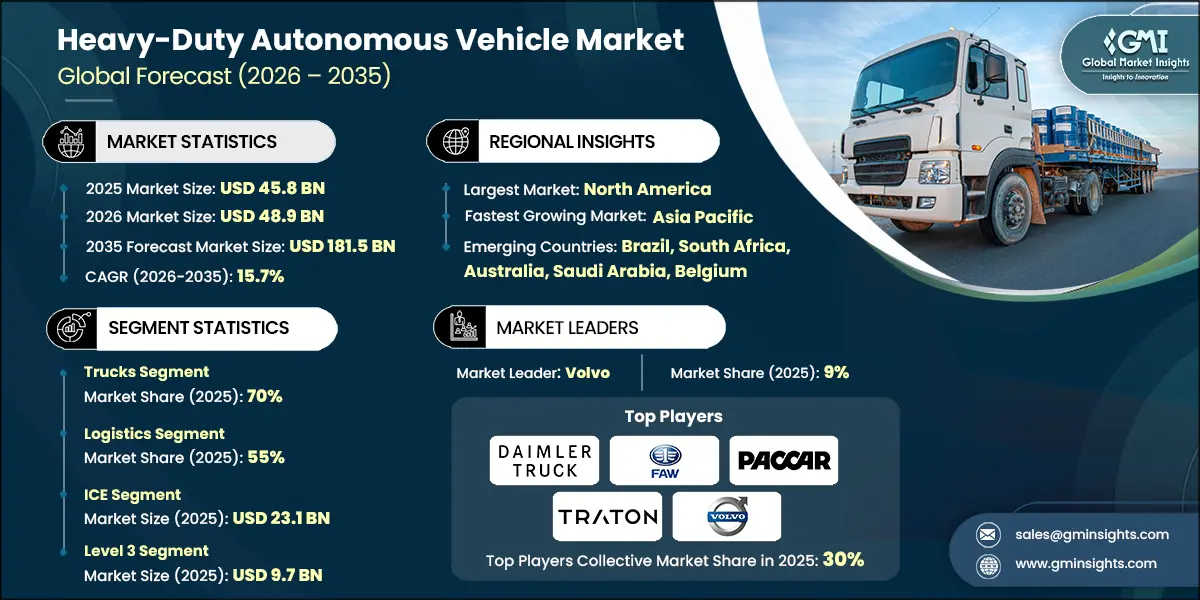
To get key market trends
Heavy-Duty Autonomous Vehicle Market Trends
The technological advances made in LiDAR, radar, cameras and additional sensors will continue to drive the development of heavy-duty autonomous vehicle technology. These advances enhance the ability of autonomous vehicles to accurately perceive their surroundings and navigate more effectively and safely in a wider variety of scenarios. In addition, the advancement of algorithms, particularly AI and ML, allows autonomous vehicles to make more intelligent real-time decisions, maneuver in complex environments and adapt more effectively to changing road conditions.
These systems utilize machine learning algorithms as well as LiDAR, radar and cameras to make predictions based on real-time input data; they bring heavy-duty transport closer to the achievement of Level 4 autonomy. Also, AI is changing the approach taken to predictive maintenance by using real-time sensor data indiscriminately to anticipate problems and eliminate unnecessary maintenance efforts.
Advancements in technology provide numerous redundant and safety protocols, which help reduce the risk of a system failure and increase overall safety. For instance, in November 2023, Tesla released an updated Beta version of its Full Self-Driving feature and secure an improved lane-changing motion and overall functionality. Although classified as a Driver's Aid, this release demonstrates the company continues to stretch the boundaries of autonomous driving capability.
The truck industry has changed extensively with the rise in popularity of battery-powered heavy trucks and growing concerns regarding emissions and fuel costs. Class 7 battery-powered trucks are experiencing a rapid increase in sales as they provide similar to lower emissions plus potential operational savings as compared to conventionally fueled trucks. The ongoing development of hydrogen and natural gas is providing alternatives to traditional diesel fuel for both classes of trucks. A more sustainable future with a variety of highly efficient class 7 trucks is bringing buyers and potential buyers to this market. For instance, BYD is introducing its first electric pickup truck model in April 2024 as an extension of its current electric vehicle offerings.
The introduction of new vehicles and models has driven rapid growth in the class 8 truck marketplace and the offerings provided by traditional truck manufacturers. Innovation and customisation to achieve new customer requirements and meet new regulatory requirements have been key focus areas for truck manufacturers. For example, in September 2023, Volvo Trucks North America ramped up their orders of the new class 8 VNL flagship tractor model, with mass production expected to begin during summer of 2024, and deliveries planned for late 2024.
Heavy-Duty Autonomous Vehicle Market Analysis
Learn more about the key segments shaping this market
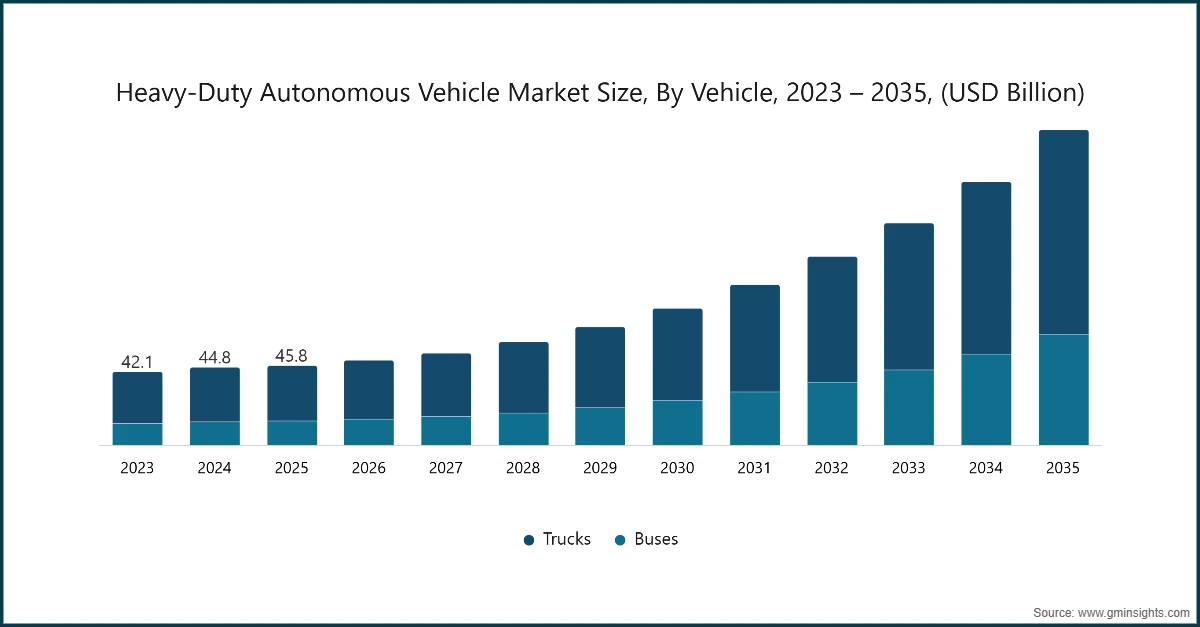
Based on vehicle, the market is divided into trucks and buses. Trucks segment dominated the market accounting by 70% in 2025 and is expected to grow at a CAGR of 14.8% from 2026 to 2035.
- Trucks dominate the market because they are used in logistics, mining, and industrial sectors. The move to automation of trucking solves issues such as labor shortage, high operation costs, and safety. Autonomous trucks work round the clock without resting, conserving fuel and enhancing delivery speed. Waymo, TuSimple, and Daimler Truck AG are among the companies leading autonomous truck deployment.
- Advanced sensor technology in LiDAR, RADAR, and AI-based navigation makes highway driving more predictable and safer for autonomous trucks than city driving with heavy buses. TuSimple, Waymo, and Aurora are already creating autonomous trucking solutions, and Amazon, UPS, and FedEx are investing in autonomous fleets to rationalize supply chains. The International Road Transport Union predicts that by 2028, Europe could be short of 7,45,000 truck drivers which is 17% of the total required workforce.
- Autonomous buses are revolutionizing public transportation by addressing critical challenges such as driver shortages, high operational costs, and safety concerns. These self-driving buses enhance efficiency, reduce fuel consumption, and improve the overall passenger experience through continuous, uninterrupted operation. Germany is a major adopter, with Berlin launching a USD 10 million pilot project in October 2025 covering 15 sq km. The initiative, known as NoWeL4 (Northwest Level 4), is a partnership between Berlin’s public transport operator BVG and Volkswagen subsidiary Moia.
Learn more about the key segments shaping this market
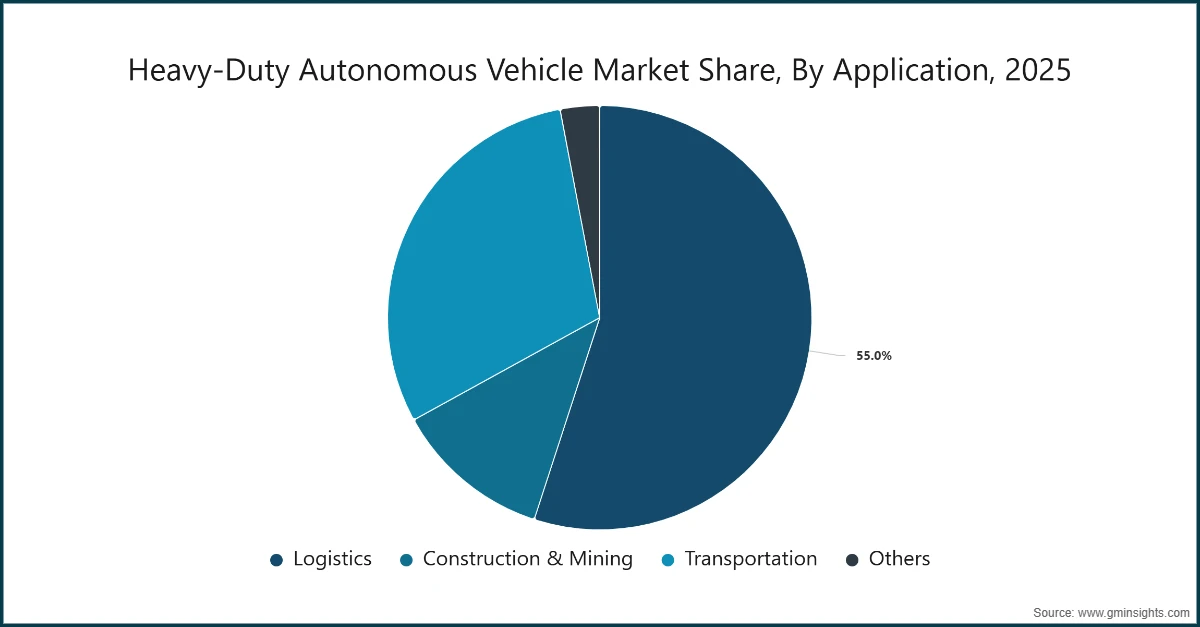
Based on the application, the heavy-duty autonomous vehicle market is divided into logistics, transportation, construction & mining, and others. Logistics dominated the market with 55% share in 2025, and the segment is expected to grow at a CAGR of 14.5% between 2026 to 2035.
- Logistics and transportation dominate the heavy-duty autonomous industry due to the increasing demand for lower-cost and efficient freight transport. The increased growth in e-commerce, just-in-time supply chains, and same-day delivery has accelerated the adoption of autonomous vehicles. For instance, In December 2024, Volvo Autonomous Solutions and DHL Supply Chain implemented driverless freight trucks on the Dallas-Houston route to boost efficiency and alleviate labor concerns in logistics.
- The transportation segment, encompassing logistics, freight, and goods movement, is the largest and fastest-growing application for heavy-duty autonomous vehicles. Rising global e-commerce demand, chronic driver shortages, and the push for operational efficiency are driving fleet operators to adopt autonomous trucks and delivery vehicles. In Europe 45 driverless electric minibuses will be scheduled to run for a year in cities such as Geneva, Kronach, and Oslo.
Based on propulsion, the market is divided into ICE, electric, and hybrid. ICE dominate the market and was valued at USD 23.1 billion in 2025.
- ICE vehicles are significantly less expensive, making them more suitable for initial research and testing. The current infrastructure for refueling stations is more advanced for ICE vehicles, making them easier to test and deploy in a variety of locations. ICE vehicles have longer driven ranges than other alternative vehicles, making them ideal for testing in a variety of environments and on longer test drives. In September 2023, Daimler Truck tested autonomous driving technology on ICE trucks, which had a longer range and established recharging infrastructure. This allows for lengthy on-road testing without concern about battery range constraints.
- The electric vehicle (EV) segment in the heavy-duty autonomous vehicle market is rapidly gaining momentum, driven by stringent emission regulations, rising fuel costs, and corporate sustainability mandates. Electrified heavy-duty trucks, buses, and delivery vehicles offer lower operational costs, reduced noise pollution, and near-zero tailpipe emissions, making them attractive for urban logistics and controlled-route operations. In September 2025, Autonomous trucking company Gatik and Loblaw Companies Ltd. plan to add dozens of self-driving EV trucks to their Greater Toronto Area delivery
Based on level of autonomy, the heavy-duty autonomous vehicle market is divided into Level 1, Level 2, Level 3, and Level 4. Level 3 dominate the market and were valued at USD 9.7 billion in 2025.
- Compared with the developments achieved by other types of heavy-duty vehicles, Level 2 autonomous vehicles are already experiencing widespread acceptance due to their ease of use, along with cost-effectiveness. As a result, heavy-duty transportation is expected to account for 13% of global greenhouse gas emissions by May 2023, while road-based transport will account for 30%. The advantages of using Level 2 autonomous technology for heavy-duty vehicles include improved fuel economy, decreased congestion, and greater optimization of logistics. In addition, many fleet operators have adopted Level 2 autonomous trucks as part of their environmental responsibility/service practices and their corporate social responsibility initiatives.
- The use of Level 3 highway-pilot routes is economically advantageous to commercial pilots by providing an efficient way to move cargo without requiring geographic coverage. Remote supervision centres provide oversight for many tractors; thus, increasing the productivity of drivers. Safety regulators concentrate their efforts on assessing the performance of goods transported on the roads where they operate. Ultimately, this contributes to faster certification of Level 3 autonomous corridor-specific operations than would otherwise be expected.
Looking for region specific data?
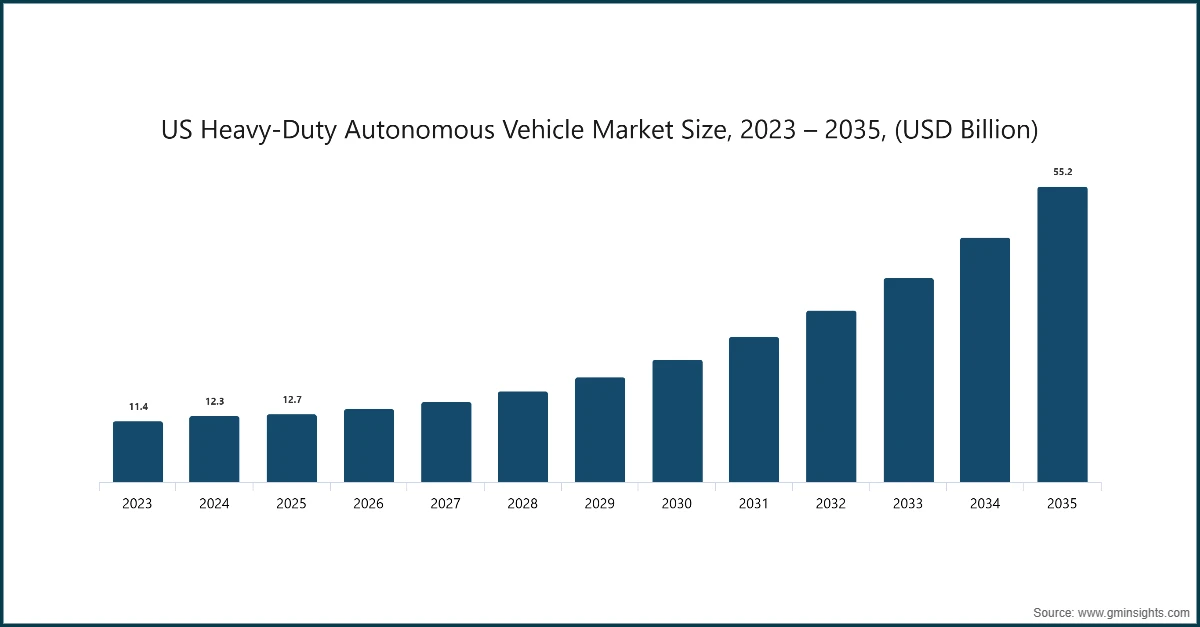
The US dominated North America heavy-duty autonomous vehicle market with revenue of USD 12.7 billion in 2025.
- Autonomous vehicle testing and deployment is becoming a focus of federal regulations and guidelines to assist governments in enacting policies that facilitate the safe and effective deployment of these types of vehicles. Factors such as consumer demand for convenience and safety, as well as changing weather patterns throughout North America, appears to drive the demand for more efficient and safer modes of transportation. These types of vehicles could also be seen as an additional method to reduce fatalities and congestion on our roadways.
- The U.S. Department of Transportation (DOT) and the National Highway Traffic Safety Administration (NHTSA) have created a regulatory framework for the deployment of autonomous vehicles. This includes states such as Texas, Arizona and California, which have emerged as leading test sites for autonomous vehicles. Conversely, the amount of autonomous trucking activity occurring on a broad scale in Canada and Mexico is relatively low.
- Canadian heavy-duty autonomous vehicle industry is well positioned for rapid growth due to the various advancements in technology, the overall regulatory climate being very supportive, and the potential economic benefits. Complementing the efforts of federal administration agencies, the National Highway Traffic Safety Administration (NHTSA) has initiated Automated Vehicle Transparency and Engagement to provide the public with real time accurate information about the testing phases of Automated Driving Systems (ADS) equipped vehicles.
Europe heavy-duty autonomous vehicle market in Germany sold 33,407 units in 2025.
- Government incentives, leading automotive companies and cutting-edge infrastructure are gearing up for significant growth within the heavy-duty autonomous vehicle marketplace in Germany. The BMDV (the German Federal Ministry for Digital and Transport) has committed to underwrite $84 million between 2022 and 2024 toward the development of autonomous vehicles. Germany established itself as the first country to pass a legal framework dealing with Level 4 (driverless) vehicles, which allows for commercial deployment of these vehicles on publicly available roads by 2024.
- Daimler Truck and Volkswagen's TRATON Group are leading an innovative charge related to autonomous trucking, as Daimler's Torc Robotics pilots’ driverless trucks for freight purposes, and TRATON partners with Navistar and Tusimple to produce fully autonomous trucks for European logistics. MAN, Truck and Bus is conducting autonomous logistics operations as part of the ANITA (2023 - 2025) program, while ZF Group launched a self-autonomous truck platform in 2023 to streamline transport solutions related to logistics.
- Logistics leaders such as DHL, and DB Schenker are piloting driverless truck operations to save time and reduce emissions at the Port of Hamburg as part of their Smart Port strategy. In addition, Germany's push for electrification aligns with the EU's Fit for 55 Policy, which aims for a 55% reduction in CO₂ emissions by 2030, with investment into battery electric and hybrid autonomous heavy-duty vehicles.
The China heavy-duty autonomous vehicle market was estimated at USD 7.7 billion in 2025.
- China's autonomous truck industry is projected to see enormous growth, making it the biggest market in Asia Pacific. This growth is being driven by regulatory policies, technological advancements, and substantial investment in automation for heavy industry and bulk transportation. According to China’s 14th Five-Year Plan (2021-2025), autonomous driving is one area being prioritized with major emphasis on automated and enhanced logistics, mine automation, and intelligent transportation systems. As of January 2023, the Chinese government’s ("MIIT") Ministry of Industry and Information Technology has created new legislation to officially allow the commercial operation of L4 autonomous trucks, opening the development path into the future.
- India is making a shift to an all-electric/hydrogen-powered truck fleet, which is the primary vehicle of choice to challenge climate change as part of its carbon-neutral objective by 2070; therefore, these technologies will create the foundation for a long-term sustainable economy. This creates opportunities for developing new standards of operation in industries and commercial automation, which is one of the main reasons innovations are being driven from within the ecosystem. For example, AI (artificial intelligence) powered driverless buses were introduced as part of the first phase of autonomous public transport at IIT Hyderabad in August 2025, which is a key milestone for the government through its plan to lead the world in autonomous public transport.
Latin America heavy-duty autonomous vehicle market in Brazil was estimated at USD 880.7 million in 2025.
- The Brazilian heavy-duty autonomous vehicle industry is developing, thanks to the national long-haul logistics network and support from the government for cleaner modes of transportation. Brazil is a significant producer of agricultural and mining goods, which provide opportunities for autonomous trucks and specialty electric vehicles (EVs) designed to move bulk products and commodities. Partnerships with local OEMs are establishing the infrastructure for Level 2 through Level 3 trucks.
- The process of adopting heavy-duty autonomous vehicles in Mexico is progressing slowly as freight and logistics providers along major US trade corridors continue to invest in transportation that utilizes autonomous technology. Pilot programs are being implemented in controlled environments on highways where Level 2 or Level 3 trucks are being utilized for long-haul freight transportation between industrial clusters and ports.|
UAE heavy-duty autonomous vehicle market will grow tremendously between 2026-2035.
- The United Arab Emirates (UAE) is building a reputation as a centre of excellence for the development and deployment of autonomous and electric heavy-duty vehicles by leveraging existing smart city infrastructure and government programs to promote the adoption of cleaner, safer modes of transportation. Early adoption of autonomous trucks by ports and logistics and industrial zones is occurring for cargo transport; Level 4 trucks are also being piloted in controlled environments at industrial and mining sites.
- South Africa’s heavy-duty autonomous vehicle industry is in the nascent stage, with adoption focused on mining, long-haul freight, and industrial logistics. Autonomous trucks are primarily tested in mining and controlled environments, where Level 2/3 systems improve safety and reduce labor dependency. EV adoption is minimal, though government and private initiatives are promoting low-emission vehicles in urban delivery and fleet operations.
Heavy-Duty Autonomous Vehicle Market Share
The top 7 companies in the market are Volvo, FAW, SAIC, Daimler Truck, TRATON, PACCAR and JAC. These companies hold around 32% of the market share in 2025.
- Volvo is one of the top companies making medium- and heavy-duty truck and bus in the world with locations across Europe, North America, and expanded operations within Asia/Pacific; their ability to utilize connected vehicle technology through investments made on safety-based automation, large scale telematics systems.
- FAW is a large Chinese automotive manufacturer specializing in manufactured trucks; it has strong government support which enables them to quickly introduce connected and automated technology into the Chinese marketplace for use on logistics and manufacturing and distribution routes.
- SAIC Motor is an automobile manufacturer in China; they manufacture medium/large commercial vehicles their focus includes a growing investment into automation/electric vehicles through implementing backend telematics systems as part of its approach to connecting fleet service partners with autonomous vehicle manufacturers.
- Daimler Truck is a world leader in the commercial vehicle market and has a great deal of experience in manufacturing medium and large commercial vehicle products; Daimler has also made a commitment to the development of autonomous vehicles and the use of alternative fuels to power those vehicles; their pilot programmes include connecting fleet telematics systems to the respective fleets for receiving Level 2–4 automation.
- TRATON , encompassing brands such as Scania and MAN, is a cornerstone of Europe’s heavy‑duty truck industry with a multi‑brand strategy that supports scalable autonomy and connectivity across diverse geographies; its synergy with Volkswagen Group’s digital platforms and partnerships in autonomous software development enable TRATON to offer fleet‑ready telematics.
- PACCAR is a highly focused North American heavy‑duty truck manufacturer (Kenworth, Peterbilt) known for its reliable chassis, strong dealer network, and integrated telematics systems; while PACCAR approaches full autonomy through strategic partnerships rather than in‑house stacks, its emphasis on uptime, serviceability, and incremental automation adoption.
- JAC Motors is a Chinese commercial and passenger vehicle OEM expanding into heavy‑duty electric and connected vehicle technologies, leveraging cost‑competitive manufacturing and strong regional demand to introduce autonomy‑enabling systems in vocational trucks and logistics platforms; while its heavy‑duty autonomous roadmap is earlier stage compared to top global players.
Heavy-Duty Autonomous Vehicle Market Companies
Major players operating in the heavy-duty autonomous vehicle industry include:
- Baidu
- Daimler Truck
- FAW
- JAC
- PACCAR
- SAIC
- TRATON
- Volvo
- Waymo
- ZF Friedrichshafen
- The market for global heavy-duty autonomous vehicles is mainly comprised of both big players and smaller players with significant engineering capability and global distribution channels (OEMs). Companies like Volvo, Daimler Truck, TRATON and PACCAR use many years of knowledge with heavy duty trucks, a strong Telematics infrastructure and established partnerships in autonomous technology to speed the process of adopting Level 2-4 vehicles. The advantage for these companies is that they can combine their scale and reliability with their large network of service providers, allowing fleets to slowly adopt autonomy without losing uptime or operational efficiency.
- These companies are uniquely positioned to quickly scale pilot programs for local autonomous technology, but also to service both the logistics and mining sectors at lower capital cost than other OEMs. Additionally, as evidenced by the number of Level 2-3 autonomous deployments in freight corridors, ports, and urban logistics, they are taking a very practical approach to commercializing their products, often faster than many Western OEMs operating in the same region.
- The dynamics of competition in the market are also influenced by the type of technology used and the types of service provided on a recurring basis. While Western OEMs focus on building highly valued fleets with advanced telematics, predictive maintenance, and conditional autonomy, the APAC based OEMs are focused on volume and regulatory compliance. Competition is further heightened due to new players emerging in the industry and technology partners providing OEMs with the tools to differentiate their product offerings through higher levels of autonomy, connectivity and integrated EV solutions.
Heavy-Duty Autonomous Vehicle Market Report Attributes
| Key Takeaway | Details |
|---|---|
| Market Size & Growth | |
| Base Year | 2025 |
| Market Size in 2025 | USD 45.8 Billion |
| Market Size in 2026 | USD 48.9 Billion |
| Forecast Period 2026-2035 CAGR | 15.7% |
| Market Size in 2035 | USD 181.5 Billion |
| Key Market Trends | |
| Drivers | Impact |
| Expansion of 5G and high-speed connectivity | Deployment of 5G networks enables real-time vehicle communication, supporting advanced connected services and data exchange. |
| Growing demand for vehicle safety and telematics | Fleet operators and consumers increasingly adopt connected safety, tracking, and remote monitoring systems. |
| Government mandates for vehicle connectivity | Regulations such as e-call systems and intelligent transport initiatives accelerate integration of connected technologies in vehicles. |
| Rising adoption of smart mobility and digital services | Integration of infotainment, navigation, and over-the-air updates drives demand for connected vehicle platforms. |
| Pitfalls & Challenges | Impact |
| Cybersecurity and data privacy concerns | Increasing vehicle connectivity raises risks of hacking, requiring robust cybersecurity frameworks. |
| High cost of connectivity hardware and integration | Advanced sensors, telematics modules, and communication systems increase vehicle manufacturing costs. |
| Opportunities: | Impact |
| Over-the-air (OTA) software updates expansion | Automakers are deploying OTA updates to improve vehicle performance, security, and feature upgrades remotely. |
| Integration of V2X communication technologies | Vehicle-to-everything connectivity enhances traffic efficiency, safety alerts, and infrastructure communication. |
| Market Leaders (2025) | |
| Market Leader |
9% market share |
| Top Players |
Collective market share in 2025 is 30% |
| Competitive Edge |
|
| Regional Insights | |
| Largest Market | North America |
| Fastest growing market | Asia-Pacific |
| Emerging countries | Brazil, South Africa, Australia, Saudi Arabia, Belgium |
| Future outlook |
|
What are the growth opportunities in this market?
Heavy-Duty Autonomous Vehicle Industry News
- February 2026, Oxa Autonomy, a British autonomous driving software developer, secured a significant investment of $103 million from Nvidia and the UK’s National Wealth Fund to expand its commercial software solutions for self‑driving industrial vehicles, boosting its global presence and supporting automation for freight and logistics applications.
- January 2026, PlusAI and IVECO launched Southern Europe’s first Level 4 autonomous trucking program, partnering with a Spanish logistics operator and regional government to deploy heavy‑duty autonomous trucks, marking a major step in commercial rollout beyond pilot zones.
- December 2025, Daimler Truck and Torc Robotics chose Innoviz Technologies as their short‑range LiDAR partner for series production of Level 4 autonomous Class 8 trucks, advancing sensor integration for commercial autonomous freight deployments.
- April 2025, Kodiak Robotics, a prominent autonomous trucking technology company, announced it is going public through a SPAC (special purpose acquisition company) deal, reflecting investor confidence and providing capital to scale autonomous freight technology commercialization.
This heavy-duty autonomous vehicle market research report includes in-depth coverage of the industry with estimates & forecasts in terms of revenue ($ Bn) and Volume (Units) from 2022 to 2035, for the following segments:
Market By Vehicle
- Trucks
- Class 7
- Class 8
- Buses
Market By Level of Autonomy
- Level 1
- Level 2
- Level 3
- Level 4
Market By Propulsion
- ICE
- Electric vehicle
- Hybrid vehicle
Market By Application
- Logistics
- Construction & Mining
- Transportation
- Others
Market By End use
- OEM
- Aftermarket
The above information is provided for the following countries:
- North America
- US
- Canada
- Europe
- UK
- Germany
- France
- Italy
- Spain
- Belgium
- Netherlands
- Nordic
- Asia Pacific
- China
- India
- Japan
- Australia
- Singapore
- South Korea
- Southeast Asia
- Latin America
- Brazil
- Mexico
- Argentina
- MEA
- UAE
- Saudi Arabia
- South Africa
Frequently Asked Question(FAQ) :
What is the market size of the heavy-duty autonomous vehicle in 2025?
The market size was USD 45.8 billion in 2025, with a CAGR of 15.7% expected through 2035, driven by growing demand for vehicle safety features, advancements in LiDAR, radar, and AI-based navigation.
What is the projected value of the heavy-duty autonomous vehicle industry by 2035?
The heavy-duty autonomous vehicle market is expected to reach USD 181.5 billion by 2035, propelled by accelerated EV adoption increasing market volume, growth of regional EV manufacturing and supply-chain investments.
What is the current heavy-duty autonomous vehicle industry size in 2026?
The market size is projected to reach USD 48.9 billion in 2026.
What was the market share of the trucks vehicle segment in 2025?
The trucks segment dominated the vehicle market with approximately 70% share in 2025, expected to grow at a CAGR of 14.8% from 2026 to 2035, driven by widespread use in logistics, mining, and industrial sectors.
What was the revenue of the ICE propulsion segment in 2025?
The ICE segment dominated the propulsion market, valued at USD 23.1 billion in 2025, driven by lower costs making them suitable for initial research and testing.
What is the growth outlook for the logistics and transportation application segment?
The logistics and transportation segment dominated the application market with 55% share in 2025, expected to grow at a CAGR of 14.5% from 2026 to 2035, driven by rising global e-commerce demand.
Which region leads the heavy-duty autonomous vehicle market?
The US dominated North America heavy-duty autonomous vehicle market with revenue of USD 12.7 billion in 2025, supported by federal regulatory frameworks from the DOT and NHTSA.
What are the key trends shaping the heavy-duty autonomous vehicle market?
Key trends include rapid growth of battery-powered heavy trucks driven by emission regulations and fuel cost concerns, introduction of new Class 8 truck models with innovation and customization meeting regulatory requirements.
Who are the key players in the heavy-duty autonomous vehicle market?
Key players include Baidu, Daimler Truck, FAW, JAC, PACCAR, SAIC, TRATON, Volvo, Waymo, and ZF Friedrichshafen.
Heavy-Duty Autonomous Vehicle Market Scope
Related Reports