Summary
Table of Content

Heat Meters Market
Get a free sample of this report
Form submitted successfully!
Error submitting form. Please try again.
Thank you!
Your inquiry has been received. Our team will reach out to you with the required details via email. To ensure that you don't miss their response, kindly remember to check your spam folder as well!
Request Sectional Data
Thank you!
Your inquiry has been received. Our team will reach out to you with the required details via email. To ensure that you don't miss their response, kindly remember to check your spam folder as well!
Form submitted successfully!
Error submitting form. Please try again.
Heat Meters Market Size
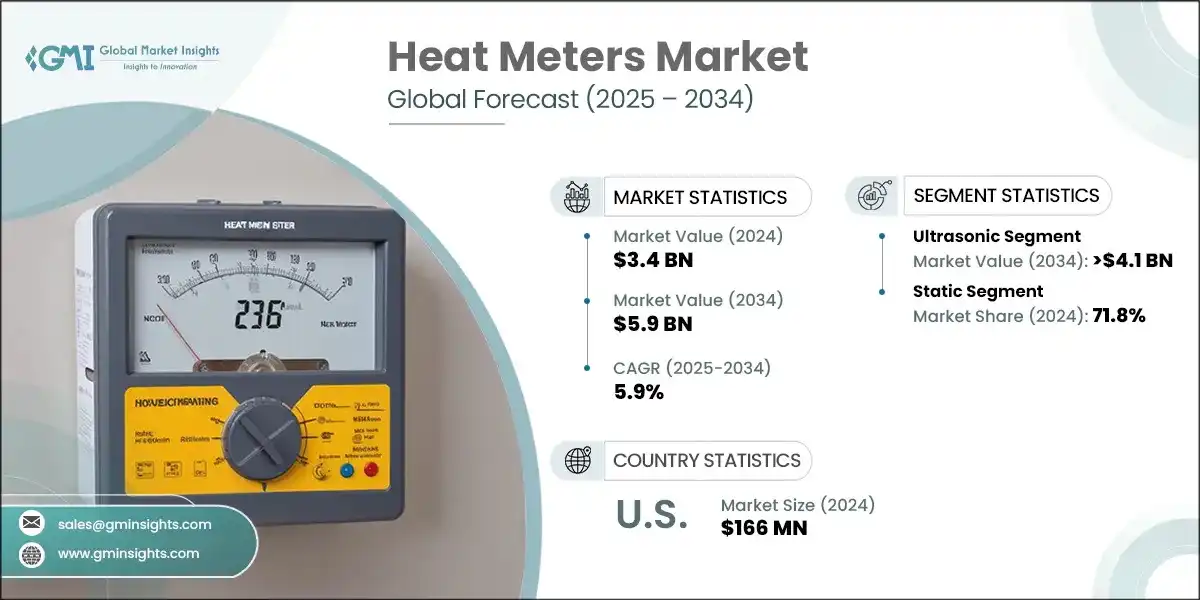
According to a recent study by Global Market Insights Inc., the global heat meters market was valued at USD 3.4 billion in 2024. The market is expected to grow from USD 3.5 billion in 2025 to USD 5.9 billion in 2034, at a CAGR of 5.9%.
Heat Meters Market Key Takeaways
Market Size & Growth
- 2024 Market Size: USD 3.4 Billion
- 2034 Forecast Market Size: USD 5.9 Billion
- CAGR (2025–2034): 5.9%
Key Market Drivers
- Stringent government norms toward carbon emissions.
- Extreme climatic conditions.
- Government incentives toward adoption of district heating systems.
- Rapid urbanization & industrialization.
- Government focus toward clean energy directives.
Challenges
- Privacy Concerns.
Opportunity
- Rising Demand for Energy Efficiency & Smart Buildings.
- Expansion of District Heating & Cooling Networks.
- Shift Towards Ultrasonic & Static Heat Meters.
- Regulatory Push & Government Incentives.
Key Players
- Market Leader: Kamstrup led with over 15% market share in 2024.
- Leading Players: Top 5 players in this market include Kamstrup, Landis+Gyr, Siemens, Danfoss, Apator, which collectively held a market share of 47% in 2024.
Get Market Insights & Growth Opportunities
- Introduction of stringent GHG regulations coupled with the growing adoption of renewable sources to generate heat and energy is likely to elevate the heat meter industry revenue over the forecast period. Heat meters are essential devices in modern heating and cooling systems, providing accurate measurements of thermal energy consumption. They play a critical role in energy management, billing, and improving the efficiency of thermal energy systems. Increasing emphasis on energy efficiency and sustainability has led to the implementation of regulations and standards that promote the use of district heating systems.
- Ongoing adoption of regulations requiring the installation of heat meters across new and existing buildings to monitor and optimize energy consumption is set to strengthen the business landscape. Further, the growth of energy service companies (ESCOs) and energy management services has contributed to the adoption of heat meters.
- Regulatory authorities across the globe are shifting their energy supply systems by increasing their dependency on renewable energy. Ambitious sustainability goals including reducing carbon emissions and promoting renewable energy sources will continue to drive the momentum.
- Various financial incentives, grants, and rebates offered by governments and utilities, encourage the businesses and homeowners to invest in energy-efficient technologies and practices. These incentives support offset the upfront costs of implementing energy-saving measures. The government further plans to roll out the traditional meters is set to create a substantial market for multinational heat meter manufacturers.
- The heat meters market was valued at USD 2.8 billion in 2021 and grew at a CAGR of 6.2% through 2024, driven by rising implementation of distinct directives to increase the adoption of these meters as a part of their energy conservation initiatives. Introduction of stringent GHG regulations coupled with the growing adoption of renewable sources to generate heat and energy is likely to elevate the heat meter industry revenue over the forecast period.
- Rapid technological advancements along with the ongoing research and development activities to introduce innovative solutions comprising IoT platforms will stimulate the heat meters market growth. The technology allows heat meters to become smart, providing real-time data, remote monitoring, and improved energy efficiency, augmenting the product adoption.
- Ongoing implementation of such devices in heat meters is bound to make energy consumption reading simpler and more efficient. Additionally, surging investments pertaining to the development of industrial urban areas will provide immense opportunities to the leading industry players for inorganic growth ventures and expansion in the forthcoming years.
- For instance, in September 2022, Axioma Metering invested USD 42.66 million in the construction of a new facility in Kaunas Free Economic Zone (FEZ). The plant will be operational in 2024 with four new production lines, enabling the production of over 4 million smart meters annually.
- Extreme climatic conditions often result in higher energy consumption for heating during the winter months. This has led to a growing emphasis on energy efficiency in heating systems. Rising energy costs and environmental concerns, is set to augment the adoption of more energy-efficient heating solutions. Growing inclination to reduce the reliance on fossil fuels for heating along with shifting focus toward sustainable and environmentally friendly alternatives to traditional fossil fuel-based heating systems is anticipated to stimulate the business landscape.
To get key market trends
Heat Meters Market Trends
- Various financial incentives, grants, and rebates offered by governments and utilities, encourage the businesses and homeowners to invest in energy efficient technologies and practices. These incentives support offset the upfront costs of implementing energy-saving measures. Furthermore, several countries have implemented distinct directives to increase the adoption of these meters as a part of their energy conservation initiatives, which will drive the business scenario.
- Increasing investments toward the development of commercial and industrial establishments have further stimulated the emission concerns, augmenting the product demand. Moreover, introduction of multiple standards and codes by the regulatory authorities including green building standards to reduce the overall emissions caused by the infrastructure development, is set to augment the business landscape.
- For instance, in December 2022, Kamstrup was awarded a contract by Silkeborg Forsyning to deliver approximately 40,000 remotely read heat meters. The delivery involved access to wireless communication network and collection system ensuring high quality data.
- Adverse economic effects coupled with unfavorable working conditions on account of the low temperatures will influence the demand for effective heat supply. High heat extraction cost, shortage of fossil fuels, and environmental concerns are some factors which will boost the heat meters demand. Growth in value and concentration of heating demand across the residential sector for hot water transport and distribution will further complement the industry outlook.
Heat Meters Market Analysis
Learn more about the key segments shaping this market
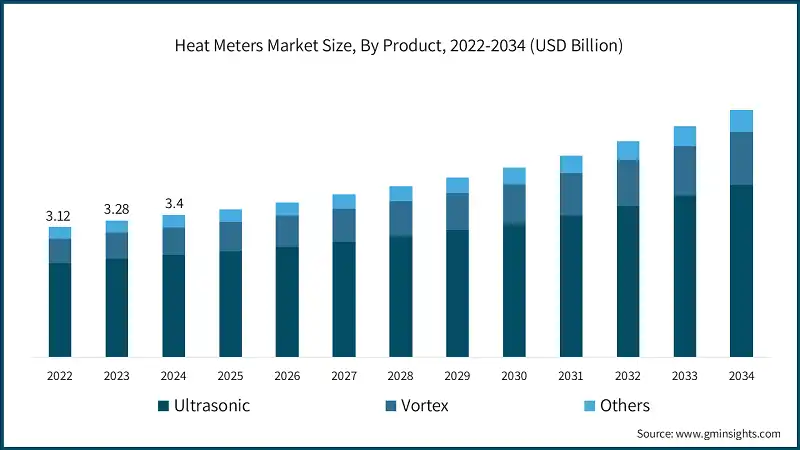
- Based on product, the market is segmented into ultrasonic, vortex and others. The ultrasonic segment is anticipated to reach over USD 4.1 billion by 2034 on account of their accuracy, reliability and non-invasive measurement capabilities.
- Increasing regulatory requirements and standards related to energy efficiency are driving the product penetration. Shifting trend toward smart cities and buildings along with ongoing retrofitting activities of the existing buildings driven by energy efficiency goals and government incentives is driving the adoption of ultrasonic heat meters, which will complement the business landscape.
- The meters can be integrated into building management systems to optimize heating, thereby improving comfort, and reducing energy costs. Ongoing retrofitting of the existing buildings owing to government incentives and energy efficiency goals will contribute to the business momentum. The meters can be installed without significant disruption to existing infrastructure.
- In January 2022, Huizhong Instrumentation Co., Ltd. introduced a heating IoT metering solution for the household heat management. The smart & advanced solution offers a wide range of functions including NB-IoT & LoRa technologies, along with big data processing and analytics and the real time monitoring & analysis of online devices. The integrated solution can be controlled remotely and offers intelligent and efficient data management. The introduction of this smart system has reinforced the company’s presence across the industry.
- Vortex heat meters market is anticipated to reach more than USD 1.2 billion by 2034. These have the capability to correct abrasions associated with the changes in the diameter, expansion of buff body and changes in the “K” factor. In addition, less leak potential, low power consumption and accommodation of liquids, gases, steam will further encourage the adoption of vortex heat meters over the coming years.
- Ongoing adoption of net metering policies supporting the small residential and commercial distributed generation resources along with introduction of regulations requiring the installation of heat meters in new and existing buildings will sway the industry trends. Large scale adoption of communication technologies owing to rising amount of digitization of power utilities, adoption of district heating systems and surging demand for reliable and accurate metering systems is set to drive the business scenario.
Learn more about the key segments shaping this market
- Others product is anticipated to grow at a CAGR of more than 5.5% till 2034. Large scale adoption of communication technologies owing to rising amount of digitization of power utilities, adoption of district heating systems and surging demand for reliable and accurate metering systems is set to drive the business scenario.
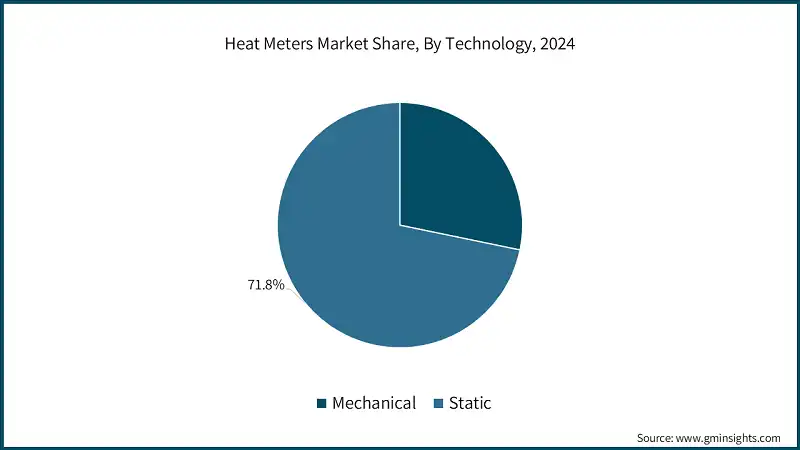
- Based on technology, the heat meters market is segmented into mechanical and static. The static segment dominates with 71.8% market share in 2024 and is set to reach USD 4.4 billion by 2034 on account of adoption of advanced and automated building technologies coupled with high precision data recording on account of its static measurement principal.
- These devices utilize fluidic oscillator principle to calculate the flow with high accuracy and reliability. These meters are unaffected by magnetic depositions in the pipes or dirty water. Availability in wide flow range along with diverse application including home automation, buildings technology and district heating systems has accelerated their growth in the industry. In addition, various other advanced features including remote reading, high precision, non-movable parts, leakage detection and detailed information of data will encourage the product penetration.
- Mechanical segment is set to grow at a CAGR of over 4.5% through 2034 on account of simple design and lower initial cost. The devices possess a range of application across home automation, building management systems and comprises of multiple read out interfaces.
- Ongoing research and development activities across various economies along with modern technological advancements will strengthen the overall industry outlook. In addition, flexible integration with advanced metering systems owing to multiple read out interfaces will contribute to the business momentum.
Looking for region specific data?
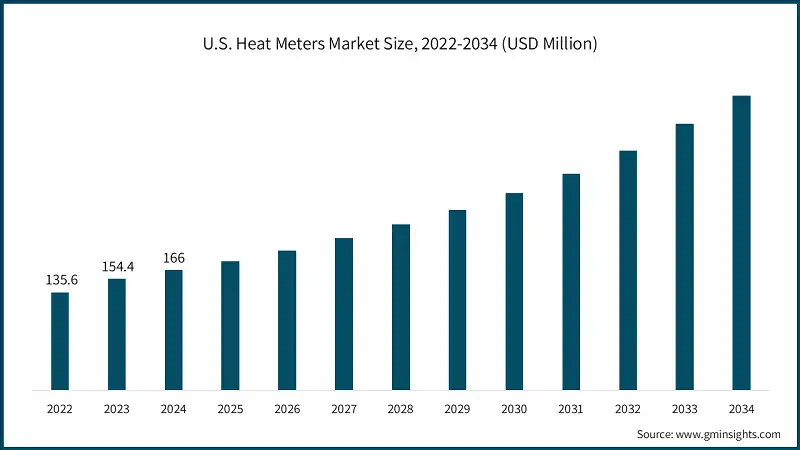
- The U.S. heat meters market recorded a valuation of over USD 135.6 million in 2022, rising to USD 154.4 million in 2023 and reaching USD 166 million by 2024. In 2024, North America accounted for 5.6% of the global market share.
- North American market for heat meters is typically clustered across dense urban areas having a very high penetration of commercial building structures. The industry has witnessed a moderate adoption rate over the years on account of higher energy prices and different ownership structures. The implementation of these mandates has resulted in effective adoption of numerous sustainable heating systems including district heating as an efficient approach for reducing peak power demand.
- The U.S. has witnessed a moderate adoption rate over the years on account of higher energy prices and different ownership structures. Stringent renewable energy targets and emission control norms instituted by the regulatory authorities is likely to enhance the investments across heat meter market over the coming years.
- Europe’s heat maters market is set to surpass USD 2 billion by 2034 owing to the abundant availability of established district heating infrastructure. Presently, around 70% of the final energy consumption across Europe is used for heating purposes. European economies are actively promoting the usage of district heating under their national strategic energy plans which has led to a favorable business scenario for the industry players.
- Stringent EU policies toward the carbon reduction has led various countries to opt for numerous sustainable measures toward heat generation. In addition, the demand for meters has been increasing on account of expansion of DH infrastructure across Tier II & III cities. The presence of a high penetration of variable renewable energy sources is anticipated to drive the Europe heat meter market size over the forecast period.
- Asia Pacific heat meters market is anticipated to grow more than 4% CAGR through 2034 on account of favorable regulatory reforms and expanding heating network across China, Japan, and South Korea. Favorable regulatory policies followed by rapid urbanization, and surging investments across the real estate industry will significantly nourish the industry outlook.
- Additionally, China with a high concentration across the Northern region has a substantial district heating capacity, which has provided immense opportunity for the industry players, thereby augmenting the industry landscape. Growing HVAC industry including manufacturing and technological sector will further institute a favorable business scenario.
Heat Meters Market Share
- The top five players in the heat meters industry include Kamstrup, Apator, Siemens, Danfoss and Landis+Gyr. Growth ventures in the heat meters industry are driven by technological advancements, increasing demand for energy efficiency, regulatory requirements, and the global shift towards sustainable energy solutions.
- Collaborations between governments and private companies to develop and deploy heat metering infrastructure. Industry alliances working towards the standardization of metering technologies and protocols to ensure interoperability and scalability, driving the market scenario.
- Increasing focus toward expansion of conventional heating systems along with the ongoing various development projects pertaining to sustainable heating network have resulted in innovations across the heat meters market. In addition, growing emphasis on effective energy management technologies on account of increasing demand for accurate and reliable metering systems will positively impact the industry growth.
- Digitalization through the deployment of IoT devices coupled with government regulations toward installation of devices across the new establishments will further provide favorable opportunities for product innovation.
- Kamstrup holds a leading position in the global heat meter market with a sustained focus on solid-state metrology, ultrasonic, and end-to-end smart-metering systems. The company pairs high accuracy ultrasonic flow sensors with cloud enabled data platforms and network communications, enabling utilities and district heating operators to deploy remote reading, leak detection and analytics at scale.
- Diehl Stiftung competes by combining modular metrology hardware with IoT communications, AI analytics, and sustainability commitments. The company invests in digital metering platforms and partnerships to accelerate smart city and utility projects, while public sustainability steps strengthen its brand with eco-conscious buyers.
Heat Meters Market Companies
Eminent players operating in the heat meters industry are:
- Apator
- Axioma Metering
- BMETERS
- Diehl Stiftung & Co. KG
- Danfoss
- Huizhong Instrumentation
- Honeywell International
- ista Energy Solutions
- Itron
- Kamstrup
- Landis+Gyr
- Micronics
- QUNDIS
- RB Flowmeter
- Schneider Electric
- Smartdhome
- Secure Meters
- Sontex
- Siemens
- WEIHAI PLOUMETER
- Xylem
- ZENNER International GmbH & Co. KG
- Sontex remains focused on compact, high-accuracy heat meters and communication modules for multi-dwelling and district-heating applications. The company’s strategy emphasizes durable ultrasonic and electronic meters for OEMs and utilities that require simple wireless readout and cost-allocation features rather than large enterprise software stacks.
- Apator competes by offering a broad, vertically integrated metering portfolio aimed at utilities and district networks across Central and Eastern Europe. Strategically, the company leverages regional contracts and technology partnerships to lock in recurring meter-and-service revenue. Additionally, it recorded a total revenue of USD 329 Million in 2024.
- Micronics positions itself on specialized ultrasonic heat and energy metering, including clamp-on ultrasonic heat meters and full inline ultrasonic solutions for retrofit and industrial uses. The company strategically pursues product differentiation via clamp-on ultrasonic technology and service/installation support for system integrators.
- Itron competes as a platform and solutions provider combining thermal energy/heat meters, communication modules, large-scale AMI networks, and utility software/services. The company reported revenue of USD 2.4 billion in 2024. The company emphasizes outcome-based services and cross-selling across thermal metering in utility customers.
Heat Meters Market Report Attributes
| Key Takeaway | Details |
|---|---|
| Market Size & Growth | |
| Base Year | 2024 |
| Market Size in 2024 | USD 3.4 Billion |
| Forecast Period 2025 - 2034 CAGR | 5.9% |
| Market Size in 2034 | USD 5.9 Billion |
| Key Market Trends | |
| Drivers | Impact |
| Stringent government norms toward carbon emissions | Stringent government norms pertaining to climate change and greenhouse gas emissions has increased the investments toward development of sustainable heating systems which in turn has accelerated the adoption of heat meters. |
| Extreme climatic conditions | Rising demand for ambient temperatures across industrial, commercial, and residential premises owing to the harsh climate will augment the heat meter market growth. |
| Government incentives toward adoption of district heating systems | direct grants, tax breaks, and incentives linked to housing subsidies and loans, which will further complement the heat meter market growth. Ongoing measures to integrate heating systems along with government funded financing schemes will encourage the industry growth. |
| Rapid urbanization & industrialization | Flourishing real estate industry across the emerging economies with improved fiscal stability and economic growth has led the local authorities to adhere to various heating systems with energy conservation and urban planning. |
| Government focus toward clean energy directives | Stringent policies to fully utilize abundant clean energy resources coupled with rigid emission norms has led to the development of sustainable heating devices which in turn has positively influenced the heat meter industry growth. |
| Pitfalls & Challenges | Impact |
| Privacy Concerns | The industry is troubled by the risks of widespread frauds subject to the associated security vulnerability. The fine granularity of the consumption records along with the sensitive personal data being disclosed about households to the authorities has raised privacy concerns among the customers. |
| Opportunities: | Impact |
| Rising Demand for Energy Efficiency & Smart Buildings | Integration of IoT-enabled and smart heat meters into building automation systems allows real-time monitoring, remote control, and predictive maintenance, making them attractive for both residential and commercial applications. |
| Expansion of District Heating & Cooling Networks | The rapid expansion of district heating systems in Europe, China, and other urban areas drives significant opportunities for large-scale deployment of heat meters. |
| Shift Towards Ultrasonic & Static Heat Meters | Growing preference for non-mechanical, maintenance-free ultrasonic meters presents a replacement opportunity in markets dominated by older mechanical devices. |
| Regulatory Push & Government Incentives | Strict regulations mandating individual metering for fair billing in multi-apartment buildings are creating opportunities. Subsidies and incentives for smart metering adoption in Asia and Europe further support growth. |
| Market Leaders (2024) | |
| Market Leaders |
15% market share |
| Top Players |
Collective market share in 2024 is 47% |
| Competitive Edge |
|
| Regional Insights | |
| Largest Market | Asia Pacific |
| Fastest Growing Market | Europe |
| Emerging Country | Germany, Poland, Sweden, Switzerland |
| Future Outlook |
|
What are the growth opportunities in this market?
Heat Meters Industry News
- In November 2024, Kamstrup introduced its first heating meter equipped with built-in LoRaWAN communication module. The LoRa communication modules can be ordered as a factory mounted, built-in version across its MULTICAL 403, 603 and 803 thermal energy meters. Further, the solution ensures that the meter can be utilized for industrial facilities, smart cities and residential complexes. Additionally, it provides precise and timestamped data suitable for analytical purposes and supports efficient heating energy management.
- In March 2023, Diehl Stiftung & Co. KG entered in an agreement with STACKFORCE for embedded software used in communication of thermal energy meters. The company further provides a cutting-edge technology, LPWAN standard miot. The inorganic growth venture will expand their position across the high-performance meters market.
- In June 2022, BMETERS Srl introduced a thermal energy meter known as HYDROCAL-M4. It is equipped with features including configuration freedom during installation, integrated communication protocols, and the ability to add on wired connectivity. Moreover, the product launch will reinforce the company's position in the heat meter industry.
This heat meters market research report includes an in-depth coverage of the industry with estimates & forecast in terms of volume and revenue in “(‘000 Units & USD Million)” from 2021 to 2034, for the following segments:
Market, By Product
- Ultrasonic
- Static
- Others
Market, By Technology
- Mechanical
- Static
Market, By Application
- Residential
- Commercial
- College/University
- Office Buildings
- Government Buildings
- Others
- Others
The above information has been provided for the following regions and countries:
- North America
- U.S.
- Canada
- Europe
- Germany
- Poland
- Sweden
- Denmark
- Finland
- Russia
- Italy
- UK
- Norway
- Czech Republic
- Estonia
- Latvia
- Lithuania
- Switzerland
- Austria
- Spain
- Asia Pacific
- China
- Japan
- South Korea
- Rest of World
Frequently Asked Question(FAQ) :
What is the market size of the heat meters in 2024?
The market size was USD 3.4 billion in 2024, with a CAGR of 5.9% expected through 2034 driven by stringent GHG regulations and growing adoption of renewable energy sources.
What is the projected value of the heat meters market by 2034?
The heat meters market is expected to reach USD 5.9 billion by 2034, propelled by energy efficiency requirements, district heating expansion, and smart building integration.
How much is the ultrasonic heat meters segment expected to grow by 2034?
Ultrasonic heat meters are anticipated to grow over USD 4.1 billion by 2034, fueled by their accuracy, reliability, and non-invasive measurement capabilities.
What was the market share of static technology segment in 2024?
Static technology dominated with 71.8% market share and will grow to more than USD 4.4 billion by 2034, due to high precision data recording and advanced automated building technologies.
What is the growth outlook for vortex heat meters from 2025 to 2034?
Vortex heat meters are anticipated to reach more than USD 1.2 billion by 2034, due to their capability to correct abrasions and low power consumption features.
Which region leads the heat meters market?
Asia Pacific heat meters market is anticipated to grow more than CAGR 4% through 2034 on account of favorable regulatory reforms and expanding heating network across China, Japan, and South Korea.
What are the key market trends in the heat meters industry?
Key trends include integration of IoT-enabled smart meters, expansion of district heating networks, shift towards ultrasonic and static meters, and regulatory push for individual metering.
Who are the top players in the heat meters market?
Major key players include Apator, Axioma Metering, BMETERS, Diehl Stiftung & Co. KG, Danfoss, Huizhong Instrumentation, Honeywell International, ista Energy Solutions, Itron, Kamstrup, Landis+Gyr, Micronics, QUNDIS, RB Flowmeter, Schneider Electric, Smartdhome, Secure Meters, Sontex, Siemens, WEIHAI PLOUMETER, Xylem.
Heat Meters Market Scope
Related Reports