Summary
Table of Content

Hearing Amplifiers Market
Get a free sample of this report
Form submitted successfully!
Error submitting form. Please try again.
Thank you!
Your inquiry has been received. Our team will reach out to you with the required details via email. To ensure that you don't miss their response, kindly remember to check your spam folder as well!
Request Sectional Data
Thank you!
Your inquiry has been received. Our team will reach out to you with the required details via email. To ensure that you don't miss their response, kindly remember to check your spam folder as well!
Form submitted successfully!
Error submitting form. Please try again.
Hearing Amplifiers Market Size
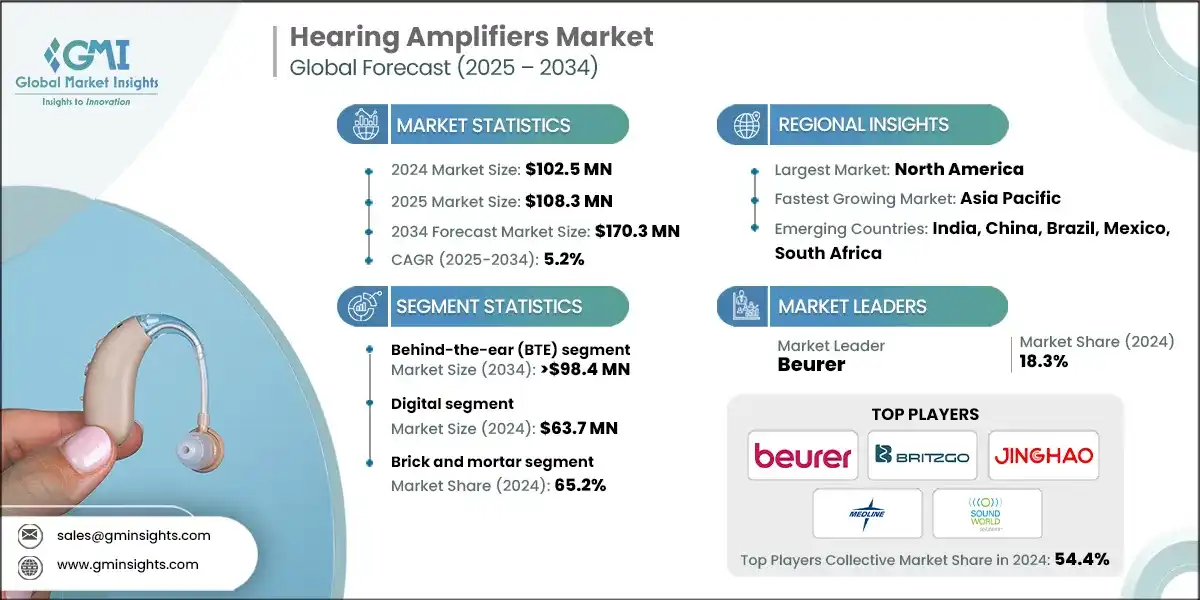
The global hearing amplifiers market was valued at USD 102.5 million in 2024. The market is expected to reach from USD 108.3 million in 2025 to USD 170.3 million in 2034, growing at a CAGR of 5.2% from 2025 to 2034, according to the latest report published by Global Market Insights Inc. The high market growth is attributed to the increasing prevalence of hearing loss, growing geriatric population, continuous advancements in technology, and rising awareness and acceptance, among other contributing factors.
Hearing Amplifiers Market Key Takeaways
Market Size & Growth
- 2024 Market Size: USD 102.5 Million
- 2025 Market Size: USD 108.3 Million
- 2034 Forecast Market Size: USD 170.3 Million
- CAGR (2025–2034): 5.2%
Regional Dominance
- Largest Market: North America
- Fastest Growing Region: Asia Pacific
Key Market Drivers
- Increasing prevalence of age-related hearing loss.
- Rising geriatric population base.
- Technological improvements in amplification and noise reduction.
Challenges
- Competition from prescription hearing aids and cochlear implants.
- Limited reimbursement/insurance coverage.
Opportunity
- Growth of online sales and tele-audiology platforms.
- Product miniaturization and improved ergonomics.
Key Players
- Market Leader: Beurer led with over 18.3% market share in 2024.
- Leading Players: Top 5 players in this market include Beurer, Britzgo, JINGHAO, Medline, Sound World Solutions, which collectively held a market share of 54.4% in 2024.
Get Market Insights & Growth Opportunities
Hearing amplifiers, also known as personal sound amplification products (PSAPs), are intended for individuals with mild to moderate hearing impairment with the objective of increasing the intensity of externally generated sounds. Unlike hearing aids that are medical grade, PSAPs do not demand the services of an audiologist and can be purchased directly from a retail outlet.
Some of the prominent market players for hearing amplifiers are Beurer, JINGHAO, Medline, Sound World Solutions, and Britzgo. These companies are able to still possess their competitiveness due to their strategic market location as well as their unparalleled innovation in their products and growing expenditures in the development and research of hearing amplifiers.
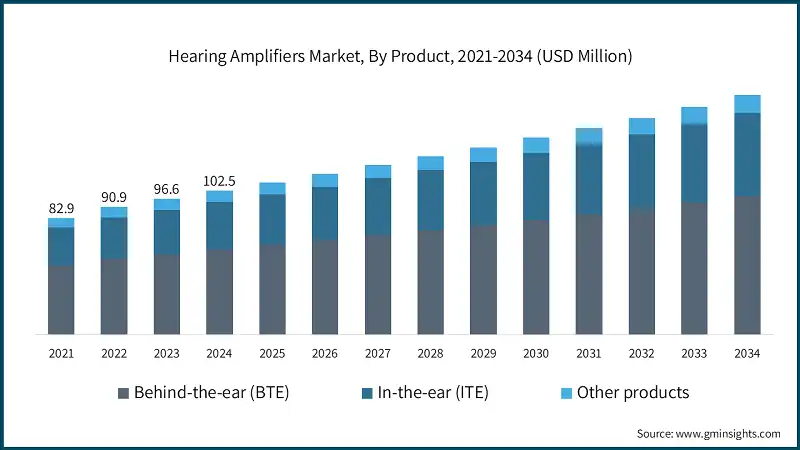
The market has increased from USD 82.9 million in 2021 and reached USD 96.6 million in 2023, with the historic growth rate of 6.8%. The prevalence of age-related hearing loss and the rising need for reasonably priced alternatives to hearing aids, along with the latest technological developments in hearing devices, have all contributed to this growth.
Moreover, the increasing incidence of age-related hearing impairment, noise-induced hearing loss, and lifestyle-related auditory conditions is fueling demand for hearing amplifiers. For instance, according to the World Health Organization (WHO), approximately 1.5 billion people globally experienced some degree of hearing loss in 2021, with this number projected to reach 2.5 billion by 2025.
Similarly, in the U.S., the National Institute on Deafness and Other Communication Disorders (NIDCD) reported that about 15% of American adults (37.5 million) aged 18 and over experienced some trouble hearing in 2022. The Centers for Disease Control and Prevention (CDC) data indicates that occupational hearing loss remains the most common work-related illness, affecting about 22 million workers annually between 2021 and 2023. Unlike traditional hearing aids, amplifiers are often chosen for mild to moderate hearing difficulties, making them attractive to a broader consumer base.
Furthermore, the global elderly population is rising rapidly, and hearing impairment is one of the most common age-related conditions. Hearing amplifiers offer an affordable and accessible solution for older adults reluctant to invest in costly hearing aids, driving adoption in this segment.
To get key market trends
Hearing Amplifiers Market Trends
The hearing amplifiers market is growing considerably with the shift toward smart and connected devices, growing popularity of OTC and DTC models, growing focus on discreet and aesthetic designs, rising use for situational hearing needs, and expansion into emerging economies, among other factors collectively driving industry growth.
- Hearing amplifiers now incorporate Bluetooth technology, wireless streaming capabilities, and smartphone applications. These features enable users to adjust sound settings, receive direct audio streaming, and manage their devices remotely. According to the National Institute on Deafness and Other Communication Disorders (NIDCD), approximately 28.8 million U.S. adults could benefit from hearing devices as of 2022.
- FDA data shows that after implementing the over-the-counter hearing aid regulation in 2022, smart hearing device adoption increased by 23% in 2023. Additionally, market surveys indicate that 67% of hearing amplifier users in 2023 specifically chose devices with smartphone connectivity and wireless streaming features.
- Moreover, with rising disposable incomes and growing awareness of hearing health, emerging markets in Asia-Pacific, Latin America, and Africa are witnessing higher adoption of hearing amplifiers. Localized manufacturing and pricing strategies are supporting this trend.
Hearing Amplifiers Market Analysis
Learn more about the key segments shaping this market
Based on the product, the hearing amplifiers market is segmented into behind-the-ear (BTE), in-the-ear (ITE), and other products. The behind-the-ear (BTE) segment has asserted its dominance in the market by securing a significant market share of 59% in 2024 owing to their higher amplification power, ease of handling, and suitability for a wide range of hearing loss levels, making them a preferred choice among elderly users. The segment is expected to exceed USD 98.4 million by 2034, growing at a CAGR of 4.9% during the forecast period.
On the other hand, the in-the-ear (ITE) segment is expected to grow with a CAGR of 5.7%. The growth of this segment is driven by their enhanced adoption due to their appealing and personalized approach to users, enhanced by their discreet design and comfortable fit.
- The behind-the-ear (BTE) segment continues to dominate the market. BTE hearing amplifiers are easy to handle, wear, and adjust. This ease is popular among elderly users with poor manual dexterity. These users can now control other functions like the battery with ease and prefer BTE as they're a better ergonomic option than in-ear types.
- These models provide stronger amplification than smaller form factors, which is especially beneficial for people with moderate to severe hearing difficulties. This makes them suitable for a wider range of users and enhances adoption.
- Further, these devices can integrate advanced features such as Bluetooth connectivity, directional microphones, and digital noise reduction more effectively due to their size. These innovations boost user satisfaction and adoption.
- The in-the-ear (ITE) segment held a revenue of USD 33.8 million in 2024, with projections indicating a steady expansion at 5.7% CAGR from 2025 to 2034. The segmental growth is driven by the growing demand for compact, lightweight devices that provide a natural listening experience. Their ability to integrate advanced features such as directional microphones and feedback cancellation makes them attractive for tech-savvy users.
- Rising adoption among younger individuals with early-stage hearing difficulties is also fueling demand. Additionally, the convenience of easy insertion and removal without external components enhances their appeal in daily use.
Based on technology, the hearing amplifiers market is segmented into digital and analog. The digital segment dominated the market in 2024, accounting for USD 63.7 million and is anticipated to grow at a CAGR of 4.9% during the forecast period.
- Modern digital hearing amplifiers are capable of advanced signal processing, which helps in the reduction of background noise while amplifying the audio. The devices can recognize speech from background sounds, which provides the user with a natural listening experience. Their ability to modify audio settings for different situations increases user satisfaction and device adoption.
- Consumers increasingly prefer hearing amplifiers that integrate with smartphones, Bluetooth-enabled devices, and apps. Digital models allow remote adjustments, audio streaming, and personalized sound profiles, aligning with the growing trend of connected healthcare and lifestyle electronics.
- The analog segment accounted for significant revenue in 2024 and is anticipated to grow at a CAGR of 5.5% over the forecast period. The growth of the segment is driven by affordability, which makes them tempting towards cost-obsessed consumers in any market, let alone developed and emerging markets. They are also appreciated by consumers who wish for complex settings of sound amplification due to the ease of use that comes along with their functionality.
- Strong availability through retail and online channels further supports their adoption. In addition, durability and longer battery life compared to some digital models enhance their continued relevance in the market.
Learn more about the key segments shaping this market
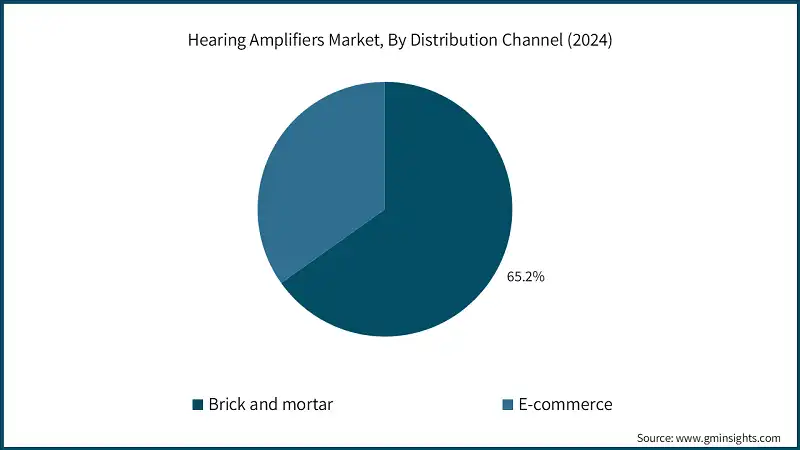
Based on distribution channel, the hearing amplifiers market is classified into brick and mortar and e-commerce. The brick and mortar segment dominated the market with a revenue share of 65.2% in 2024 and is expected to reach USD 108 million within the forecast period.
- Physical retail shops enable direct communication with customers and provide the opportunity to evaluate hearing amplifiers. This tactile interaction inspires trust, which is critical for elderly customers, who in most cases have a reluctance to online purchases.
- Brick-and-mortar outlets allow customers to purchase and use the product instantly, without waiting for shipping. This instant gratification appeals to users with urgent hearing needs, especially in regions where logistics and online delivery may be slow or unreliable.
- Moreover, retailers and pharmacies often provide guidance, recommendations, and after-sales support for hearing amplifiers. Personalized consultations help consumers select the right device based on their comfort, lifestyle, and degree of hearing difficulty, which increases satisfaction and loyalty.
- The e-commerce segment held a revenue of USD 35.7 million in 2024, with projections indicating a steady expansion at 5.7% CAGR from 2025 to 2034. The segmental growth is attributed to the provision of easy access to several brands and models at competitive prices. Also, the convenience of additional services such as home delivery and easy returns is fueling the popularity of ecommerce.
- Customer reviews and product comparisons available on digital platforms are empowering buyers to make informed decisions. Moreover, targeted online marketing and subscription-based sales models are expanding consumer reach and loyalty.
Looking for region specific data?
North America Hearing Amplifiers Market
North America dominated the market with the highest market share of 38.5% in 2024.
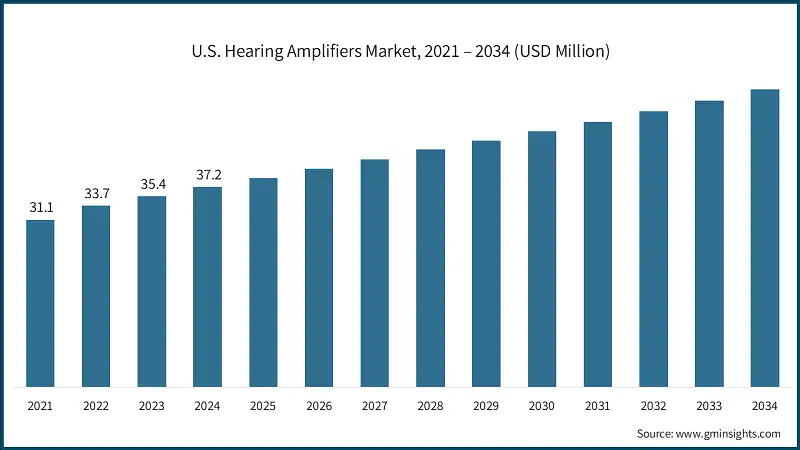
- The U.S. market was valued at USD 31.1 million and USD 33.7 million in 2021 and 2022, respectively. The market size reached USD 37.2 million in 2024, growing from USD 35.4 million in 2023, and is anticipated to grow at a CAGR of 4% between 2025 and 2034.
- The population of North America is suffering from loss of hearing, which is caused by advanced age, lifestyle, and exposure to noise. The National Institute on Deafness and Other Communication Disorders (NIDCD), in 2022, estimated that 37.5 million American adults experienced some form of hearing complications.
- The Centers for Disease Control and Prevention (CDC) estimates that about 40 million U.S. adults aged 20-69 have noise-induced hearing loss as of 2023. These high prevalence rates drive demand for cost-effective solutions such as hearing amplifiers.
- Moreover, the FDA's approval of over-the-counter (OTC) hearing devices has created additional market opportunities for hearing amplifiers in the U.S. This type of regulatory backing lowers market entry obstacles, broadens distribution, and motivates consumers to pursue unobstructed, over-the-counter alternatives.
Europe Hearing Amplifiers Market
Europe market accounted for USD 33.5 million in 2024 and is anticipated to show lucrative growth over the forecast period.
- European governments and non-governmental organizations implement public health campaigns to promote early detection and management of hearing problems. According to the European Commission's 2023 Health Report, USD 527.2 million was allocated for hearing health awareness programs across member states.
- The UK National Health Service reported that hearing aid adoption rates increased by 28% between 2021 and 2023, following targeted public awareness campaigns. In Germany, public health initiatives led to a 35% increase in early hearing screenings during 2022-2024, while France recorded a 42% rise in hearing aid prescriptions from 2021 to 2023.
- The European Union’s harmonized trade policies and cross-border e-commerce growth have improved accessibility of hearing amplifiers across member states. Consumers benefit from wider product variety, competitive pricing, and streamlined distribution, fueling steady market expansion.
Asia Pacific Hearing Amplifiers Market
The Asia Pacific market is anticipated to grow at the highest CAGR of 6.8% during the analysis timeframe.
- The Asia-Pacific population suffers from hearing problems, especially in rural and semi-urban areas, where access to therapeutic devices is limited. According to WHO 2023, about 360 million people in the Asia-Pacific region have disabling hearing loss; only some 17% have received suitable hearing care.
- India alone, according to the National Health Portal, in 2022 about 63 million people who were suffering from hearing loss (6.3% of the populace). The Ministry of Health, Labour, and Welfare of Japan came up with the report in 2021 that 23.5% of adults over 65 years suffered from hearing challenges. Hearing amplifiers bridge this gap in health care by offering low-cost and easily accessible solutions.
- The middle class base in countries such as China, India, and Indonesia is also expanding and insisting on paying more attention to affordable healthcare solutions. Hearing amplifiers can offer a cost-effective alternative to expensive hearing aids, making them an even more attractive option for price-conscious consumers.
Latin America Hearing Amplifiers Market
The Latin America market is experiencing robust growth over the analysis timeframe.
- The hearing amplifier market in Latin America is getting traction because of the community programs and NGO programs focused on hearing health and affordable remedial measures offered to solve hearing problems.
- Limited access to specialized audiology devices or services and the high cost of hearing aids push consumers toward cost-effective hearing amplifiers, particularly in rural and underserved areas. The expanding presence of pharmacies, consumer electronics stores, and local retail chains enhances product availability across urban and semi-urban regions.
- A growing elderly population in countries like Brazil and Mexico further contributes to rising demand, as amplifiers provide practical support for age-related hearing loss. Additionally, informal markets and cross-border trade facilitate access to low-cost devices, boosting overall market adoption.
Middle East and Africa Hearing Amplifiers Market
The Middle East and Africa market is experiencing robust growth over the analysis timeframe.
- The regional growth is driven by increasing investment in private healthcare facilities and clinics, which improves access to hearing solutions. Rising awareness of hearing health through government initiatives and community programs is encouraging early adoption of assistive devices.
- The growing expatriate population and urbanization are creating demand for modern, convenient hearing solutions like amplifiers. Limited availability of high-cost hearing aids in many regions makes affordable amplifiers a preferred option for a wider audience.
- Additionally, the expansion of retail chains and e-commerce platforms is enhancing accessibility and distribution across both urban and semi-urban areas.
Hearing Amplifiers Market Share
The market is competitive, featuring a mix of established consumer electronics brands, medical device companies, and emerging startups. Companies are competing on the basis of product features, price, distribution channels, and technological innovations such as Bluetooth connectivity, noise reduction, and smartphone integration.
Key players include Beurer, JINGHAO, Medline, Sound World Solutions, and Britzgo, collectively accounting for 54.4% of the total market share. Players are increasingly focusing on expanding their distribution networks, leveraging e-commerce platforms, and introducing user-friendly, ergonomically designed products to attract a broader consumer base.
Strategic collaborations, product launches, and investments in research and development are common approaches to gain a competitive edge. The market also witnesses competition from low-cost regional manufacturers, particularly in emerging economies, which intensifies price-based rivalry.
Hearing Amplifiers Market Companies
Few of the prominent players operating in the hearing amplifiers industry include:
- Alango
- Beurer
- Britzgo
- Conversor
- Diglo
- Foshan Vohom Technology
- Innerscope Hearing Technologies
- JINGHAO
- Kinetik Medical
- MEDCA HEARING
- Medline
- NUHEARA
- Sound World Solutions
- Beurer
The company is leading the hearing amplifiers market with a 18.3% share in 2024, Known for its strong consumer health brand, Beurer offers hearing amplifiers that combine reliability with user-friendly features, making them accessible for first-time users. Its wide retail presence ensures easy availability and trusted after-sales support.
Medline leverages its extensive healthcare distribution network to provide hearing amplifiers alongside other medical products, ensuring broad reach. The brand emphasizes durability and clinical-grade quality, appealing to institutional and home-care users.
Sound World Solutions focuses on technologically advanced amplifiers with features like Bluetooth connectivity and customizable sound profiles. Their products are designed for convenience and portability, targeting active and tech-savvy consumers.
Hearing Amplifiers Market Report Attributes
| Key Takeaway | Details |
|---|---|
| Market Size & Growth | |
| Base Year | 2024 |
| Market Size in 2024 | USD 102.5 Million |
| Market Size in 2025 | USD 108.3 Million |
| Forecast Period 2025 - 2034 CAGR | 5.2% |
| Market Size in 2034 | USD 170.3 Million |
| Key Market Trends | |
| Drivers | Impact |
| Increasing prevalence of age-related hearing loss | The surge in hearing impairment cases among older adults is directly boosting demand for cost-effective amplification solutions. |
| Rising geriatric population base | The growing elderly population, particularly in developed and emerging economies, is creating a sustained demand for non-prescription hearing support devices. |
| Technological improvements in amplification and noise reduction | Advancements such as digital signal processing, Bluetooth, and adaptive noise reduction have made amplifiers more appealing. |
| Pitfalls & Challenges | Impact |
| Competition from prescription hearing aids and cochlear implants | Strong competition from clinically fitted devices limits the penetration of amplifiers, especially among users with severe hearing loss. |
| Limited reimbursement/insurance coverage | Since hearing amplifiers are rarely covered by insurance or reimbursement schemes, consumers must bear out-of-pocket expenses. |
| Opportunities: | Impact |
| Growth of online sales and tele-audiology platforms | Expanding digital sales channels and remote support will make hearing amplifiers more accessible, driving higher adoption across underserved regions. |
| Product miniaturization and improved ergonomics | Smaller, discreet, and more comfortable designs will reduce stigma and enhance user acceptance, fueling future market expansion. |
| Market Leaders (2024) | |
| Market Leaders |
18.3% market share |
| Top Players |
Collective Market Share 54.4% |
| Competitive Edge |
|
| Regional Insights | |
| Largest Market | North America |
| Fastest growing market | Asia Pacific |
| Emerging countries | India, China, Brazil, Mexico, South Africa |
| Future outlook |
|
What are the growth opportunities in this market?
Hearing Amplifiers Industry News:
- In April 2025, Amplifon had completed the acquisition of Safe in Sound Hearing, LLC and SISH Tucson, LLC, which operated in the U.S. This expansion strengthened Amplifon’s footprint in the largest hearing care market globally. The acquisition enhanced the company’s service network, enabling broader access to hearing solutions. It also supported growth in the hearing amplifiers and related consumer segments by reaching more customers.
- In July 2021, Alango Technologies had launched an advanced version of its BeHear ACCESS hearing amplification headset. The release expanded its product portfolio and attracted a wider customer base. This strengthened the company’s presence in the market and boosted consumer adoption.
The hearing amplifiers market research report includes an in-depth coverage of the industry with estimates and forecast in terms of revenue (USD Million) and volume (Units) from 2021 - 2034 for the following segments:
Market, By Product
- Behind-the-ear (BTE)
- In-the-ear (ITE)
- Other products
Market, By Technology
- Digital
- Analog
Market, By Distribution Channel
- Brick and mortar
- E-commerce
The above information is provided for the following regions and countries:
- North America
- U.S.
- Canada
- Europe
- Germany
- UK
- France
- Spain
- Italy
- Netherlands
- Asia Pacific
- China
- Japan
- India
- Australia
- South Korea
- Latin America
- Brazil
- Mexico
- Argentina
- Middle East and Africa
- South Africa
- Saudi Arabia
- UAE
Frequently Asked Question(FAQ) :
What is the market size of the hearing amplifiers market in 2024?
The market size was USD 102.5 million in 2024, with a CAGR of 5.2% expected through 2034 driven by increasing prevalence of hearing loss.
What is the projected value of the hearing amplifiers industry by 2034?
The market is expected to reach USD 170.3 million by 2034, driven by aging populations, cost-effective amplification solutions.
Which product segment dominates the hearing amplifiers market in 2024?
The behind-the-ear (BTE) segment dominates the market with a 59% share in 2024 due to higher amplification power, ease of handling.
What is the forecast for the behind-the-ear (BTE) segment through 2034?
The BTE segment is expected to exceed USD 98.4 million by 2034, growing at a CAGR of 4.9% during the forecast period.
How is the in-the-ear (ITE) segment expected to grow?
The ITE segment held USD 33.8 million in revenue in 2024 and is projected to grow at a CAGR of 5.7% from 2025 to 2034.
Which technology segment leads the hearing amplifiers market in 2024?
The digital segment dominated in 2024 with USD 63.7 million revenue and is anticipated to grow at a CAGR of 4.9% through 2034 due to advanced features like noise reduction, speech recognition, and smartphone integration.
Which region holds the largest share in the global hearing amplifiers industry in 2024?
North America dominated with a 38.5% market share in 2024, led by high prevalence of hearing loss and favorable regulatory support such as the FDA's OTC hearing device approval.
Who are the key players in the global hearing amplifiers market?
Key players include Beurer, JINGHAO, Medline, Sound World Solutions, and Britzgo, collectively holding 54.4% of the total market share in 2024.
What are the key trends driving the hearing amplifiers industry?
Key trends include integration of Bluetooth and wireless streaming, smartphone app connectivity, miniaturization, rising OTC adoption post-FDA regulation, and growth of online sales and tele-audiology platforms.
What challenges does the hearing amplifiers market face?
Challenges include competition from prescription hearing aids and cochlear implants, limited insurance coverage, and price-based rivalry from low-cost regional manufacturers.
Hearing Amplifiers Market Scope
Related Reports