Summary
Table of Content

Healthy Snacks Market
Get a free sample of this report
Form submitted successfully!
Error submitting form. Please try again.
Thank you!
Your inquiry has been received. Our team will reach out to you with the required details via email. To ensure that you don't miss their response, kindly remember to check your spam folder as well!
Request Sectional Data
Thank you!
Your inquiry has been received. Our team will reach out to you with the required details via email. To ensure that you don't miss their response, kindly remember to check your spam folder as well!
Form submitted successfully!
Error submitting form. Please try again.
Healthy Snacks Market Size
- The market for healthy snacks has shown substantial expansion during the past few years because consumers have become more knowledgeable about health and wellness. Consumers now prefer to purchase better-for-you foods because they want quick access to nutritious products which will help them maintain their active lifestyles. People need healthy snacks because they give vital nutrients which help them manage their weight while decreasing their consumption of processed foods and foods with high sugar content.
- Healthy snacks offer advantages which help people increase their energy levels and get more nutritional value while achieving better health results. The products contain natural components which have been created to fulfill dietary requirements by providing options that are gluten-free and vegan and keto-friendly and which contain no artificial preservatives.
- Healthy snacks serve multiple industries because they function as essential components in several applications. Retailers sell the products through their supermarket and health food store and e-commerce platform distribution channels. The foodservice industry provides healthy snack choices in its cafes and vending machines and convenience store facilities to respond to the increasing consumer demand. Customers who lead active lives now have access to healthier snack options through the market introduction of portable nuts and dried fruits and protein bars and vegetable chips.
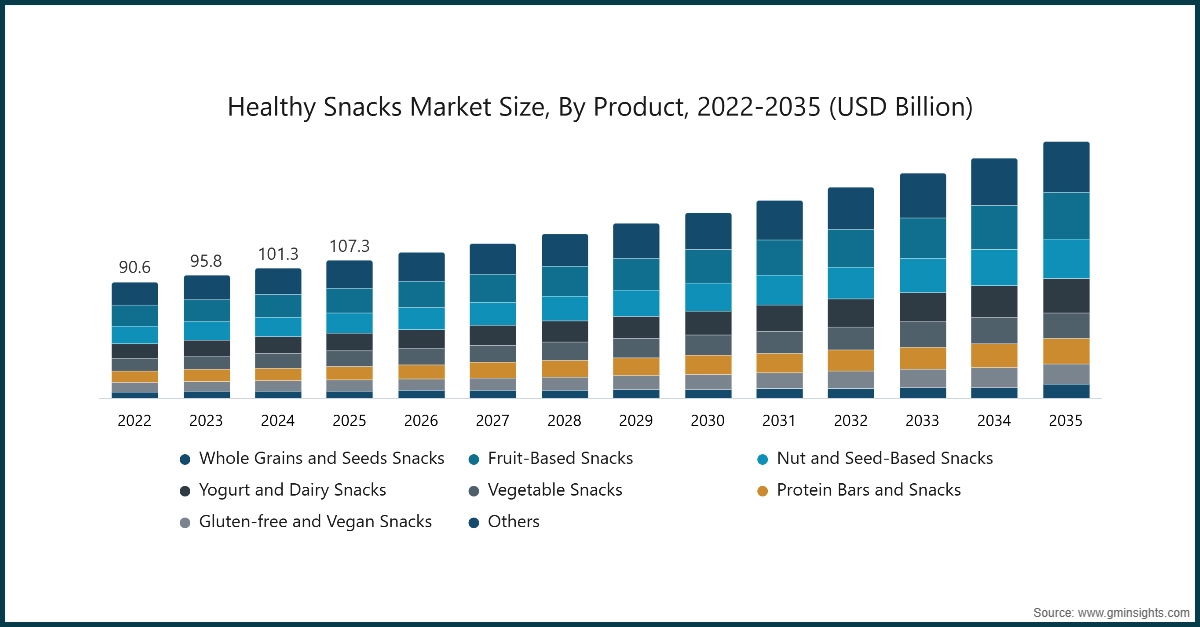
The global healthy snacks market was valued at USD 107.3 billion in 2025. The market is expected to grow from USD 113.8 billion in 2026 to USD 200.5 billion in 2035, at a CAGR of 6.5% according to latest report published by Global Market Insights Inc.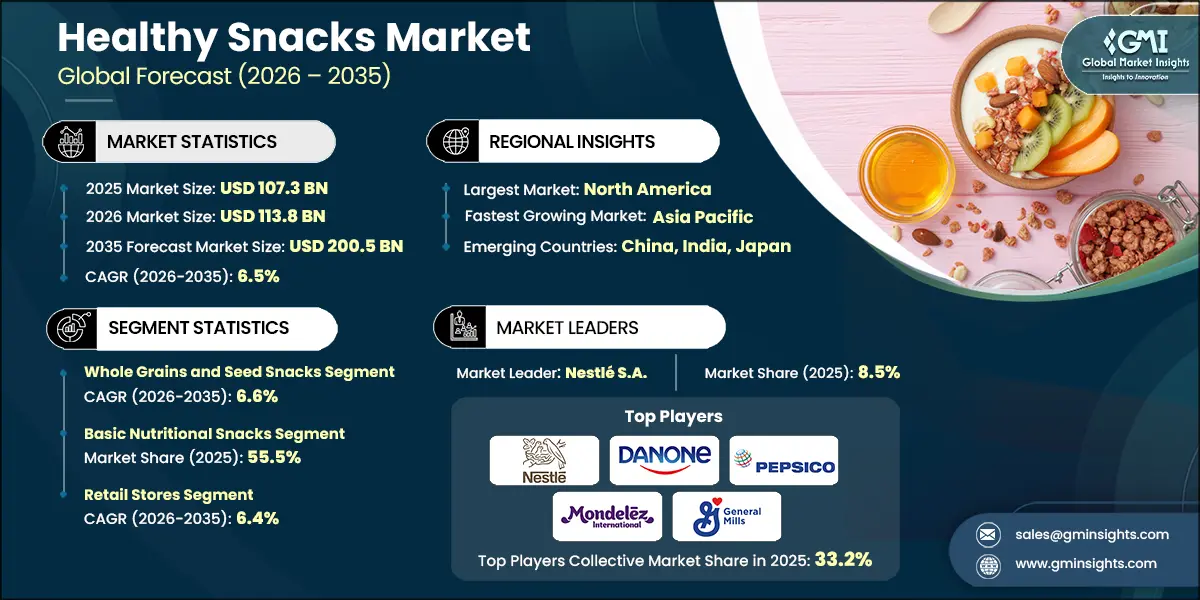
Healthy Snacks Market Key Takeaways
Market Size & Growth
- 2025 Market Size: USD 107.3 Billion
- 2026 Market Size: USD 113.8 Billion
- 2035 Forecast Market Size: USD 200.5 Billion
- CAGR (2026–2035): 6.5%
Regional Dominance
- Largest Market: North America
- Fastest Growing Region: Asia Pacific
Key Market Drivers
- Rising health consciousness.
- Product innovation.
- Urbanization and busy lifestyles.
Challenges
- High production cost.
- Limited shelf life.
Opportunity
- Expansion of e-commerce.
- Customization and personalization.
Key Players
- Market Leader: Nestlé S.A. led with over 8.5% market share in 2025.
- Leading Players: Top 5 players in this market include Nestlé S.A., Danone S.A., PepsiCo, Inc., Mondelēz International, Inc., General Mills, Inc., which collectively held a market share of 33.2% in 2025.
Get Market Insights & Growth Opportunities
To get key market trends
Healthy Snacks Market Trends
- The healthy snack market has experienced considerable expansion because more people understand the importance of maintaining good health and fitness. Consumers now require quick access to healthy food choices which has created increased interest in snacks made from natural ingredients and organic products and functional food items. The industry expanded because technological progress developed better product formulation methods and superior preservation systems and novel packaging designs. The manufacturing process which uses clean-label products together with minimally processed ingredients provides customers with transparent product information and genuine product characteristics.
- The healthy snack industry now operates under enhanced regulatory control because authorities have established more stringent requirements for food product labeling and ingredient disclosure and health-related product assertions. The regulations create a foundation of consumer trust which motivates brands to develop new products through responsible innovation. Companies must now disclose nutritional details while refraining from making deceptive statements to establish transparent business operations.
- Product innovation drives market growth because it generates new business opportunities for companies. Brands are launching new product lines which include plant-based snacks and protein-rich bars and functional bites that contain superfoods and probiotics and adaptogens. The product development team uses functional ingredients to create solutions which treat specific health issues like immunity and digestion and energy management. Sustainable sourcing and eco-friendly packaging practices have become vital factors which appeal to consumers who value environmental protection.
Healthy Snacks Market Analysis
Learn more about the key segments shaping this market
Based on product, the market is segmented into whole grains and seeds snacks, fruit-based snacks, nut and seed-based snacks, yogurt and dairy snacks, vegetable snacks, protein bars and snacks, gluten-free and vegan snacks, others. Whole grains and seed snacks dominated the market with an approximate market share of 20% in 2025 and is expected to grow with CAGR of 6.6% by 2035.
- The healthy snack market observes increasing consumer demand for natural nutrient-rich snacks while whole grain and seed-based snacks become more popular because of their high fiber content and health advantages. Fruit-based snacks are also in demand because consumers search for vitamin-rich sweet alternatives which provide their sweet cravings without extra sugars. Nut and seed-based snacks continue to grow because people appreciate their healthy fats and protein content and their ability to create satisfying and energizing snacks for health-focused consumers.
- Yogurt and dairy snacks which include probiotics for gut health now experience higher demand. The market for vegetable snacks and protein bars is growing because consumers want plant-based products that provide high protein content. The popularity of gluten-free and vegan snacks is increasing because more people need to follow special diets and people want to eat food based on ethical principles. The healthy snack market will establish its future through product innovation and clean-label ingredient usage and sustainable development of existing product lines.
Learn more about the key segments shaping this market
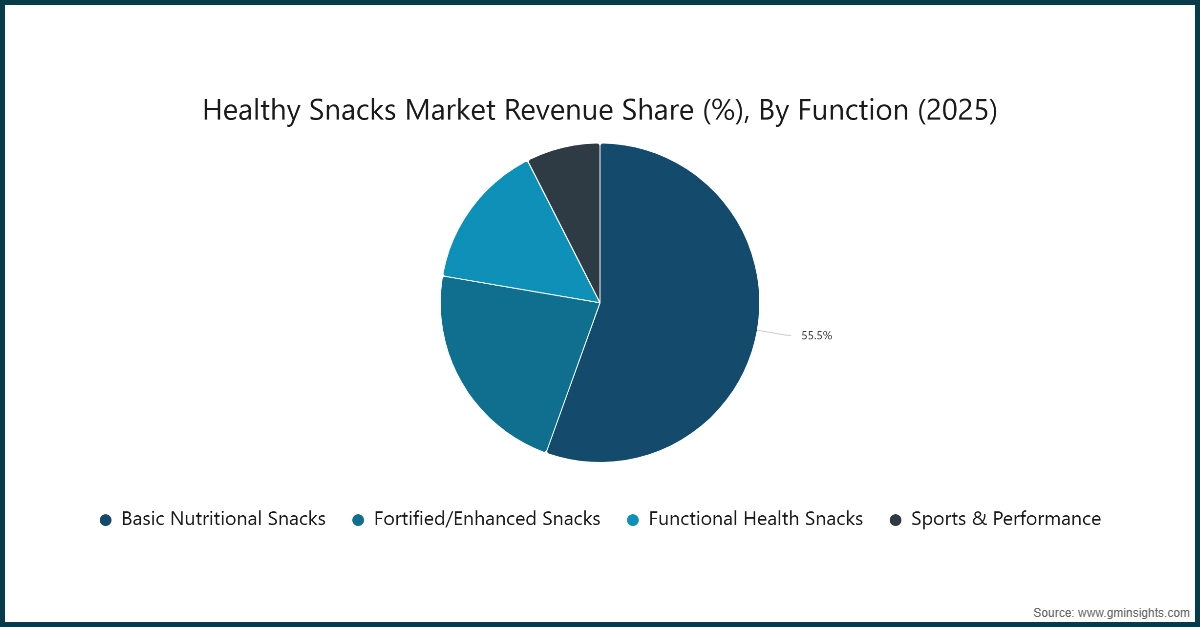
Based on function, the healthy snacks market is segmented into basic nutritional snacks, fortified/enhanced snacks, functional health snacks, sports & performance. Basic nutritional snacks held the largest market share of 55.5% in 2025 and is expected to grow at a CAGR of 6.2% during 2026-2035.
- The market by function is undergoing fast transformation because consumers request specific health advantages. Basic nutritional snacks continue to hold a significant share because consumers prefer simple wholesome snacks that deliver essential nutrition. Snacks that contain vitamins, mineral and superfood ingredients are experiencing rising popularity because these products provide solutions for specific health needs related to immunity and energy and cognitive abilities. The adoption of functional health snacks which deliver specific advantages for digestive health and heart health and weight management has increased because people now understand preventive healthcare better.
- The sports and performance snacks market is growing quickly because it provides athletes and fitness enthusiasts with easy-to-use products that deliver high protein content and energy enhancement. As consumers become more health-conscious, brands are developing multifunctional products that provide multiple advantages, which leads to industry growth in every sector. Snack products that combine personalized nutrition and functional food elements will continue to drive the global market, which will establish function-oriented snacks as essential market drivers.
Based on distribution channel, the healthy snacks market is segmented into retail stores, online retail, vending machines, direct-to-consumer. Retail stores dominated the market with an approximate market share of 60% in 2025 and is expected to grow with a CAGR of 6.4% by 2035.
- The worldwide market for healthy snacks depends on distribution channels to support its ongoing growth. Retail stores, which include supermarkets and health food outlets, remain the main distribution method because they enable customers to access various products. However, online retail has experienced exponential growth because online shopping offers better accessibility to more products and customers want to shop through online platforms. Online platforms have become the preferred choice for people who want to find new healthy snacks which exist outside of traditional markets after the pandemic ended. Vending machines are increasingly popular in workplaces and gyms and public areas because they deliver fast and easy dining solutions.
- The DTC model has become a major market force because it enables brands to create direct customer connections while delivering personalized products and obtaining important consumer information. Digital channels have become the preferred choice for consumers who want to experience shopping that provides them with both made-to-order products and shopping convenience and product information. E-commerce will increase, which will make these channels essential for healthy snack sales and market growth in the global market.
Looking for region specific data?
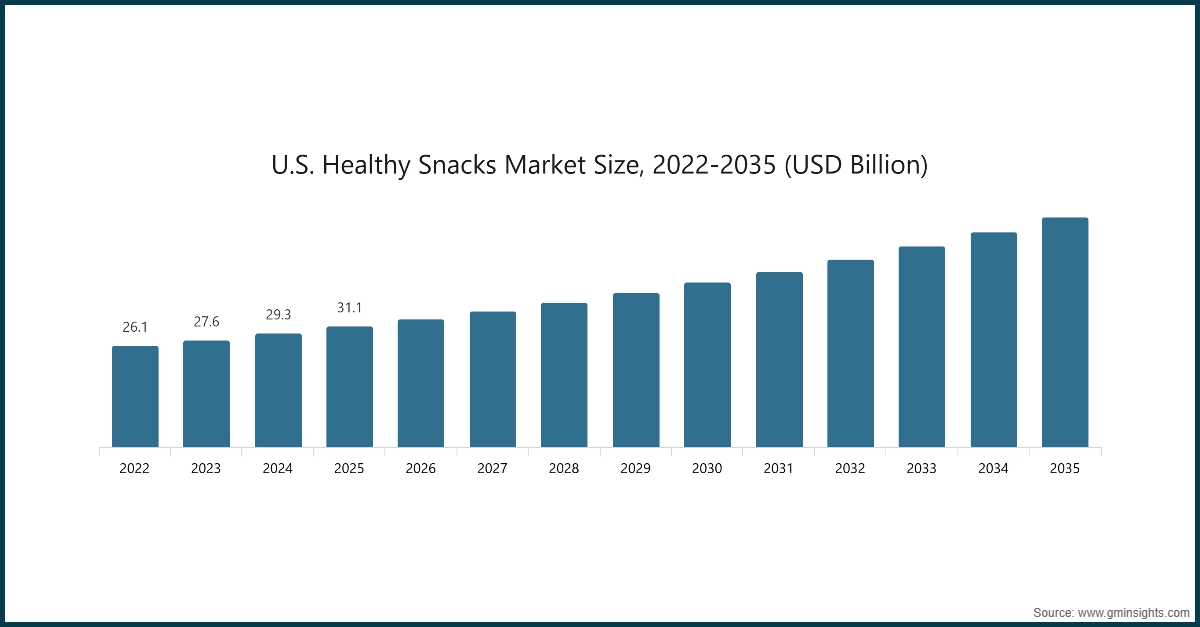
The North America healthy snacks market is growing rapidly on the global level with a market share of 36.2% in 2025.
- The healthy snack market in North America is experiencing rapid growth because consumers now understand health, more people develop lifestyle-related health problems and people prefer to eat clean-label products and organic foods. Millennials and Gen Z consumers want innovative functional snacks which deliver health benefits through protein enrichment and gut health and immune support. The market continues to grow because people look for easy-to-eat products which supermarkets and convenience stores and online platforms now provide through their healthier product lines.
Europe healthy snacks industry leads the industry with revenue of USD 29.8 billion in 2025 and is anticipated to show lucrative growth over the forecast period.
- Europe's healthy snack market supports both natural ingredient consumption and sustainable practices while requiring all products to obtain organic certification. Consumer preferences are shifting toward minimally processed, plant-based, and gluten-free snacks, which regulations and environmental concerns both support. The market trends now follow two main factors which include dietary restriction awareness and traditional health food popularity. Retailers are expanding their assortments of innovative products while e-commerce works to connect with health-conscious consumers.
The Asia Pacific healthy snacks market is anticipated to grow at a CAGR of 6.8% during the analysis timeframe.
- The healthy snack market in Asia Pacific is growing strongly because urban areas expand, people earn more money and their daily habits change. People now eat Western health snacks together with traditional diets because product makers design their products with local flavors and ingredients, which reflect regional preferences. The youth demographic and working professionals are the primary consumers who want to buy products which include both convenience and nutritional value. E-commerce platforms and modern retail chains experience rapid growth which enables more people to adopt healthy snacks throughout the region.
Latin America healthy snacks accounted for 8% market share in 2025 and is anticipated to show steady growth over the forecast period.
- In Latin America the healthy snack market is growing because consumers want to eat healthier snacks which match their better understanding of nutrition and wellness. The trend benefits from middle class growth and urban areas expanding together with people learning about global health developments. Traditional snacks now have healthier ingredient alternatives because people choose plant-based and natural product options as their preferred snacks. Local brands are now competing with international companies, while social media platforms determine which products consumers will buy.
Middle East & Africa healthy snacks accounted for USD 5.3 billion market size in 2025 and is anticipated to show lucrative growth over the forecast period.
- The healthy snack market in Middle East & Africa is growing because urban areas expand and the youth population increases and people learn about health problems. Consumers want functional snacks which help them boost their immunity and energy levels while improving their overall health. The regional market shows a preference for products which contain locally sourced ingredients and certified halal items. People can access more healthy snack choices because retail spaces and online shopping both grow however they still need to consider product costs before buying.
Healthy Snacks Market Share
The top 5 companies in healthy snacks industry include Nestlé S.A., Danone S.A., PepsiCo, Inc., Mondelēz International, Inc., General Mills, Inc. These are prominent companies operating in their respective regions covering approximately 33.2% of the market share in 2025. These companies hold strong positions due to their extensive experience in market. Their diverse product portfolios, backed by robust production capabilities and distribution networks, enable them to meet the rising demand across various regions.
- Nestlé leads the global food and beverage market as an international company which operates with a primary mission to promote health and wellness. Nestlé uses its broad range of products and product development skills and global distribution system to attract customers in the healthy snack market. The company develops snacks by using natural ingredients and organic components which provide health benefits through superfoods and clean-label elements.
- Danone strengthens its market position through its development of health-oriented products which include plant-based and organic offerings that match current consumer preferences. The company develops dairy alternatives together with plant-based snacks and functional foods which create unique products for the healthy snack industry. The company uses its European market presence together with its North American and Asian market expansion through acquisition and product development to establish regional market power.
- PepsiCo controls the global snack market while running the healthy snack business through its brands. The company uses its extensive distribution system and marketing capabilities together with its innovation track system to quickly meet changing customer demands. PepsiCo spends substantial funds on R&D and marketing to educate consumers about its products which contain reduced sugar and increased fiber and natural components.
- Mondelēz International, Inc. develops snacking products which target health-seeking customers through its brand portfolio. The company develops new health-oriented products through product reformulation which improves existing products nutritional value. Mondelēz gains a competitive advantage through its global operations which combine strong marketing capabilities with local market adaptations.
- General Mills Foodservice has established itself as a major force in the healthy snack industry through its brands. The company offers products which include organic and non-GMO and minimally processed ingredients to meet consumer needs for product transparency and health advantages. The company uses its sustainability efforts and clean-label product development to build a strong competitive position in the market. General Mills uses its strong retail partnerships together with its investment in plant-based products and functional snacks to attract health-focused buyers in North America and developing international markets.
Healthy Snacks Market Companies
Major players operating in the healthy snacks industry include:
- Danone S.A.
- General Mills, Inc.
- Glanbia PLC
- Hain Celestial Group, Inc.
- Hippeas
- Hormel Foods Corporation
- Kellanova Company
- Mondelēz International, Inc.
- Nestlé S.A.
- PepsiCo, Inc.
- Simply Good Foods Company
Healthy Snacks Market Report Attributes
| Key Takeaway | Details |
|---|---|
| Market Size & Growth | |
| Base Year | 2025 |
| Market Size in 2025 | USD 107.3 Billion |
| Market Size in 2026 | USD 113.8 Billion |
| Forecast Period 2026-2035 CAGR | 6.5% |
| Market Size in 2035 | USD 200.5 Billion |
| Key Market Trends | |
| Drivers | Impact |
| Rising health consciousness | Increasing awareness about nutrition and wellness encourages consumers to choose healthier snack options over traditional junk foods. |
| Product innovation | Development of innovative products such as plant-based, gluten-free, and functional snacks attracts a broader consumer base. |
| Urbanization and busy lifestyles | The fast-paced urban environment boosts demand for convenient, portable, and on-the-go healthy snack options. |
| Pitfalls & Challenges | Impact |
| High production cost | Healthy snacks often cost more than conventional snacks, which may deter price-sensitive consumers. |
| Limited shelf life | Many healthy ingredients, like natural and organic components, have shorter shelf lives, complicating storage and distribution. |
| Opportunities: | Impact |
| Expansion of e-commerce | Online platforms provide a wider reach and direct engagement with health-conscious consumers, boosting sales. |
| Customization and personalization | Offering tailored snacks for specific dietary needs or preferences (e.g., keto, vegan) can attract niche markets. |
| Market Leaders (2025) | |
| Market Leader |
8.5% |
| Top Players |
Collective Market Share of 33.2% in 2025 |
| Competitive Edge |
|
| Regional Insights | |
| Largest Market | North America |
| Fastest growing market | Asia Pacific |
| Emerging countries | China, India, Japan |
| Future outlook |
|
What are the growth opportunities in this market?
Healthy Snacks Industry News
- In October 2024, Zydus Wellness announced to enter the healthy snacks industry by acquiring Naturell India, known for protein-rich Ritebite snacks, for USD 42.3 million. The deal includes 100% equity shares and Naturell’s subsidiary. This acquisition expands Zydus Wellness’ consumer wellness portfolio and is expected to boost earnings per share (EPS) from the first year post-acquisition.
- In March 2022, CLIFexpanded its snack category with the launch of CLIF Thins, a crispy and crunchy variation of the original CLIF BAR. CLIF Thins are consciously crafted using plant-based ingredients.
- In February 2022, DaburIndia, a prominent Natural Health Care and Ayurvedic Company, expanded its Réal portfolio by introducing a line of healthy snacks in the Superfoods Seeds category.
This healthy snacks market research report includes in-depth coverage of the industry, with estimates & forecasts in terms of revenue (USD Billion) and volume (Kilo Tons) from 2026 to 2035, for the following segments:
Market, by Product
- Whole grains and seeds snacks
- Fruit-based snacks
- Nut and seed-based snacks
- Yogurt and dairy snacks
- Vegetable snacks
- Protein bars and snacks
- Gluten-free and vegan snacks
- Others
Market, by Function
- Basic nutritional snacks
- Fortified/enhanced snacks
- Functional health snacks
- Sports & performance
Market, by Distribution Channel
- Retail stores
- Online retail
- Vending machines
- Direct-to-consumer
The above information is provided for the following regions and countries:
- North America
- U.S.
- Canada
- Europe
- Germany
- UK
- France
- Spain
- Italy
- Rest of Europe
- Asia Pacific
- China
- India
- Japan
- Australia
- South Korea
- Rest of Asia Pacific
- Latin America
- Brazil
- Mexico
- Argentina
- Rest of Latin America
- Middle East and Africa
- Saudi Arabia
- South Africa
- UAE
- Rest of Middle East and Africa
Frequently Asked Question(FAQ) :
What is the market size of the healthy snacks market in 2025?
The global healthy snacks market was valued at USD 107.3 billion in 2025, driven by rising consumer awareness regarding health and nutrition.
What is the expected market size of the healthy snacks market in 2026?
The market is projected to reach USD 113.8 billion in 2026, supported by increasing adoption of clean-label products and growing demand for functional and plant-based snacks.
What is the projected value of the healthy snacks market by 2035?
The market is expected to reach USD 200.5 billion by 2035, growing at a CAGR of 6.5%, driven by product innovation, expanding distribution channels, and a rising health-conscious consumer base.
How much market share did the whole grains and seeds snacks segment hold in 2025?
The whole grains and seeds snacks segment held approximately 20% market share in 2025 and is expected to grow at a CAGR of 6.6% through 2035.
Which distribution channel leads the healthy snacks industry?
The retail stores segment led the market with around 60% share in 2025, supported by wide product availability across supermarkets, hypermarkets, and health food stores.
Which region leads the healthy snacks industry?
North America leads the market with a 36.2% share in 2025, driven by high consumer awareness and strong demand for healthier food alternatives.
Who are the key players in the healthy snacks market?
Key players include Nestlé S.A., Danone S.A., PepsiCo, Inc., Mondelēz International, Inc., and General Mills, Inc., among others.
Healthy Snacks Market Scope
Related Reports