Summary
Table of Content

Healthcare 3D Printing Market
Get a free sample of this report
Form submitted successfully!
Error submitting form. Please try again.
Thank you!
Your inquiry has been received. Our team will reach out to you with the required details via email. To ensure that you don't miss their response, kindly remember to check your spam folder as well!
Request Sectional Data
Thank you!
Your inquiry has been received. Our team will reach out to you with the required details via email. To ensure that you don't miss their response, kindly remember to check your spam folder as well!
Form submitted successfully!
Error submitting form. Please try again.
Healthcare 3D Printing Market Size
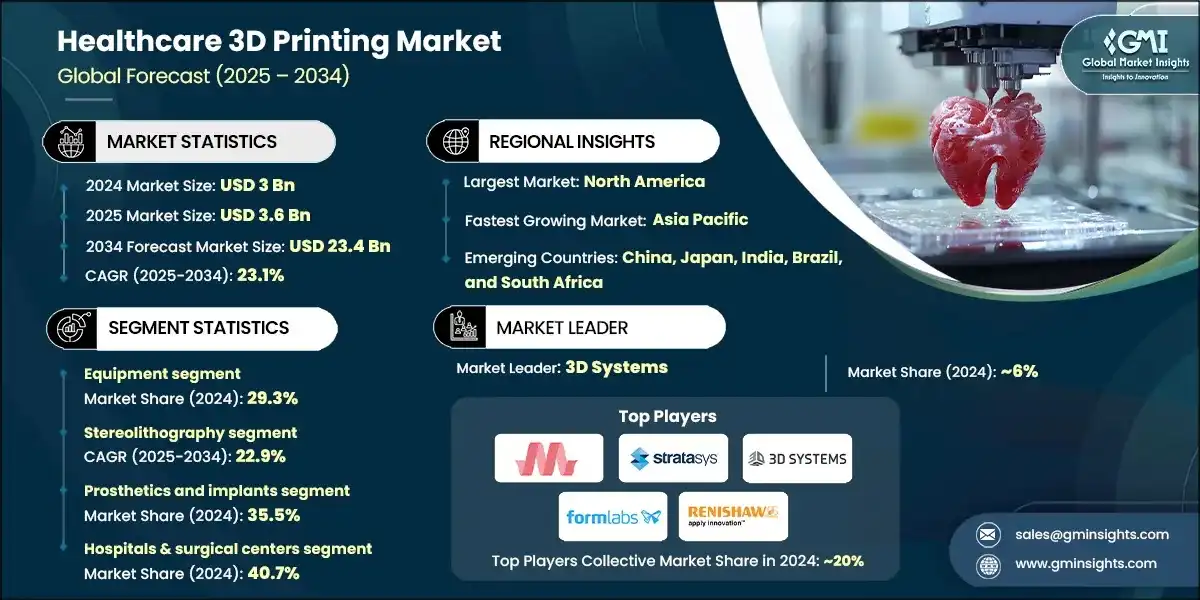
The global healthcare 3D printing market size was valued at USD 3 billion in 2024. The market is expected to grow from USD 3.6 billion in 2025 to USD 23.4 billion in 2034, at a CAGR of 23.1% during the forecast period, according to the latest report published by Global Market Insights Inc. The high market growth is attributed to the rising demand for custom implants, increasing R&D investments from manufacturers and institutions, and extending clinical applications, among others.
Healthcare 3D Printing Market Key Takeaways
Market Size & Growth
- 2024 Market Size: USD 3 Billion
- 2025 Market Size: USD 3.6 Billion
- 2034 Forecast Market Size: USD 23.4 Billion
- CAGR (2025–2034): 23.1%
Regional Dominance
- Largest Market: North America
- Fastest Growing Region: Asia Pacific
Key Market Drivers
- Rising demand for custom implants.
- Increasing R&D investments from manufacturers and institutions.
- Extending clinical applications.
- Technological advancements.
Challenges
- Lack of skilled professionals.
- High price associated with 3D printing.
Opportunity
- Rising adoption in emerging markets.
- AI & simulation integration.
Key Players
- Market Leader: 3D Systems led with over 6% market share in 2024.
- Leading Players: Top 5 players in this market include materialize, stratasys, 3D Systems, formlabs, RENISHAW, which collectively held a market share of 20% in 2024.
Get Market Insights & Growth Opportunities
Healthcare 3D printing technologies are transformative tools used in clinical medicine, surgical planning, prosthetics, and regenerative therapies. Leading manufacturers such as 3D Systems, Stratasys, Materialise, Desktop Metal, and Renishaw provide a diverse portfolio of 3D printing solutions, including stereolithography (SLA), selective laser sintering (SLS), and bioprinting platforms. These systems incorporate advanced technologies such as AI-driven design automation, biocompatible materials, and integration with electronic health records, ensuring high accuracy, clinical relevance, and streamlined workflows.
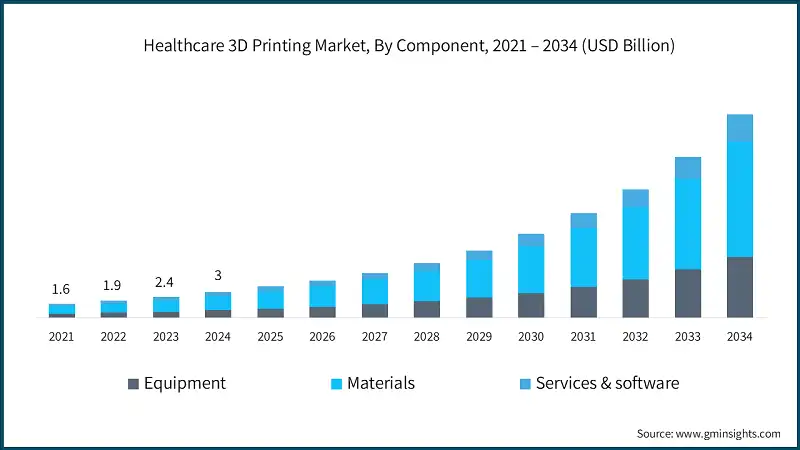
The market has increased from USD 1.6 billion in 2021 and reached USD 2.4 billion in 2023, with a historic growth rate of 22.5%. This expansion has been driven by increasing demand for personalized medical solutions, rising prevalence of chronic diseases, and growing adoption of digital health technologies. The surge in orthopedic, dental, and surgical applications, combined with the need for cost-effective and rapid prototyping in healthcare, has further accelerated market growth.
With the global healthcare system shifting toward precision medicine and an aging population requiring more customized care, the demand for reliable and easy-to-use 3D printing solutions is rising. Hospitals and research institutions are increasingly investing in point-of-care 3D printing labs, enabling faster turnaround and improved patient outcomes. As awareness of the benefits of personalized implants and bioprinted tissues grows, both healthcare providers and patients are embracing these technologies for early diagnosis, surgical planning, and regenerative treatments, thereby fueling market expansion.
A healthcare 3D printing system typically consists of a 3D printer or bioprinter, design software, and biocompatible materials such as polymers, metals, or hydrogels. These components work together to fabricate complex medical devices or biological structures based on patient-specific data, often derived from CT or MRI scans.
To get key market trends
Healthcare 3D Printing Market Trends
Technological innovation is one of the most significant factors propelling the market forward. Continuous improvements in printing technologies, materials science, and software integration have expanded the scope of applications in clinical settings.
- Advanced 3D printing techniques such as stereolithography (SLA), selective laser sintering (SLS), and fused deposition modeling (FDM) now deliver higher precision, faster build times, and improved scalability, making them suitable for producing 3D printed medical devices & implants.
- Another major advancement is the development of bioprinting technologies, which enable the fabrication of living tissues and organ structures using bio-inks composed of cells and biomaterials. This innovation holds transformative potential for regenerative medicine, organ transplantation, and drug testing, addressing critical challenges like organ shortages and personalized therapy.
- Additionally, the introduction of biocompatible polymers, high-strength metals, and bioresorbable materials ensures that 3D-printed implants and surgical tools meet stringent clinical safety standards. These materials enhance durability, reduce rejection risks, and support complex geometries that traditional manufacturing cannot achieve.
Healthcare 3D Printing Market Analysis
Learn more about the key segments shaping this market
The global market was valued at USD 1.6 billion in 2021. The market size reached USD 2.4 billion in 2023, from USD 1.9 billion in 2022.
Based on the component, the market is segmented into equipment, materials, and services & software. The equipment segment accounted for 29.3% of the market in 2024 due to the rising adoption of advanced 3D printers and bioprinters in hospitals, research institutions, and point-of-care settings, driven by their critical role in producing customized implants, anatomical models, and surgical tools. The segment is expected to exceed USD 7 billion by 2034, growing at a CAGR of 23.4% during the forecast period.
On the other hand, the materials segment held a dominant market share of 54.8% in 2024, and its growth can be attributed to the increasing demand for biocompatible polymers, metals, and biomaterials used in custom implants, surgical guides, and bioprinted tissues, driven by advancements in material science and expanding clinical applications.
- The equipment segment’s growth is also supported by the trend of point-of-care manufacturing, where hospitals establish in-house 3D printing labs to reduce turnaround times and improve patient outcomes. As healthcare systems increasingly prioritize cost efficiency and personalized care, the demand for advanced 3D printing equipment is expected to remain strong, positioning this segment as a cornerstone of the market.
- The services & software segment is expected to grow with a 21% CAGR during the analysis period due to the increasing demand for design optimization, simulation tools, and cloud-based platforms that enable seamless integration of 3D printing workflows, along with the rising adoption of on-demand printing services by hospitals and research institutions to reduce capital expenditure and improve operational efficiency.
Based on technology, the healthcare 3D printing market is segmented into stereolithography, fused deposition modelling (FDM), selective laser sintering (SLS), metal printing, and other technologies. The stereolithography segment dominated the market in 2024 and is growing with a CAGR of 22.9% during the forecast period.
- The stereolithography (SLA) segment holds a dominant share in the market by technology, primarily due to its high precision, smooth surface finish, and ability to produce intricate geometries required for medical applications. SLA technology is widely used for creating anatomical models, surgical guides, dental prosthetics, and custom implants, where accuracy and detail are critical for clinical outcomes.
- The fused deposition modelling (FDM) segment is expected to grow with a 23.9% CAGR during the analysis period. This growth is primarily driven by its cost-effectiveness, ease of use, and compatibility with a wide range of thermoplastic materials, making it an attractive option for producing anatomical models, surgical guides, and low-cost prototypes in healthcare settings.
- The market for the selective laser sintering (SLS) segment is expected to expand rapidly, driven primarily by its ability to produce highly durable, complex, and lightweight medical components without the need for support structures, making it ideal for manufacturing surgical instruments, orthopedic implants, and dental prosthetics.
- The metal printing segment is expected to grow with a 22.2% CAGR during the analysis period. This growth is primarily driven by the increasing demand for high-strength, biocompatible metal implants such as orthopedic and cranial components, coupled with advancements in metal additive manufacturing technologies like electron beam melting (EBM) and selective laser melting (SLM).
- On the other hand, the other technologies segment held a market share of 8.6% in 2024, and its growth can be attributed to the adoption of emerging and niche 3D printing methods such as inkjet printing, laminated object manufacturing, and hybrid additive manufacturing, which offer unique advantages for specialized medical applications like drug delivery systems, micro-scale devices, and experimental bioprinting solutions.
Based on the application, the healthcare 3D printing market is segmented into prosthetics and implants, dental, bioprinting, tissue and organ generation, and other applications. The prosthetics and implants segment held a market share of 35.5% in 2024 and is expected to grow at a 23.5% CAGR during the forecast period.
- The growth of this segment is driven by the rising demand for patient-specific implants, advancements in biocompatible materials, and the increasing prevalence of orthopedic and dental disorders requiring customized solutions.
- The dental segment accounted for a 25.2% share in 2024. The growth is driven due to the increasing adoption of 3D printing for dental implants and abutment systems, coupled with the rising demand for same-day restorations, cost efficiency, and improved patient outcomes in dental practices and laboratories.
- The market for the bioprinting segment is expected to expand rapidly, driven primarily by the growing demand for tissue engineering and regenerative medicine, advancements in bio-ink formulations, and increasing research investments aimed at developing functional organs and complex biological structures for transplantation and drug testing.
- The tissue and organ generation segment is expected to grow with a 22.3% CAGR during the analysis period, driven by increasing research in regenerative medicine, advancements in bioprinting technologies, and rising investments aimed at developing functional tissues and organs for transplantation and drug testing applications.
- On the other hand, the other applications segment held a market share of 6.5% in 2024, and its growth can be attributed to the increasing use of 3D printing in niche medical applications such as drug delivery systems, surgical instruments, and experimental research models, supported by ongoing innovation and the exploration of new clinical use cases.
Learn more about the key segments shaping this market
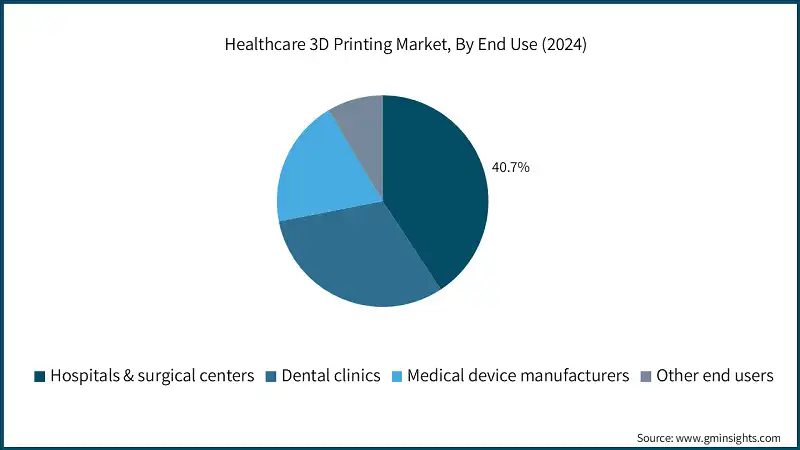
Based on end use, the healthcare 3D printing market is segmented into hospitals & surgical centers, dental clinics, medical device manufacturers, and other end users. The hospitals & surgical centers segment dominated the market with a revenue share of 40.7% in 2024 and is expected to reach USD 9.7 billion within the forecast period.
- This dominance is primarily attributed to the widespread adoption of 3D printing technologies in hospitals and surgical centers for producing patient-specific implants, anatomical models, and surgical guides, which enhance surgical precision and reduce operation times. Additionally, the growing trend of establishing in-house 3D printing labs for point-of-care manufacturing, coupled with increasing investments in advanced medical technologies, further strengthens this segment’s leadership in the market.
- The dental clinics segment accounted for a 31.2% share in 2024 and is expected to grow at a 23.9% CAGR. This growth is primarily driven by the increasing adoption of 3D printing for dental restorations such as crowns, bridges, and aligners, the demand for same-day treatment solutions, and the cost-effectiveness of in-house 3D printing systems, which enhance patient satisfaction and operational efficiency.
- The market for the medical device manufacturers segment is expected to expand rapidly, driven primarily by the increasing demand for customized and patient-specific solutions. 3D printing enables manufacturers to produce complex medical devices such as implants, prosthetics, and surgical instruments tailored to individual anatomical requirements.
- The other end users segment is expected to grow with a 19.1% CAGR during the analysis period. This growth is primarily driven by the increasing adoption of 3D printing technologies by academic institutions, research organizations, and pharmaceutical companies. These entities are leveraging 3D printing for a wide range of applications, including anatomical modeling, drug development, and experimental surgical planning. The ability to create highly detailed and patient-specific models enhances research accuracy and supports innovation in treatment methodologies.
Looking for region specific data?
North America Healthcare 3D Printing Market
North America dominated the market with the highest market share of 42% in 2024.
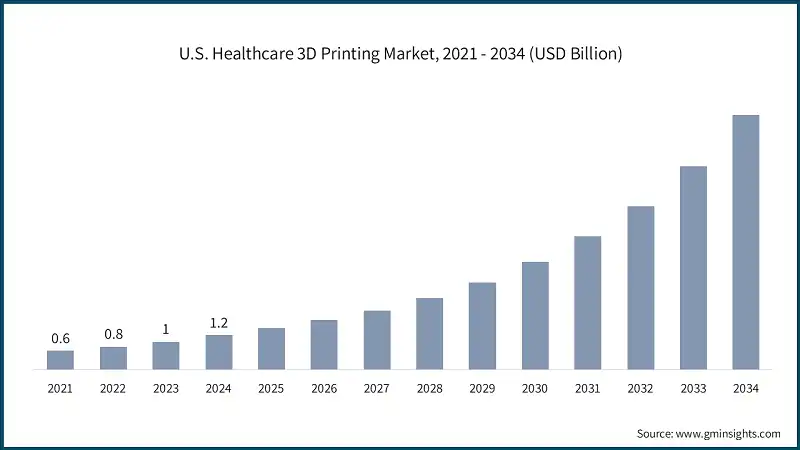
- The U.S. market was valued at USD 648.8 million and USD 787.7 million in 2021 and 2022, respectively. The market size reached USD 1.2 billion in 2024, growing from USD 960 million in 2023, and is anticipated to grow at a CAGR of 22.3% between 2025 and 2034.
- North America leads the healthcare 3D printing landscape due to its advanced medical infrastructure and strong emphasis on innovation. The region benefits from a well-established ecosystem of research institutions, medical device manufacturers, and regulatory bodies that support the development and integration of 3D printing technologies. Hospitals and clinics across the U.S. and Canada are increasingly adopting 3D printing for applications such as patient-specific implants, prosthetics, and anatomical models used in surgical planning.
- The region also enjoys a high level of collaboration between academia and industry, which accelerates the commercialization of new technologies. Regulatory agencies like the FDA have created pathways for approving 3D-printed medical devices, fostering trust and adoption. Additionally, the presence of major players in the 3D printing and healthcare sectors contributes to continuous innovation and expansion of applications, including bioprinting and regenerative medicine.
Europe Healthcare 3D Printing Market
Europe market accounted for USD 854.2 million in 2024 and is anticipated to show lucrative growth over the forecast period.
- Countries such as Germany, France, and the UK are at the forefront of integrating 3D printing into clinical workflows, particularly in orthopedics, dental care, and reconstructive surgery. The region’s emphasis on precision and quality aligns well with the capabilities of 3D printing, making it a valuable tool for producing customized medical solutions.
- European governments and institutions actively support research and development in this field, with funding initiatives and collaborative projects aimed at advancing medical applications. The regulatory environment, while stringent, provides clear guidelines that encourage safe and effective use of 3D-printed devices. As a result, Europe continues to see growing adoption across hospitals, labs, and academic centers, with increasing interest in bioprinting and tissue engineering.
Asia Pacific Healthcare 3D Printing Market
The Asia Pacific market is anticipated to grow at a CAGR of 24.5% during the analysis timeframe.
- Asia Pacific is emerging as a major hub for healthcare 3D printing, fueled by rising healthcare demands and technological advancement. Countries like China, Japan, and India are investing heavily in medical innovation, with 3D printing being recognized as a transformative tool for improving patient outcomes. The region’s large and diverse population creates a strong need for personalized medical solutions, which 3D printing is well-suited to deliver.
- Local manufacturing capabilities and growing expertise in additive technologies are helping reduce costs and improve accessibility. Governments and private institutions are supporting pilot projects and startups focused on medical 3D printing, especially in areas like prosthetics, dental applications, and surgical aids. As awareness and technical proficiency increase, Asia Pacific is expected to play a pivotal role in shaping the future of healthcare through additive manufacturing.
Latin America Healthcare 3D Printing Market
The Latin America market is experiencing robust growth over the analysis timeframe.
- Countries in the region are exploring the use of 3D printing for producing implants, surgical models, and prosthetics tailored to individual patients. Technology is particularly valuable in regions with limited access to specialized medical devices, offering a cost-effective and customizable alternative.
- Academic institutions and medical centers are beginning to collaborate on research and development initiatives, fostering innovation and skill development. While infrastructure and funding challenges persist, the region is showing promising signs of growth through public-private partnerships and increased awareness of the benefits of 3D printing. As adoption expands, Latin America is poised to become a more active participant in the global healthcare 3D printing ecosystem.
Middle East & Africa Healthcare 3D Printing Market
The Middle East & Africa (MEA) market is experiencing notable growth over the analysis timeframe.
- The region is 3D printing into healthcare for applications such as dental prosthetics, orthopedic implants, and surgical planning tools. These innovations are helping improve patient care and reduce dependency on imported medical devices. Government initiatives and strategic collaborations with global technology providers are supporting the growth of this sector.
Healthcare 3D Printing Market Share
Leading industry players such as materialize, Stratasys, 3D Systems, formlabs, and RENISHAW hold around 20% of the market share in the fragmented market. These companies maintain their leadership through comprehensive product portfolios, advanced printing technologies, and strong partnerships with hospitals, research institutions, and medical device manufacturers. Their strategic focus on innovation, regulatory compliance, and integration of biocompatible materials has enabled them to stay ahead in a rapidly evolving market. Expansion into emerging markets and investment in bioprinting and regenerative medicine further reinforce their competitive positioning.
Other notable players in the market include Axial3D, eos, OPM, and ExOne, each contributing to the sector’s dynamic and fragmented nature. These companies are actively involved in developing specialized applications such as tissue engineering, dental prosthetics, and surgical planning tools. The competitive landscape is shaped by continuous technological advancements, growing demand for personalized medical solutions, and increasing adoption of point-of-care 3D printing. As the industry matures, collaborations between technology providers and healthcare institutions are expected to play a key role in driving innovation and expanding the scope of 3D printing in clinical settings.
Healthcare 3D Printing Market Companies
A few of the prominent players operating in the healthcare 3D printing industry include:
- 3D Systems
- Axial3D
- eos
- ETEC
- ExOne
- formlabs
- KONICA MINOLTA
- materialise
- nanoscribe
- OPM
- PROTOLABS
- RENISHAW
- stratasys
- stratasys
Stratasys is a pioneer in healthcare 3D printing, known for its precision, reliability, and innovation across a wide range of medical applications. The company offers anatomically accurate, patient-specific models that enhance surgical planning, medical education, and diagnostic accuracy. Its advanced printers, such as the J5 MediJet and Digital Anatomy series, support multi-material and multicolor printing, enabling lifelike replicas of human tissue and organs.
- 3D Systems
3D Systems is a global leader in healthcare 3D printing, offering end-to-end solutions that span surgical planning, patient-specific implants, and medical device manufacturing. Its VSP (Virtual Surgical Planning) platform integrates digital workflows with additive manufacturing to deliver customized surgical guides and anatomical models that improve clinical precision and patient care.
- formlabs
Formlabs has carved a niche in healthcare 3D printing by offering accessible, high-performance solutions tailored to hospitals, clinics, and medical device firms. Its printers are designed for rapid, precise production of patient-specific models, surgical guides, and custom orthotics. The company’s intuitive software and validated workflows make it easy for healthcare providers to adopt 3D printing without specialized training.
Healthcare 3D Printing Market Report Attributes
| Key Takeaway | Details |
|---|---|
| Market Size & Growth | |
| Base Year | 2024 |
| Market Size in 2024 | USD 3 Billion |
| Market Size in 2025 | USD 3.6 Billion |
| Forecast Period 2025 - 2034 CAGR | 23.1% |
| Market Size in 2034 | USD 23.4 Billion |
| Key Market Trends | |
| Drivers | Impact |
| Rising demand for custom implants | Drives adoption of patient-specific solutions, improving surgical outcomes. |
| Increasing R&D investments from manufacturers and institutions | Accelerates innovation in bioprinting and medical-grade materials. |
| Extending clinical applications | Expands use in orthopedics, dentistry, and regenerative medicine. |
| Technological advancements | Enhances precision, speed, and integration with digital health systems. |
| Pitfalls & Challenges | Impact |
| Lack of skilled professionals | Limits widespread adoption and operational efficiency in clinical settings. |
| High price associated with 3D printing | Restricts access for smaller healthcare providers and emerging markets. |
| Opportunities: | Impact |
| Rising adoption in emerging markets | Opens new revenue streams and expands global healthcare access. |
| AI & simulation integration | Enables smarter design, predictive modeling, and personalized treatment planning. |
| Market Leaders (2024) | |
| Market Leaders |
~6% market share |
| Top Players |
Collective market share in 2024 is ~20% |
| Competitive Edge |
|
| Regional Insights | |
| Largest Market | North America |
| Fastest growing market | Asia Pacific |
| Emerging countries | China, Japan, India, Brazil, and South Africa |
| Future outlook |
|
What are the growth opportunities in this market?
Healthcare 3D printing Industry News:
- In April 2024, 3D Systems announced the Food and Drug Administration (FDA) had provided 510(k) clearance for its 3D-printed, patient-specific cranial implant solution, VSP PEEK Cranial Implant, which can produce patient-specific cranial implants with up to 85% less material than similar implants and significantly reduce cost. This approval increased the company’s competitiveness in the market.
The healthcare 3D printing market research report includes an in-depth coverage of the industry with estimates and forecasts in terms of revenue in USD Million from 2021 - 2034 for the following segments:
Market, By Component
- Equipment
- 3D printers
- 3D bioprinters
- Materials
- Plastics
- Thermoplastics
- Photopolymers
- Metals and metal alloys
- Biomaterials
- Ceramics
- Paper
- Wax
- Other materials
- Plastics
- Services & software
Market, By Technology
- Stereolithography
- Fused deposition modelling (FDM)
- Selective laser sintering (SLS)
- Metal printing
- Other technologies
Market, By Application
- Prosthetics and implants
- Dental
- Bioprinting
- Tissue and organ generation
- Other applications
Market, By End Use
- Hospitals & surgical centers
- Dental clinics
- Medical device manufacturers
- Other end use
The above information is provided for the following regions and countries:
- North America
- U.S.
- Canada
- Europe
- Germany
- UK
- France
- Italy
- Spain
- Netherlands
- Asia Pacific
- China
- Japan
- India
- Australia
- South Korea
- Latin America
- Brazil
- Mexico
- Argentina
- Middle East and Africa
- South Africa
- Saudi Arabia
- UAE
Frequently Asked Question(FAQ) :
What is the market size of the healthcare 3D printing market in 2024?
The market size was USD 3 billion in 2024, driven by increasing demand for personalized implants, growing R&D investments, and expansion of clinical applications.
What is the projected value of the healthcare 3D printing industry by 2034?
The market is expected to reach USD 23.4 billion by 2034, growing at a CAGR of 23.1% due to technological advancements, biocompatible materials, and integration with digital health systems.
What is the estimated market size of the healthcare 3D printing market in 2025?
The market is projected to reach USD 3.6 billion in 2025, reflecting strong early momentum supported by rapid adoption across hospitals, dental clinics, and medical device manufacturers.
Which component segment dominated the market in 2024?
The materials segment dominated the market with 54.8% share in 2024, attributed to the high demand for biocompatible polymers, metals, and biomaterials used in custom implants and bioprinted tissues.
What was the valuation of the equipment segment in 2024?
The equipment segment accounted for 29.3% market share in 2024 and is expected to exceed USD 7 billion by 2034, driven by adoption of advanced 3D printers and bioprinters in hospitals and research institutions.
Which technology led the healthcare 3D printing market in 2024?
Stereolithography (SLA) dominated the market in 2024 and is projected to grow at a CAGR of 22.9% during the forecast period due to its high precision and suitability for intricate medical applications.
Which application segment generated the largest revenue in 2024?
Prosthetics and implants accounted for 35.5% of the market in 2024, supported by the rising need for patient-specific solutions and advancements in biocompatible materials.
Which end-use segment dominated the market in 2024?
Hospitals and surgical centers led the market with 40.7% share in 2024, valued for their increasing use of in-house 3D printing labs to produce surgical guides and patient-specific models.
Which region leads the healthcare 3D printing industry?
North America dominated with 42% share (USD 1.2 billion in 2024), supported by advanced healthcare infrastructure, regulatory approvals for 3D-printed devices, and strong R&D investment.
Which region is expected to be the fastest-growing market through 2034?
The Asia Pacific region is projected to grow at a CAGR of 24.5%, fueled by increasing healthcare expenditure, local manufacturing initiatives, and government support for medical innovation.
Who are the key players in the healthcare 3D printing market?
Key players include 3D Systems, Stratasys, Materialise, Renishaw, Formlabs, Axial3D, EOS, OPM, ExOne, and Protolabs.
Healthcare 3D Printing Market Scope
Related Reports