Summary
Table of Content

Health-Monitoring Car Seat Market
Get a free sample of this report
Form submitted successfully!
Error submitting form. Please try again.
Thank you!
Your inquiry has been received. Our team will reach out to you with the required details via email. To ensure that you don't miss their response, kindly remember to check your spam folder as well!
Request Sectional Data
Thank you!
Your inquiry has been received. Our team will reach out to you with the required details via email. To ensure that you don't miss their response, kindly remember to check your spam folder as well!
Form submitted successfully!
Error submitting form. Please try again.
Health-Monitoring Car Seat Market Size
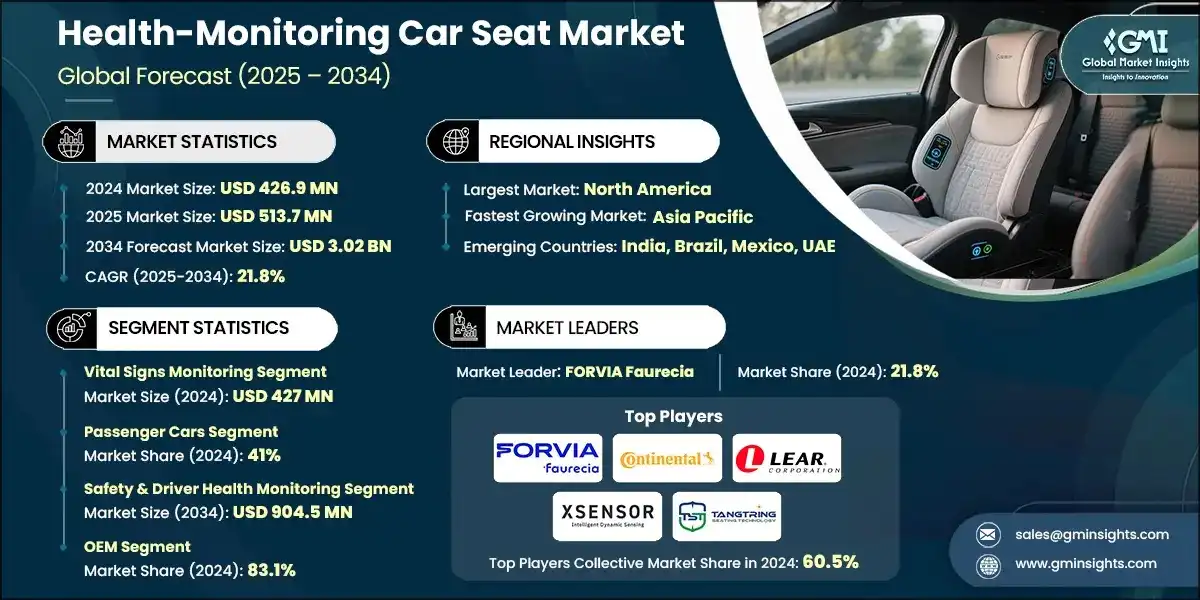
The global health-monitoring car seat market was estimated at USD 426.9 million in 2024. The market is expected to grow from USD 513.7 million in 2025 to USD 3.02 billion in 2034, to a CAGR of 21.8% according to latest report published by Global Market Insights Inc.
Health-Monitoring Car Seat Market Key Takeaways
Market Size & Growth
- 2024 Market Size: USD 426.9 Million
- 2025 Market Size: USD 513.7 Million
- 2034 Forecast Market Size: USD 3.02 Billion
- CAGR (2025–2034): 21.8%
Key Market Drivers
- Rising Health Awareness.
- Technological Advancements in Sensors and AI.
- Regulatory and Safety Standards.
- Connected and Autonomous Vehicle Growth.
- Increasing Consumer Demand for Personalized In-Cabin Experience.
Challenges
- High Implementation Cost.
- Data Privacy and Security Concerns.
Opportunity
- Integration with Wearables and Health Apps.
- Expansion in Electric and Premium Vehicles.
- AI-Driven Predictive Health Analytics.
- Emerging Markets and Urbanization.
Key Players
- Market Leader: FORVIA Faurecia led with over 21.8% market share in 2024.
- Leading Players: Top 5 players in this market include FORVIA Faurecia, Continental AG, Lear, XSENSOR Technology, Tangtring Seating Technology, which collectively held a market share of 60.5% in 2024.
Get Market Insights & Growth Opportunities
The heightened interest by consumers in health and wellness is increasing the growth of automotive smart seats with health technologies. Consumers are showing more interest in safety features that allow driving with better monitoring of vital signs, stress, or fatigue to promote safer travel, preventive health efforts, and motivate automotive manufacturers to include biometric sensors and AI-enabled wellness systems.
Rapid advancements in sensors, wearable electrodes, and artificial intelligence now provide accurate and direct measurements of the occupants' vitals and behaviors in real-time. This technology enables automotive seats to reliably sense heart rate, respiration, and posture, which will create predictive health alerts, optimize comfort, and increase driving safety. In volume terms, the market is projected to expand over 322K units in 2024 to 856K units by 2030.
As vehicles become more connected and autonomous, health monitoring inside the cabin will become increasingly important. Smart seating with biometric sensors enables continuous monitoring of occupants' health and wellbeing to improve safety, promote a proactive response, and complement autonomous driving applications to ensure driver preparedness and occupant wellbeing.
In North America, increasing regulations for safety and wellness advocate for vehicle attendance to monitor levels of health. Governments and agencies are looking for developments in those efforts to promote technologies that can eliminate the monitoring of driver levels of alertness, vital signs, and effective driving posture; and to challenge automotive manufacturers to include more integrated sensor systems to better monitor safety and health for occupants. All of which contributes to meeting safety and health legislation.
The rapid growth of connected and autonomous vehicles in the Asia-Pacific region drives the rise of smart seats with Features. The increase in urbanization, strong government support for innovation in the automotive sector, and consumer demand for wellness and comfort lead to biometrics sensors, AI analytics, and adaptive systems in vehicle seating quickly being integrated.
In April 2024, NOVELDA announced its X7 ultra-wideband radar sensor that is designed to detect seat occupancy and monitor a passenger's vital signs, such as heartbeat and respiration, through seat upholstery. This represents the next step in smart seat technology by facilitating effective non-intrusive health monitoring from inside a seat and for better occupant safety and wellness in vehicles.
To get key market trends
Health-Monitoring Car Seat Market Trends
Modern intelligent seats come with capacitive ECG, ballistocardiograph, thermal and pressure sensors to capture vitals and monitor posture. Studies indicate that seat-based ECG devices have a reliability ranging from 85–93%, supporting their use in commercial applications. An example of multi-modal monitoring can be seen in Continental’s 2024 “Invisible Biometrics Display”. It is projected that mass market adoption will occur between 2024 and 2030, starting with the premium vehicle segment, followed by the mid-market segments.
Machine learning is changing how datasets from sensors can be used as health-based insights (i.e., highlighting fatigue, stress, and medical anomalies). Shen AI’s rPPG SDK tracks 30+ metrics with a margin of error below 0.5 bpm. We anticipate predictive health modeling to demonstrate continual evolution between 2024-2030, as driver alertness detection improvements could range between 15-20%. There could also be a 25–30% reduction in stale false alerts based on premium-level neural network-based personalized analysis.
Smart seating provides seamless integration with digital health platforms, telematics, and insurance networks for continuous health monitoring and emergency medical assistance coordination. Hyundai Mobis features (in development) an ability to monitor health information with four sensors linked to telematics. Implementation will occur within 2024-2032, generating a new source of OEM revenue, lowering insurance premiums, and enhancing emergency medical response with automatic alerting of medical history and connection to wellness platforms.
Collectively, these trends provide a value proposition to vehicle ownership that transcends passenger comfort and safety and into the total wellness of occupants. While R&D remains high in complexity, the integration of wellness into every experience offers an opportunity for premium pricing, new business models for automakers and technology suppliers, and ultimately enhanced growth of the vehicle market through the expansion of integrated health platforms that allow for personalization and technology differentiation through advertising and other sources of monetizing through collected health information.
Health-Monitoring Car Seat Market Analysis
Learn more about the key segments shaping this market
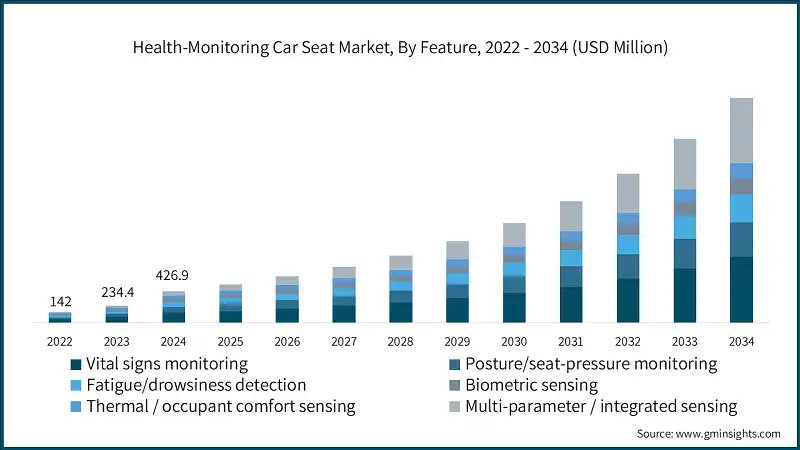
Based on feature, the health-monitoring car seat market is segmented as vital signs monitoring, posture/seat-pressure monitoring, fatigue/drowsiness detection, biometric sensing, thermal/occupant comfort sensing, multi-parameter/integrated sensing. The vital signs monitoring segment is dominant and is estimated to hold a revenue of around USD 427 million in 2024 and grow at a CAGR of 21.3% from 2025 to 2034.
- Vital signs monitoring leads the segment, where heart rate, blood pressure, and respiration data are monitored via the use of capacitive ECG sensors embedded in the seat. This segment offers a high degree of consistent and reliable signal, primarily aimed at the commercial fleet and high-end vehicle supplier markets comprised of a regulatory focus on driver health and a rising consumer awareness component. There is also a standardization by the mid-range of vehicle market by 2027 - 2028.
- Multi-parameter integrated sensing is the fastest growing segment. Multi-parameter integrated sensing will integrate vital signs monitoring, posture, biometric identification, and thermal detection into a single platform. Continental's invisible biometrics display is an example of multi-parameter integrated sensing, applied in the premium vehicle market as the first introduction, incorporating artificial intelligence and advanced analytics, with the expectation of extending across the mainstream vehicle market and further solidifying multi-parameter integrated sensing into a vehicle segment by 2030 as consumers' demand for ingestible in-car health platforms increases.
- Posture and seat-pressure monitoring pertains to ergonomic health, featuring connected pressure sensors and algorithms for postural analysis to provide real-time feedback and adjust seating automatically. Settings apply to long-haul comfort or premium passenger wellness and are anchored by increasing awareness of musculoskeletal health and literacy, even in regard to related regulations for promoting occupational wellness in commercial vehicles.
- Fatigue and drowsiness detection is found in seat-based sensors that integrate into larger vehicle driver monitoring systems and use micro-movements and heart rate variability for analysis. This thematic area supports regulatory emphasis on pre-crash prevention, improves alert systems, and activates emergency response, all with the goal of improving driver safety as it relates to fatigue and drowsiness while the vehicle is in operation.
Learn more about the key segments shaping this market
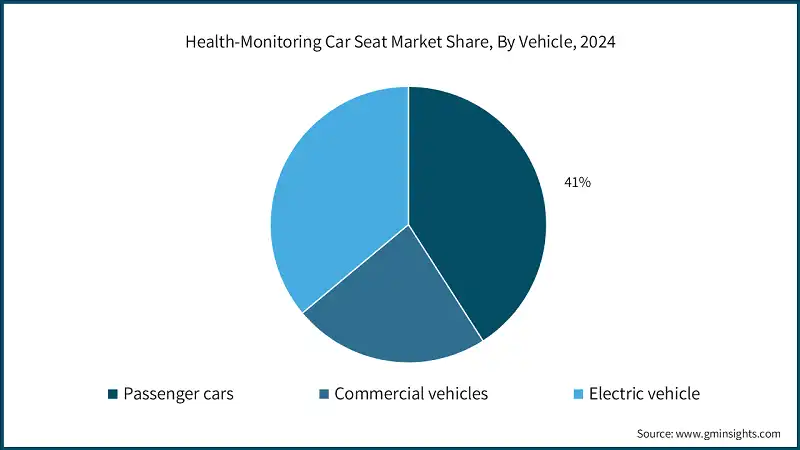
Based on vehicle, the health-monitoring car seat market is fragmented into passenger cars, commercial vehicles, electric vehicle. The passenger cars segment is the dominant segment and is estimated to hold a share of 41% in 2024.
- Health-monitoring systems, measuring heart rate, posture, and overall fatigue, are being incorporated into embedded seat technology into SUVs and sedans increasingly. Seat systems enabled by artificial intelligence facilitate in-the-moment alerts and comfort customization for the occupant.
- Luxury SUVs are at the forefront of multi-parameter integration efforts, while sedans look to incorporate essential vital sign monitoring some start to fit, if not conform to some modest degree. Such adoption will be referencing points for passengers, while adoption of commercial vehicles will be methods of compliance to regulations and for premium occluded operators’ vehicles and general differentiation among consumer, for safety awareness and compliance preparation.
- Light, medium, and heavy commercial vehicles are beginning to utilize smart seats to measure the fatigue and stress of a driver during a prolonged operation. Vital-sign and pressure sensors feed fleet telematics for regulatory compliance and efficiency in operations. The commercial vehicle adoption rate is highest in long-haul trucks (HCVs), followed in some measures by delivery vans (LCVs), and regional vehicles (MCVs).
- Biometric and thermal sensors in seats are being integrated in battery, plug-in hybrid and fuel-cell EVs to monitor health-impacting metrics continuously. The electrical architecture of EVs facilitates the operation of the various seat-mounted sensors without interruption, thus supporting preemptive wellness alerts and adaptable comfort. The premium segments for BEVs and FCEVs lead to adoption while the PHEVs are focused on the energy-efficiency level of powering the sensors.
Based on application, the health-monitoring car seat market is classified into safety & driver health monitoring, comfort & ergonomics enhancement, wellness / preventive health, fleet driver monitoring and others. The safety & driver health monitoring is estimated to hold a share of 31.6% in 2024 and reach market revenue of USD 904.5 million by 2034.
- Sophisticated safety trends include real-time biometric monitoring systems that monitor fatigue, stress, and bio-signs in the seats of vehicles. With capacitive ECG and micro-movement sensors in conjunction with the camera and steering wheels, the vehicle can act on the data to intervene, alert, or respond in emergencies. This is driven by regulatory emphasis to increase occupant safety and reduce crashes with human error.
- Automotive focus on ergonomics of seats preferred distributed pressure sensors, adaptive posture systems and bolsters compromising constant adjustments, and acted in real-time to optimize comfort and reduce musculoskeletal strain of long drives. This technology enhances comfort in sitting in a variety of settings while optimizing thermal and vibration features to enhance personalized comfort in both high-end and mainstream passenger vehicles.
- The use of seat-integrated sensors in fleet vehicles facilitates the measurement of driver fatigue, vital signs, and posture in long-haul trucks and buses. In conjunction with telematics technology, the data collected ensures regulatory compliance, promotes the safety of operations, and provides performance analytics to reduce accident risks and manage fleet driver wellness across all commercial vehicle operations.
- Emerging trends include identification of seating occupants, personalized climate control, and adjustable seat ergonomics/fit. Biometric and thermal sensors collect physiological data to elevate comfort, optimize energy consumption and support any differentiation in luxury. Connected vehicle systems facilitate the integration of intelligent cabin ecosystem applications that extend beyond the functionality of comfort and safety.
Based on sales channel, the health-monitoring car seat market is bifurcated into OEM and aftermarket. The OEM held a market share of 83.1% in 2024 and is anticipated to grow at a CAGR of 21.6% from 2025 to 2034.
- OEMs are also currently developing multi-parameter smart seats that enable them to measure vital signs, posture and thermal comfort with sensors. The capabilities of AI will make it possible to predict capabilities in wellness, fatigue, and personalized adjustments, mostly in premium and EV segments targeted towards occupant health and in-cabin experience.
- Manufacturers also are prepared to provide modular and scalable seating designs using sustainable materials and economical solutions to incorporate health-monitoring systems to all vehicle categories to increase differentiation and high-end tactics.
- Aftermarket suppliers have also taken up the mantra of retrofitting biometric kits to provide real-time monitoring of heart rate, respiration, posture, and fatigue, allowing legacy vehicles the same breadth of health-monitoring capabilities that are pre-installed in the vehicles by the OEM.
- Connected wellness devices have connected sensors to apps and telematics to provide real-time personalized health notes, emergency alerts, and fleet monitoring. This avenue expands the functionality of the smart seat to other legacy vehicles and commercial fleets.
Looking for region specific data?
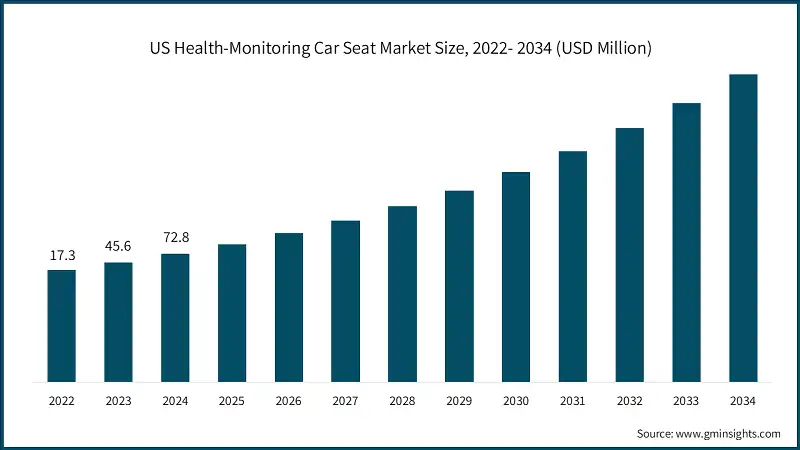
The health-monitoring car seat market in US is expected to hold a share of 85.4% in 2024 and was valued as USD 72.8 million.
- US is the leading North American market due to a large vehicle population that creates significant OEM integration opportunities and the installation of retrofit aftermarket products. Both passenger and commercial vehicle segments exhibit early adoption of health-monitoring technologies, which is further supported by increasing consumer demand for in-cabin wellness solutions.
- Federal regulations, such as FMVSS and guidelines published by the NHTSA, require safety, diagnostic protocols, and cybersecurity standards for equipment used in vehicles. In this context, regulatory frameworks addressing functional safety, electronic control systems, and occupant monitoring directly encourage vehicle OEMs to adopt and develop smart seat health monitoring technologies in passenger and commercial vehicles-.
- US automakers are leading the way in integrating health-monitoring technologies in vehicles, especially in the premium vehicle segment. Tesla's wellness-monitoring technology and several partnerships developed between traditional OEMs and health technology companies underscore commitment to health monitoring in high-end vehicles. Pulling on the regulatory framework, the health factors for commercial drivers provide a compelling reason for raising health monitoring technologies in a fleet-based context while reassuring the environment of occupant health and safety in the automotive ecosystem.
North America health-monitoring car seat market is estimated to grow at a CAGR of 15.9% from 2025 to 2034.
- North America is a technologically developed and mature market with a high adoption rate of premium health-monitoring smart seats. Consumers have a strong preference for systems with many rich features, illustrating their willingness to pay for advanced technology. The North American market heavily supports high-value integrations instead of basic implementations, with regards to both passenger and commercial vehicle sectors.
- The NHTSA is responsible for administering vehicle safety and sets standards for the performance of electronic systems, compliance with ISO 26262 functional safety, and guidance on cybersecurity with the NIST. There is active, ongoing research on driver monitoring systems examining the efficacy of health-monitoring systems across a wide demographic base to ensure that smart seat systems in North America provide rigorous performance against safety, functional, and data security standards.
- North America taps into a mature automotive industry, telematics, and healthcare integration as a pioneering ground for integration of smart seat health-monitoring. OEMs such as Tesla, GM, and Ford lead the way for implementation of their health-monitoring seats in the premium segment. Partnerships with insurance companies and telematics-based programs further supporting the adoption of health-monitoring systems that promote occupant wellness, safety, and predictive health analytics in automotive vehicles.
The health-monitoring car seat market in Europe is expected to reach USD 896.8 million by 2034.
- Europe is experiencing the highest growth of any region bolstered by strict safety requirements, advanced automotive technology and consumer preferences for premium vehicles with health-monitoring seats. The market is weighed up towards more advanced, feature-rich systems, advancing adoption in both passenger and commercial markets, positioning Europe as a technology-leading region in smart seat development.
- Euro NCAP has determined occupant monitoring standards through its Safe Driving Occupant Monitoring Protocol, which rewards use of a seatbelt, occupant classification, and occupant presence. Such standards encourage OEM deployment of direct sensing technologies into vehicles and create a case for the integration of health-monitoring systems, all while standardizing occupant privacy and safety as a regional growth area.
- In addition to regulations like the Driver Drowsiness and Attention Warning (DDAW) and Advanced Driver Distraction Warning (ADDW), European Union GDPR and data privacy regulations (EU – General Data Protection Regulation) dictate both safety policy and data privacy rights. Compliance with data privacy concerns ensures that OEMs implement safety-related health monitoring sensors and systems into the system design of vehicles across Europe to meet health-, distraction-, and safety-focused standards.
The health-monitoring car seat market in Germany is expected to hold 33.6% market share in 2024 and experience significant and promising growth from 2025 to 2034.
- Germany leads smart seat health monitoring in Europe due to its position as an automotive manufacturing center. The country hosts the headquarters of BMW, Mercedes-Benz, Audi and Volkswagen allowing for direct technology integration into original equipment manufacturer (OEM) products, which supports the development of premium vehicles and occupant health-monitoring systems in both passenger and commercial vehicle segments.
- German OEMs have established global benchmarks for health-monitoring in premium automotive seats. BMW's personalization systems, for instance, are complemented with the Mercedes-Benz MBUX and Audi's own driver assistance systems that integrate a number of occupant wellness technologies. Alongside these, several tier 1 suppliers, including Continental, Bosch, and ZF Friedrichshafen, actively contribute to seat health-monitoring R&D to bolster Germany's position in smart seat technology.
- Germany has also implemented Industry 4.0 programs, with government support, to facilitate advanced manufacturing, IoT-connections, and digital transformation (e.g., automation and artificial intelligence). These advances help to accelerate the introduction of smart seat health-monitoring systems supporting both safety and overall well-being, while existing and forthcoming infrastructure in data protection provides guidelines for product development to ensure compliance with government standards that will shape global strategies for automotive safety and technology.
The health-monitoring car seat market in Asia Pacific held over 30.9% of the revenue share in 2024, growing over 25% CAGR from 2025 to 2034.
- The smart seat health-monitoring market will have the largest and fastest growth in the Asia Pacific region, primarily due to the high scale of automotive manufacturing, rising consumer acceptance, and favorable government policies. The region is leading in both value and volume and has rapidly adopted advanced technologies focused on occupant wellness into passenger vehicles and commercial vehicles.
- This region has the highest concentration of automotive manufacturing capabilities throughout countries with industry leaders like China, India, Japan, and South Korea. These countries have developed cost-effective means to manufacture sensors and integrate health monitoring smart seats into vehicles. Additionally, government initiatives such as Made in China 2025 and Japan’s Society 5.0, help support low-cost, high-volume adoption of health-monitoring smart seats.
- In South Korea and Japan, it is mandatory for automakers to implement health-monitoring systems into vehicles to enhance driver safety. China provides national standards for all vehicle and transport types, which describes the technical requirements for performance-based attention monitoring. Plus, government regulations in the region facilitate connected vehicles, as well as information-sharing and safe deployment of smart seat health monitoring systems and technologies.
The health-monitoring car seat market in China is estimated to hold market revenue of USD 55.8 million in 2024 and is expected to experience significant and promising growth from 2025 to 2034.
- China leads the smart seat health-monitoring market in the Asia Pacific region because of supportive government policies, growing battery electric and plug-in hybrid vehicles, and connected vehicle programs. Rapid growth and supportive policy environments allow innovative occupant wellness technologies to be integrated with the passenger experience specifically through the premium electric vehicle segment making China an important global market leader.
- China's New Energy Vehicle (NEV) strategy "Made in China 2025" combined with smart city initiatives, encourages advanced vehicle technology and connected mobility solutions. Additionally, the policies create incentive structures to enable the rapid deployment, adoption, and development of in-cabin health-monitoring systems that will connect automotive interiors to urban infrastructure, healthcare systems, and technology development programs that will enable rapid deployment and innovation of kid seat occupant wellness technologies.
- Many major manufacturers such as BYD, NIO, XPeng, and Li Auto use health-monitoring systems in their premium EVs to provide differentiation from competitors. China is also able to deploy, innovate, and scale smart seat occupant wellness solutions faster than competitors due to its strong electronics manufacturing industry and supply chain. As a result, the use of occupant wellness systems such as health-monitoring improves vehicle comfort while also improving vehicle safety.
The Latin America health-monitoring car seat market is estimated to USD 123.4 million by 2034 and is projected to grow at a remarkable CAGR.
- Latin America shows moderate growth in smart seat health monitoring by offering needed features to account for cost and infrastructure challenges. As economic conditions improve the market will grow from both original equipment manufacturer and aftermarket retrofits with the potential for growth in both passenger and commercial vehicles.
- Brazil leads regional adoption supported by automotive production and innovation programs such as Rota 2030. Mexico and Argentina provide cost incentives and funding in competitiveness leveraging the adoption of local technologies. These increases strengthen manufacturing and facilitate OEM investment and adoption of health-monitoring systems to be integrated incrementally into passenger and commercial vehicles across the region.
- The region focuses on developing cost-effective, trusted health monitoring systems that range from vital signs tracking to SOS and driver fatigue detection, rather than multi-parameter platforms. The aftermarket solutions and connected vehicle applications present growth opportunities and are backed by telecommunications infrastructure improvement occurs over time and in-cabin health and safety features become more pervasive.
The MEA health-monitoring car seat market is projected to grow at a CAGR of 21.3% and held a market share of around 4% in 2024.
- The market for smart seat health monitoring in the Middle East and Africa is steadily progressing, led by the UAE as consumers in the region adopt premium vehicles and advanced infrastructure supports market implementation. Market growth and expansion focus on luxury segments, as consumer purchasing power is comparatively high. The market can support both integration into OEM products and aftermarket retrofit installations with improved health monitoring into passenger and commercial vehicles.
- Saudi Arabia's Vision 2030 and the UAE government specific smart city initiatives for Example Dubai could assist in transforming and develop the automotive sector, support the connected vehicle adoption, and endorse the implementation of health monitoring system in vehicles. The government IVA policies promoting local content requirements, provide investors or OEM plants with manufacturing incentives, and encourage infrastructure development. These actions could motivate or attract OEMs to invest in local operations and fulfill consumer requirements associated with adopting smart seat technologies for occupants’ wellness in existing and future premium and luxury segment vehicles.
- The region offers an emphasis on luxury and premium vehicle applications associated with consumer purchasing power compared to other segments of the vehicle market in the region. Following this theme, extreme climates will drive local consumers to consider and adopt thermal comfort and specialty health-monitoring sensors. The aftermarket for retrofits is additionally potential for smart seat technologies for existing vehicles to offer some level of upgrade and possible connected wellness applications to the market.
Health-Monitoring Car Seat Market Share
- The top 7 companies in the health-monitoring car seat industry are Continental, FORVIA Faurecia, Lear, NOVELDA, Tangtring Seating Technology, XSENSOR Technology, Yanfeng contributing around 14.4% of the market in 2024.
- Continental is the leading company in the global smart seat health-monitoring market based on its strong integration of advanced technology and OEM relationships and the outcomes associated with premium customers. The “Invisible Biometrics Sensing Display” is a great model of seamless integration of sensors classified under the health-monitoring system. Its diverse collection of sensors, software, and user interfaces solidify its supremacy and supports sophisticated occupant wellness systems geared towards premium segment vehicles.
- Faurecia has a significant share of the market by aligning health-monitoring sensor integration with its traditional knowledge of advanced seating. The company is focused on providing a wellness system in vehicles marketed at premium consumers and seeks to deliver a seamless user experience while integrating a luxurious interior. Its market strategy considers its seating manufacturing leadership position as well as its technological capabilities stemming capability and sophistication that add value in managing occupant wellness prototype monitoring systems in automobiles.
- Lear is integrating health-monitoring technology into its automotive seating product portfolio by maximizing its supplier capabilities and experience driven by automotive seating manufacturing. Lear has reinforced OEM relationships and cost-to-market manufacturing straits which facilitate a consolidated focus on adapting smart seat wellness prototypes within the AE and mid-market customers as a driver and passenger wellness monitoring system.
- Tangtring Seating Technology utilizes biometric and ergonomic data to monitor and adjust smart seats in real-time through alterations of bolsters, lumbar support, and posture. The company's pneumatic comfort system leverages China's manufacturing scale to target premium electric vehicles and connected vehicles, by addressing occupant wellness via cost-effective manufacturing and rapid technology deployment through the Asia-Pacific region.
- NOVELDA designs ultra-wideband radar sensors for in-cabin monitoring, which can determine the presence of a child, track vital signs, indicate occupancy, and recognize gestures. The company's X7 sensor reduces the number of sensors needed for OEM integration into a smart seat, lowers the $ costs for the automotive OEM, and a multi-functional occupant monitoring platform across passenger vehicles, enabling enhanced safety, comfort, and predictive wellness applications.
Health-Monitoring Car Seat Market Companies
Major players operating in the health-monitoring car seat industry are:
- Continental AG
- FORVIA Faurecia
- Lear
- NOVELDA
- Robert Bosch GmbH
- Tangtring Seating Technology
- Visteon Corporation
- XSENSOR Technology
- Yanfeng
- ZF Friedrichshafen AG
- Continental AG is a leader in automotive health-monitoring solutions, combining sensors, software and system platforms, and their Invisible Biometrics Sensing Display is an example of non-intrusive monitoring of occupants. Their benefits include being able to offer health monitoring as an extension of their platform and in more vehicles while maintaining cost-effectiveness. A key strength for Continental AG is their manufacturing capabilities across the globe and ability to cover the entire technology, integration and market delivery via their relationships with OEMs.
- Faurecia combines its knowledge of seating and systems with current health-monitoring integration, allowing their manufacturers to create luxury interiors seamlessly while they manage scalable manufacturing. For example, Faurecia launched strategic partnerships with an existing health technology company and are developing well-being ecosystems for a vehicle and driver to create an experience that maximizes occupant comfort, preventive health insights, and wellness solutions in-cabin with customizable data that goes beyond basic monitoring capabilities and is offered on premium to mainstream vehicles.
- Lear integrates health-monitoring sensors into its automotive seating, leveraging manufacturing expertise and scalable, cost-effective solutions. The company emphasizes selected OEM partnerships to manufacture smart seats with fatigue detection, tracking of vital signs, and adjustable ergonomic features based on occupant preference. Selected strategic initiatives target the premium and mid-market vehicle segments with seats that increase occupant wellness and comfort, while also increasing safety.
- NOVELDA focuses on ultra-wideband radar sensors used for in-cabin monitoring, providing key inputs for child presence detection, tracking of vital signs, occupancy detection, and gesture recognition. The company's X7 sensor provides functional monitoring for several different applications with minimal sensor count. Strategic initiatives include OEM integration to support the implementation of smart seats to improve safety for occupants, offer predictive wellness (active monitoring), and provide cost-effective applications for passenger vehicle segments.
- Tangtring also creates adaptive smart seats that combine both biometric and pneumatic seats and adjustable posture seats on the choice of the occupant. The company will utilize its experience in the development of comfort systems and Chinese production capacities to continue to include health monitoring solutions in high-end EVs and other connective cars. Its strategic plans focus on the occupant welfare and the ergonomics optimization that focuses on the rapid adoption of the new regional technology in the Asia Pacific market.
Health-Monitoring Car Seat Market Report Attributes
| Key Takeaway | Details |
|---|---|
| Market Size & Growth | |
| Base Year | 2024 |
| Market Size in 2024 | USD 426.9 Million |
| Market Size in 2025 | USD 513.7 Million |
| Forecast Period 2025 - 2034 CAGR | 21.8% |
| Market Size in 2034 | USD 3.02 Billion |
| Key Market Trends | |
| Drivers | Impact |
| Rising Health Awareness | Increasing focus on personal health encourages automakers to integrate biometric sensors in smart seats. This promotes preventive health monitoring, reduces driver fatigue, and enhances passenger safety, creating demand for intelligent seating systems capable of real-time vitals tracking and adaptive interventions. |
| Technological Advancements in Sensors and AI | Innovations in AI, radar, and electrode sensors allow precise detection of heartbeat, respiration, and posture. This enables real-time health insights, predictive alerts, and personalized comfort adjustments, enhancing overall driving safety and passenger well-being while driving the smart seat market forward. |
| Regulatory and Safety Standards | Stringent safety and wellness regulations encourage adoption of health-monitoring smart seats. Compliance drives integration of driver alertness and vital sign monitoring technologies, improving occupant safety, reducing accident risk, and fostering trust in intelligent vehicle seating systems. |
| Connected and Autonomous Vehicle Growth | As autonomous and connected vehicles proliferate, continuous occupant health monitoring becomes vital. Smart seats provide real-time biometric feedback, ensuring driver readiness, enabling proactive health interventions, and complementing vehicle automation, thereby enhancing passenger safety and comfort. |
| Increasing Consumer Demand for Personalized In-Cabin Experience | Consumers increasingly expect vehicles to adapt to individual comfort and wellness needs. Smart seats with health monitoring can adjust posture, temperature, and support based on real-time biometric data, enhancing passenger comfort, reducing fatigue, and differentiating vehicles in a competitive market, thereby driving adoption and innovation in intelligent seating systems. |
| Pitfalls & Challenges | Impact |
| High Implementation Cost | Advanced sensor systems and AI integration significantly increase manufacturing costs. This can limit adoption, especially in mid- and low-range vehicles, slowing market penetration despite technological feasibility. |
| Data Privacy and Security Concerns | Health data collection raises privacy issues and regulatory scrutiny. Lack of robust cybersecurity measures can reduce consumer trust, hinder adoption, and complicate compliance with data protection regulations. |
| Opportunities: | Impact |
| Integration with Wearables and Health Apps | Smart seats can sync with smartphones and health apps, providing a holistic health monitoring ecosystem. This enhances user experience, supports personalized wellness plans, and strengthens customer engagement with automotive brands. |
| Expansion in Electric and Premium Vehicles | Electric and luxury vehicle segments are ideal for adopting smart health-monitoring seats. These markets offer higher willingness to pay, accelerating adoption, and allowing OEMs to showcase innovative features that combine comfort, wellness, and safety. |
| AI-Driven Predictive Health Analytics | Integration of AI enables predictive insights from vital signs, such as detecting stress, fatigue, or early health anomalies. This offers preventive safety measures and personalized interventions, increasing passenger trust and driving demand for advanced smart seating solutions. |
| Emerging Markets and Urbanization | Rising urban populations and increasing disposable incomes in Asia-Pacific create demand for smart, health-focused automotive technologies. Adoption of connected vehicles and government support for innovation expands market opportunities for health-monitoring smart seats. |
| Market Leaders (2024) | |
| Market Leaders |
Top company hold 21.8% market share |
| Top Players |
Collective market share in 2024 is 60.5% |
| Competitive Edge |
|
| Regional Insights | |
| Largest Market | North America |
| Fastest Growing Market | Asia Pacific |
| Emerging Country | India, Brazil, Mexico, UAE |
| Future Outlook |
|
What are the growth opportunities in this market?
Health-Monitoring Car Seat Industry News
- In January 2025, trinamiX showcased biometric imaging technology for in-cabin health monitoring at InCabin 2025, demonstrating a contactless solution for occupant health assessment and management. The demonstration will illustrate automotive safety use cases, emphasizing non-intrusive vital-sign monitoring and additional wellness predictive capabilities, as well as advancing smart seat technology and occupant monitoring development according to a trinamiX press release.
- In November 2024, Continental AG will announce the “Invisible Biometrics Sensing Display,” where biometric sensing capabilities are integrated into automotive interior display surfaces allowing for non-intrusive occupant health monitoring and assessment. The innovation will enhance premium vehicles' wellness offering, combining integrated advanced sensors with interior design according to a Continental press release.
- In May 2024, Shen AI expands its automotive health monitoring Software Development Kit (SDK) to estimate a range of over thirty health metrics through remote photoplethysmography (rPPG) and clinically validated accuracy within 0.5 bpm. Based on Shen AI documentation, the contactless occupant monitoring system augments driver safety, assessment of wellness, and predictive analytics for the next generation of smart seating systems.
- ZF LIFETEC has revealed the combination of smart seat and occupant-monitoring technology which includes sensors embedded in the seat with data from a camera. This occupant-monitoring technology knows the occupant's size, weight, and posture and can use this information to adjust passive safety features. It adds seat-data-driven adjustments to protection and comfort factors and is an advancement from monitoring occupants using cameras only in automotive applications.
The health-monitoring car seat market research report includes in-depth coverage of the industry with estimates & forecasts in terms of revenue ($Mn, Units) from 2021 to 2034, for the following segments:
Market, By Feature
- Vital signs monitoring
- Posture/seat-pressure monitoring
- Fatigue/drowsiness detection
- Biometric sensing
- Thermal / occupant comfort sensing
- Multi-parameter / integrated sensing
Market, By Vehicle
- Passenger cars
- Hatchback
- Sedan
- SUV
- Commercial vehicles
- LCV
- MCV
- HCV
- Electric vehicle
- BEV
- PHEV
- FCEV
Market, By Sales Channel
- OEM
- Aftermarket
Market, By Application
- Safety & driver health monitoring
- Comfort & ergonomics enhancement
- Wellness / preventive health
- Fleet driver monitoring
- Others
The above information is provided for the following regions and countries:
- North America
- US
- Canada
- Europe
- Germany
- UK
- France
- Italy
- Spain
- Russia
- Nordics
- Netherlands
- Asia Pacific
- China
- India
- Japan
- ANZ
- Singapore
- Thailand
- Vietnam
- South Korea
- Latin America
- Brazil
- Mexico
- Argentina
- MEA
- South Africa
- Saudi Arabia
- UAE
Frequently Asked Question(FAQ) :
What was the market size of the health-monitoring car seat in 2024?
The market size was estimated at USD 426.9 million in 2024, growing at a CAGR of 21.8% through 2034, driven by increasing consumer interest in health and wellness technologies integrated into vehicles.
What is the projected value of the health-monitoring car seat market by 2034?
The market is projected to reach USD 3.02 billion by 2034, fueled by advancements in biometric sensors, AI-enabled wellness systems, and rising demand for in-cabin health monitoring.
What is the expected size of the health-monitoring car seat industry in 2025?
The market size is expected to grow to USD 513.7 million in 2025.
How much revenue is the vital signs monitoring segment expected to generate in 2024?
The vital signs monitoring segment is estimated to generate approximately USD 427 million in 2024.
What is the market share of the passenger cars segment in 2024?
The passenger cars segment is projected to hold a 41% market share in 2024, led by the integration of health-monitoring systems in SUVs and sedans.
What is the growth outlook for the safety and driver health monitoring segment?
The safety and driver health monitoring segment is expected to hold a 31.6% market share in 2024 and reach USD 904.5 million by 2034.
Which region leads the health-monitoring car seat sector?
The United States leads the market in North America, holding an 85.4% share in 2024, valued at USD 72.8 million. This is attributed to a large vehicle population and early adoption of in-cabin wellness technologies.
What are the upcoming trends in the health-monitoring car seat market?
Trends include capacitive ECGs, ballistocardiographs, thermal and pressure sensors, AI-driven health prediction, seamless digital health connectivity, and telematics-based emergency assistance systems.
Who are the key players in the health-monitoring car seat industry?
Key players include Continental AG, FORVIA Faurecia, Lear, NOVELDA, Robert Bosch GmbH, Tangtring Seating Technology, Visteon Corporation, XSENSOR Technology, Yanfeng, and ZF Friedrichshafen AG.
Health-Monitoring Car Seat Market Scope
Related Reports