Summary
Table of Content

Harvester Market
Get a free sample of this report
Form submitted successfully!
Error submitting form. Please try again.
Thank you!
Your inquiry has been received. Our team will reach out to you with the required details via email. To ensure that you don't miss their response, kindly remember to check your spam folder as well!
Request Sectional Data
Thank you!
Your inquiry has been received. Our team will reach out to you with the required details via email. To ensure that you don't miss their response, kindly remember to check your spam folder as well!
Form submitted successfully!
Error submitting form. Please try again.
Harvester Market Size
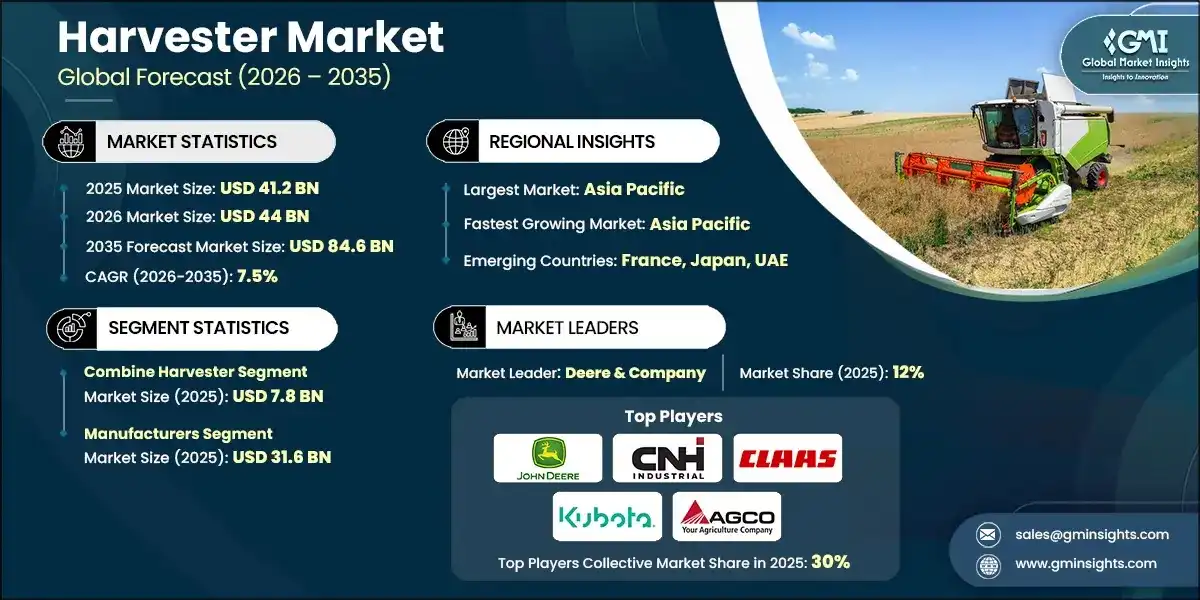
The global harvester market was estimated at USD 41.2 billion in 2025. The market is expected to grow from USD 44 billion in 2026 to USD 84.6 billion in 2035, at a CAGR of 7.5%, according to latest report published by Global Market Insights Inc.
Harvester Market Key Takeaways
Market Size & Growth
- 2025 Market Size: USD 41.2 Billion
- 2026 Market Size: USD 44 Billion
- 2035 Forecast Market Size: USD 84.6 Billion
- CAGR (2026–2035): 7.5%
Key Market Drivers
- Global Population Growth & Food Demand.
- Rising Labor Costs and Shortages.
- Advancements in Precision Agriculture (Ag 4.0).
Challenges
- High Initial Investment Cost.
- Lack of Skilled Operators/Technicians.
Opportunity
- Expansion of Leasing & Rental Models.
- Development of Specialty/Electric Harvesters.
Key Players
- Market Leader: Deere & Company led with over 12% market share in 2025.
- Leading Players: Top 5 players in this market include Deere & Company, CNH Industrial NV, CLAAS KGaMBH, Kubota, AGCO Corporation, which collectively held a market share of 30% in 2025.
Get Market Insights & Growth Opportunities
The demand for eco-friendly harvesting solutions is on the rise as manufacturers respond to the need for sustainable practices. Innovations, such as energy-efficient engines and reduced emissions technologies, align with environmental concerns and ensure compliance with evolving regulations, driving the overall growth of the harvester market.
Manufacturers are engaged in developing novel versions of harvesters and are increasing their market presence by launching new machines and equipment. For instance, in 2023, Swaraj Tractors, a Mahindra & Mahindra division, introduced the Swaraj 8200 Smart Harvester, tailored for Indian farmers. Featuring an in-house engine with top-notch fuel efficiency and adherence to eco-friendly BS IV emission standards, the innovation addresses the agricultural needs of India while prioritizing sustainability and performance.
The harvester industry is experiencing substantial growth, propelled by technological strides and frequent product launches. Continuous advancements, such as precision farming technologies and smart harvesting solutions, fuel efficiency and productivity. Manufacturers keenly introduce new products, meeting the evolving demands of modern agriculture. This dynamic synergy of technology and innovation propelled the market forward and ensured a competitive landscape, meeting the diverse needs of the farming industry.
Modern global food demand is reshaping global agricultural supply chains to be more efficient in harvesting due to the growing number of global consumers in need of stable and affordable food supplies. As a result of the increased global demand for fresh produce, and the necessity to complete the harvest quickly and efficiently, large-scale corporate farms and specialized contract farming providers are purchasing more high capacity combines and specialized harvesting machines (e.g., for fruit/vegetables). There is thus a rise in the volume of high-performance agricultural machinery such as combine harvesters, forage harvesters, and smart tillage equipment required to sustain the increased levels of rapid and high-volume yield collection that modern farms are obliged to carry out. The rapid, low-loss transfer of harvested products from the field to storage will turn into a competitive advantage for farming enterprises, and hence, it will result in an escalated demand for high-capacity harvesters in the agriculture sector.
Furthermore, with precision agriculture being part of the harvester market, e.g., through yield mapping, section control, and intelligent crop sensing applications, the craving for sophisticated harvesters will be escalated to a greater extent. Companies are constantly investing in automated operations through which they become less dependent on human labor (especially during peak seasons) and have better accuracy and increased utilization of the available land, which will have an impact on the productivity levels of high-density farming in all geographical regions. As more companies are adopting advanced farm management systems (FMS), the requirement for sophisticated harvesters that come with RTK-GPS, telematics, and connectivity features is turning into a vital component of the eco-friendly farming environment in the present economy. The combination of continuous food demand growth and farm automation will be instrumental in maintaining the market for advanced harvesters in the coming years.
At present, the agriculture 4.0 emergence is basically the major point of change that is turning over the whole crop harvesting transformation from every sector of the supply chain by the introduction of digitally intelligent harvesters. The usage of such technologies as the internet of things (IoT), artificial intelligence (AI), and telematics allows for the possibility to check the health of the current assets in real-time, implement predictive maintenance, and add the optimization of the assets fleet based on field data to the benefits of lesser downtime, longer asset life, and safety improvement, which in turn leads to significant cost savings to the end users. Besides that, intelligent harvesters will communicate in real-time with farm management systems (FMS) on yield throughput, grain moisture, and operational efficiency with the goal of establishing a fully integrated ecosystem that not only supports the principles of resource-lean farming but also agile harvest logistics.
Besides this, the option to use autonomy technology and the ability to link assets with one another goes hand in hand with the wide range of new trends that are coming into existence in the field of smart farms and digital agricultural technology. The basis of autonomous harvesting solutions will directly provide a remedy to the current labor shortage situation while, at the same time, allowing for an increase in the field throughput as well as reduction of human error will be laid by autonomous navigation systems and machine learning algorithms. As sustainability and operational resilience have become the main concerns of all agricultural companies, harvesters equipped with Agriculture 4.0 technology present a great chance for manufacturers and farm owners to fulfill the requirements of an ever-changing global marketplace.
To get key market trends
Harvester Market Trends
The agrarian harvester sector is evolving as technology keeps on changing, gov compliance/action towards SDGs, and trends in precision ag & farm mgt. Agro-industries are still seeking electric and self-driving solutions to align with enviro regulations, meet sustain. goals, and drive op. eff. concurrently. Digitization & Agri 4.0 tech are a big part of the changes in fleet mgt & field ops that are happening simultaneously.
- Shift to electric and alternative power sources: The harvester market is transitioning towards electric and hybrid-powered vehicles as businesses are achieving their global sustainability goals and are still able to comply with strict nation-wide and local business-government regulations by using alternative power sources. Fuel cells running on hydrogen and batteries with high energy density are winning the favor of the business community at large because they combine the ability to give high power output with low emissions, noise reduction, and almost maintenance-free operation compared to the commonly used diesel engine. Moreover, corporate responsibility in the form of government incentives and ESG commitments is making it easy for industry to switch to electric and hybrid vehicles and fasten their popularization among it.
- Emergence of automation and autonomy: Autonomy is increasingly seen as one of the main elements of today's smart farming system. More large-scale farms are installing autonomous guided harvesters (AGH) and using autonomous field robots/tractors. These machines are capable of almost nonstop work with minimal human guidance and error and are at the same time a safer working environment for existing employees and a solution for labor shortage problems. The movement and collection of crops will be on the way, thus coordinated as it happens, leading to increased efficiency of work and optimal timing in the harvesting process with the help of autonomous harvesters that are doing many of the repetitive, high-power tasks usually performed by humans, and through integration with farm management systems (FMS). In addition, autonomy is most likely to be deeply intertwined with most harvester fleets as worldwide food demand and the need for precision keep on rising.
- Impact of digitalization and connectivity: Digitalization has revolutionized the way harvesters’ function, turning them into intelligent, connected resources for farm businesses. Internet-of-things (IoT) sensors, telematics, and yield mapping can significantly assist business owners in getting very urgent real-time information of the condition and performance of their machinery, which also includes the yield history of the field as well as usage of fuel/energy rates. These are the keys to establishing predictive maintenance schedules that will drastically decrease the periods when equipment is not functioning during very important harvest times and will prolong the lifespan of the assets. Moreover, with the presence of connectivity and IoT solutions, the remote monitoring of harvesters can effortlessly work together with a company's enterprise resource planning (ERP) systems, thus forming a networked agricultural supply chain.
- Demand for specialty and high-density harvesters: The expansion of high-value specialty crops (e.g., fruits, nuts, and vegetables) coupled with the necessity to extract maximum yield from limited land has led to a considerable rise in the number of small-to-medium-scale operations, in which precision and minimal crop damage are the primary focus. This phenomenon has led to the increased need for specialty harvesters (e.g., grape or cotton pickers), controlled traffic.
Harvester Market Analysis
Learn more about the key segments shaping this market
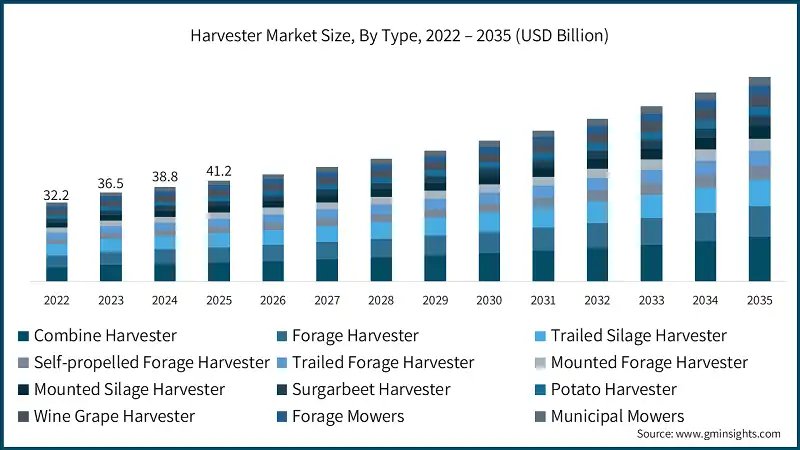
Based on type, the market is divided into combine harvester, forage harvester, trailed silage harvester, self-propelled forage harvester, trailed forage harvester, mounted forage harvester, mounted silage harvester, surgarbeet harvester, potato harvester, wine grape harvester, forage mowers, and municipal mowers. In 2025, combine harvester is projected to hold the major market share, generating a revenue of USD 7.8 billion and maintaining the highest growth rate (9.1% CAGR).
- Combine harvesters are the most critical and high-value type of harvesting machinery, designed to efficiently reap, thresh, and winnow a variety of grain crops like wheat, rice, corn, and soybeans in a single pass. These sophisticated machines are essential for large-scale, commercial grain farming globally. Their high capacity and speed allow farmers to complete the harvest quickly, minimizing weather-related risks and ensuring optimal grain quality. The dominance of this segment is directly tied to the fundamental need for efficient staple crop production worldwide.
- Modern combine harvesters are advanced systems that are seeing rapid integration of autonomy and precision technology. Key features include real-time yield and moisture monitoring, automated header height control, and intelligent cleaning systems that adjust settings on-the-go based on crop conditions. Manufacturers are focused on increasing machine capacity (e.g., grain tank size, engine horsepower) and reducing grain loss through superior separation and cleaning technology to maximize farmer profitability.
- The continued growth of the combine harvester segment is propelled by the global demand for food security and the increasing size of farming operations, which demand larger and more efficient equipment.
- The adoption of advanced technology like AI-powered automation (e.g., CLAAS CEMOS) is allowing these machines to operate with peak efficiency, reducing reliance on expert human judgment. Furthermore, the ability of modern combines to collect and transmit vast amounts of agronomic data is integral to farm management systems (FMS), making them the central data point for modern precision agriculture.
Learn more about the key segments shaping this market
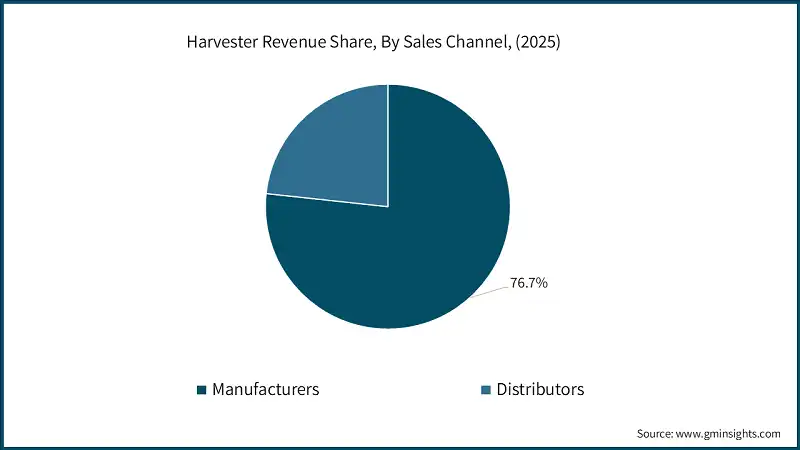
Based on sales channels, the harvester market is divided into manufacturers and distributors. In 2025, the manufacturers segment is projected to hold the major market share, accounting for a revenue of USD 31.6 billion.
- Manufacturers account for the dominant share because they handle high-value fleet sales to large corporate farms and contractors, ensuring strong control over pricing, after-sales service, and the integration of their proprietary precision technology (e.g., John Deere Operations Center, CNH's Raven). This direct relationship allows manufacturers to build brand loyalty, offer specialized financing, and conduct the necessary training required for complex, high-horsepower machinery.
- Distributors, while holding a smaller share of the total revenue, are critical to market function and will continue to grow, generating USD 9.6 billion in 2025. Dealer networks are essential for providing local, regional support, particularly for small-to-medium-scale farmers. They provide crucial after-sales services, maintenance, spare parts inventory, and machine customization, which are vital for ensuring maximum uptime during the short, critical harvest season.
- The strategic relationship between manufacturers and their dealer networks is increasingly vital. As harvesters become more connected and technologically advanced, distributors act as the local implementation partner for precision agriculture technologies, providing connectivity infrastructure, sensor calibration, and technical expertise required to keep autonomous and smart harvesting systems operational in the field. This collaboration supports the market's overall growth by enhancing customer service and addressing the challenge of limited skilled technicians.
Looking for region specific data?
Asia Pacific Harvester Market
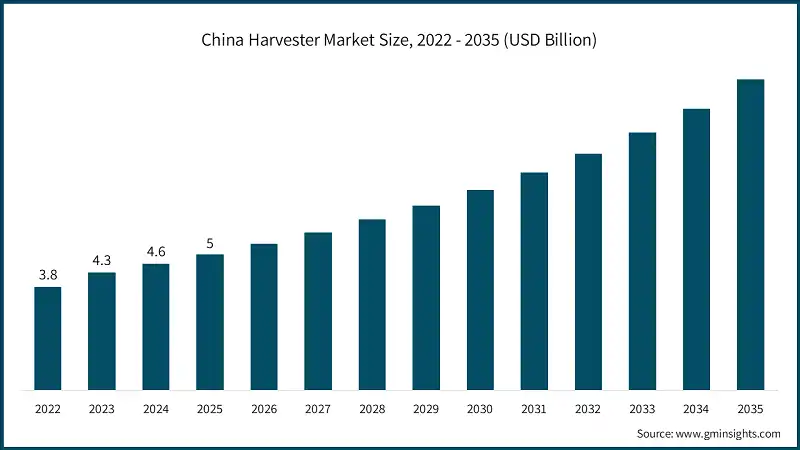
The Asia Pacific leads the global harvester industry with a 36.9% share in 2025. China is the major driver in the region, holding approximately 32.5% of the regional market share and growing at an 8.8% CAGR from 2022 to 2035.
- Asia-Pacific is the fastest-growing and leading region of the global market due to rapid mechanization, government subsidies for small machinery, and the need for efficient harvesting of staple crops like rice and wheat.
- China, India, and Japan will play a significant role in the growth of the region. The strong governmental initiatives to support farm modernization are driving an enormous demand for specialized, track-based combinations and small-scale power tillers, alongside advanced lithium-ion electric equipment.
- In addition to high-volume crop harvesters, Asia-Pacific is seeing the emergence and rapid growth of adoption of compact, cost-effective electric harvesters and autonomous field robots for specialized farming environments. As more companies and governments invest in agricultural supply chain modernization, Asia-Pacific will continue to be at the forefront of both volume and localized innovation in the market, particularly in rice, tea, and vegetable harvesting
North America Harvester Market
In 2025, the U.S. is projected to dominate the North America harvester industry, accounting for around 83% of the regional revenue and generating around USD 8 billion in the same year. The North America market is expected to grow to an 8% CAGR during the forecast period.
- Due to the presence of vast farmlands and high-value crops, the demand for high-horsepower, high-capacity combine harvesters and self-propelled forage harvesters is driving market growth. Increasingly, there is greater acceptance for autonomous and large-scale precision farming equipment, driven by the need to maximize productivity, address severe labor shortages, and adhere to strict environmental standards.
- Throughout North America, the market benefits from the sustained demand for efficient grain and oil-seed harvesting, supported by government incentives for farm technology investment and strong farmer purchasing power.
- The shift to the use of telematics and integrated FMS (farm management systems) for fleet tracking, ongoing yield optimization, and improving the overall energy efficiency of harvesting processes is being encouraged using federal tax incentives for purchasing clean energy equipment. Therefore, North America is considered a mature market but is also undergoing a rapid transformation toward full automation and data-driven farming
Europe Harvester Market
Europe market is projected to hold a 27.2% share in 2025 and is expected to grow at 7.3% CAGR during the forecast period.
- With sustainability and precision farming as its primary focus and multiple regulatory authorities overseeing all aspects of Europe's harvester market, Europe is an extremely mature and regulative region. The rapid move towards electric and hybrid harvesters (e-Agri) and advanced precision attachments is the result of governments and companies having set up strict emission controls and environmental social governance (ESG) commitments.
- Countries such as Germany, France, and the UK are leading the way in the adoption of agriculture 4.0 technology, specifically the integration of internet of things (IoT) for monitoring crop health, and using telecommunications and sensors for fleet management, predictive maintenance, and optimal field route planning.
- The continued growth of high-value crops and specialized farming in Europe, along with its strong manufacturing base (CLAAS, Fendt), continues to drive the demand for efficiency using smaller, specialized harvesters and building autonomy systems
Latin America Harvester Market
Latin America Harvester markets are growing at a 4% CAGR during the forecast period. Brazil is the leading market in the region, accounting for approximately 48.3% of the regional share in 2025
- The Latin American market for Harvesters is on a steady rise as a result of an expanding agribusiness, sugarcane, and soybean sector across the continent. Brazil and Mexico have become leading agricultural centers of growth and the subsequent increase in demand for large-scale, rugged harvesters has streamlined operations within these sectors. Although internal combustion engine (ICE) powered harvesters account for most of the market today, due to their lower costs and tolerance for challenging field conditions, electric harvesters (EITs) are becoming increasingly popular for use in indoor storage and specialized crop operations.
- In addition, Latin America is also exhibiting increasing interest in the use of automated and telematics systems for the purpose of increasing operational efficiencies and managing large, remote fleets. Additionally, many global manufacturers are expanding their presence in this area with the assistance of established partnerships and dealer networks, thereby enabling users of those technologies to have access to cutting-edge technologies. As economic development continues and there is a greater need for large-scale, efficient harvests across Latin America, this provides significant opportunities for providing high-capacity and specialized crop harvesting solutions.
Harvester Market Share
Deere & Company is leading with 12% market share. Deere & Company, CNH Industrial NV, CLAAS KGaMBH, Kubota, and AGCO Corporation collectively hold around 30%, indicating moderately fragmented market concentration. These prominent players are proactively involved in strategic endeavors, such as mergers & acquisitions, facility expansions & collaborations, to expand their product portfolios, extend their reach to a broad customer base, and strengthen their market position.
Deere & Company is the world leader in high-horsepower agricultural machinery, specializing in tractors, combines, and precision technology. It has strategically transitioned from a machinery manufacturer to a provider of data-driven solutions, centered around its smart industrial strategy. Deere's significant annual research & development investment focuses on integrating cutting-edge autonomy (like the Autonomous 8R and 9RX), AI, and connectivity into its fleet. Its platform, the John Deere Operations Center, sets the standard for fleet management, data analytics, and remote diagnostics, allowing farmers to reduce input costs and maximize yields with unparalleled precision.
CNH Industrial NV (Case IH & New Holland) is a global agricultural and construction equipment manufacturer with a strategic focus on expanding its Precision Tech portfolio. CNH's goal, as outlined in its strategic business plan, is to nearly double Precision Tech sales as a percentage of total Agriculture Net Sales by 2030, leveraging its acquisition of autonomy and digital farming leader Raven. Its brands are rapidly developing and integrating intelligent systems like Combine Automation, Sense and Act Spraying, and advanced guidance systems to deliver predictive, sustainable solutions that help farmers increase productivity with less environmental impact, targeting full-cycle automation.
AGCO Corporation (Fendt, Massey Ferguson, Valtra) is a global full-line supplier with a differentiated brand portfolio. Its strategic focus is on Farmer-First innovation delivered through its new precision ag brand, PTx (following the acquisition of Trimble assets). AGCO aims to serve the mixed-fleet market by offering both factory-fit and retrofit precision solutions for all makes and models of equipment. AGCO's premium brand, Fendt, leads the push in high-efficiency equipment like the IDEAL Combine and the e100 Vario electric tractor, while Valtra focuses on highly customized, easy-to-use solutions with AI integration, such as the Valtra Coach Talking Tractor concept.
Harvester Market Companies
Major players operating in the harvester industry are:
- Anhui Heli
- BYD Company
- Clark Material Handling Company
- Combilift
- Crown Equipment
- Doosan Corporation Industrial Vehicle
- Hangcha Group
- Hyster-Yale Materials Handling
- Hyundai Heavy Industries
- Jungheinrich AG
- KION Group AG
- Komatsu
- Manitou Group
- Mitsubishi Logisnext
- Toyota Industries
CLAAS KGaA mbH is the European market leader in combine harvesters and the world leader in self-propelled forage harvesters (JAGUAR). As a technology leader in harvesting, its core strategy revolves around maximum efficiency, performance, and fuel economy, driven by systems like the CEMOS combine automation and DYNAMIC POWER engine management. CLAAS promotes sustainability by making its entire new fleet compatible with Hydrotreated Vegetable Oil (HVO), a low-carbon diesel alternative, and by expanding its diverse harvester family (LEXION, TRION, EVION) to ensure the right technology is available for every farm size and crop type globally.
Kubota is a major Japanese manufacturer with a strategic focus on becoming a Global Major Brand by expanding its presence in emerging markets, particularly Asia and Africa, and strengthening its mid-to-high horsepower offerings. Kubota leverages its Japanese engineering excellence in durability and fuel efficiency to develop region-specific solutions, such as its robust track-based combines for paddy fields and high-traction tractors for India. Through joint ventures and partnerships, Kubota aims to become the go-to brand for reliable and localized mechanization, moving beyond equipment sales to providing full-cycle operation and maintenance (O&M) solutions in underserved regions
Harvester Market Report Attributes
| Key Takeaway | Details |
|---|---|
| Market Size & Growth | |
| Base Year | 2025 |
| Market Size in 2025 | USD 41.2 Billion |
| Market Size in 2026 | USD 44 Billion |
| Forecast Period 2026-2035 CAGR | 7.5% |
| Market Size in 2035 | USD 84.6 Billion |
| Key Market Trends | |
| Drivers | Impact |
| Global Population Growth & Food Demand | Directly increases pressure on farmers to maximize yield and necessitates the adoption of high-capacity, efficient harvesting machinery. |
| Rising Labor Costs and Shortages | Accelerates the adoption of automation and autonomous harvesters to reduce reliance on human labor during peak, time-sensitive harvest seasons. |
| Advancements in Precision Agriculture (Ag 4.0) | Drives demand for smart harvesters equipped with AI, IoT, and yield mapping, optimizing harvesting routes and minimizing crop loss. |
| Pitfalls & Challenges | Impact |
| High Initial Investment Cost | Restricts the adoption of advanced, high-technology harvesters, especially among small and medium-sized farms in developing economies. |
| Lack of Skilled Operators/Technicians | Hinders the effective utilization and maintenance of complex, digitally integrated machines, limiting the realized benefits of automation. |
| Opportunities: | Impact |
| Expansion of Leasing & Rental Models | Allow smaller farms to access advanced, high-capacity machinery without full capital outlay, broadening the markets customer base. |
| Development of Specialty/Electric Harvesters | Creates new market segments focused on high-value crops (fruits, vegetables) and sustainable farming, meeting emission standards and niche demand. |
| Market Leaders (2025) | |
| Market Leaders |
12% market share |
| Top Players |
|
| Competitive Edge |
|
| Regional Insights | |
| Largest Market | Asia Pacific |
| Fastest Growing Market | Asia Pacific |
| Emerging Country | France, Japan, UAE |
| Future Outlook |
|
What are the growth opportunities in this market?
Harvester Industry News
- In January 2025, Deere & Company revealed its second-generation autonomy kit at CES, expanding its autonomous technology from the 8R Tractor to include the new Autonomous 9RX Tractor for large-scale tillage and the Autonomous 5ML Orchard Tractor for spraying. This new kit features 16 advanced cameras providing a 360-degree view, enhanced AI for obstacle detection, and the option for customers to purchase Autonomy Ready machines or retrofit existing equipment with a Precision Upgrade. The move is a significant step in addressing labor shortages and maximizing tight operational windows for farmers.
- In October 2025, AGCO Corporation (Fendt) featured its Fendt IDEAL combine harvester during the 2025 North American Harvest Tour. The demonstrations highlighted the machine’s IDEALdrive joystick steering system (the only one of its kind offered by a major manufacturer) and the IDEALharvest automation system. The automation system fine-tunes combine settings like rotor speed and fan speed in real-time using in-cab grain quality cameras, allowing operators to focus less on manual adjustments and more on maximizing yield quality and throughput during the harvest.
- In August 2025, CLAAS KGaA mbH unveiled its expanded LEXION 8000 Series of combine harvesters for the North American market, featuring new MAN engines that deliver increased power up to 549 hp and a massive 510-bushel grain tank capacity. The launch emphasizes the continuous industry push for higher-capacity machines to reduce field time and increase efficiency during peak harvesting windows. This series also includes premium cab features designed to improve operator comfort during long harvest days.
- In February 2025, CNH Industrial NV finalized the acquisition of Augmenta, an agricultural artificial intelligence (AI) and automation company. This deal strategically integrates Augmenta's Mantis system into CNH's precision technology portfolio under its Raven brand. Augmenta's technology uses computer vision and deep learning to automate real-time crop analysis and variable rate application of inputs (like fertilizers or pesticides), allowing CNH to offer seamless solutions for farm input automation aimed at reducing environmental impact and maximizing yields.
- In December 2025, Kubota announced a focus on delivering high-horsepower, technologically advanced harvesters for the emerging Asia-Pacific markets. The company highlighted models like the Kubota HARVESKING DC-68G-HK (68 HP) and DC-99G (98.3 HP) combines. This strategy reflects a broader market trend of focusing on affordable, regional-specific mechanization, particularly track-based harvesters for the wet terrain common in rice and paddy field harvesting across Southeast and South Asia.
- In November 2025, CLAAS introduced the production-ready TORION 537e SINUS wheel loader, a six-tonne class machine with a battery-electric drive, slated for its material handling product range in 2026. While not a harvester, this reflects the company's commitment to electrification across its heavy machinery fleet, responding to the growing demand from farms and contractors for locally emission-free equipment to meet sustainability goals in material handling tasks related to harvest logistics (like moving silage and grain).
The harvester market research report includes in-depth coverage of the industry with estimates & forecasts in terms of revenue (USD Billion) and volume (Thousand Units) from 2022 to 2035, for the following segments:
Market, By Type
- Combine harvester
- Forage harvester
- Trailed silage harvester
- Self-propelled forage harvester
- Trailed forage harvester
- Mounted forage harvester
- Mounted silage harvester
- Surgarbeet harvester
- Potato harvester
- Wine grape harvester
- Forage mowers
- Municipal mowers
Market, By Sales Channel
- Manufacturer
- Distributor
The above information is provided for the following regions and countries:
- North America
- U.S.
- Canada
- Europe
- Germany
- UK
- France
- Italy
- Spain
- Asia Pacific
- China
- India
- Japan
- Australia
- South Korea
- Latin America
- Brazil
- Mexico
- Argentina
- Middle East and Africa
- South Africa
- Saudi Arabia
- UAE
Frequently Asked Question(FAQ) :
What is the harvester market size in 2025?
The global market size for harvester was valued at USD 41.2 billion in 2025. Rising food demand, expansion of commercial farming, and increased adoption of precision agriculture technologies supported consistent market growth.
What is the market size of the harvester industry in 2026?
The market size for harvesters reached USD 44 billion in 2026, reflecting steady expansion driven by mechanization needs and high-capacity machinery adoption.
What is the projected value of the harvester market by 2035?
The market size for harvester is expected to reach USD 84.6 billion by 2035, growing at a CAGR of 7.5%. This growth is fueled by automation, Agriculture 4.0 technologies, sustainability-focused equipment, and the rising need for efficient harvesting systems.
How much revenue did the combine harvester segment generate in 2025?
The combine harvester segment generated USD 7.8 billion in 2025, making it the largest product category. High adoption of multifunctional grain-harvesting systems continues to strengthen segment leadership.
What was the valuation of the manufacturer sales channel segment in 2025?
The manufacturers segment accounted for USD 31.6 billion in 2025, making it the dominant sales channel. Direct OEM sales, integrated precision technologies, and strong after-sales support contribute to its market dominance.
Which region leads the North America harvester market?
The U.S. led the North America harvester industry in 2025 with 83% of regional revenue, generating about USD 8 billion. The regional market is projected to grow at a CAGR of 8% during the forecast period.
What are the upcoming trends in the harvester industry?
Key trends include electrification and hydrogen-powered harvesters, AI-driven precision agriculture, autonomous harvesting systems, 5G-enabled telematics, and the rise of specialty harvesters for fruits and vegetables. These advancements are improving productivity, sustainability, and operational efficiency across global farm operations.
Who are the key players in the harvester market?
Key players include Deere & Company, CNH Industrial, CLAAS, Kubota, AGCO Corporation, Komatsu, KION Group, Jungheinrich AG, Manitou Group, and Toyota Industries. These companies are expanding automation capabilities, precision farming technologies, and electric machinery portfolios to strengthen their competitive presence.
Harvester Market Scope
Related Reports