Summary
Table of Content

Hardware-in-the-Loop (HIL) Testing Market
Get a free sample of this report
Form submitted successfully!
Error submitting form. Please try again.
Thank you!
Your inquiry has been received. Our team will reach out to you with the required details via email. To ensure that you don't miss their response, kindly remember to check your spam folder as well!
Request Sectional Data
Thank you!
Your inquiry has been received. Our team will reach out to you with the required details via email. To ensure that you don't miss their response, kindly remember to check your spam folder as well!
Form submitted successfully!
Error submitting form. Please try again.
Hardware-in-the-Loop Testing Market Size
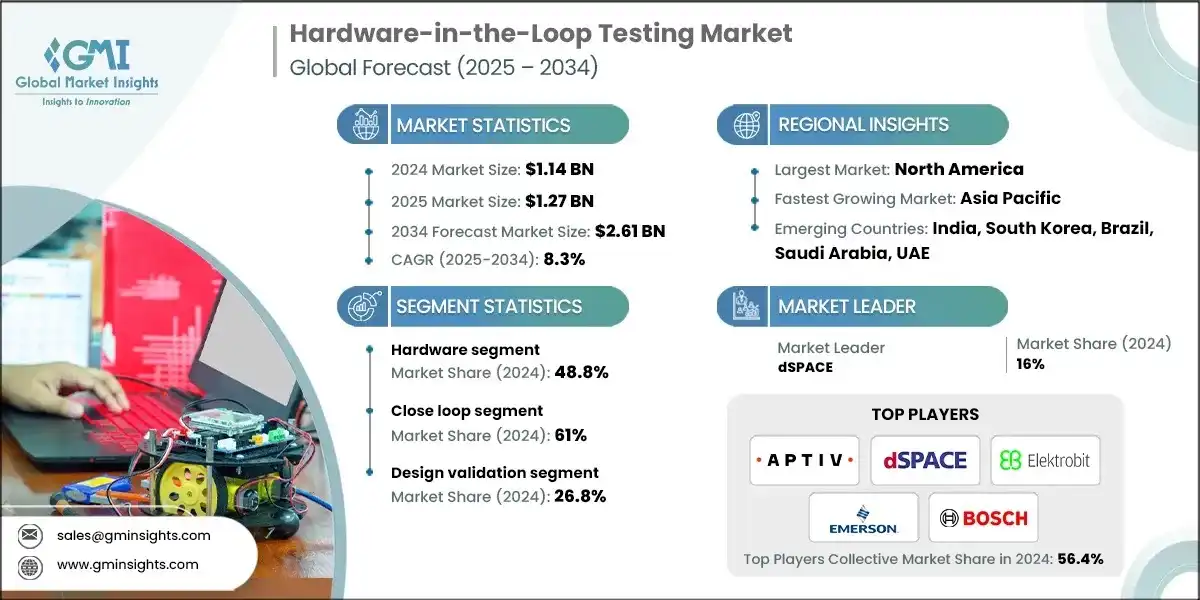
The global hardware-in-the-loop (HIL) testing market size was estimated at USD 1.14 billion in 2024. The market is expected to grow from USD 1.27 billion in 2025 to USD 2.61 billion in 2034, at a CAGR of 8.3%, according to the latest report published by Global Market Insights Inc.
To get key market trends
The high-rate integration of software-defined architecture, electrified powertrain, and autonomous capabilities are leading to a paradigm shift in global validation ecosystem. HIL testing platforms allow real time simulation of complex systems like ADAS, BMS, power electronics and avionics. Such sites enable OEMs and Tier-1 suppliers to speed up the development process and decrease reliance on physical models. This development justifies incessant software check, multi-domain emulation, and early fault identification making HIL one of the pillars of present-day product engineering.
In January 2025, dSPACE and Microsoft specifically declared a strategic partnership to use generative AI to create and verify virtual ECUs (V-ECUs), improving a software-in-the-loop and hardware-in-the-loop integration process.
Simulation platform vendors, test-equipment vendors and model-based engineering tool vendors are increasingly adopting strategic investments and capacity expansions in response to the increasing demand of real-time simulations. HIL system vendors have also extended real time computing cluster, added I/O boards with a high number of channels, and collaborated with software ecosystem participants to speed up EV, aerospace, and industrial automation development.
For example, in June 2025, Infineon Technologies agreed to a strategic partnership with Typhoon HIL, a major high-fidelity real-time HIL simulation platform maker, to accelerate the development and test of power-electronic systems in electric vehicles (xEVs).
HIL is being adopted because of the electrification of commercial fleets, progress in aviation powertrain R&D, and smart-grid connection. Stress testing is necessary to high-voltage energy systems, electric propulsion modules, and grid-interactive charging architectures. HIL systems offer a testable solution to checking the behaviors of controllers under loads like thermal, grid variation, device age, and fault conditions without endangering hardware.
HIL systems are also appearing to grow in smart mobility, defense digitalization and renewable energy R&D programs. Modular HIL benches, scenario-based testing models, and standardized safety interfaces are being adopted by major stakeholders, such as large simulation labs, EV battery giga factories, aerospace integrators, and railway automation developers, to meet the requirements of standards, including ISO 26262, DO-178C, and grid interoperability. Such improvements increase the safety of the system, interoperability, and life cycle reliability.
HIL continues to expand into North America and Europe due to the high investment in autonomous mobility, EV platforms, avionics modernization, and industrial robotics. Strong regulatory systems were put in place to test-equipments suppliers and advanced digital engineering ecosystems encourage fast adoption. The main areas of interest are retrofitting older labs to provide high-fidelity real-time simulations, incorporating cybersecurity-in-the-loop testing, and developing software-defined vehicle (SDV) systems.
Asia-Pacific remains the fastest-growing HIL market, which is driven by mass EV production, fast industrial automation, growing aerospace initiatives, and developing many digital R&D hubs. China has the highest number of HIL deployments in large volumes and economically viable integrations in the car, rail, and energy industries. Concurrently, Japan and South Korea focus on reliability-oriented HIL testing, and are aimed at robotics, semiconductors, and precision power electronics.
Hardware-in-the-Loop (HIL) Testing Market Report Attributes
| Key Takeaway | Details |
|---|---|
| Market Size & Growth | |
| Base Year | 2024 |
| Market Size in 2024 | USD 1.14 Billion |
| Market Size in 2025 | USD 1.27 Billion |
| Forecast Period 2025 - 2034 CAGR | 8.3% |
| Market Size in 2034 | USD 2.61 Billion |
| Key Market Trends | |
| Drivers | Impact |
| Increase in ADAS & Autonomous Vehicle Development | The rapid evolution of ADAS and autonomous systems requires extremely accurate validation of real-time decision-making algorithms, sensor fusion, and complex ECUs. HIL testing enables OEMs to replicate risky driving scenarios safely and cost-effectively, reducing prototype failures while supporting regulatory compliance. This makes HIL essential in modern automotive development cycles. |
| Electrification of Transportation | Electric vehicles rely on highly sensitive control units for battery management, motor control, charging, and inverter operations. HIL platforms allow engineers to validate these systems under real-world electrical and thermal conditions without risking physical hardware. As EV production surges globally, demand for HIL solutions for EV powertrain and charging systems continues to increase. |
| Growth of Digital Twin Adoption | Digital twins simulate the real-world behavior of complex systems, but they require real-time hardware interaction to validate accuracy. HIL acts as the bridge between digital models and physical components, enabling predictive maintenance, faster prototyping, and error-free design cycles. This integration significantly reduces time-to-market across automotive, aerospace, and industrial sectors. |
| Rise in Power Electronics Testing | The expansion of renewable energy, smart grids, and high-efficiency power electronics drives the need for accurate testing of inverters, converters, and grid controllers. HIL systems allow engineers to evaluate high-voltage operations and fault behavior safely in a controlled environment. Growing investment in clean energy directly boosts HIL adoption. |
| Pitfalls & Challenges | Impact |
| High Initial Setup and Integration Costs | HIL solutions require specialized real-time simulators, advanced FPGA platforms, custom I/O modules, and software ecosystems that result in high capital expenditure. The cost rises further with integration into existing development workflows. This limits adoption among SMEs and startups despite clear performance and safety benefits. |
| Shortage of Skilled Engineers in Real-Time Simulation | HIL testing demands expertise in simulation modeling, control systems, FPGA configuration, and real-time operating environments. The shortage of such multidisciplinary talent slows deployment and makes training a significant additional cost. Many organizations struggle to scale HIL operations due to limited access to experienced simulation engineers. |
| Opportunities: | Impact |
| Increasing Use of HIL in Aerospace & Defense | Aerospace and defense applications involve mission-critical systems like avionics, UAV control, radar modules, and navigation systems that require fault-tolerant validation. HIL enables safe simulation of extreme conditions and hardware failures that cannot be replicated physically. Growing investments in military modernization and space programs expand this opportunity. |
| Expansion of HIL in Medical Device Testing | Regulated healthcare devices such as ventilators, infusion pumps, diagnostic equipment, and robotic surgical tools require precise verification under diverse patient scenarios. HIL testing ensures high reliability before clinical deployment, meeting FDA standards. Rising digitalization and global demand for advanced medical devices create significant growth potential in this emerging segment. |
| Growing Demand from Smart Grid & Energy Systems | As microgrids, renewable energy systems, and DER technologies expand, utilities require real-time validation of protection systems, inverter behaviour, and grid-forming algorithms. HIL allows testing of high-risk grid scenarios without real-world consequences, helping accelerate grid modernization efforts worldwide. This makes energy a major future growth domain. |
| AI-Enhanced Real-Time Simulation | Artificial intelligence is increasingly integrated into HIL systems to automate scenario generation, detect anomalies, and improve test coverage. AI-driven simulation accelerates development cycles and enhances predictive analytics, enabling faster decision-making. As industries incorporate AI/ML into their engineering workflows, AI-based HIL testing becomes a major emerging opportunity. |
| Market Leaders (2024) | |
| Market Leaders |
16 % market share |
| Top Players |
Collective Market Share in 2024 is 56.4% |
| Competitive Edge |
|
| Regional Insights | |
| Largest Market | North America |
| Fastest Growing Market | Asia Pacific |
| Emerging Country | India, South Korea, Brazil, Saudi Arabia, UAE |
| Future Outlook |
|
What are the growth opportunities in this market?
Hardware-in-the-Loop Testing Market Trends
The shift toward cloud-based and remote HIL testing allows engineering teams to perform real-time simulations from anywhere, reducing dependency on on-site infrastructure. It enables scalable testing, automated scenario execution, and seamless collaboration across global teams. Accelerated by COVID-19, this trend is transforming traditional testing environments, enhancing efficiency, accessibility, and faster validation cycles in HIL applications.
In January 2024, Cognata announced a collaboration with Microsoft Azure to integrate its SimCloud HIL simulation into Microsoft’s Software-Defined Vehicle (SDV) cloud infrastructure, enabling advanced virtual and real-time HIL testing.
FPGA-based HIL provides microsecond-level execution speed required for applications like EV motor control, aerospace actuation, and high-frequency power electronics. As systems become more dynamic and model complexity increases, FPGA-accelerated HIL is becoming a standard offering, delivering high accuracy and deterministic performance.
HIL-as-a-Service provides subscription-based or cloud-hosted access to real-time simulators, lowering the barrier for small and mid-size companies. Organizations can run HIL tests without owning expensive hardware. This model is gaining traction as vendors increasingly offer pay-as-you-go simulation environments.
In February 2025, Methodica Technologies published a case on commissioning low-voltage EV truck ECUs using a “HIL Test as a Service” model, allowing validation without long lead times for hardware procurement.
Hardware-in-the-Loop Testing Market Analysis
Learn more about the key segments shaping this market
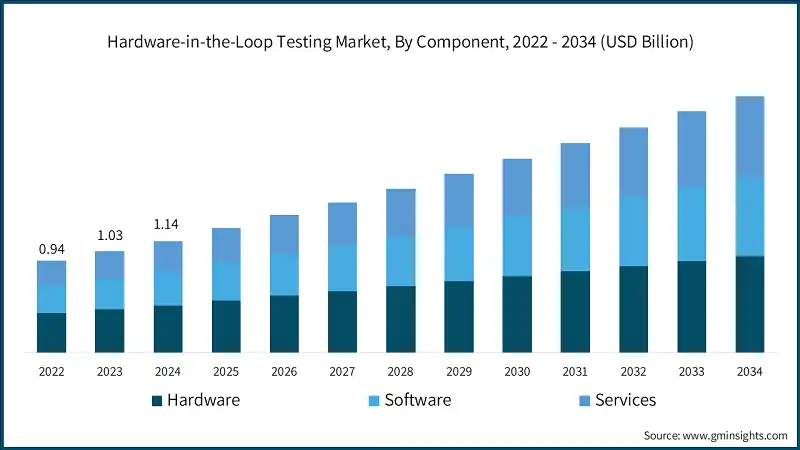
Based on component, the hardware-in-the-loop testing market is divided into hardware, software, and services. The hardware segment dominated the market, accounting for around 48.8% in 2024 and is expected to grow at a CAGR of more than 7.1% through 2034.
- The hardware segment leads the hardware-in-the-loop (HIL) testing market, driven by the necessity for high-performance physical components such as real-time simulators, I/O modules, FPGA-based processors, load boxes, power electronics rigs, and communication interfaces. These components are critical for real-time validation, replicating ECU behavior with microsecond-level precision, which is essential for safety-critical applications. Key industries, including automotive, aerospace, rail, and power electronics, rely on robust hardware systems to validate EV powertrains, ADAS controllers, avionics systems, and protection relays under real-world conditions.
- The higher investment cycle associated with hardware infrastructure compared to software further contributes to its dominant revenue share. OEMs and Tier-1 suppliers consistently expand their test labs with advanced racks, amplifiers, domain-specific HIL benches, and high-density FPGA platforms. As system complexity increases, particularly with the rise of electrification, autonomous driving, and software-defined vehicles, the demand for scalable, high-performance HIL hardware continues to grow, reinforcing the segment's market leadership.
- In December 2024, dSPACE introduced an end-to-end SIL/HIL validation workflow for EV and autonomous systems at CES 2025, enabling seamless transitions from virtual simulation to physical hardware.
- The service segment is projected to achieve a CAGR exceeding 10% in the HIL testing market, fueled by the growing need for expert integration, customization, and lifecycle support as systems become increasingly software-driven and complex. OEMs and Tier-1 suppliers are increasingly outsourcing engineering service providers for model development, test automation, scenario generation, calibration, and cloud-based HIL deployments.
- With the rapid evolution of EV, ADAS, and power electronics platforms, businesses are adopting service-based models to maintain operational flexibility and reduce internal engineering costs.
Learn more about the key segments shaping this market
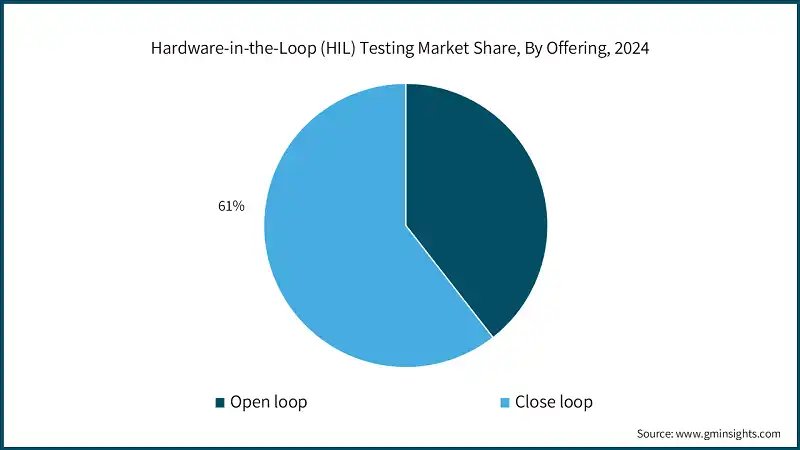
Based on offering, the hardware-in-the-loop testing market is segmented into open loop, and close loop. The close loop segment dominates the market accounting for around 61% share in 2024, and the segment is expected to grow at a CAGR of over 8% from 2025 to 2034.
- The closed-loop segment holds the largest market share in the hardware-in-the-loop (HIL) testing market due to its capability to enable real-time simulation and feedback between physical hardware and virtual models. This functionality allows engineers to test complex systems, such as ECUs, powertrains, and ADAS, under realistic operating conditions while mitigating risks to vehicles and prototypes.
- Closed-loop HIL testing facilitates iterative validation, fault injection, and scenario-based testing, which are essential for the development of autonomous and electric vehicles. Its ability to replicate dynamic interactions, including sensor feedback, actuator performance, and control algorithms, ensures enhanced accuracy and reliability in system development. As the automotive and aerospace industries increasingly prioritize rigorous safety and compliance testing, the adoption of closed-loop HIL continues to dominate the market.
- The open-loop segment is expected to grow at a CAGR of over 8.9%, driven by its cost-effective and simplified testing solutions for individual components without requiring real-time feedback. This segment is particularly suited for early-stage development, educational laboratories, and prototype validation, enabling faster iterations and reducing time-to-market for automotive, aerospace, and industrial systems.
Based on testing phase, the hardware-in-the-loop testing market is segmented into design validation, integration testing, acceptance testing, manufacturing testing, performance testing, and others. Design validation segment dominates with around 26.8% share in 2024 due to its critical role in ensuring that automotive, aerospace, and industrial systems meet functional and safety requirements early in the development cycle.
- The design validation segment holds a dominant position in the hardware-in-the-loop (HIL) testing market, driven by the increasing complexity of modern automotive and industrial systems. As vehicles incorporate advanced driver-assistance systems (ADAS), electric powertrains, and sophisticated electronic control units (ECUs), early-stage validation has become essential.
- HIL testing enables engineers to simulate real-world conditions in a controlled environment, identifying design flaws, inefficiencies, and safety concerns before investing in costly prototypes. This approach reduces development timelines, ensures regulatory compliance, and mitigates recall risks, making design validation a strategic priority for OEMs and Tier-1 suppliers globally.
- The growing prevalence of software-driven vehicles and industrial automation has further underscored the importance of design validation. Embedded software now controls critical vehicle functions, and any design defect can cascade across systems, affecting safety and performance.
- HIL-based design validation supports iterative testing, continuous integration, and system optimization, ensuring reliable operations under diverse conditions. Regulatory mandates, increased ADAS adoption, and electrification trends are driving sustained investments in HIL for design validation, reinforcing its leadership in the HIL market.
- The performance testing segment is projected to grow at a CAGR exceeding 10%, fueled by the rising demand for high-reliability and high-efficiency systems across automotive, aerospace, and industrial applications. As vehicles and machinery become increasingly complex, validating system performance under real-world conditions is critical. HIL testing facilitates the simulation of extreme scenarios, dynamic loads, and continuous operation cycles without risking hardware damage, ensuring components and control systems meet stringent performance standards.
Based on end use, the hardware-in-the-loop (HIL) testing market is divided into aerospace defence, railway, power electronics, automotive, medical devices, renewable energy systems, telecom and networking, and others. The aerospace and defence segment dominated the market.
- The aerospace and defense segment dominates the hardware-in-the-loop (HIL) testing industry, driven by stringent safety, reliability, and performance requirements in aircraft, spacecraft, and defense systems. HIL testing facilitates the simulation of complex avionics, propulsion, and control systems under real-world conditions, enabling the identification of potential faults or failures without risking costly hardware or human safety. The growing integration of advanced sensors, autonomous systems, and electronic warfare components underscores the need for rigorous validation to meet regulatory and operational standards.
- Furthermore, the extended development cycles and significant R&D investments associated with aerospace and defense projects make early-stage simulation critical for cost optimization. Governments and defense contractors increasingly leverage HIL platforms to accelerate system development, enhance reliability, and ensure mission readiness, thereby solidifying the segment's market leadership.
- The renewable energy systems segment is projected to achieve a CAGR of 11% till 2034, fueled by the rapid adoption of wind, solar, and energy storage technologies that demand advanced power electronics validation. HIL testing enables the simulation of inverters, converters, and grid integration components under varying load and environmental conditions, ensuring reliability and performance prior to deployment.
Looking for region specific data?
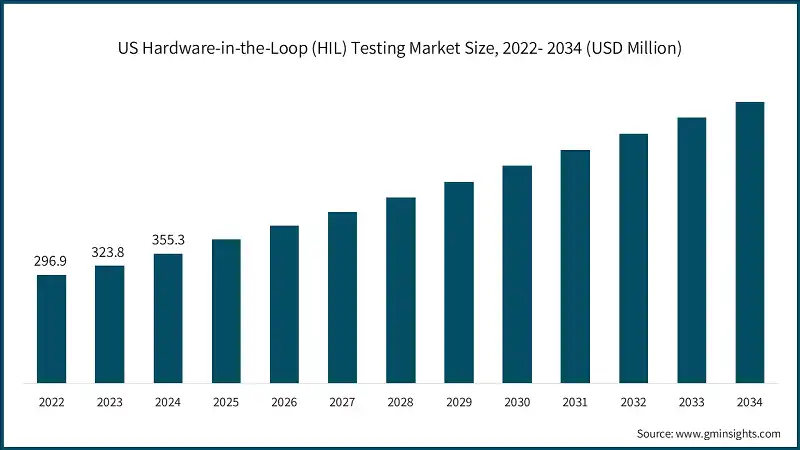
US dominated the hardware-in-the-loop testing market in North America with around 86.6% share and generated USD 355.3 million in revenue in 2024.
- The U.S. HIL testing market is experiencing significant growth, driven by advancements in autonomous driving technologies, ADAS Level 3/4 systems, EV powertrain innovations, and software-defined vehicle architectures. To address increasingly stringent safety, cybersecurity, and regulatory requirements, American OEMs and technology-focused automotive companies are expanding their validation infrastructure.
- Substantial investments in electric vehicle platforms, battery systems, and drivetrain electrification are further propelling HIL adoption, as organizations leverage real-time simulation to accelerate development timelines and reduce physical prototype expenses.
- Additionally, the U.S. is witnessing rising demand for HIL testing across aerospace, defense, robotics, and industrial automation sectors, which require high-precision testing for mission-critical control systems. Government-supported initiatives targeting advanced mobility, EV charging infrastructure, and energy resilience are driving new testing requirements, particularly in power electronics and V2X communication. The presence of leading HIL solution providers, a highly skilled engineering workforce, and substantial R&D investments from automotive and technology firms position the U.S. as one of the most dynamic and rapidly growing HIL markets globally.
- For example, in March 2025, Emerson introduced the NI LabVIEW+ Suite for HIL, a comprehensive software package designed to help HIL engineers simulate complex scenarios and streamline embedded software validation using NI’s hardware.
- In Canada, the Hardware-in-the-Loop (HIL) Testing market is projected to expand at a CAGR of approximately 9.2%, driven by the increasing adoption of electric vehicles (EVs) and advanced driver-assistance systems (ADAS) by Canadian automakers and fleet operators. OEMs and Tier-1 suppliers are investing in localized HIL testing infrastructure to efficiently validate ECUs, battery management systems, and powertrain components.
The hardware-in-the-loop testing market in Germany is expected to experience significant and promising growth from 2025-2034.
- Europe accounts for over 35.5% of the HIL testing market in 2024 and is expected to grow at a CAGR of around 7.1% driven by EV adoption, ADAS, and regulatory compliance.
- Germany's strong automotive and industrial automation sectors establish it as a key player in the market. Leading HIL solution providers such as dSPACE, Vector Informatik, and ETAS operate within the country, delivering advanced testing systems for automotive ECUs, ADAS, electric powertrains, and industrial control systems. The presence of a mature automotive R&D ecosystem, coupled with stringent regulatory frameworks like ISO 26262 and Euro 7, drives significant adoption of HIL systems to ensure compliance, safety, and reliability.
- Germany's strategic focus on Industry 4.0 and smart manufacturing further accelerates the demand for HIL testing in robotics, automation, and power electronics. Collaborative partnerships among OEMs, technology providers, and research institutions foster innovation, positioning Germany as a leading hub for advanced simulation and real-time testing solutions in Europe.
- For instance, in September 2024, ETAS GmbH (a Bosch subsidiary) announced its "Vehicle Software Platform Suite" at IAA Mobility 2025, designed to support zonal vehicle architectures and HIL-compatible ECU validation.
- The Nordic region is emerging as a growing market for hardware-in-the-loop (HIL) testing, driven by the increasing adoption of EVs, advanced driver-assistance systems, and smart mobility initiatives. Government incentives, a focus on sustainable transportation, and substantial investments in automotive R&D hubs across Sweden, Norway, and Finland are fueling the demand for real-time simulation and HIL solutions.
The hardware-in-the-loop (HIL) testing market in China is expected to experience significant and promising growth from 2025-2034.
- Asia Pacific accounts for over 25.9% of the market in 2024 and is expected to grow at a CAGR of around 10.3% owing to rapid EV adoption, rising automotive electronics demand, government support for smart mobility, and expanding automotive R&D centers in China, Japan, and India.
- China maintains its leadership in the hardware-in-the-loop (HIL) testing market, driven by its expansive automotive production capabilities, rapid adoption of electric vehicles (EVs), and substantial government support for automotive research and innovation. Leading domestic OEMs, including BYD, NIO, XPeng, and SAIC, are making significant investments in advanced driver-assistance systems (ADAS), battery management systems (BMS), and autonomous driving technologies, all of which rely heavily on HIL testing for validation. The country’s strategic focus on carbon neutrality and smart mobility is further accelerating the integration of HIL platforms across automotive, power electronics, and industrial applications.
- Additionally, initiatives such as Weihe Information’s acquisition of ETAS LABCAR IP from Bosch have strengthened China’s domestic HIL ecosystem. The presence of advanced testing infrastructure, collaborations with international HIL vendors, and government incentives for testing and validation facilities reinforce China’s competitive edge. The combination of large-scale production, innovation-driven R&D, and robust local supply chains ensure China’s continued dominance in HIL testing adoption on a global scale.
- In May 2025, IPG Automotive China organized an Open House event in Shanghai, showcasing its comprehensive validation strategy, which encompasses virtual ECUs, HIL, and Vehicle-in-the-Loop (VIL) technologies.
- India is rapidly positioning itself as one of the fastest-growing markets in the Asia-Pacific Hardware-in-the-Loop (HIL) Testing segment. This growth is fueled by the expansion of EV manufacturing, increasing adoption of advanced driver-assistance systems (ADAS), rising local R&D investments by OEMs, and growing demand for automotive electronics validation across passenger and commercial vehicles. The government’s “Make in India” initiative, coupled with its support for EV and hybrid vehicle production, is further driving HIL adoption among domestic suppliers and technology integrators.
The hardware-in-the-loop testing market in Brazil is expected to experience significant and promising growth from 2025-2034.
- Latin America holds around 3.05% of the HIL testing market and is growing steadily at a CAGR of around 8.2%. The developments are fueled by increasing automotive production in countries like Brazil and Mexico, rising investment in EV and hybrid vehicle programs, and growing adoption of advanced testing solutions by local OEMs.
- Brazil leads the hardware-in-the-loop (HIL) testing market in Latin America, driven by its position as the region's largest automotive manufacturing hub, hosting prominent OEMs such as Volkswagen, Fiat, General Motors, and Toyota. The country's focus on vehicle electrification, hybrid powertrains, and advanced driver-assistance systems (ADAS) has significantly increased the demand for advanced testing solutions to validate electronic control units (ECUs), battery management systems (BMS), and power electronics components. Local suppliers are increasingly adopting HIL systems to enhance product reliability, reduce development cycles, and ensure compliance with stringent emissions and safety regulations.
- Brazil's HIL market growth is further supported by strategic partnerships with global HIL vendors, including dSPACE, National Instruments, and IPG Automotive, which provide training, technology transfer, and turnkey solutions. Additionally, government initiatives promoting electric vehicle (EV) adoption and increasing R&D investments in smart mobility and industrial automation are accelerating market expansion. This combination of industrial scale, technological advancements, and strategic collaborations solidifies Brazil's dominance in the Latin American market.
- Mexico's hardware-in-the-loop (HIL) testing market is experiencing robust growth, underpinned by its emergence as a key automotive manufacturing and export hub in North America. Leading OEMs such as General Motors, Ford, Volkswagen, and Nissan have expanded their production capacities to meet growing regional and U.S. demand, driving the adoption of advanced testing solutions to ensure product quality and compliance.
The hardware-in-the-loop testing market in UAE is expected to experience significant and promising growth from 2025-2034.
- MEA holds around 2.37% of the market and is growing steadily at a CAGR of around 6.1% due to increasing investments in automotive, aerospace, and renewable energy sectors. Countries like the UAE, Saudi Arabia, and South Africa are focusing on industrial modernization and advanced vehicle testing infrastructure, creating demand for HIL systems.
- The UAE leads the MEA hardware-in-the-loop (HIL) testing market, driven by its strategic focus on advanced automotive, aerospace, and smart city initiatives. Government programs such as the UAE’s National Innovation Strategy and Vision 2031 are accelerating the adoption of technologies like electric and autonomous vehicles. The nation’s advanced infrastructure, substantial investments in R&D centers, and collaborations with global automotive OEMs provide a favorable environment for HIL testing solutions. These efforts enable companies to efficiently validate complex electronic control units (ECUs), ADAS systems, and powertrain components, ensuring adherence to global safety and performance standards.
- The presence of HIL solution providers, including dSPACE, National Instruments, and Emerson, further strengthens the UAE’s position. These companies are actively collaborating with local universities, testing facilities, and industrial hubs to develop customized HIL testing systems for both electric and conventional vehicles. The UAE’s expanding automotive and aerospace sectors, coupled with the increasing adoption of autonomous technologies, solidify its status as the regional leader in the market.
- Saudi Arabia is projected to achieve the highest CAGR in the MEA hardware-in-the-loop (HIL) testing market, supported by significant investments in automotive, aerospace, and smart mobility initiatives under Vision 2030. The country is fostering the adoption of electric and autonomous vehicles, establishing testing facilities, and attracting global technology providers to build local HIL expertise.
Hardware-in-the-Loop Testing Market Share
- The top 7 companies in the hardware-in-the-loop (HIL) testing industry are Robert Bosch, dSPACE, Aptiv, Elektrobit, Emerson, IPG Automotive, Vector Informatik, contributed around 60.2% of the market in 2024.
- Bosch focuses on expanding HIL solutions for automotive electrification and autonomous driving. They emphasize modular, scalable test platforms, integration of real-time simulation with digital twins, and collaborations with OEMs to accelerate validation of advanced driver-assistance systems (ADAS) and powertrain components while ensuring compliance with functional safety standards.
- dSPACE leverages expertise in real-time simulation and software-in-the-loop (SIL)/HIL integration. Their strategy includes cloud-enabled HIL platforms, AI-driven test automation, and modular hardware architectures to support automotive, aerospace, and renewable energy validation while strengthening partnerships with vehicle manufacturers and software developers.
- Aptiv integrates HIL testing into its ADAS and electrification solutions. Their strategy focuses on end-to-end system validation, combining sensor fusion testing, real-time simulation, and digital twins to reduce development cycles, improve safety, and support autonomous vehicle deployment.
- Elektrobit emphasizes software-centric HIL solutions for connected and autonomous vehicles. Their approach combines simulation-based testing, continuous integration frameworks, and cybersecurity validation, enabling OEMs to accelerate development of software-defined vehicle architectures.
- Emerson targets industrial and power electronics applications, offering HIL platforms for energy systems and automation. Their strategy includes integrating predictive analytics, digital twin modeling, and cloud-based remote testing to enhance system reliability, reduce downtime, and support renewable energy validation.
- IPG Automotive focuses on scalable, modular HIL platforms for automotive, e-mobility, and ADAS testing. Their strategy involves combining virtual vehicle simulation, real-time hardware interfaces, and scenario generation tools to optimize development cycles, improve software quality, and enable global customer deployments.
- Vector Informatik emphasizes HIL testing for automotive electronics, ECU development, and network communication systems. Their strategy includes automated regression testing, integration with model-based design tools, and support for CAN, FlexRay, and Ethernet protocols, enabling OEMs to streamline validation of complex electronic architecture.
Hardware-in-the-Loop Testing Market Companies
Major players operating in the hardware-in-the-loop (HIL) testing industry are:
- Aptiv
- dSPACE
- Elektrobit
- Emerson
- IPG Automotive
- Lynx Software Technologies
- MathWorks
- Robert Bosch
- Typhoon HIL
- Vector Informatik
- Digitalization and Smart HIL Platforms: Manufacturers in the HIL testing market are increasingly adopting advanced simulation, digital twin, and cloud-based testing platforms that enhance system validation, reduce development cycles, and improve reliability of electronic control units (ECUs). Real-time monitoring, IoT integration, and AI-powered analytics allow predictive fault detection, automated scenario testing, and enhanced performance insights, helping OEMs and Tier 1 suppliers optimize product design and ensure regulatory compliance across automotive, aerospace, and renewable energy applications.
- Strategic Collaborations and Ecosystem Partnerships: Partnerships between HIL system providers, automotive OEMs, semiconductor suppliers, and software integrators are driving innovation in autonomous vehicle validation, battery management system (BMS) testing, and ADAS simulation. These collaborations support standardized interfaces, interoperability of HIL platforms, and accelerated deployment of Level 3/4 ADAS systems. Vertical integration and co-development programs are strengthening global supply chains, enabling cross-market scalability, and facilitating faster adoption of software-defined vehicle validation ecosystems.
Hardware-in-the-Loop Testing Industry News
- In October 2025, Aptiv introduced its Gen 8 radar family, featuring advanced front-facing radars with detection capabilities exceeding 300 meters. The system's ultra-fine 4D angular resolution delivers a 30% performance improvement compared to previous generations, reinforcing its position in the ADAS market.
- In September 2025, Robert Bosch announced at IAA Mobility 2025 its commitment to invest nine-figure euro sum in Vehicle Motion Management development through 2028. This investment aims to enhance modular software and functional portfolios across braking, steering, powertrain, and chassis systems.
- In August 2025, Elektrobit participated in IAA Mobility 2025, showcasing its focus on partnerships and innovative solutions to drive the growth of software-defined vehicles. The company highlighted collaborations as key enablers for accelerating software and system integration for automotive OEMs and suppliers.
- In March 2025, Emerson launched the NI LabVIEW+ suite for HIL, offering a comprehensive software solution for high-fidelity validation of embedded systems. The suite integrates testing, validation, and data analysis functionalities, utilizing NI Switch Load and Signal Conditioning hardware.
- In September 2024, dSPACE presented its radar test solution at European Microwave Week, designed for separation and interference testing. This solution expands the Essential 2D Radar Test Bench portfolio by incorporating a rail system with two DARTS RF front ends, enabling the development of two monostatic systems.
The hardware-in-the-loop (HIL) testing market research report includes in-depth coverage of the industry with estimates & forecasts in terms of revenue ($Bn) from 2021 to 2034, for the following segments:
Market, By Component
- Hardware
- I/O interfaces
- PCIe-based I/O interfaces
- Standard PCIe cards
- High-speed DAQ modules
- Custom FPGA-integrated PCIe solutions
- FPGA-based I/O solutions
- Intel (Altera) Arria-based interface modules
- Xilinx Zynq-based interface modules
- FPGA I/O expansion boards
- Real-time logic control & signal conditioning interfaces
- Ethernet-based and EtherCAT interfaces
- Industrial ethernet (GigE, 10GigE, TSN-enabled)
- EtherCAT master/slave modules
- Distributed I/O nodes with EtherCAT
- Time-synchronized communication modules
- Processors
- Real-time simulators
- Data acquisition systems
- Others
- I/O interfaces
- Software
- Services
- Professional services
- Managed services
Market, By Offering
- Open loop
- Close loop
Market, By Testing phase
- Design validation
- Integration testing
- Acceptance testing
- Manufacturing testing
- Performance testing
- Others
Market, By End Use
- Aerospace
- Defence
- Railway
- Power electronics
- Automotive
- Medical devices
- Renewable energy systems
- Telecom and networking
- Others
The above information is provided for the following regions and countries:
- North America
- US
- Canada
- Europe
- Germany
- UK
- France
- Italy
- Spain
- Russia
- Nordics
- Asia Pacific
- China
- India
- Japan
- South Korea
- ANZ
- Southeast Asia
- Latin America
- Brazil
- Mexico
- Argentina
- MEA
- South Africa
- Saudi Arabia
- UAE
Frequently Asked Question(FAQ) :
Who are the key players in the hardware-in-the-loop (HIL) testing industry?
Key players include Aptiv, dSPACE, Elektrobit, Emerson, IPG Automotive, Lynx Software Technologies, MathWorks, Robert Bosch, Typhoon HIL, and Vector Informatik.
What are the upcoming trends in the hardware-in-the-loop testing market?
Trends include the adoption of cloud-based and remote HIL testing, FPGA-accelerated HIL systems for high-speed applications, HIL-as-a-Service models, and collaborations for advanced simulation platforms.
Which region leads the hardware-in-the-loop testing sector?
The United States leads the market in North America, accounting for 86.6% of the regional revenue and generating USD 355.3 million in 2024. Growth is driven by advancements in autonomous driving technologies, EV powertrains, and software-defined vehicle architectures.
What is the growth outlook for the design validation segment from 2025 to 2034?
The design validation segment, which held a 26.8% market share in 2024, due to its critical role in ensuring functional and safety compliance in automotive, aerospace, and industrial systems.
What was the valuation of the closed-loop segment in 2024?
The closed-loop segment accounted for 61% of the market share in 2024 and is set to expand at a CAGR of over 8% till 2034.
What is the expected size of the hardware-in-the-loop testing industry in 2025?
The market size is projected to reach USD 1.27 billion in 2025.
How much revenue did the hardware segment generate in 2024?
The hardware segment generated approximately 48.8% of the market share in 2024 and is expected to grow at a CAGR of over 7.1% through 2034.
What is the projected value of the hardware-in-the-loop (HIL) testing market by 2034?
The market is poised to reach USD 2.61 billion by 2034, driven by advancements in real-time simulation, FPGA-based HIL systems, and cloud-based testing platforms.
What is the market size of the hardware-in-the-loop (HIL) testing in 2024?
The market size was USD 1.14 billion in 2024, with a CAGR of 8.3% expected through 2034. The integration of software-defined architecture, electrified powertrains, and autonomous capabilities is driving market growth.
Hardware-in-the-Loop (HIL) Testing Market Scope
Related Reports