Summary
Table of Content

Ground Support Equipment Market
Get a free sample of this report
Form submitted successfully!
Error submitting form. Please try again.
Thank you!
Your inquiry has been received. Our team will reach out to you with the required details via email. To ensure that you don't miss their response, kindly remember to check your spam folder as well!
Request Sectional Data
Thank you!
Your inquiry has been received. Our team will reach out to you with the required details via email. To ensure that you don't miss their response, kindly remember to check your spam folder as well!
Form submitted successfully!
Error submitting form. Please try again.
Ground Support Equipment Market Size
The growth in the ground support equipment market is due to the increasing size of the global fleet of commercial aircraft, the need to meet stringent airport turnaround time requirements, and continuing investments in modernization of airport infrastructure. In addition, the rapid growth of low-cost carrier operations and the rising focus of airlines on operational efficiency are driving higher utilization of standardized, reliable, and technology-enabled GSE across commercial airports worldwide.
Ground Support Equipment Market Key Takeaways
Market Size & Growth
- 2025 Market Size: USD 6.7 Billion
- 2026 Market Size: USD 7 Billion
- 2035 Forecast Market Size: USD 11.8 Billion
- CAGR (2026–2035): 5.9%
Regional Dominance
- Largest Market: North America
Key Market Drivers
- Global commercial aircraft fleet expansion.
- Stringent airport turnaround time requirements.
- Rising airport infrastructure modernization projects.
- Growth in low-cost carrier operations.
- Airline focus on operational efficiency.
Challenges
- Complex regulatory compliance across regions.
- Limited charging infrastructure at regional airports.
Opportunity
- Smart GSE integration with airport automation systems.
- Aftermarket services and fleet retrofitting demand.
Key Players
- Market Leader: TLD Group led with over 11.6% market share in 2025.
- Leading Players: Top 5 players in this market include TLD Group, JBT Corporation, Textron Ground Support Equipment Inc., Tronair Inc., ITW GSE, which collectively held a market share of 34% in 2025.
Get Market Insights & Growth Opportunities
The ground support equipment market is driven by global commercial aircraft fleet expansion, backed by recent government and industry data indicating sustained growth in global aircraft numbers. Based on the information presented by the International Air Transport Association (IATA), the world commercial fleets are made of more than 35,550 aircraft, where the majority of them are narrowbody jets as of June 2025, reflecting strong growth seen in airline capacity worldwide. This continued expansion increases demand for GSE including tugs, loaders, and ground power units as airports and ground handlers scale operations to support higher utilization and turnover of aircraft in major markets worldwide.
The ground support equipment market is further by rising airport infrastructure modernization projects, which is supported by funding provided by governments worldwide to upgrade the airside facilities and handling of systems. For instance, the Federal Ministry for Digital Affairs and Transport of Germany has increased funding for apron modernization, including ground power and preconditioned air systems of commercial airports to minimize harmful emissions and noise levels. These investments by countries are driving the market for advanced and electric GSE systems to boost sustainable operation and increase overall competitiveness of respective airports globally.
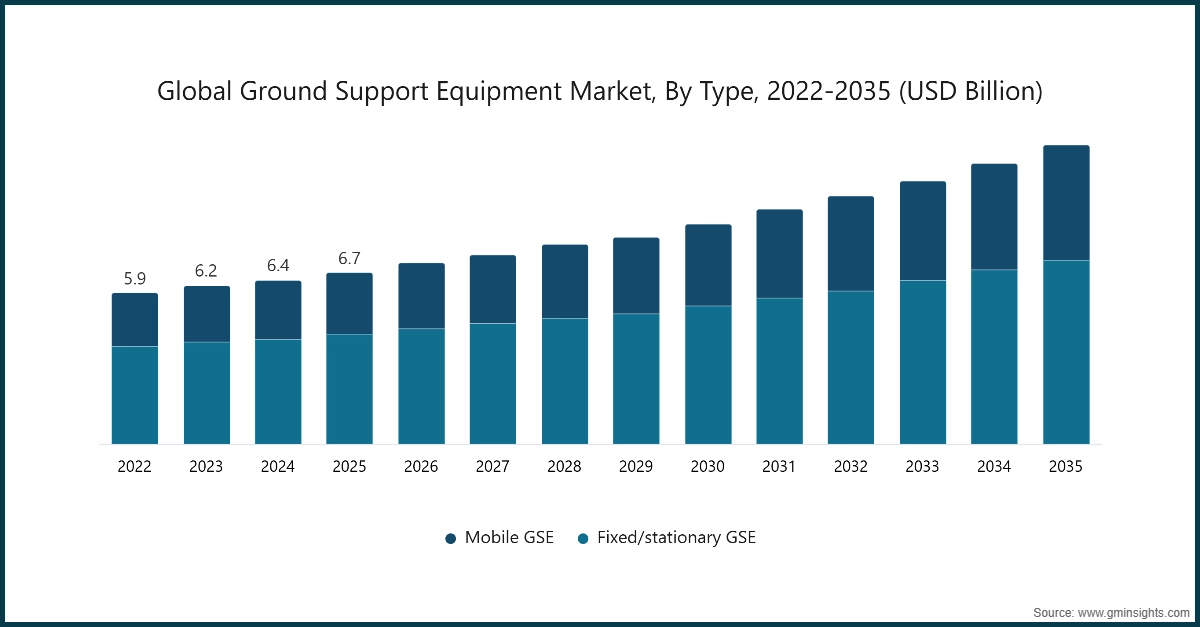
Between 2022 and 2024, the market witnessed considerable growth, increasing from USD 5.9 billion in 2022 to USD 6.5 billion in 2024 driven by rising flight counts, airport congestion levels, and replacements of aging GSE fleets. The major factors fueling market growth included rising rates of airport infrastructure development enhancements, increases in electric and digital-enabled GSE usage, and rising demand from LCCs flying on high frequency short-haul routes.
The global ground support equipment market was valued at USD 6.7 billion in 2025. The market is expected to grow from USD 7 billion in 2026 to USD 9.2 billion in 2031 & USD 11.8 billion in 2035, at a CAGR of 5.9% during the forecast period according to the latest report published by Global Market Insights Inc.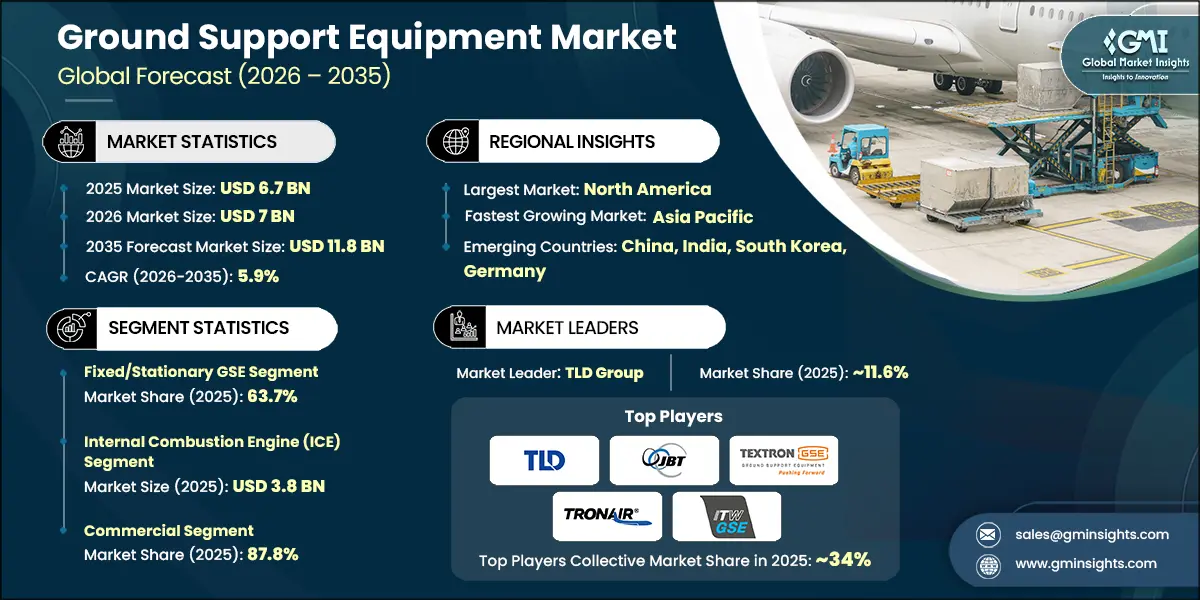
To get key market trends
Ground Support Equipment Market Trends
- The deployment of connected and telematics-enabled GSE is changing the way equipment utilization and maintenance planning are executed within the airport. The pace and momentum picked up from 2020 as operators sought to gain equipment visibility and reduce maintenance downtimes. This trend is likely to expand through 2030 with wider digital airport platforms. It enables real-time tracking, predictive maintenance, and improved fleet optimization, enhancing operational reliability and cost control.
- Automation and semi-autonomous GSE are now changing workflows within ground handling, especially for high-traffic airports. Deployments began early in 2021 to address labor shortages and safety concerns. Expansion will continue up to 2031 as regulatory acceptance continues. This offers greater consistency with ground services, reduces the risk of human error, and allows for faster standardized aircraft servicing.
- The increasing emphasis on standardization and modular design of GSE is also affecting procurement strategies of air carriers and ground handlers. The use of the technology is believed to increase between the years 2020, particularly, because of training and spares simplification considerations. There is also a chance that this technology will be used until 2030, owing to its importance in terms of fleet commonality. It lowers maintenance complexity, enhances scalability, and improves operational flexibility across diverse airport environments.
Ground Support Equipment Market Analysis
Learn more about the key segments shaping this market
Based on type, the global ground support equipment market is segmented into mobile GSE and fixed/stationary GSE.
- The fixed/stationary GSE segment led the market in 2025 with share of 63.7%, as permanently installed systems such as fixed ground power units and pre-conditioned air units are critical for high-traffic terminals. These systems reduce aircraft auxiliary power unit usage, lower emissions, and enhance apron efficiency. Their integration into terminal infrastructure ensures long-term operational reliability and regulatory compliance at major international airports.
- The mobile GSE segment is anticipated to grow at a CAGR of 6.5% over the forecast period. Growth is supported by increasing aircraft movement frequency, expansion of remote stands, and operational flexibility requirements. Mobile GSE offers scalable deployment, adaptability across aircraft types, and faster procurement cycles, making it essential for expanding airports and high-rotation airline operations.
Based on power source, the global ground support equipment market is classified into electric, internal combustion engine (ICE), and hybrid.
- The internal combustion engine (ICE) segment dominated the market in 2025 and valued at USD 3.8 billion due to its widespread legacy deployment, high torque output, and suitability for heavy-duty ramp operations. Diesel equipment remains prevalent in developing markets and high-capacity airports where charging infrastructure is limited. However, stricter emissions regulations, rising fuel costs, and sustainability targets are gradually reducing its long-term share despite continued operational reliability.
- The electric GSE segment is expected to witness growth at a CAGR of 6.3% during the forecast period due to increasing airport decarbonization mandates and airline sustainability commitments. Electric equipment reduces fuel consumption, lowers operating costs, and minimizes ramp noise and emissions. Advancements in lithium-ion battery performance, faster charging systems, and total cost-of-ownership benefits are accelerating fleet electrification across major global hubs.
Learn more about the key segments shaping this market
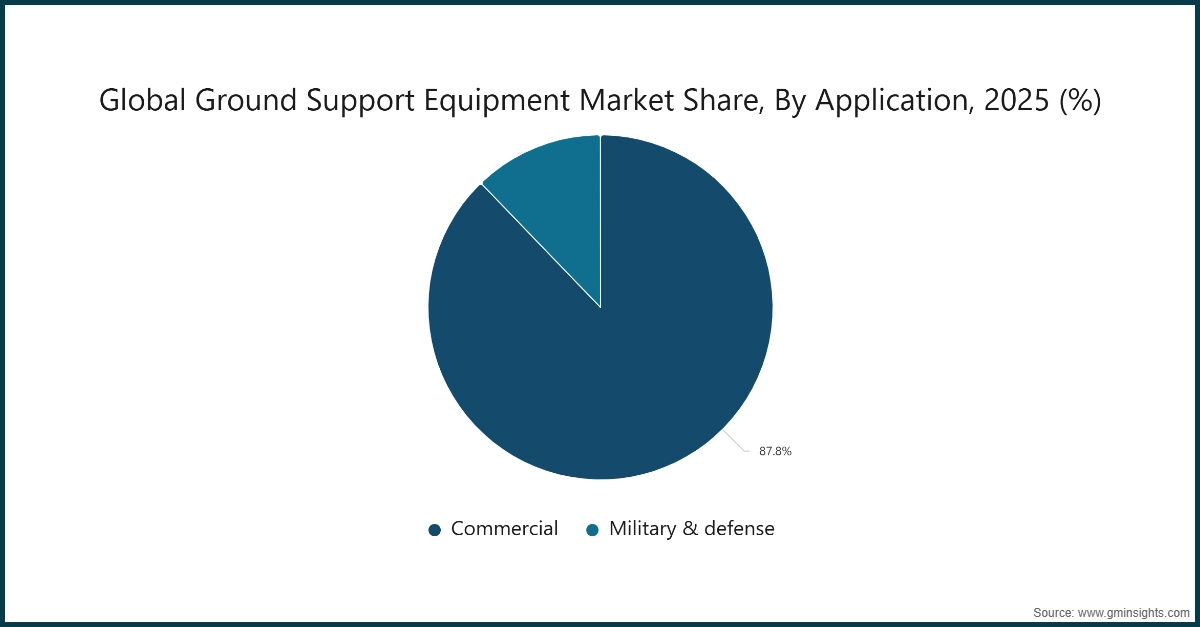
Based on application, the global ground support equipment market is segmented into commercial and military & defense.
- The commercial segment led the market in 2025 with a market share of 87.8%. Commercial aviation dominates the market due to the large number of passenger aircraft operations at major international and regional airports. Ground support equipment such as aircraft tugs, passenger boarding stairs, baggage loaders, ground power units, and aircraft refueling vehicles are essential for efficient aircraft turnaround and airport ground handling operations. The continuous expansion of airline fleets, increasing flight frequencies, and airport infrastructure upgrades are driving sustained demand for advanced and reliable ground support equipment across commercial aviation hubs.
- The military & defense segment is expected to grow at a CAGR of 6.3% during the forecast period. This growth is driven by increasing defense aviation activities, modernization of military airbases, and rising investments in advanced aircraft support infrastructure. Military operations require specialized ground support equipment including aircraft tow tractors, maintenance platforms, and power units designed for fighter jets, transport aircraft, and surveillance platforms. The expansion of defense aviation fleets and the establishment of modern airbase facilities are accelerating the adoption of high-performance ground support equipment in the military sector.
Looking for region specific data?
North America Ground Support Equipment Market
The North America held around 41.1% of ground support equipment industry share in 2025.
- In North America, the ground support equipment market is growing owing to the growth of air passenger traffic, capacity expansion of the airports, and increasing electrification of airside ground vehicles. Airfields in the U.S. and Canada are investing more in electric ground support equipment in order to meet federal and state emission reduction objectives.
- Airport authorities and airlines are using electric GPUs, tow tractors, and charging infrastructure in their sustainability strategies. Fleet modernization and automation projects are accelerating technology adoption. The region is expected to remain a technological leader in the deployment of electric and connected ground support equipment through 2035.
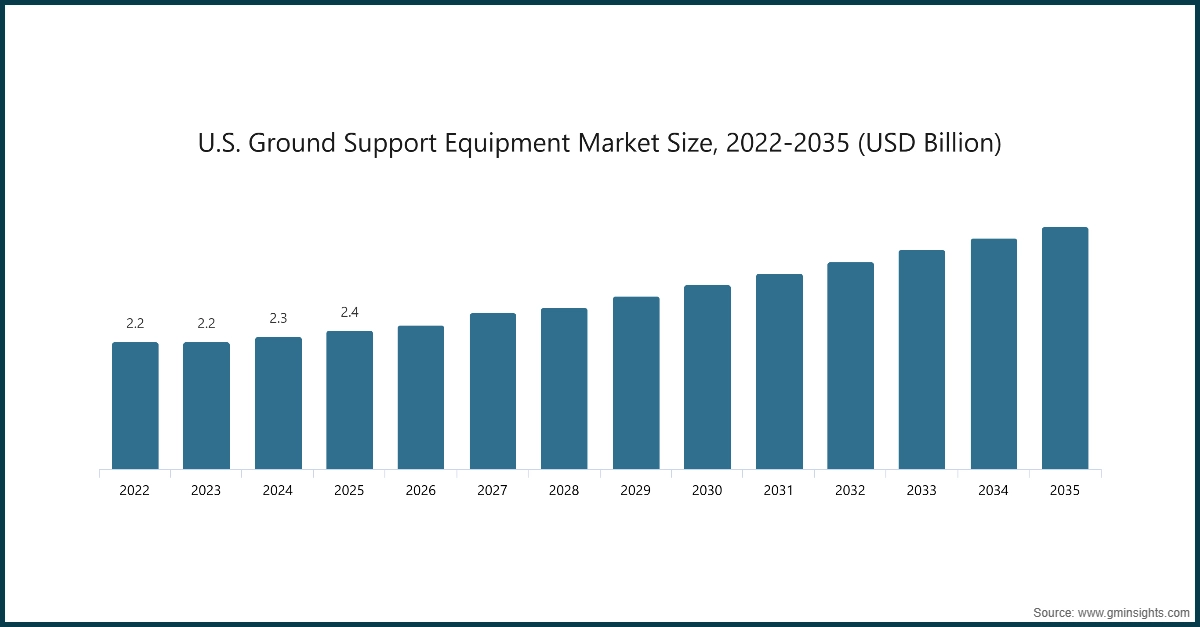
The U.S. ground support equipment market was valued at USD 2.2 billion and USD 2.2 billion in 2022 and 2023, respectively. The market size reached USD 2.4 billion in 2025, growing from USD 2.3 billion in 2024.
- The U.S. market is witnessing strong growth driven by federally funded airport modernization and sustainability initiatives. Under the Bipartisan Infrastructure Law, the Airport Infrastructure Grant (AIG) program allocates USD 15 billion (2022–2026) for airport projects, including airside upgrades.
- Additionally, the FAA’s Airport Zero Emissions Vehicle (ZEV) Program provides funding specifically for replacing fossil-fuel-powered GSE with electric equipment and installing charging infrastructure. These federal programs are directly accelerating electric GSE adoption across major U.S. airports, positioning the country as the leading market in North America.
Europe Ground Support Equipment Market
Europe market accounted for USD 1.6 billion in 2025 and is anticipated to show lucrative growth over the forecast period.
- Europe’s ground support equipment industry is expanding due to binding aviation decarbonization targets under the EU “Fit for 55” package and the ReFuelEU Aviation regulation, which are accelerating airport electrification and low-emission ground operations. The European Commission’s Alternative Fuels Infrastructure Regulation (AFIR) further supports deployment of electric charging infrastructure at transport hubs, including airports.
- Airports such as Amsterdam Schiphol, Paris Charles de Gaulle, and Frankfurt have implemented large-scale electric GSE transition programs aligned with net-zero airport roadmaps under ACI Europe’s Net Zero 2050 initiative. Additionally, EU taxonomy rules and green financing mechanisms are pushing airport operators to replace diesel GSE fleets with electric and hybrid alternatives, ensuring sustained technology upgrades across European hubs.
UK dominates the Europe ground support equipment market, showcasing strong growth potential.
- The UK market is supported by the government’s Jet Zero Strategy (2022), which targets net-zero aviation emissions by 2050 and promotes zero-emission airside operations. Heathrow Airport has committed to achieving net-zero carbon for airport operations by 2030, driving large-scale electrification of ground fleets and charging infrastructure deployment.
- Additionally, the UK Civil Aviation Authority’s sustainability reporting frameworks require airports to disclose carbon reduction measures, directly influencing GSE fleet modernization. Major UK airports, including Heathrow and Gatwick, have introduced electric ground handling equipment programs aligned with carbon-neutral airport operations, positioning the UK as a leading European adopter of low-emission GSE technologies.
Asia Pacific Ground Support Equipment Market
The Asia Pacific market is anticipated to grow at the highest CAGR of 8% during the forecast period.
- The Asia Pacific market is expanding rapidly due to large-scale airport capacity expansion programs and rising aircraft movements across major hubs. According to Airports Council International (ACI), Asia-Pacific airports have outlined multi-billion-dollar infrastructure pipelines through 2035 to accommodate long-term passenger traffic growth.
- Countries such as India are executing phased airport development programs under public–private partnership (PPP) models, while Southeast Asian nations are upgrading secondary airports to handle narrowbody traffic growth. Additionally, regional sustainability roadmaps, including airport carbon accreditation participation across APAC hubs, are accelerating the transition toward electric and hybrid GSE fleets, supporting sustained modernization of airside operations.
China ground support equipment market is estimated to grow with a significant CAGR, in the Asia Pacific market.
- China dominates the Asia Pacific ground support equipment industry due to its centrally coordinated aviation infrastructure strategy led by the Civil Aviation Administration of China (CAAC). The government prioritizes airport construction and hub development under national Five-Year Plans, positioning civil aviation as a strategic growth sector. Major new-generation airports are designed with advanced apron layouts, automated stand allocation, and integrated airside logistics systems.
- Additionally, China’s Green Airport program mandates low-emission and electric ground operations at key hubs, accelerating fleet replacement cycles. Strong domestic manufacturing capabilities and state-supported procurement policies further strengthen China’s leadership in technologically advanced and electric GSE deployment across the region.
Middle East and Africa Ground Support Equipment Market
Saudi Arabia ground support equipment industrty to experience substantial growth in the Middle East and Africa.
- Saudi Arabia’s ground support equipment market is expanding in line with the Kingdom’s Vision 2030 aviation transformation strategy, which prioritizes positioning the country as a global air transport and logistics hub. The General Authority of Civil Aviation (GACA) is advancing large-scale airport privatization and expansion programs, including King Salman International Airport in Riyadh and capacity upgrades at Jeddah and Dammam. The National Aviation Strategy emphasizes operational efficiency, fleet readiness, and sustainability across airport infrastructure.
- In parallel, Saudi Green Initiative commitments are accelerating the transition toward electric ground operations and low-emission airside equipment, encouraging airports and ground handlers to modernize and electrify GSE fleets to align with national decarbonization objectives.
Ground Support Equipment Market Share
The ground support equipment industry is led by players such as TLD Group, JBT Corporation, Textron Ground Support Equipment Inc., Tronair Inc., and ITW GSE. These five companies collectively accounted for 34% share of the global market in 2025, supported by diversified equipment portfolios, strong OEM relationships, and extensive international service networks. Their comprehensive offerings across aircraft towing, ground power, air start, cargo handling, and electric GSE platforms enable broad penetration across commercial, military, and business aviation segments.
These companies maintain competitive advantage through electrification strategies, telematics integration, lifecycle service contracts, and continuous investment in product engineering and emission-compliant technologies. Strategic global manufacturing footprints and long-term airport partnerships further strengthen their ability to capture sustained demand arising from airport modernization, fleet expansion, and sustainability initiatives across major aviation markets.
Ground Support Equipment Market Companies
Prominent players operating in the ground support equipment industry are as mentioned below:
- AERO Specialties
- Air+MAK Industries Inc.
- ATEC Inc.
- Charlatte Manutention
- Cobus Industries
- Eagle Tugs
- ITW GSE
- Japanese GSE manufacturers
- JBT Corporation
- Rheinmetall AG
- Sinfonia Technology Co. Ltd.
- Textron Ground Support Equipment Inc.
- TLD Group
- Tronair Inc.
- Unitron, LP
- Weihai Guangtai Airport Equipment
- TLD Group
TLD Group offers products ranging from aircraft tractors, aircraft loaders, passenger steps, to electric GSE, which aim to bring a whole new level of aircraft servicing at airports whose ground handlers want to improve efficiency, reduce emissions, and improve their sustainable development programs.
JBT Corporation offers ground handling solutions equipped with advanced technologies. Their products include cargo loaders, de-icers, pushback tractors, and automated gates. The company offers digital solutions and electric technology that facilitate efficiency, safety, and effectiveness in ground handling operations, whether it is a commercial or military airport.
Textron Ground Support Equipment Inc. offers aircraft servicing equipment under established brands, based on reliability, durability, international model availability, and support. It serves commercial, military air forces, and ground handling organizations as a single supplier of reliable, high-quality aircraft ground support equipment.
Tronair Inc. provides solutions related to ground support equipment, including specific tow bars, jacks, tugs, and support equipment for airlines. They gain this by enabling compatibility across several aircraft types and distributing to all aviation markets. They serve business aviation, military aviation, and the commercial aviation sectors.
ITW GSE specializes in the manufacturing and distribution of efficient and high-performance ground power equipment, air start equipment, and preconditioned air systems that help minimize fuel consumption and emissions. Moreover, the firm puts significant emphasis on energy optimization, silent operations, and strictly adheres to strict regulations pertinent to airport environment regulations.
Ground Support Equipment Market Report Attributes
| Key Takeaway | Details |
|---|---|
| Market Size & Growth | |
| Base Year | 2025 |
| Market Size in 2025 | USD 6.7 Billion |
| Market Size in 2026 | USD 7 Billion |
| Forecast Period 2026-2035 CAGR | 5.9% |
| Market Size in 2035 | USD 11.8 Billion |
| Key Market Trends | |
| Drivers | Impact |
| Global commercial aircraft fleet expansion | Accounts for 24% growth by increasing the number of active aircraft, directly driving demand for towing tractors, loaders, ground power units, and maintenance GSE to support higher aircraft utilization across airports worldwide. |
| Stringent airport turnaround time requirements | Drives 20% growth as stringent airport turnaround time requirements push airlines and ground handlers to deploy faster, highly reliable GSE that minimizes aircraft ground time, supports parallel servicing activities, and improves on-time departure performance at congested airports. |
| Rising airport infrastructure modernization projects | Contributes 18% as rising airport infrastructure modernization projects expand apron capacity, add new gates, and upgrade ground handling zones, increasing procurement of next-generation GSE to support higher aircraft throughput and compliance with modern operational standards. |
| Growth in low-cost carrier operations | Supports 18% growth as growth in low-cost carrier operations increases aircraft movement frequency, intensifying demand for standardized, high-utilization GSE optimized for short-haul, high-rotation flight operations. |
| Airline focus on operational efficiency | Adds 17% growth as airlines focus on operational efficiency, leading to investments in fuel-efficient, low-maintenance, and automated GSE solutions that reduce labor costs and improve asset productivity. |
| Pitfalls & Challenges | Impact |
| Complex regulatory compliance across regions | Restrains market growth as complex regulatory compliance across regions requires GSE manufacturers and operators to meet varying emissions, safety, and operational standards, increasing certification costs and delaying cross-border equipment deployment. |
| Limited charging infrastructure at regional airports | Limits growth due to limited charging infrastructure at regional airports, which constrains large-scale adoption of electric GSE, particularly in developing markets where grid capacity and charging investments remain insufficient. |
| Opportunities: | Impact |
| Smart GSE integration with airport automation systems | Presents strong growth opportunity through smart GSE integration with airport automation systems, enabling real-time equipment tracking, predictive maintenance, and optimized ground operations via seamless connectivity with airport management platforms. |
| Aftermarket services and fleet retrofitting demand | Offers significant opportunity from rising aftermarket services and fleet retrofitting demand, as airports and ground handlers extend asset lifecycles through electrification upgrades, digital retrofits, spare parts replacement, and long-term maintenance contracts. |
| Market Leaders (2025) | |
| Market Leader |
~11.6% market share. |
| Top Players |
Collective Market Share of ~34% |
| Competitive Edge |
|
| Regional Insights | |
| Largest Market | North America |
| Fastest Market | Asia Pacific |
| Emerging Countries | China, India, South Korea, Germany |
| Future Outlook |
|
What are the growth opportunities in this market?
Ground Support Equipment Industry News
- In September 2025, Textron Ground Support Equipment Inc. showcased its latest electrified GSE lineup including the Endurance high-voltage tractor and the Safeaero 220E electrified deicer at the GSE Expo 2025, featuring automotive-style charging compatibility and extended runtime performance that drive sustainable ramp operations and broader adoption of electric ground handling equipment in commercial aviation.
- In September 2025, TLD Group partnered with BKJ Airports to deploy a next-generation electric ground support equipment fleet, including electric coaches and ramp cars, as part of a strategic move toward greener airport operations in India. This large-scale rollout underscores TLD’s expanding footprint in emerging markets and its commitment to sustainable, efficient ground support solutions.
- In November 2024, JBT Corporation secured multi-hub electric GSE contracts to supply and service fleets of electric GPUs and tow tractors across major U.S. airports, supporting reduced emissions and improved turnaround performance.
The ground support equipment market research report includes in-depth coverage of the industry with estimates and forecast in terms of revenue (USD Million) from 2022 – 2035 for the following segments:
Market, By Type
- Mobile GSE
- Self-propelled equipment
- Towable equipment
- Fixed/stationary GSE
- Passenger boarding bridges
- Fixed ground power units
- Fixed pre-conditioned air systems
Market, By Power Source
- Electric
- Battery-electric systems (lithium-ion)
- Battery-electric systems (lead-acid)
- Grid-powered systems
- Internal combustion engine (ICE)
- Hybrid
Market, By Equipment Type
- Aircraft movement & positioning equipment
- Pushback tractors
- Luggage tugs
- Chocks & wheel restraints
- Others
- Cargo & baggage handling equipment
- Belt loaders
- Container & pallet loaders
- Cargo dollies & baggage carts
- Conveyor systems
- Others
- Passenger handling equipment
- Passenger boarding bridges (PBBs)
- Passenger stairs
- Apron buses
- Others
- Aircraft servicing equipment
- Ground power units (GPUs)
- Pre-conditioned air units (PCAs/ACUs)
- Fuel trucks & refueling systems
- Others
- Aircraft safety & maintenance equipment
- Air start units (ASUs)
- Deicing & anti-icing equipment
- Maintenance stands & platforms
- Others
- Others
Market, By Automation Level
- Conventional/manual-operated GSE
- Semi-automated GSE (Telematics & IoT-Enabled)
- Autonomous GSE (AGVS)
- Autonomous tugs & tractors
- Autonomous baggage vehicles
- Autonomous maintenance equipment
Market, By Application
- Commercial aviation
- Passenger airlines
- Cargo airlines
- Business aviation
- Military & defense aviation
Market, By Ownership
- Airport-owned GSE
- Airline-owned GSE
- Ground handling service provider-owned GSE
- Leased GSE
The above information is provided for the following regions and countries:
- North America
- U.S.
- Canada
- Europe
- Germany
- UK
- France
- Spain
- Italy
- Netherlands
- Asia Pacific
- China
- India
- Japan
- Australia
- South Korea
- Latin America
- Brazil
- Mexico
- Argentina
- Middle East and Africa
- South Africa
- Saudi Arabia
- UAE
Frequently Asked Question(FAQ) :
What is the market size of the ground support equipment in 2025?
The market size was USD 6.7 billion in 2025, with a CAGR of 6.3% expected through 2035 driven by commercial aircraft fleet expansion, airport infrastructure modernization, and the rise of low-cost carrier operations.
What is the projected value of the ground support equipment industry by 2035?
The ground support equipment market is expected to reach USD 12.4 billion by 2035, propelled by accelerating airport decarbonization mandates, adoption of electric and sustained investment in airport capacity expansion worldwide.
What is the current ground support equipment industry size in 2026?
The market size is projected to reach USD 7.1 billion in 2026.
How much revenue did the third-party ground handling service providers segment generate in 2025?
Third-party ground handling service providers led the end-user market with a 32.8% share in 2025, driven by increasing outsourcing of ramp, baggage, and aircraft servicing operations by airlines and airports requiring diversified, high-utilization GSE fleets.
What was the market share of the fixed/stationary GSE segment in 2025?
The fixed/stationary GSE segment dominated the market with a 63.7% share in 2025, as permanently installed systems such as fixed ground power units and pre-conditioned air units are critical for high-traffic terminal.
What is the growth outlook for the electric GSE power source segment?
The electric GSE segment is the fastest-growing power source category with a CAGR of 9.3% expected through 2035, driven by increasing airport decarbonization mandates.
Which region leads the ground support equipment market?
North America leads the global ground support equipment market, accounting for a 41.1% market share in 2025, supported by accelerating electric GSE adoption across major U.S. airports.
What are the key trends shaping the ground support equipment market?
Key trends include adoption of connected telematics-enabled GSE for real-time monitoring, increasing automation to address labor shortages, growing electrification of ground fleets, and rising standardization in GSE procurement.
Who are the key players in the ground support equipment market?
Key players include TLD Group, JBT Corporation, Textron Ground Support Equipment Inc., Tronair Inc., and ITW GSE.
Ground Support Equipment Market Scope
Related Reports