Summary
Table of Content

Green Building Market
Get a free sample of this report
Form submitted successfully!
Error submitting form. Please try again.
Thank you!
Your inquiry has been received. Our team will reach out to you with the required details via email. To ensure that you don't miss their response, kindly remember to check your spam folder as well!
Request Sectional Data
Thank you!
Your inquiry has been received. Our team will reach out to you with the required details via email. To ensure that you don't miss their response, kindly remember to check your spam folder as well!
Form submitted successfully!
Error submitting form. Please try again.
Green Building Market Size
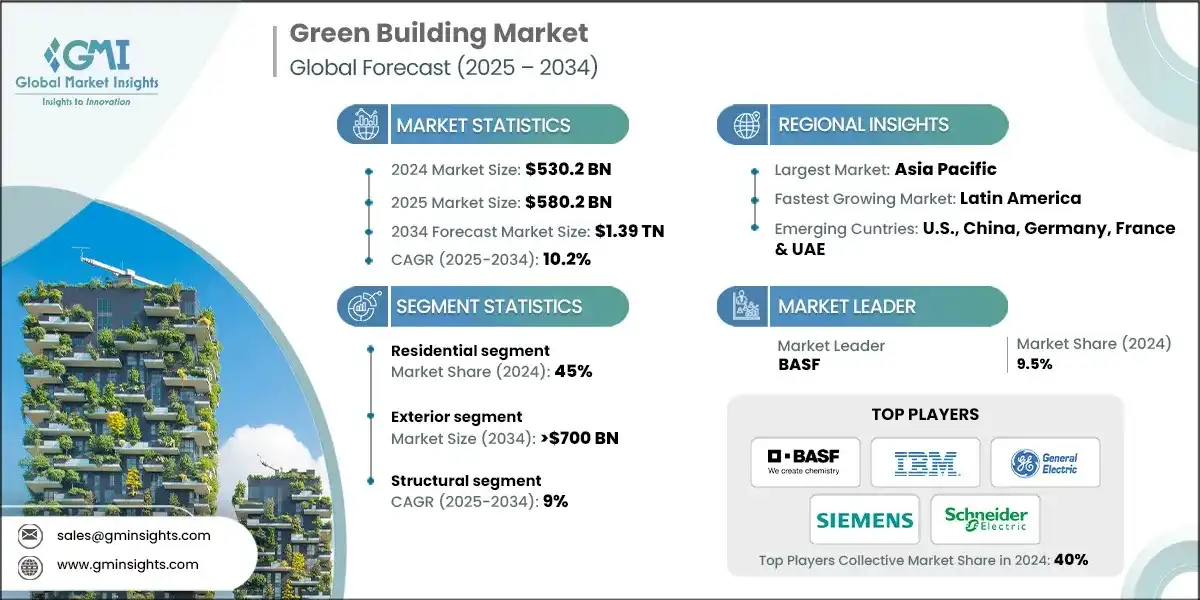
According to a recent study by Global Market Insights Inc., the green building market was estimated at USD 530.2 billion in 2024. The market is expected to grow from USD 580.2 billion in 2025 to USD 1.39 trillion by 2034, at a CAGR of 10.2%.
Green Building Market Key Takeaways
Market Size & Growth
- 2024 Market Size: USD 530.2 Billion
- 2025 Market Size: USD 580.2 Billion
- 2034 Forecast Market Size: USD 1.39 Trillion
- CAGR (2025–2034): 10.2%
Key Market Drivers
- Increasing environmental regulations.
- Rising demand for energy-efficient buildings.
- Growing adoption of sustainable construction materials & technologies.
Challenges
- High initial construction and material costs.
Opportunity
- Integration of smart building technologies.
- Government incentives and green financing.
- Retrofit and renovation of existing buildings.
- Expansion of net-zero and positive-energy buildings.
Key Players
- Market Leader: BASF led with over 9.5% market share in 2024.
- Leading Players: Top 5 players in this market include BASF, IBM, General Electric Company, Siemens, Schneider Electric, which collectively held a market share of 40% in 2024.
Get Market Insights & Growth Opportunities
- The industry is expanding rapidly as governments, developers and consumers prioritize sustainability, energy efficiency & environmental protection. Rising urbanization along with strict building codes and growing awareness of carbon footprints are accelerating the product adoption. Technologies such as smart HVAC, energy-efficient materials and on-site renewables are now standard components, driving long-term transformation of construction practices.
- Green buildings are structures constructed, designed & operated to minimize environmental impact while maximizing resource efficiency and occupant well-being. They use energy-efficient systems, sustainable materials, water-saving technologies, and low-emission construction practices. These reduce carbon footprints, lower operating costs, enhance indoor environmental quality, and support long-term ecological sustainability across various applications.
- For illustration, in March 2023, the U.S. Green Building Council reported that LEED projects have diverted over 80 million tons of waste from landfills to date, projected to reach 540 million tons by 2030. LEED-certified buildings average an ENERGY STAR score of 89 out of 100, with a study of 7,100 certified projects finding that more than 90% achieved at least 10% energy performance improvement.
- The green building market was valued at USD 401.9 billion in 2021 and grew at a CAGR of approximately 6% through 2024. Increased collaboration between governments, financial institutions and developers will further accelerate the product penetration, making sustainable construction the industry norm worldwide.
- Demand for green buildings is propelled by regulatory mandates, voluntary certification programs including LEED and BREEAM, and corporate net-zero commitments. Cost savings from reduced energy and water consumption also motivate adoption. Additionally, increasing public pressure for climate-conscious development encourages builders to integrate eco-friendly materials, waste-reduction practices and smart systems, strengthening the industry momentum.
- Multinational companies are upgrading offices, factories and logistics hubs to meet carbon-reduction targets. Green buildings help them align with Scope 1–3 emission goals, reduce operational energy intensity, and qualify for global sustainability ratings. This corporate shift is stimulating large, multi-year green building investments & offering significant opportunities for business expansion.
- For instance, in November 2023, the American Society of Heating, Refrigerating and Air-Conditioning Engineers (ASHRAE) published Standard 228 for evaluating zero net energy and zero net carbon building performance. The standard provides standardized definitions, calculation methods, and verification procedures for net-zero buildings, supporting consistent evaluation and comparison.
To get key market trends
Green Building Market Trends
- The innovations including smart sensors, IoT-enabled building automation, AI-based energy optimization and modular prefabrication are redefining green construction. Advanced insulation, high-performance glazing and recycled composites are improving building efficiency. These technologies reduce lifecycle emissions and operational costs while enhancing occupant comfort, making green buildings technologically superior and increasingly attractive to governments, corporations and residential buyers.
- The government is implementing green codes, carbon reduction standards and incentives such as tax rebates, green loans and mandatory energy audits. Urban planning laws increasingly require sustainable materials, rainwater harvesting and efficient HVAC systems. Certification standards guide developers toward eco-compliant practices, encouraging transparency and performance benchmarking across residential, commercial and industrial construction segments.
- The industry is set to grow significantly as decarbonization, circular economy principles and climate-resilient infrastructure become central to global policy. Smart energy systems, net-zero buildings and nature-based design will shape future developments.
- For citation, in January 2024, China released its 2024-25 Energy Conservation & Carbon Reduction Action Plan, targeting 2.5% national energy intensity improvement in 2024 with 3.5% improvement in large industries, and approximately 100 million tons of coal equivalent (2.9 EJ) savings over 2024-25. The plan includes sectoral targets for buildings, industry, and transportation, and emphasizes digital technology deployment for energy management.
- The rapid expansion of ESG reporting and sustainable finance is emerging as a major market driver. Green bonds, sustainability-linked loans and climate-aligned investment criteria are pushing developers to adopt certified green buildings. Financial institutions increasingly reward energy-efficient and low-carbon projects with better lending terms, accelerating large-scale adoption and strengthening long-term sustainable construction pipelines.
- Rising investing in smart cities is creating strong demand for green buildings that integrate digital infrastructure. Real-time energy monitoring, automated climate control, predictive maintenance and integrated renewable systems boost building efficiency and performance. As cities adopt digital twins, 5G connectivity and sensor-rich utilities, green buildings become essential nodes, accelerating market growth across urban development projects.
- For instance, global energy efficiency investment in buildings reached approximately USD 300 billion in 2021, representing a 10% increase, though this must triple by 2030 to align with net-zero pathways as per the International Energy Agency. This driver is estimated to add 15% to the market's CAGR through direct demand for energy-efficient building solutions and technologies.
Green Building Market Analysis
Learn more about the key segments shaping this market
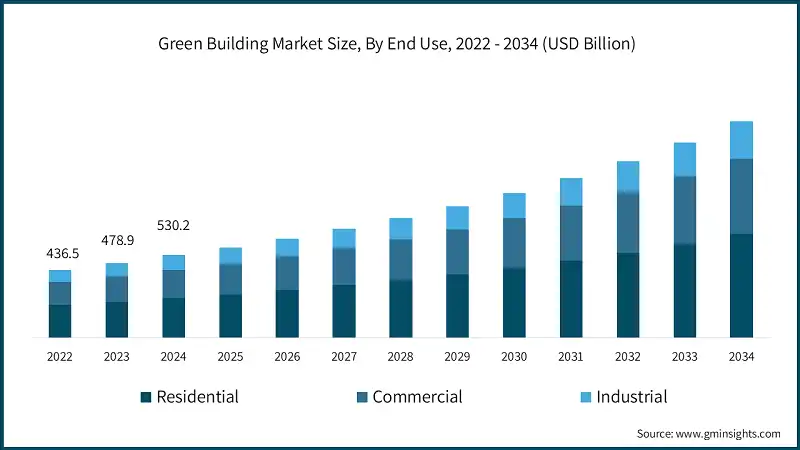
- Based on end use, the industry is segmented into residential, commercial and industrial. The residential segment holds a share of about 45% in 2024 and is projected to grow at a rate of over 9.5% through 2034.
- The market is expanding as homeowners prioritize energy efficiency, healthier indoor environments, and lower long-term operating costs. The demand is driven by eco-friendly materials, smart home integration, and sustainable construction practices that reduce carbon footprints. Government incentives in line with rising environmental awareness, and stricter building codes will support the product adoption, positioning green buildings as one the major contributor to sustainable urban development.
- The commercial segment is set to exceed USD 450 billion by 2034. The industry is growing rapidly as businesses pursue energy-efficient facilities that lower operating expenses and enhance corporate sustainability goals. Demand is driven by green certifications, advanced HVAC systems, renewable energy integration, and smart building technologies.
- The industrial application was valued at USD 94.8 billion in 2024. The industrial green building market is expanding as manufacturers adopt sustainable facility designs to reduce energy consumption, optimize resource use, and meet environmental compliance standards.
- Growing emphasis on renewable energy integration, waste minimization, and eco-efficient materials supports adoption. Companies also leverage green buildings to enhance operational efficiency, lower emissions, and strengthen sustainability commitments, driving robust growth across industrial sectors.
- For instance, in 2022, direct CO2 emissions from building operations totaled 3 Gt CO2, while indirect emissions from electricity and heat used in buildings reached approximately 6.8 Gt CO2, growing approximately 1.4% year-over-year due to increased electricity consumption according to IEA data.
Learn more about the key segments shaping this market
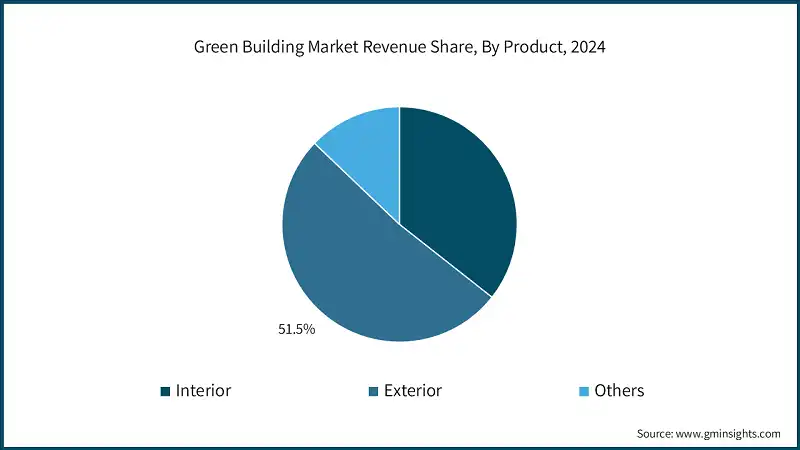
- Based on product, the industry is divided into interior, exterior and others. The exterior green building market holds a share of 51.5% in 2024 and is set to reach over USD 700 billion by 2034.
- Interior green building was estimated at USD 188.8 billion in 2024. The market is advancing as builders and occupants prioritize eco-friendly materials, healthier indoor environments, and energy-efficient systems. Demand is driven by low-VOC paints, recycled furnishings, natural lighting, and smart controls that optimize air quality and comfort. Rising sustainability standards, wellness certifications, and corporate ESG goals further accelerate deployment, making green interiors a key component of modern sustainable construction.
- For instance, the International Finance Corporation estimates that global incremental investment for energy-efficient construction from 2022 to 2035 will total approximately USD 3.5 trillion, with emerging markets requiring approximately USD 1.5 trillion of this total as per IFC analysis.
- The exterior market is set to grow at a rate of over 10% from 2025 to 2034. The market will gain an appreciable momentum as developers adopt sustainable façade materials, energy-efficient envelopes, and climate-responsive designs. Demand is driven by advanced insulation, green roofs, solar-integrated exteriors, and durable recycled materials that enhance performance and reduce lifecycle costs. Stricter building codes, climate resilience goals, and rising awareness of long-term environmental benefits continue to fuel strong growth in this segment.
- Based on material type, the industry is bifurcated into structural, insulation, finishing and glass & glazing. The structural green building industry will witness a CAGR of about 9% by 2034.
- The market is growing as developers prioritize sustainable construction frameworks that enhance durability, reduce embodied carbon, and improve energy performance. Rising sustainability regulations, green certification requirements, and cost benefits from efficient structural designs are driving adoption, positioning structural systems as a core component of modern green buildings.
- The insulation green building market is witnessing strong momentum as sustainable thermal protection becomes central to modern construction. Growing regulatory pressure coupled with higher energy prices, and green certification targets continue to accelerate the adoption of advanced, environmentally responsible insulation technologies.
- The finishing green building market is gaining traction as developers emphasize sustainable materials and low-impact design elements. Environmentally friendly paints, recycled flooring, energy-efficient lighting, and water-saving fixtures are increasingly preferred to enhance indoor quality and reduce lifecycle impacts. Supportive regulations are in line with rising consumer awareness, and the push for green certifications continue to strengthen adoption across residential, commercial, and industrial projects.
- Growing emphasis on energy-efficient building envelopes is driving the glass and glazing green building market, with advanced materials enhancing sustainability and performance. Low-emissivity glass insulated glazing units, and solar-control coatings help reduce heat loss and optimize natural lighting. Stricter energy codes, rising environmental awareness, and demand for high-performance fades continue to accelerate adoption across modern construction projects.
Looking for region specific data?
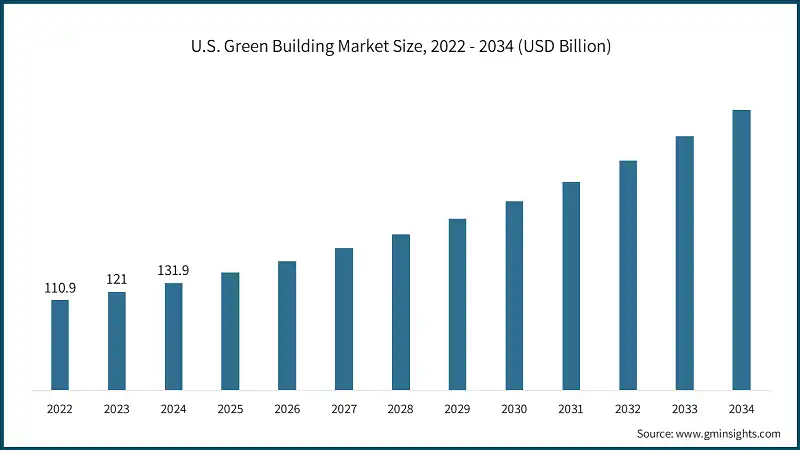
- The U.S. dominated the green building market in North America with around 80% share in 2024 and generated USD 131.9 billion in revenue. Growing environmental priorities and strict efficiency standards are propelling the market, with developers increasingly adopting sustainable materials and advanced energy-saving technologies. Strong federal and state incentives, widespread use of LEED and WELL certifications, and rising corporate ESG commitments further accelerate the adoption. Demand for healthier spaces and long-term cost savings continues to drive the business growth.
- The North America green building market is projected to hit USD 400 billion by 2034. Rising sustainability goals and stricter environmental regulations are accelerating the growth of the industry. Developers increasingly adopt energy-efficient designs, eco-friendly materials, and smart building technologies to reduce carbon footprints and operating costs. Strong policy support, widespread certification programs, and growing demand for healthier indoor environments continue to drive industry penetration.
- For instance, in October 2024, the International Finance Corporation published Building Green: Sustainable Construction in Emerging Markets, providing comprehensive analysis of construction value chain emissions and investment requirements. The report estimates that emerging markets require approximately USD 1.5 trillion in incremental green construction investment from 2022 to 2035, with detailed regional breakdowns and technology pathways.
- Growing momentum for sustainable construction is shaping the Europe green building market, where strict climate policies and energy-efficiency rules guide development. Builders are adopting low-carbon materials, advanced insulation, and smart technologies to reduce emissions. Rising demand for healthier spaces and long-term cost savings continue to drive adoption across key sectors.
- For illustration, in May 2024, the European Union reported progress on its Renovation Wave initiative, with member states submitting updated long-term renovation strategies pursuant to the revised Energy Performance of Buildings Directive. The strategies outline pathways to achieve zero-emission building stock by 2050, with interim targets for 2030 and 2040.
- The Asia Pacific accounts for about 20% of the green building market share in 2024. Strong urbanization & rising environmental awareness are driving the market, with governments enforcing stricter efficiency standards and promoting sustainable construction. Developers increasingly adopt energy-saving technologies, eco-friendly materials, and certified designs. Growing demand for healthier indoor environments along with reduced operational costs will favor the business scenario.
- For citation, the World Bank released a comprehensive global dataset on building energy codes, covering 88 countries with mandatory codes or standards. The Mapping Energy Efficiency dataset provides standardized metrics on code existence, coverage, enforcement, compliance, and stringency of requirements, enabling cross-country comparisons and benchmark.
- The Middle East & Africa green building market is set to grow at a rate of over 10.5% by 2034. Rising focus on energy efficiency in line with sustainable urban development is shaping the industry. Governments are promoting eco-friendly construction through stricter regulations and green certification programs. Developers increasingly adopt advanced insulation, solar-integrated systems, and water-saving technologies, supporting the business growth.
- For instance, IEA analysis indicates that under the Net Zero Emissions by 2050 Scenario, all new buildings and about 20% of existing stock must reach zero-carbon-read standards by 2030. Achieving this target requires building energy intensity to drop roughly 35% from 2022 levels almost five times the pace of improvement seen over the past decade.
- Paradigm shift toward climate-resilient infrastructure and stronger public–private sustainability partnerships are stimulating the Latin America green building market. Governments are prioritizing disaster-resistant designs, while developers incorporate natural ventilation, passive cooling, and locally sourced materials. Growing investment in low-carbon construction and community-focused urban planning is further accelerating the industry potential.
Green Building Market Share
- The top 5 players in green building industry are BASF, IBM, General Electric Company, Siemens and Schneider Electric contribute around 40% of the market share in 2024.
- The green building industry is characterized by steady expansion driven by rising sustainability mandates, increasing energy costs, and growing environmental awareness. It operates as a multi-disciplinary market integrating construction, advanced materials, renewable technologies, and smart building systems. The market is highly innovation-oriented, influenced by evolving regulations, green certifications, and investor preference for low-carbon assets.
- In Q1 2025, General Electric Company, now operating primarily as GE Aerospace, reported net sales of USD 9.9 billion, reflecting solid year-over-year growth. The company achieved strong profitability, recording an EBITDA of approximately USD 2.8 billion and generating USD 1.4 billion in free cash flow, supported by robust demand across its aviation portfolio.
- In 2024, Daikin Industries reported USD 30.3 billion in sales revenue and an operating profit margin of approximately 8.9%, reflecting strong performance across its global HVAC portfolio. The company demonstrated solid operational resilience amid fluctuating demand and cost pressures, while continuing to prioritize innovation, energy-efficient technologies, and strategic expansion to support long-term, sustainable growth.
- In 2024, ABB reported USD 32.9 billion in net sales, underlining its solid market presence. Its operational EBITA rose to USD 5.9 billion, corresponding to an EBITA margin of 18.1%, evidenced by strong operational efficiency. It posted a net income of USD 3.9 billion, up compared with prior year’s results, illustrating enhanced profitability. The company continues to focus on its strategic goals strengthening its leadership in electrification and automation, boosting innovation, and investing in growth areas to drive sustained and high-quality value creation.
Green Building Market Companies
Major players operating in the green building industry are:
- ABB
- Alleguard
- Alumasc Building Products
- BASF
- Bauder
- Binderholz
- Bosch Sicherheitssysteme
- BSW GROUP
- CEMEX
- CertainTeed
- Daikin
- DuPont
- Forbo
- General Electric Company
- HOLCIM
- IBM
- Interface
- Johnson Controls
- Kingspan Group
- Owens Corning
- RedBuilt
- Schneider Electric
- Siemens
- Signify Holding
- BASF is a chemical company providing construction chemicals, insulation materials, coatings, and sustainable solutions for buildings. The company's portfolio includes polyurethane insulation systems, concrete admixtures, and exterior insulation finishing systems (EIFS).
- IBM specializes in providing smart building solutions, IoT platforms, artificial intelligence for building optimization, and data analytics. Its Maximo Application Suite includes building management capabilities, while Watson IoT enables predictive maintenance and energy optimization.
- General Electric Company offers comprehensive solutions including building automation and controls, energy-efficient lighting, HVAC equipment, renewable energy systems, energy storage, and digital platforms for building energy management. Its integrated approach and presence position as a preferred partner for large-scale commercial and institutional green building projects.
- Siemens is a technology company providing building automation, fire safety, security, and HVAC controls. The company’s platform offers integrated building management, while the company's smart infrastructure division addresses electrification, automation, and digitalization of buildings.
- Schneider Electric is a specialist in energy management and automation. Its EcoStruxure platform provides IoT-enabled solutions for buildings, including building management systems, power distribution, lighting controls, and energy analytics. The company is recognized as a sustainability leader and offers comprehensive solutions for net-zero buildings.
Green Building Market Report Attributes
| Key Takeaway | Details |
|---|---|
| Market Size & Growth | |
| Base Year | 2024 |
| Market Size in 2024 | USD 530.2 Billion |
| Market Size in 2025 | USD 580.2 Billion |
| Forecast Period 2025 - 2034 CAGR | 10.2% |
| Market Size in 2034 | USD 1.39 Trillion |
| Key Market Trends | |
| Drivers | Impact |
| Increasing environmental regulations | Governments are enforcing stricter building energy codes, carbon-emission targets, and sustainability mandates, driving developers toward green construction practices. |
| Rising demand for energy-efficient buildings | Building owners and occupiers are prioritizing lower operating costs, reduced energy consumption, and improved indoor environmental quality all of which push demand for green buildings. |
| Growing adoption of sustainable construction materials & technologies | Advances in eco-friendly materials, smart building systems, and renewable energy integration are making green buildings more practical and cost-effective. |
| Pitfalls & Challenges | Impact |
| High initial construction and material costs | Green buildings often require certified sustainable materials, advanced HVAC systems, energy-efficient technologies, and specialized design expertise. |
| Opportunities: | Impact |
| Integration of smart building technologies | The rise of IoT, AI-driven building management, and digital twins offers significant opportunities to optimize energy performance, reduce operational costs, and enhance occupant comfort within green buildings. |
| Government incentives and green financing | Expanding carbon-reduction policies, green bonds, and tax incentives are creating new funding and investment opportunities for developers, contractors, and technology providers focused on sustainable construction. |
| Retrofit and renovation of existing buildings | A vast share of the global building stock is old and energy inefficient. This creates strong opportunities for energy-efficient retrofits, HVAC upgrades, insulation improvements, smart meters, and renewable system integration. |
| Expansion of net-zero and positive-energy buildings | Growing climate commitments are pushing demand for buildings that generate as much or more energy than they consume, creating opportunities in advanced insulation, on-site renewables, and smart energy systems. |
| Market Leaders (2024) | |
| Market Leaders |
9.5% market share |
| Top Players |
Collective market share in 2024 is 40% |
| Competitive Edge |
|
| Regional Insights | |
| Largest Market | Asia Pacific |
| Fastest Growing Market | Latin America |
| Emerging Country | U.S., China, Germany, France & UAE |
| Future Outlook |
|
What are the growth opportunities in this market?
Green Building Industry News
- In November 2025, Siemens launched Building X, an AI-powered solution aimed at enabling the transition to climate-neutral buildings. As the first next-generation product built on the Siemens Xcelerator design principles, it supports the company’s open digital business platform, which is intended to speed up digital transformation and create added value across sectors such as industry, transportation, energy grids, and building systems.
- In October 2025, Daikin’s new Poland-based factory, designed by Takenaka, has been honored at the PLGBC Green Building Awards for its sustainable design and integration of ecological technologies including rainwater retention solutions, building management system and heat pumps. The award was presented on October 9 in Warsaw during the 15th Green Building Summit, leading event on sustainable construction organized by the Polish Green Building Council.
- In December 2024, ABB formed a new partnership with the World Green Building Council’s European Regional Network to advance sustainable, energy-efficient building solutions. This collaboration provides the company with broader access to industry expertise and member organizations, helping strengthen engagement, gather valuable insights, and guide future technology innovation.
- In July 2024, Cemex formed a Network Partnership with the Ellen MacArthur Foundation to strengthen circular economic initiatives in the built environment. The Foundation’s network is widely regarded as the leading global platform for circular economy collaboration, uniting innovative organizations dedicated to advancing sustainable and circular solutions worldwide.
The green building market research report includes in-depth coverage of the industry with estimates & forecast in terms of revenue (USD Million) from 2021 to 2034, for the following segments:
Market, By End Use
- Residential
- Commercial
- Industrial
Market, By Project Type
- New
- Retrofit
Market, By Product
- Interior
- Exterior
- Others
Market, By Material Type
- Structural
- Insulation
- Finishing
- Glass & Glazing
Market, By Sales Channel
- Online
- Offline
The above information has been provided for the following regions & countries:
- North America
- U.S.
- Canada
- Mexico
- Europe
- Germany
- UK
- France
- Netherlands
- Sweden
- Italy
- Spain
- Denmark
- Norway
- Asia Pacific
- China
- Japan
- India
- South Korea
- Australia
- Singapore
- Indonesia
- Malaysia
- Middle East & Africa
- UAE
- Saudi Arabia
- South Africa
- Qatar
- Kuwait
- Egypt
- Kenya
- Morocco
- Latin America
- Brazil
- Chile
- Argentina
Frequently Asked Question(FAQ) :
What is the market size of the green building in 2024?
The market size was USD 530.2 billion in 2024, with a CAGR of 10.2% expected through 2034 driven by rising sustainability priorities among governments, developers, and consumers, along with growing focus on energy efficiency and environmental protection.
What is the projected value of the green building market by 2034?
The green building market is expected to reach USD 1.39 trillion by 2034, propelled by decarbonization goals, circular economy principles, and climate-resilient infrastructure development.
What is the current green building market size in 2025?
The market size is projected to reach USD 580.2 billion in 2025.
How much revenue did the residential end-use segment generate in 2024?
The residential segment held about 45% market share in 2024 and is projected to grow at a rate of over 9.5% through 2034.
What was the market share of the exterior product segment in 2024?
The exterior green building market held 51.5% share in 2024 and is set to reach over USD 700 billion by 2034.
What is the growth outlook for the structural material type from 2025 to 2034?
The structural green building industry is projected to grow at a CAGR of about 9% by 2034, driven by sustainable construction frameworks that enhance durability and reduce embodied carbon.
Which region leads the green building market?
The U.S. dominated North America green building market with around 80% share and generated USD 131.9 billion in 2024, with strong federal incentives and LEED certifications fueling growth.
What are the upcoming trends in the green building market?
Key trends include integration of smart sensors, IoT-enabled building automation, AI-based energy optimization, modular prefabrication, net-zero energy buildings, and adoption of circular construction practices with digital twins.
Who are the key players in the green building market?
Key players include ABB, Alleguard, Alumasc Building Products, BASF, Bauder, Binderholz, Bosch Sicherheitssysteme, BSW GROUP, CEMEX, CertainTeed, Daikin, DuPont, Forbo, General Electric Company, HOLCIM, IBM, Interface, Johnson Controls, Kingspan Group, Owens Corning, RedBuilt, Schneider Electric, Siemens, and Signify Holding.
Green Building Market Scope
Related Reports