Summary
Table of Content

Green Ammonia Production Market
Get a free sample of this report
Form submitted successfully!
Error submitting form. Please try again.
Thank you!
Your inquiry has been received. Our team will reach out to you with the required details via email. To ensure that you don't miss their response, kindly remember to check your spam folder as well!
Request Sectional Data
Thank you!
Your inquiry has been received. Our team will reach out to you with the required details via email. To ensure that you don't miss their response, kindly remember to check your spam folder as well!
Form submitted successfully!
Error submitting form. Please try again.
Green Ammonia Production Market Size
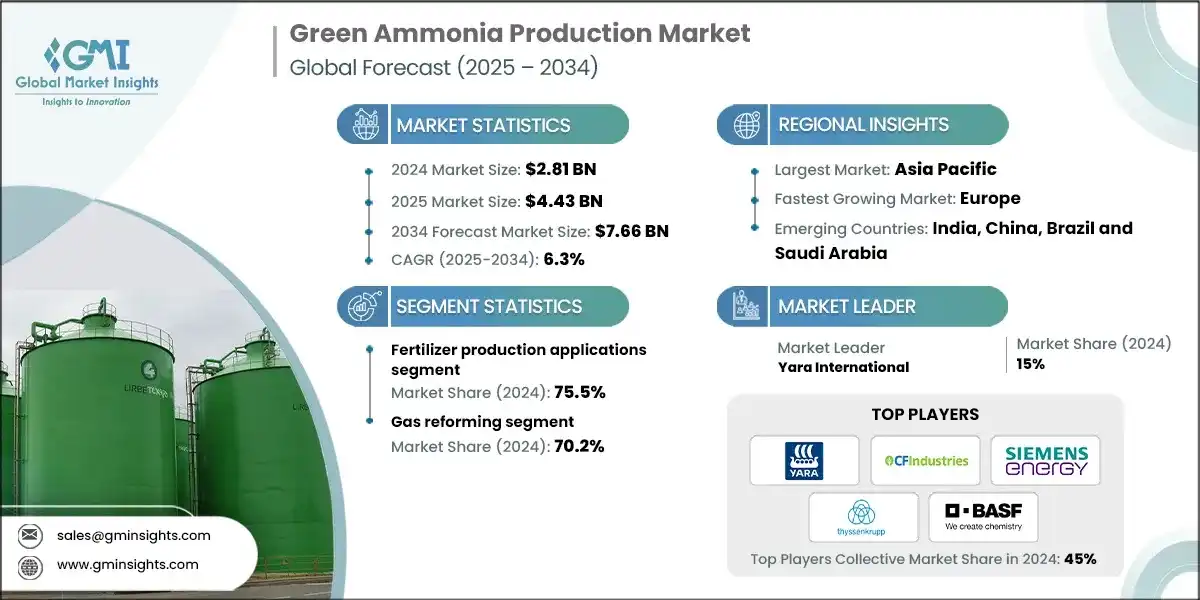
The green ammonia production market size was valued at more than USD 2.81 billion in 2024. The market is expected to grow from USD 4.43 billion in 2025 to USD 7.66 billion by 2034, at a CAGR of 6.3%, according to Global Market Insights, Inc.
Green Ammonia Production Market Key Takeaways
Market Size & Growth
- 2024 Market Size: USD 2.81 Billion
- 2025 Market Size: USD 4.43 Billion
- 2034 Forecast Market Size: USD 7.66 Billion
- CAGR (2025–2034): 6.3%
Regional Dominance
- Largest Market: Asia Pacific
- Fastest Growing Region: Europe
Key Market Drivers
- Decarbonization and net zero commitments.
- Expansion of renewable energy integration.
- Rising demand for sustainable fertilizers.
Challenges
- High production costs.
- Energy intensity and efficiency losses.
Opportunity
- Decarbonization of fertilizer industry.
- Emerging maritime fuel market.
- Hydrogen carrier and energy storage applications.
Key Players
- Market Leader: Yara International led with over 15% market share in 2024.
- Leading Players: Top 5 players in this market include BASF, ThyssenKrupp, Siemens Energy, CF Industries Holdings, Yara International, which collectively held a market share of 45% in 2024.
Get Market Insights & Growth Opportunities
- Green ammonia production are a next-generation PV technology that combines high efficiency, low-cost fabrication, and versatility. They use a perovskite-structured compound as light-absorbing layer to convert sunlight into electricity. Further, they can be fabricated using low-temperature solution methods like blade-coating, or inkjet printing, spin-coating, thereby reducing the manufacturing costs.
- Green ammonia serves as an efficient energy carrier for hydrogen, enabling the transport and storage of renewable energy across long distances. Its high energy density and existing global logistics infrastructure make it ideal for power generation and grid balancing applications. This role in the clean energy supply chain is becoming increasingly important for renewable integration and energy storage.
- For instance, in January 2025, Avaada Group partnered with Casale to develop India's largest green ammonia plant in India. It will be completely powered by renewable energy and aims to significantly reduce carbon emissions, aligning with India's net zero ambitions. The project further supports the country's renewable energy and industrial decarbonization objectives.
- Government policies and funding programs are critical in accelerating adoption. Regions including the EU, U.S., and Japan offer incentives through mechanisms such as the U.S. Inflation Reduction Act (IRA), EU Green Deal, and Japan’s Green Innovation Fund. These policies reduce project risks, provide tax credits, and encourage private sector investments in large-scale green ammonia facilities.
- For instance, in November 2024, Pupuk Indonesia announced Green Ammonia Initiative from Aceh (GAIA) at COP29, demonstrating government support for green ammonia development in Southeast Asia and integration of green ammonia production with national energy and industrial strategies.
- Countries rich in renewable resources, including Australia, Saudi Arabia, Chile, and India, are investing heavily in green ammonia export projects to supply regions with limited renewable capacity, like Japan, South Korea, and Europe. This growing trade potential is transforming green ammonia into a globally tradable low-carbon commodity, boosting both economic development and clean energy cooperation.
- For instance, in October 2024, KAPSOM launched third-generation green ammonia plant incorporating advanced electrolysis technologies and process optimization to achieve improved energy efficiency and reduced production costs, claiming delivery of world's first set of green ammonia units and demonstration projects in Middle East, South America, and Africa.
To get key market trends
Green Ammonia Production Market Trends
- Green ammonia is gaining traction as a cornerstone of global decarbonization strategies. Numerous countries have pledged carbon neutrality by 2050, driving the transition from traditional fossil-fuel-based ammonia synthesis to cleaner, renewable methods.
- For instance, in May 2025, Coal India to supply 4500 MW of renewable energy to AM Green's green ammonia plants via solar and wind projects across India. The partnership aims to support AM Green's goal of producing 5 MTPA green ammonia by 2030, aligning with India’s National Green Hydrogen Mission.
- Governments worldwide are implementing supportive policies to accelerate the adoption of green ammonia. These include subsidies, tax incentives, and grants aimed at reducing the financial risks associated with pioneering new technologies. For instance, in 2024, The International Renewable Energy Agency projected that renewable ammonia generation capability could reach 566 million tons by 2050 under a 1.5°C scenario, requiring unprecedented industrial mobilization.
- Ongoing shift toward modular, distributed production systems will enable localized ammonia production that serves regional agricultural markets while providing grid services, contributing to the overall business statistics. Moreover, integration of artificial intelligence will fundamentally transform green ammonia production efficiency and economics, leading to product penetration.
- For instance, in June 2025, UNSW Sydney researchers applied machine learning to identify an optimized multi-metal catalyst comprising iron, bismuth, nickel, tin and zinc, achieving a sevenfold increase in ammonia production rate and near-100% Faradaic efficiency at approximately 25°C less than 10% of traditional Haber-Bosch temperatures. This will further enable compact, factory-built distributed ammonia modules in shipping-container sizes for on-site fertilizer production.
Green Ammonia Production Market Analysis
Learn more about the key segments shaping this market
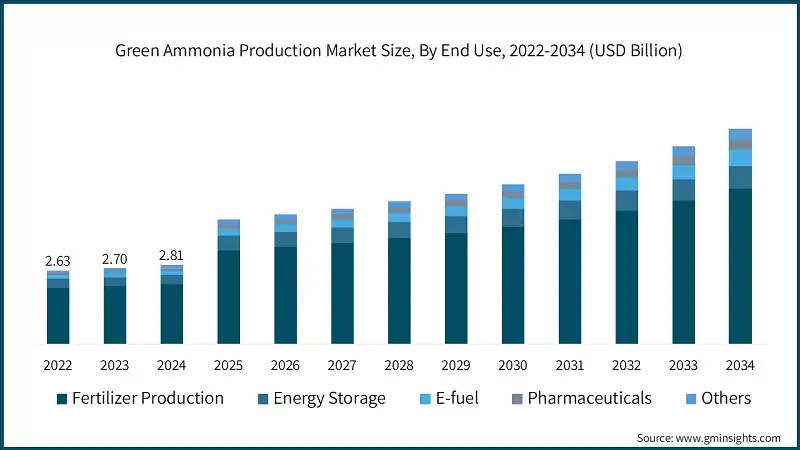
- Based on end use, the market is segmented into fertilizer production, energy storage, e-fuel, pharmaceuticals, and others. The fertilizer production applications hold the largest market share at 75.5% in 2024, growing at more than 5.5% CAGR through 2034 on account of ammonia's critical role in supporting nearly 40% of global food production through nitrogen fertilizers.
- Established global distribution infrastructure, with over 10,000 ammonia storage sites and approximately 3,000 miles of pipelines in the U.S. This provides a significant advantage for green ammonia deployment, requiring modifications rather than complete reconstruction, leading to market growth.
- For instance, in February 2025, TalusAg demonstrated the modular green ammonia production in the U.S., with practical fertilizer applications and production of 1-2 tons/day for direct application to farm fields. This represents the first commercial delivery of green ammonia from a small-scale facility in North America.
- Energy storage segment will grow more than 4.5% CAGR through 2034, on account of its ability for seasonal energy balancing and renewable energy integration. Ongoing studies demonstrate that coordinated operation of ammonia plants with distribution systems can reduce the electricity costs by nearly one-third while providing grid stability benefits, leading to product penetration.
- For instance, in July 2025, Envision Energy's AI-enabled facility demonstrated the real-time optimization for grid services, with dynamic air-separation units that convert surplus renewable power to liquid nitrogen for storage, providing additional grid flexibility beyond ammonia production.
- E fuel market holds 5.4% revenue share in 2024, driven primarily by maritime fuel applications where green ammonia is positioned as a zero-carbon alternative to heavy fuel oil. Existing global ammonia transportation infrastructure, with nearly 170 ships capable of transporting ammonia and 120 ports equipped for import/export operations will augment the green ammonia production market growth.
- For instance, in November 2023, Wärtsilä introduced the first commercially available 4-stroke marine engine-based solution for ammonia fuel. The full solution includes the Wärtsilä Ammonia Release Mitigation System (WARMS), an AmmoniaPac fuel gas supply system and the Wärtsilä NOx Reducer (NOR) used for optimal exhaust after-treatment.
- Pharmaceuticals segment will grow more than 10.5% CAGR through 2034, on account of expanding recognition of green ammonia's versatility in specialty chemical production and the pharmaceutical industry's commitment to sustainable supply chains. Industrial decarbonization initiatives will further drive the manufacturers to seek green alternatives for chemical feedstocks, creating premium pricing opportunities for certified green ammonia, leading to green ammonia production market growth.
- Others comprising of industrial processes, refrigeration, and specialty chemical production is set to reach more than USD 380 million by 2034, owing to expanding recognition of green ammonia's versatility beyond traditional uses. Industrial decarbonization initiatives along with the development of new applications leveraging green ammonia's zero-carbon properties will institute a favorable industrial landscape.
Learn more about the key segments shaping this market
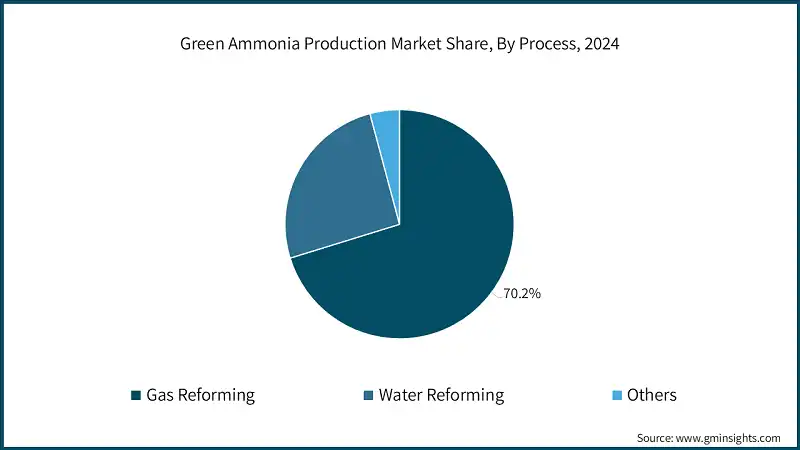
- Based on process, the green ammonia production market is segmented into water reforming, gas reforming and others. The gas reforming dominates with 70.2% market share and is anticipated to register over 5.5% CAGR through 2034. Key factors comprising of large existing infrastructure for natural gas-based ammonia the availability of CO2 storage options and lower capital costs in comparison to entirely renewable hydrogen systems will lead to the process adoption.
- It allows producers to reduce emissions while leveraging the established technology, making it a preferred choice for regions where renewable electricity is expensive or intermittent. Additionally, carbon pricing, policy incentives, and the growing market for ammonia as a tradeable low-carbon commodity will accelerate the process adoption.
- The water reforming holds 25.5% market share and is anticipated to grow over 6.5% CAGR up to 2034, driven by rapidly declining renewable electricity costs and improving electrolysis efficiency. Further, the process offers flexibility for small-to-medium or decentralized scale production, making it attractive for countries aiming to produce green ammonia close to renewable energy sources and export hubs.
- For instance, in April 2022, LSB Industries, entered into an agreement with Lapis Energy to develop a project to capture and sequester CO2 at LSB’s El Dorado, Arkansas facility The project is expected to be completed by 2025 and is the third CCS project from ammonia production in the U.S.
- Others include photochemical routes, electrochemical synthesis, and hybrid systems combining renewable hydrogen with conventional ammonia synthesis and will grow more than USD 350 million by 2034. Growing potential to drastically reduce capital and operational costs, bypass the energy-intensive Haber-Bosch step, and offer modular or distributed production solutions will drive the industry scenario. Moreover, increasing government R&D funding, the rising requirement for innovation to meet net-zero targets, and the shifting focus to integrate ammonia production with renewable energy grids more flexibly will institute a favorable business momentum.
Looking for region specific data?
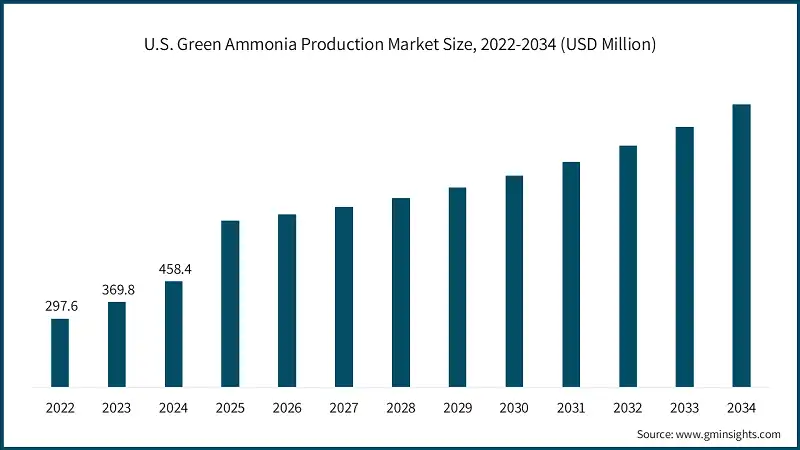
- The U.S. green ammonia production market recorded a valuation of USD 297.6 million in 2022, reached USD 369.8 million in 2023 and will reach USD 458.4 million by 2024. North America accounted for 20.6% of the global market share in 2024 supported by substantial government funding and strategic research initiatives.
- In the U.S., abundant renewable energy resources, including wind and solar, provide a cost-effective means to produce green hydrogen for ammonia synthesis. The agricultural sector's increasing emphasis on sustainable practices will drive the demand for green ammonia as a cleaner alternative to traditional fertilizers.
- For instance, in January 2025, Blue Sky Infrastructure, GTI Energy, and Aker Carbon Capture initiated a USD 1.5 million pre-FEED study to apply CCS to SMR based ammonia production. The Mosaic Faustina facility in Louisiana is one of the North America’s largest ammonia production facilities, with a capacity of 500,000 tons per year.
- Europe green ammonia production market is anticipated to cross over USD 2.1 billion by 2034, driven by stringent environmental regulations and ambitious decarbonization targets. The EU's carbon pricing mechanisms, such as the Carbon Border Adjustment Mechanism (CBAM) and the Emissions Trading System (ETS) create financial incentives for ammonia producers to reduce their carbon footprints. Moreover, substantial government funding aimed at bridging the cost gap between conventional and green ammonia production, will facilitate the scaling of renewable hydrogen and ammonia projects across the region, driving the market growth.
- For instance, in December 2024, Kyuden and Uniper SE signed memorandum of understanding for hydrogen and ammonia trading, carbon capture utilization and storage (CCUS), and renewable energy development, establishing framework for international green ammonia trade between Asia and Europe.
- Asia Pacific dominates the green ammonia production market with 37.8% share in 2024 and will grow more than 5.5% CAGR through 2034. Growing investments in renewable energy sources in countries including South Korea, China and Japan to produce green hydrogen, which is then used to synthesize ammonia will complement the business landscape. The region's strong industrial base, particularly in agriculture and shipping, creates a substantial demand for green ammonia as a sustainable alternative to conventional ammonia. In addition, government policies and initiatives further support this transition, positioning green ammonia as a key component of the region's decarbonization strategies.
- In China, substantial renewable energy capacity and strategic industrial policies will complement the market growth. The country’s commitment to decarbonization and its significant investments in renewable energy infrastructure position it as a global leader in green ammonia production. For instance, in July 2025, The Da'an Wind-Solar-Powered Green Hydrogen to Ammonia Integration demonstration project came into operation in Jilin Province in China. In addition, once operational, it will save about 230,000 tons of standard coal and reduce carbon emissions by approximately 650,000 tons annually.
Green Ammonia Production Market Share
- The top five players operating in the industry include Yara International, CF Industries Holdings Inc., Siemens Energy, ThyssenKrupp, and BASF. The major manufacturers/producers represent a comprehensive ecosystem spanning established ammonia producers, breakthrough technology developers, renewable energy companies, and emerging specialists. This diverse landscape reflects the multidisciplinary nature of green ammonia production, requiring expertise in artificial intelligence, electrolysis, renewable energy integration, chemical synthesis, and industrial-scale operations.
- The competitive landscape is influenced by government policies and support programs, which favor certain technologies or market participants. Companies with strong relationships with government agencies and access to public funding programs achieve competitive advantages in project development and deployment.
- Strategic partnerships are becoming increasingly common as companies combine complementary capabilities and share investment risks. Notable collaborations include Yara-Siemens partnerships for green ammonia plants, and various international supply agreements for low-carbon ammonia trade.
- ACME Group established itself as a dominant force in the Indian green ammonia market through strategic investments exceeding USD 6 billion. The company’s integrated renewable energy and green ammonia development approach leverages its solar and wind energy capabilities to support large-scale production facilities designed for both domestic and export markets.
Green Ammonia Production Market Companies
Eminent players operating in the green ammonia production industry are:
- ACME Group
- AM Green Ammonia
- BASF
- CSBP Limited
- CF Industries Holdings Inc.
- Envision Energy
- ENGIE
- Enaex
- First Ammonia
- Fertiberia
- Group DF
- IFFCO
- LSB Industries
- Nutrien
- Ørsted
- PT Pupuk Sriwidjaja Palembang (Pusri)
- Statkraft
- Scatec
- Talus Renewables
- Yara International
- AM Green Ammonia is a specialized developer with ambitious scaling targets, achieving final investment decision (FID) for 1.0 million tonnes per annum in August 2024 and strategic target of 5.0 million tonnes per annum by 2030 . The company's technology-agnostic approach enables optimal production technology selection for specific project requirements and market conditions. Further, the company’s partnership with BASF through a non-binding letter of intent for 100,000 tonnes per year demonstrates international market development.
- BASF is the world's largest chemical companies and major ammonia consumer, initiated a pilot project for green ammonia production in April 2024, demonstrating commitment to decarbonizing chemical operations while developing commercial-scale production capabilities. The company’s global presence and customer relationships provide significant advantages in developing green ammonia markets and securing long-term offtake agreements.
- CF Industries Holdings leverages its position as a leading North American ammonia producer to develop integrated green ammonia production capabilities. The company is advancing CCS at Yazoo City, Mississippi, targeting CO2 reduction through a USD 100 million investment in CO2 dehydration and compression units, with sequestration expected to begin in 2028. Further, the company’s established distribution networks and customer relationships provide significant competitive advantages in deploying clean ammonia technologies.
- Yara International is the world's largest conventional ammonia producer and maintains leadership position in green ammonia development through comprehensive technology investments and global market presence. In June 2024, the company opened Europe's largest renewable hydrogen plant, producing 20,500 tonnes ammonia per year converted to 60,000-80,000 tonnes green fertilizer annually. Furthermore, the company’s partnerships with technology providers and renewable energy developers enable large-scale green ammonia production facilities across multiple regions and provide significant competitive advantages.
Green Ammonia Production Market Report Attributes
| Key Takeaway | Details |
|---|---|
| Market Size & Growth | |
| Base Year | 2024 |
| Market Size in 2024 | USD 2.81 Billion |
| Market Size in 2025 | USD 4.43 Billion |
| Forecast Period 2025 - 2034 CAGR | 6.3% |
| Market Size in 2034 | USD 7.66 Billion |
| Key Market Trends | |
| Drivers | Impact |
| Decarbonization and net zero commitments | Governments and industries are now focusing on green hydrogen-derived ammonia to meet Paris Agreement and net-zero 2050 targets. Countries such as Japan, Germany, and Australia have made green ammonia a central component of their energy transition roadmaps. |
| Expansion of renewable energy integration | Nations with strong renewable potential are leveraging this synergy to establish green ammonia export hubs, reducing dependence on fossil fuels and enhancing energy security. |
| Rising demand for sustainable fertilizers | Green ammonia offers a sustainable alternative, helping producers and farmers reduce their carbon footprints and comply with tightening agricultural sustainability regulations. |
| Pitfalls & Challenges | Impact |
| High production costs | The main cost drivers are expensive electrolyzers, high electricity requirements, and the need for continuous power supply to ensure efficient hydrogen production. Until renewable electricity becomes cheaper and electrolyzer capital costs decline further, green ammonia will struggle to achieve price parity. |
| Energy intensity and efficiency losses | Green ammonia production through electrolysis and Haber–Bosch synthesis is extremely energy-intensive. Moreover, converting electricity into hydrogen and then into ammonia involves multiple energy conversion steps, each with inherent losses. |
| Opportunities: | Impact |
| Decarbonization of fertilizer industry | Green ammonia offers a transformative opportunity to decarbonize fertilizer production, helping major producers like Yara International, CF Industries, and Nutrien transition toward low-carbon operations. |
| Emerging maritime fuel market | Green ammonia is a promising marine fuel due to its carbon-free combustion, high energy density, and existing transport infrastructure. Several shipping giants like Maersk, NYK Line, and MAN Energy Solutions are investing in ammonia-ready vessels and engines. This growing maritime demand represents one of the largest future markets for green ammonia production and export. |
| Hydrogen carrier and energy storage applications | Green ammonia serves as an efficient hydrogen carrier a safer and more transportable form of renewable hydrogen. This creates opportunities for energy companies to integrate ammonia into renewable storage, long-distance hydrogen trade, and power export strategies. |
| Market Leaders (2024) | |
| Market Leaders |
Market Share 15% |
| Top Players |
Collective market share in 2024 is 45% |
| Competitive Edge |
|
| Regional Insights | |
| Largest Market | Asia Pacific |
| Fastest Growing Market | Europe |
| Emerging Countries | India, China, Brazil and Saudi Arabia |
| Future outlook |
|
What are the growth opportunities in this market?
Green Ammonia Production Market News
- In January 2025, MIT engineers proposed revolutionary geological ammonia production by injecting water and catalyst particles into iron-rich subsurface rock. The process will utilize Earth's natural heat and pressure to potentially reduce global CO2 emissions by up to 1% while enabling decentralized production in regions lacking large Haber-Bosch plants.
- In August 2024, AM Green Ammonia, initiated the production of renewable ammonia in India. The project reached FID on the first phase of a multi-million ton per year plant. Moreover, by late 2026, retrofits at the existing Nagarjuna Fertilizers and Chemicals Limited complex will allow for ammonia production based on renewable electricity inputs from the grid. In addition, the phase one of the project has been awarded RFNBO pre-certification including additionality requirements and hourly matching of renewables.
- In October 2022, Fortescue Future Industries (FFI) and Incitec Pivot entered in a framework agreement to convert Incitec Pivot’s Gibson Island ammonia production facility to run on renewable hydrogen feedstock. It will be implemented through a FID which is anticipated to complete around 2025. Further, the Australian government body ARENA will provide a grant towards the FEED study, contributing USD 8.9 million of the required USD 24.7 million.
This green ammonia production market research report includes an in-depth coverage of the industry with estimates & forecast in terms of revenue and volume in “USD Million and Million tonnes” from 2021 to 2034, for the following segments:
Market, By Process
- Gas reforming
- Water reforming
- Others
Market, By End Use
- Fertilizer production
- Energy storage
- E-fuel
- Pharmaceuticals
- Others
The above information has been provided for the following regions and countries:
- North America
- U.S.
- Canada
- Europe
- Germany
- UK
- France
- Italy
- Poland
- Asia Pacific
- Japan
- South Korea
- China
- India
- Australia
- Rest of world
Frequently Asked Question(FAQ) :
What is the market size of green ammonia production in 2024?
The market size was USD 2.81 billion in 2024, with a CAGR of 6.3% expected through 2034 driven by rising demand for sustainable energy solutions and global decarbonization commitments.
What is the projected value of the green ammonia production market by 2034?
The green ammonia production market is expected to reach USD 7.66 billion by 2034, propelled by renewable energy integration, maritime fuel demand, and expansion of sustainable fertilizer applications.
What is the current green ammonia production market size in 2025?
The market size is projected to reach USD 4.43 billion in 2025.
How much revenue did the fertilizer production segment generate in 2024?
Fertilizer production held the largest market share at 75.5% in 2024, growing at more than 5.5% CAGR through 2034 due to ammonia's critical role in supporting global food production.
What was the market share of gas reforming process in 2024?
Gas reforming dominated with 70.2% market share in 2024, led by existing infrastructure and lower capital costs.
What is the growth outlook for water reforming process from 2025 to 2034?
Water reforming held 25.5% market share and is anticipated to grow over 6.5% CAGR through 2034, propelled by declining renewable electricity costs and improving electrolysis efficiency.
Which region leads the green ammonia production market?
Asia Pacific dominated with 37.8% share in 2024 and will grow more than 5.5% CAGR through 2034. Strong industrial base and government policies supporting decarbonization fuel the region's dominance.
What are the upcoming trends in the green ammonia production market?
Key trends include shift toward modular distributed production systems, integration of AI for production optimization, development of ammonia-ready maritime vessels, and expansion of green ammonia export hubs in renewable-rich countries.
Who are the key players in the green ammonia production market?
Key players include Yara International, CF Industries Holdings Inc., Siemens Energy, ThyssenKrupp, BASF, ACME Group, AM Green Ammonia, CSBP Limited, Envision Energy, ENGIE, Enaex, First Ammonia, Fertiberia, Group DF, IFFCO, LSB Industries, Nutrien, Ørsted, PT Pupuk Sriwidjaja Palembang (Pusri), Statkraft, Scatec, and Talus Renewables.
Green Ammonia Production Market Scope
Related Reports