Summary
Table of Content

Gravity Based Energy Storage Market
Get a free sample of this report
Form submitted successfully!
Error submitting form. Please try again.
Thank you!
Your inquiry has been received. Our team will reach out to you with the required details via email. To ensure that you don't miss their response, kindly remember to check your spam folder as well!
Request Sectional Data
Thank you!
Your inquiry has been received. Our team will reach out to you with the required details via email. To ensure that you don't miss their response, kindly remember to check your spam folder as well!
Form submitted successfully!
Error submitting form. Please try again.
Gravity Based Energy Storage Market Size
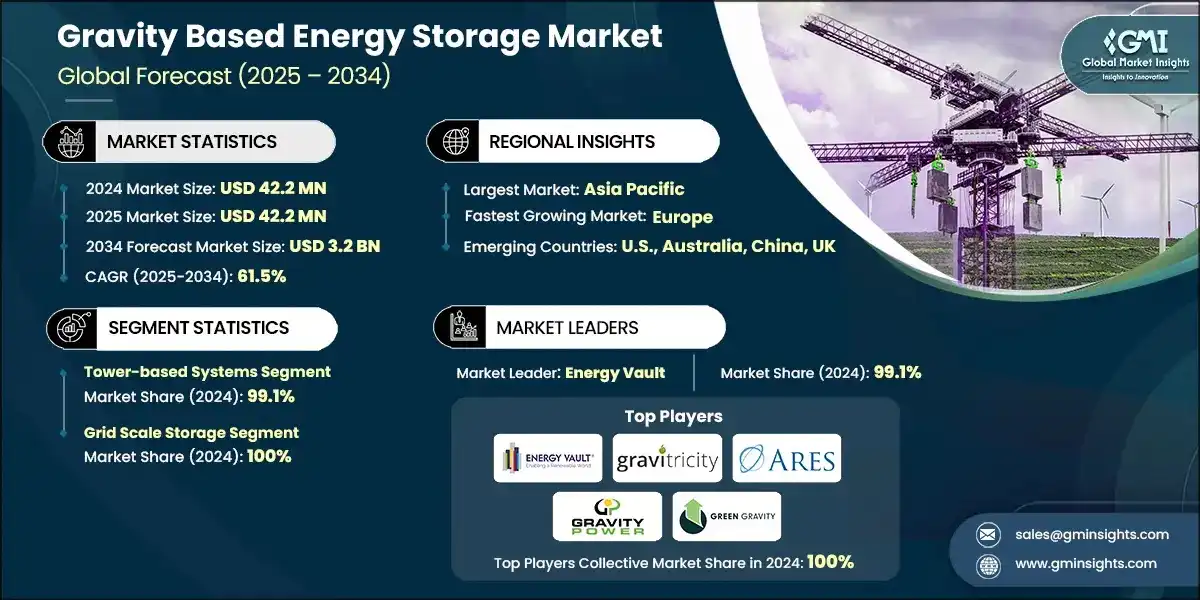
The global gravity based energy storage market size was valued at USD 42.2 million in 2024. The market is expected to grow from USD 42.2 million in 2025 to USD 3.2 billion by 2034, at a CAGR of 61.5%, according to Global Market Insights Inc.
Gravity Based Energy Storage Market Key Takeaways
Market Size & Growth
- 2024 Market Size: USD 42.2 Million
- 2025 Market Size: USD 42.2 Million
- 2034 Forecast Market Size: USD 3.2 Billion
- CAGR (2025–2034): 61.5%
Key Market Drivers
- Growing demand for Long Duration Energy Storage (LDES).
- Rising decarbonization goals & net zero targets.
Challenges
- High capital cost & long pay back periods.
Opportunity
- Grid stability and renewable integration.
- Long-duration storage for remote areas.
Key Players
- Market Leader: Energy Vault led with over 99.1% market share in 2024.
- Leading Players: Top 5 players in this market include Energy Vault, Gravitricity, ARES, Gravity Power, Green Gravity Energy, which collectively held a market share of 100% in 2024.
Get Market Insights & Growth Opportunities
- As renewable energy sources like solar and wind become more prevalent, the need for long-duration energy storage grows. Gravity-based systems offer multi-hour to multi-day storage, helping balance supply and demand. Their ability to store energy without degradation makes them ideal for grid-scale applications, especially in regions with high renewable penetration and variable generation patterns.
- Global climate commitments are accelerating the shift to low-carbon technologies. Gravity-based energy storage supports decarbonization by enabling clean energy integration and reducing reliance on fossil-fuel-based peaker plants. Governments and utilities are investing in sustainable storage solutions to meet net-zero targets, positioning gravity systems as a key enabler of climate-resilient infrastructure.
- Innovations in materials, automation, and control systems are improving the efficiency and scalability of gravity-based storage. Companies are developing modular designs, AI-driven dispatch systems, and hybrid configurations that enhance performance. These advancements reduce costs and increase competitiveness against chemical batteries, making gravity storage more attractive for utilities and industrial users.
- For instance, the U.S. Department of Energy announced USD 15 million in funding under the CiFER program to support grid-scale energy storage technologies, including gravity-based systems, aimed at enhancing critical infrastructure resilience during emergencies.
- Gravity-based systems use mechanical processes and often repurpose existing infrastructure like mine shafts or recycled materials, minimizing environmental footprint. Unlike chemical batteries, they avoid toxic waste, water usage, and fire risks. Their eco-friendly profile aligns with sustainability goals, attracting support from regulators, investors, and environmentally conscious consumers.
- For illustration, Energy Vault Holdings Inc. secured a USD 300 million preferred equity investment from a leading infrastructure investor in 2025 to expand its gravity and battery energy storage portfolio across the U.S., Europe, and Australia.
- Gravity storage enhances grid stability by providing frequency regulation, voltage support, and backup power during outages. Its rapid response and long service life make it ideal for critical infrastructure and disaster-prone regions. As grids modernize and decentralize, gravity systems offer dependable solutions for maintaining reliability and resilience.
To get key market trends
Gravity Based Energy Storage Market Trends
- While initial capital costs can be high, gravity-based systems offer low operating expenses and long lifespans with minimal maintenance. Their cost per cycle improves over time, especially compared to batteries that degrade. As economies of scale and technological improvements continue, gravity storage is becoming increasingly cost-competitive for utility-scale deployment.
- Governments are introducing policies and incentives to promote clean energy storage, including grants, tax credits, and regulatory support. Gravity-based systems benefit from these frameworks, especially in regions prioritizing non-chemical, sustainable solutions. Policy backing accelerates commercialization and encourages private sector investment in gravity storage technologies.
- For reference, Gravitricity partnered with IEA Infrastructure Construction to access the USD 450 million U.S. clean energy fund, targeting repurposed mine-based gravity storage projects under the Biden administration’s infrastructure initiative.
- Companies like Gravitricity utilize abandoned mine shafts and industrial sites for gravity storage, reducing construction costs and environmental impact. This approach enables faster deployment and revitalizes underused assets. Repurposing infrastructure also aligns with circular economy principles, making gravity storage a practical and sustainable solution for urban and rural areas.
- Gravity-based systems can be scaled from small installations to large grid-connected facilities. Modular designs allow flexible deployment based on energy needs and site conditions. This adaptability makes gravity storage suitable for diverse applications—from remote communities to large industrial zones—enhancing its market potential across geographies.
- Gravity storage is well-suited for microgrids powered by solar or wind. It provides stable, long-duration backup without the limitations of chemical batteries. In remote or island communities, gravity systems enhance energy access and reliability, supporting development and reducing dependence on diesel generators or costly imports.
- For illustration, ARES North America broke ground on its GravityLine facility in Nevada, backed by local government support and private investment, marking a milestone in rail-based gravity energy storage deployment for grid flexibility.
- Gravity storage contributes to energy independence by reducing reliance on imported fuels and batteries. It enables local energy generation and storage, enhancing national security and economic resilience. Countries seeking to strengthen domestic energy systems are increasingly exploring gravity-based solutions as part of their strategic energy mix
Gravity Based Energy Storage Market Analysis
Learn more about the key segments shaping this market
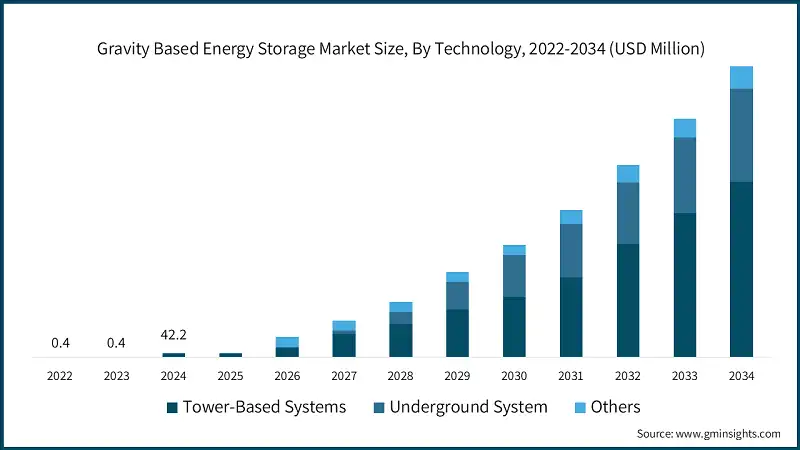
- Based on technology, the industry is segmented into tower-based systems, underground systems, and others. The tower-based systems segment dominated the gravity based energy storage market accounting for 99.1% in 2024 and is expected to grow at a CAGR of 52.8% through 2034.
- Tower-based systems like Energy Vault’s EVx offer modular scalability, enabling flexible deployment across varied terrains. Their vertical design maximizes gravitational potential, making them ideal for urban and industrial zones with limited horizontal space, while supporting multi-hour energy storage for grid balancing.
- Tower-based gravity systems increasingly use recycled concrete blocks and construction waste, reducing environmental impact and material costs. This sustainable approach aligns with circular economy principles and enhances the appeal of gravity storage for eco-conscious utilities and developers.
- Advanced automation and AI-driven control systems optimize energy dispatch and load balancing in tower-based setups. These technologies improve operational efficiency, reduce human intervention, and enable predictive maintenance, making tower systems more reliable and cost-effective over time.
- The gravity based energy storage market from underground systems segment will project at a CAGR of 141.1% by 2034. Underground gravity systems like Gravitricity’s use of disused mine shafts offer low-cost, low-impact energy storage. These systems repurpose existing infrastructure, reducing land use and construction time while providing fast-response capabilities for grid services and emergency backup.
- Underground systems benefit from natural geotechnical stability, offering long-term durability and minimal exposure to weather-related risks. Their enclosed design ensures consistent performance and safety, making them suitable for densely populated or environmentally sensitive regions.
- Technologies like ARES North America’s rail-based systems use electric-powered mass cars on inclined tracks to store and release energy. These systems offer scalable, non-flammable, and water-free solutions with long service lives, ideal for utility-scale applications in open terrains.
- Gravity-based systems generally have fewer moving parts and no chemical degradation, resulting in low maintenance and long operational lifespans. This reliability reduces lifecycle costs and enhances the economic viability of gravity storage for long-term energy infrastructure planning.
Learn more about the key segments shaping this market
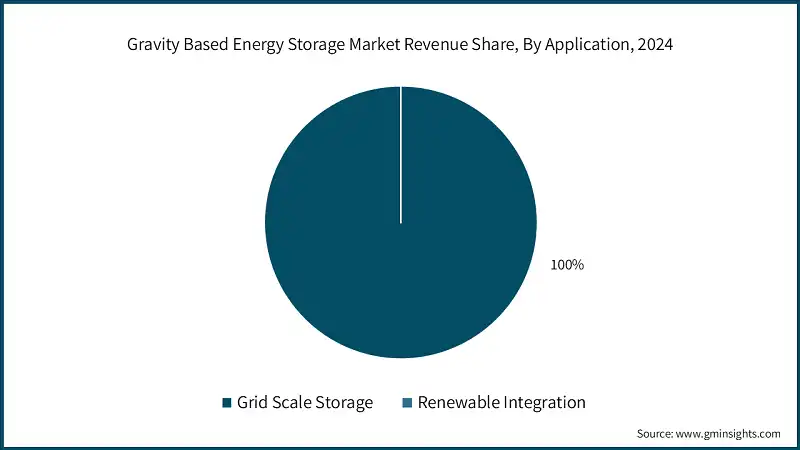
- Based on application, the gravity based energy storage market is segmented into grid scale storage and renewable integration. The grid scale storage segment held a 100% market share in 2024, and the segment is expected to grow at a CAGR of 45.3% from 2025 to 2034.
- Gravity-based energy storage systems provide essential grid services like frequency regulation and load balancing. Their rapid response capabilities help stabilize voltage fluctuations and maintain grid reliability, especially during peak demand or renewable intermittency. This makes them a valuable asset for modernizing power grids and supporting decentralized energy networks.
- Gravity storage enhances infrastructure resilience by providing reliable backup power during emergencies, such as natural disasters or grid failures. Its mechanical nature ensures consistent performance without degradation, making it suitable for critical facilities like hospitals, data centers, and emergency response units.
- Gravity storage supports decentralized energy models by enabling local energy storage and distribution. It empowers communities and industrial zones to manage their own energy needs, reduce transmission losses, and enhance energy independence, especially in remote or underserved areas.
- Gravity-based systems help utilities manage peak demand by storing energy during off-peak hours and discharging during peak periods. This reduces strain on the grid, lowers operational costs, and improves energy efficiency, especially in regions with high electricity demand variability.
- The gravity based energy storage market from renewable integration segment is expected to reach a value of over USD 1.5 billion by 2034. As solar and wind generation increase, gravity storage helps manage variability by storing excess energy and releasing it during low production periods. This smooths renewable output and reduces curtailment, enabling higher penetration of clean energy sources into the grid without compromising stability or reliability.
- Gravity-based systems offer multi-hour to multi-day energy storage, making them ideal for long-duration applications. This capability supports grid resilience during extended outages or low renewable generation periods, ensuring continuous power supply and reducing dependence on fossil-fuel backup systems.
- For instance, the U.S. Energy Information Administration (EIA) reported that in 2023, the United States added around 6.4 GW of small-scale solar capacity, with rooftop installations accounting for a substantial share of this growth.
- Gravity storage integrates seamlessly with smart grid platforms, enabling automated control, predictive analytics, and real-time energy management. This enhances operational efficiency, supports demand response programs, and facilitates the transition to intelligent, adaptive energy networks.
Looking for region specific data?
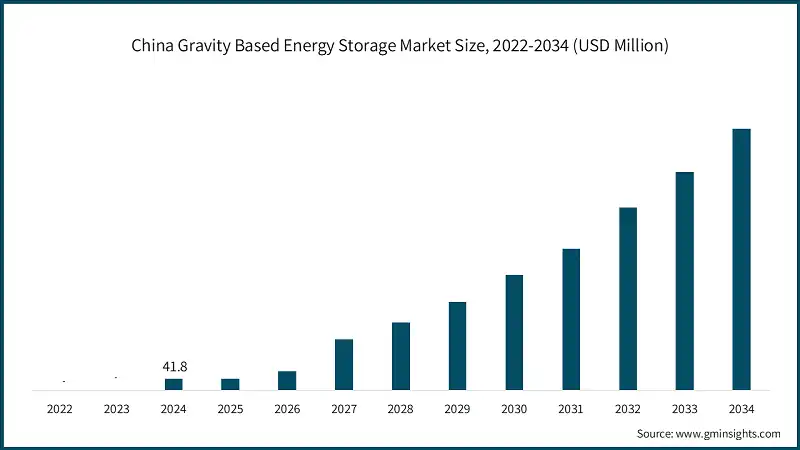
- China gravity based energy storage market is set to reach a value of USD 964.3 million by 2034. China’s gravity-based energy storage market is expanding rapidly due to its push for renewable energy integration and grid stability. As solar and wind power adoption accelerates, gravity systems offer long-duration storage to manage intermittency. Government support through subsidies and pilot projects is boosting deployment. These systems, which use elevated masses to store energy, are gaining traction for their sustainability, low maintenance, and long operational life.
- Furthermore, the market is driven by China’s decarbonization goals and energy transition policies. Gravity-based storage aligns with environmental priorities, using non-toxic, abundant materials and avoiding rare earth elements. Urbanization and industrial growth are increasing electricity demand, making scalable storage essential. Strategic investments in smart grid infrastructure and regional energy planning—especially in provinces like Guangdong and Jiangsu—are fostering innovation and adoption of gravity-based solutions.
- For illustration, in 2024, China has successfully commissioned the Rudong EVx gravity energy storage system, marking a global milestone in non-pumped hydro storage. Developed by Energy Vault in partnership with China Tianying and Atlas Renewable, the 25MW/100MWh facility near Shanghai uses massive blocks lifted by surplus renewable energy and dropped to generate electricity. This project is part of China’s broader strategy to stabilize its grid and meet decarbonization goals.
- In North America, private sector investment is growing, driven by the need for sustainable alternatives to lithium-ion batteries. Regional collaboration and cross-border energy strategies are creating opportunities for scalable gravity-based solutions across North America.
- The U.S. is leveraging its vast industrial and mining infrastructure to support gravity-based energy storage deployment. Repurposing disused facilities for underground or tower-based systems reduces costs and accelerates implementation. Combined with innovation hubs and national labs driving R&D, this synergy between infrastructure and technology positions the U.S. as a leader in scalable, sustainable energy storage solutions.
- In Europe, emphasis on sustainability and circular economy principles supports gravity storage adoption. Repurposing old infrastructure like mine shafts aligns with EU climate goals. Regulatory frameworks and funding programs such as Horizon Europe encourage innovation, making the region a hub for pilot projects and commercial deployments of gravity-based technologies.
- Germany and the UK lead in gravity storage innovation, driven by strong engineering capabilities and decarbonization targets. National energy strategies prioritize long-duration storage, and public-private partnerships are accelerating deployment. These countries serve as testbeds for underground and hybrid gravity systems, influencing broader European market trends.
- In Asia Pacific, rapid renewable energy expansion and urbanization create demand for reliable storage. Countries like China, India, and Australia are investing in gravity-based systems to support grid stability and reduce fossil fuel dependence. The region’s diverse geography allows for both tower-based and underground applications, enhancing market versatility.
- In regions like Africa, Latin America, and the Middle East, gravity storage offers a sustainable solution for energy access and grid reliability. Its low maintenance and long lifespan make it suitable for remote and off-grid areas. International development agencies are exploring gravity-based systems to support clean energy goals in emerging economies.
- Cross-regional collaboration is accelerating gravity storage innovation. International research partnerships, technology exchanges, and joint ventures are helping standardize best practices and reduce deployment costs. This global momentum is fostering a unified approach to long-duration energy storage, positioning gravity-based systems as a cornerstone of future energy infrastructure.
Gravity Based Energy Storage Market Share
- The top 5 companies in the gravity based energy storage industry are Energy Vault, Gravitricity, ARES North America, Gravity Power, and Green Gravity Energy contributing around 100% of the market in 2024.
- Energy Vault holds a dominant position in the gravity energy storage market, leveraging its patented EVx platform and global partnerships. With commercial deployments in China and the U.S., it leads in revenue share and scalability. The company’s modular tower-based systems use recycled materials, offering a sustainable and cost-effective alternative to chemical batteries. Its strong R&D pipeline and strategic alliances with utilities and renewable developers have enabled rapid market penetration. As of 2023, Energy Vault accounted for a significant portion of global gravity storage revenue, positioning itself as a key player in long-duration energy storage solutions.
- Gravitricity commands a growing niche in the gravity energy storage market through its unique underground shaft-based systems. Focused on repurposing disused mine shafts, the company offers fast-response, low-impact energy storage ideal for urban and industrial applications. Its pilot projects in the UK and Germany demonstrate technical viability and cost efficiency. Though smaller in scale than Energy Vault, Gravitricity’s specialization and partnerships, such as with IEA Infrastructure in the U.S. are expanding its footprint. By 2023, Gravitricity had secured a notable share in the European market, with plans to scale operations across multiple continents.
Gravity Based Energy Storage Market Companies
Major players operating in the gravity based energy storage industry are:
- ARES North America
- Energy Vault
- GRAVIENT
- Gravitricity
- Gravity Power
- Gravity Storage
- Green Gravity Energy Pty
- Renewell Energy
- RheEnergise Limited
- Terrament
- Energy Vault reported revenue of USD 17.1 million in Q2 2025. The company is a global leader in gravity-based energy storage, known for its modular EVx systems that use eco-friendly materials and recycled concrete blocks. With deployments in China, the U.S., and Australia, Energy Vault is rapidly scaling its build-own-operate model. Strategic partnerships and a robust IP portfolio position it as a dominant force in long-duration energy storage, enabling grid reliability and renewable integration across diverse geographies.
- Gravitricity reported estimated revenues of over USD 10 million in 2024. Based in Edinburgh, the company specializes in underground gravity storage using disused mine shafts. Its shaft-based systems offer fast response times and minimal environmental impact, making them ideal for urban and industrial applications. With pilot projects in the UK and Germany, Gravitricity is carving out a niche in the European market. Its innovative approach and growing partnerships position it as a key player in sustainable, long-duration energy storage.
- ARES North America reported an estimated annual revenue of around USD 5 million in 2024. The company pioneers rail-based gravity energy storage, using electric-powered mass cars on steel tracks to store and release energy. Its flagship GravityLine™ project in Nevada is a 50 MW facility designed to support renewable integration and grid flexibility. ARES systems are non-flammable, water-free, and offer a 40-year service life with no degradation. With patented technology and scalable infrastructure, ARES is redefining utility-scale energy storage through sustainable, mechanical innovation.
Gravity Based Energy Storage Market Report Attributes
| Key Takeaway | Details |
|---|---|
| Market Size & Growth | |
| Base Year | 2024 |
| Market Size in 2024 | USD 42.2 Million |
| Market Size in 2025 | USD 42.2 Million |
| Forecast Period 2025 - 2034 CAGR | 61.5% |
| Market Size in 2034 | USD 3.2 Billion |
| Key Market Trends | |
| Drivers | Impact |
| Growing demand for Long Duration Energy Storage (LDES) | The demand for Long-Duration Energy Storage (LDES) has been gaining momentum as countries worldwide accelerate the transition toward renewable energy integration and grid decarbonization |
| Rising decarbonization goals & net zero targets | Rising decarbonization policies and ambitious net zero targets are driving transformational change across the global energy sector, profoundly impacting the growth trajectory of gravity-based energy storage systems |
| Pitfalls & Challenges | Impact |
| High capital cost & long pay back periods | The gravity-based energy storage market faces significant headwinds due to high initial capital expenditure requirements that often exceed those of competing storage technologies |
| Opportunities: | Impact |
| Grid stability and renewable integration | Gravity-based energy storage offers a scalable solution for balancing intermittent renewable sources, enhancing grid reliability, and reducing curtailment. |
| Long-duration storage for remote areas | This technology provides cost-effective, long-duration energy storage for off-grid and remote locations, supporting energy access and resilience |
| Market Leaders (2024) | |
| Market Leaders |
99.1% |
| Top Players |
Collective market share in 2024 is 100% |
| Competitive Edge |
|
| Regional Insights | |
| Largest Market | Asia Pacific |
| Fastest Growing Market | Europe |
| Emerging Country | U.S., Australia, China, UK |
| Future Outlook |
|
What are the growth opportunities in this market?
Gravity Based Energy Storage Industry News
- in February 2025, Green Gravity received funding from the New South Wales state government to support the development of its “Weights and Gripper” subsystems critical components for commercializing its gravity energy storage technology. The grant, awarded through an energy innovation program, will accelerate engineering and manufacturing efforts to enable the lifting and lowering of heavy blocks in repurposed mine shafts. This milestone strengthens Green Gravity’s path toward scalable, low-carbon energy solutions.
- In September 2024, Energy Vault will develop a 100MW gravity energy storage project at Carbosulcis, Sardinia’s largest former coal mining site, to support the development of a carbon-free technology hub. Leveraging deep mine shafts and existing infrastructure, the EV0 solution will combine modular gravity storage with batteries and VaultOS software. This phased deployment aims to enhance local renewable energy use and repurpose legacy industrial assets for sustainable innovation.
- In February 2024, Gravitricity came into partnership with Callio Pyhäjärvi to launch a GraviStore pilot project at the decommissioned Pyhäsalmi copper mine in central Finland. This initiative aims to demonstrate the feasibility of gravity-based energy storage by repurposing existing mine infrastructure. The project supports sustainable redevelopment while validating the company’s technology in a real-world setting.
- In October 2023, RheEnergise signed its first turbine contract, with Hydropower Engineering of Turkey for a custom 500 kW unit. The turbine will be deployed in RheEnergise’s inaugural UK demonstration of its High-Density Hydro pumped storage technology. This milestone marks a critical step in the development of its pilot facility and the commercialization of its innovative energy storage solution.
The gravity based energy storage market research report includes in-depth coverage of the industry with estimates & forecast in terms of revenue (USD Million) and volume (MW) from 2021 to 2034, for the following segments:
Market, By Technology
- Tower-based systems
- Underground systems
- Others
Market, By Application
- Grid scale storage
- Renewable integration
The above information has been provided for the following regions and countries:
- North America
- U.S.
- Canada
- Europe
- Germany
- UK
- Finland
- Asia Pacific
- China
- Australia
- Rest of World
Frequently Asked Question(FAQ) :
What was the market size of the gravity-based energy storage in 2024?
The market size was valued at USD 42.2 million in 2024, with a CAGR of 61.5% expected through 2034. The growing adoption of renewable energy sources like solar and wind is driving the demand for long-duration energy storage solutions.
What is the projected value of the gravity-based energy storage market by 2034?
The market is poised to reach USD 3.2 billion by 2034, driven by advancements in technology, cost competitiveness, and increasing renewable energy integration.
What is the expected size of the gravity-based energy storage market in 2025?
The market size is projected to remain at USD 42.2 million in 2025.
What was the market share of the tower-based systems segment in 2024?
The tower-based systems segment dominated the market with a 99.1% share in 2024 and is expected to witness over 52.8% CAGR through 2034.
What was the market share of the grid-scale storage segment in 2024?
The grid-scale storage segment held a 100% market share in 2024 and is set to expand at a CAGR of 45.3% from 2025 to 2034.
What is the growth outlook for the China gravity-based energy storage sector?
China's market is anticipated to reach USD 964.3 million by 2034, led by government subsidies, pilot projects, and the need for renewable energy integration and grid stability.
What are the key trends in the gravity-based energy storage market?
Key trends include mine shaft use, modular scalability, microgrid integration, supportive policies, and growing traction for gravity storage.
Who are the major players in the gravity-based energy storage industry?
Key players include ARES North America, EnergyVault, GRAVIENT, Gravitricity, Gravity Power, Gravity Storage, Green Gravity Energy Pty, Renewell Energy, RheEnergise Limited, and Terrament.
Gravity Based Energy Storage Market Scope
Related Reports