Summary
Table of Content

Grant Management Software Market
Get a free sample of this report
Form submitted successfully!
Error submitting form. Please try again.
Thank you!
Your inquiry has been received. Our team will reach out to you with the required details via email. To ensure that you don't miss their response, kindly remember to check your spam folder as well!
Request Sectional Data
Thank you!
Your inquiry has been received. Our team will reach out to you with the required details via email. To ensure that you don't miss their response, kindly remember to check your spam folder as well!
Form submitted successfully!
Error submitting form. Please try again.
Grant Management Software Market Size
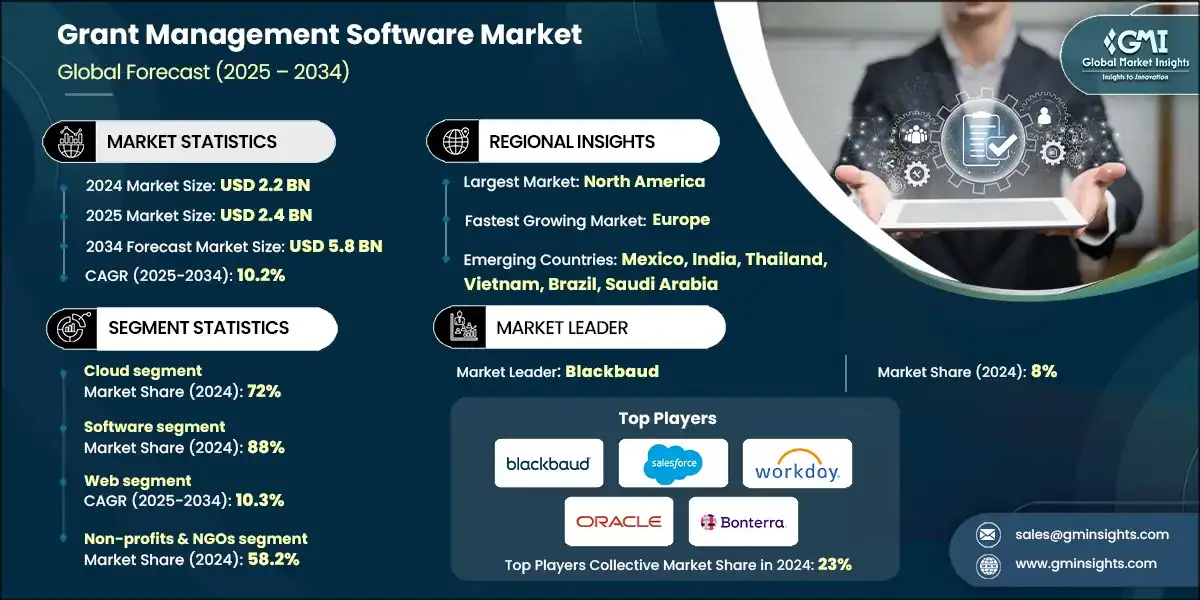
The global grant management software market was valued at USD 2.2 billion in 2024. The market is expected to grow from USD 2.4 billion in 2025 to USD 5.8 billion in 2034 at a CAGR of 10.2%, according to latest report published by Global Market Insights Inc.
To get key market trends
The grant management software market is seeing considerable expansion in response to a growing user demand for effective, streamlined, and transparent processes for grant management. Various organizations in the public, private, and nonprofit sectors want to bring efficiency and consistency to the entire grant lifecycle, from the submission of applications for consideration to the actual distribution of funding and impact reports. Innovation of cloud-based solutions have found a strong foothold among grant management software tools because of their scalability, ease of access, and efficiencies in cost, allowing any grant-making organization to manage their grant programs effectively.
Moreover, digital transformation efforts are moving at a phenomenal pace. Rather than the potential need for advanced grant management software to ensure compliance and accurately track grant funds, there is a growing number of organizations leveraging software to oversee their grant portfolios and ensure transparency while using data to drive decision making. Government, higher education, research institutions, and nonprofits are all looking to grant management software to respond to the increasing volumes of philanthropy and funding programs in a complex landscape; large-scale grant accountants and management systems are needed in addition to integration that interacts with other enterprise software (e.g., financial and accounting) leverage in large scale grant administration.
In addition, combining new technologies, such as AI and ML, create more opportunities for market expansion. These technologies can allow for an automated review of the application, predictive analytics to detect fraud, and better resource allocation based on past successful rates. AI-based grant management software will provide far more value by optimizing fund allocation, improving compliance monitoring, and generating actionable insights that enhance the overall impact of grants. In addition, blockchain technology will enable future potential to allow organizations to introduce robust, trustworthy, and transparent automated contract execution processes, further enhancing trust and efficiency for grant management.
The European Research Council (ERC) has announced, as of September 2024, that it will be awarding 494 Starting Grants for early career researchers in Europe. These research proposals were awarded €780 million ($848 million) in total funding to support pioneering research across all fields, including the life sciences, physics, social sciences, and the humanities. This funding is aimed at assisting researchers, who are starting their careers, in getting their own research projects off the ground, building new teams, and working on their most promising ideas.
The geographic composition of the market displays trends that are distinctly delineated. North America serves in a leadership role due to robust funding programs established by governments and nonprofits to foster technological innovation under significant pioneering implementation. Europe also demonstrates strong adoption resulting from notable data privacy mandates and the digitization of grants within dominant funding programs such as Horizon Europe from the European Unions. At the same time, the Asia-Pacific region is becoming a fast-growing market due to philanthropy, government grants, and digital strategies that look to modernize fund distribution mechanisms across countries like China, India, and Australia.
Grant Management Software Market Report Attributes
| Key Takeaway | Details |
|---|---|
| Market Size & Growth | |
| Base Year | 2024 |
| Market Size in 2024 | USD 2.2 Billion |
| Market Size in 2025 | USD 2.4 Billion |
| Forecast Period 2025 - 2034 CAGR | 10.2% |
| Market Size in 2034 | USD 5.8 Billion |
| Key Market Trends | |
| Drivers | Impact |
| Increasing Regulatory Compliance Requirements | Boosts demand for advanced grant management platforms ensuring transparency, auditability, and adherence to complex funding guidelines. |
| Digital Transformation Acceleration in Government & Nonprofits | Drives widespread adoption of cloud-based grant management software for process consolidation |
| Growing Grant Funding Volumes Globally | Encourage organizations to deploy scalable software solutions for efficient tracking, monitoring, and reporting. |
| AI & Automation Adoption for Efficiency Gains | Enhancing accuracy, reducing manual workload, and improving overall grant lifecycle efficiency. |
| Pitfalls & Challenges | Impact |
| High Initial Implementation Costs & TCO Concerns | Prevent smaller institutions from adopting enterprise-grade grant management systems. |
| Data Security & Privacy Compliance Burden | Increasing data security and privacy compliance demands elevate operational complexity and costs, requiring strict adherence to global regulations like GDPR and HIPAA |
| Opportunities: | Impact |
| FedRAMP High Authorization Market Gap | Offers vendors scope to target U.S. federal agencies needing compliant, secure grant management platforms. |
| International Development Aid Digitization | Creates demand for centralized, transparent, and data-driven grant management ecosystems. |
| AI-Powered Grant Matching & Predictive Analytics | Enable smarter fund allocation, application scoring, and fraud detection capabilities. |
| Mobile-First Solutions for Field Operations | Enhance field accessibility, real-time reporting, and collaboration among distributed grant teams. |
| Market Leaders (2024) | |
| Market Leaders |
8% market share |
| Top Players |
Collective market share in 2024 is 23% |
| Competitive Edge |
|
| Regional Insights | |
| Largest Market | North America |
| Fastest growing market | Europe |
| Emerging countries | Mexico, India, Thailand, Vietnam, Brazil, Saudi Arabia |
| Future outlook |
|
What are the growth opportunities in this market?
Grant Management Software Market Trends
Artificial intelligence and machine learning capabilities have now become crucial part of software industry specifically made for analytics, monitoring, and risk prevention. In the grant management software industry, leaders who are offering AI-based capabilities integrated with their software offering, are attracting end users to go with their solutions. As continuous advancements in AI & ML are capturing consumer interest simultaneously their trust.
OpenGov, a software company located in the US, introduced its three new AI-enabled applications in April 2025, designed to facilitate complex processes, enhance financial oversight for significance and fairness, achieve transparency, and demonstrate regulatory compliance at all levels of government. The solutions include Grants Management, Infrastructure Fund & Loan Management, and Disaster Preparedness & Recovery. Such instances indicate how leaders see AI as an opportunity in the grant management software market.
For storage of large data there is a requirement of solutions such as cloud. Almost the entire software market is now becoming heavily dependent on cloud infrastructure. The cloud infrastructure is becoming a supporting factor for the grant management software, helping in managing and storing huge amounts of data. Also, the easy-to-integrate nature of cloud solutions will continue to be in trend.
The landscape of grant programs is expanding globally, with the prospect of new funding in emerging markets and an increase in the range of funding sources, including corporate foundations and corporate social responsibility programs. Software needs to support workflows with multi-currency, multi-language, and multi-jurisdictional operations. Modular and flexible frameworks enable both large government programs and smaller philanthropic programs to customize their processes, while also improving inclusivity and flexibility in the grant management process.
Grant Management Software Market Analysis

Learn more about the key segments shaping this market
Based on deployment model, the market is divided into cloud, on-premises and hybrid. The cloud segment dominated the market with 72% share in 2024, due to its less integration cost as compared to other deployment models.
- Fast deployment and scalability, lower upfront costs, and subscription pricing that appeals to varied organizations keeps cloud deployment ahead of the game. With regular feature updates, inherent backups, and ease integration with CRM and finance systems, vendors provide the ability for mobile access, collaboration, and automated reporting for widely distanced grant teams. These characteristics have made cloud the platform of choice among larger funders, and smaller nonprofits needing a quicker time to value.
- On the other hand, on-premises segment is expected to grow at a CAGR of 9.5% between 2025 and 2034. As on-premise solutions are still applicable when stringent data sovereignty, legacy integrations, or internal IT control are necessary. Organizations with significant customizations, sensitive workloads for government agencies, or lengthy procurement processes prefer on-premises because of predictable total cost and compliance considerations in the organization's environment. However, ongoing challenges with upgrades and scalable technology, in general, are making many on-premise customers reconsider hybrid or managed-hosting options to reduce operational burden.
- Hybrid deployments of grant management software are emerging as a sensible compromise: critical data and compliance requirements reside on-premises, while user-facing workflows and analytics run in the cloud. This deployment model aids phased cloud migration, multi-jurisdictional compliance, and balance of latency, cost and control. Future trend suggests that hybrid adoption will be accelerated by vendor offerings to orchestrate the deployment model with simple orchestrators, secure connectors, and predictable consumption pricing.
- In November 2025, IBM announced a plan through its AI-driven solutions designed to strengthen and modernize global supply chains. With this, IBM plans to automate its IBM Impact Accelerator, a social innovation program that offers grants of IBM resources, including hybrid cloud, AI technology, and an ecosystem of experts, to enhance and scale nonprofit and government organization initiatives, accelerating economic impact.
Learn more about the key segments shaping this market
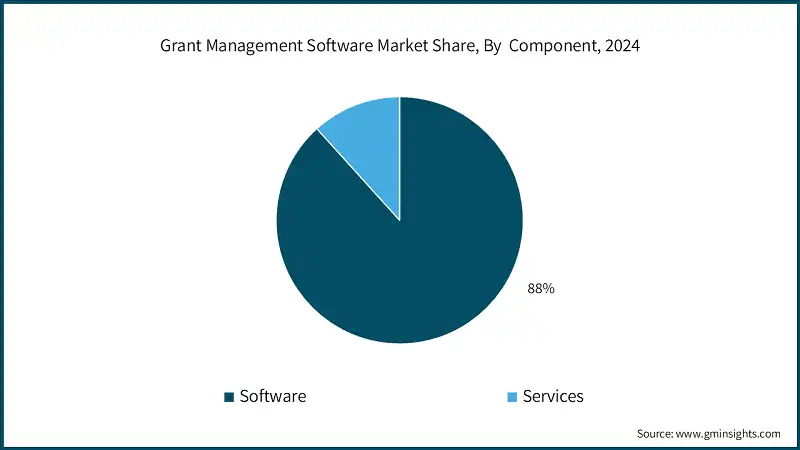
Based on component, the market is segmented into software and services. The software segment substantially leads the grant management software market by 88% share in 2024, due to its integration capabilities with CRM, ERP, and financial management systems.
- Demand for platforms that help organizations in managing grant and awards process such as application intake, review, award, monitoring and reporting, have increased. Organizations are incentivizing the software component, since they frequently request integrated solutions that automate internal processes or flows, use analytics, encourage compliance, and integrate with CRM, ERP, etc. Demand for software that is rich in features, and configurable is gaining priority for both grant-makers and grant recipients as the amount of funding (amount of complexity) increases.
- The services segment (implementation, consulting, training, support) is increasing in traction as organizations are acknowledging that the purchase of software is not enough, they need experts to assist in deploying, customizing, integrating, training users and migrating data from legacy systems. Smaller non-profits and academic institutions do not have the IT or process expertise in-house and rely on vendor or partner services to maximize the value they can get from grant-management platforms. As these systems become more complex (AI modules, multi-jurisdiction workflows, compliance features), the demand for professional services continues to rise.
- There is an emerging trend of AI-integrated grant management software among the industries as AI extends the efficiency, reliability, analytics and security of the grant management process. AI is expected to push the software demand most in the coming years.
- Advance Solutions collaborated with ServiceNow in February 2025 as part of their "Partnership for Good Grant" initiative to provide nonprofits with donated software licenses, implementation services, consulting hours, and monetary grants worth up to US $2 million. Such collaboration between service and software providers clearly indicates a collaborative approach in the grant management landscape.
Based on platform, the market is segmented into web and mobile app. The web segment is expected to dominate the grant management software market and is set to grow at a CAGR of 10.3% in the projected period.
- Web-based options offer centralized data, simplified integration capabilities, and enterprise-level security - everything typically required by large funders, which favors web solutions over desktop applications. The segment holds the largest portion of the market, as it accounted for 82.7% of the grant management software market. Web-based options also limit the frictional cost of deployment with the common software as a service (SaaS) subscription-based models, continuous updates of hosting solutions, and single-source backups, making it the most preferred option over mobile apps.
- On the other hand, mobile apps provide excellent field access, involvement with applicants, and the ability for grantees and reviewers to check-in quickly, resulting in faster response times and greater participation. Mobile-first capabilities-including push notifications of new funding opportunities, the ability to complete forms offline, and document upload capabilities through a camera are especially valuable for applicants in hard-to-reach locations and speed up grant validation activities.
- In the future, the market will gravitate towards hybrid experiences: a rich web console experience for complex administration and a lightweight mobile client experience for outreach managers, field leadership and field operations. API integration will be deeper so that the mobile application will surface web-hosted intelligence (analytics, eligibility scoring) but will maintain the same audit trail and security. Cross-platform sync, progressive web apps and AI-assisted intelligence will blur the lines between web and mobile administration and will allow users to transition seamlessly between desktop planners and mobile implementers without data loss or duplicative action.
- In May 2025, Blackbaud revealed significant product updates across its social-impact suite with an emphasis on connected cloud experiences. Blackbaud granting solutions platform is aligned with the web segment's position in grant management because of the nature of its cloud-based application systems.
Based on end use, the market is segmented into government and public sector, non-profits & NGOs, corporate and others. The non-profits & NGOs segment dominated around 58.2% share of the grant management software market in 2024.
- The dominant nature of the non-profits & NGOs segment was primarily because these organizations handle large volumes of diverse funding sources, must report outcomes to multiple stakeholders, and face increasing transparency and compliance demands. For this reason, vendors are developing SaaS-based, cloud-accessible platforms, tailored to the scale and flexible workflows, of the non-profits & NGOs segment. The convergence of operational pressure, funding complexities, and digital readiness has been the impetus for the leading user context occurring within the non-profits & NGOs sector.
- On the other hand, corporates are more frequently using grant management platforms to ensure their Corporate Social Responsibility (CSR) programs align with Environmental, Social, and Governance (ESG) frameworks. This trend is being impulse by the necessity to measure, report, and verify social impact in a transparent manner. In result, grant management software provides the necessary visibility and accountability to meet stakeholder needs and adhere with global sustainability reporting standards.
- On a global scale, governments are replacing the outdated grant administration systems of the past and transitioning to cloud-based, centralized systems. This transition is better for scaling and accessing data, as well as promoting collaborative work between agencies. The move to the cloud also allows for remote access to these systems, improved disaster recovery, and reduced back-end administrative burden, which all contribute to national objectives for digital governance. Many public agencies are also beginning to examine the advantages of SaaS deployment models to improve the application process and disbursement of funds.
- In April 2025, Instrumentl announced a growth investment from Summit Partners for $55 million. This investment will allow Instrumentl to grow the AI capabilities of its platform at speed, scale customer acquisition efforts in the U.S. and help grant seekers diversify and strengthen their fundraising strategies in light of the federal funding repeals.
Looking for region specific data?
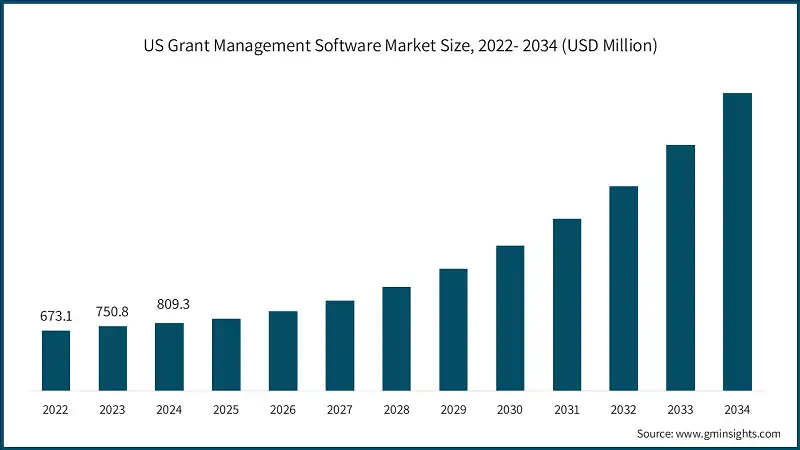
The U.S. grant management software market reached USD 809.3 million in 2024, growing from USD 750.8 million in 2023.
- In North America, the U.S. holds the largest share of the grant management software industry, largely due to widespread acceptance among non-profits, government departments, and educational organizations. The availability of sophisticated digital infrastructure, enterprise software vendors, and cloud services facilitate the implementation of end-to-end grant lifecycle solutions. Implementation is also aided by synergies between software vendors, consulting firms, and public funding partners that collectively facilitate deployment, standardization, and compliance for federal- and state-level grant programs.
- In the United States, the total award count for Fiscal Year (FY) 2024 was 145,831 up 2% from the FY 2023. The integration of substantial investments in research and development, increasingly innovative public-private partnerships, and a strong push for digital advancements by foundations and corporate social responsibility programs, are all driving the use of digital grant solutions. Transformations resulting from AI, analytics, and automated functionalities are shifting manual grant processes into intelligent, data-infused processes.
- In the future, the growth of the market for Grant Management Software in the United States will stem from increasing initiatives related to digital transformation, higher use of AI-enabled advanced grant analytics, and modernization of public funding ecosystems. Increasing federal and state investment in outcome-driven programs will also create demand for more advanced compliance, monitoring, and reporting tools.
The North America region dominated the grant management software market with a revenue share of 38.7% in 2024.
- A significant trend in North America is the shift to cloud-based grant management solutions, which are easy to scale up and down, consistently accessible from remote locations, and cost effective to maintain. The driving factor behind this trend is the increasing number of organizations providing funding whether they are government, not for profit, or private who want to manage the grant process from application, to award, to reporting on one platform.
- Another important trend relates to advanced analytics and workflow automation integrated into grant-management platforms. Organizations are becoming more accustomed to real-time dashboarding, predictive outcome modelling, automated eligibility screening and submission-to-award processing. With a more developed vendor ecosystem in North America, platforms are merging with donor CRM systems and ERP and financial tools, enabling end-to-end data flows with stakeholders.
- In Canada, there is a consistent adoption of grant-management software among provincial and federal funding agencies, with interest in modular, software-as-a-service (SaaS) solutions that are well-suited for a bilingual and multi-jurisdictional environment. The trend among Canadian organizations is to adopt scalable services that enable the grant process to be applied in both English and French, support of funding across provinces, and encourage collaboration across agencies.
Europe grant management software market accounted for USD 609.7 million in 2024 and is anticipated to show fastest growth over the forecast period.
- In Europe, one prominent trend is the shift toward cloud-first deployments and modular, flexible software architectures. Many organizations across public, non-profit and research sectors are moving away from legacy on-premises grant portals and toward SaaS solutions that allow rapid configuration, multi-tenant access and integration with other digital systems. The desire for workflow automation, mobile access and real-time dashboarding is pushing vendors to offer more agile, user-centric platforms.
- A second key regional trend in Europe is the strong emphasis on compliance, transparency, open data and cross-border interoperability. Many European programs (especially those funded via the European Commission or other trans-national mechanisms) require stringent audit trails, fund-tracking, multilingual reporting and adherence to data-protection regimes such as General Data Protection Regulation. As a result, grant-management systems are increasingly expected to offer embedded compliance modules, standardized data-exchange protocols and secure document repositories.
- The future trend for the grant management software in Europe seems promising. For instance, European Commission has proposed to double the ERC budget to about €31 billion over 2028-34. A larger ERC budget will greatly expand the number and breadth of research funding grants across universities, innovation hubs, and cross-border collaborations. This growth will necessitate enhanced grants management systems, with greater throughput capacity, multilingual procedures, and cross-institutional coordination.
Germany dominates the grant management software market, showcasing strong growth potential, with a CAGR of 12.1% between 2025-2034.
- Germany creates opportunities for the grant management software sector as the funding environment is being increased that typically requires grant management solutions. Key players like SAP are continuously contributing to the market, serving government agencies, non-profits and corporations with grant management systems.
- The significant investment by the German federal government in infrastructure, which included an increase of €800 million in grants for Autobahn motorway infrastructure in Germany in 2024 compared to 2023 demonstrates a major allocation of funds that will require advanced and well-managed grant systems to effectively deploy these fund allocations.
- In summary, the market seems positive for Germany's grant management software and is forecast to continue to grow, with further double-digit growth from increasing government and EU funding for innovation, infrastructure, and sustainability projects.
The Asia Pacific grant management software market is anticipated to grow at CAGR of 8.9% during the analysis timeframe.
- A key trend in the Asia Pacific region is the rapidly increased digitization of grant-administration new processes across the public, education and non-profit sectors. Multijurisdictional governments and philanthropies are increasingly adopting cloud-based grant management platforms to manage multi-currency, multi-jurisdiction and multi-stakeholder funding flows.
- One of the other noteworthy trends in Asia Pacific is the expansion of grants out of the traditional non-profit sector and into supporting educational, research and corporate social responsibility (CSR) activities, which is increasing growth in advanced grant software features. Foundations and donors in the region are also wanting platforms that allow for local language preference, regional compliance, mobile access and easy collaboration across countries, reflecting the diversity of Asian Pacific markets.
- In China, the market is being driven by state-funded grants for research, education, technology innovation and rural revitalization that are in need of advanced grant management systems. Chinese agencies and institutions are focusing on systems with strong control and governance, centralized fund allocation, fraud mitigation, and real-time fund tracking.
China is estimated to grow with a CAGR of 9.3%, in the Asia Pacific grant management software market.
- The market for grant management software in China offers significant opportunities for major players to capitalize on the country’s rapid acceleration of its transition to digital public administration and transparent fund governance. In fact, China shows a substantial demand for an end-to-end, cloud-based grant management platform in research, education, and innovation that is driven by the government’s continued modernization of funding systems.
- In April 2024, China granted over 200 billion yuan (about 28.16 billion U.S. dollars) from the central budget to expand effective investment so far this year. Such big grants from the government continuously require a sophisticated system for managing grants and also creating opportunities for players in the long-term sustainability within the Chinese market.
- Moreover, adoption by research institutions, universities, and philanthropic foundations, is influenced by a desire for outcome-based reporting, automated eligibility and review workflows, and built-in analytics. Grant management solution provider are responding with AI-assisted modules for reviewing and vetting applications, automation to reduce administrative overhead, and performance analytics dashboards; local market assessments also identify a preference for locally customized solutions that account for language, regulatory differences, and mobile apps or functionality.
Latin America grant management software market accounted for USD 209.9 million in 2024 and is anticipated to show lucrative growth over the forecast period.
- In the region, organizations are progressively adopting cloud-based grant management platforms for managing increasing volumes of social program funding and donor-driven grants. Many public administration and non-profit entities in the region prefer solutions that provide multilingual support, budget-control dashboards, and bilingual (Spanish/Portuguese) functionalities, as they facilitate implementation of the technology and lessen the burden of training. The shift away from spreadsheets and local siloed systems to consolidated grant-lifecycle software is prevalent across mid-sized NGOs and government organizations.
- Another significant regional trend is the enhancement of collaboration among funders, non-profits, and social-impact technology providers to customize grant-management workflows for the unique institutional and regulatory contexts in Latin America. Platforms are increasingly adding modules for outcomes tracking, community-based project monitoring, and mobile data entry; these features are aligned with the regional emphasis on social-inclusion and rural program delivery.
- In Brazil, Mexico, Argentina and other nations, adoption trends of grant-management manifests differently. Brazil is pushing enterprise deployments that includes national public financial systems, as well as major philanthropic foundations, and in turn, there is a greater demand for platforms that support scalability and analytics.
- Mexico trend is a more pronounced trend of cloud, and AI-enabled platforms that is supported by burgeoning tech hubs, hyperscale investments, and an increase in enterprise/consulting activity that is accelerating digital implementations. Overall, there are potential opportunities for grant management vendors throughout the region.
Brazil is estimated to grow with a CAGR of 10.2%, in the Latin America grant management software market.
- There is a strong demand for grant management software in Brazil as the country continues to expand the number of governmental and non-profit funding programs that require increased grant administration that is efficient and transparent. Brazil is expected to grow at the highest CAGR and contribute to the overall Latin America grant management software market, which reached USD 85.8 million in 2024. This demand is driven by the increasing complexity of grant applications and the need for automated processes to track and report on grant activity in order to meet lines of accountability for regulatory compliance and transparency across multiple sectors.
- Moreover, Brazil is moving toward cloud-based grant management platforms, representing an increasing share of revenue in 2024 and likely to show rapid growth due to their scale, accessibility, and cost-effectiveness. Following ongoing growth in Brazil's nonprofit sector coupled with increasing government investment in social, educational, and research projects, a more user-friendly and affordable form of grant management software that allows for real-time financial overview as well as engagement with relevant stakeholders, is likely to become more widespread.
- Operational trends in Brazil highlight aspects such as full-cycle monitoring, more mobile data capture in the field, and increased connections to public financial systems and donor reporting standards. All these aspects are prevalent in regional procurement and the local NGO engagement in selecting platforms that reduce administrative tasks while increasing impact visibility.
The Middle East and Africa accounted for USD 100.5 million in 2024 and is anticipated to show lucrative growth over the forecast period.
- The grant management software market in the Middle East and Africa is heavily driven by targeted government funding programs like the Research Grant program by Saudi Arabia Environment Fund. The program encourages research institutions and universities to carry out more substantial environmental research. The program grants research funding up to 100% of research project costs, and funds are allocated in stages throughout the research project based on stages of deliverables agreed upon at the start of the research project, which aids in project and funding management for timely utilization of the grant. In turn, this grows demand for grant management software that can offer transparency and efficient tracking related to total funds disbursed.
- Another important factor driving the market is institutional support from entities, such as the Arab Fund for Economic and Social Development. This organization invests about 5% of its net profit in grants that assist with building member states. This funding is used for social and economic development strategy, and it will lead to an increased volume and complexity of grant management activities.
- Alongside that comes an emerging need for integrated software solutions to facilitate complex, multi-layered grant portfolios, automate compliance checks, and manage dynamic real-time reporting for multiple stakeholders throughout the Middle East and Africa.
- Additional trends entail the use of cloud-based and collaborative platforms that address the typically geographically dispersed nature of funding organizations and recipients in these areas. Emerging technologies help organizations to improve decision-making, optimize grant distribution, and increase transparency, all of which are important growth factors in the Middle East and Africa refgion.
UAE to experience substantial growth in the Middle East and Africa grant management software market in 2024.
- The United Arab Emirates grant management software industry is increasingly influenced by the government’s strategic push toward digital transformation and smart governance. Integrated digital platforms that oversee the complete digital grant lifecycle from application to award is becoming standard, which reflects the UAE’s vision of a fund-distributing government that is efficient, transparent, and paperless.
- For example, significant funding schemes, such as the competitive research funding provided by UAEU's Research Centers, as well as the Department of Health Abu Dhabi's Research and Innovation Grants, indicate that institutional funding plays an active role in the region. UAEU's funding supports interdisciplinary research projects across a variety of thematic areas, promoting research productivity and innovation.
- Furthermore, the Abu Dhabi Department of Health supports innovators in the healthcare ecosystem to address pressing challenges in the sector, while providing substantial research and innovation funding. These focused grant programs increase the need for scalable, cloud-based, and collaborative grant management software that meets the needs of diverse programs, streamline engagement with stakeholders and help improve operational efficiency across the growing grant landscape in the UAE.
Grant Management Software Market Share
The top 7 companies in the grant management software industry are Blackbaud, Salesforce, Workday, Oracle, Bonterra, Submittable and Euna Solutions, contributing 25% of the market in 2024.
- Blackbaud is a prominent provider of grant management software with a strong focus on social impact and nonprofit technology solutions. Its integrated cloud ecosystem connects fundraising, financial management, and impact tracking enabling organizations to offer a seamless grantmaking experience from end to end. The strength of Blackbaud lies in its deep specialization in solutions for philanthropic and educational efforts, including obligations for transparency, compliance, and measurable results in its Blackbaud Grantmaking ecosystem and SKY platform.
- Salesforce provides its industry-leading CRM foundation and the Nonprofit Cloud to bring digital transformation to grantmakers. The company’s strategy is to integrate relationship management, impact reporting, and collaboration into a scalable and highly configurable cloud architecture. Its ecosystem of integrations is designed to help easily connect across teams, which supports data-driven decision-making and transparency across the grant cycle.
- Workday brings together its expertise in financial and human capital management with intelligent grants management functionality for higher education, research, and government. The application emphasizes data accuracy and audit compliance, as well as workflow automation of information that offers better visibility into the grant lifecycle. Workday's competitive edge lies in embedding AI and predictive analytics into its unified architecture, bringing accountability and real-time visibility into sponsored research and project funding.
- Oracle provides grant management solutions at enterprise-grade powered by ERP and a flexible cloud infrastructure. This suite allows organizations to automate and manage the entire grant lifecycle from application and award management to financial reconciliation with advanced analytics and reporting features. In addition, Oracle's future strategy will advance efforts toward intelligent automation, security, and data integrity positioned as a prominent partner for complex, multi-stakeholder grant environments across government, academia or enterprise organizations.
- Bonterra thrives in the social impact management space with its technology combined with services to create an effective grantmaking, employee giving, and CSR solution. The software-as-a-service solution works in a single, cloud-based ecosystem that enables just, effective, transparent, and measurable distribution of funds. The Bonterra approach to social impact management combines grantmakers and nonprofits in a single-impact platform that promotes ongoing and consistent communication, compliance tracking, and outcome measurement.
- Submittable is in the business of modernizing grantmaking through a submission management software that is user centric and all-in-one. Its easy-to-use design and powerful automation simplifies the application, review, and reporting process for grantmakers. Submittable's offering enables organizations to easily manage complex, longitudinal, community, or corporate grant programs. It does this with a focus on persistence in user experience renewal, leveraging data access and transparency for success, and integrations with other impact measurement tools all of which makes the document service platform attractive to foundations and CSR programs moving to digital-first operations.
- Euna Solutions is dedicated to enhancing grant management in the public sector by offering a single platform that allows for visibility, compliance, and performance tracking. The company specializes explicitly in solutions for the government and education sectors that increase the efficacy of funding and its outcomes. The Euna Solutions methodology combines financial transparency with digital workflows to improve accountability and efficiency and supports multiple grant programs.
Grant Management Software Market Companies
Major players operating in the grant management software industry are:
- Blackbaud
- Salesforce
- Workday
- Oracle
- Bonterra
- Submittable
- Euna Solutions
- Blackbaud is a leading software provider in the grant management sector, with about 8% of the market share. Blackbaud offers comprehensive CRM and grant management systems, an entire suite of cloud-based solutions for nonprofits, foundations and higher-education institutions. Blackbaud solutions incorporate significant workflow automation, reporting and compliance, and donor management tools that allow for seamless stewardship. As a partner that specializes in stakeholder engagement and grant lifecycle automation, Blackbaud is extremely well-positioned to support organizations looking for an integrated end-to-end grant solution.
- Salesforce's grant management applications provide high levels of automation, real-time collaboration, and constituent engagement, designed and built on its fundamental CRM features, for funders in both the government and social sectors. Additionally, embedded features of artificial intelligence (AI) in their platform help facilitate the efficiency of the levels of objective application assessment, impact measurement, and distribution of funds.
- Workday is particularly distinctive in its integration of finance, human capital management, and grant management in one system, particularly for organizations in higher education and research. Its grant management application provides real-time budgeting, expense tracking, and compliance monitoring, along with robust analytics to maximize funding allocations. Workday also benefits from unified data models and mobile-first approaches to support collaborative grant administration at scale.
- Oracle has maintained a very strong presence with its strong enterprise grant management modules included in its complete cloud ERP solution. Oracle's solutions will have appeal to larger institutions and government agencies wanting grant workflows that are highly secure, auditable, and regulated. Oracle differentiates itself in complex grant environments and compliance-heavy workflows through features like automated risk management, configurable approvals, and financial integration with other departments.
- Bonterra offers customized solutions for foundations, corporations, and nonprofits. The software offered by Bonterra emphasizes quick implementation, intuitive configurability, and automated reporting and compliance with tight security. Bonterra’s integrated platform model enhances tracking and communication tools for internal teams and external applicants.
- Submittable specializes in convenient and cloud-based grant management software that is used by both private and public grantmakers to simplify application intake and review and reporting. It provides simple-to-complete forms, collaborative evaluation workflows, and robust document management functions. Submittable has an open API architecture that allows for smooth integration with third-party software and an efficient and scalable process to deploy grant programs that can change rapidly.
- Euna Solutions has a distinct focus on public sector and higher education clients by offering grant management tools that automate workflow, demonstrate compliance, and provide real-time insights. The value proposition of the platform is to enable collaborative budgeting, the management of deadlines, and auditing of grants which promote transparency across a wide range. The approach specific to a sector is designed to assist public agencies and educational institutions in reducing their administrative burden without sacrificing the rigor of reporting.
Grant Management Software Industry News
- In March 2025, Euna Solutions acquired AmpliFund, a leader in grant management software landscape. Euna Solutions aims to strengthen their current grant management SaaS offerings for the public sector.
- In January 2025, Submittable announced that they had signed a new grant management contract with the Texas Department of Information Resources. Texas DIR puts thorough evaluation for vendors at the forefront of their process - with rigorous negotiations to ensure that entities receive the highest quality products at the most reasonable price.
- In August 2024, Submittable acquired WizeHive. WizeHive which had previously acquired BRIGHT FUNDS and WEHERO, also benefits Submittable, brings together four social impact brands to establish market-leading grants management software, accelerate corporate social responsibility (CSR) solutions, and ultimately empower customers to be greater catalysts for social good.
- In August 2024, Temelio and UpMetrics announced a collaboration that will merge Temelio's grant management software with UpMetrics software that provides impact analytics. The integration supports a seamless experience, promotes partnerships between funders and grantees.
- In March 2023, SmartSimple Software made an announcement the launch of SmartSimple Cloud +AI that provides end-to-end AI support throughout the entire grant management lifecycle, streamlining the process, and further reducing administrative burden.
The grant management software market research report includes in-depth coverage of the industry with estimates & forecasts in terms of revenue ($ Mn/Bn) from 2021 to 2034, for the following segments:
Market, By Deployment Model
- Cloud
- On-premises
- Hybrid
Market, By Component
- Software
- Services
- Professional Services
- Managed Services
Market, By Platform
- Web
- Mobile app
Market, By Enterprise Size
- Large enterprises
- SMEs
Market, By End Use
- Government and public sector
- Non-Profits & NGOs
- Corporate
- Others
The above information is provided for the following regions and countries:
- North America
- US
- Canada
- Europe
- Germany
- UK
- France
- Italy
- Spain
- Russia
- Nordics
- Benelux
- Asia Pacific
- China
- India
- Japan
- South Korea
- ANZ
- Singapore
- Malaysia
- Indonesia
- Vietnam
- Thailand
- Latin America
- Brazil
- Mexico
- Argentina
- Colombia
- MEA
- South Africa
- Saudi Arabia
- UAE
- Turkey
Frequently Asked Question(FAQ) :
What was the valuation of the cloud deployment segment in 2024?
Cloud deployment held 72% market share in 2024, due to its less integration cost as compared to other deployment models.
What is the growth outlook for the on-premises deployment from 2025 to 2034?
On-premises solutions are projected to grow at a 9.5% CAGR till 2034, serving organizations with stringent data sovereignty, legacy integrations, or internal IT control requirements.
Which region leads the grant management software market?
The U.S. grant management software market reached USD 809.3 million in 2024, owing to widespread acceptance among non-profits, government departments, and educational organizations.
What are the upcoming trends in the grant management software market?
Key trends include adoption of cloud-based platforms, AI-powered grant matching & predictive analytics, mobile-first solutions for field operations, blockchain-based audit capabilities, and integration with CRM and ERP systems for enhanced transparency and efficiency.
Who are the key players in the grant management software market?
Key players include Blackbaud, Salesforce, Workday, Oracle, Bonterra, Submittable, Euna Solutions, Microsoft, Sage, Benevity, Fluxx Labs, Optimy, AmpliFund, eCivis, CyberGrants, SmartSimple Cloud, HTC Global Services, REI Systems, WizeHive, Foundant Technologies, Instrumentl, SurveyMonkey Apply, Award Force, FluidReview, ZoomGrants, Good Grants, and Grantseeker.
How much revenue did the software component generate in 2024?
The software segment leads market by 88% share in 2024, due to its integration capabilities with CRM, ERP, and financial management systems.
What is the current grant management software market size in 2025?
The market size is projected to reach USD 2.4 billion in 2025.
What is the market size of the grant management software in 2024?
The market size was USD 2.2 billion in 2024, with a CAGR of 10.2% expected through 2034 driven by rising demand for advanced platforms that ensure transparency, auditability, and compliance with complex funding guidelines.
What is the projected value of the grant management software market by 2034?
The grant management software market is expected to reach USD 5.8 billion by 2034, propelled by digital transformation acceleration, AI & automation adoption, and growing grant funding volumes globally.
Grant Management Software Market Scope
Related Reports