Summary
Table of Content

Gesture Recognition Market
Get a free sample of this report
Form submitted successfully!
Error submitting form. Please try again.
Thank you!
Your inquiry has been received. Our team will reach out to you with the required details via email. To ensure that you don't miss their response, kindly remember to check your spam folder as well!
Request Sectional Data
Thank you!
Your inquiry has been received. Our team will reach out to you with the required details via email. To ensure that you don't miss their response, kindly remember to check your spam folder as well!
Form submitted successfully!
Error submitting form. Please try again.
Gesture Recognition Market Size
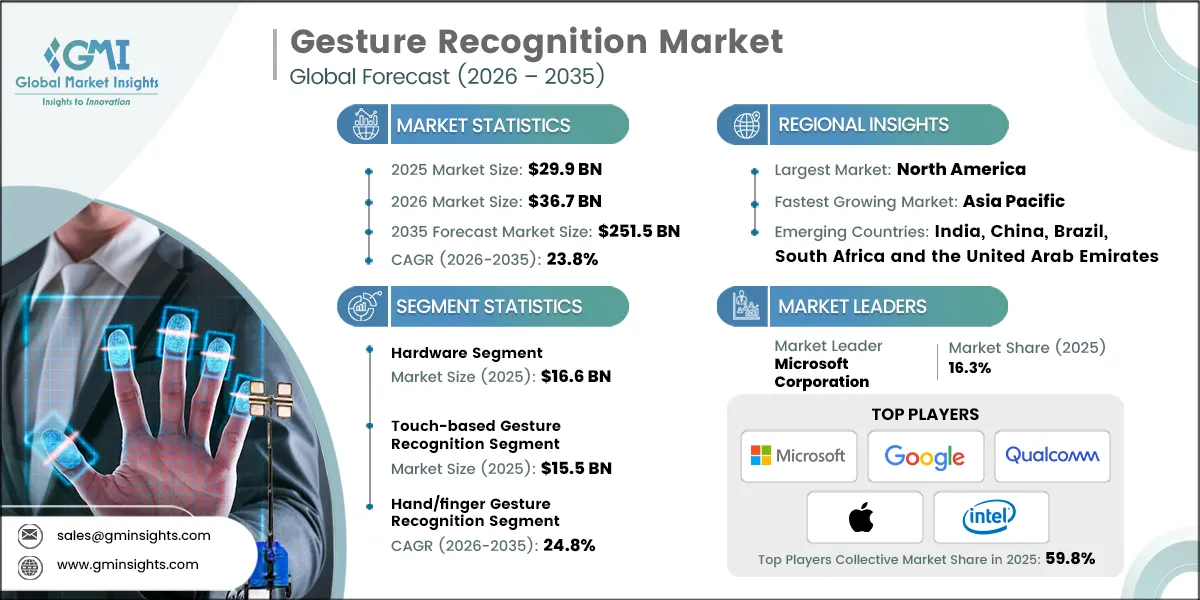
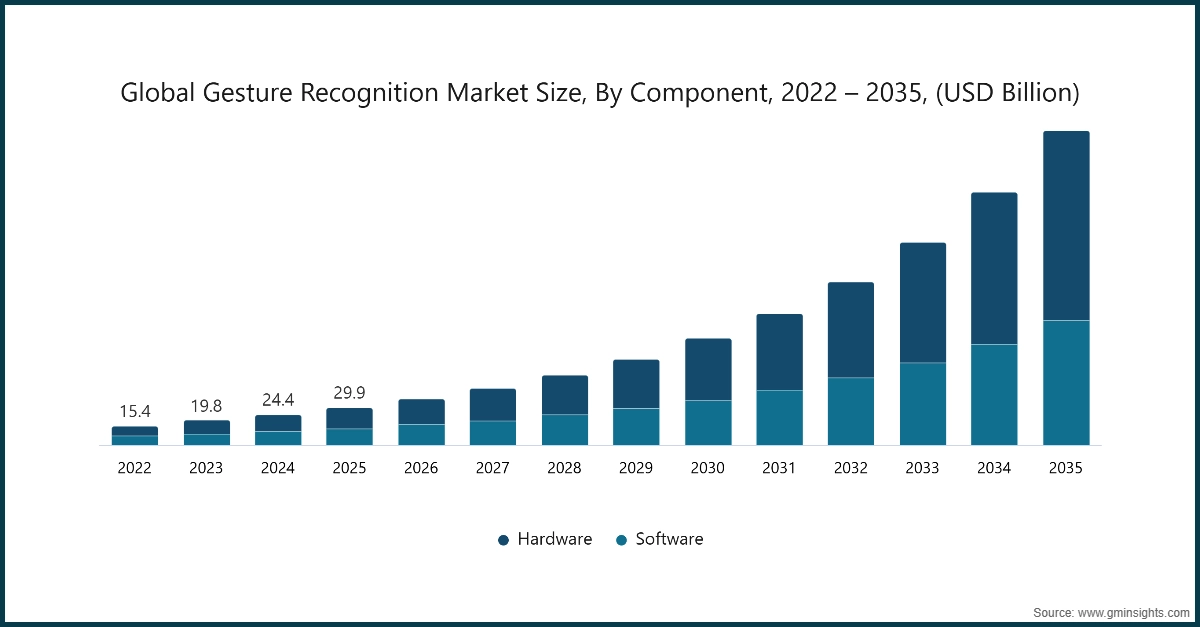
The global gesture recognition market was valued at USD 29.9 billion in 2025. The market is expected to grow from USD 36.7 billion in 2026 to USD 105.4 billion in 2031 and USD 251.5 billion in 2035, at a CAGR of 23.8% during the forecast period, according to the latest report published by Global Market Insights Inc. The market growth is driven by rising demand for touchless interaction, growth of smart retail and digital stores, advancements in computer vision and artificial intelligence, increased use of surveillance and camera infrastructure, and rising focus on customer behavior analytics.
Gesture Recognition Market Key Takeaways
Market Size & Growth
- 2025 Market Size: USD 29.9 Billion
- 2026 Market Size: USD 36.7 Billion
- 2035 Forecast Market Size: USD 251.5 Billion
- CAGR (2026–2035): 23.8%
Regional Dominance
- Largest Market: North America
- Fastest Growing Region: Asia Pacific
Key Market Drivers
- Rising Demand for Touchless Interaction.
- Growth of Smart Retail and Digital Stores.
- Advancements in Computer Vision and Artificial Intelligence.
- Increased Use of Surveillance and Camera Infrastructure.
- Rising Focus on Customer Behavior Analytics.
Challenges
- Privacy and Ethical Concerns.
- High Computational and Implementation Cost.
Opportunity
- Advancement of edge AI–based gesture recognition.
- Expansion of gesture recognition in healthcare and assistive technologies.
Key Players
- Market Leader: Microsoft Corporation led with over 16.3% market share in 2025.
- Leading Players: Top 5 players in this market include Microsoft Corporation, Apple Inc., Google LLC, Intel Corporation, Qualcomm Technologies, Inc., which collectively held a market share of 59.8% in 2025.
Get Market Insights & Growth Opportunities
The need to have touchless interaction has increased to a large extent because of the public health and safety concerns highlighted through Government of India. Governmental guidelines during and after COVID-19 encouraged non-contact community services and online communication. The programs of smart public infrastructure and Ministry of Health and Family Welfare promoted automation of operations to minimize physical interactions within the premises. The gesture recognition system can help in achieving these goals through supporting touch-free digital sign boards, touch-free market kiosks, and touch-free service counters. Gesture based interaction technologies are getting increasingly relevant and institutionally sanctioned as governments are fast becoming hygiene centric in their infrastructure development.
Artificial intelligence (AI) and automation has become the focal point of the national innovation and digital transformation strategy in Germany, and the government leverages this through policy to enhance research and industry uptake and application. The policies of the governments focus on the sustainable implementation of AI in the manufacturing, services, and digital infrastructure, which will allow businesses to use advanced technologies at a larger scale, such as the implementation of the systems of intuitive human-machine interaction, such as gesture recognition.
Governmental efforts and programs to grow domestic AI capacity, start-ups and make Germany competitive in world-tec interests as automation spreads in Industry 4.0 communities. For instance, in February 2026, the government of Germany announced that, they are making AI usage more urgent in order to transform industry and the work of the public administration and enhance the number of AI-oriented startups, 25 percent of which already use AI as a part of their business.
Gesture recognition is a technology that enables computers, devices, and systems to interpret and respond to human gestures, such as hand movements, finger motions, or body postures, as input commands. It combines sensors, cameras, and advanced algorithms, often powered by AI and machine learning, to detect, analyze, and translate gestures into actionable signals. This technology enhances user interaction, enabling touchless control in applications like gaming, healthcare, automotive systems, and smart devices.
To get key market trends
Gesture Recognition Market Trends
- In the field of touchless technologies, retailers are becoming more aggressive in integrating gesture recognition into enhancing their hygiene, convenience, and consumer comfort. Kiosks, digital signboards, and smart displays are also being integrated with gesture recognition to enable customers to navigate the interfaces and browse products without touching or having to gain physical contact with them. This is consistent with emerging trends of the consumer regarding smooth and hands-free shopping experiences.
- Gesture recognition also will be used alongside AI-based video analytics systems deployed in the retail setting already. Using the combination of gesture and footfall data, dwell time, and motion tracking, businesses will have a better understanding of customer motives and actions. With convergence, decision making and real time response becomes more intelligent in dynamic market conditions.
- Gesture recognition systems are being deployed directly onto edge devices like edge cameras and more powerful processors to mitigate the latency and privacy concerns. Edge AI can also detect gestures in real-time without sending the raw video footage to centralized servers, enhancing the quickness of the response and data security. This trend carries scalable implementation in the crowded market and retail environments.
Gesture Recognition Market Analysis
Learn more about the key segments shaping this market
Based on components, the market is divided into hardware and software.
- The hardware segment was valued at USD 16.6 billion in 2025. The demand for sensors, cameras, and motion sensors in gaming, AR, VR, and auto technologies is driving this segment, as vendors are developing precise technologies for gesture recognition purposes.
- The integration of gesture recognition technology into more consumer electronics and smart home technology products will result in more hardware sales, given that users of these products favor convenient interface systems.
- Manufacturers should be encouraged to concentrate their efforts on improving the precision and ruggedness of their sensors and cameras to meet increasing requirements from fields such as AR/VR, autos, and smart devices.
- The software segment is anticipated to grow at a CAGR of 22.4% during the forecast period. The advancements seen in AI and machine learning techniques have significantly contributed to an increased level of accuracy with regard to the detection and subsequent understanding of gestures, thereby fueling their use in industries like healthcare, automotive, and industrial sectors.
- Rising demand for gesture recognition software in AR/VR environments and gaming applications is also projected to further extend the scope for the market to grow in the coming years.
- Software developers must focus on the accuracy, efficiency, and ability of AI-powered algorithms to incorporate multiple gestures for the smooth operation of numerous applications.
Learn more about the key segments shaping this market
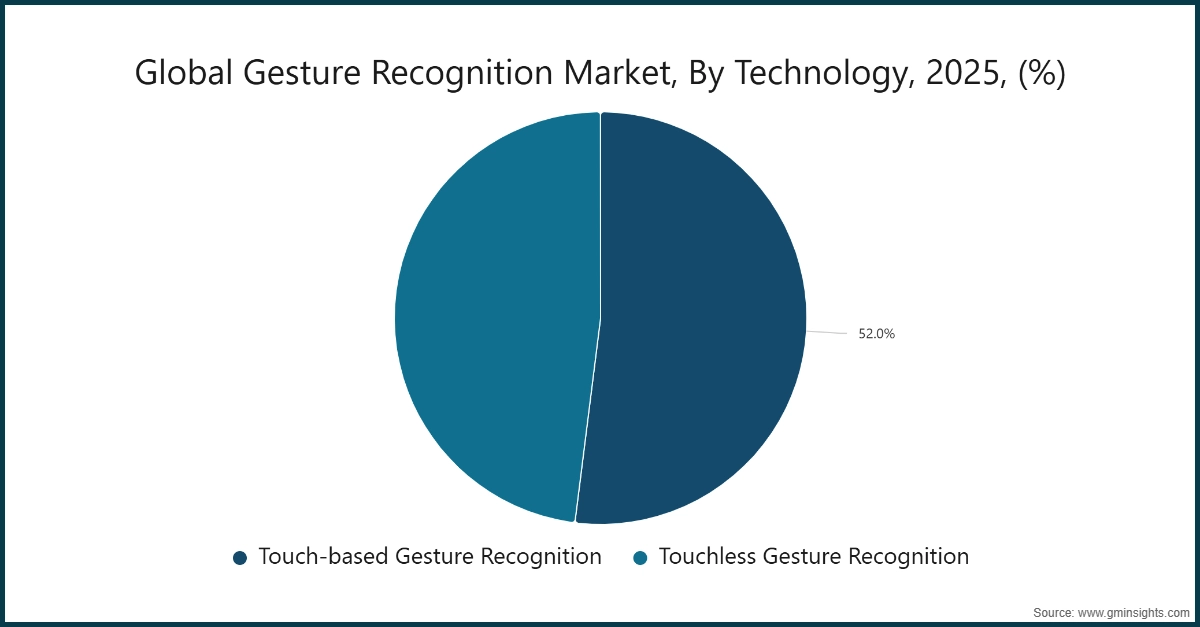
On the basis of technology, the gesture recognition market is divided into touch-based gesture recognition and touchless gesture recognition.
- The touch-based gesture recognition segment was valued at USD 15.5 billion in 2025. Large-scale adoption of touchscreen-enabled smartphones, tablets, and kiosks fuels demand for touch-based gesture recognition due to the necessity for intuitive interaction and precise input control in consumer and industrial use.
- Touch-based gesture systems help integrate gaming consoles, automated teller machines, and automotive dashboards, making the user experience better and fostering market growth, as consumers and enterprises take a liking to touch-sensitive interfaces.
- Manufacturers should enhance sensor accuracy and responsiveness to improve touch-based interaction, catering to smartphones, tablets, and industrial devices while maintaining durability and cost efficiency.
- The touchless gesture recognition segment is set to grow at a CAGR of 24.5% during the forecast period. The increasing demand for touchless user interfaces, especially in the healthcare, automotive, and kiosk industries, is increasing the adoption of touchless gesture recognition systems.
- Technologies such as AI, computer vision, and motion sensors are improving significantly and help in the accurate interpretation of gestures without the use of physical touch, thereby promoting the adoption of various technologies such as AR/VR.
- Manufacturers should invest in AI-driven algorithms and high-precision sensors that improve touchless gesture precision for various industries such as healthcare, automotive, and public interfaces.
Based on the authentication factor, the gesture recognition market is divided into hand/finger gesture recognition, facial gesture recognition, voice gesture recognition, eye movement gesture recognition, and body movement gesture recognition.
- The facial gesture recognition segment was valued at USD 8.2 billion in 2025. There is an increase in the adoption of facial gesture recognition in smartphones, laptops, and security systems, which enhances the growth of the market. People are seeking more convenient authentication and personalized experiences in smartphones, laptops, and security.
- The increase of facial gesture recognition technology in banking, healthcare, and surveillance applications improves security, accuracy, and even usability, thereby fueling the market growth of industries that require accurate authentication methods.
- Manufacturers should concentrate on improving facial recognition algorithm accuracy through AI integration to improve security and user experience, processing speed, and compatibility with multiple device platforms.
- The hand/finger gesture recognition segment is anticipated to grow at a CAGR of 24.8% during the forecast period. This segment is growing due to increasing adoption in Augmented Reality and Virtual Reality, gaming, and automotive industries for precise, intuitive, and interactive results.
- Improved sensors with machine learning technology will improve the accuracy of technologies like hand or finger gesture, which will be used in intelligent devices, robots.
Investments should be made by manufacturers in compact sensors with higher precision for hand/finger gestures for applications like AR/VR, gaming, and devices.
 Looking for region specific data?
Looking for region specific data?
North America Gesture Recognition Market
North America dominated about 33.5% of gesture recognition industry share in 2025.
- North America is seeing the rapid adoption of gesture recognition systems due to the presence of robust digital infrastructure and the early adoption of AI.
- Retailers and commercial spaces can adopt gesture-based interfaces in their existing or new kiosks, smart shelves, or displays to increase customer engagement and optimize efficiency.
- The region benefits from strong collaboration between public institutions, research universities, and technology providers, which is driving commercialization. There is significant privacy-focused AI deployment and edge computing driving system designed to operate in strict regulatory environments.
- Manufacturers should look for opportunities in privacy-conformal solutions for edge-based gestures and partnerships with retailers/public institutions to deploy large-scale trial opportunities for smart business environments.
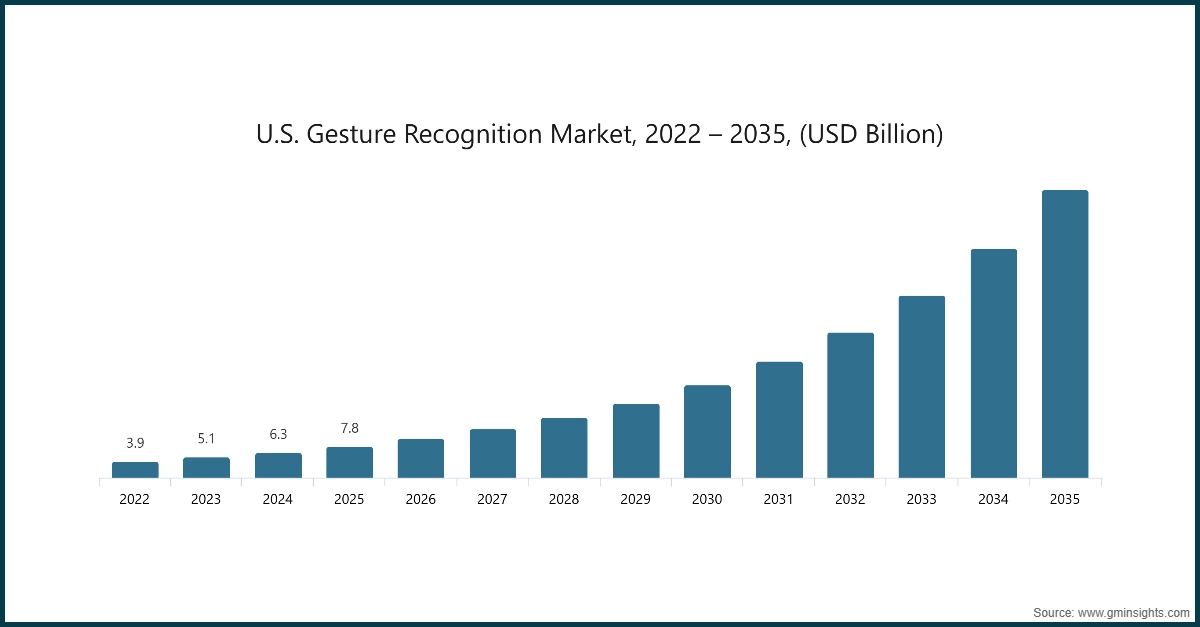
The U.S. gesture recognition market was valued at USD 3.9 billion and USD 5.1 billion in 2022 and 2023, respectively. The market size reached USD 7.8 billion in 2025, growing from USD 6.3 billion in 2024.
- The US market is being propelled by AI innovation fueled by the government, smart infrastructure development, and digital transformation of retail and public services. Gesture recognition technology is being adopted for touchless kiosk solutions, accessibility services, and intelligent customer interaction systems.
- The focus of the federal government on trusted and responsible AI is shaping the design of federal systems, encouraging vendors to promote explainable, secure, and unbiased models. Funding in AI by governments is resulting in faster research, allowing us to leapfrog from lab-scale gesture recognition models to production-grade deployments.
- For instance, the National Institute of Standards and Technology emphasized federal efforts in October 2023 to advance safe, reliable, and interoperable AI technologies, including human machine interaction technologies, under the U.S. AI Risk Management Framework.
- Manufacturers of gesture recognition software should aim to comply with government standards on the implementation of artificial intelligence, focusing on safety, transparency, and accessibility to make the software suitable for the public sector and large enterprises.
Europe Gesture Recognition Market
Europe market was worth USD 7 billion in 2025 and is anticipated to show lucrative growth over the forecast period.
- The market for Europe region is driven by regulatory and ethical considerations in AI, along with smart cities.
- Adoption is rising in retail, transport terminals, and public service provision areas where touchless engagement enhances accessibility and hygiene. The European approach to data privacy and user consent stimulates innovation in device processing and anonymized gesture analysis.
- Gesture recognition is being expanded beyond the retail sector and into other interaction ecosystems through the integration of smart city infrastructure and digital public services.
- Manufacturers must ensure that designs of gesture systems conform to the requirements of the GDPR, using the consent mechanism, while engaging with smart city initiatives to incorporate their projects in public-facing digital technologies.
Germany dominated the Europe gesture recognition market, showcasing strong growth potential.
- Germany’s market is strongly influenced by its leadership in Industry 4.0, automation, and applied artificial intelligence. Gesture recognition is gaining traction as a natural human–machine interface within digitally enabled commercial and service environments.
- The government's focus on transferring AI research into practical applications, supporting deployment in retail, logistics, and public services. Emphasis on reliability, engineering precision, and industrial-grade performance demands robust, high-accuracy gesture recognition systems.
- For instance, In July 2023, the Federal Ministry for Economic Affairs and Climate Action presented expanded funding and implementation measures regarding Germany's new AI Strategy to accelerate real-world AI adoption across economic sectors.
- Manufacturers should prioritize industrial-grade accuracy, system robustness, and partnerships with German SMEs to integrate gesture recognition into Industry 4.0 and smart retail ecosystems.
Asia Pacific Gesture Recognition Market
The Asia Pacific market is anticipated to grow at a CAGR of 25.5% during the analysis timeframe.
- Asia Pacific is witnessing rapid growth due to rapid urbanization, increasing smart retail environments, and large-scale digital transformation programs.
- Governments are spending on smart cities, AI infrastructure, and digital services, indirectly fueling the growth of gesture recognition system adoption. Due to high population density, there is an increased market that encourages the installation of touchless technologies for better crowd handling capabilities.
- Cost-effective hardware, mobile-first approach, and real-time capabilities are critical factors for success in this area.
- Manufacturers should focus on cost-optimized, scalable gesture recognition solutions and tailor deployments for high-traffic retail and public environments across emerging Asia Pacific markets.
China gesture recognition market is estimated to grow with a CAGR of 27.4% during the forecast period, in the Asia Pacific market.
- China’s market is led by robust digital infrastructure development efforts by the government, coupled with the high penetration of AI-based surveillance systems.
- Gesture recognition is frequently used in the construction of smart stores, automated service systems, and informational displays.
- Emphasis of the government towards self-reliance of AI and domestic innovation also facilitates the fast pace of commercialization. The massive pilot tests enable the rapid evolution of various forms of gesture recognition technologies.
- Manufacturers should focus on large-scale deployment capability, partnership with local ecosystems, and integration with existing AI cameras and smart retail infrastructures.
Latin American Gesture Recognition Market
Brazil leads the Latin American gesture recognition industry, exhibiting remarkable growth during the analysis period.
- Brazil is slowly embracing gesture recognition technology through digital modernization in retail stores and public services.
- Growth drivers are rising urban digitization, increasing camera infrastructure, and a need for enhancing customer experience for commercial environments.
- Though the rate of adaptation is slower in comparison to the developed regions of the world, there is an increased interest, especially in cost-effective and multi-functional AI solutions. In the case of gesture recognition, it may be part of the larger video analysis solution.
- Manufacturers should offer affordable, modular gesture recognition systems and position them as value-added features within broader video analytics and smart retail solutions.
Middle East and Africa Gesture Recognition Market
South Africa gesture recognition industry to experience substantial growth in the Middle East and Africa market in 2025.
- South Africa possesses an emerging market with a pace of digital evolution throughout the retail industry, transportation hubs, and public services.
- Gesture recognition technology is adopted because of the need to have touchless interaction, security integration, and accessibility of services.
- Limited infrastructure and budget constraints also push for hybrid approaches that combine hand-gesture recognition with prevailing surveillance architectures, where public-private partnership is an important factor in early deployments.
Gesture Recognition Market Share
The gesture recognition industry is moderately concentrated, with leading technology companies collectively accounting for a significant share of global revenues. Major players operating in the industry include Microsoft Corporation, Apple Inc., Google LLC, Intel Corporation, and Qualcomm Technologies, Inc. These major players control approximately 59.2% of the total market share. These players use advanced artificial intelligence, machine learning, cameras with depth information, computer vision, and sensor fusion to provide gesture interfaces to consumers in various consumer electronic devices, AR/VR platforms, automotive, healthcare infrastructure, and smart devices.
Strong integration of gesture recognition into proprietary platforms, operating systems, and chipsets, along with continuous R&D investments in real-time processing, edge AI, and multimodal interaction, reinforces their market leadership. Strategic partnerships with device manufacturers, automotive OEMs, and software developers further strengthen their positions. Despite this concentration, emerging and specialized players continue to compete by focusing on niche applications such as industrial automation, healthcare rehabilitation, and customized enterprise solutions, sustaining innovation and competitive intensity in the market.
Gesture Recognition Market Companies
Prominent players operating in the gesture recognition industry are as mentioned below:
Apple Inc.
- Crunchfish
- Elliptic Labs
- EyeSight Technologies
- GestureTek
- Google LLC
- Infineon
- Intel Corporation
- Leap Motion (UltraHaptics)
- ManoMotion
- Microchip Technology Inc.
- Microsoft Corporation
- Pyreos
- Qualcomm Technologies, Inc.
- SoftKinetic (Sony Depthsensing Solutions)
- Synaptics Incorporated
- Microsoft Corporation leads the gesture recognition market with a 16.3% share, due to their strong portfolio in AI, computer vision, and cloud services. They offer gesture recognition across their product portfolio like Windows operating systems, Azure AI services, and their mixed reality services. Microsoft works with manufacturers, software developers, and enterprises to make gesture interfaces scale with high accuracy, security, and real-time capabilities for enterprise computing, AR/VR, gaming, healthcare, and industrial automation scenarios.
- Apple Inc. holds a 14.8% market share, leveraging its tightly integrated hardware–software ecosystem and advanced sensor technologies. Apple focuses on gesture recognition for consumer electronics, wearables, and augmented reality applications, employing depth sensors, neural engines, and on-device AI in the delivery of intuitive and privacy-centric user experiences. The company is continuing to develop gesture-based interactions throughout iOS, macOS, and into vision-based ecosystems through its internal R&D and control of the ecosystem.
- Google LLC accounts for 11.6% of the market, supported by its leadership in AI, machine learning, and computer vision. Google deploys gesture recognition across Android devices, smart home products, and AR/VR platforms, emphasizing software-driven innovation and data-driven optimization. Strategic collaborations with OEMs and developers enable scalable gesture recognition solutions across smartphones, smart displays, automotive infotainment, and cloud-connected devices.
- Intel Corporation represents 9.7% of the market, focusing on processor-level optimization and edge AI capabilities for gesture recognition. Intel integrates gesture recognition support into CPUs, GPUs, and AI accelerators, enabling real-time processing for industrial systems, robotics, automotive applications, and AR/VR devices. The company works closely with hardware manufacturers and system integrators to deliver efficient, low-latency gesture recognition solutions.
- Qualcomm Technologies Inc. holds a 7.4% share, with a strong presence in the mobile and edge computing chipsets space. Qualcomm has incorporated gesture recognition technology in Snapdragon products. This uses artificial intelligence engines, computer vision, and fusion sensors for smartphones, XR devices, automotive cockpits, and IoT devices. Qualcomm works with various device makers and automotive companies to drive the adoption of power-efficient on-device gesture recognition technology.
Gesture Recognition Market Report Attributes
| Key Takeaway | Details |
|---|---|
| Market Size & Growth | |
| Base Year | 2025 |
| Market Size in 2025 | USD 29.9 Billion |
| Market Size in 2026 | USD 36.7 Billion |
| Forecast Period 2026-2035 CAGR | 23.8% |
| Market Size in 2035 | USD 251.5 Billion |
| Key Market Trends | |
| Drivers | Impact |
| Rising Demand for Touchless Interaction | Accelerates adoption of gesture recognition systems as consumers and enterprises prioritize hygiene, convenience, and hands-free control across healthcare, automotive, public kiosks, and smart home environments, improving user experience and safety. |
| Growth of Smart Retail and Digital Stores | Drives deployment of gesture recognition in interactive displays, smart shelves, and self-service checkouts, enabling contactless navigation, personalized shopping experiences, and improved customer engagement in modern retail environments. |
| Advancements in Computer Vision and Artificial Intelligence | Enhances accuracy, speed, and reliability of gesture recognition by enabling real-time motion tracking, complex gesture interpretation, and adaptive learning, thereby expanding use cases across consumer electronics, AR/VR, and industrial automation. |
| Increased Use of Surveillance and Camera Infrastructure | Supports gesture recognition adoption by leveraging existing camera networks, reducing additional hardware requirements and enabling scalable deployment in smart cities, transportation hubs, and commercial facilities. |
| Rising Focus on Customer Behavior Analytics | Strengthens demand for gesture recognition solutions as businesses seek deeper insights into user interactions, movement patterns, and engagement metrics to optimize layouts, services, and digital experiences. |
| Pitfalls & Challenges | Impact |
| Privacy and Ethical Concerns | Restrict market adoption as concerns over biometric data collection, surveillance misuse, and regulatory compliance increase, forcing companies to invest in privacy-preserving technologies and transparent data governance frameworks. |
| High Computational and Implementation Cost | Limits adoption, particularly among small and mid-sized enterprises, as advanced sensors, high-performance processors, and AI infrastructure raise upfront investment and operational costs. |
| Opportunities: | Impact |
| Advancement of edge AI–based gesture recognition | Will reduce latency, bandwidth usage, and privacy risks by enabling on-device processing, improving real-time performance and accelerating adoption across consumer electronics, automotive, and industrial applications. |
| Expansion of gesture recognition in healthcare and assistive technologies | Will create strong demand for touchless interaction systems in rehabilitation, patient monitoring, and accessibility solutions, encouraging development of accurate, user-friendly, and compliant gesture recognition platforms. |
| Market Leaders (2025) | |
| Market Leader |
16.3% market share |
| Top Players |
Collective market share in 2024 is 59.8% |
| Competitive Edge |
|
| Regional Insights | |
| Largest Market | North America |
| Fastest growing market | Asia Pacific |
| Emerging countries | India, China, Brazil, South Africa, and the United Arab Emirates |
| Future outlook |
|
What are the growth opportunities in this market?
Gesture Recognition Market News
- In December 2025, Neuranics debuted MiMiG, the world's first wearable, multi-channel magnetomyography (MMG) wristband prototype. This 8-channel device uses ultra-sensitive tunneling magnetoresistance (TMR) sensors to detect tiny magnetic signals generated by muscle activity, enabling precise, real-time gesture recognition without direct skin contact or tight straps.
- In March 2025, Synaptics introduced the Astra SR110 as part of its SR-Series AI Microcontroller Units (MCUs). This high-performance, ultra-low-power (ULP) processor is designed for on-device, camera-based gesture control, voice recognition, and computer vision in smart home devices, TVs, and IoT edge applications.
The gesture recognition market research report includes in-depth coverage of the industry with estimates & forecasts in terms of revenue (USD Million) from 2022 to 2035, for the following segments:
Market, By Component
- Hardware
- Sensors
- Cameras
- Controllers
- Others
- Software
Market, By Technology
- Touch-based gesture recognition
- Multi-touch system
- Motion sensors
- Touchless gesture recognition
- Ultrasonic
- Infrared
- Capacitive/electric field
- 2D cameras
- 3D cameras
- Voice recognition
- Others
Market, By Type
- Hand/finger gesture recognition
- Facial gesture recognition
- Voice gesture recognition
- Eye movement gesture recognition
- Body movement gesture recognition
Market, By Authentication Type
- Single-factor authentication
- Multi-factor authentication
Market, By End-use Industry
- Automotive
- Lighting system
- HUD
- Biometric access
- Others
- Consumer electronics
- Smartphone
- Laptops & tablets
- Gaming console
- Smart TV
- Set-top box
- Head-mount display (HMD)
- Others
- Healthcare
- Sign language
- Lab & operating rooms
- Diagnosis
- Others
- Advertisement & communication
- Hospitality
- Others
The above information is provided for the following regions and countries:
- North America
- U.S.
- Canada
- Europe
- Germany
- UK
- France
- Spain
- Italy
- Netherlands
- Asia Pacific
- China
- India
- Japan
- Australia
- South Korea
- Latin America
- Brazil
- Mexico
- Argentina
- Middle East and Africa
- South Africa
- Saudi Arabia
- UAE
Frequently Asked Question(FAQ) :
What is the market size of the gesture recognition in 2025?
The market size was USD 29.9 billion in 2025, with a CAGR of 23.8% expected through 2035, driven by rising demand for touchless interaction, advancements in computer vision and AI, and growing smart retail adoption.
What is the projected value of the gesture recognition market by 2035?
The gesture recognition market is expected to reach USD 251.5 billion by 2035, propelled by expansion of edge AI-based systems, increased deployment in healthcare and assistive technologies, and growing integration across consumer electronics and automotive sectors.
What is the current gesture recognition market size in 2026?
The market size is projected to reach USD 36.7 billion in 2026.
How much revenue did the hardware segment generate in 2025?
The hardware segment generated USD 16.6 billion in 2025, leading the market driven by demand for sensors, cameras, and motion sensors across gaming, AR/VR, and automotive technologies.
What was the valuation of the facial gesture recognition segment in 2025?
The facial gesture recognition segment accounted for the largest share among authentication types, valued at USD 8.2 billion in 2025, fueled by increasing adoption in smartphones, laptops, banking, and surveillance applications.
What is the growth outlook for touchless gesture recognition from 2026 to 2035?
Touchless gesture recognition is projected to grow at a CAGR of 24.5% through 2035, driven by rising demand for touchless user interfaces in healthcare, automotive, and kiosk industries, supported by advancements in AI, computer vision, and motion sensors.
Which region leads the gesture recognition market?
North America dominated the market with a 33.5% share in 2025, supported by robust digital infrastructure, early AI adoption, strong public-private collaboration, and growing deployment of gesture-based interfaces in retail and commercial spaces.
What are the upcoming trends in the gesture recognition market?
Key trends include integration of gesture recognition with AI-based video analytics in retail, deployment of edge AI for real-time on-device processing, and expanding use of touchless interfaces across smart cities, healthcare rehabilitation, and augmented reality platforms.
Who are the key players in the gesture recognition market?
Key players include Apple Inc., Crunchfish, Elliptic Labs, EyeSight Technologies, GestureTek, Google LLC, Infineon, Intel Corporation, Leap Motion, ManoMotion, Microchip Technology Inc., Microsoft Corporation, Pyreos, Qualcomm Technologies Inc., SoftKinetic, and Synaptics Incorporated.
Gesture Recognition Market Scope
Related Reports