Summary
Table of Content

Germany Computational Biology Market
Get a free sample of this report
Form submitted successfully!
Error submitting form. Please try again.
Thank you!
Your inquiry has been received. Our team will reach out to you with the required details via email. To ensure that you don't miss their response, kindly remember to check your spam folder as well!
Request Sectional Data
Thank you!
Your inquiry has been received. Our team will reach out to you with the required details via email. To ensure that you don't miss their response, kindly remember to check your spam folder as well!
Form submitted successfully!
Error submitting form. Please try again.
Germany Computational Biology Market Size
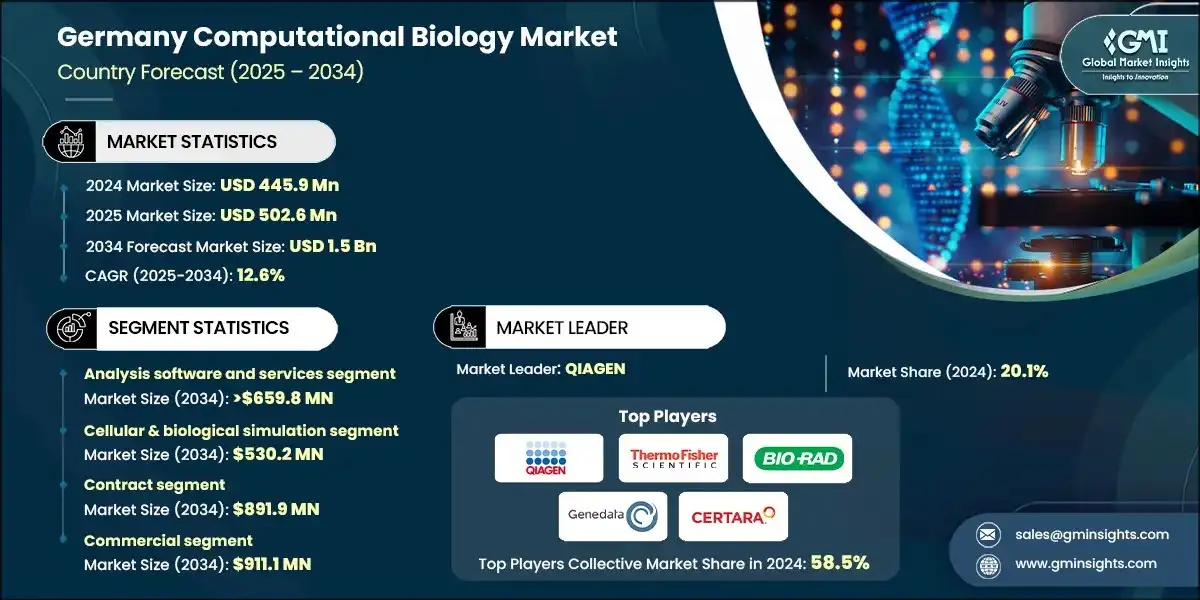
The Germany computational biology market was valued at USD 445.9 million in 2024. The market is expected to reach from USD 502.6 million in 2025 to USD 1.5 billion in 2034, growing at a CAGR of 12.6% during the forecast period, according to the latest report published by Global Market Insights Inc. Increasing use of AI-based drug discovery, genomics research, and precision medicine programs is fueling Germany's market for computational biology.
Germany Computational Biology Market Key Takeaways
Market Size & Growth
- 2024 Market Size: USD 445.9 Million
- 2025 Market Size: USD 502.6 Million
- 2034 Forecast Market Size: USD 1.5 Billion
- CAGR (2025–2034): 12.6%
Key Market Drivers
- Adoption of AI and machine learning.
- Rising demand for personalized medicine.
- Expansion of genomics research.
- Increasing clinical trial activities using computational designs.
Challenges
- High cost of computational biology tools.
- Lack of skilled professional.
Opportunity
- Growth of precision medicine initiatives.
- Real-time wearable data integration platforms.
Key Players
- Market Leader: QIAGEN led with over 20.1% market share in 2024.
- Leading Players: Top 5 players in this market include QIAGEN, Thermo Fisher Scientific, BIO-RAD, Certara, Genedata (Danaher), which collectively held a market share of 58.5% in 2024.
Get Market Insights & Growth Opportunities
The German computational biology market offers cutting-edge solutions to life sciences firms, payers, healthcare providers, and healthcare technology firms to optimize regulatory compliance, expedite drug discovery, deliver better patient outcomes, and maximize operational effectiveness. Solutions encompass sophisticated genomics platforms, bioinformatics solutions, data analysis in the cloud, and predictive modeling solutions that enable effective research, personalized medicine, and decision-making with data.
The major players in the German market are QIAGEN, Thermo Fisher Scientific, BioRad, Genedata (Danaher), and Certara. Such players stay ahead of the curve through ongoing innovation in their products, increased global and local outreach, strategic collaborations, and significant investments in research and development to serve increased clinical and scientific requirements while enhancing their market standing.
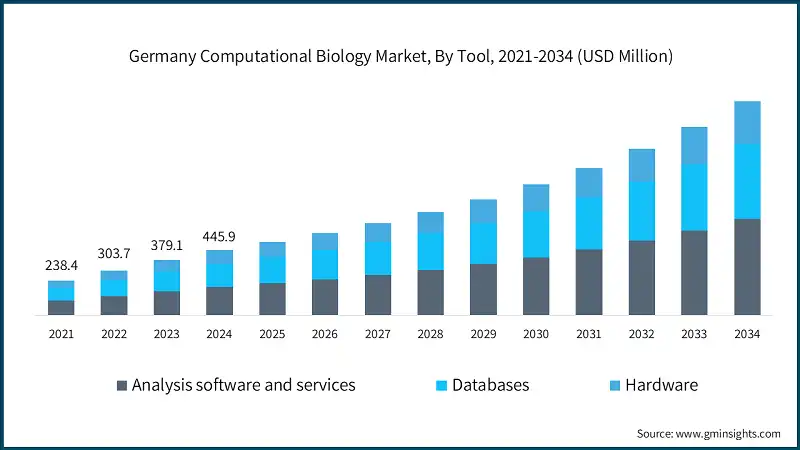
The market has increased from USD 238.4 million in 2021 and reached USD 379.1 million in 2023. The Germany computational biology market is primarily driven by the increasing adoption of advanced technologies such as artificial intelligence in healthcare, machine learning (ML), and high-throughput genomics platforms in drug discovery, clinical research, and precision medicine.
Growing demand for personalized therapies and targeted treatments has accelerated the use of bioinformatics software and predictive modeling tools, enabling researchers and healthcare providers to analyze large-scale biological datasets efficiently. The rising prevalence of chronic diseases, cancer, and genetic disorders in Germany has further increased the need for computational biology solutions to support early diagnosis, biomarker discovery, and therapeutic development.
Additionally, the expansion of digital health initiatives and integration of cloud-based data analysis platforms allow healthcare organizations and life sciences companies to streamline research workflows, enhance regulatory compliance, and optimize operational efficiency. Government support for genomics research, precision medicine programs, and funding for innovative healthcare technologies is also contributing to market growth.
Leading companies, including QIAGEN, Thermo Fisher Scientific, BioRad, Genedata (Danaher), and Certara, are continuously investing in research and development, forming strategic partnerships, and enhancing their product portfolios, further propelling market adoption. Increasing awareness among healthcare providers about the benefits of computational biology solutions, coupled with rising collaborations between academic institutions and industry players, continues to drive Germany’s computational biology market growth.
Computational biology is an interdisciplinary field that uses mathematical models, algorithms, and software tools to analyze and interpret complex biological data. It enables understanding of genomics, proteomics, drug discovery, and disease mechanisms, supporting personalized medicine, predictive modeling, and efficient research in healthcare, life sciences, and biotechnology.
To get key market trends
Germany Computational Biology Market Trends
The adoption of artificial intelligence (AI) and machine learning (ML) is one of the most significant drivers of the market. AI and ML technologies enable researchers, healthcare providers, and life sciences companies to analyze vast and complex biological datasets with greater speed, accuracy, and predictive power.
- In Germany, where precision medicine, genomics research, and bioinformatics are rapidly advancing, AI-driven computational biology tools are increasingly integrated into drug discovery, clinical trial design, and personalized therapy development.
- Technological advancements, such as deep learning algorithms, natural language processing for biomedical literature, and AI-powered predictive modeling, have revolutionized genomics analysis and biomarker discovery. Cloud-based platforms and high-performance computing infrastructures further enhance the scalability and efficiency of AI applications, allowing seamless integration with existing laboratory information management systems (LIMS) and electronic health records (EHRs).
- Current market trends include the use of AI for multi-omics data integration, virtual screening of drug candidates, and patient stratification in clinical trials, which reduce research timelines and operational costs. Additionally, Germany’s growing focus on digital health initiatives and smart hospital ecosystems accelerates the deployment of AI-enabled computational biology solutions.
- From a macroeconomic perspective, increasing government funding for AI and genomics research, supportive regulatory frameworks, and growing healthcare expenditure encourage market growth.
- On a microeconomic level, competition among key players such as QIAGEN, Thermo Fisher Scientific, and Bio-Rad fosters continuous innovation and adoption of AI-powered solutions. Moreover, rising awareness among healthcare providers and researchers about the benefits of AI in improving patient outcomes and operational efficiency further reinforces market expansion.
Germany Computational Biology Market Analysis
Learn more about the key segments shaping this market
Based on the tool, the Germany computational biology market is segmented into analysis software and services, databases, and hardware. The analysis software and services segment dominated the market in 2024, accounting for a 43.4% share, driven by the rising adoption of bioinformatics, predictive modeling, and AI-driven solutions. This segment is projected to exceed USD 659.8 million by 2034, expanding at a CAGR of 13% during the forecast period.
On the other hand, the databases segment is expected to grow with a CAGR of 12.4%. The growth of this segment can be attributed to the increasing need for organized genomic, proteomic, and clinical data, which is driving the development and utilization of databases.
- The analysis software and services segment dominates the Germany computational biology market, driven primarily by the increasing adoption of bioinformatics tools, AI-powered predictive modeling, and computational solutions for genomics and proteomics research.
- Rising demand for personalized medicine and targeted therapies has fueled the need for platforms that can process, analyze, and visualize complex biological datasets efficiently. Integration of machine learning and deep learning algorithms enables accelerated drug discovery, biomarker identification, and clinical trial design, reducing time and cost for research organizations.
- Additionally, cloud-based software services and subscription models offer scalable solutions for both academic institutions and commercial life sciences companies, enhancing accessibility and operational efficiency. The growing number of collaborations between healthcare providers, pharmaceutical companies, and technology vendors further accelerates adoption.
- The databases segment held a revenue of USD 159.2 million in 2024, with projections indicating a steady expansion at 12.4% CAGR from 2025 to 2034. The databases segment of the Germany computational biology market is growing steadily due to the rising demand for well-structured, comprehensive, and easily accessible biological and clinical datasets.
- Genomic, proteomic, and metabolomic research generates enormous amounts of data that require efficient storage, curation, and retrieval systems. The increasing prevalence of chronic diseases, cancer, and rare genetic disorders has driven the need for integrated databases that enable accurate disease modeling, biomarker discovery, and patient stratification.
Based on application, the Germany computational biology market is classified into cellular & biological simulation, drug discovery & disease modelling, preclinical drug development, clinical trials, and human body simulation software. The cellular & biological simulation segment dominated the market with a revenue share of 35.8% in 2024 and is expected to reach USD 530.2 million within the forecast period.
- The cell and biological simulation division is fueled by growing demand for simulating intricate biological processes at the cellular and molecular levels. Scientists and drug companies in Germany use sophisticated simulation software to simulate cellular mechanisms, signaling pathways, and interactions between genes, allowing accurate predictions of biological consequences.
- Technological advancements, including high-performance computing, artificial intelligence integration, and multi-scale modeling, have significantly enhanced simulation precision, reducing experimental costs and shortening research timelines. Moreover, the growing demand for personalized medicine and targeted therapies requires complex cellular simulations to optimize drug efficacy and safety.
- Germany’s strong focus on academic and industrial research collaborations, combined with government funding for computational biology initiatives, further fuels adoption. The availability of sophisticated bioinformatics tools and software platforms also allows integration with omics data, improving predictive capabilities.
- The drug discovery & disease modelling segment held a revenue of USD 134.1 million in 2024, with projections indicating a steady expansion at 13.1% CAGR from 2025 to 2034. The drug discovery and disease modeling segment is primarily driven by the increasing need to accelerate therapeutic development while reducing costs and risks.
- Computational biology tools enable researchers in Germany to predict drug-target interactions, model disease pathways, and simulate compound efficacy before clinical trials. Advances in AI, machine learning, and molecular docking algorithms have enhanced predictive accuracy, enabling faster identification of promising drug candidates.
- Rising prevalence of chronic diseases, cancer, and genetic disorders in Germany has further increased demand for computational models to understand disease mechanisms and identify novel therapeutic targets.
Based on services, the Germany computational biology market is classified into contract and in-house. The contract segment dominated the market with a revenue share of 59% in 2024 and is expected to reach USD 891.9 million within the forecast period.
- The market is led by the contract services segment because of growing computational research and data analysis outsourcing by pharmaceutical, biotechnology, and healthcare firms. Increasing R&D expenses, intricate bioinformatics demands, and pressure for shorter drug discovery timelines persuade organizations to depend on expert contract research organizations (CROs) and contract computational biology service providers.
- Advancements in technology like AI-based predictive modeling, cloud bioinformatics platforms, and high-throughput data analytics help contract providers make accurate, scalable, and cost-effective solutions available.
- Additionally, companies benefit from flexible project-based services without the burden of maintaining in-house infrastructure or skilled personnel. Strategic partnerships between life sciences firms and contract service providers further enhance market penetration.
- The in-house segment held a revenue of USD 182.8 million in 2024, with projections indicating a steady expansion at 12.1% CAGR from 2025 to 2034. The in-house services segment is driven by companies seeking full control over computational biology operations, data security, and proprietary research workflows. Large pharmaceutical, biotechnology, and research organizations in Germany prefer in-house solutions to maintain confidentiality of sensitive genomic and clinical data, ensure compliance with strict regulatory standards, and rapidly iterate on drug discovery or precision medicine projects.
- Technological innovations, including integrated bioinformatics platforms, AI-enabled analytics, and high-performance computing, make in-house operations increasingly efficient and scalable. Macro-economic factors, such as rising healthcare expenditure, supportive government initiatives for digital health and genomics research, and strong investments in local R&D infrastructure, also encourage adoption of in-house computational biology services.
Learn more about the key segments shaping this market
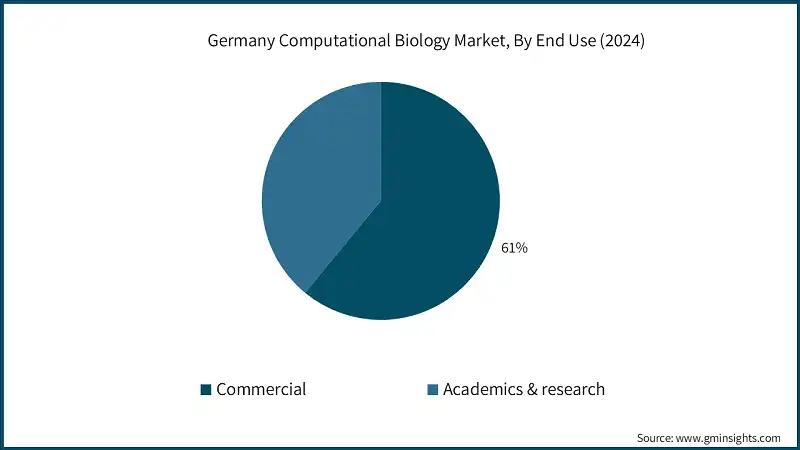
Based on end use, the Germany computational biology market is classified into commercial and academics & research. The commercial segment dominated the market with a revenue share of 61% in 2024 and is expected to reach USD 911.1 million within the forecast period.
- The commercial segment dominates the market due to increasing adoption of advanced computational tools by pharmaceutical, biotechnology, and healthcare technology companies. Rising demand for AI-driven drug discovery, predictive modeling, and bioinformatics solutions enables commercial organizations to accelerate research, optimize clinical trials, and reduce development costs.
- The need for efficient data analysis, regulatory compliance, and faster time-to-market for therapeutics drives adoption of computational biology platforms.
- Moreover, Germany’s robust life sciences industry, strong R&D investment, and presence of leading players such as QIAGEN, Thermo Fisher Scientific, and Bio-Rad further strengthen the commercial segment.
- The academics & research segment held a revenue of USD 174 million in 2024, with projections indicating a steady expansion at 12.3% CAGR from 2025 to 2034. Rising interest in precision medicine, biomarker discovery, and disease mechanism exploration has fueled the demand for computational biology solutions in academic laboratories. Advanced analysis software, high-throughput sequencing hardware, and curated biological databases enable researchers to efficiently process complex datasets and generate meaningful insights.
- Collaborations between universities, research institutes, and technology providers facilitate knowledge sharing and accelerate adoption of cutting-edge tools. Additionally, Germany’s supportive research ecosystem, including grants, tax incentives, and government initiatives, encourages integration of AI, machine learning, and predictive modeling in academic research.
- The growing number of publications and clinical trials leveraging computational biology further underscores the segment’s expansion. Increasing awareness of the benefits of bioinformatics and the need for advanced data management drives continuous adoption, ensuring sustainable growth in the academic and research sector.
Germany Computational Biology Market Share
The market is highly competitive, with leading life sciences and biotechnology companies focusing on product innovation, advanced technologies, and strategic collaborations to strengthen their market positions. Increasing adoption of AI-driven drug discovery, precision medicine, and bioinformatics platforms is driving companies to leverage R&D investments, cloud-based analytics, and predictive modeling tools to improve research efficiency and patient outcomes. Growing genomics research, government funding for digital health initiatives, and expanding clinical trial activities are further encouraging players to develop comprehensive, scalable, and cost-effective computational biology solutions.
Key players in the German market include QIAGEN, Thermo Fisher Scientific, BioRad, Genedata (Danaher), and Certara, collectively accounting for approximately 58.5% of the market. These companies maintain leadership through extensive product portfolios, strong local and global distribution networks, and continuous advancements in analysis software, bioinformatics services, hardware, and cloud-based solutions. Their dominance is reinforced by strategic partnerships with academic institutions, research centers, and commercial organizations to enhance accessibility, adoption, and integration of computational biology platforms.
Smaller and niche players are also gaining traction by offering specialized, user-friendly, and application-specific bioinformatics tools. Competitive differentiation is increasingly defined by the ability to deliver innovative, efficient, and integrated computational solutions tailored to diverse research, clinical, and commercial environments. As the market evolves, competition is expected to intensify, with both established leaders and emerging firms pursuing technological advancements, strategic collaborations, and service diversification to capture greater market share.
Germany Computational Biology Market Companies
A few of the prominent players operating in the Germany computational biology industry include:
- BIO-RAD
- cadence
- Certara
- Dassault Systèmes
- Genedata (Danaher)
- QIAGEN
- Schrödinger
- Thermo Fisher Scientific
- QIAGEN
QIAGEN leads the computational biology market with a share of 20.1% in 2024. QIAGEN’s USP lies in its comprehensive genomics and molecular diagnostics solutions, strong presence in Germany, and advanced bioinformatics platforms. The company excels in sample preparation, precision medicine applications, and integrated software services, enabling efficient data analysis, regulatory compliance, and accelerated research for academic, clinical, and commercial organizations.
Thermo Fisher Scientific differentiates itself through an extensive portfolio of life sciences instruments, high-throughput sequencing technologies, and cloud-based bioinformatics solutions. With strong R&D investments and localized operations in Germany, it offers scalable, AI-driven computational biology platforms that enhance drug discovery, biomarker research, and operational efficiency for laboratories, research institutes, and pharmaceutical companies.
Germany Computational Biology Market Report Attributes
| Key Takeaway | Details |
|---|---|
| Market Size & Growth | |
| Base Year | 2024 |
| Market Size in 2024 | USD 445.9 Million |
| Market Size in 2025 | USD 502.6 Million |
| Forecast Period 2025 - 2034 CAGR | 12.6% |
| Market Size in 2034 | USD 1.5 Billion |
| Key Market Trends | |
| Drivers | Impact |
| Adoption of AI and machine learning | AI and machine learning enable efficient data analysis, predictive modeling, and drug discovery, accelerating research productivity and reducing time-to-market for novel therapies in Germany. |
| Rising demand for personalized medicine | Growing preference for tailored therapies drives the use of computational biology, supporting biomarker identification and treatment optimization, improving patient outcomes across German healthcare systems. |
| Expansion of genomics research | Increased genomics projects and high-throughput sequencing initiatives generate large datasets, enhancing bioinformatics applications and accelerating breakthroughs in disease understanding and drug development. |
| Increasing clinical trial activities using computational designs | Use of computational models in clinical trials streamlines protocol design, predicts outcomes, and reduces trial duration, lowering costs while improving regulatory compliance in Germany. |
| Pitfalls & Challenges | Impact |
| High cost of computational biology tools | Expensive software, platforms, and sequencing technologies limit adoption, particularly among smaller labs, hindering widespread market penetration and slowing technology democratization in Germany. |
| Lack of skilled professional | Shortage of bioinformaticians and computational biologists restricts effective deployment of solutions, slowing R&D and innovation despite rising demand for advanced analyses. |
| Opportunities: | Impact |
| Growth of precision medicine initiatives | Expanding precision medicine programs in Germany will increase demand for computational biology tools, enabling personalized treatment development, faster diagnostics, and improved patient outcomes. |
| Real-time wearable data integration platforms | Integration of wearable health devices with computational platforms will enable continuous patient monitoring, dynamic data analysis, and predictive healthcare solutions, expanding market applications and adoption. |
| Market Leaders (2024) | |
| Market Leaders |
Market Share 20.1% |
| Top Players |
Collective market share in 2024 is Market Share 58.5% |
| Competitive Edge |
|
What are the growth opportunities in this market?
Germany Computational Biology Industry News:
- In June 2025, Illumina, Inc. announced that it had entered into a definitive agreement with Standard BioTools to acquire SomaLogic. This development will enhance Illumina's presence in the growing proteomics market. It will aid the company in improving its industry presence.
- In December 2024, QIAGEN announced the launch of Ingenuity Pathway Analysis (IPA) Interpret, a new feature designed to simplify and accelerate the interpretation of complex biological data. This development enabled the company to enhance its service offering and improve the user experience through continuous advancement and updates.
- In November 2024, NVIDIA announced the availability of the open-source platform NVIDIA BioNeMo Framework to advance drug discovery and accelerate molecule design. This platform focuses on accelerating and scaling digital biology for different stakeholders in the industry.
The Germany computational biology market research report includes an in-depth coverage of the industry with estimates and forecast in terms of revenue in USD Million from 2021 – 2034 for the following segments:
Market, By Tool
- Analysis software and services
- Databases
- Hardware
Market, By Application
- Cellular & biological simulation
- Computational genomics
- Computational proteomics
- Pharmacogenomics
- Other simulations
- Drug discovery & disease modelling
- Target identification
- Target validation
- Lead discovery
- Lead optimization
- Preclinical drug development
- Pharmacokinetics
- Pharmacodynamics
- Clinical trials
- Phase I
- Phase II
- Phase III
- Phase IV
- Human body simulation software
Market, By Services
- Contract
- In-house
Market, By End Use
- Commercial
- Academics & research
Frequently Asked Question(FAQ) :
What was the market size of the Germany computational biology in 2024?
The market size was valued at USD 445.9 million in 2024, driven by advancements in AI-based drug discovery, genomics research, and precision medicine programs.
What is the projected value of the Germany computational biology market by 2034?
The market is expected to reach USD 1.5 billion by 2034, growing at a CAGR of 12.6% during the forecast period.
What is the projected size of the Germany computational biology market in 2025?
The market is expected to reach USD 502.6 million in 2025.
How much revenue did the analysis software and services segment generate in 2024?
The analysis software and services segment accounting for a 43.4% market share in 2024.
What was the valuation of the cellular & biological simulation segment in 2024?
The cellular & biological simulation segment held a 35.8% revenue share in 2024.
Which segment dominated the services category in 2024?
The contract services segment dominated the market with a 59% revenue share in 2024.
Which end-use segment led the Germany computational biology market in 2024?
The commercial segment led the market with a 61% revenue share, generating in 2024.
What are the key trends in the Germany computational biology industry?
Key trends include the adoption of AI and machine learning for drug discovery and personalized therapy development, advancements in deep learning algorithms, natural language processing for biomedical literature.
Who are the key players in the Germany computational biology market?
Key players include BIO-RAD, Cadence, Certara, Dassault Systèmes, Genedata (Danaher), QIAGEN, Schrödinger, and Thermo Fisher Scientific.
Germany Computational Biology Market Scope
Related Reports