Summary
Table of Content

Germany Carbon-Sequestering Building Materials Market
Get a free sample of this report
Form submitted successfully!
Error submitting form. Please try again.
Thank you!
Your inquiry has been received. Our team will reach out to you with the required details via email. To ensure that you don't miss their response, kindly remember to check your spam folder as well!
Request Sectional Data
Thank you!
Your inquiry has been received. Our team will reach out to you with the required details via email. To ensure that you don't miss their response, kindly remember to check your spam folder as well!
Form submitted successfully!
Error submitting form. Please try again.
Germany Carbon-Sequestering Building Materials Market Size
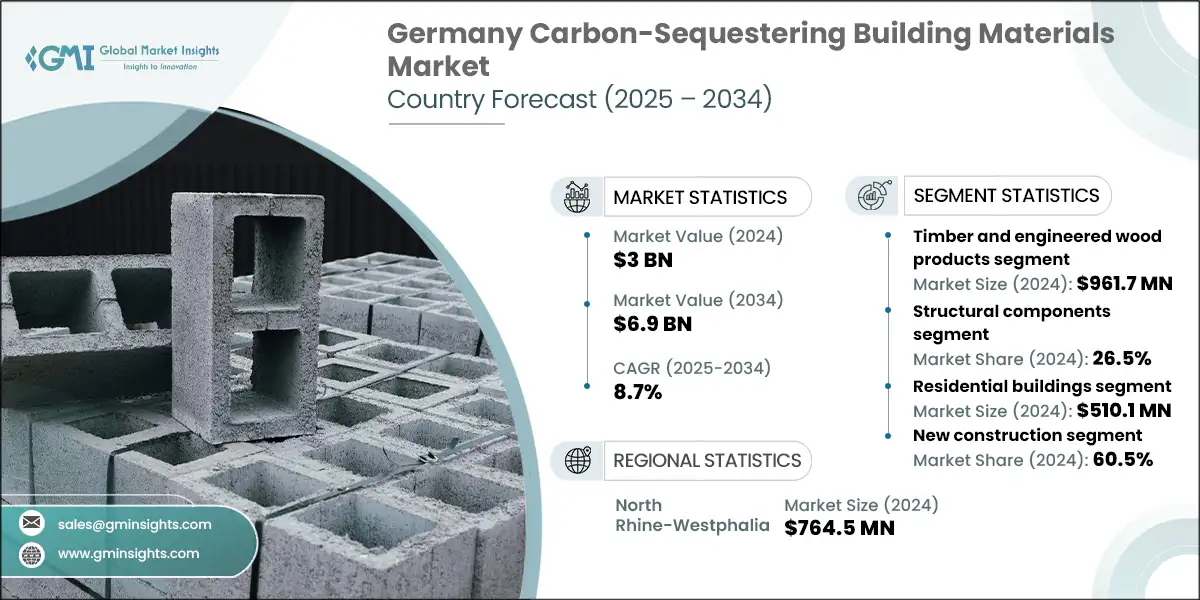
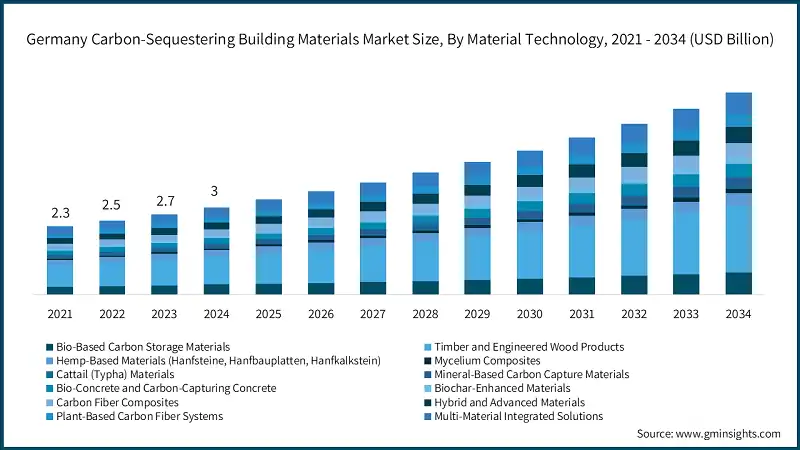
The Germany carbon-sequestering building materials market size was estimated at USD 3 billion in 2024. The market is expected to grow from USD 3.2 billion in 2025 to USD 6.9 billion in 2034, at a CAGR of 8.7%, according to Global Market Insights Inc.
Germany Carbon-Sequestering Building Materials Market Key Takeaways
Market Size & Growth
- 2024 Market Size: USD 3 Billion
- 2034 Forecast Market Size: USD 6.9 Billion
- CAGR (2025–2034): 8.7%
Regional Dominance
- Largest Market: North Rhine-Westphalia
- Fastest Growing Country: Bavaria
Key Market Drivers
- Growing demand for sustainable construction.
- Government policies supporting green building.
- Technological advancements in carbon-sequestering materials.
Challenges
- High costs of advanced materials.
- Lack of standardization and certification.
Opportunity
- Expansion of green building projects.
- Incentives and subsidies for sustainable construction.
Key Players
- Market Leader: Heidelberg Materials led with over 7.6% market share in 2024.
- Leading Players: Top 5 players in this market include Heidelberg Materials, Holcim Deutschland, PYREG GmbH, CharLine GmbH, NovoCarbo, which collectively held a market share of 35.4% in 2024.
Get Market Insights & Growth Opportunities
- The Germany carbon-sequestering building materials industry is propelled by a confluence of environmental policies, technological advancements, and increasing awareness of sustainability. Government initiatives aimed at reducing greenhouse gas emissions and promoting sustainable construction practices serve as primary drivers. For instance, Germany's commitment to the European Green Deal and national climate targets incentivize the adoption of eco-friendly building materials. This policy environment encourages builders and developers to incorporate carbon-sequestering materials, thereby expanding the market. Additionally, stringent building codes and regulations mandating energy efficiency and low emissions further stimulate demand, creating a conducive environment for market growth.
- Technological innovations in bio-based and mineral-based carbon sequestration methods have significantly enhanced the efficiency and affordability of these materials. Advances in material science have led to the development of innovative products such as carbon-negative concrete and biochar-infused insulation, which contribute actively to carbon sequestration. These technological improvements reduce costs and improve performance, making such materials more attractive to construction firms.
- Growing awareness among stakeholders about climate change and the environmental impact of traditional building materials is another critical factor driving market expansion. Architects, developers, and consumers are increasingly prioritizing sustainability, pushing for greener construction options. The rising demand for eco-friendly buildings is exemplified by Germany’s LEED-certified and Passivhaus projects, which often utilize carbon-sequestering materials. The shift in consumer preferences is supported by governmental and industry-driven sustainability certifications, which incentivize the use of such materials. This trend is expected to continue, further fueling the market’s expansion over the next decade.
- Economic factors also play a vital role in market growth. The declining costs of carbon-sequestering materials, driven by economies of scale and technological innovations, make them more competitive compared to conventional materials. Additionally, the rising costs associated with carbon emissions and potential penalties motivate builders to adopt low-carbon options.
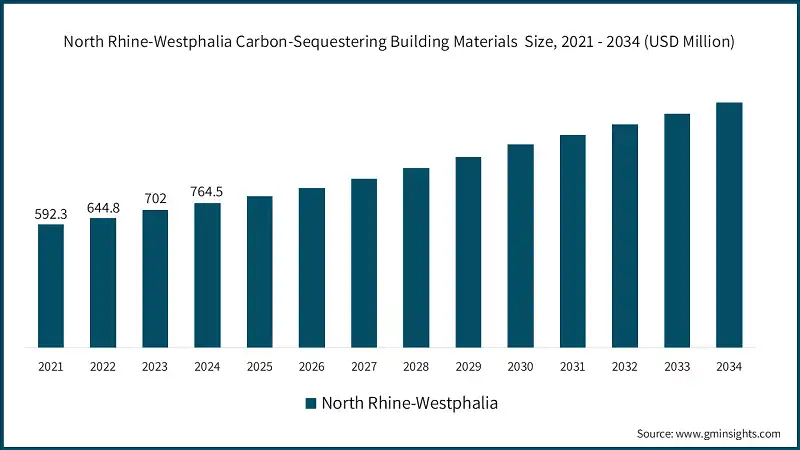
- North Rhine-Westphalia leads the market due to its large construction sector and focus on sustainability.
- Bavaria is the fastest-growing state, driven by innovative projects and regional green initiatives.
To get key market trends
Germany Carbon-Sequestering Building Materials Market Trends
The construction industry in Germany is increasingly prioritizing sustainability, driven by stringent environmental regulations and a societal shift towards eco-consciousness. This trend has led to heightened demand for carbon-sequestering building materials that reduce the overall carbon footprint of construction projects. Developers and architects are opting for innovative materials that actively capture and store CO2, aligning with Germany’s climate goals and green building standards such as DGNB certification. This shift is fostering innovation in material formulations and encouraging the adoption of new construction methodologies.
Emerging technologies, including bio-based and mineral carbonation methods, are revolutionizing the development of carbon-sequestering building materials. Companies are investing in research to create more efficient, cost-effective, and durable materials that can actively absorb carbon during manufacturing or use. These technological advancements not only enhance environmental benefits but also improve the structural performance of building materials, making them more attractive to a broad range of stakeholders.
Germany’s evolving regulatory landscape, with stricter building codes and incentives for low-carbon construction, is significantly influencing Germany carbon-sequestering building materials market growth. Policies such as subsidies for green building materials and mandates for carbon reduction in construction projects are encouraging manufacturers to innovate and scale up production of carbon-sequestering materials. This regulatory push is expected to accelerate market adoption and foster a competitive environment for sustainable building solutions.
Modern consumers and property developers are increasingly valuing sustainability and environmental responsibility. This shift in customer expectations is driving demand for buildings that not only meet energy efficiency standards but also incorporate materials that actively sequester carbon. As awareness grows, the market is witnessing a preference for transparent, verifiable carbon sequestration claims, prompting companies to adopt standardized testing and certification processes.
The adoption of digital tools such as Building Information Modeling (BIM) and life cycle assessment software is enabling stakeholders to better evaluate and optimize the carbon sequestration potential of building materials. These technologies facilitate transparent tracking of carbon savings, support sustainable design decisions, and enhance market confidence in the efficacy of carbon-sequestering materials. As digital integration becomes more prevalent, it will further accelerate innovation and adoption in this segment.
Germany Carbon-Sequestering Building Materials Market Analysis
Learn more about the key segments shaping this market
Based on material technology, the Germany market is segmented into bio-based carbon storage materials, timber and engineered wood products, hemp-based materials (such as hanfsteine, hanfbauplatten, hanfkalkstein), mycelium composites, cattail (typha) materials, mineral-based carbon capture materials, bio-concrete and carbon-capturing concrete, biochar-enhanced materials, carbon fiber composites, hybrid and advanced materials, wood-mycelium composites, plant-based carbon fiber systems, and multi-material integrated solutions. Among these segments, timber and engineered wood products are estimated to increase from approximately USD 961.7 million in 2024, reflecting a compound annual growth rate of around 9%, driven by rising demand for sustainable, low-carbon building materials and technological advancements in engineered wood solutions.
- The timber and engineered wood products segment is a key driver in Germany’s carbon-sequestering building materials market, owing to their strong carbon storage capacity, structural benefits, and ongoing innovations that improve durability, ease of installation, and overall performance. Advancements in engineered wood technology, such as cross-laminated timber (CLT) and glulam, have enhanced product versatility and safety, making them increasingly favored in sustainable construction. Their growth is supported by favorable pricing dynamics resulting from manufacturing efficiencies and expanding supply chains, although competition from alternative low-carbon materials presents ongoing challenges.
- Bio-based carbon storage materials, including bio-concrete and biochar-enhanced products, are gaining traction due to their innovative approach to capturing carbon during production and use. These solutions appeal to environmentally conscious builders and developers but face hurdles related to scalability, long-term performance validation, and higher initial costs. Overcoming these challenges through technological improvements and cost reductions will be vital for broader adoption.
- Mycelium composites and cattail (typha) materials represent emerging eco-friendly options, offering benefits such as insulation properties and biocompatibility. However, their widespread market penetration is limited by the need for further development to improve mechanical strength, durability, and cost competitiveness relative to conventional materials. Ongoing research and development are essential to unlock their full potential in the building sector.
- Mineral-based carbon capture materials, such as mineral carbonation products, leverage mature technology but must demonstrate competitive costs and seamless integration with existing construction practices to expand their market share. Their performance benefits are recognized, but economic and logistical considerations remain key challenges.
- Hybrid and advanced materials, including carbon fiber composites and multi-material solutions, provide enhanced performance, lightweight properties, and customization options that appeal to high-end construction projects. However, their higher manufacturing costs and complexity can hinder mass market adoption. Ongoing innovation aimed at reducing costs and simplifying production processes will be critical to increasing their market penetration.
Learn more about the key segments shaping this market
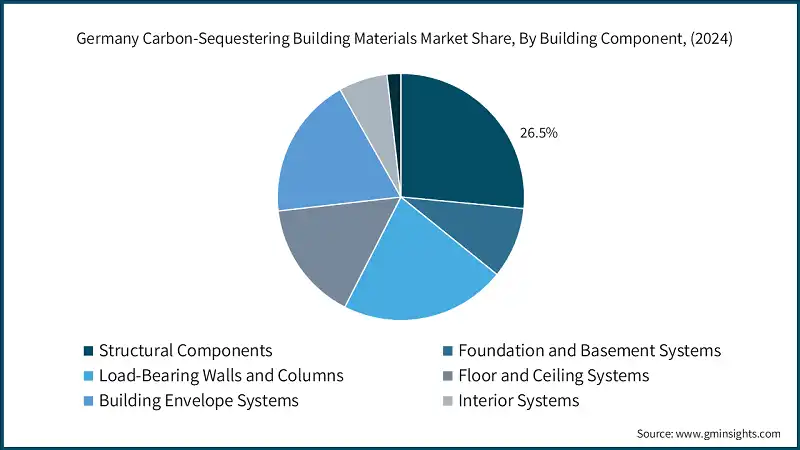
Based on building components, the Germany carbon-sequestering building materials market is segmented into structural components, foundation and basement systems, load-bearing walls and columns, floor and ceiling systems, building envelope systems, interior systems, and infrastructure components. Among these, structural components command the major market share, accounting for approximately 26.5% of the total market in 2024 and are expected to grow at a CAGR of over 8.9% from 2025 to 2034. This dominance is driven by the critical role that structural elements play in ensuring building stability and safety, as well as increasing demand for sustainable and innovative structural solutions that incorporate carbon-sequestering materials. The growth trajectory reflects ongoing technological advancements, the integration of eco-friendly materials, and the emphasis on resilient construction practices across the industry.
- Structural components are experiencing rapid growth driven by innovations in sustainable and high-strength materials such as engineered timber and fiber-reinforced composites. These materials enhance durability and environmental performance, aligning with the industry’s shift towards eco-friendly construction. However, high manufacturing and installation costs, along with the need for specialized expertise, pose challenges to widespread adoption. The increasing demand for resilient structures in earthquake-prone and climate-affected regions further fuels growth, but market penetration is sometimes limited by traditional construction practices and price sensitivity.
- The foundation and basement systems segment is expanding due to technological advancements in waterproofing, soil stabilization, and insulation solutions that extend building lifespan and improve energy efficiency. Innovations such as chemical grouts and composite materials provide superior performance, but the high costs associated with these advanced systems can restrict adoption, especially in cost-sensitive markets. Additionally, installation complexities and regional soil conditions influence growth, requiring tailored solutions that can increase project timelines and expenses.
- Growth in load-bearing walls and columns is driven by the adoption of modular, prefabricated, and lightweight materials that reduce construction time and labor costs. These innovations enable faster project completion and greater design flexibility, appealing to modern construction demands. Challenges include ensuring compatibility with diverse architectural designs and maintaining structural integrity over time. Price fluctuations of raw materials like steel and concrete also impact the cost-effectiveness of these components, influencing overall market dynamics.
- The market for floor and ceiling systems is propelled by innovations in lightweight, insulating, and soundproofing materials that support energy efficiency and occupant comfort. Modular and customizable solutions are gaining popularity, especially in commercial and residential sectors. Nonetheless, price competition from traditional materials and concerns over long-term durability can hinder adoption. Additionally, integrating smart technologies for automated controls and enhanced performance presents both opportunities and technical challenges.
- Building envelope systems are increasingly integrating smart, energy-efficient materials such as dynamic insulation and reflective coatings that optimize thermal performance and reduce energy consumption. The trend towards sustainable building certifications accelerates demand. However, higher initial costs and the need for specialized installation techniques can act as barriers. Compatibility with existing structures and regulatory standards also influence market growth, requiring ongoing innovation to balance performance with affordability.
- Interior systems are evolving with eco-friendly finishes, modular partitions, and advanced insulation solutions that improve indoor air quality and energy efficiency. The focus on aesthetics combined with sustainability drives innovation, but durability and maintenance costs of new materials can pose challenges. Moreover, rapid changes in interior design trends demand adaptable solutions, which can increase complexity and costs for manufacturers and consumers alike.
- Infrastructure components are expanding with durable, low-maintenance, and environmentally sustainable materials designed for urban development projects. Innovations such as corrosion-resistant metals and recycled composites support infrastructure longevity and sustainability goals. However, challenges include scaling these advanced materials for large infrastructure projects and aligning with regional standards and regulations. Cost and supply chain considerations also influence the pace of adoption in this segment, despite the growing emphasis on resilient urban infrastructure.
Based on the end-use sector, the Germany carbon-sequestering building materials market is segmented into residential buildings, commercial buildings, industrial buildings, and public infrastructure. The residential buildings segment holds a market size of USD 510.1 million in 2024 and is expected to grow at a faster rate of 8.4% CAGR through 2034. Residential Buildings segment is primarily driven by increasing urbanization, a rising demand for sustainable and energy-efficient homes, and advancements in construction technologies that improve insulation and durability. These factors contribute to the sector’s growth, although high initial costs and strict regulatory requirements present challenges that could impact rapid market expansion.
- The commercial buildings sector benefits from ongoing modernization efforts, including the adoption of smart building technologies designed to enhance occupant comfort and operational efficiency. Despite these opportunities, the sector faces pricing pressures and the need for scalable, cost-effective solutions to meet the demands of large-scale projects, which can influence the pace of growth.
- Industrial Buildings are distinguished by the demand for high-performance, durable materials capable of withstanding harsh environmental conditions. Innovation in construction methods and materials is a key driver here, although fluctuating raw material prices and the necessity for rapid construction processes pose challenges that could affect sector growth.
- Public Infrastructure projects are propelled by government investments aimed at developing sustainable and resilient infrastructure. However, bureaucratic delays, budget constraints, and lengthy approval processes can hinder project implementation. The sector’s growth is also influenced by the emphasis on innovative, cost-effective solutions that meet public safety and environmental standards.
Based on the construction type Germany carbon-sequestering building materials market is segmented into new construction and renovation and retrofitting. New construction commands the major market share, precisely around 60.5% of the total market in 2024 and expected to grow at a CAGR of over 6.8% from 2025 to 2034.
- The new construction segment is primarily driven by ongoing urban development, infrastructure expansion, and new residential and commercial projects, which create a steady demand for innovative building materials and technologies. The growth in new construction is also fueled by the adoption of advanced construction methods that improve efficiency, safety, and sustainability. However, high upfront costs and longer project timelines can pose challenges to the adoption of new construction solutions.
- Renovation and retrofitting constitute the remaining portion of the market, with a focus on upgrading existing structures to meet modern standards for energy efficiency, safety, and performance. The primary drivers here include aging infrastructure, stricter regulatory requirements, and the rising need for sustainable upgrades. While renovation projects often face challenges related to structural complexity, limited space, and higher per-project costs, they also benefit from innovations in lightweight, adaptable materials that facilitate retrofitting. Pricing dynamics in this segment are influenced by the need for cost-effective solutions that can be integrated into existing structures, emphasizing performance improvements without significant disruptions.
Looking for region specific data?
North Rhine-Westphalia dominated the Germany carbon-sequestering building materials market in with around 25.7% share and generated USD 764.5 million in revenue in 2024. The market driven by ongoing urban development projects and technological advancements in carbon sequestration methods.
- Bavaria’s market is experiencing a CAGR of approximately 6.5%, fueled by its focus on eco-friendly construction initiatives and a high rate of adoption of innovative building materials. The state’s emphasis on renewable energy integration and sustainable urban planning further boosts demand for carbon-sequestering materials, especially in residential and commercial sectors.
- With a CAGR of about 6.1%, Baden-Württemberg’s market growth is mainly driven by its strong automotive and manufacturing sectors adopting green building solutions. The state’s proactive policies supporting environmental sustainability and advancements in material technology contribute to steady expansion in the region.
- Lower Saxony’s market is growing at a CAGR of roughly 6.2%, supported by government incentives for sustainable construction and increased adoption of carbon-reducing materials in new projects. The region’s focus on renewable energy and green infrastructure development also plays a significant role.
- Hesse exhibits a CAGR of approximately 6.4%, with growth driven by urbanization and modernization efforts in Frankfurt and neighboring metropolitan areas. The increasing emphasis on energy-efficient buildings and green certifications encourages the adoption of carbon-sequestering building materials.
- The combined market in Berlin and Brandenburg is expanding at a CAGR of around 6.2%, largely due to city-led initiatives promoting sustainable urban development, green building standards, and innovative construction techniques. The region’s focus on eco-conscious infrastructure investments supports this growth trajectory.
- Saxony’s market is experiencing a CAGR of 6.3%, driven by technological innovation and a focus on sustainable manufacturing practices. The state’s investment in research and development of new carbon-sequestration materials further bolsters its market expansion.
- Collectively, the remaining states are observing a CAGR of 6.5%, influenced by national policies, increased environmental awareness, and a growing trend toward sustainable construction across Germany. These regions are gradually adopting carbon-sequestering solutions, supported by governmental incentives and technological advancements.
Germany Carbon-Sequestering Building Materials Market Share
Top 7 companies include Heidelberg Materials, Holcim Deutschland, Pyreg Gmbh, Charline Gmbh, Novocarbo, Icon Carbon, Steico. These are prominent companies within the Germany market operating in their respective states and accounting for the market share of 43.4%. These companies hold strong positions due to their extensive experience in Germany market. Their diverse product portfolios, backed by robust production capabilities and distribution networks, enable them to meet the rising demand for carbon-sequestering building materials across various states.
- Heidelberg Materials is leveraging strategic acquisitions and collaborations to expand its footprint in sustainable construction solutions. The company emphasizes investment in R&D to develop innovative, high-performance carbon-sequestering materials that meet evolving regulatory standards. Its focus on integrating digital manufacturing processes and optimizing supply chain efficiencies provides a competitive edge, enabling faster delivery and cost competitiveness. Additionally, Heidelberg is actively engaging in partnerships to address unmet market needs for eco-friendly construction materials, positioning itself as a leader in sustainable building solutions.
- Holcim Deutschland’s strategy revolves around aggressive pricing models combined with value-added services to attract environmentally conscious clients. The company is investing heavily in developing next-generation carbon capture and utilization technologies, aiming to differentiate its product offerings. Holcim’s focus on expanding its green product portfolio and leveraging digital platforms for customer engagement helps it capture unmet needs in eco-friendly construction materials, while its sustainability commitments bolster its reputation in the industry.
- PYREG GmbH is capitalizing on its innovative waste-to-carbon technology to gain a competitive edge. The company emphasizes R&D to refine its pyrolysis processes, enabling the production of high-quality biochar and other carbon-sequestering materials. PYREG actively seeks strategic partnerships and government grants to fund its technological advancements, positioning itself as a pioneer in sustainable, cost-effective solutions. Its focus on addressing the unmet needs for scalable carbon sequestration solutions helps it strengthen market positioning.
- Charline Group is focusing on expanding its product line through strategic mergers and collaborations with research institutions. The company’s competitive advantage lies in its ability to customize solutions that cater to specific regional construction needs and regulatory standards. Charline is also adopting competitive pricing strategies and investing in brand differentiation through certifications and eco-labeling, aiming to increase its market share by addressing gaps in the availability of tailored, sustainable building materials.
- NovoCarbo’s approach centers around innovation in the development of bio-based and carbon-negative materials. The company invests heavily in R&D to improve the performance and affordability of its products, aiming to meet the increasing demand for sustainable construction solutions. NovoCarbo’s strategy includes forming strategic alliances with larger construction firms and government agencies to expand its reach. Its focus on unmet market needs for scalable, eco-friendly materials provides a competitive advantage.
- Icon Carbon is leveraging advanced carbon capture and storage (CCS) technologies to differentiate itself. The company is actively pursuing new project collaborations, including mergers and joint ventures, to accelerate commercialization of its proprietary solutions. Its competitive strategy involves offering integrated solutions that combine sequestration with traditional building materials, targeting unmet needs for holistic sustainability solutions in construction. Continuous investment in R&D and strategic partnerships bolsters its market position.
- STEICO is focusing on expanding its sustainable wood-based insulation and building materials through innovation and strategic product diversification. The company’s competitive advantage lies in its integrated manufacturing process and eco-certifications, which appeal to environmentally conscious consumers. STEICO is investing in R&D to develop new bio-composite materials and leveraging its strong distribution network to penetrate underserved regional markets. Its strategy emphasizes addressing unmet demands for high-performance, sustainable building solutions.
Germany Carbon-Sequestering Building Materials Market Companies
Major players operating in the Germany carbon-sequestering building materials industry are:
- Heidelberg Materials
- Holcim Deutschland
- PYREG GmbH
- CharLine GmbH
- NovoCarbo
- Icon Carbon
- STEICO
- Biofabrik
- EcoLocked
- Celitement GmbH & Co.KG
Germany Carbon-Sequestering Building Materials Market Report Attributes
| Key Takeaway | Details |
|---|---|
| Market Size & Growth | |
| Base Year | 2024 |
| Market Size in 2024 | USD 3 Billion |
| Forecast Period 2025 - 2034 CAGR | 8.7% |
| Market Size in 2034 | USD 6.9 Billion |
| Key Market Trends | |
| Drivers | Impact |
| Growing demand for sustainable construction | Boosts market growth and adoption of carbon-sequestering materials. |
| Government policies supporting green building | Accelerates industry investments and project implementation. |
| Technological advancements in carbon-sequestering materials | Enhances product efficiency and competitiveness, fueling expansion. |
| Pitfalls & Challenges | Impact |
| High costs of advanced materials | May limit widespread adoption, slowing market growth. |
| Lack of standardization and certification | Hinders industry trust and regulatory approval, restraining market expansion. |
| Opportunities: | Impact |
| Expansion of green building projects | Opens new markets and increases demand for carbon-sequestering materials. |
| Incentives and subsidies for sustainable construction | Stimulates adoption and accelerates market growth. |
| Market Leaders (2024) | |
| Market Leaders |
7.6% Market Share |
| Top Players |
Collective Market Share of 35.4% in 2024 |
| Competitive Edge |
|
| Regional Insights | |
| Largest Market | North Rhine-Westphalia |
| Fastest growing market | Bavaria |
| Emerging states | Baden-Württemberg, Lower Saxony, Hesse, Berlin and Brandenburg |
| Future outlook |
|
What are the growth opportunities in this market?
Germany Carbon-Sequestering Building Materials Industry News:
- In August 2025, InventWood has developed Superwood, a highly modified, super-strong timber claimed to be stronger than steel and capable of withstanding bullets, with potential applications in military shelters and resilient construction. This engineered wood, created by chemically treating and compressing timber to enhance its strength while retaining its natural grain, offers an eco-friendly alternative to traditional materials, aiding in decarbonization efforts. While similar to existing products like glulam and CLT, Superwood could serve as durable cladding or finishing layer, expanding the options for sustainable, resilient architecture amid a growing market of innovative wood-based materials.
- In March 2025, Teijin Carbon announced the launch of its new brand, Tenax Next, representing next-generation, circular carbon fiber products. These materials feature significantly reduced carbon footprints while maintaining high strength and durability. The launch includes two products: Tenax Next HTS45 E23 24K, a high-performance filament yarn, and Tenax Next R2S 513, a 6mm short fiber for reinforcement. The filament yarn is produced using renewable energy and sustainable raw materials, offering a 35% reduction in CO2 emissions.
The Germany carbon-sequestering building materials market research report includes an in-depth coverage of the industry with estimates and forecast in terms of revenue (USD Billion) and (Kilo Tons) in volume from 2021 - 2034 for the following segments:
Market, By Material Technology
- Bio-based carbon storage materials
- Timber and engineered wood products
- Hemp-based materials (hanfsteine, hanfbauplatten, hanfkalkstein)
- Mycelium composites
- Cattail (typha) materials
- Mineral-based carbon capture materials
- Bio-concrete and carbon-capturing concrete
- Biochar-enhanced materials
- Carbon fiber composites
- Hybrid and advanced materials
- Wood-mycelium composites
- Plant-based carbon fiber systems
- Multi-material integrated solutions
Market, By Building Component
- Structural components
- Foundation and basement systems
- Load-bearing walls and columns
- Floor and ceiling systems
- Building envelope systems
- External wall systems (including integrated insulation)
- Roofing systems (including insulation)
- Window and door frames
- Interior systems
- Non-load-bearing partitions
- Interior finishes and panels
- Flooring systems
- Infrastructure components
- Transportation infrastructure elements
- Utility infrastructure components
Market, By End Use Sector
- Residential buildings
- Single-family houses
- Multi-family buildings
- Social housing projects
- Commercial buildings
- Office and administrative buildings
- Retail and hospitality
- Educational and healthcare facilities
- Industrial buildings
- Manufacturing and production facilities
- Warehouses and logistics centers
- Specialized industrial structures
- Public infrastructure
- Transportation infrastructure
- Utilities and energy infrastructure
- Public and municipal buildings
Market, By Construction Type
- New construction
- Greenfield residential projects
- New commercial developments
- New infrastructure projects
- Renovation and retrofitting
- Energy efficiency upgrades
- Structural renovations
- Heritage building restoration
The above information is provided for the following states:
- Key trends
- North Rhine-Westphalia
- Bavaria
- Baden-Württemberg
- Lower Saxony
- Hesse
- Berlin and Brandenburg
- Saxony
- Other Federal States
Frequently Asked Question(FAQ) :
What is the market size of the Germany carbon-sequestering building materials in 2024?
The market size was USD 3 billion in 2024, driven by government green policies, technological advancements, and rising demand for sustainable construction.
What is the projected value of the Germany carbon-sequestering building materials market by 2034?
The market is expected to reach USD 6.9 billion by 2034, growing at a CAGR of 8.7% from 2025 to 2034.
What is the market forecast for 2025?
The Germany carbon-sequestering building materials market is projected to reach USD 3.2 billion in 2025, supported by stricter building codes and increasing investments in green infrastructure.
How much revenue did the timber and engineered wood products segment generate in 2024?
Timber and engineered wood products generated approximately USD 961.7 million in 2024, benefiting from their carbon storage capacity and structural advantages.
What was the valuation of the structural components segment in 2024?
Structural components accounted for 26.5% of the market in 2024, valued at about USD 795 million, reflecting their dominance in sustainable building design.
What is the growth outlook for residential buildings from 2025 to 2034?
The residential buildings segment is projected to grow at a CAGR of 8.4% till 2034, supported by urbanization and demand for sustainable, energy-efficient homes.
Which region leads the Germany carbon-sequestering building materials market?
North Rhine-Westphalia led the market with a 25.7% share, generating USD 764.5 million in 2024 due to large-scale construction and sustainability initiatives.
Who are the key players in the Germany carbon-sequestering building materials market?
Key players include Heidelberg Materials, Holcim Deutschland, PYREG GmbH, CharLine GmbH, NovoCarbo, Icon Carbon, STEICO, Biofabrik, EcoLocked, and Celitement GmbH & Co.KG.
Germany Carbon-Sequestering Building Materials Market Scope
Related Reports