Summary
Table of Content

Geothermal Energy Market
Get a free sample of this report
Form submitted successfully!
Error submitting form. Please try again.
Thank you!
Your inquiry has been received. Our team will reach out to you with the required details via email. To ensure that you don't miss their response, kindly remember to check your spam folder as well!
Request Sectional Data
Thank you!
Your inquiry has been received. Our team will reach out to you with the required details via email. To ensure that you don't miss their response, kindly remember to check your spam folder as well!
Form submitted successfully!
Error submitting form. Please try again.
Geothermal Energy Market Size
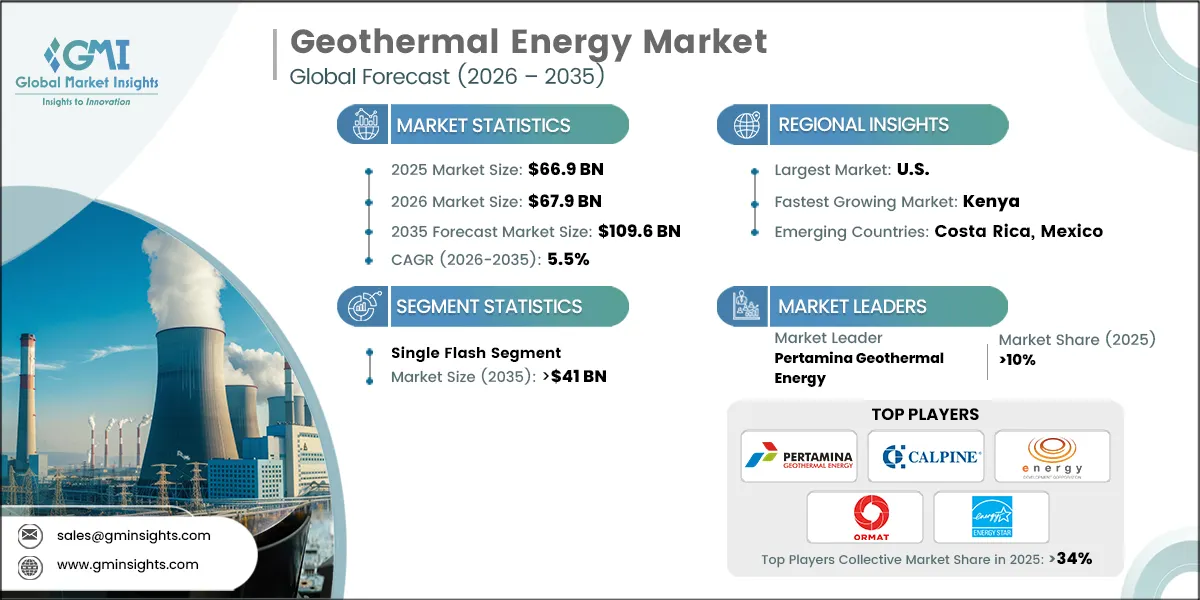
According to a recent study by Global Market Insights Inc., the geothermal energy market was estimated at USD 66.9 billion in 2025. The market is expected to grow from USD 67.9 billion in 2026 to USD 109.6 billion by 2035, at a CAGR of 5.5%.
Geothermal Energy Market Key Takeaways
Market Size & Growth
- 2025 Market Size: USD 66.9 Billion
- 2026 Market Size: USD 67.9 Billion
- 2035 Forecast Market Size: USD 109.6 Billion
- CAGR (2026–2035): 5.5%
Regional Dominance
- Largest Market: U.S.
- Fastest Growing Region: Kenya
Key Market Drivers
- Rising Global Clean‑Energy Demand.
- Advances in Drilling & Enhanced Geothermal Systems.
- Government Incentives & Climate Policies.
Challenges
- High Upfront Capital & Exploration Risk.
Opportunity
- Expansion of Enhanced Geothermal Systems (EGS).
- Industrial Heat & District Heating Applications.
Key Players
- Market Leader: Pertamina Geothermal Energy led with over 10% market share in 2025.
- Leading Players: Top 5 players in this market include Pertamina Geothermal Energy, Ormat Technologies, Energy Development Corporation, Star Energy, Calpine, which collectively held a market share of 34% in 2025.
Get Market Insights & Growth Opportunities
- Clean-firm procurement mandates for grid reliability drive geothermal growth by rewarding high-capacity-factor resources. For instance, California’s CPUC Decision D.21-06-035 ordered 11,500 MW of new net qualifying capacity for 2023–2026 and required at least 1,000 MW from clean firm resources such as geothermal, explicitly to support mid-decade reliability and deep decarbonization. This policy signal increases contract visibility, improves valuation of firm renewables in capacity markets, and strengthens bankability for developers and suppliers.
- Public R&D and demonstration funding lowers technology risk and accelerates commercialization of next-generation geothermal. For instance, the U.S. Department of Energy announced an USD 84 million program under the Bipartisan Infrastructure Law to support enhanced geothermal systems (EGS) pilot demonstration projects across multiple geologic settings. By underwriting field validation and data generation, such programs reduce perceived subsurface uncertainty, attract private co-investment, and expand the addressable geothermal resource base beyond traditional hydrothermal regions.
- Improving project economics through cost declines and performance learning strengthens the investment case for geothermal as firm renewable capacity. For instance, IRENA reported that the global weighted-average geothermal power LCOE fell 16% in 2024, from USD 0.072/kWh to USD 0.060/kWh. Lower levelized costs, alongside stable capacity factors, make geothermal more competitive in resource adequacy markets and support broader adoption of modular binary and ORC solutions for diverse reservoir temperatures, raising expected project returns.
- Regulatory-backed utility procurement creates long-tenor revenue certainty that unlocks project finance and accelerates scale. For instance, the CPUC approved Southern California Edison mid-term reliability contracts in 2024 that included geothermal (binary) supply from Fervo affiliates, with contracted capacities of 70 MW and 250 MW and deliveries beginning in 2027. Such approvals validate offtake structures, reduce counterparty risk, and encourage a deeper pipeline of geothermal capacity aligned with system planning needs.
- Heat decarbonization policies and dedicated incentives are expanding geothermal beyond power into large-scale district heating, especially in Europe. For instance, Germany’s Federal Funding for Efficient Heat Networks (BEW) makes about USD 3.57 billion available through 2026 to support renewable heat sources including deep geothermal. Separately, Munich’s Stadtwerke München received USD 52.2 million in federal funding in 2024 to expand geothermal district heating, catalyzing multi-year buildouts by utilities and municipalities.
- State-led geothermal buildout programs and PPP-style execution models de-risk large projects in emerging markets. For instance, ThinkGeoEnergy reported that Kenya’s state utility KenGen planned the 80.3 MW Olkaria VII geothermal plant with an estimated USD 248 million budget, supported by regulatory filings, and later received Cabinet approval targeting grid supply by June 2027. Anchored by national planning and permitting, these frameworks sustain a bankable pipeline for EPC, drilling, and O&M providers.
- Brownfield optimization through bottoming-cycle co-generation is a fast route to incremental geothermal capacity, leveraging existing wells and steamfields. For instance, Indonesia’s energy ministry highlighted co-generation additions with COD targets in 2027–2029, and a Pertamina Geothermal Energy–PLN joint development agreement focused on a 30 MW Ulubelu bottoming unit and a 15 MW Lahendong bottoming unit, both targeted for COD in 2027. Such add-ons lift output with shorter development cycles and lower incremental drilling intensity.
- Energy security imperatives and concessional finance are enabling first-of-a-kind geothermal plants in small island systems. For instance, ThinkGeoEnergy reported that the Caribbean Development Bank approved a USD 34.8 million loan to support construction of Dominica’s 10 MW geothermal power plant, addressing an electricity mix still heavily dependent on diesel imports. Subsequent construction updates targeted commercial operation in late 2025, demonstrating how blended finance can unlock projects where upfront drilling and infrastructure costs are prohibitive.
To get key market trends
Geothermal Energy Market Trends
- Capacity expansion is gradual and highly concentrated, with incremental additions dominating. For instance, ThinkGeoEnergy reported global installed geothermal power capacity rising from 16,873 MW at year‑end 2024 to 17,173 MW at year‑end 2025, with the top ten countries representing more than 93% of installed capacity. The trend indicates a capital‑intensive market where mature jurisdictions and repeat developers capture most near‑term growth, while emerging markets build pipelines for later commissioning globally.
- Policy outlooks increasingly frame geothermal as a firm complement to variable renewables, pointing to stronger medium‑term additions. For instance, the IEA’s Renewables 2025 analysis projects annual geothermal capacity additions in 2030 reaching a historic high, about triple the 2024 increase, driven by growth in the U.S., Indonesia, Japan, Türkiye, Kenya, and the Philippines. This reflects tightening reliability expectations, capacity adequacy needs, and deeper integration of geothermal into national decarbonization pathways worldwide.
- Market concentration among leading operators is becoming more visible, especially in the U.S. For instance, the DOE‑supported 2025 U.S. Geothermal Market Report notes that Ormat and Calpine remain dominant operators and together account for a large majority of U.S. installed geothermal capacity, alongside rising commercial activity through new PPAs. This consolidation strengthens operating expertise, fleet optimization, and procurement leverage, but also intensifies competition for high‑quality resource areas and interconnection capacity.
- Advanced geothermal is shifting from R&D toward field demonstrations, broadening developable geology and project types. For instance, the U.S. DOE reported in February 2024 that its first round of Enhanced Geothermal Systems pilot demonstrations will provide up to USD 60 million to three projects across diverse subsurface conditions. By validating stimulation, monitoring, and multi‑well designs, these pilots de‑risk replication and accelerate supplier learning curves, supporting future commercial pipelines beyond conventional hydrothermal plays.
- Execution and interconnection constraints are shaping procurement behavior, favoring phased delivery strategies and interim contracting. For instance, CPUC staff’s 2025 compliance status review for Mid‑Term Reliability procurement reports broad compliance progress despite interconnection challenges, with many entities relying on bridge contracts to manage timing risk. In parallel, CPUC materials describe added flexibility and deadline extensions in supplemental procurement actions, underscoring how schedule risk is being managed programmatically across portfolios overall.
- Government-led investment promotion is expanding Asia’s bankable pipeline and signaling increased competition for project development rights. For instance, ThinkGeoEnergy reported that Indonesia’s Ministry of Energy and Mineral Resources presented 12 geothermal power projects at COP29 with an estimated investment need of about USD 2.14 billion, spanning greenfield and brownfield opportunities. Complementing this, state-led partnerships have highlighted add-on projects such as binary/bottoming units at existing fields, indicating structured pathways from concept to procurement.
- Repowering and uprating of existing geothermal assets is emerging as a near-term lever, improving output faster than greenfield development. For instance, ThinkGeoEnergy reported in 2025 that rehabilitation of Kenya’s Olkaria I station is progressing toward increasing capacity from 45 MW to 63 MW, with first-turbine commissioning targeted for June 2026. This reflects a broader trend toward life‑extension, efficiency upgrades, and better steam utilization to maximize returns on proven reservoirs and reduce execution risk.
Geothermal Energy Market Analysis
 Learn more about the key segments shaping this market
Learn more about the key segments shaping this market
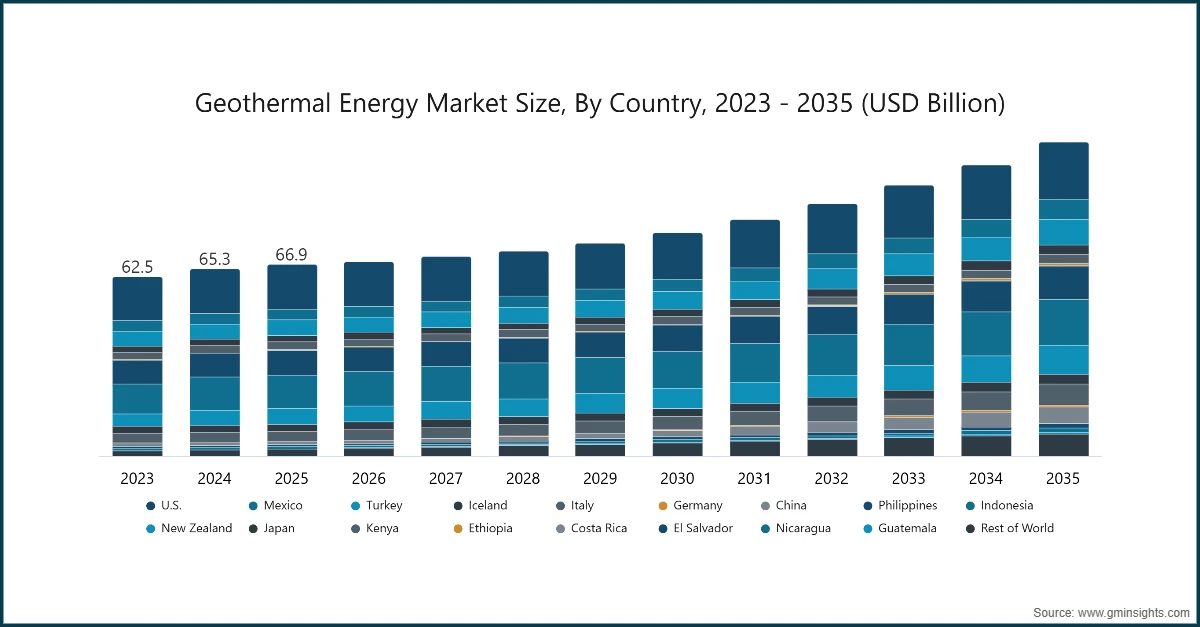
- The global geothermal energy industry is largely dominated by countries such as the U.S., Indonesia, the Philippines, Turkey, New Zealand, Mexico, Kenya, Italy, Iceland, and Japan. The market was valued at USD 62.5 billion in 2023, rising to USD 65.3 billion in 2024 and USD 66.9 billion in 2025. This steady growth is driven by increasing investments in renewable baseload power and expanding geothermal exploration initiatives.
- Public-land access and streamlined leasing pipelines are a key U.S. growth driver, expanding the inventory of drillable prospects for developers. For instance, the Bureau of Land Management announced a competitive geothermal lease sale on 8 October 2024 offering 66 parcels totaling about 219,250 acres across Nevada. Regular, large-scale lease offerings improve project optionality, enable portfolio-based exploration strategies, and create earlier visibility on permitting and environmental stipulations that underpin financing and supply-chain planning.
- Auction-based procurement and standardized tariffs are a central growth driver in the Philippines, improving revenue certainty and accelerating project execution. For instance, the Department of Energy released the Green Energy Auction 3 Notice of Award on 10 June 2025, which included geothermal bids totaling 30.887 MW against a 2025–2027 delivery window. Formal awards and defined delivery periods strengthen bankability, support lender diligence, and encourage developers to advance drilling, EPC contracting, and grid-connection readiness.
- Government prioritization of geothermal within the renewable mix is a primary growth driver in Indonesia, supporting faster commercialization of projects with advanced readiness. For instance, Indonesia’s Ministry of Energy and Mineral Resources stated in December 2024 that geothermal is the mainstay for lifting the national renewable share, citing expected end‑year progress from projects such as Sorik Merapi and planned Salak Binary and Ijen facilities. Explicit ministerial focus improves permitting momentum, reinforces investor confidence, and helps mobilize capital toward near-term commissioning.
- National resource assessment and policy-backed planning is a core growth driver in Iceland, aligning development with quantified subsurface potential and sustainability constraints. For instance, a September 2025 government publication, prepared by Iceland GeoSurvey (ÍSOR) for the Ministry of Environment, Energy and Climate, updates the geothermal assessment and frames future utilization pathways. Updated heat-flow and reservoir evaluations improve site screening, reduce exploration uncertainty, and support more disciplined investment decisions for power-focused expansions and upgrades.
- State-led capacity additions and execution by experienced utilities remain a key growth driver in Kenya, enabling reliable baseload expansion and stronger investor confidence. For instance, KenGen announced in March 2022 that construction of the 83 MW Olkaria I Additional Unit 6 geothermal plant was completed, initiating grid-connection activities and reliability testing toward commercial operation. Delivery of large units builds local supply-chain capability, improves operational learning curves, and supports further private participation around proven steam fields.
- Modernization of existing geothermal fleets is a practical growth driver in Mexico, sustaining baseload output while improving reliability and control performance. For instance, a 6 February 2024 procurement document from CFE’s Cerro Prieto geothermal complex covers acquisition of PLC and excitation-control equipment for multiple generating units, reflecting ongoing upgrades to plant automation and voltage regulation systems. Such reinvestment reduces forced outages, extends asset life, and supports incremental capacity and efficiency improvements without greenfield exploration risk.
- A supportive regulatory environment and continued renewables build-out is a key growth driver in Türkiye, sustaining geothermal’s role as dispatchable renewable capacity. For instance, the Ministry of Energy and Natural Resources reports that by end‑December 2025 the country had 68 geothermal power plants and geothermal supplied 3.2% of electricity generation. Clear national reporting and plant counts signal an established operating base, which supports vendor ecosystems, operational benchmarking, and ongoing reinvestment in efficiency and capacity enhancements.
- Large-scale utility investment in geothermal baseload to strengthen system reliability is a key growth driver in New Zealand. For instance, Contact Energy’s Tauhara geothermal power station began supplying electricity to the grid on 6 May 2024 and was officially opened on 22 November 2024, designed to reach full output of 174 MW. Commissioning of major new units tightens supply-demand balance, reduces reliance on fossil peakers, and encourages follow-on geothermal projects and supply-chain specialization.
- Improved market transparency and standardized project tracking is an important growth driver across other geothermal markets, lowering information barriers for investors and suppliers. For instance, Global Energy Monitor’s Global Geothermal Power Tracker publishes summary tables (March 2025) covering operating capacity, planned capacity by year, and top owners of operating and prospective units. Public, comparable datasets support benchmarking, early pipeline identification, and more efficient capital allocation into developers, drillers, and equipment vendors.
Learn more about the key segments shaping this market
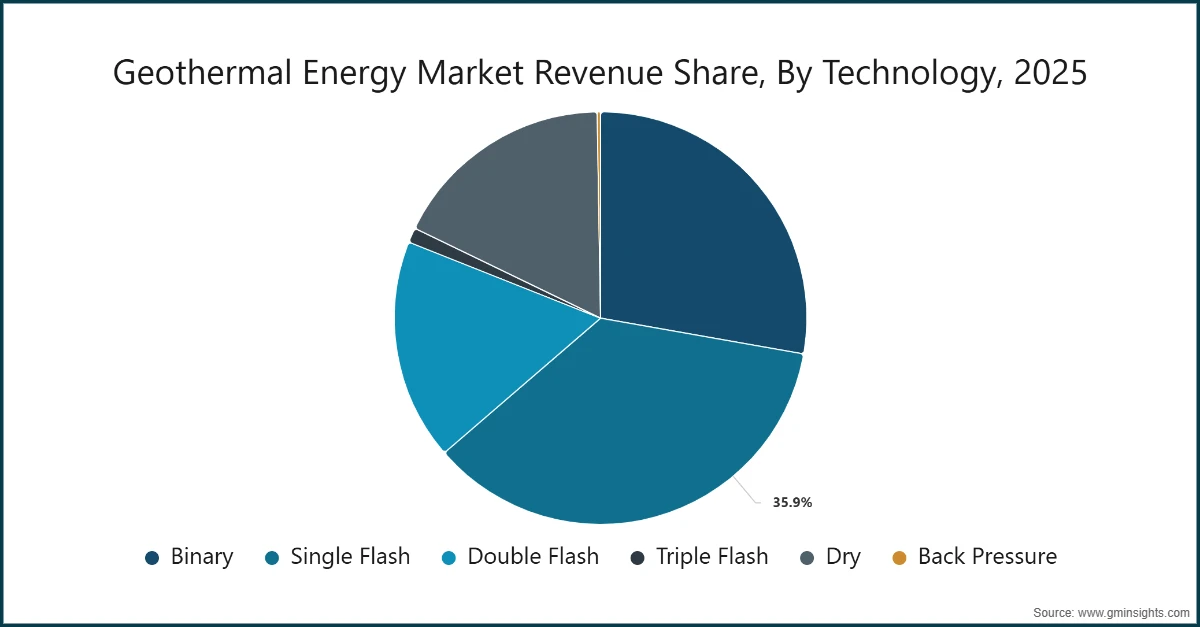
Based on technology, the industry is segmented into binary, single flash, double flash, triple flash, dry steam and back pressure. The single flash geothermal energy market holds a share of 35.9% in 2025 and is set to reach over USD 41 billion by 2035.
- Single-flash is the workhorse technology where high-pressure hot water from a geothermal reservoir is depressurized (“flashed”) into steam to drive a turbine, with remaining liquid typically reinjected. It is widely used because it balances simplicity, proven turbines/separators, and strong performance in high-temperature hydrothermal fields. EIA highlights flash plants as the most common geothermal type, and the California Energy Commission explains the flash process and the option to add more stages for higher recovery.
- Japan’s Appi Geothermal Power Plant illustrates single-flash market viability for mid-scale developments: it began commercial operations in 2024 and is explicitly described as using a single-flash turbine, with output sold under Japan’s renewable support framework. This demonstrates how single-flash remains the preferred “bankable default” where resource temperatures justify flash steam, enabling straightforward EPC execution and predictable operations compared with more complex multi-stage configurations.
- Binary-cycle plants are gaining momentum because they unlock moderate-temperature geothermal resources and operate as a closed-loop, using geothermal fluid to heat a secondary working fluid that vaporizes and drives the turbine, often with very low atmospheric emissions. This expands the addressable resource base beyond high-enthalpy fields, supports development in water‑constrained regions via air‑cooling, and aligns with tighter environmental permitting. California Energy Commission and EIA both describe binary as the go-to option for moderate-temperature resources and note its closed-loop emissions advantage.
- A clear commercial signal for binary/ORC scaling is Türkiye’s continued buildout of modular ORC capacity. For instance, HEZ Enerji reported full-capacity operations of the Morali geothermal plant in Aydın using ORC technology supplied by Exergy, following earlier partial commissioning, showing how developers de-risk projects by ramping in phases and then uprating to full output. This “phase-in → optimize → scale” pattern is common for binary additions on proven fields and brine-to-power opportunities.
- Double-flash plants are used when developers want more energy extraction from the same high-enthalpy fluid. After the first flash tank produces high‑pressure steam, remaining hot liquid can be flashed again at lower pressure in a second tank to generate additional steam and increase total turbine throughput. The California Energy Commission describes this two-stage re-flash concept as a practical way to “extract even more energy” than single flash, at the cost of extra equipment and complexity.
- A real-world illustration of double-flash tradeoffs appears in geothermal design work for Kenya’s Menengai prospect, where researchers compared single and double‑flash configurations to evaluate output, reinjection conditions, and system behavior. The analysis shows why developers don’t automatically choose “more stages”: double flash can increase recoverable steam but introduces different mass-flow and reinjection dynamics that may or may not improve net plant performance under a given field chemistry and well strategy.
- Triple-flash is a specialized option used in very high‑enthalpy, two‑phase fields when developers seek maximum energy recovery by separating steam at three pressure levels. A documented example is New Zealand’s Nga Awa Purua project, which selected a triple flash separation system to exploit exceptionally high-energy two-phase fluid and feed a large single-cylinder geothermal turbine, showing triple flash as a niche but powerful tool when resource conditions justify the added complexity.
- On the supplier side, OEM capability is also expanding: Mitsubishi Power notes it supplies steam turbine lineups spanning single, double, and triple flash cycles to match different geothermal steam conditions. This matters commercially because it reduces “technology risk” for developers considering multi-stage flash, availability of standardized turbine frames and proven configurations helps EPC scheduling, spare parts planning, and long-term O&M strategies, making triple flash more feasible where the reservoir supports it.
- Dry steam plants are the simplest conversion pathway: steam from the reservoir goes directly to the turbine without flashing hot water. They are rare because true vapor‑dominated reservoirs are uncommon, but where they exist, dry steam offers robust baseload operation and relatively straightforward surface equipment. EIA and the California Energy Commission both describe dry steam as the oldest geothermal plant type and note its hallmark use case at The Geysers in California.
- A market-defining dry-steam instance is The Geysers, described as an approximately 725‑MW geothermal complex owned/managed by Calpine, where public procurement and utility agreements continue to contract for dependable geothermal output. For example, a 2025 release notes new deliveries from a Geysers expansion tranche and reiterates the complex’s scale as a world-leading geothermal asset. This highlights how dry steam’s competitive edge is not “new build volume,” but long-life baseload plus incremental optimization and wellfield management.
Looking for region specific data?
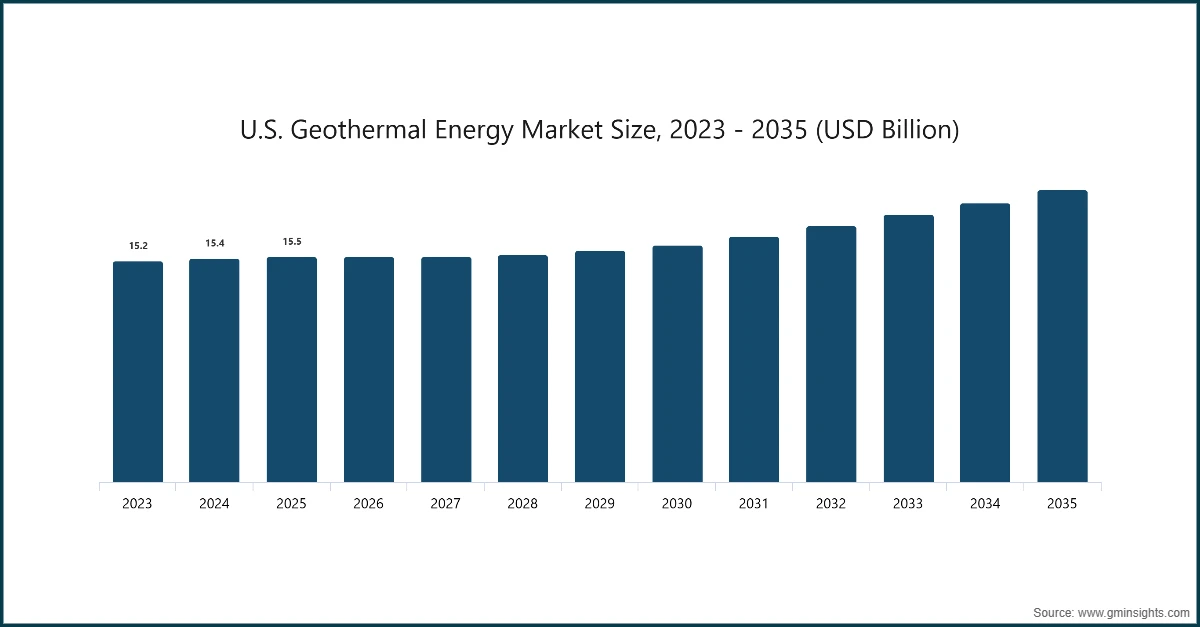
- The U.S. geothermal energy market has shown consistent growth, with its cumulative value rising from USD 15.3 billion in 2023 to USD 15.4 billion in 2024 and reaching USD 15.5 billion in 2025. This steady expansion reflects increasing investment in renewable energy solutions, supported by rising demand for low‑emission power sources and government incentives promoting clean energy development. Collectively, these factors continue to strengthen geothermal’s role in the nation’s energy mix.
- Federal permitting and project approvals on public lands are accelerating the U.S. geothermal pipeline by reducing development uncertainty and opening new resource areas. For instance, the Bureau of Land Management’s “Pending Geothermal Projects” register (updated December 2024) lists the approved Fervo Cape geothermal project in Utah with potential output of up to 2,000 MW, alongside other approved exploration and development actions. Such approvals signal regulatory readiness, improve offtake confidence, and catalyze earlier procurement of drilling and power‑island equipment.
- Contracted capacity under competitive procurement is a near-term growth driver in the Philippines, converting bids into bankable delivery obligations. For instance, the Department of Energy announced on 25 June 2025 that Energy Development Corporation and Bac-Man Geothermal formally accepted GEA‑3 awards for geothermal facilities including the 21.573‑MW Tanawon plant and the 5.645‑MW Bago Binary Unit 1. Award acceptances tighten execution timelines, support financial close, and align developers, EPC firms, and grid operators around commissioning milestones.
- Government-reported capacity additions and COD tracking are accelerating geothermal buildout in Indonesia by improving visibility on what is deliverable and when. For instance, the Ministry of Energy and Mineral Resources stated in August 2025 that geothermal contributed 105.2 MW of new renewable capacity in the first half of 2025, naming Lumut Balai, Ijen, and Gunung Salak among the projects reaching commercial operation. Clear COD recognition reinforces investor confidence, validates permitting progress, and helps crowd in capital for follow-on phases.
- Strong institutional capability and transparent performance reporting underpin Iceland’s geothermal growth by supporting disciplined reservoir management and reinvestment decisions. For instance, the National Energy Authority’s public dashboard reports geothermal electricity production of 5,916 GWh, alongside hydro and wind figures, providing a consistent basis for system planning and asset optimization. Reliable operating data improves benchmarking of plant availability and field performance, strengthening the business case for incremental capacity, uprates, and technology upgrades within existing high-temperature systems.
- Grid demand growth combined with geothermal’s role as dominant baseload continues to drive investment and operational optimization in Kenya. For instance, EPRA’s Energy & Petroleum Statistics Report for the year ended 30 June 2025 states renewables accounted for 80.17% of the electricity mix and geothermal remained the leading source at 39.51%, with geothermal also the largest share of installed capacity. These fundamentals sustain expansion plans, support transmission investments, and improve bankability for new units and field rehabilitation.
- Targeted public investment programs help sustain Mexico’s geothermal pipeline by funding studies, upgrades, and expansion planning in priority fields. For instance, reporting on Mexico’s 2023 federal budget plans, CFE was granted about USD 75.2 million for geothermal investment projects, including pre‑investment studies and capacity-related work across multiple geothermal areas. Dedicated capital allocations reduce development friction, protect resource rights, and enable staged modernization and drilling that preserves baseload output.
- Private-sector buildout supported by project finance is a key growth driver in Türkiye, expanding capacity through modular ORC and binary additions. For instance, HEZ Enerji reported full-capacity operations of the 24‑MW Morali geothermal power plant in Aydin in October 2025 after earlier partial commissioning, citing total investment of about USD 100 million and ORC technology supply. Bringing new plants to full output strengthens investor confidence, deepens the local supply chain, and supports continued buildout across licensed fields.
- Utility-scale investment and staged replacement of aging assets are driving New Zealand’s geothermal expansion by locking in long-lived baseload supply. For instance, Contact Energy confirmed via the NZX in November 2024 that it will build the 101‑MW Te Mihi Stage 2 geothermal plant under an EPC contract, with total expected construction cost of USD 430.1 million and targeted online timing in 2027. Long-horizon commitments strengthen contractor ecosystems and improve financing appetite for additional geothermal projects.
- Government-backed risk mitigation and FIT-linked revenue support are key drivers for Japan’s geothermal additions, especially for mid-scale projects. For instance, the 14.9‑MW Appi geothermal power plant in Iwate Prefecture began commercial operations in March 2024, with project support including a JOGMEC debt guarantee and power sales under the feed-in-tariff mechanism. This framework lowers financing barriers, enables multi-year drilling programs, and encourages additional projects in suitable national-park-adjacent resource areas nationwide, carefully.
- Regulatory certainty over concessions is a central growth driver for Italy’s geothermal sector, enabling operators to commit to long-lived investments and modernization. For instance, in February 2025 Tuscany’s regional council approved a 20‑year extension of Enel Green Power’s geothermal concessions until 2046 after prolonged negotiations, addressing prior short-horizon uncertainty. Longer concession terms improve investment recoverability, support plant efficiency upgrades, and create a clearer pathway for new power plant additions within established geothermal districts.
Geothermal Energy Market Share
- The top five players, Pertamina Geothermal Energy, Ormat Technologies, Energy Development Corporation (EDC), Star Energy, and Calpine, together represent about 34% of the global market share in 2025. Their market strength is anchored in their control of large, long‑lived geothermal resources and scaled operating footprints, which reduce execution risk and enhance operating continuity. Companies such as Pertamina, Star Energy, and Calpine benefit from multi‑field or world‑scale project clusters, enabling familiarity with permitting, reuse of wells and infrastructure, and streamlined brownfield expansions.
- Competitive positioning is further reinforced by these companies’ integrated end‑to‑end capabilities, which combine development, drilling, engineering, and long‑term operations. Ormat exemplifies this through its dual role as both a technology provider and plant operator, allowing rapid learning feedback between equipment design and field performance. EDC similarly leverages integrated stewardship, continuous drilling, incremental binary additions, and field optimization, to stabilize output and extend reservoir life. This integration enables higher plant availability, predictable production profiles, and improved bankability for future expansions.
- Additionally, these leading developers outperform peers through strong offtake structures, financing readiness, and upgrade velocity. Their established track records allow them to secure long‑tenor power purchase agreements and execute phased capacity additions, retrofits, and repowering programs with greater reliability. Their supplier leverage and repeatable development playbooks accelerate the path from concept to commercial operation, while providing resilience against equipment lead‑time constraints, drilling bottlenecks, and grid‑integration challenges. This proven execution capability gives them a decisive competitive edge over smaller or less‑proven geothermal developers globally.
Geothermal Energy Market Companies
- Pertamina Geothermal Energy holds a strong presence in Indonesia by combining self-operated plants with joint-operation assets across its geothermal working areas. It reports 672 MW operated directly and 1,205 MW managed under Joint Operation Contracts, giving it exposure to multiple producing steamfields and partners. On growth, PGEO has pursued new resource positions such as the Way Ratai working area with Chevron, planned to move through permits, exploration, and potential power plant development, extending the pipeline beyond core fields.
- Ormat’s market presence is built on vertical integration, design, equipment manufacturing, EPC delivery, ownership and O&M, supporting a diversified geothermal footprint. The company states a 1.268‑GW geothermal and solar generation portfolio spread across the U.S. and several international markets. Recent activity includes bringing the 35‑MW Ijen geothermal plant in Indonesia to commercial operation with Medco, and reaching an EPC understanding for Contact Energy’s 101‑MW Te Mihi Stage 2 in New Zealand, strengthening multi‑year backlog visibility.
- EDC maintains market presence as the Philippines’ leading geothermal operator, running a portfolio of 13 integrated geothermal power stations across Leyte, Bicol, Negros and Mindanao, with installed geothermal capacity cited at about 1,189 MW. The company’s growth thesis is rooted in drilling-led field optimization and modular additions that preserve steam supply in mature reservoirs. A recent proof point is the Tanawon geothermal power plant in Sorsogon, inaugurated in 2025, expanding baseload renewable output and signaling continued project pipeline execution.
- Star Energy Geothermal’s position is anchored by three large West Java assets, Wayang Windu, Salak and Darajat, where it discloses operating capacities of 227 MW, 377 MW and 271 MW respectively. This concentrated cluster supports shared infrastructure, operating synergies and a strong baseload profile. Recent investment momentum is supported by Barito Renewables’ announcement of a USD 346 million program to expand and retrofit units across these fields, adding incremental capacity and improving plant efficiency over time.
- Calpine’s geothermal market presence is dominated by The Geysers in Northern California, a 725‑MW complex that provides exceptional scale, long operating history and deep reservoir-management expertise. The company continues to extend asset life and output through drilling and collection-system upgrades rather than greenfield builds. A recent commercial signal is MCE’s June 2025 start of deliveries from Calpine’s incremental development expansion tranche, illustrating how Calpine converts brownfield upgrades into contracted, firm renewable electricity supply.
- Contact Energy sustains market presence in New Zealand by pairing a mature geothermal fleet with large new-build execution. Tauhara, its flagship recent geothermal station, was officially opened in November 2024 and is designed to reach 174 MW at full output, strengthening firm renewable generation. Financially, Contact’s FY25 update highlighted performance “powered by geothermal expansion,” citing a major uplift in geothermal generation alongside risk-management assets. Continued buildout projects keep geothermal central to its resilience strategy.
Major players operating in the geothermal energy market are:
- Ansaldo Energia
- Calpine
- Contact Energy
- Energy Development Corporation
- Enel Green Power
- Enertime
- Exergy International
- First Gen
- Fuji Electric
- GE Vernova
- Halliburton
- KenGen
- Mitsubishi Heavy Industries
- Ormat Technologies
- Pertamina Geothermal Energy
- Reykjavik Geothermal
- SLB
- Star Energy
- Toshiba
- Turboden
Geothermal Energy Market Report Attributes
| Key Takeaway | Details |
|---|---|
| Market Size & Growth | |
| Base Year | 2025 |
| Market Size in 2025 | USD 66.9 Billion |
| Market Size in 2026 | USD 67.9 Billion |
| Forecast Period 2026-2035 CAGR | 5.5% |
| Market Size in 2035 | USD 109.6 Billion |
| Key Market Trends | |
| Drivers | Impact |
| Rising Global Clean‑Energy Demand | Growing pressure to decarbonize energy systems is driving interest in geothermal, a reliable baseload renewable source. Countries seeking 24/7 clean power to complement intermittent solar and wind increasingly view geothermal as a stable option supporting long‑term climate goals and energy security. |
| Advances in Drilling & Enhanced Geothermal Systems | Technological progress in deep drilling, reservoir stimulation, and Enhanced Geothermal Systems has expanded feasible project locations. These innovations reduce exploration risks, improve heat extraction efficiency, and open new markets previously unsuitable for traditional geothermal, accelerating global adoption and investment. |
| Government Incentives & Climate Policies | Stronger policy support, tax credits, grants, renewable mandates, and climate‑neutrality commitments, boosts geothermal development. Nations prioritizing clean baseload power are increasing funding for exploration, grid integration, and research, making geothermal more economically viable and attractive for private developers and utilities. |
| Pitfalls & Challenges | Impact |
| High Upfront Capital & Exploration Risk | Geothermal projects require substantial initial investment and carry high geological uncertainty. Drilling unsuccessful wells can significantly inflate costs, discouraging private investors. The long development timeline, paired with exploration risk, often makes geothermal less competitive than faster‑deploying renewable technologies. |
| Opportunities: | Impact |
| Expansion of Enhanced Geothermal Systems (EGS) | EGS offers enormous potential by enabling geothermal development in regions lacking natural hydrothermal resources. As technology matures, it could unlock vast untapped heat reserves, creating new markets, attracting investment, and transforming geothermal into a scalable global energy solution. |
| Industrial Heat & District Heating Applications | Geothermal’s ability to supply constant high‑temperature heat positions it well for industrial processes and urban district heating networks. Growing demand for clean thermal energy across manufacturing, buildings, and agriculture presents a major opportunity to diversify geothermal revenue streams beyond electricity. |
| Market Leaders (2025) | |
| Market Leader |
Over 10% Market Share |
| Top Players |
Collective Market Share of over 34% |
| Competitive Edge |
|
| Regional Insights | |
| Largest Market | U.S. |
| Fastest growing market | Kenya |
| Emerging countries | Costa Rica, Mexico |
What are the growth opportunities in this market?
Geothermal Energy Industry News
- In June 2025, the Philippines’ Department of Energy released Green Energy Auction 3 Notices of Award, allocating about 30.887 MW of geothermal capacity for delivery during 2025–2027. Awards to EDC and Bac-Man Geothermal included the Tanawon project and binary plant additions, bringing geothermal into the auction mechanism for the first time. The result signals a policy-backed route to offtake certainty, while also highlighting that project readiness and commercial conditions remain decisive for higher geothermal participation.
- In February 2025, Tuscany approved a 20‑year extension of Enel Green Power’s geothermal concessions, securing operating rights through 2046 and restoring long-horizon investment visibility. The decision follows years of uncertainty around expiring concessions and is intended to unlock upgrades and new build activity, including Enel’s previously presented multi‑billion‑euro geothermal investment plan. For Italy’s market, the move reduces regulatory risk, supports modernization of mature assets, and could re-start a pipeline after a decade of limited new capacity.
- In February 2025, Ormat Technologies and Medco Power announced commercial operations for the first 35‑MW phase of the Ijen geothermal power plant in East Java, supplying the Java grid under a 30‑year PPA. The milestone establishes East Java’s first geothermal facility and advances a larger development plan targeting 110 MW total capacity. For the market, Ijen underscores continued bankable project delivery in Indonesia and supports renewed investor confidence in Southeast Asia’s geothermal buildout.
- In July 2024, Exergy International, a leader in geothermal ORC systems, partnered with RentCo Africa Ltd to develop the Wellhead geothermal project in Olkaria, Kenya. The company will supply eight ORC systems, and provide advanced technical expertise, including its efficient radial outflow turbine technology, to help expand RentCo's geothermal operations.
The geothermal energy market research report includes in-depth coverage of the industry with estimates & forecast in terms of revenue (USD Million) and capacity (MW) from 2022 to 2035, for the following segments:
Market, By Technology
- Binary
- Single Flash
- Double Flash
- Triple Flash
- Dry
- Back Pressure
The above information has been provided for the following countries:
- U.S.
- Mexico
- Turkey
- Iceland
- Italy
- Germany
- China
- Philippines
- Indonesia
- New Zealand
- Japan
- Kenya
- Ethiopia
- Costa Rica
- El Salvador
- Nicaragua
- Guatemala
- Rest of World
Frequently Asked Question(FAQ) :
What is the market size of the geothermal energy in 2025?
The market size was USD 66.9 billion in 2025, with a CAGR of 5.5% expected through 2035, driven by rising global clean energy demand, advances in drilling and enhanced geothermal systems, and strong government incentives and climate policies.
What is the projected value of the geothermal energy market by 2035?
The geothermal energy market is expected to reach USD 109.6 billion by 2035, propelled by expansion of enhanced geothermal systems, growing industrial heat and district heating applications, and increasing regulatory-backed utility procurement across key markets.
What is the current geothermal energy market size in 2026?
The market size is projected to reach USD 67.9 billion in 2026.
What market share does the single flash technology segment hold in 2025?
The single flash segment holds a market share of 35.9% in 2025 and is set to reach over USD 41 billion by 2035, driven by its proven reliability, straightforward EPC execution, and strong performance in high-temperature hydrothermal fields.
Which region leads the geothermal energy market?
The U.S. geothermal energy market reached USD 15.5 billion in 2025, supported by increasing renewable energy investments, federal permitting advancements, and government incentives promoting clean energy development.
What are the upcoming trends in the geothermal energy market?
Key trends include advancement of enhanced geothermal systems from R&D to field demonstrations, repowering and uprating of existing assets for faster capacity gains, gradual policy shift recognizing geothermal as a firm complement to variable renewables, and expanding government-led investment programs across Asia and emerging markets.
Who are the key players in the geothermal energy market?
Key players include Ansaldo Energia, Calpine, Contact Energy, Energy Development Corporation, Enel Green Power, Enertime, Exergy International, First Gen, Fuji Electric, GE Vernova, Halliburton, KenGen, Mitsubishi Heavy Industries, Ormat Technologies, Pertamina Geothermal Energy, Reykjavik Geothermal, SLB, Star Energy, Toshiba, and Turboden.