Summary
Table of Content

Gasoline Direct Injection (GDI) System Market
Get a free sample of this report
Form submitted successfully!
Error submitting form. Please try again.
Thank you!
Your inquiry has been received. Our team will reach out to you with the required details via email. To ensure that you don't miss their response, kindly remember to check your spam folder as well!
Request Sectional Data
Thank you!
Your inquiry has been received. Our team will reach out to you with the required details via email. To ensure that you don't miss their response, kindly remember to check your spam folder as well!
Form submitted successfully!
Error submitting form. Please try again.
Gasoline Direct Injection System Market Size
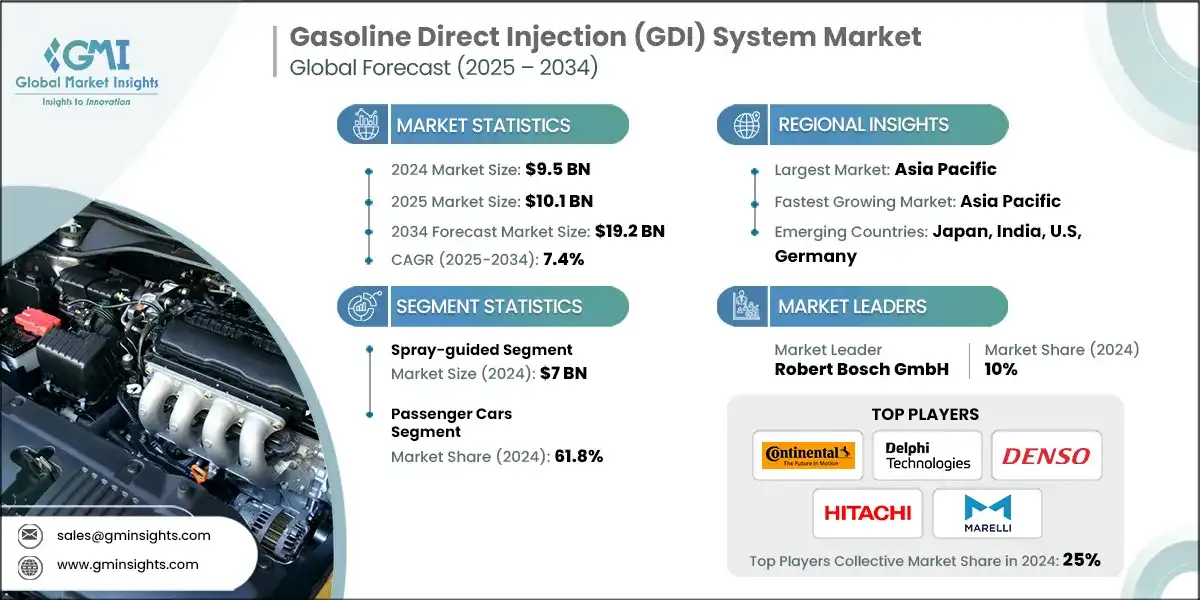
The global gasoline direct injection system market was estimated at USD 9.5 billion in 2024. The market is expected to grow from USD 10.1 billion in 2025 to USD 19.2 billion in 2034, at a CAGR of 7.4%, according to Global Market Insights Inc.
Gasoline Direct Injection (GDI) System Market Key Takeaways
Market Size & Growth
- 2024 Market Size: USD 9.5 Billion
- 2034 Forecast Market Size: USD 19.2 Billion
- CAGR (2025–2034): 7.4%
Regional Dominance
- Largest Market: Asia Pacific
- Fastest Growing Region: Asia Pacific
Key Market Drivers
- Growing adoption of energy-efficient and high-performance vehicles.
- Stringent emission regulations.
- Technological advancements.
Challenges
- Carbon buildup concerns.
- Emission concerns.
Opportunity
- Integration of advanced control systems.
- Compatibility with alternative fuels.
Key Players
- Market Leader: Robert Bosch GmbH led with over 10% market share in 2024.
- Leading Players: Top 5 players in this market include Continental AG, Delphi Technologies, Denso, Hitachi, Marelli, which collectively held a market share of 25% in 2024.
Get Market Insights & Growth Opportunities
- The increased focus on fuel efficiency has led to significant design improvements in vehicles. One key technological advancement is the widespread adoption of Gasoline Direct Injection (GDI) engine configuration.
- Port Fuel Injected (PFI) engines were traditionally the most common type of internal combustion engines, where fuel mixes with incoming air in the intake ports. However, GDI systems offer several advantages over PFI designs, primarily improved fuel economy.
- In GDI engines, fuel injectors located in the cylinder head spray fuel directly into the cylinder for air-fuel mixing. The increasing implementation of this technology by automotive manufacturers and its projected growth in new vehicle production indicates that GDI vehicles will constitute a significant portion of the global vehicle fleet across all regions.
- Passenger cars held the largest share in the market, due to the increasing demand for passenger cars particularly in emerging economies. Automotive manufacturers are prioritizing enhanced fuel efficiency and reduced emissions to comply with stricter regulations and meet consumer preferences.
- The integration of variable valve timing with turbocharging and engine downsizing technologies in passenger cars improves overall performance and fuel efficiency.
- Asia Pacific held the largest share in the global gasoline direct injection (GDI) system industry, driven by growing vehicle production and stringent emission regulations in China and Japan. According to CEIC data, Chinese automotive production reached 30.16 million units in 2023, marking a record high from 27.02 million units in 2022, positioning China as the world's largest vehicle manufacturer.
- The demand for fuel-efficient and high-performance engines is increasing due to higher disposable incomes and evolving consumer preferences. Moreover, government regulations focus on improving fuel efficiency and reducing CO2 emissions, especially in China where Turbocharged Gasoline Direct Injection (TGDI) technology is emphasized, thus driving the market growth.
To get key market trends
Gasoline Direct Injection System Market Trends
- Gasoline direct injection (GDI) systems have achieved significant advancements through improved fuel economy, engine performance, and emissions reduction.
- Key technological developments include optimized spray-guided system in combustion chambers, enhanced ignition control, and advanced turbocharging combined with engine downsizing to meet and exceed regulatory requirements.
- The spray-guided injection system enables uniform fuel distribution, resulting in more efficient combustion throughout the combustion chamber, which enhances overall performance and efficiency. One prominent trend is the integration of GDI technology with turbocharging and engine downsizing. The integration of turbocharging with GDI enables smaller displacement engines to maintain performance while improving fuel efficiency.
- The precise fuel measurement and adjustment capabilities of GDI reduce emissions, particularly CO2 and unburned hydrocarbons. This trend aligns with the global push for improved fuel economy and reduced emissions.
- According to the International Council on Clean Transportation (ICCT), the use of LPG in conjunction with GDI can significantly reduce NOx emissions compared to gasoline-only engines. Ongoing research in combustion optimization continues to enhance fuel efficiency and reduce emissions. The system's compatibility with alternative fuels supports sustainability objectives.
- GDI technology integrates with other advanced systems, including electric motors, to create more efficient powertrains with improved performance and lower emissions.
Gasoline Direct Injection System Market Analysis

Learn more about the key segments shaping this market
Based on the type, the gasoline direct injection (GDI) system industry is categorized into wall-guided and spray-guided. In 2024, spray-guided segment held the largest share in the market, valued at USD 7 billion.
- Spray-guided GDI systems control fuel injection spatially to create a stratified charge in the combustion chamber. These systems utilize specialized injectors that deliver a precise, well-directed fuel spray toward the spark plug. This controlled mixture formation enables the engine to operate at higher performance levels under lean conditions.
- The spray-guided system creates a rich mixture near the spark plug while maintaining a leaner mixture in other areas, supporting stratified combustion. This results in improved fuel consumption and reduced emissions during low-load operations.
- Wall-guided GDI systems utilize the piston or cylinder wall as part of the mixing mechanism instead of a specialized targeting system. High-pressure fuel injectors, positioned above the spark plug, spray fuel into the combustion chamber.
- The fuel contacts the piston top or cylinder wall, promoting atomization and mixture with incoming air. This design eliminates complex targeting mechanisms for spray patterns, making it suitable for various engine sizes and applications.
Learn more about the key segments shaping this market
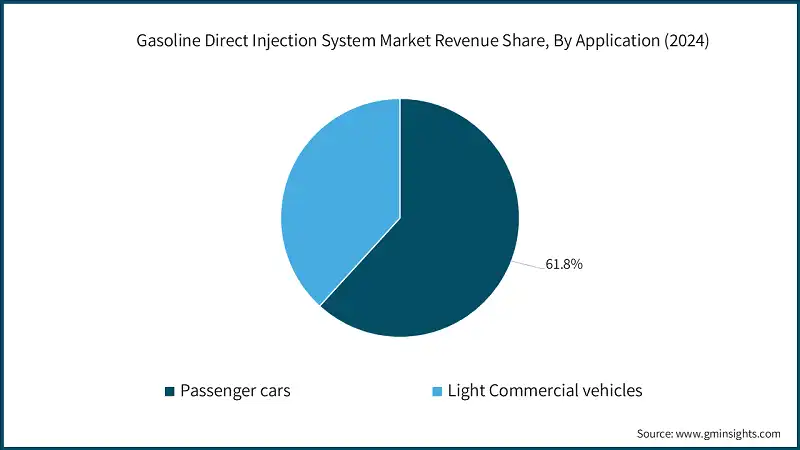
Based on the application, the gasoline direct injection system market is segmented into passenger cars and light commercial vehicles. In 2024, the passenger cars segment held 61.8% share of the market, valued at USD 5.9 billion.
- Passenger cars are the most common vehicles used for personal transportation globally. Their widespread adoption stems from increasing urbanization, rising disposable incomes, and a preference for private mobility over public transportation in many regions.
- Automotive advancements, including improved fuel efficiency, electric and hybrid options, and enhanced safety features, have increased the appeal of passenger vehicles.
- The established infrastructure and stable production and sales volumes support consistent market growth. Consumer preferences for comfort, convenience, and brand variety continue to drive purchases.
- As per the European Automobile Manufacturers' Association report published in 2023, China produced 34% of the 69 million cars that are manufactured worldwide each year, followed by Europe (19%), and North America (15%).
Looking for region specific data?
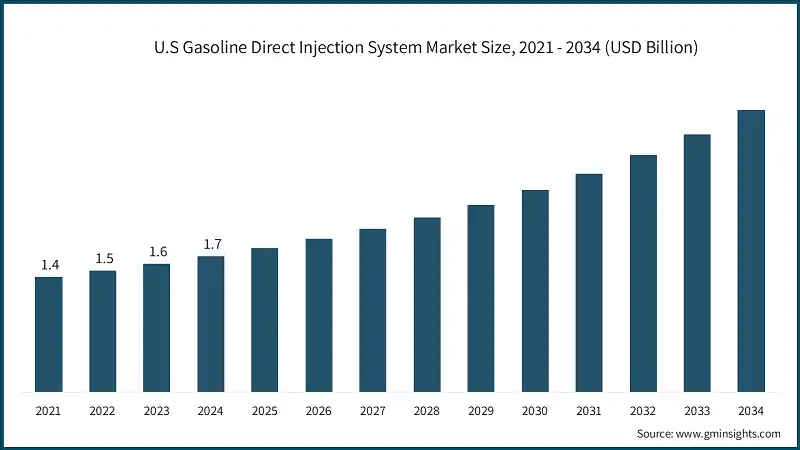
In 2024, the U.S. contributed significantly to the gasoline direct injection system market, generating revenue of USD 1.7 billion.
- The U.S. represents a major market for GDI technology, driven by increasing consumer demand for fuel-efficient and environmentally friendly vehicles. GDI engines offer superior fuel economy and lower emissions compared to conventional port fuel injected engines.
- The market growth is further supported by significant investments from major OEM automakers in GDI technology, stringent fuel efficiency standards, and strict emission regulations. The integration of GDI technology in hybrid and electric vehicles has provided additional momentum to market expansion in the U.S.
Europe gasoline direct injection system market holds significant share in 2024 and is expected to grow at 6.6% during the forecast period.
- Europe maintains a well-established GDI market, primarily influenced by government regulations targeting emission reduction and air quality improvement. European automakers have increased their adoption of GDI technology to comply with Euro emission standards.
- The market emphasizes the development of fuel-saving solutions and the transition toward cleaner fuels and hybrid systems. Consumer preferences for compact, efficient vehicles have contributed to GDI technology growth. The market evolution is also influenced by the increasing focus on alternative fuels and electrification.
- Germany is home to some of the world's largest and most innovative car manufacturers like Volkswagen Group, Daimler (Mercedes-Benz), and BMW. These companies are heavily invested in GDI technology to comply with strict EU emission regulations and offer competitive fuel efficiency in their vehicles.
Asia Pacific gasoline direct injection system market is expected to grow at 8% during the forecast period.
- The GDI market is experiencing significant growth in Asia Pacific, primarily in China, Japan, and South Korea. This growth stems from increased vehicle production and sales, ongoing urbanization, and a growing middle class with higher disposable income.
- Regional manufacturers are implementing GDI technology to comply with local fuel efficiency and emission regulations.
- Government initiatives supporting clean transportation and the expansion of automotive manufacturing infrastructure contribute to market expansion. The region's focus on cost-effective yet efficient vehicles drive GDI technology adoption among both consumers and manufacturers.
Gasoline Direct Injection System Market Share
- The top companies in the gasoline direct injection (GDI) system industry are Continental AG, Delphi Technologies, Denso, Hitachi and Marelli, contributing approximately 25% of the market in 2024.
- Continental AG, a German automotive supplier, specializes in advanced fuel injection systems, including gasoline direct injection (GDI). The company manufactures high-pressure fuel pumps, injectors, and control units for GDI applications.
- BorgWarner, acquired by Delphi Technologies, supplies powertrain and propulsion systems, including GDI components. The company produces high-pressure fuel pumps, injectors, and electronic control modules designed for efficiency and emissions compliance.
- Denso Corporation, a Japanese automotive supplier and Toyota Group member, manufactures fuel injection systems, including GDI components. The company's product portfolio encompasses fuel injectors, high-pressure fuel pumps, and electronic control units that emphasize durability and efficiency.
Gasoline Direct Injection System Market Companies
Major players operating in the gasoline direct injection (GDI) system industry are:
- Aisin Seiki Co Ltd
- BorgWarner Inc
- Robert Bosch GmbH
- Continental AG
- Delphi Technologies
- Denso
- Hitachi
- Infineon Technologies AG
- Keihin Corporation
- Marelli
- Park Ohio Holdings Corp
- PHINIA
- Stanadyne LLC
- Standard Ignition
- TI Fluid Systems
Park Ohio Holdings Corp is a diversified industrial and manufacturing company based in the United States. While not primarily focused on GDI technology, its subsidiaries manufacture various automotive components, including fuel injection systems.
Stanadyne LLC specializes in fuel injection systems and components for the automotive and engine markets. The company designs and manufactures high-precision fuel injection technologies, ranging from traditional GDI engines to advanced fuel delivery systems.
Standard Ignition manufactures ignition systems, spark plugs, and related engine components for the automotive aftermarket industry. The company has established a strong presence in the aftermarket segment through its extensive distribution network and product reliability.
Gasoline Direct Injection (GDI) System Market Report Attributes
| Key Takeaway | Details |
|---|---|
| Market Size & Growth | |
| Base Year | 2024 |
| Market Size in 2024 | USD 9.5 Billion |
| Forecast Period 2025 – 2034 CAGR | 7.4% |
| Market Size in 2034 | USD 19.2 Billion |
| Key Market Trends | |
| Drivers | Impact |
| Growing adoption of energy-efficient and high-performance vehicles | The demand for fuel-efficient vehicles is increasing due to rising fuel costs and growing consumer awareness about environmental impacts. |
| Stringent emission regulations | Governments and regulatory bodies worldwide are implementing stricter emission standards to address vehicle-related environmental damage, driving market growth. |
| Technological advancements | Ongoing developments in GDI technology, including enhanced fuel injectors, higher injection pressure, and improved electronic control units (ECUs), are enhancing vehicle performance and fuel economy. |
| Pitfalls & Challenges | Impact |
| Carbon buildup concerns | GDI engines face carbon accumulation on intake valves and piston tops due to direct fuel injection into the combustion chamber. This carbon accumulation can decrease engine performance and fuel efficiency, potentially requiring costly maintenance procedures for component cleaning or replacement. |
| Emission concerns | GDI engines reduce CO2 emissions but generate higher levels of particulate matter compared to PFI engines. Increasingly strict PM regulations, particularly for fine particles, necessitate enhanced combustion chamber designs. |
| Opportunities: | Impact |
| Integration of advanced control systems | The implementation of advanced Electronic Control Units (ECUs) and sensor technologies enables precise fuel delivery and optimized combustion strategies. These systems adjust in real-time to driver inputs and driving conditions, improving fuel efficiency and reducing emissions. |
| Compatibility with alternative fuels | The development of GDI systems to accommodate alternative fuels, including biofuels and hydrogen, represents a significant growth opportunity. |
| Market Leaders (2024) | |
| Market Leaders |
10% market share |
| Top Players |
The collective market share in 2024 is 25% |
| Competitive Edge |
|
| Regional Insights | |
| Largest Market | Asia Pacific |
| Fastest Growing Market | Asia Pacific |
| Emerging Countries | Japan, India, U.S, Germany |
| Future outlook |
|
What are the growth opportunities in this market?
Gasoline Direct Injection System Industry News
- In January 2024, Standard Motor Products, Inc. launched the new GDI systems units Fuel Injection Program. Standard's complete Fuel Injection program features over 1,100 all-new, Gasoline Direct Injection (GDI), Multi-Port Fuel Injection (MFI) and Throttle Body Injection (TBI) Injectors, as well as Fuel Injector Multi-Packs for a complete repair solution.
- In December 2023, Stanadyne expanded its performance and specialty product portfolio with the launch of its patented Goliath 350-bar gasoline direct injection (GDI) performance fuel injector. The new injector is designed to complement Stanadyne’s new Goliath high-flow, 12mm bore, 350-bar performance gasoline direct injection (GDI) fuel pump as a system or operate as a separate component.
The gasoline direct injection system market research report includes in-depth coverage of the industry with estimates & forecasts in terms of revenue (USD Billion) and volume (Units) from 2021 to 2034, for the following segments:
Market, By Type
- Wall-guided
- Spray-guided
Market, By Component
- Fuel pump
- Fuel injector
- Electronic control unit
- Fuel rail
- Others
Market, By Vehicle Type
- Conventional gasoline-powered vehicles
- Hybrid vehicles
Market, By Application
- Passenger cars
- Light commercial vehicles
The above information is provided for the following regions and countries:
- North America
- U.S.
- Canada
- Europe
- Germany
- UK
- France
- Italy
- Spain
- Asia Pacific
- China
- India
- Japan
- Australia
- South Korea
- Latin America
- Brazil
- Mexico
- Argentina
- MEA
- South Africa
- Saudi Arabia
- UAE
Frequently Asked Question(FAQ) :
What is the market size of the gasoline direct injection (GDI) system industry in 2024?
The market size was USD 9.5 billion in 2024, with a CAGR of 7.4% expected through 2034 driven by rising demand for energy-efficient and high-performance vehicles.
What is the current gasoline direct injection (GDI) system market size in 2025?
The market size is projected to reach USD 10.1 billion in 2025.
What is the projected value of the gasoline direct injection system market by 2034?
The gasoline direct injection system market is expected to reach USD 19.2 billion by 2034, supported by stricter emission regulations, hybrid vehicle adoption, and continuous technological advancements in injection systems.
How much revenue did the spray-guided GDI segment generate in 2024?
The spray-guided segment generated USD 7 billion in 2024.
What was the valuation of the passenger cars application segment in 2024?
Passenger cars held 61.8% share, generating USD 5.9 billion in 2024.
Which country leads the gasoline direct injection (GDI) system market?
The U.S. market was valued at USD 1.7 billion in 2024. Growth is driven by strong OEM investments, stringent fuel efficiency standards, and rising adoption of hybrid and fuel-efficient vehicles.
What are the upcoming trends in the gasoline direct injection (GDI) system industry?
Key trends include integration of GDI with turbocharging and engine downsizing, adoption of advanced spray-guided systems, and compatibility with alternative fuels such as biofuels and hydrogen.
Who are the key players in the gasoline direct injection system market?
Key players include Robert Bosch GmbH, Continental AG, Delphi Technologies, Denso Corporation, Hitachi, Marelli, Aisin Seiki, BorgWarner, Infineon Technologies, and TI Fluid Systems.
Gasoline Direct Injection (GDI) System Market Scope
Related Reports