Summary
Table of Content

Gas Valve Market
Get a free sample of this report
Form submitted successfully!
Error submitting form. Please try again.
Thank you!
Your inquiry has been received. Our team will reach out to you with the required details via email. To ensure that you don't miss their response, kindly remember to check your spam folder as well!
Request Sectional Data
Thank you!
Your inquiry has been received. Our team will reach out to you with the required details via email. To ensure that you don't miss their response, kindly remember to check your spam folder as well!
Form submitted successfully!
Error submitting form. Please try again.
Gas Valve Market Size
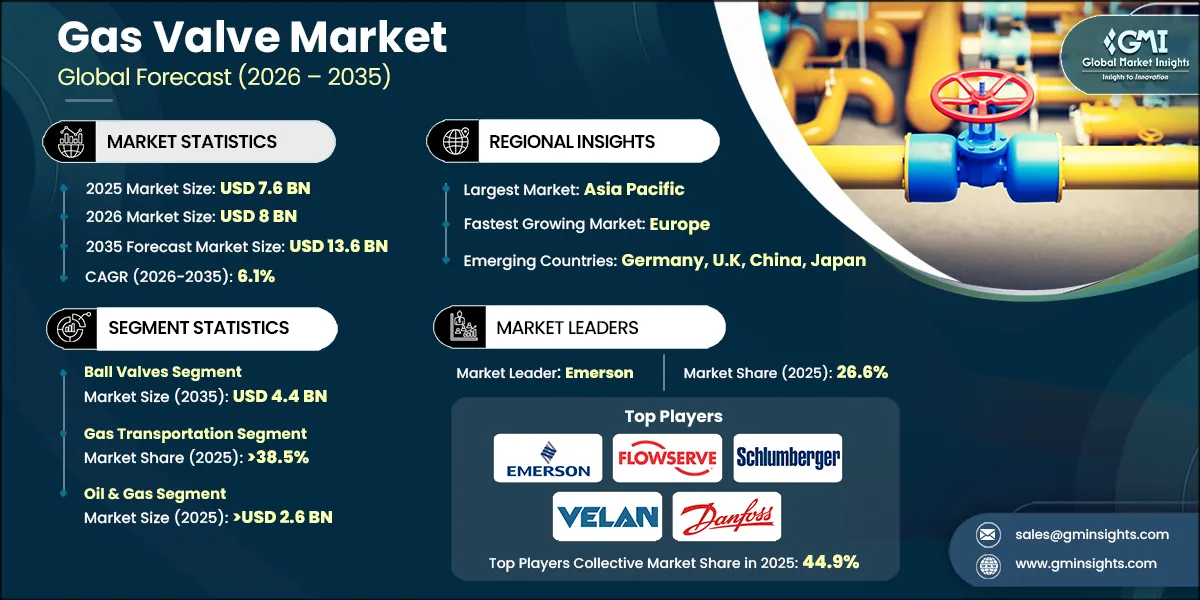
The gas valve market was valued at USD 7.6 billion in 2025. The market is expected to grow from USD 8 billion in 2026 to USD 13.6 billion in 2035, at a CAGR of 6.1%, according to latest report published by Global Market Insights Inc.
Gas Valve Market Key Takeaways
Market Size & Growth
- 2025 Market Size: USD 7.6 Billion
- 2026 Market Size: USD 8 Billion
- 2035 Forecast Market Size: USD 13.6 Billion
- CAGR (2026–2035): 6.1%
Regional Dominance
- Largest Market: Asia Pacific
- Fastest Growing Region: Europe
Key Market Drivers
- Increasing demand for natural gas.
- Rapid industrialization.
- Renewable energy integration.
Challenges
- Regulatory compliance.
- Price volatility of raw materials.
Opportunity
- Growth in hydrogen & LNG infrastructure.
- Adoption of smart & IoT-enabled valves.
Key Players
- Market Leader: Emerson led with over 26.6% market share in 2025.
- Leading Players: Top 5 players in this market include Emerson, Flowserve, Schlumberger, Velan, Danfoss, which collectively held a market share of 44.9% in 2025.
Get Market Insights & Growth Opportunities
The global emphasis on energy conservation is driving the adoption of energy-efficient gas valves, there has been an increase in the number of energy-efficient gas valves being manufactured. In fact, this increase in production of energy-efficient gas valves is partly due to the U.S. Department of Energy's (DOE) estimate that various energy efficiency programs will save at least five quadrillion British Thermal Units (BTUs) of energy in 2023. Companies like Honeywell, are creating very high-tech gas valves that provide users with a greater ability to optimize their use of energy.
Today manufacturers are also developing gas valves that are compatible with renewable energy sources that generate and employ biogas & hydrogen. The International Energy Agency (IEA) has stated that the global production of hydrogen increased by 8% from 2022 to 2023. Emerson has designed products specifically for the safe and effective management of all types of renewable gases, which will accelerate the transition to cleaner energy sources. The demand for "intelligent gas valves," which incorporate IoT technology to provide greater safety and operational efficiency through the application of automation, is expected to continue to grow.
The U.S. government allocated USD 500 million for "smart cities" in 2023, and part of that investment will be in regard to smart infrastructures associated with gas systems. In response, Siemens has developed smart valves with predictive maintenance capabilities and remote monitoring systems. With both the LNG and petrochemical sectors continuing to grow at a rapid pace, demand continues to increase for advanced gas valves. The US Energy Information Administration reported that LNG exports have increased 14% from 2022 to 2023. The necessary types of products for both LNG terminals and petrochemical plants have been created by Flowserve.
In response to stricter environmental regulations imposed by governments worldwide, more businesses are now looking for gas valves that meet these environmental requirements. In particular, the European Union has set a goal of reducing greenhouse gas emissions by 55 percent by 2030 with its green deal. In addition, Parker Hannifin is designing green gas valves, which will allow companies to comply with the regulations while still providing maximum operational efficiency.
To get key market trends
Gas Valve Market Trends
Changing innovation and technology transformation are important for the growth driver for market growth.
- The stringent regulations requiring certification for safety in manufacturing of the gas valve category is forcing manufacturers of gas valve's to innovate development in their use of valves. U.S. Department of Energy requires equipment manufacturers to meet ANSI / CSA 2024 standards so their products can be approved for installation and use by gas utility/water treatment facilities. With the need to create equipment that exceeds compliance with regulatory standards, manufacturers such as Emerson Electric Co., have been very active in developing advanced technology for gas valve design through research and development.
- The rapid growth of internet of things (IoT) technologies is creating a significant demand for smart gas valves, which allows consumers to monitor and manage their gas systems remotely and efficiently. Both consumers and utilities benefit from the capabilities of these automation products to provide predictive decision-making capabilities to improve safety and control the operation of gas systems. An example of this technology in gas valve development is provided by Honeywell International Inc., who has created a gas valve that uses the IoT technologies to enhance safety and provide improved operational.
- Industry is increasingly demanding the ability to specify and procure custom gas valve, which allows for easier integration into their processes and systems. Modular valve designs have been created to provide many variations that will allow industry to use their custom gas valve products to meet their needs for flexibility and scalability. The trend in modular valve design has developed in response to industry needs for the creation and installation of customizable products in both industrial and residential applications.
- The implementation of environmental regulations in the manufacturing of gas valve has driven the gas valve manufacturers to begin using eco-friendly materials. For example, the Environmental Protection Agency promotes the usage of lead-free brass as an environmentally sustainable product for gas valve manufacturing. Manufacturers such as Mueller Industries have begun to use the eco-friendly materials lead-free brass & stainless steel to limit the environmental impacts associated with the usage of Lead in their manufacturing processes and to provide a safe alternative to consumers.
- The gas valve market is consolidating through mergers and acquisitions to enhance competitiveness. According to the Federal Trade Commission, such activities are reshaping the market landscape. For instance, IMI plc’s acquisition of Rotork expanded its product portfolio and technological capabilities, driving innovation in valve design and functionality.
Gas Valve Market Analysis

Learn more about the key segments shaping this market
Based on product type, the gas valve market is segmented into gate valves, control valves, ball valves, butterfly valve, plug valve and others. The ball valves segment accounts for revenue of around USD 2.4 billion in 2025 and is expected to reach USD 4.4 billion by 2035.
- The ball valve's superior efficiency, reliability, ease-of-use, and fast acting shut-off make them an excellent choice for controlling gas flow. Simultaneously they helping in eliminating the risk of gas escaping from the pipeline and have become increasingly important to the safety and operational efficiency of natural gas systems between consumers and users. According to the EIA, total U.S. natural gas consumption was approximately 30 trillion cubic feet in 2023, which illustrates the increased use of electric gas valves, such as ball valves.
- Thus, the adoption of ball valves is being driven by the incentives provided by governmental regulatory agencies regarding the safety and efficiency of gas distribution systems, further the U.S. Department of Transportation's Pipeline and Hazardous Materials Safety Administration (PHMSA) enforces strict regulations about the safe operation of pipelines, and by using the unique characteristics of ball valves, those regulatory requirements are met.
- Major manufacturers of ball valves such as Emerson Electric Co., Flowserve Corporation, and others that have in developing the technology driving the innovation. Notably, Fisher Vee-Ball valve by Emerson is known for its high accuracy and reliability in being able to correctly regulate flow for gas distribution systems, and the Trunnion-mounted ball valve manufactured by Flowserve is designed to be able to handle the extreme pressures that are present in heavy-duty industrial applications and is therefore very popular in the industry.
- Ball valves are also used in many residential and commercial types of gas distribution systems because they are very compact and easy to install. They are therefore suited for many applications, from small residential installations to large industrial plants.
- As the global energy market becomes more focused on using cleaner forms of energy, and as more countries start using natural gas as part of their overall strategy for producing energy, the demand for these types of valves will likely continue to grow over the forecast period. The continued development of these products by major manufacturers will keep them at the top of the market.
Learn more about the key segments shaping this market
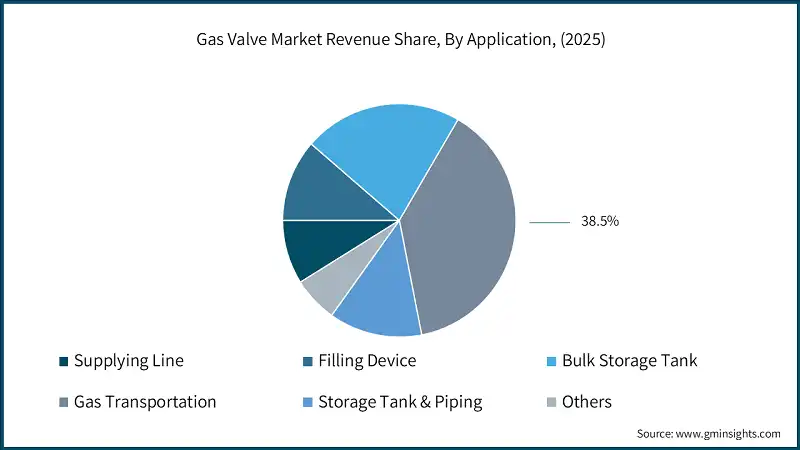
Based on the application, the gas valve market is bifurcated into supplying line, filling device, bulk storage tank, gas transportation, storage tank & piping and others. The gas transportation segments accounted for over 38.5% of the market share in 2025.
- The growing demand for natural gas as an environmentally friendly alternative to fossil fuels has led to an increase in the number of gas valves in the world in that they provide safety and efficiency through providing a controlled flow of gas through pipelines. According to the U.S. Energy Information Administration, it is estimated that consumption of natural gas in America reached around 30.5 trillion cubic feet by 2023. Some of the largest organization involved in the manufacture and supply of valves for gas transportation systems globally are Emerson Electric.
- The increase in gas valve applications in the transportation sector is being further fueled by government initiatives to develop the infrastructure of natural gas. For example, in India, National Gas Grid project underway with plans to extend approximately 34,500km of the gas pipeline system. This type of project requires high-quality valves to properly control flow and pressure in the pipeline system. Various companies also manufacture and supply valves for large gas transportation infrastructure projects around the world, such as Honeywell International.
- Also, the increased demand for advanced valve technology in the gas transportation industry is driven by the government's stringent regulations on safety in the transportation of gas. In the USA, the government established regulations through the Department of Transportation (DOT) and Pipeline and Hazardous Materials Safety Administration (PHMSA) that specify that advanced valve technology must be used on all gas pipeline systems to minimize leak risks and to ensure the integrity of the pipeline system. One example is the valve technology developed and manufactured by Schlumberger.
- The increased use of LNG as fuel in transport raises the demand for specialized valves. LNG valves must withstand the extreme conditions of liquid, as well as handle high temperature and high-pressure, Flowserve Corporation provides cryogenic valves designed for LNG applications, addressing the rising global LNG trade, which reached 400 million tons in 2023, according to the International Gas Union.
- Advanced technology in gas valve technology supports gas transport via pipes and in well head systems. These include smart valves which have advanced IoT sensor systems for providing real-time monitoring of gas transmission & predictive maintenance to reduce operating costs. Baker Hughes have introduced digital valve solutions that enhance pipeline efficiency and safety, aligning with the modernization of gas transportation infrastructure worldwide.
Based on end use, the gas valve market is segmented into water & wastewater, food & beverage, chemicals, pharma, pulp & paper, oil & gas, power, semiconductor and others. The oil & gas segment exceeded USD 2.6 billion in 2025.
- The oil & gas segment dominates the market for gas valves because of their crucial control of gas flow within upstream, midstream & downstream activities; gas valves are required for the management of natural gas as well as the noble gases such as propane, butane etc., in addition to the other hydrocarbons. Approximately 38 trillion cubic feet of natural gas was produced in the U.S. in 2023 U.S. Energy Information Administration (EIA).
- The rise of the oil & gas segment is being driven by government funded improvements in energy infrastructure around the world. One example of this is the Indian Government's National Infrastructure Pipeline (NIP) which has allocated USD 1.4 trillion to invest in energy-related projects by 2025 including large investment amounts for oil and gas pipeline construction. The construction of these pipelines requires the use of high-performance gas valves to ensure that the pipelines adhere to safety requirements.
- Manufacturers are innovating gas valves so that they meet the specific demands of the oil & gas sector. For example, Emerson Electric Co. manufactures gas valves that are equipped with smart actuators. These actuators enable remote monitoring and control capability. These valves are used extensively in centralized control centers to increase operating efficiencies. Similarly, Baker Hughes produces gas valves that are designed for use in very taxing environments with differential pressure and temperature standing capacity.
- The integration of automation and IoT technologies in gas valves has further enhanced their functionality. IoT-enabled actuators allow real-time monitoring, predictive maintenance, and improved safety protocols. These advancements align with the industry's focus on digital transformation and sustainability, making gas valves indispensable for meeting global energy demands while ensuring operational excellence.
Looking for region specific data?
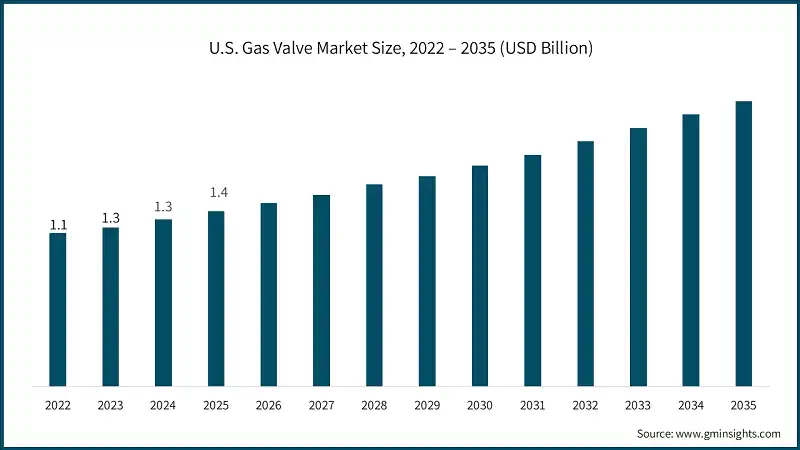
U.S. dominated about 73% share of North America gas valve market in 2025.
- The market is also being propelled by the United States' vast Natural Gas pipeline network and ability to export liquefied natural gas (LNG). According to the U.S. Energy Information Administration (EIA) report, the U.S. is still the world's largest LNG exporter with continued support from LNG development and export projects such as golden pass and Plaquemines LNG." This increased production of liquified natural gas and ExxonMobil's Pennzoil pipeline expansions has increased demand for cryogenic valves and high-pressure valves from upstream and midstream sectors.
- U.S. Government regulations and enforcement of methane emissions and pipeline integrity continue to spur adoption of more advanced valves technology. The U.S. Pipeline and Hazardous Materials Safety Administration (PHMSA) have mandated greater levels of leak detection and control to operators and have begun to require operators to begin transitioning to low-emission and smart valves. The Infrastructure investment and jobs act of 2021 will provide more opportunities for automation of valve systems to utility's municipal and industrial gas needs.
Asia Pacific gas valve market is expected to grow at 6.3% CAGR during the forecast period.
- The market is fueled by rapid urbanization and energy transition initiatives in China, India, and Southeast Asia. China’s 14th Five-Year Plan emphasizes LNG import terminals and hydrogen infrastructure, while India’s National Gas Grid expansion targets 34,500 km of pipelines by 2030. These developments create strong demand for cryogenic valves and automated flow control systems in LNG regasification and industrial gas distribution.
Europe gas valve market is expected to grow at 6.5% CAGR during the forecast period.
- Europe’s growth is supported by decarbonization policies and hydrogen adoption under the EU’s RE Power EU plan. The European Commission aims to produce 10 million tons of renewable hydrogen by 2030, requiring specialized valves for hydrogen transport and storage. Additionally, retrofitting existing gas networks for low-carbon fuels drives demand for high-integrity and low-emission valves across industrial and municipal sectors.
Middle East and Africa gas valve market is expected to grow at 4.4% CAGR during the forecast period.
- The region’s growth stems from large-scale LNG and gas projects in Qatar, UAE, and Africa. Qatar Energy’s North Field Expansion and ADNOC’s gas development programs boost demand for cryogenic and severe-service valves in liquefaction and pipeline systems. African nations like Mozambique and Nigeria are investing in LNG export facilities, creating opportunities for high-pressure and corrosion-resistant valves in challenging environments.
Gas Valve Market Share
The top companies in the gas valve industry include Emerson Electric Co., Flowserve Corporation, Schlumberger Limited, Velan and Danfoss A/S and collectively hold a share of 44.9% of the market in 2025. These prominent players are proactively involved in strategic endeavors, such as mergers & acquisitions, facility expansions & collaborations, to expand their product portfolios, extend their reach to a broad customer base, and strengthen their market position.
- Emerson provides advanced cryogenic and severe-service isolation valves for LNG, hydrogen, and aerospace applications. Its portfolio includes AEV C-Ball valves and ASCO zero-emission solutions for sustainability compliance. Emerson integrates digital diagnostics and automation for predictive maintenance and operational efficiency. The company leads in low-emission and high-integrity valve technologies for energy transition markets.
- Flowserve specializes in cryogenic ball valves for LNG, hydrogen, and industrial gas sectors, ensuring fugitive-emission compliance and fire-safe performance. Its Worcester Cryogenic Series offers modular designs for cost efficiency and reliability. Flowserve supports customers through global quick response centers and engineering services. The company focuses on energy transition and digital valve solutions for critical gas applications.
- Schlumberger’s Cameron division delivers high-performance valves for pipelines, LNG, and subsea gas operations. Its portfolio includes fully welded ball valves, gate valves, and butterfly valves for severe-service conditions. SLB emphasizes low-emission certifications and durability for hydrogen and CO2 applications. The company combines hardware with flow assurance expertise for upstream and midstream gas infrastructure.
Gas Valve Market Companies
Major players operating in the gas valve industry are:
- China Yuanda Valve
- CNNC Sufa Technology
- Crane
- Dalian DV Valve
- Danfoss
- Emerson Electric
- Flowserve
- Henan Kaifeng High Pressure Valve
- Neway
- Pentair
- Schlumberger
- Shandong Yidu Valve
- SWI Valve
- Velan
- Watts
Velan manufactures steel industrial valves for nuclear, LNG, and cryogenic gas applications, including gate, globe, check, and severe-service ball valves. Its designs meet ASME III and ISO standards for extreme temperatures and pressures. Velan focuses on clean energy valves for nuclear and hydrogen sectors, supported by digital monitoring tools. The company is recognized for precision engineering and lifecycle reliability in critical gas systems.
Danfoss offers solenoid, motorized, and control valves for HVAC-R and industrial refrigeration systems handling ammonia and fluorinated gases. Its solutions include ICLX suction stop valves and EV220B servo-operated valves for large-scale gas installations. Danfoss integrates automation and monitoring platforms for efficient gas flow control. The company targets energy-efficient and compliant valve technologies for industrial and commercial applications.
Gas Valve Market Report Attributes
| Key Takeaway | Details |
|---|---|
| Market Size & Growth | |
| Base Year | 2025 |
| Market Size in 2025 | USD 7.6 Billion |
| Market Size in 2026 | USD 8 Billion |
| Forecast Period 2026 - 2035 CAGR | 6.1% |
| Market Size in 2035 | USD 13.6 Billion |
| Key Market Trends | |
| Drivers | Impact |
| Increasing demand for natural gas | Rising consumption for power generation and industrial use drives LNG terminal and pipeline expansions. This creates strong demand for high-performance valves that ensure safe and efficient gas flow. Manufacturers are focusing on emission-compliant designs and advanced sealing technologies to meet global standards. |
| Rapid industrialization | Growth in manufacturing and energy-intensive sectors accelerates adoption of automated valves for precision and reliability. These valves help reduce downtime and improve operational efficiency in large-scale industrial systems. Emerging economies are fueling demand for smart valve technologies integrated with monitoring tools. |
| Renewable energy integration | Hydrogen and biogas projects under global decarbonization initiatives require specialized cryogenic valves. These valves must handle extreme temperatures and pressures while ensuring zero leakage for safety compliance. Manufacturers offering hydrogen-ready and low-emission solutions gain a competitive edge in clean energy markets. |
| Pitfalls & Challenges | Impact |
| Regulatory compliance | Strict emission and safety standards increase complexity in valve design and certification processes. Meeting global norms such as API and ISO adds significant testing and engineering costs, slowing time-to-market. Non-compliance risks penalties and loss of contracts in regulated sectors like oil and gas. |
| Price volatility of raw materials | Fluctuating prices of steel, alloys, and specialty metals impact production costs and profit margins for valve manufacturers. Supply chain disruptions further complicate cost management and delivery timelines for large projects. Companies are adopting strategic sourcing and exploring alternative materials to mitigate these risks. |
| Opportunities: | Impact |
| Growth in hydrogen & LNG infrastructure | Global investments in LNG liquefaction, regasification, and hydrogen pipelines are creating strong demand for cryogenic and severe-service valves. These valves must withstand ultra-low temperatures and high-pressure conditions for safe gas handling. Companies with specialized cryogenic technologies are securing long-term contracts in energy transition markets. |
| Adoption of smart & IoT-enabled valves | Digital valves equipped with sensors enable real-time monitoring, predictive maintenance, and remote control. This reduces downtime, improves safety, and optimizes operational efficiency in gas distribution networks. Industry 4.0 adoption in oil and gas and municipal sectors accelerates demand for connected valve solutions. |
| Market Leaders (2025) | |
| Market Leaders |
26.6% market share |
| Top Players |
|
| Competitive Edge |
|
| Regional Insights | |
| Largest market | Asia Pacific |
| Fastest growing market | Europe |
| Emerging countries | Germany, U.K, China, Japan |
| Future outlook |
|
What are the growth opportunities in this market?
Gas Valve Industry News
- In February 2025, Emerson introduced ASCO zero-emissions electric dump valves to help oil & gas operators meet stringent emissions regulations. These valves eliminate vented and fugitive emissions, offering ultra-low power consumption and fast actuation for upstream applications.
- In February 2025, Flowserve launched the Worcester Cryogenic Series Floating Ball Valves for LNG, hydrogen, and industrial gas sectors. These valves provide enhanced fugitive emissions control and modular design for cost efficiency.
- In January 2025, Emerson acquired Advanced Engineering Valves (AEV) and launched the AEV ²XC C-Ball Valves. Featuring a unique “C”-shaped ball design, these valves improve safety, reliability, and emissions performance. The innovation targets LNG value chains and aerospace applications, reinforcing Emerson’s leadership in cryogenic and severe-service isolation valves..
- In January 2025, Velan announced major strategic initiatives, including divesting asbestos-related liabilities and negotiating the sale of its French subsidiaries to Framatome. The move strengthens Velan’s financial position and allows focus on clean energy valves, especially for nuclear and small modular reactors.
- In November 2024 Crane acquired Technifab Products, Inc., enhancing its portfolio in cryogenic valves and vacuum-insulated piping systems. This acquisition solidifies Crane’s presence in LNG and industrial gas markets, boosting its expertise in ultra-low temperature flow control solutions.
The gas valve market research report includes in-depth coverage of the industry, with estimates & forecasts in terms of revenue (USD Billion) and volume (Thousand Units) (from 2022 to 2035), for the following segments:
Market, By Product Type
- Gate valves
- Control valves
- Ball valves
- Butterfly valve
- Plug valves
- Others (needle valves, globe valves, drain valves, etc.)
Market, By Size
- Lesser than 1inch
- Between 1 to 6 inch
- Between 7 to 25 inch
- Between 26 to 50 inch
- Greater than 50 inch
Market, By Material
- Stainless steel
- Carbon steel
- Brass
- Alloy & specialty materials
Market, By Application
- Supplying line
- Filling device
- Bulk storage tank
- Gas transportation
- Storage tank & piping
- Others
Market, By End Use
- Water & wastewater
- Food & beverage
- Chemicals
- Pharma
- Pulp & paper
- Oil & gas
- Power
- Semiconductor
- Others
Market, By Distribution Channel
- Direct sales
- Indirect sales
The above information is provided for the following regions and countries:
- North America
- U.S.
- Canada
- Europe
- Germany
- France
- UK
- Italy
- Spain
- Asia Pacific
- China
- Japan
- India
- Australia
- South Korea
- Latin America
- Brazil
- Mexico
- Argentina
- MEA
- Saudi Arabia
- UAE
- South Africa
Frequently Asked Question(FAQ) :
What is the market size of the gas valve market in 2025?
The market size was USD 7.6 billion in 2025, with a CAGR of 6.1% expected through 2035 driven by rising demand for energy-efficient gas valves and renewable energy integration.
What is the projected value of the gas valve market by 2035?
The gas valve market is expected to reach USD 13.6 billion by 2035, propelled by LNG infrastructure expansion, hydrogen adoption, and IoT-enabled smart valve technologies.
What is the current gas valve market size in 2026?
The market size is projected to reach USD 8 billion in 2026.
How much revenue did the ball valves segment generate in 2025?
Ball valves generated USD 2.4 billion in 2025 and are expected to reach USD 4.4 billion by 2035.
What was the valuation of the oil & gas end-use segment in 2025?
The oil & gas segment exceeded USD 2.6 billion in 2025, dominating the market due to critical control requirements in upstream, midstream, and downstream operations.
What is the growth outlook for the Asia Pacific gas valve market during 2026 to 2035?
Asia Pacific market is projected to grow at a 6.3% CAGR during the forecast period, supported by rapid urbanization, China's LNG import terminals, and India's National Gas Grid expansion targeting 34,500 km of pipelines by 2030.
Which region leads the gas valve market?
U.S. accounted for nearly 73% of the North America gas valve market share in 2025, as its extensive natural gas pipeline infrastructure and strong LNG export capacity.
What are the upcoming trends in the gas valve market?
Key trends include adoption of smart and IoT-enabled valves for real-time monitoring and predictive maintenance, integration with hydrogen and biogas infrastructure, and increasing use of cryogenic valves for LNG applications.
Who are the key players in the gas valve market?
Key players include Emerson Electric, Flowserve, Schlumberger, Velan, Danfoss, China Yuanda Valve, CNNC Sufa Technology, Crane, Dalian DV Valve, Henan Kaifeng High Pressure Valve, Neway, Pentair, Shandong Yidu Valve, SWI Valve, and Watts.
Gas Valve Market Scope
Related Reports