Summary
Table of Content

Gas Turbine Market
Get a free sample of this report
Form submitted successfully!
Error submitting form. Please try again.
Thank you!
Your inquiry has been received. Our team will reach out to you with the required details via email. To ensure that you don't miss their response, kindly remember to check your spam folder as well!
Request Sectional Data
Thank you!
Your inquiry has been received. Our team will reach out to you with the required details via email. To ensure that you don't miss their response, kindly remember to check your spam folder as well!
Form submitted successfully!
Error submitting form. Please try again.
Gas Turbine Market Size
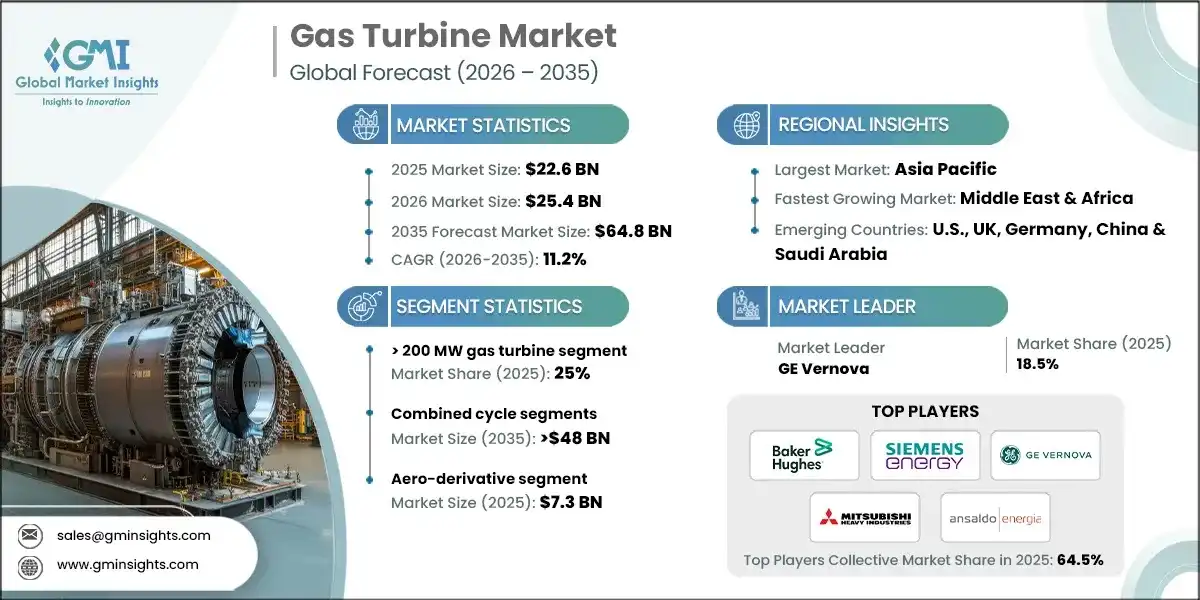
According to a recent study by Global Market Insights Inc., the gas turbine market was estimated at USD 22.6 billion in 2025. The market is expected to grow from USD 25.4 billion in 2026 to USD 64.8 billion by 2035, at a CAGR of 11.2%.
Gas Turbine Market Key Takeaways
Market Size & Growth
- 2025 Market Size: USD 22.6 Billion
- 2026 Market Size: USD 25.4 Billion
- 2035 Forecast Market Size: USD 64.8 Billion
- CAGR (2026–2035): 11.2%
Regional Dominance
- Largest Market: Asia Pacific
- Fastest Growing Region: Middle East & Africa
Key Market Drivers
- Surging focus toward clean power generation.
- Reducing dependency over conventional coal-fired power generation.
- Stringent government norms to limit carbon emissions.
Challenges
- Cost competitiveness.
Opportunity
- Hybrid energy integration.
- Advanced fuel adaptability.
- Digital performance optimization.
- Distributed power generation.
Key Players
- Market Leader: GE Vernova led with over 18.5% market share in 2025.
- Leading Players: Top 5 players in this market include Ansaldo Energia, Mitsubishi Heavy Industries, GE Vernova, Siemens Energy, Baker Hughes, which collectively held a market share of 64.5% in 2025.
Get Market Insights & Growth Opportunities
- Growing emphasis on low-emission technologies in tandem with stringent environmental regulations will accelerate the product adoption. Integration of advanced digital monitoring systems coupled with predictive maintenance capabilities will strengthen industry scenario. Moreover, increasing demand for combined cycle plants in association with rising energy efficiency targets will boost the business growth.
- Gas turbine technology encompasses a range of advanced engineering solutions and operational practices aimed at delivering efficient & reliable power generation. These systems perform essential roles such as optimizing combustion processes, managing thermal performance, ensuring operational flexibility, and supporting integration with diverse energy sources.
- Its application has evolved beyond conventional electricity production to become a critical element in supporting grid stability, integrating renewable sources, and reducing emissions. Modern turbines now focus on advanced combustion control, operational adaptability, and digital optimization, ensuring they remain indispensable in meeting diverse load requirements and sustainability objectives.
- For instance, in 2025, the Canadian government continued advancing its USD 350 million initiative to strengthen natural gas infrastructure, supporting rising energy demand driven by population growth and industrial expansion. The program is expected to catalyze approximately USD 4.5 billion in private sector investments, further reinforcing long-term energy security and infrastructure resilience.
- The gas turbine market was valued at USD 15.6 billion in 2022 and grew at a CAGR of approximately 5% through 2025. Continuous innovation in modular and simpler design coupled with enhanced operational flexibility will positively impact the industry landscape.
- The role of gas turbines is shifting in response to the growing penetration of renewable energy sources. They are increasingly being used as complementary assets to balance intermittent power from solar and wind. Their ability to start quickly and adjust output dynamically makes them ideal for grid stability in hybrid energy systems.
- Beyond large-scale power plants, gas turbines are finding increased use in industrial settings and distributed generation systems. Their compact design, high power-to-weight ratio, and ability to deliver continuous energy make them suitable for sectors including oil & gas, process plants and mining. This diversification of applications is expanding the footprint and creating opportunities for customized turbine solutions tailored to specific operational needs.
- For citation, in 2025, China continued to enforce and refine its administrative measures governing natural gas utilization, with a focus on balancing domestic production and imported supplies. These measures aim to strengthen supply security, improve market transparency and align natural gas usage with the country’s evolving long-term energy transition & security objectives.
To get key market trends
Gas Turbine Market Trends
- The energy sector is experiencing an unprecedented push toward emissions compliance, and gas turbines are at the center of this transformation. Governments and regulatory bodies are enforcing stricter standards on greenhouse gas emissions, nitrogen oxides, and particulate matter.
- Operators are deploying IoT-enabled sensors and AI-driven analytics to monitor emissions in real time and optimize combustion parameters dynamically. Predictive maintenance tools further enhance operational efficiency, ensuring turbines run within regulatory limits while reducing downtime.
- Utilities and industrial operators are allocating significant capital toward upgrading existing turbine fleets and adopting next-generation models that meet stringent environmental standards. While these investments increase upfront costs, they offer long-term benefits in terms of regulatory security, operational efficiency, and brand reputation.
- For instance, in April 2025, GE Vernova launched the AGP XPAND upgrade, an enhanced iteration of its AGP technology. The solution is designed to improve gas turbine performance by increasing output, boosting efficiency, and extending operational flexibility across a wide range of power generation applications.
- The growing emphasis on decentralized power generation coupled with rapid advancements in turbine design, components & engineering will accelerate product adoption. Modular configurations and the capability to operate independently of large grid networks enhance their appeal, particularly in regions requiring dependable and continuous energy supply.
- The growing commitment to decarbonization in line with the increasing need for dependable backup power solutions is driving the adoption of advanced gas turbine technologies. Rising demand for natural gas along with a stronger focus on cleaner and carbon-neutral energy alternatives will further drive industry expansion.
- Rapid industrialization across sectors including oil & gas, aviation and mining, is creating a significant surge in energy requirements. These industries operate high-load equipment and continuous production cycles, making reliable and efficient power generation critical.
- For instance, GE Vernova partnered with Oak Ridge National Laboratory to leverage machine learning and advanced simulation technologies. This collaboration aims to significantly reduce CO2 emissions and accelerate the adoption of low-carbon power generation. The initiative targets impactful outcomes, including an estimated reduction of up to 5 million tons of emissions, reinforcing GE Vernova’s commitment to sustainable energy innovation.
- These turbines are favored in various environments owing to their ability to deliver consistent output, high thermal efficiency, and adaptability to varying operational conditions. Their capability to support combined heat and power applications further enhances their appeal, allowing industries to optimize energy utilization and reduce operational costs.
- Collaborations between turbine manufacturers, energy companies, and technology providers are accelerating innovation in design and performance. These partnerships focus on integrating advanced materials, digital monitoring systems, and hybrid configurations that combine gas turbines with renewable sources.
- Operators are investing in retrofits that include advanced combustion systems, low-NOx technologies, and digital control upgrades. These initiatives extend equipment life, reduce fuel consumption, and ensure compliance with stringent emission regulations. Moreover, modernization programs also enable turbines to operate on alternative fuels, supporting the transition toward cleaner energy systems.
Gas Turbine Market Analysis

Learn more about the key segments shaping this market
- Based on capacity, the industry is segmented into ≤ 50 kW, > 50 kW to 500 kW, > 500 kW to 1 MW, > 1 MW to 30 MW, > 30 MW to 70 MW, > 70 MW to 200 MW and > 200 MW. The > 200 MW gas turbine market holds a share of around 25% in 2025, driven by increasing governmental initiatives to address rising energy requirements and advancing sustainability objectives.
- The ≤ 50 kW gas turbine market was valued at USD 1.4 billion in 2025, owing to the rising preference for decentralized power generation. These systems are deployed in industrial facilities, remote locations, and specialized setups including microgrids, where reliability, efficiency, and operational flexibility are critical.
- The > 50 kW to 500 kW gas turbine market will witness a CAGR of over 12% by 2035, due to the growing need for distributed energy solutions and the increasing emphasis on efficient, reliable power generation for mid-sized commercial and industrial operations.
- > 500 kW to 1 MW gas turbine market will witness an upsurge on account of the rising shift toward decentralized energy generation. The rising demand for dependable and efficient energy solutions is accelerating the transition toward power generation, reducing reliance on centralized grids through strategic investments in on-site power capabilities reshaping the industry landscape.
- The > 1 MW to 30 MW gas turbine market will reach USD 6 billion by 2035. The sector is projected to grow due to increasing demand for flexible and efficient power generation across industrial operations. These turbines are particularly attractive to oil and gas, chemical processing, and large-scale manufacturing facilities that rely on dependable energy supply.
- For citation, the Canadian government proposed draft regulations aimed at reducing oil and gas sector emissions by 35% by 2030, marking a significant step toward accelerating decarbonization in industries. Formal consultations on these proposed measures will continue through January 2025, reinforcing Canada’s commitment to sustainability and regulatory compliance.
- The ≤ 30 MW to 70 MW rated capacity gas turbine market will grow substantially, owing to superior efficiency enables rapid and cost-effective power generation, delivering optimized performance for demanding applications. Increasing incorporation of advanced analytics and digital technologies coupled with continuous improvements in airfoil design and coating materials to boost torque transmission will accelerate business penetration.
- Leading manufacturers are continuously innovating gas turbine engines, prioritizing operational reliability and ease of maintenance to strengthen the product portfolio. These 70 MW to 200 MW gas turbines play a pivotal role in power generation, particularly in cogeneration plants, industrial applications, and medium- to large-scale utilities.

Learn more about the key segments shaping this market
- Based on technology, the industry is divided into open cycle and combined cycle. The combined cycle gas turbine market holds a share of 77.9% in 2025 and is set to surpass USD 48 billion by 2035. Adoption of additive manufacturing technologies together with faster prototyping will enhance the business opportunities.
- Ongoing transition toward decarbonization coupled with the substitution of coal-fired power plants by cleaner alternatives has accelerated the adoption of combined cycle gas turbines. Their capability to integrate seamlessly into existing renewable energy frameworks will foster product penetration.
- For citation, in April 2025, Kuwait’s Ministry announced plans to expand the Sabiya power plant by adding 900 MW of gas turbine capacity. The proposed expansion is intended to enhance generation efficiency, meet rising electricity demand, and strengthen the country’s gas-based power infrastructure.
- The open cycle segment will witness a CAGR of over 10.5% by 2035. Heightened focus on grid security in line with the surging demand for distributed power generation across industrial facilities will propel the business growth. Furthermore, continuous advancements in turbine designs in association with efforts to enhance fuel efficiency and comply with stringent emission standards will augment the product landscape.
- The simplicity and portability of open cycle gas turbines make them well-suited for remote industrial sites, mining operations, and isolated communities. These areas often lack access to centralized grids, creating a need for autonomous power generation systems.
- Based on product, the market is segmented into aero-derivative and heavy duty gas turbine. The aero-derivative gas turbine market is estimated at USD 7.3 billion in 2025. The evolution of advanced grid infrastructure incorporating renewable integration and demand-response capabilities is set to strengthen the industry landscape.
- Its lightweight design and modular configuration make these turbines highly suitable for distributed power systems. Combined with rapid start-up capability and adaptability for on-demand operations in competitive markets, which in turn will escalate the product deployment.
- Heavy-duty gas turbines will gain an appreciable momentum on account of rising demand for high-capacity & reliable power generation in large-scale industrial operations and utility projects. Their ability to deliver superior efficiency, withstand extreme operating conditions, and integrate with advanced digital monitoring systems positions them as a preferred choice for sectors requiring continuous & high-output performance.
- For instance, in May 2025, Baker Hughes awarded a contract to deliver 16 NovaLT gas turbines by Frontier Infrastructure Holdings, for data center power projects in Wyoming and Texas, delivering up to 270 MW. The deal includes turbines, generators, and gear systems for behind-the-meter energy islands, building on their partnership focused on carbon capture and power solutions in the U.S.
Looking for region specific data?
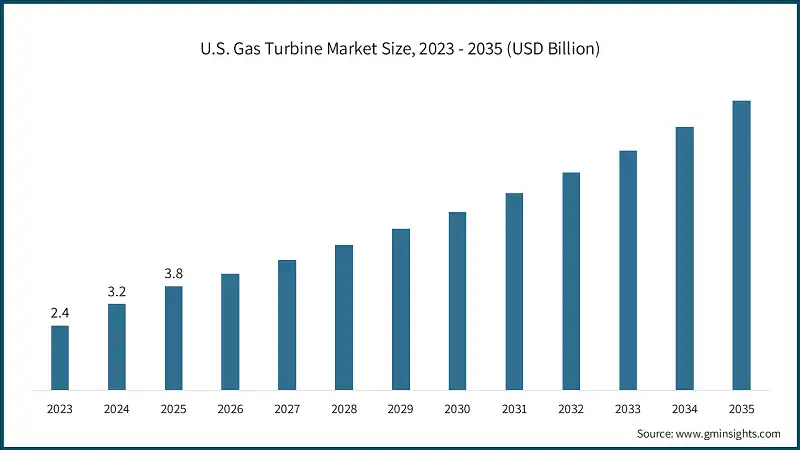
- The U.S. dominated the gas turbine market in North America with around 72% share in 2025 and generated USD 3.8 billion in revenue. Continuous R&D in carbon capture compatibility together with emission reduction will enhance the business scenario across the country.
- The recently enacted U.S. spending legislation is designed to accelerate investment in the nation’s technology sector, incorporating key provisions from the Infrastructure Investment and Jobs Act, Inflation Reduction Act (IRA), and CHIPS and Science Act. Collectively, these measures represent one of the most ambitious industrial policy frameworks since the post-Cold War era, aimed at strengthening domestic manufacturing, clean energy innovation, and technology development.
- The North America gas turbine market is projected to hit USD 12 billion by 2035. The transition toward advanced, efficient, and low-emission gas turbines, coupled with stringent environmental standards and a strong sustainability focus, is set to redefine the industry landscape.
- Rising industrial activity combined with continuous technological progress will further accelerate regional demand for gas turbines. Rising emphasis on decarbonization and energy transition is accelerating the adoption of advanced turbine technologies with improved efficiency and lower carbon footprints.
- For illustration, in October 2025, Siemens Energy will supply ten gas turbines and related equipment to Xcel Energy to support two new power plants in Texas and New Mexico, addressing rising electricity demand and the planned closure of the Tolk coal plant. The new facilities will provide 2,088 MW of dispatchable capacity. Five turbines will be installed at the Tolk site, while the remaining five will power a new peaker plant in Gaines County for high-demand periods.
- The Europe gas turbine industry is set to grow at a rate of over 9% by 2035. The regional gas turbine market is advancing rapidly, driven by strong commitments to carbon reduction and the transition toward cleaner energy sources. Decarbonization initiatives and stringent regulatory frameworks are accelerating the adoption of high-efficiency turbines, supporting efforts to phase out coal and reduce dependence on conventional fossil fuels.
- The Asia Pacific gas turbine holds a market share of 35% in 2025. The industry is set for strong growth, driven by rapid economic expansion and accelerating urbanization. Governments are channeling investments into energy infrastructure and promoting advanced technologies to address rising power demand and enhance system efficiency.
- For illustration, the Malinauskas Labor Government has partnered with ATCO Australia and GE Vernova to deliver a pioneering hydrogen-powered gas turbine solution for South Australia’s Whyalla hydrogen power plant. The project features four LM6000VELOX aeroderivative turbines capable of running on 100% renewable hydrogen, with commissioning expected in early 2026.
- Economic diversification and expanding industrial activity are driving demand for reliable, scalable power solutions across the Middle East & Africa region. Growing emphasis on energy efficiency and emissions reduction is accelerating the adoption of advanced turbine technologies featuring enhanced performance and cutting-edge emissions control systems.
- For citation, in March 2025, GE Vernova, closely with the Saudi Electricity Company, completed the gas turbine outage fully planned and executed by Saudi engineers at SEC’s 8th power plant in Riyadh. This milestone supports Saudi Vision 2030 by building local engineering expertise, enhancing operational independence, and reinforcing national capabilities in power plant maintenance and execution.
- The Latin America gas turbine market will grow substantially, propelled by surging investments in natural gas infrastructure in line with the development of power generation projects. Supportive government policies aimed at reducing dependence on imported fuels along with abundant natural gas reserves will energize the industry scenario.
Gas Turbine Market Report Attributes
| Key Takeaway | Details |
|---|---|
| Market Size & Growth | |
| Base Year | 2025 |
| Market Size in 2025 | USD 22.6 Billion |
| Market Size in 2026 | USD 25.4 Billion |
| Forecast Period 2026-2035 CAGR | 11.2% |
| Market Size in 2035 | USD 64.8 Billion |
| Key Market Trends | |
| Drivers | Impact |
| Surging focus toward clean power generation | Growing adoption of lower-emission energy sources is accelerating gas turbine deployment as a cleaner & flexible power solution. |
| Reducing dependency over conventional coal-fired power generation | The utilities are replacing aging coal plants with gas turbines to improve efficiency, reliability & environmental performance. |
| Stringent government norms to limit carbon emissions | Tightening emission regulations encourage power producers to shift toward gas turbines with lower carbon footprints. |
| Pitfalls & Challenges | Impact |
| Cost competitiveness | High capital costs, fuel price volatility & competition from renewables can limit gas turbine adoption in cost-sensitive power markets. |
| Opportunities: | Impact |
| Hybrid energy integration | The growing need for flexible power generation is creating opportunities for gas turbines that can seamlessly integrate with renewable energy sources, ensuring grid stability and supporting intermittent solar and wind output. |
| Advanced fuel adaptability | The shift toward low-carbon energy is driving innovation in gas turbines capable of operating on alternative fuels such as hydrogen, synthetic gas, and biofuels, enabling operators to meet sustainability targets without compromising performance. |
| Digital performance optimization | The adoption of AI-driven analytics and IoT-enabled monitoring systems is transforming gas turbine operations, allowing predictive maintenance, real-time efficiency tuning, and reduced downtime for critical energy infrastructure. |
| Distributed power generation | Increasing demand for localized and reliable energy supply is accelerating the deployment of compact gas turbines in distributed generation setups, supporting industrial clusters and remote facilities with high-efficiency solutions. |
| Market Leaders (2025) | |
| Market Leaders |
18.5% market share |
| Top Players |
|
| Competitive Edge |
|
| Regional Insights | |
| Largest Market | Asia Pacific |
| Fastest Growing Market | Middle East & Africa |
| Emerging Country | U.S., UK, Germany, China & Saudi Arabia |
| Future outlook |
|
What are the growth opportunities in this market?
Gas Turbine Market Share
- The top 5 players in gas turbine industry are Baker Hughes, Siemens Energy, GE Vernova, Mitsubishi Heavy Industries and Ansaldo Energia contribute around 64.5% of the market share in 2025.
- The industry is highly dynamic and technology-driven, shaped by the growing need for efficient, low-emission power generation and compliance with stringent environmental standards. It is a competitive market where leading players focus on advanced turbine designs, digital monitoring solutions and fuel-flexible systems to enhance performance & reliability.
- Baker Hughes delivers integrated gas turbine solutions focused on efficiency, fuel flexibility, and emissions reduction. Their portfolio includes advanced turbine designs optimized for industrial and power generation applications, supported by digital monitoring platforms for predictive maintenance.
- Siemens Energy provides cutting-edge gas turbine technologies designed for high efficiency and low emissions. Their offerings include turbines compatible with hydrogen and other sustainable fuels, alongside digital solutions for real-time performance optimization. The company prioritizes innovation in aerodynamics, materials, and smart controls, enabling customers to achieve decarbonization targets while maintaining grid reliability.
- GE Vernova specializes in advanced gas turbine systems that integrate seamlessly with renewable energy and hybrid configurations. Their turbines feature high-efficiency combustion technology, digital twins, and IoT-enabled platforms for predictive analytics. It focuses on enabling flexible, reliable power generation for utilities and industrial clients, supporting global energy transition initiatives.
- Mitsubishi Heavy Industries offers a comprehensive range of heavy-duty and aero-derivative gas turbines engineered for superior performance and operational flexibility. Their solutions incorporate advanced cooling systems, low-NOx combustion, and hydrogen-ready designs. MHI emphasizes lifecycle services and modernization programs, helping operators enhance efficiency and reduce emissions across large-scale power projects.
- Ansaldo Energia delivers gas turbine solutions tailored for distributed generation and hybrid energy systems. Their focus includes modular designs, rapid start-up capability, and integration with renewable sources. The company combines mechanical expertise with smart technologies, offering IoT-enabled monitoring and management platforms to optimize performance & support sustainability goals.
Gas Turbine Market Companies
- Siemens Energy reported revenues of USD 69.2 billion for fiscal year 2025, supported by its extensive global operations in the energy sector. The company reported solid profitability, supported by strong cost discipline and effective operational execution. The performance highlights its ability to sustain stable results and remain resilient while navigating changing market conditions.
- GE Vernova reported revenues of USD 27.1 billion for the first nine months of 2025. During this period, the power segment contributed USD 14 billion, the Wind segment generated USD 6.7 billion, and the electrification segment delivered USD 6.8 billion. This distribution underscores the scale and diversification of its operations across core business units.
- Mitsubishi Heavy Industries reported revenues of USD 13.6 billion for the first half of 2025, alongside a net profit of USD 750 million, reflecting solid financial performance during the period. These figures highlight the company’s operational scale and profitability within the reporting timeframe.
Major players operating in the gas turbine market are:
- Ansaldo Energia
- Baker Hughes
- Bharat Heavy Electricals Limited
- Capstone Green Energy
- Destinus Energy
- Doosan Enerbility
- FlexEnergy Solutions
- GE Vernova
- Harbin Electric Corporation
- IHI Corporation
- Kawasaki Heavy Industries
- MAN Energy Solutions
- Mitsubishi Heavy Industries
- Nanjing Steam Turbine Motor (Group)
- Rolls-Royce
- Shanghai Electric
- Siemens Energy
- Solar Turbines
- Vericor
- Wärtsilä
Gas Turbine Industry News
- In October 2025, Ansaldo Energia completed a major upgrade at Alpiq’s San Severo combined-cycle power plant in Foggia, Italy, aimed at enhancing performance and supporting national decarbonization efforts. The project delivered a power increase of 43 MW, an efficiency improvement of 0.9%, and a reduction of over 10,000 tons of CO2 emissions annually. The upgrade involved the gas turbine, steam turbine, and generator, while also improving operational flexibility. The plant is now capable of operating with up to 25% hydrogen, marking an essential step toward ensuring the stability and adaptability of Italy’s energy infrastructure.
- In October 2025, GE Vernova has secured an order from QPM Energy Limited, an independent Australian energy & gas producer company, for two LM6000 gas turbine packages. The turbines will be deployed at QPM’s Isaac Power Station, located in Queensland, and are expected to generate up to 112 MW of electricity. The LM6000 turbines are designed for fuel flexibility, allowing the plant to operate using QPM’s existing natural gas reserves or coal mine waste gas containing at least 50% methane.
- In September 2025, Doosan Enerbility entered into a memorandum of understanding with GS Banwol Combined Heat and Power to advance the Collective Energy Fuel Conversion and Modernization Project. The partnership focuses on assessing the conversion of the aging CHP facility at Ansan Smart Hub into a high-efficiency, natural gas-fired plant. Under the agreement, this CHP will ensure reliable heat and power supply to the national grid and nearby industrial complex, while it will provide key components, including domestically produced gas turbines, and jointly support the engineering, procurement, and construction (EPC) activities.
- In May 2025, Baker Hughes launched its latest innovation in gas turbine safety Flame Tracker Increased Low Gain (ILG). This advanced flame detection technology is designed to significantly improve flame sensing capabilities in gas turbines, enhancing operational safety and reliability. Flame sensors are critical components in gas turbines, responsible for detecting the presence of a flame in the combustor section. They serve as early warning systems, triggering shutdown sequences if a flame is lost or becomes unstable, a vital safeguard against potential turbine damage and hazardous events such as explosions caused by unburned fuel buildup.
The gas turbine market research report includes in-depth coverage of the industry with estimates & forecast in terms of revenue (USD Million) & volume (MW) from 2022 to 2035, for the following segments:
Market, By Capacity
- ≤ 50 kW
- > 50 kW to 500 kW
- > 500 kW to 1 MW
- > 1 MW to 30 MW
- > 30 MW to 70 MW
- > 70 MW to 200 MW
- > 200 MW
Market, By Product
- Aero-derivative
- Heavy duty
Market, By Technology
- Open cycle
- Combined cycle
Market, By Application
- Power plants
- Oil & gas
- Process plants
- Aviation
- Marine
- Others
The above information has been provided for the following regions and countries:
- North America
- U.S.
- Canada
- Mexico
- Europe
- UK
- France
- Germany
- Russia
- Italy
- Netherlands
- Finland
- Greece
- Denmark
- Romania
- Poland
- Sweden
- Asia Pacific
- China
- Australia
- Japan
- India
- South Korea
- Indonesia
- Thailand
- Malaysia
- Bangladesh
- Middle East & Africa
- Saudi Arabia
- UAE
- Qatar
- Kuwait
- Oman
- Egypt
- Turkey
- Bahrain
- Iraq
- Jordan
- Lebanon
- South Africa
- Nigeria
- Algeria
- Kenya
- Ghana
- Latin America
- Brazil
- Argentina
- Peru
- Chile
Frequently Asked Question(FAQ) :
What is the market size of the gas turbine in 2025?
The market size was USD 22.6 billion in 2025, with a CAGR of 11.2% expected through 2035 driven by rising demand for low-emission technologies and stringent environmental regulations.
What is the projected value of the gas turbine market by 2035?
The gas turbine market is expected to reach USD 64.8 billion by 2035, propelled by decarbonization initiatives, digital optimization, and integration with renewable energy sources.
What is the current gas turbine market size in 2026?
The market size is projected to reach USD 25.4 billion in 2026.
How much revenue did the combined cycle technology segment generate in 2025?
Combined cycle technology held 77.9% market share and is set to surpass USD 48 billion by 2035, owing to superior efficiency and seamless renewable energy integration.
What was the valuation of aero-derivative gas turbine segment in 2025?
Aero-derivative gas turbines were estimated at USD 7.3 billion in 2025, supported by lightweight design and rapid start-up capabilities.
What is the growth outlook for the >50 kW to 500 kW capacity segment from 2026 to 2035?
The >50 kW to 500 kW segment is projected to grow at over 12% CAGR by 2035, due to rising need for distributed energy solutions and efficient power generation for mid-sized operations.
Which region leads the gas turbine market?
Asia Pacific held 35% share in 2025. Rapid economic expansion, urbanization, and government investments in energy infrastructure fuel the region's dominance.
What are the upcoming trends in the gas turbine market?
Key trends include adoption of hydrogen-compatible turbines, AI-driven predictive maintenance, IoT-enabled monitoring systems, and increasing focus on hybrid energy integration for grid stability.
Who are the key players in the gas turbine market?
Key players include Baker Hughes, Siemens Energy, GE Vernova, Mitsubishi Heavy Industries, Ansaldo Energia, Bharat Heavy Electricals Limited, Capstone Green Energy, Destinus Energy, Doosan Enerbility, FlexEnergy Solutions, Harbin Electric Corporation, IHI Corporation, Kawasaki Heavy Industries, MAN Energy Solutions, Nanjing Steam Turbine Motor (Group), Rolls-Royce, Shanghai Electric, Solar Turbines, Vericor, and Wärtsilä.
Gas Turbine Market Scope
Related Reports