Summary
Table of Content

Gallium Nitride (GaN) EV Charger Market
Get a free sample of this report
Form submitted successfully!
Error submitting form. Please try again.
Thank you!
Your inquiry has been received. Our team will reach out to you with the required details via email. To ensure that you don't miss their response, kindly remember to check your spam folder as well!
Request Sectional Data
Thank you!
Your inquiry has been received. Our team will reach out to you with the required details via email. To ensure that you don't miss their response, kindly remember to check your spam folder as well!
Form submitted successfully!
Error submitting form. Please try again.
Gallium Nitride EV Charger Market Size
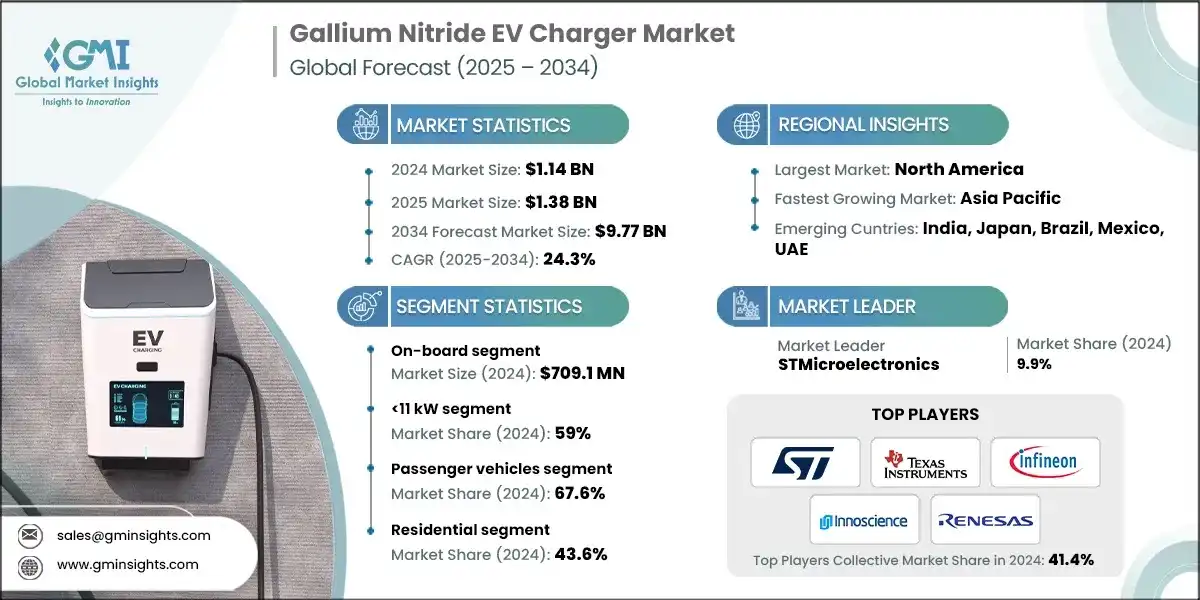
The global gallium nitride (GaN) EV charger market size was estimated at USD 1.14 billion in 2024. The market is expected to grow from USD 1.38 billion in 2025 to USD 9.77 billion in 2034, at a CAGR of 24.3% according to latest report published by Global Market Insights Inc.
Gallium Nitride (GaN) EV Charger Market Key Takeaways
Market Size & Growth
- 2024 Market Size: USD 1.14 Billion
- 2025 Market Size: USD 1.38 Billion
- 2034 Forecast Market Size: USD 9.77 Billion
- CAGR (2025–2034): 24.3%
Key Market Drivers
- Rising EV Adoption.
- Energy Efficiency and Sustainability.
- Electrification of Fleets.
- Government Policies and Incentives.
- Technological Advancements in GaN.
Challenges
- High Initial Cost.
- Integration Challenges.
Opportunity
- Integration with Renewable Energy.
- High-Power Industrial Fleet Charging.
- Expansion of Public Charging Networks.
- Smart Charging and Grid Management.
Key Players
- Market Leader: STMicroelectronics led with over 9.9% market share in 2024.
- Leading Players: Top 5 players in this market include STMicroelectronics, Texas Instruments, Infineon Technologies, Innoscience Technology, Renesas Electronics, which collectively held a market share of 41.4% in 2024.
Get Market Insights & Growth Opportunities
The expansion in sales of electric vehicles, driven by environmental reasons, stricter emission rules, and more vehicle options available, requires significant charging infrastructure. GaN chargers (Gallium Nitride), that can provide higher efficiency with small form factors, are key in meeting residential, commercial, public, and industrial charging usage rates quickly and reasonably.
With electricity prices increasing and sustainability insisting on new load consumption decisions, there is a higher demand for energy efficient chargers. GaN chargers (Gallium Nitride) have greater energy efficiencies compared to silicon-based chargers, they can also lower power losses, waste heat, while compact, which would enable their use in homes, businesses, and industrial markets which are looking for sustainable and/or affordable charging options.
Logistics, delivery, and industrial truck capacity is quickly changing to electric vehicles for lower emissions and operational costs. GaN chargers charge quickly are high power as well. Fleet operators can use many GaN chargers it does not matter how many vehicles are charged in the operational hours, in other words, it is not too many vehicles charging while operational. Fleet operators can also charge a larger load in a more demanding facility minimizing electric demand facilities that would limit energy and space with silicon-based chargers.
In October of 2025, Infineon Technologies successfully introduced the CoolGaN Automotive Transistor 100 V family, which is fully AEC-Q101 automotive-qualified, for use in electric vehicle on-board chargers and DC/DC converters. This ushered in improved efficiency, reduced size, and faster charging of automotive applications. This also demonstrated the continued rise and acceptance of GaN technology in industrial and high-power applications, particularly related to EV charging infrastructure for fleets and public charging around the world.
To get key market trends
Gallium Nitride EV Charger Market Trends
DC fast-charging stations are being rapidly deployed along highways and urban corridors in North America. GaN technology enables higher power density and faster charging times, which are important for EV adoption, reducing range anxiety, and catering to commercial fleets, especially for logistics, ride-sharing, and long-distance travel across the U.S. and Canada.
Solar, wind, and energy storage systems are increasingly integrated with chargers. GaN-based EV chargers allow for efficient bi-directional power flow enabling smart grid participation, load management, and reductions in the cost of electricity for residential, commercial, and industrial users while promoting sustainability and supporting government initiatives on clean energy.
Fleet operators are quickly moving to electrify delivery trucks, buses and service vehicles throughout North America. High-power GaN chargers enable fast and highly efficient charging during operational hours, maintaining unimpeded fleet operations while decreasing emissions and energy costs particularly in regions with great industrial and logistic activity.
Europe is focused on aligning charging standards, protocols and payment systems harmoniously. Deployment of interoperable networks is supported by the installation of Gallium Nitride chargers that allow quick, efficient and reliable charging of EVs across borders. The trend thus facilitates cross-boundary EV travel, public adoption, and integration with renewable energy and smart grid systems.
The governments of the Asia-Pacific region- especially China, Japan, and South Korea-are aggressively expanding public fast-charging networks. GaN-based chargers can offer compact, high-power installations that help to cure range anxiety, support growing fleets of EVs, and facilitate integration with renewable energy sources and smart grid management.
Gallium Nitride EV Charger Market Analysis
Learn more about the key segments shaping this market
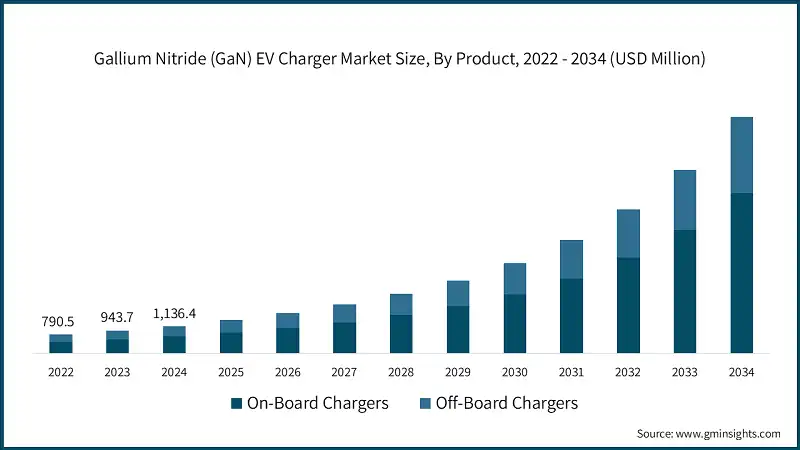
Based on product, the gallium nitride EV charger market is bifurcated as on-board chargers and off-board chargers. On-board segment represents 62% of market share with USD 709.1 million revenue in 2024.
- Onboard chargers convert AC from residential or workplace Level 2 chargers into DC for the EV batteries, which is typically the primary interface for most charging events. GaN technology has greatly improved efficiency, reduced size and weight, and enabled better thermal performance, enabling higher power ratings and growing onboard charger adoption across all electric vehicles.
- GaN-based onboard chargers create vehicle packaging space for batteries, passengers, or cargo, which helps to differentiate products. Increased efficiency minimizes wasted energy during charging, allowing for extended range. Higher onboard power ratings of 11 - 22 kW and higher allow for efficiency, design, and thermal performances.
- DC fast chargers and other off-board chargers deliver power to the battery in DC form, avoiding the onboard charger thus providing for faster charge times. GaN technology allows for high-power applications with superior efficiency and thermal performances reducing heat and energy loss for public charging and industrial charging infrastructure.
- The efficiency gains from GaN also benefit high-power DC fast chargers with powers between 50 to 350 kW, reducing cooling requirements and energy losses. Ultra-fast chargers above 150 kW are rapidly growing, thus making GaN technology unavoidable in achieving sustainable high-performance charging networks in public, commercial, and industrial environments.
Learn more about the key segments shaping this market
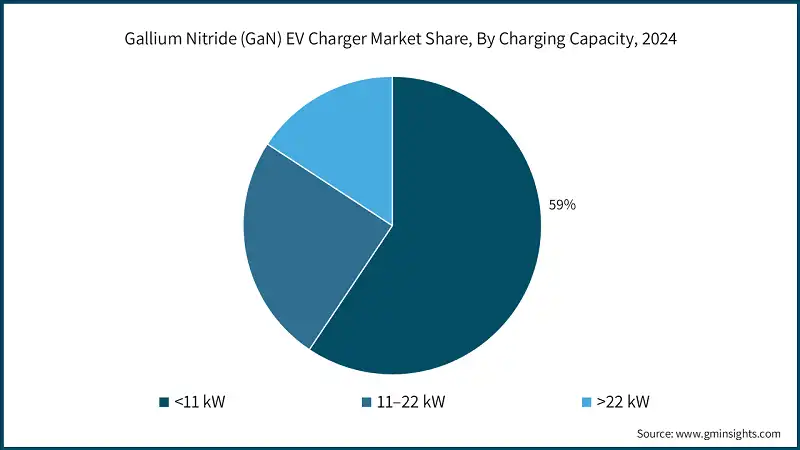
Based on charging capacity, the gallium nitride EV charger market is fragmented as <11 kW, 11–22 kW and >22 kW. <11 kW dominates the market with 59% share in 2024 and is projected to grow at a CAGR of 24.8% from 2025 to 2034.
- Connecting residential and commercial needs, this range can be used for higher capacity houses, workplaces or destination chargers, using GaN technology to create compact and wall-mounted units that are well-suited for tight spaces, but provide performance characteristics that would typically be associated with larger installations. The adoption and efficiency of this type of charging is simplified even further in a commercial environment, where three-phase electricity is available.
- In a segment that is dominated by DC fast chargers, this is a more general segment that offers installations ranging from 50-350 kW, (DC fast chargers) and ultra-fast chargers (150 kW+) segment is evolving at a very fast pace in order to keep up with the higher battery capacity and faster charging speed acceptance of today's EV's. The high efficiency and thermal characteristics of GaN technology will allow for high-power, high-density installations in both public networks and industrial networks.
- High-capacity chargers will be an essential component of the commercial EV fleet, fleet types that incorporate delivery vehicles and buses, will need 150 - 350 kW charging installations in order to minimize downtime associated with short time layovers. Fast charging with GaN technology will assist in a more rapid replenishment of energy, ultimately leading to a better utilization of an asset's potential, while also making electrification of fleets an economically feasible activity for fleet operators who want reliable and high-quality charging infrastructure.
Based on vehicle, the gallium nitride EV charger market is classified into passenger vehicles and commercial vehicles. Passenger vehicles represent the largest charging location segment with 67.6% market share in 2024 and is projected to grow at a CAGR of 25% from 2025 to 2034.
- Passenger EVs take up a larger portion of the vehicle sales and fleet size and share the same need for charging options as everyone else. Most of the time, charging is done at home, with 80% somewhere at a home charging location. GaN technology is enhancing the performance (efficiency, size and thermal) of onboard and Level 2 charging, while supporting urban and long-distance charging for the new population of EV drivers.
- Urban-dwelling residents who park on-street and do not have assigned parking contribute to the need for public Level 2 chargers. GaN-enhanced chargers provide compact and high-performance charging infrastructure for commercial, municipal and multi-unit residential sites, while extending the adoption of charging infrastructure and addressing the challenge caused by the inability to provide conventional home charging access.
- Commercially available electric vehicles (EVs), such as delivery vans, buses, and electric trucks require higher power charging in a predictable schedule. Fleet operators emphasize minimizing downtime and maximizing utilization. With GaN chargers, higher power (150-350 kw) charging is compact and fast, enabling efficient depot and fleet charging. Charging docks will increase operational efficiency and decrease total cost of ownership.
Based on application, the gallium nitride (GaN) EV charger market is segmented into residential, commercial, public and industrial. Residential represents the largest segment with 43.6% market share and USD 495.5 million revenue in 2024.
- Residential charging primarily supports passenger EV needs, with approximately 80% of charging occurring at home or work. Level 2 AC chargers are available with charging capabilities between 6.6–11 kW (around 20 miles of charge hourly) and can charge EVs overnight. GaN technology introduces improvements in efficiency and electric costs for charging, while also reducing overall footprint of charging infrastructure devices. Homeowners/occupants of apartments can install a GaN technology-based charger in either a garage or carport while facilitating residential growth over time.
- Commercial charging solutions include workplace or fleet depot charging solutions where multiple EVs can charge simultaneously and support a heavier charging need. GaN technology-based infrastructure can support new functionality such as load management or demand response and can help manage efficiency of charging assets while ensuring reliability and which may positively impact operational costs - no matter the commercial or fleet application.
- Public charging solutions are designed to support drivers needing to charge who may not have beneficial home-charging scenarios, along with support travel needs for distance driving with Level 2 AC and/or DC fast charging. GaN-based technology can provide high-power charging at a more efficient rate and look for better thermal performance. Initiatives to deploy charging infrastructure are arising from government programs, private investors into infrastructure, and charging network operators are deploying widespread support options to support open-ended EV accessibility which can facilitate strong outcomes for mass EV adoptions.
Looking for region specific data?
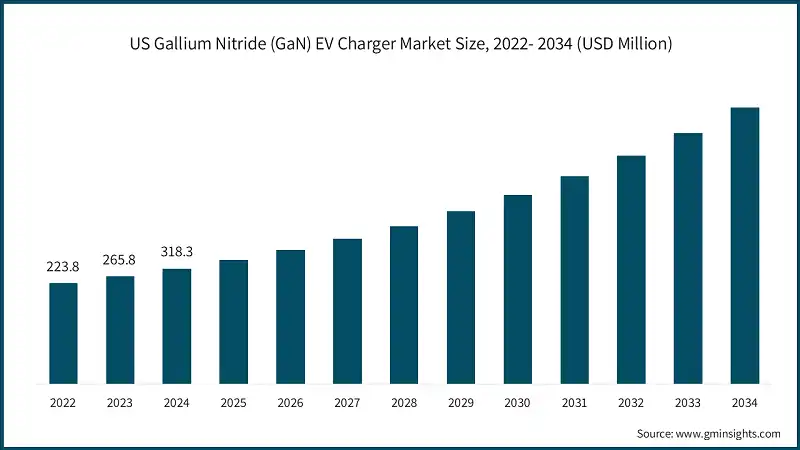
The gallium nitride EV charger market in US dominates regional revenue with approximately 87% share in 2024. The market in US held a revenue of USD 318.3 million in 2024 and is expected to experience significant and promising growth from 2025 to 2034.
- The National Electric Vehicle Infrastructure (NEVI) program is helping to deploy DC fast chargers nationwide on interstate corridors. Gallium nitride technology allows for compact, energy-efficient, and high-power charging stations that satisfy the program parameters, while reducing heat loss and enabling charging of both passenger and commercial electric vehicles, thus accelerating the adoption of electric vehicles both in urban and rural locations.
- The increased population of apartment and condominium dwellers that do not have access to private garages is causing demand for smaller, apartment-appropriate Level II GaN chargers. These efficient wall-mounted chargers can be installed safely in shared parking areas and accommodate daily charging needs for passenger vehicles, overcoming physical space challenges, and helping to further facilitate convenient electric vehicle adoption in urban areas.
- Electric powertrains are being utilized by school buses, delivery vans, and municipal vehicles, which are important segments of the EV market. GaN-based fast chargers are able to deliver fast charging capability during short layovers and shift change which improves fleet availability, reduces operational costs and improves total cost of ownership, while also overcoming energy efficiency and thermal management issues in depot environments.
- Utilities and private operators are deploying GaN chargers with additional advanced load management capabilities, demand response, and time-of-use rate optimization. This will support dynamic allocation of energy supply, peak load reduction, participation in programs with the grid, and improved operational efficiency for commercial facilities while meeting sustainability targets for energy consumption.
North America accounts for 32% of the gallium nitride EV charger market share in 2024 and is expected to reach USD 2.9 million by 2034.
- High-power chargers using Gallium Nitride (GaN) are being rolled out at increasing rates along highways and urban corridors to alleviate range anxiety and support extensive travel. GaN chargers consume less energy, install faster, and have a smaller footprint than other alternatives, allowing for rapid deployment and charging for both public and commercial electric vehicle (EV) uses, including those in the United States and Canada.
- Charger prices are declining while also being combined with solar module/panel systems and energy storage systems to enhance the energy use at charging locations. The efficiencies afforded by GaN based systems will further improve energy use, as it permits bidirectional power flows, demand response activities, and smart grid types of participation. These prolong the electrical grid's performance and life, while being more economical, sustainable, and provide great incentives for both residential, commercial and industrial use.
- Logistics, delivery, and municipal fleeks continue to switch to EV, at a pace never seen before. High power GaN chargers will minimize downtime during working hours on the operation sites, and to improve energy use, charging could conduct at the storage location gate, and on the route back to their depot. Fleet electrification will maintain operations as well as enhance thermal and density benefits of GaN charged commercial fleets.
In 2024, the gallium nitride (GaN) EV charger market in Europe held 23% market share and is expected to grow at 24.7% CAGR from 2025 to 2034. The region is expected to reach USD 2.3 billion by 2034.
- Regulators in Europe are also pushing toward interoperability across borders and across manufacturers. GaN-based chargers support open and standardized communication and power protocols, enabling cross-border EV travel, creating better user experience, and ensuring efficient operation for both public and commercial charging infrastructures across urban, highway, and fleet applications.
- Low-emission zones are being imposed by European cities to keep down urban pollution. Commercial fleets and delivery vehicles are increasingly installing high-power GaN chargers to keep regulations at bay and ensure zero-emission operation while minimizing downtime, improving fleet utilization, and enabling scalable charging infrastructure for urban logistics.
- Solar, wind, and energy storage are increasingly integrated into European public and commercial charging stations. The capability of GaN chargers for high-efficiency energy conversion reduces electricity costs, supports sustainability targets, and enables chargers to participate in grid demand-response programs while maintaining rapid, reliable vehicle charging.
Germany leads European growth, accounting for approximately 34% of regional revenue in 2024. German suppliers maintain strong global gallium nitride EV charger market positions through comprehensive system integration capabilities and regulatory compliance expertise.
- Federal and state programs in Germany fund the subsidy of EV adoption and charging infrastructures. Because of this, the installation of GaN-based chargers becomes highly efficient in compact form for residential, commercial, and public use, thereby accelerating the uptake of EVs and reducing carbon emissions in urban and industrial settings.
- Logistics and delivery fleets in Germany are rapidly adopting electric vans and buses. GaN chargers support high-power depot and on-route charging, reducing downtime and improving operational efficiency while maintaining compact form factors suitable for space-constrained urban depots and high-utilization applications.
- The low-emission zones in German cities are acting as a catalyst for zero-emission vehicles and high-efficiency GaN chargers. These chargers enable fast, reliable commercial and passenger EV charging while optimizing energy consumption and supporting compliance with local environmental regulations.
- Germany is expanding solar and wind energy deployment. GaN chargers with on-site renewable generation and energy storage enable smart grid participation, electricity cost reductions, and high efficiency charging for residential, commercial, and public applications, respectively. This is supportive of sustainability and green mobility objectives.
Asia Pacific represents 38% share of the gallium nitride EV charger market and held USD 430.3 million revenue in 2024. The region is expected to grow at 25% CAGR between 2025 and 2034.
- China leads the way in EV uptake and infrastructure development. Gao chargers are in wide circulation for residential, public, and commercial applications supported by government incentives, domestic semiconductor development in conjunction with high EV penetration creating the fastest presently developing regional market found in the Asia-Pacific.
- The rapid expansion of DC fast chargers in urban, suburban, and highway networks is now addressing range anxiety and supporting fleet operations. GaN technology allows for high-power, compact, and energy-efficient stations that can deliver ultra-fast charging for passenger and commercial EVs.
- Japan, South Korea, India, and the ASEAN region are seeing increasing levels of EV deployment. GaN chargers are being adopted by these markets, allowing for residential, commercial, and public charging opportunities with space and infrastructure challenges.
- GaN chargers can be integrated with energy storage and renewables to facilitate electricity use optimization, reduce peak loads, whilst supporting customer participation in demand-response programs, thus supporting efficiency and sustainability across urban, industrial, and commercial applications in the region.
The GaN EV charger market in China is estimated to hold market revenue of USD 186.3 million in 2024 and is expected to experience significant and promising growth from 2025 to 2034.
- Government support through subsidies, non-monetary incentives such as priority lane access or preferential public parking for electric vehicles (EVs), and proactive infrastructure investments can promote EV adoption. Moreover, GaN-based charging infrastructure can take advantage of favorable government policy to advance rapid deployment for residential, public, and commercial property use, along with improved efficiency and size.
- Chinese firms such as Innoscience Technology are advancing GaN and its related technologies for the development of high-power, energy-efficient charging equipment. Having domestically developed capabilities for GaN technology assures some degree of security for the domestic supply chain while also enabling national efforts towards infrastructure built out for passenger and commercial electric vehicles (EVs).
- National efforts in China are being dedicated to developing public and residential charging networks necessary for ultra-fast DC charging to support passenger vehicle environmental performance improvements. GaN technology will provide smaller, more thermally capable, high-density charging solutions that will realize the pressures of evolving installed vehicle battery capacities and commercial fleet operational needs.
- Many major metropolitan areas are expanding access to residential or public charging networks, while new charge deployment strategies are being used in places like India, Southeast Asia and the Asia-Pacific region where new GaN charging solutions are pressing to be deployed to meet a growing demand for EV use and sustainability.
Latin America held 4% of the gallium nitride EV charger market share and USD 46.5 million revenue in 2024. Logistics and delivery companies are piloting EV fleets. GaN chargers allow high-efficiency, rapid charging for commercial vehicles, improving asset utilization and reducing total cost of ownership.
- EV uptake is gradually improving, owing to urban pollution concerns and incentives unveiled by the governments. GaN chargers provide energy-efficient, compact solutions suitable for residential, commercial, and public infrastructure, thus allowing gradual adoption in passenger and commercial vehicles.
- Investment in public DC fast chargers has been on the rise to facilitate long-distance travel and urban mobility. GaN technology ensures high-power, reliability, and space-efficient installations in cities and highways with limited electrical infrastructure.
- Solar and microgrid projects are mushrooming in Latin America. GaN-based chargers will enable better smart grid integration, further reduce electricity costs and enhance energy sustainability for residential, commercial, and public EV charging applications.
The MEA gallium nitride (GaN) EV charger market is projected to grow at a CAGR of 22.8% from 2025 to 2034 and held a market share of around 3% in 2024.
- The rise of urbanization and sustainability goals creates increasing interest in the availability of public and commercial charging for EVs. GaN chargers deliver highly efficient, compact, and very high-power solutions that support the movement of individual travelers and fleet vehicles to electrification.
- Ultra-fast DC chargers in urban areas and along transport corridors are being deployed to tackle the issue of range anxiety. GaN technology has the potential to facilitate an energy-efficient and reliable means of providing high-power installations for commercial and public EV chargers.
- Countries across the globe are leveraging incentives and programs to facilitate EV adoption and EV infrastructure. GaN chargers will use logical technology to capitalize on these initiatives for residential and commercial deployment at the regional level.
- In addition, solar and wind energy projects are being developed as complementary projects to EV infrastructure. Adding GaN-enabled smart charging and energy management capabilities will drive optimized electricity use with reduced peak loads and enable the public's sustainable adoption of EVs at residential, commercial, and public levels.
Gallium Nitride EV Charger Market Share
- The top 7 companies in the gallium nitride (GaN) EV charger industry are STMicroelectronics, Texas Instruments, Infineon Technologies, Renesas Electronics, Innoscience Technology, Navitas Semiconductor, Power Integrations contributing around 49.5% of the market in 2024.
- STMicroelectronics leads the industry with a wide product portfolio, a global manufacturing footprint, and close links with its automotive customers. Its devices support on-board and off-board charging for 650 to 1,200-volt applications-putting up reliable and efficient solutions. Strong technical expertise, quality assurance, and supply chain strength make the company a preferred supplier for both OEMs and infrastructure providers.
- Texas Instruments maintains a leading market share in GaN for automotive and industrial uses. Its integrated devices combine power, gate drivers, and protection circuitry. Extensive distribution networks and applications engineering support enable rapid adoption across diverse charging applications and regions, reinforcing TI's role as a key supplier in the global EV charging ecosystem.
- Infineon Technologies, with the CoolGaN portfolio, focuses on automotive and power electronics leadership. Devices are optimized in terms of efficiency, reliability, and usability for EV charging. With investments in the development and manufacturing capacity of GaN technology, and providing comprehensive reference designs, Infineon will drive automotive electrification and charging infrastructure applications strategically.
- Renesas Electronics leverages expertise in automotive microcontrollers and power management to offer integrated GaN solutions, combining power devices with control and communication functionality. The acquisition of Dialog Semiconductor strengthens its portfolio by addressing smart charging applications and expanding market reach across automotive and industrial EV charging infrastructure.
- Innoscience Technology is a Chinese vertically integrated GaN specialist that provides cost-competitive GaN solutions for EV charging. With full-scale manufacturing and major focus on the domestic market, it challenges established global players. Its growth reflects the strategic emphasis by China on advanced semiconductors and the expanding deployment of EV charging infrastructure.
Gallium Nitride EV Charger Market Companies
Major players operating in the gallium nitride (GaN) EV charger industry are:
- Chanan
- Infineon Technologies
- Innoscience Technology
- Navitas Semiconductor
- Power Integrations
- Renesas Electronics
- ROHM Semiconductor
- STMicroelectronics
- Texas Instruments
- VisIC Technologies
- STMicroelectronics provides an all-encompassing GaN solution through its MasterGaN platform to support onboard and off-board electric-vehicle (EV) chargers. With 650V–1,200V devices and extensive automotive qualifications, it has a full supply chain across Europe, Asia, and North America. It gives vehicle manufacturers and providers of charging equipment the advantage of supply chain resilience, a simpler path to design, and accelerated adoption.
- Texas Instruments capitalizes on its power management expertise and broad distribution network to deliver GaN solutions for EV chargers. The company emphasizes ease of integration, protection features, and a simplified gate drive in its portfolio. The company is confident that both the reference designs and LMG3526 GaN power stage simplify historical barriers associated with design complexity with onboard and off-board applications, ultimately leading to accelerated adoption.
- Infineon’s CoolGaN portfolio highlights high-efficiency, reliable, and thermally optimized devices for EV charging. With investments for dedicated GaN manufacturing and assurance on the automotive quality, with Munich and Villach a stone’s throw away, Infineon is establishing itself as a trusted brand in this space. They should be a leader in high adaptable onboard and off-board chargers, especially with applications that would benefit from reliability, their technology is very appealing to the safety-critical application and automotive space.
- Innoscience Technology is a Chinese GaN specialist that has vertically integrated manufacturing and competitive pricing. Operating an 8-inch GaN-on-silicon wafer facility, it makes the 650V–1,200V devices an onboard charger and/or off-board charger. Innoscience Technology benefits from China's semiconductor strategy and growing domestic infrastructure for EVs to enable scalable and cost-effective adoption of GaN around the world.
Gallium Nitride (GaN) EV Charger Market Report Attributes
| Key Takeaway | Details |
|---|---|
| Market Size & Growth | |
| Base Year | 2024 |
| Market Size in 2024 | USD 1.14 Billion |
| Market Size in 2025 | USD 1.38 Billion |
| Forecast Period 2025 - 2034 CAGR | 24.3% |
| Market Size in 2034 | USD 9.77 Billion |
| Key Market Trends | |
| Drivers | Impact |
| Rising EV Adoption | Growing global EV sales increase demand for charging infrastructure. GaN chargers, with high efficiency and compact size, enable rapid deployment across residential, commercial, public, and industrial segments, supporting faster EV adoption while reducing energy consumption and operational costs. |
| Energy Efficiency and Sustainability | GaN-based chargers reduce power losses, heat generation, and material usage compared to silicon alternatives. This efficiency lowers electricity costs, supports green initiatives, and aligns with global sustainability goals, attracting both consumers and industrial users. |
| Electrification of Fleets | Logistics, bus, and industrial fleets are shifting to electric. GaN chargers enable high-power, rapid charging for multiple vehicles, minimizing downtime, ensuring operational continuity, and accelerating fleet electrification across commercial and industrial sectors. |
| Government Policies and Incentives | Subsidies, tax credits, and mandates encourage EV adoption and charger installation. GaN-based high-efficiency solutions benefit from supportive regulations, driving market growth and fostering technology adoption in both public and private sectors. |
| Technological Advancements in GaN | Rapid innovation in GaN semiconductors improves switching speeds, thermal performance, and reliability. These advances allow compact, high-power chargers suitable for diverse applications, boosting adoption in high-demand residential, commercial, and industrial segments. |
| Pitfalls & Challenges | Impact |
| High Initial Cost | GaN chargers are more expensive than traditional silicon-based chargers. The high upfront investment can limit adoption in cost-sensitive residential, commercial, or industrial markets, despite long-term efficiency and operational savings. |
| Integration Challenges | Compatibility with existing EV standards, grid infrastructure, and thermal management requirements can complicate deployment. These technical hurdles may slow adoption and require additional investment in system design. |
| Opportunities: | Impact |
| Integration with Renewable Energy | GaN chargers can efficiently interface with solar, wind, and energy storage systems. This enables sustainable, off-grid, or grid-supportive charging solutions, reducing energy costs and promoting green energy adoption for commercial and industrial fleets. |
| High-Power Industrial Fleet Charging | Growing industrial electrification creates demand for fast, large-scale chargers. GaN technology supports high-power DC charging for trucks, buses, and warehouse vehicles, minimizing downtime and improving operational efficiency. |
| Expansion of Public Charging Networks | Rapid development of highway and urban fast-charging stations offers growth potential. Compact, high-efficiency GaN chargers reduce installation costs, improve charging speed, and enhance user convenience, accelerating EV adoption across regions. |
| Smart Charging and Grid Management | GaN chargers support bi-directional power flow, demand response, and smart grid integration. These features optimize energy use, reduce peak loads, and open revenue streams through grid services, appealing to commercial and industrial operators. |
| Market Leaders (2024) | |
| Market Leaders |
9.9% market share in 2024 |
| Top Players |
Collective market share in 2024 is 41.4% |
| Competitive Edge |
|
| Regional Insights | |
| Largest Market | North America |
| Fastest Growing Market | Asia Pacific |
| Emerging Country | India, Japan, Brazil, Mexico, UAE |
| Future Outlook |
|
What are the growth opportunities in this market?
Gallium Nitride EV Charger Industry News
- In October 2024, STMicroelectronics increased its MasterGaN platform with devices rated at 1,200V to enable high-power EV charging to go above 350 kW while being very compact. The devices reduce on-resistance and improve thermal performance to enhance overall efficiency. The devices are currently being qualified with both automotive original equipment manufacturers (OEMs) and charging providers, with volume production expected in mid-2025.
- In September 2024, Infineon opened a new production line for GaN at Villach, Austria, and has invested over EUR 200 million in the facility. The Fab will produce GaN-on-silicon wafers at 300mm and increase capacity while decreasing manufacturing costs by 20–30%. This increased production capabilities and lower manufacturing costs can be leveraged to scale GaN across the EV charging space and to achieve cost parity with silicon-based technology in high-performance EV charging solutions.
- In August 2024, Navitas Semiconductor announced a partnership with one of the premier charging equipment manufacturers in China to launch ultra-fast DC chargers that push above 350 kW with the support of the Navitas GaNFast ICs based chargers. The partnership is looking to target commercial fleets and public charging capability, with initial product demonstrations expected in early 2025 and a commercial rollout in the second half of 2025.
- In July 2024, Texas Instruments announced a new reference GaN design for bidirectional onboard chargers that can support vehicle-to-grid, or V2G, applications. These designs have been shown to achieve over 96% efficiency when charging and discharging, enabling a performance based V2G solution that is economically viable to replace typical EV fast charging. Texas Instruments is seeing unbelievable interest from auto manufacturers looking to ramp in the next generation of EVs supporting grid capability.
- In June 2024, Innoscience boosted its Zhuhai GaN-on-silicon production capacity by 50% in response to both local and international demand. It also launched automotive-qualified GaN devices intended for onboard chargers in the 11-22 kW range, enhancing compact and efficient options for residential, commercial, and fleet charging purposes.
- In May 2024, Renesas announced the release of third-generation GaN power stage devices with enhanced capabilities, including integrated current sensing and temperature monitoring. These enhancements will improve design simplification, protection, and reliability both onboard and off-board for automotive and industrial EV charging applications. A number of customers are engaged in design-in activities.
The gallium nitride (GaN) EV charger market research report includes in-depth coverage of the industry with estimates & forecasts in terms of revenue ($Mn), volume (Units) from 2021 to 2034, for the following segments:
Market, By Product
- On-Board Chargers
- Off-Board Chargers
- Residential
- Commercial
- Public / High-Power
Market, By Charging Capacity
- <11 kW
- 11–22 kW
- >22 kW
Market, By Vehicle
- Passenger Vehicles
- Hatchback
- Sedan
- SUV
- Commercial Vehicles
- LCV
- MC
- HCV
Market, By Application
- Residential
- Commercial
- Public
- Industrial
Market, By Distribution channel
- OEM
- Aftermarket
The above information is provided for the following regions and countries:
- North America
- US
- Canada
- Europe
- Germany
- UK
- France
- Italy
- Spain
- Russia
- Nordics
- Netherlands
- Asia Pacific
- China
- India
- Japan
- ANZ
- Singapore
- Thailand
- Vietnam
- South Korea
- Latin America
- Brazil
- Mexico
- Argentina
- MEA
- South Africa
- Saudi Arabia
- UAE
Frequently Asked Question(FAQ) :
What is the market size of the gallium nitride (GaN) EV charger in 2024?
The market size was USD 1.14 billion in 2024, with a CAGR of 24.3% expected through 2034. The growth is driven by increasing EV adoption, stricter emission regulations, and the need for efficient charging infrastructure.
What is the projected value of the gallium nitride (GaN) EV charger market by 2034?
The market is poised to reach USD 9.77 billion by 2034, fueled by advancements in GaN technology, integration with renewable energy, and the expansion of EV fleets globally.
What is the expected size of the gallium nitride (GaN) EV charger industry in 2025?
The market size is projected to reach USD 1.38 billion in 2025.
How much revenue did the on-board segment generate in 2024?
The on-board segment generated approximately USD 709.1 million in 2024, dominating with a 62% market share due to its role as the primary interface for most charging events.
What was the market share of chargers operating at <11 kW in 2024?
Chargers operating at <11 kW held a 59% market share in 2024 and are set to expand at a CAGR of 24.8% till 2034, led by their compact design and suitability for residential and commercial use.
What is the growth outlook for passenger vehicles as a charging location segment from 2025 to 2034?
The passenger vehicle segment is anticipated to observe around 25% CAGR up to 2034, maintaining its position as the largest segment with a 67.6% market share in 2024.
Which region leads the gallium nitride (GaN) EV charger sector?
The U.S. leads the market, accounting for approximately 87% of regional revenue in 2024, with a valuation of USD 318.3 million.
What are the upcoming trends in the gallium nitride EV charger market?
Key trends include rising DC fast-charging deployment, renewable and smart-grid integration, accelerating fleet electrification, harmonized European standards, and expanding public fast-charging networks across Asia-Pacific.
Who are the key players in the gallium nitride (GaN) EV charger industry?
Key players include Chanan, Infineon Technologies, Innoscience Technology, Navitas Semiconductor, Power Integrations, Renesas Electronics, ROHM Semiconductor, STMicroelectronics, Texas Instruments, and VisIC Technologies.
Gallium Nitride (GaN) EV Charger Market Scope
Related Reports