Summary
Table of Content

Functional Printing Market
Get a free sample of this report
Form submitted successfully!
Error submitting form. Please try again.
Thank you!
Your inquiry has been received. Our team will reach out to you with the required details via email. To ensure that you don't miss their response, kindly remember to check your spam folder as well!
Request Sectional Data
Thank you!
Your inquiry has been received. Our team will reach out to you with the required details via email. To ensure that you don't miss their response, kindly remember to check your spam folder as well!
Form submitted successfully!
Error submitting form. Please try again.
Functional Printing Market Size
The key driver of the rapid adoption of functional printing and usage of functional printing technologies in applications of great value is the continuous innovations occurring at the forefront of advanced materials, conductive ink materials, and advanced printing technologies like inkjet printing, screen printing, and gravure printing.
Functional Printing Market Key Takeaways
Market Size & Growth
- 2025 Market Size: USD 17.3 Billion
- 2026 Market Size: USD 19.1 Billion
- 2035 Forecast Market Size: USD 134.9 Billion
- CAGR (2026–2035): 24.2%
Regional Dominance
- Largest Market: Asia Pacific
- Fastest Growing Region: Asia Pacific
Key Market Drivers
- Rising labor shortages & manufacturing reshoring.
- AI, generative design & software integration.
- IT/OT convergence in printing operations.
Challenges
- High integration complexity.
- Data privacy & cybersecurity.
Opportunity
- Printing-as-a-Service (PaaS).
- Growth in printed electronics & smart packaging.
Key Players
- Market Leader: HP Inc. led with over 8% market share in 2025.
- Leading Players: Top 5 players in this market include HP Inc., EFI, Durst Group, Kornit Digital, Bobst Group, which collectively held a market share of 45% in 2025. held a market share of 45% in 2025.
Get Market Insights & Growth Opportunities
A major factor for the growing market has been the recent increase in strategic industry consolidation through mergers, acquisitions, and technology partnerships within the printed electronics industry. Consolidations between key players in the conductive ink market, flexible substrate suppliers, and printed sensor technology providers reflect the direction of this industry towards integrated technology portfolios and the development of high-volume deployable technology solutions.
The evolution from conventional subtractive-based conventional manufacturing methodologies, such as lithography and conventional PCB construction, towards additive-based and digitalized functional printing represents the essence of a revolution in terms of production philosophies. Such functional printing is specifically intended for encouraging high customization, low waste, and reduced product development cycles, rendering it suitable for high mix/low volume production, reflecting global industry trends.
The growing demand for reshoring, digital manufacturing, and smart factory solutions from North America and Europe, together with the growing automation budgets of Asia-Pacific, has newly increased the commercial viability of functional printing. Manufacturers, OEMs, and system integrators increasingly strive for efficient, scalable, and material-optimized production processes that present functional printing as a competitive alternative to conventional electronic manufacturing.
Some of the most influential technological advancements driving this market include the integration of multi-material deposition, advanced nanoparticle inks, and hybrid printing systems, which ensure superior electrical performance, flexibility, and durability. Alongside this trend, AI-enabled printing controls and inline inspection systems have also gained increasing prominence because they allow print accuracy and defect reduction, performing real-time optimization of printing parameters.
The functional printing market is also driven by the increased presence of digital twins, predictive maintenance, and IoT‑enabled monitoring systems to ensure better equipment uptime and improved printhead performance with enhanced material output. In functional printing, heightened focus is now on self-healing materials, stretchable substrates, and lower-temperature sintering methods, each serving to extend product lifespan and expand applicability for harsh or dynamic environments.
Indeed, better user experience has resulted from the increasingly enhanced analytics, cloud-based quality management platforms, and modular printing architectures that are being integrated into these solutions, thus yielding better control, data visibility, and operational flexibility. This, in addition to strong demand from SMEs who look for cost-efficient production pathways and rapid adoption of printed sensors in supply chain automation, retail, and healthcare, continues to reinforce the momentum of the market.
Industries such as packaging, medical devices, automotive, and consumer electronics are increasingly deploying functional printing solutions to realize smart labels, wearable health patches, environmental sensors, in‑mold electronics, and flexible display components. For instance, printed biosensors and flexible diagnostic strips are turning out to be critical in healthcare institutions for decentralized diagnostics and reducing procedural workloads by means of automation and disposable sensor technologies.
With smart healthcare, logistics optimization, and consumer interactivity demanding more and more attention globally, functional printing technologies stand at the threshold of a transitional role. The combination of rapid prototyping capabilities, material efficiency, and compatibility with flexible substrates enables functional printing to address increasing requirements for sustainability, compact electronics, and connected products across developed and emerging markets.
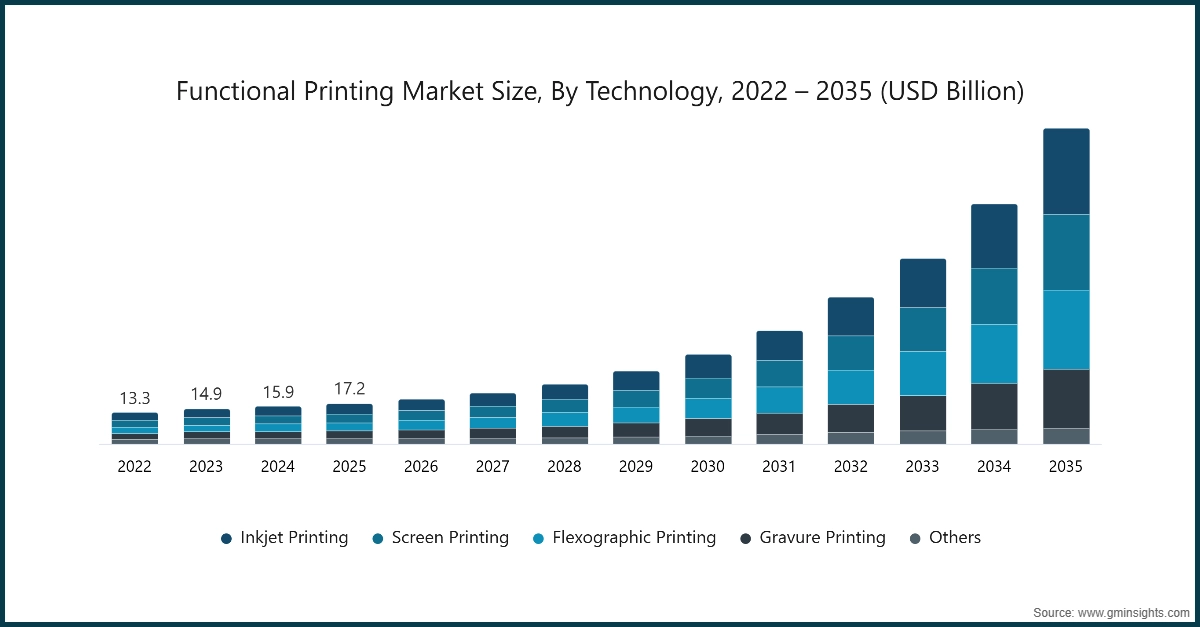
The global functional printing market was estimated at USD 17.3 billion in 2025. The market is expected to grow from USD 19.1 billion in 2026 to USD 134.9 billion in 2035, at a CAGR of 24.2% according to latest report published by Global Market Insights Inc.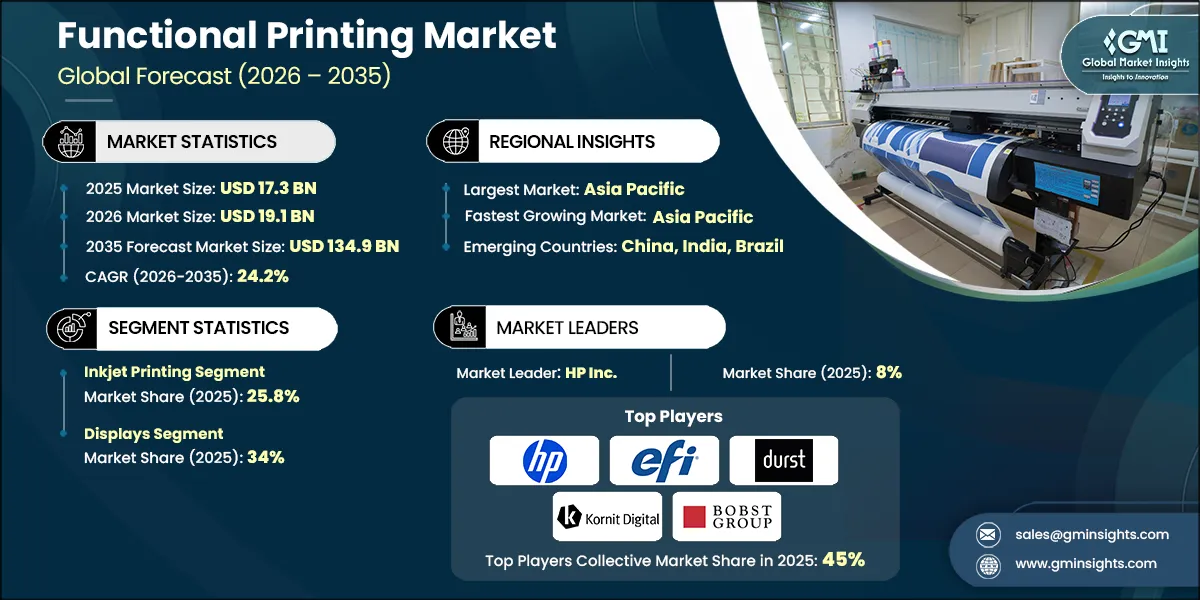
To get key market trends
Functional Printing Market Trends
The market is going through an altogether new phase of evolution and development with new advancements taking place in digital printing technologies, conductive materials, smart inks, and AI-enabled workflow automation. New innovations in materials sciences are coming together with modern printing technologies to bring precision-printed electronics to the industry with utmost precision. The various companies within the printing industry are launching next-generation digital and hybrid presses, curing systems, and intelligent print management software for use in zero downtime, high mix, and low volume production environments. This has resulted in the development of fully automated, resilient, and self-correcting manufacturing ecosystems that are capable of meeting the demand for customized and functional products.
- Adoption of advanced materials is transforming functional printing: Advances in conductive ink formulations, stretchable substrates, dielectric materials, and nanoparticles are allowing for significant advancements in the capabilities and functionalities of functional printing technologies. Such advanced materials allow for the possibility of multilayers, 3D, flexible, and high compliance structures, thereby enabling flexible sensors, wearable electronics, smart labels, and printed circuits. Material flexibility and mechanical durability are improved, enabling printed parts to function reliably in complex, dynamic, or curved situations, creating possibilities for new applications
- High‑performance inks & printed actuation components: Rapid improvements in functional inks (conductive, electroluminescent, piezoelectric, and biochemical) and printing calibration systems are significantly enhancing precision, conductivity, and durability. This expands the feasibility of replacing traditional components with lightweight, thin, and flexible printed counterparts. Industries such as healthcare, automotive, smart packaging, and environmental monitoring are increasingly adopting functional printing for applications ranging from printed sensors to diagnostic strips, RFID antennas, and lighting elements.
- Lightweight manufacturing & advanced 3D/hybrid printing techniques: Manufacturers are focusing heavily on developing compact, modular, and lightweight digital printing units, supported by advanced 3D printing and hybrid (flexo + inkjet + screen) architectures. The integration of additive and subtractive processes enhances the capability to print complex multilayer electronic structures while maintaining superior mechanical performance.
- Functional printing gains momentum in various industries: Functional printing technologies are being rapidly adopted in the food and beverage, packaging, and FMCG sectors for applications such as smart labels, track‑and‑trace RFID tags, anti-counterfeit features, and intelligent packaging systems. For example, several companies are collaborating to integrate digital inkjet modules with automated packaging lines, combining advanced printheads with material‑efficient substrate technologies. These partnerships are enabling converters to deliver high‑speed, cost‑efficient, and feature‑rich packaging solutions that incorporate functional elements such as freshness indicators, QR‑coded intelligence, and supply chain visibility features.
These improvements are enabling greater penetration of functional printing in industries requiring compact, flexible, and precision‑aligned components, including wearables, medical patches, smart surfaces, and automotive electronics.
Functional Printing Market Analysis
Learn more about the key segments shaping this market
Based on technology, the functional printing market is segmented into inkjet printing, screen printing, flexographic printing, gravure printing, and others. In 2025, the inkjet printing segment held the largest share at 25.8%, valued at USD 4.4 Billion.
- Inkjet printing leads the market due to its adaptability for printed electronics, smart packaging, and high-resolution functional layers.
- The segment benefits from rapid material innovation, including nanoparticle conductive inks, flexible substrates, and low‑temperature sintering.
- Its ability to support high‑mix, low‑volume and on‑demand production makes it the top choice for electronics, textiles, and packaging converters.
- This flexibility allows for the deposition of functional inks, such as conductive inks, dielectric inks, and functional fluids, to create functional components and devices with diverse applications across industries. Designers can create and modify digital designs using computer-aided design (CAD) software, and then directly print functional components and prototypes on-demand, reducing time-to-market and enabling customization for specific applications and requirements, thereby driving market growth.
Learn more about the key segments shaping this market
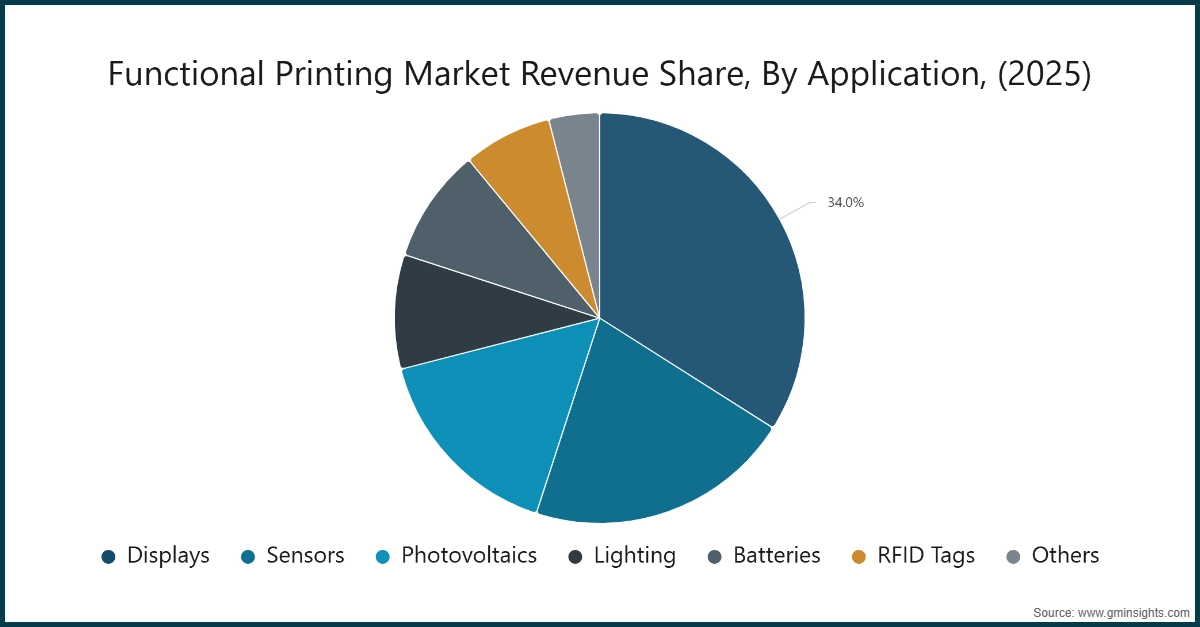
Based on the application, the functional printing market is segmented into displays, sensors, photovoltaics, lighting, batteries, RFID Tags, and others. In 2025, the displays segment led the market with 34% due to demand for flexible displays, OLED panels, touch interfaces, and printed backplanes.
- Increasing adoption of roll-to-roll manufacturing and transparent conductive materials strengthens growth.
- Sensors captured a 22% share in 2025 including printed biosensors, pressure sensors, environmental monitors, and industrial IoT sensors. Growth is fueled by wearables, automotive systems, smart infrastructure, and medical diagnostics.
- High adoption in sustainable energy generation, portable devices, and building-integrated solutions.
- Functional printing technologies, including inkjet printing, screen printing, and gravure printing, enable the fabrication of flexible displays using organic and inorganic electronic materials. Functional printing technologies enable the fabrication of e-paper and e-ink displays using conductive inks and encapsulation materials, contributing to the segment growth.
North America Functional Printing Market
Looking for region specific data?
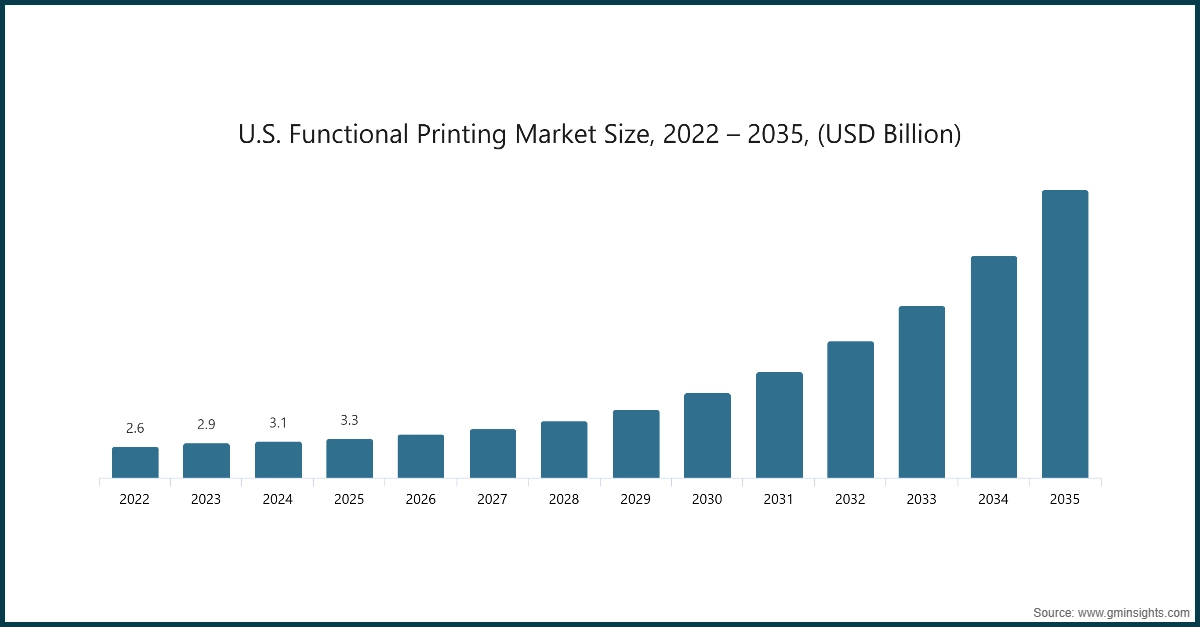
- The U.S. dominates the regional market, contributing approximately 64.4% of the North American value. The strong position is driven by high adoption of digitized packaging, printed electronics, and flexible display manufacturing.
- The region benefits from fast-growing demand for smart labels, RFID tracking, printed sensors, and additive electronics driven by e-commerce, healthcare, and consumer electronics.
- The market is also expanding due to widespread implementation of hybrid printing platforms, combining flexo + inkjet technologies for high-speed industrial printing.
- Strong investments in AI-driven print optimization, inline inspection, and predictive maintenance tools enhance reliability for converters and OEMs.
- North America’s mature printing ecosystem supported by leading brands in inkjet and digital printing makes it a prime hub for next-generation functional printing in logistics, automotive interiors, and electronic components.
Europe Functional Printing Market
Europe is a significant and technologically advanced market, valued at USD 4.1 billion in 2025, with a projected CAGR of 23.7% through 2035. Germany leads the region, followed by the UK, France, Italy, and Spain.
- Europe’s strong engineering heritage and rapid transition toward Industry 4.0 encourage adoption of functional printing for flexible circuits, biosensors, photovoltaics, and printed lighting.
- Germany shows the highest sub-regional CAGR of 24.3%, driven by investments in automotive electronics, industrial IoT, and flexible display research.
- The region’s focus on sustainable manufacturing supports the shift toward energy-efficient printed electronics, organic photovoltaics (OPV), and biodegradable substrates.
- Nations like Italy and Spain are adopting functional printing to offset labor shortages and reduce operational costs through automated digital printing lines.
- Europe’s emphasis on precision printing and material innovation positions the region as a global leader in advanced functional materials and hybrid printing technology
Asia Pacific Functional Printing Market
Asia Pacific is the second-largest and fastest-growing regional market, with a 2025 valuation of USD 6.4 billion and the highest CAGR globally at 25.4% through 2035.
- China is the dominant contributor with an impressive 25.8% CAGR, driven by the nation’s strong manufacturing ecosystem, investments in flexible electronics, and the Made in China 2025 innovation roadmap.
- India and Japan follow with strong demand for wearables, low-cost sensors, and printed batteries, fueling regional expansion.
- Massive investments in electronics assembly, smart packaging, printed solar (OPV), and roll-to-roll printing drive rapid adoption.
- Asia Pacific is the center for high-volume production, enabling cost-efficient scaling of printed RFID tags, displays, and smart surfaces.
- The region increasingly invests in “lights-out” factories, using automated and digitally optimized functional printing lines to boost output and reduce labor burden.
Latin America Functional Printing Market
Latin America represents a smaller but steadily growing segment of the global market, expanding at a 22.8% CAGR in the forecast period of 2026–2035.
- Brazil is the key growth driver, capturing ~33% of regional value and posting a CAGR of 23.6%, supported by automotive electronics, FMCG packaging, and printed sensor adoption.
- Mexico and Brazil are moving toward automation in food packaging, logistics, and industrial labeling, where hybrid and inkjet functional printing systems ensure strong export competitiveness.
- Functional printing adoption is supported by increasing industrialization in urban centers and the need for traceable packaging, low-cost flexible electronics, and smart labels.
- Manufacturers are focusing on expanding distribution networks to reach emerging industrial hubs, leveraging demand for printed RFID, anti-counterfeit features, and digital branding.
Functional Printing Market Share
HP Inc. is currently the leading player in the functional printing industry, holding an estimated 8% market share. The top companies including HP Inc., Durst Group, EFI, Bobst Group, and Uteco Converting collectively account for approximately 45% of the global market, indicating a moderately consolidated but highly competitive landscape. These major participants are actively engaging in strategic acquisitions, cross-technology collaborations, investments in advanced ink platforms, and global facility expansions to strengthen their portfolios and serve a broader industrial customer base.
EFI is undergoing a significant organizational transformation designed to reposition the company as a high-growth digital and industrial inkjet technology specialist. Expanding its Fiery digital front end (DFE) ecosystem, leveraging AI for color accuracy, workflow automation, and predictive calibration. Investing heavily in functional ink chemistry, including conductive inks and high-performance UV-curable formulations designed for electronics and smart packaging.
Functional Printing Market Companies
Major players operating in the functional printing industry are:
- Bobst Group
- Comexi Group
- Domino
- Durst Group
- EFI
- HP Inc.
- Kornit Digital
- KYMC
- Mark Andy
- Mimaki Engineering
- PCMC
- Roland DG
- SPGPrints
- Thieme
- Uteco Converting
Eastman Kodak Company holds a significant market share in the functional printing market due to its pioneering technologies in printing and extensive expertise in chemical and material science. Kodak's advanced inkjet and flexographic printing solutions cater to high-demand applications like printed electronics and photovoltaics, leveraging their robust R&D capabilities and deep industry knowledge to innovate and deliver high-quality, functional printing solutions.
Functional Printing Market Report Attributes
| Key Takeaway | Details |
|---|---|
| Market Size & Growth | |
| Base Year | 2025 |
| Market Size in 2025 | USD 17.3 Billion |
| Market Size in 2026 | USD 19.1 Billion |
| Forecast Period 2026-2035 CAGR | 24.2% |
| Market Size in 2035 | USD 134.9 Billion |
| Key Market Trends | |
| Drivers | Impact |
| Rising labor shortages & manufacturing reshoring | Declining skilled labor availability in major manufacturing economies is accelerating the shift toward automated functional printing lines, enabling high volume, precision production with reduced human intervention. |
| AI, generative design & software integration | The industry is rapidly moving from manual print calibration to AI optimized print workflows. Generative algorithms automatically adjust ink deposition, curing temperatures, and registration—making advanced printing accessible to non technical operators. |
| IT/OT convergence in printing operations | Real time connectivity between digital front-end systems (DFE), inline sensors, and production hardware is enabling predictive maintenance, digital twins for print quality simulation, and end to end traceability across packaging, textiles, and electronics printing. |
| Pitfalls & Challenges | Impact |
| High integration complexity | Upgrading existing analog printing lines (flexo, gravure) with digital modules, sensor arrays, and curing systems often requires custom retrofitting, interoperability upgrades, and significant operator training. |
| Data privacy & cybersecurity | As presses become cloud-connected for workflow automation, remote diagnostics, and color management, risks of data breaches, IP theft, and production line cyberattacks increase significantly. |
| Opportunities: | Impact |
| Printing-as-a-Service (PaaS) | Subscription-based models from OEMs allow converters and SMEs to access high-end inkjet, hybrid, or screen printing technology without high upfront CapEx—covering maintenance, consumables, and upgrades. |
| Growth in printed electronics & smart packaging | Demand for flexible circuits, printed RFID, OLED displays, and conductive patterns is rising sharply, enabling manufacturers to diversify into high-margin functional printing applications and expand beyond traditional print markets. |
| Market Leaders (2025) | |
| Market Leader |
8% market share |
| Top Players |
Consolidate share of 45% |
| Competitive Edge |
|
| Regional Insights | |
| Largest market | Asia Pacific |
| Fastest growing market | Asia Pacific |
| Emerging countries | China, India, Brazil |
| Future Outlook |
|
| Companies covered: | 15 |
| Tables, Charts & Figures: | 150 |
| Countries covered: | 18 |
| No of Pages: | 250 |
What are the growth opportunities in this market?
Functional Printing Industry News
- In November 2025, HP Inc. partnered with Microsoft to launch a cloud‑native “Cognitive Print Manufacturing Framework. This collaboration integrates HP’s new High-Fidelity Functional Inkjet (HFFI) systems with Microsoft’s Azure-based AI architecture, enabling real‑time print-path correction, substrate deformation prediction, and adaptive ink deposition. The system leverages low‑latency edge computing to ensure flawless printing of RFID antennas, flexible circuits, and smart packaging layers, even under high-speed industrial conditions.
- In July 2025, Durst Group Introduces Durst VisioniQ, a Generative AI Assistant for Industrial Printing. At the 2025 drupa/Automatic industrial showcase, Durst Group unveiled VisioniQ, a generative AI copilot that allows operators to control and calibrate functional printing lines using natural language prompts. The system automatically generates print profiles, ink‑layer compensation strategies, and defect‑mitigation instructions for complex multilayer electronics and packaging. VisioniQ reduces setup time by over 40%, enabling converters to quickly shift between printed displays, sensors, and variable-data applications.
- In July 2025, EFI released the Nozomi‑FX Pro, a next-generation single-pass industrial inkjet platform designed to support UV-curable conductive inks, barrier coatings, and anti-counterfeit functional layers. Equipped with OptiTrace AI, the machine achieves a 30% improvement in print accuracy and enables high-resolution tracking features for smart packaging. EFI’s AI-driven registration system ensures stable output even at ultra-high speeds, meeting the rising demand for intelligent, traceable, and sustainable packaging solutions.
- In September 2025, Bobst Group introduced the HybridFlex 500, a modular hybrid press combining flexographic, screen, and inkjet stations for multi-technology functional printing. The machine features a redesigned AI-controlled tension-management system and a 3D‑optimized ink‑delivery lattice that stabilizes conductive ink deposition across thin substrates. This breakthrough directly addresses the industry’s need for precision in OPV (organic photovoltaics), printed sensors, and in-mold electronics production.
- In 2024, Uteco Converting and Durst expanded their strategic partnership to accelerate development of “Smart Compliance Printing” technologies. Using AI-supported 3D substrate visualization and digital twins, the system allows converters to simulate ink behavior, curing response, and material stress in real time—eliminating the need for manual recalibration. The technology is especially impactful in high‑mix packaging lines, enabling seamless integration of RFID tags, freshness indicators, anti-tamper seals, and nano‑functional coatings.
- In late 2024, Mimaki Engineering introduced the UltraFine Electronics Series, a precision inkjet platform designed for micro‑pattern printing, such as flexible circuits and biosensor probes.The machine employs AI‑modeled droplet control and low-temperature nanoparticle sintering, making it ideal for medical devices, wearables, and compact consumer electronics.
The functional printing market research report includes in-depth coverage of the industry with estimates & forecasts in terms of revenue (USD Billion) and volume (Thousand Units) from 2022 to 2035, for the following segments:
Market, By Material
- Substrate
- Glass
- Plastic
- Paper
- Silicon Carbide
- Gallium Nitride
- Others
- Inks
- Conductive inks
- Dielectric inks
- Graphene inks
- Others
Market, By Technology
- Inkjet printing
- Screen printing
- Flexographic printing
- Gravure printing
- Others
Market, By Application
- Displays
- Sensors
- Photovoltaics
- Lighting
- Batteries
- RFID Tags
- Others
The above information is provided for the following regions and countries:
North America
- U.S.
- Canada
Europe
- Germany
- UK
- France
- Italy
- Spain
Asia Pacific
- China
- India
- Japan
- Australia
- South Korea
Latin America
- Brazil
- Mexico
- Argentina
Middle East and Africa
- South Africa
- Saudi Arabia
- UAE
Frequently Asked Question(FAQ) :
What is the market size of the functional printing market in 2025?
The market size was USD 17.3 billion in 2025 and is projected to grow rapidly driven by advancements in conductive inks, smart materials, and digital printing technologies.
What is the current functional printing market size in 2026?
The market is expected to reach USD 19.1 billion in 2026 as adoption of printed electronics, smart packaging, and flexible displays accelerates across industries.
What is the projected value of the functional printing market by 2035?
The market is anticipated to reach USD 134.9 billion by 2035, growing at a CAGR of 24.2% supported by AI-enabled printing, hybrid manufacturing, and rising demand for flexible electronic components.
How much revenue did the inkjet printing segment generate in 2025?
Inkjet printing generated USD 4.4 billion in 2025, accounting for 25.8% of the functional printing industry share due to its adaptability for printed electronics and smart packaging applications.
What was the valuation of the displays application segment in 2025?
The displays segment held 34% of the functional printing industry in 2025, driven by strong demand for flexible displays, OLED panels, and printed backplanes.
What share did the sensors application capture in 2025?
Sensors accounted for 22% of the market in 2025, supported by increasing deployment of printed biosensors, environmental monitors, and industrial IoT sensors.
Which region leads the functional printing market?
Asia Pacific led the global market with a valuation of USD 6.4 billion in 2025 and is projected to grow at the highest CAGR of 25.4% through 2035. Growth is driven by strong electronics manufacturing ecosystems, investments in flexible electronics, and large-scale roll-to-roll production capabilities.
What is the size of the North America functional printing industry?
North America market reached USD 5.2 billion in 2025 with a projected CAGR of 23.4% through 2035. Growth is supported by rising adoption of printed electronics, smart labels, RFID tracking, and AI-driven hybrid printing platforms.
What are the key trends in the functional printing market?
Key trends in the functional printing industry include integration of AI-driven workflow automation, hybrid flexo-inkjet systems, advanced nanoparticle inks, multi-material deposition, digital twins, predictive maintenance, and increasing adoption of sustainable and flexible substrates across packaging, healthcare, and automotive sectors.
Who are the major players in the functional printing industry?
Major companies operating in the market include HP Inc., Durst Group, EFI, Bobst Group, Uteco Converting, Eastman Kodak Company, Domino, Comexi Group, Kornit Digital, Mimaki Engineering, Mark Andy, Roland DG, SPGPrints, Thieme, and PCMC.
Functional Printing Market Scope
Related Reports