Summary
Table of Content

Fullerene-Based Specialty Chemicals Market
Get a free sample of this report
Form submitted successfully!
Error submitting form. Please try again.
Thank you!
Your inquiry has been received. Our team will reach out to you with the required details via email. To ensure that you don't miss their response, kindly remember to check your spam folder as well!
Request Sectional Data
Thank you!
Your inquiry has been received. Our team will reach out to you with the required details via email. To ensure that you don't miss their response, kindly remember to check your spam folder as well!
Form submitted successfully!
Error submitting form. Please try again.
Fullerene-Based Specialty Chemicals Market size
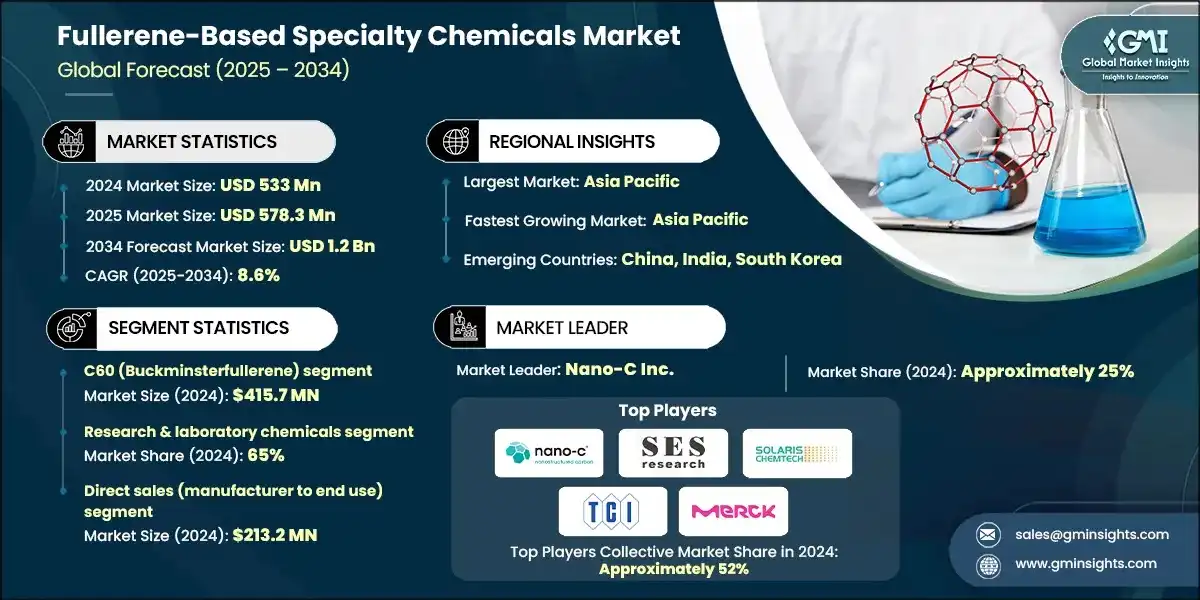
The global fullerene-based specialty chemicals market was valued at USD 533 million in 2024 and reflects expanding commercial viability across research, electronics, and niche industrial uses. It is projected to grow from USD 578.3 million in 2025 to USD 1.2 billion by 2034, a trajectory that implies an 8.6% CAGR over 2025–2034 according to latest report published by Global Market Insights Inc.
To get key market trends
- The near-term demand trend is the greatest in organic photovoltaics (OPV) and other related electronics, while high-purity and functionalized fullerene derivatives widen the addressable applications of the market. The drive behind this momentum is a combination of performance gains in OPV, solid funding for nanotechnology research, and the steady commercialization of functionalized chemistries, such as PCBM/ICBA. This includes policy tailwinds and maturing quality frameworks on adoption within energy, electronics, and pharmaceutics research and development.
- Fullerene-based specialty chemicals are mushrooming in the market for high-performance nanomaterials that are fast translating into organic electronics and photovoltaics as well as advanced applications in research. C-60 and C-70 fullerenes exhibit terrific electron-accepting abilities and are structurally stable, thus putting them on the forefront of the next generation of organic photovoltaic cells and flexible electronics. The great electronic properties of fullerene derivatives with their ready functionalization for applications make them perfect for cutting-edge organic electronics and energy storage systems.
- Major technological advancements in fullerene functionalization and synthesis have enhanced their solubility, processability, and application scope, paving the way for a wider adoption of fullerene units in specialty chemical formulations. Advances in supramolecular fullerene chemistry and methods for controllable functionalization demonstrate improved yields and selectivity, where certain mechanically robust derivatives have shown enhanced performance in electronic devices. These innovations broaden the horizon of applications, moving from traditional research chemicals to advanced materials for perovskite solar cells, organic field-effect transistors, and biomedical applications.
- The increasing trend towards sustainable energy solutions and advanced materials is gradually leading to a substantial demand increase among fullerene-based specialty chemicals for organic photovoltaic and energy storage applications. Fullerene derivatives, namely, PCBM and PC70BM, have now become common electron acceptors in bulk heterojunction solar cells, while novel battery materials and supercapacitor applications will testify to their versatility. Very noticeable trends are emerging for next-generation photovoltaic devices and energy storage systems that will require very high-performance electron transport materials.
Fullerene-Based Specialty Chemicals Market Report Attributes
| Key Takeaway | Details |
|---|---|
| Market Size & Growth | |
| Base Year | 2024 |
| Market Size in 2024 | USD 533 Million |
| Market Size in 2025 | USD 578.3 Million |
| Forecast Period 2025 - 2034 CAGR | 8.6% |
| Market Size in 2034 | USD 1.2 Billion |
| Key Market Trends | |
| Drivers | Impact |
| Increasing demand for organic photovoltaic cells and flexible electronics | Drives adoption of fullerene derivatives as electron acceptors for next-generation solar cells and organic electronics |
| Advances in fullerene functionalization chemistry enabling improved solubility and processability | Enables broader applications from research chemicals to commercial electronic materials and biomedical products |
| Growing research activities in nanotechnology and materials science | Accelerates development of novel fullerene-based specialty chemicals for emerging applications |
| Rising investment in sustainable energy technologies and advanced materials | Encourages commercialization of fullerene-based solutions for energy storage and conversion systems |
| Pitfalls & Challenges | Impact |
| High production costs and complex synthesis processes | Limits adoption in cost-sensitive applications, requiring continued process optimization and scale-up |
| Regulatory uncertainty surrounding nanomaterials | Regulatory uncertainty surrounding nanomaterials |
| Competition from non-fullerene acceptors in organic electronics | Impacts market share in photovoltaic applications, driving need for performance improvements |
| Opportunities: | Impact |
| Expansion into biomedical and pharmaceutical applications | Enables market growth into high-value therapeutic and diagnostic applications |
| Development of functionalized derivatives for specific applications | Creates new market segments and increases value proposition for specialty chemical manufacturers |
| Integration into emerging technologies like perovskite solar cells and organic electronics | Opens new application areas in next-generation energy and electronic devices |
| Strategic partnerships for co-development of application-specific solutions | Strategic partnerships for co-development of application-specific solutions |
| Market Leaders (2024) | |
| Market Leaders |
Market Share Approximately 25% |
| Top Players |
Collective Market Share Approximately 52% |
| Competitive Edge |
|
| Regional Insights | |
| Largest Market | Asia Pacific |
| Fastest growing market | Asia Pacific |
| Emerging countries | China, India, South Korea |
| Future outlook |
|
What are the growth opportunities in this market?
Fullerene-Based Specialty Chemicals Market Trends
Five strengthening trend lines-an advanced photovoltaic integration, high-purity material evolution, commercialization of functionalized fullerene, sustainable manufacturing, and digital integration-are changing the market direction of fullerene-based specialty chemicals through redirecting innovations on R&D investments, specification updates, and procurement decisions.
- Ongoing innovation is driven forward by the incorporation of fullerene-based acceptors in organic and hybrid tandem photovoltaic systems where efficiency records are continuously crossed in accredited measurements. Hybrid "perovskite/organic" tandems, illustrated in NREL charts, underscore the increasing importance of fullerene acceptor engineering. In the short to medium term, the industrial OPV and BIPVs will be designed through scaling up roll-to-roll thin film production. Efficiency gains into the mid-teens at the cell level and leading expansions in capacity among the leading OPV vendors are increasing demand for PCBM derivatives and compatible electron transport layers, notably fueling the development of flexible and lightweight energy applications.
- Pushes for ultra-high-purity fullerene materials (≥99.5% and 99.9%+) are gaining momentum from increasingly stringent pharmaceutical and electronics quality frameworks. The FDA's approach to the risk from nanomaterials has ramped up the need for validated purification techniques, such as HPLC and sublimation. Over the next several years, a competitive position will be realized by suppliers with cutting-edge QA pipes and traceable analytics. Premiums that are charged for fullerene materials with high purity and pharmaceutical grade account for elevated purification costs and quality assurance overheads, thus supporting growth in the pharmaceutical and biomedical R&D arenas.
- A long-term ramp-up in commercialization is ongoing for PCBM/ICBA derivatives and the rest of functionalized fullerene variants that have been developed to improve solubility and electronic properties. These innovations facilitate solution-processing techniques and improve device performance in OPV, OLED, and OFET applications. Patent activities are advancing as well, highlighting the strong R&D momentum. Despite maintaining 2-10 times price premiums over pristine grades, demand continues to grow in high-performance niches where functionality surpasses cost. Market development will trend more toward specialized SKUs under strong technical and documentation frameworks.
- Fullerene production is experiencing change regarding environmental responsibility and corporate sustainability goals. Manufacturers are converting to environment-friendly synthesized methods, lean solvent systems, and closed-loop operations to reduce environmental impact. Commercial-scale production is now influenced by green chemistry principles, which lend themselves well to progress in the medium-term. These improvements, alongside energy efficiency gains and reduced carbon footprints, enhance vendor competitiveness, while third-party certifications such as ISO standards and life cycle assessments develop into procurement differentiators.
- Digital transformation of fullerene manufacturing leads to enhanced productivity and consistency. Producers are establishing sensor-based process monitoring, predictive maintenance systems, and in-line quality analytics to enable tighter purity and yield control. These digitalized workflows can deliver productivity gains of 20-25%, especially in high-purity production environments. Hence, the market, characterized by enhanced digital maturity, favors those suppliers that can ensure reproducibility, traceability, and rapid lot release supported by robust data-driven documentation.
Fullerene-Based Specialty Chemicals Market Analysis
Learn more about the key segments shaping this market
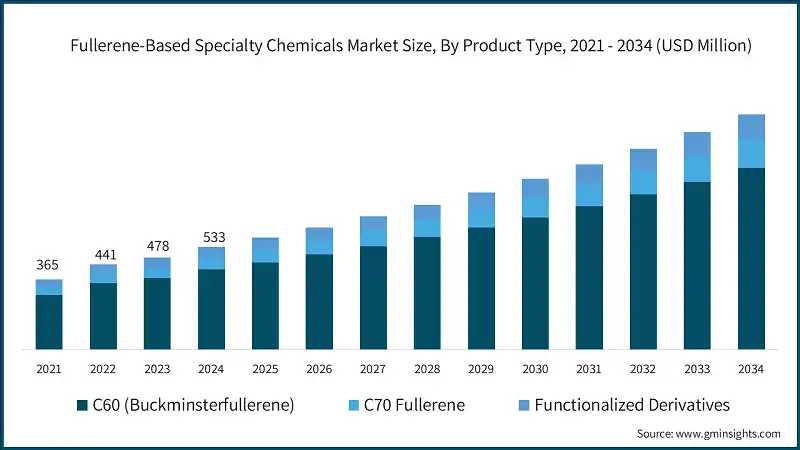
The C60 (Buckminsterfullerene) segment was valued at USD 415.7 million in 2024, and it is anticipated to expand at 8.5% CAGR during 2025-2034, holding a market share of 78% in 2024.
- Innovations in synthetic technologies, versatility in raw materials use, and well-accepted purification standards at grades of ≥99.5% and 99.9%+ underpin C60's (buckminsterfullerene) dominate in the fullerene-based specialty chemicals industry. Its stable spherical cage structure, coupled with proven electron-acceptor properties, makes it a preferred material for organic electronics, sustaining an ever-consistent demand in research, pilot, and production environments. Processing flexibility for thin-film device fabrication is further improved by functionalization of C60 as exemplified by derivatives of the PCBM class.
- C70, which has an extended optical absorption profile that enhances the spectral response of photovoltaic and optoelectronic devices, is used in a more niche way. Purity grades of >98% and 99% offered to suppliers round out this use in high-end OPV and related applications.
- Bright functionalized derivatives like PCBM, ICBA, and others are the fastest-growing segment in the market because of their high solubility and tunable electronic properties ideal for processing through a solution. The premium price they hold above pristine fullerenes is due to the complexity in the synthesis and purification of these materials and the great performance boosts that these materials provide in OPV, OLED, and OFET formulations. Fullerene-based specialty chemicals are thus increasingly splintering behind high-volume C60/C70 research-grade products on the one hand, and value-added functionalized derivatives on the other, which, quite simply, is the way the competition among suppliers will run from here on out through purity levels, analytical documentation, and specialized technical support.
Learn more about the key segments shaping this market
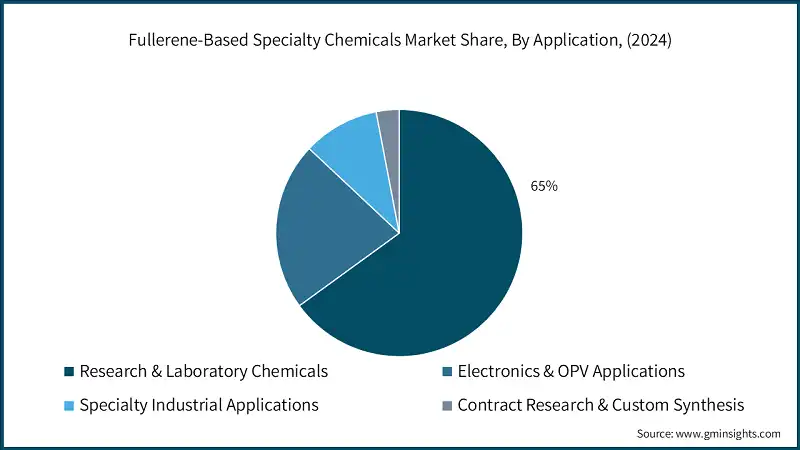
The fullerene-based specialty chemicals market from research & laboratory chemicals segment was valued at USD 346.5 million in 2024, and it is anticipated to expand at 8.6% CAGR during 2025-2034, holding a market share of 65% in 2024
- The largest usage segment for fullerene-based specialty chemicals is research and laboratory chemicals with a strong agency backing in the US and Europe and university industry collaborations. The NNI budget, DOE/NSF portfolios, and EU funding streams for emerging PV, nanomaterials, and molecular electronics sustain high purity C60/C70 consumption and derivative exploration across chemistry, physics, materials science, and biomedical fields. Electronics and OPV stand out as fast-normalizing commercial uses: fullerene acceptors and transport interfaces remain an integral part of high efficiency organic architectures, while hybrid tandem categories keep OPV relevant alongside silicon through niche advantages like flexibility, low weight, and low light performance.
- Electronics and OPV, with an estimated USD 117.3 million and 22% market share in 2024, are bolstering their growth trajectory in a constantly evolving organic electronics market for advanced device performance and scalability. Fullerene derivatives PCBM and PC70BM have very good properties for being electron acceptors, while still remaining solution-processable; it is ideal for organic photovoltaic cells, organic field-effect transistors, and even perovskite solar cell applications. It's a segment benefiting from the increasing uptake of organic electronics into flexible displays, wearables, and building-integrated photovoltaics, as all these import demand for top-class fullerene acceptors.
- Heterogeneous specialty industrial applications involve catalyst supports, tribology/coatings, and composite performance modifiers wherein small fullerene loadings can deliver premium property gains; a long tail of tribological and composite case studies and pilot deployments are provided by EU programs and project databases. Contract research and custom synthesis create a flexible channel for application specific derivatives, isotopic labels, and documentation-heavy orders that labs and OEMs increasingly need; favored by solvent free, sublimed, and water soluble fullerene forms, process integration and preclinical assessment pathways get boosted.
The fullerene-based specialty chemicals market from direct sales (manufacturer to end use) segment was valued at USD 213.2 million in 2024, and it is anticipated to expand at 8.6% CAGR during 2025-2034, holding a market share of 40% in 2024.
- In arriving at the sentence on sales dynamics: Direct sales, as the largest segment of distribution channels, covered direct relations between fullerene manufacturers and the major end users-research institutions, electronics companies, and pharmaceutical organizations. Direct selling itself tends to benefit because of the specialized nature of fullerene products that require technical support, custom specifications, and quality assurance protocols. This aspect of having end users supports its dominance because fullerene specialty chemicals are high-value, low-volume materials for which direct manufacturer-to-customer relationships translate to better technical collaboration, faster problem-resolution systems, and customized product developments.
- Chemical distributors are estimated to value at USD 149.2 million with a 28% share in 2024. Chemical distributors cater to mid-tier customers who require smaller quantities and standardized products. These distributors provide essential market access for fullerene manufacturers while offering customers consolidated sourcing, inventory management, and local technical support. It benefits from the increasing number of research institutions and small-to-medium enterprises adopting fullerene-based materials for various applications.
- Specialty chemical suppliers, occupying a market share of 22% in 2024, target high-purity, research-grade fullerenes and their derivatives for use in both academic and industrial research. Online chemical marketplaces, with a share of 10% in 2024, meet the rising demand for convenient procurement of standard fullerene products, particularly among smaller research groups and emerging technology companies requiring quick access to catalog products.
Looking for region specific data?
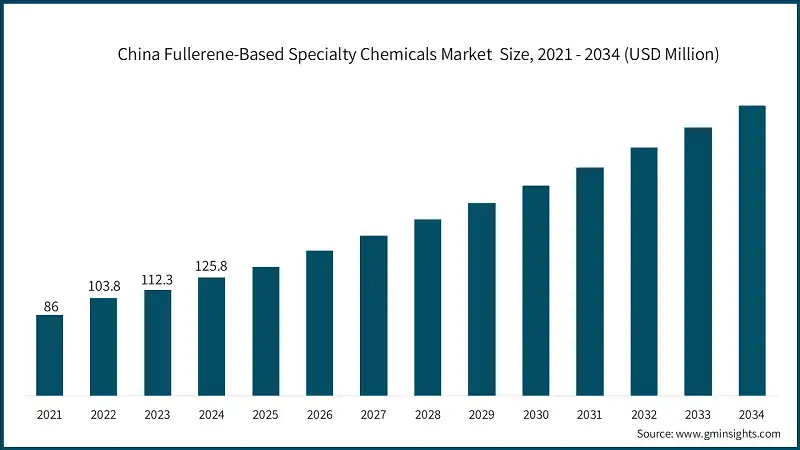
The Asia Pacific fullerene-based specialty chemicals market was valued at USD 255.9 million in 2024, and it is anticipated to expand at 10.2% CAGR during 2025-2034, holding a market share of 48% in 2024
- Asia-Pacific is the market leader in fullerene-based specialty chemicals for both shares and growth. This has been supported by advanced electronics manufacturing and a solid chemical supply network. The country has a high pureness of various fullerenes and derivatives for OPV, flexible electronics, and semiconductor applications, with China, Japan, and South Korea leading in production and consumption. The Department of Science and Technology initiatives in India support the advancement of nanomaterials and next-generation PV research while trade and start-up agencies in Japan boost advanced materials innovation. Supplier networks help supply scalable production capabilities of functionalized fullerene derivatives, solvent-free and sublimed, advancing both OPV commercialization and R&D momentum.
- In the Asia Pacific region, China is the largest market for fullerene-based specialty chemicals and is predicted to grow at the highest CAGR within the region. The fastest growing economy in Asia Pacific is China due to its advancing research infrastructure and electronics manufacturing industry, and increasing investments in nanotechnology applications. Massive academic production, along with the government's support for advanced materials development and emerging companies that manufacture fullerene, classifies China's role as both a major consumer and producer within the global reference market on fullerene-based specialty chemicals.
The North America fullerene-based specialty chemicals market dominated the global market with a market share of 31.2% from 2025 - 2034.
- The market for specialty chemicals based on fullerene in North America is characterized by a very strong research base with sustained federal funding and clear nanomaterial regulations. Initiatives in the U.S., such as the National Nanotechnology Initiative and programs by the DOE, NSF, and NIH, support the research of photovoltaics and advanced materials, which translates into stable demand for high-purity C60/C70 derivatives. Guidelines from the FDA on drugs containing nanomaterials formalize the CMC and risk-based reviews important for pharmaceutical R&D. OSHA's updated Hazard Communication standards further improve workplace safety regarding nanomaterials and the precision of SDSs. The U.S. market is also linked to OPV/BIPV pilots and IoT energy systems, while Canada's NRC and academic consortia work towards OPV and nanocarbon safety studies.
The Europe fullerene-based specialty chemicals market accounted for USD 88.9 million in 2024 and is anticipated to show steady growth over the forecast period.
- The market of Europe focuses on quality standards, regulatory take compliance, and technological innovations. The REACH nanoforms, EUON, and ISO TC 229 are some frameworks guiding supplier transparency and procurement standards. The REPowerEU plan and solar initiatives maintain downstream PV demand. The CORDIS projects funded by the EU are fully exploring fullerene acceptors, hybrid nanocarbon systems, and OPV device engineering funded by MSCA and Horizon programs. The major players include IoLiTec (high-purity materials), Heliatek and ASCA (OPV lines), and Dyenamo (chemical intermediates). National research funding agencies, such as DFG and UKRI, continue to support research projects in printed electronics, catalysis, and optoelectronics linked to fullerene chemistry.
The Latin America fullerene-based specialty chemicals market accounted for 2.6% in 2024 and is anticipated to show moderate growth over the forecast period.
- Research activities across Latin America, with particular intensity in Brazil, Mexico, and Argentina, have been complemented by expanding university research programs and numerous newly funded nanotechnology initiatives. The market opportunity for the region is underpinned by increasing academic collaboration with North American and European institutions, a growing interest in renewable energy technologies, and developing materials science capabilities. Brazil has a very strong chemical industry and solid research infrastructure, establishing the basis for a further adoption of specialty chemicals based on fullerenes.
- Brazil is at the head of Latin America in the market and shows steady growth throughout the analysis period. Brazil leads the regional market, having well-established research universities that are beginning to grow in materials science programs. The academic sector benefits largely from government funds, international collaborations, and the growing effort on the applications of nanotechnology, creating sound, ongoing demand for fullerene-based specialty chemicals in research and early commercial applications.
Middle East & Africa fullerene-based specialty chemicals market is anticipated to grow at a CAGR of 7.5% during 2025 to 2034.
- The Middle East & Africa region presents moderate growth opportunities, mainly due to expanding research capabilities, expanding university programs, and increasing interest in advanced materials applications. This investment in science and technology infrastructure creates opportunities for fullerene-based specialty chemical applications in research and development activities in Saudi Arabia, the UAE, and so on.
- Saudi Arabia's leadership role in the Middle East & Africa fullerene specialty chemical market with great growth potential. Saudi Arabia has enthroned itself as the regional leader with heavy investment in science and technology research under the framework of Vision 2030. The establishment of world-class research institutions like KAUST (King Abdullah University of Science and Technology) and growing materials science programs are positioning Saudi Arabia as a key market for fullerene-based specialty chemicals, especially in academic research and emerging technology applications.
Fullerene-Based Specialty Chemicals Market Share
In 2024, the global fullerene-based specialty chemicals industry was led by a diverse group of established chemical manufacturers and specialized nanomaterial suppliers, where the top seven companies collectively held approximately 52% of the market share, including SES Research Inc., Nano-C Inc., Solaris Chem, TCI (Tokyo Chemical Industry), Sigma-Aldrich/Merck KGaA, American Elements, and Strem Chemicals. These companies maintain strong positions in the market owing to their advanced synthesis capabilities, high-purity production processes, extensive R&D investments, and established relationships with major research institutions, electronics manufacturers, and pharmaceutical companies.
- Nano-C Inc. is a pioneering U.S.-based nanomaterials company specializing in fullerene and derivative production for advanced materials and energy applications. It offers high-purity C60, C70, and a wide portfolio of functionalized fullerenes used in organic photovoltaics (OPV), organic electronics, and nanocomposites. The company’s proprietary synthesis and purification technologies ensure consistent quality, making it a global leader in fullerene-based specialty chemicals for both R&D and commercial manufacturing.
- SES Research Inc. is a leading American supplier and manufacturer of fullerenes and fullerene derivatives serving academic, industrial, and government research sectors. The company produces a comprehensive range of high-purity C60, C70, PCBM, and carbon nanotube products, supporting both small-scale laboratory and bulk industrial orders. Its strong focus on quality control, quick fulfillment, and customized solutions positions SES Research as a reliable source for fullerene-based specialty chemicals in nanotechnology, electronics, and pharmaceutical research.
- Solaris Chem is a Canadian specialty chemical manufacturer recognized for its expertise in fullerene chemistry and advanced organic materials. The company offers high-purity C60/C70 fullerenes, PCBM derivatives, and water-soluble fullerenols tailored for photovoltaic, electronic, and biomedical applications. With strong R&D integration and a global customer base, Solaris Chem bridges laboratory innovation and commercial production, emphasizing purity, consistency, and scalable synthesis of fullerene-based specialty chemicals.
- Tokyo Chemical Industry (TCI) is a globally trusted supplier and manufacturer of research and specialty chemicals, with a strong portfolio in fullerene and fullerene derivative products. Its high-purity C60, C70, PCBM, and ICBA materials support research and manufacturing in OPV, OLED, and nanomaterial development. TCI’s rigorous quality standards, detailed documentation, and broad distribution network make it a key supplier to academic institutions and high-tech industries working with fullerene-based specialty chemicals.
Fullerene-Based Specialty Chemicals Market Companies
The major players operating in fullerene-based specialty chemicals industry include:
- Nano-C Inc.
- SES Research Inc.
- Solaris Chem
- TCI (Tokyo Chemical Industry)
- Sigma-Aldrich / Merck KGaA
- American Elements
- Strem Chemicals
- Ossila
- Alfa Aesar (Thermo Fisher)
- Frontier Carbon Corporation
- ACS Material
- Abvigen Inc.
Fullerene-Based Specialty Chemicals Industry News
- In April 2024, Mitsubishi Corporation (MC) and Denka Company Limited (Denka) announced a joint-venture agreement in the fullerene business, under which Denka will acquire a 50% stake in Frontier Carbon Corporation (FCC), a company specializing in the manufacture and sale of fullerenes. Fullerenes, nanoscale carbon allotropes with spherical hexagonal structures, offer excellent conductive and thermal properties and are soluble in common organic solvents, making them valuable in organic thin-film and perovskite solar cells, as well as potential applications in smartphone sensors and other emerging technologies.
The fullerene-based specialty chemicals market research report includes in-depth coverage of the industry with estimates & forecast in terms of revenue (USD Million) & (Kilo Tons) from 2021 to 2034, for the following segments:
Market, By Product Type
- C60 (buckminsterfullerene)
- 95% purity grade
- 99% purity grade
- 99.5% purity grade
- 99.9% purity grade
- C70 fullerene
- Standard grade
- High purity grade
- Functionalized Fullerene Derivatives
- PCBM ([6,6]-Phenyl-C61-butyric Acid Methyl Ester)
- ICBA (Indene-C60 Bisadduct)
- Water-soluble fullerene derivatives
- Custom functionalized derivatives
Market, By Application
- Research & laboratory chemicals
- Academic & university research
- Pharmaceutical r&d applications
- Material science research
- Government research institutes
- Commercial research services
- Electronics & organic photovoltaics
- Organic photovoltaic (OPV) applications
- Semiconductor applications
- Electronic component integration
- Display technology applications
- Specialty industrial applications
- Advanced catalyst applications
- Specialty coatings & materials
- Tribological applications
- Niche industrial uses
- Contract research & custom synthesis
- Pharmaceutical contract research
- Technology company r&d support
- Custom derivative development
- Specialized research chemical services
Market, By Distribution Channel
- Direct sales (manufacturer to end use)
- Chemical distributors
- Specialty chemical suppliers
- Online chemical marketplaces
The above information is provided for the following regions and countries:
- North America
- U.S.
- Canada
- Europe
- UK
- Germany
- France
- Italy
- Spain
- Rest of Europe
- Asia Pacific
- China
- India
- Japan
- South Korea
- Australia
- Rest of Asia Pacific
- Latin America
- Brazil
- Mexico
- Argentina
- Rest of Latin America
- MEA
- UAE
- Saudi Arabia
- South Africa
- Rest of Middle East and Africa
Frequently Asked Question(FAQ) :
Who are the key players in the fullerene-based specialty chemicals market?
Major players include Nano-C Inc., SES Research Inc., Solaris Chem, TCI (Tokyo Chemical Industry), Sigma-Aldrich / Merck KGaA, American Elements, Strem Chemicals, Ossila, Alfa Aesar (Thermo Fisher), and Frontier Carbon Corporation.
What are the upcoming trends in the fullerene-based specialty chemicals industry?
Key trends include commercialization of functionalized fullerene derivatives, integration into hybrid photovoltaic technologies, and sustainable manufacturing practices. Digital transformation in production and increasing demand for ultra-high-purity grades are reshaping the competitive landscape.
Which region leads the fullerene-based specialty chemicals market?
The U.S. fullerene-based specialty chemicals market dominated North America with a 31.2% share in 2024, reflecting strong R&D funding and robust nanomaterial regulations.
What was the valuation of the research & laboratory chemicals segment in 2024?
The research & laboratory chemicals segment was valued at USD 346.5 million in 2024, representing 65% market share.
What is the projected value of the fullerene-based specialty chemicals market by 2034?
The fullerene-based specialty chemicals market is expected to reach USD 1.2 billion by 2034, fueled by advances in fullerene functionalization, growing nanotechnology research, and expansion into electronics and biomedical applications.
How much revenue did the C60 (Buckminsterfullerene) segment generate in 2024?
The C60 (Buckminsterfullerene) segment generated USD 415.7 million in 2024, accounting for 78% of the market.
What is the market size of the fullerene-based specialty chemicals market in 2024?
The market size was USD 533 million in 2024, with a CAGR of 8.6% expected through 2034 driven by rising demand for organic photovoltaic cells and flexible electronics.
What is the current fullerene-based specialty chemicals market size in 2025?
The market size is projected to reach USD 578.3 million in 2025.
Fullerene-Based Specialty Chemicals Market Scope
Related Reports