Summary
Table of Content

Food Waste-Derived Protein Hydrolysates Market
Get a free sample of this report
Form submitted successfully!
Error submitting form. Please try again.
Thank you!
Your inquiry has been received. Our team will reach out to you with the required details via email. To ensure that you don't miss their response, kindly remember to check your spam folder as well!
Request Sectional Data
Thank you!
Your inquiry has been received. Our team will reach out to you with the required details via email. To ensure that you don't miss their response, kindly remember to check your spam folder as well!
Form submitted successfully!
Error submitting form. Please try again.
Food Waste-Derived Protein Hydrolysates Market Size
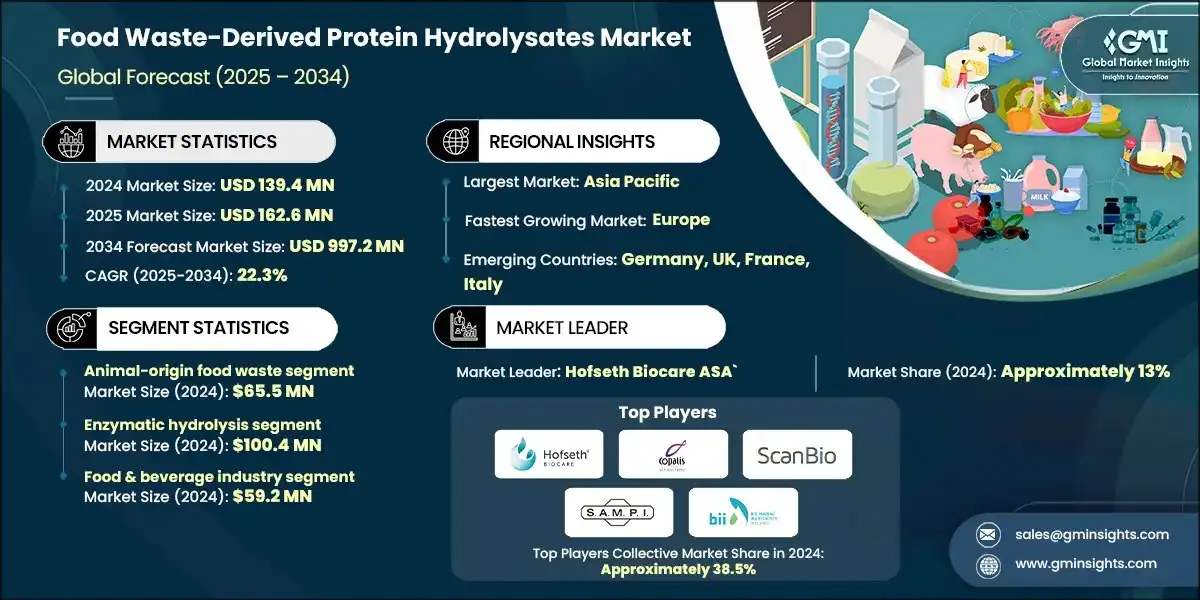
The global food waste-derived protein hydrolysates market was valued at USD 139.4 million in 2024. The market is expected to grow from USD 162.6 million in 2025 to USD 997.2 million in 2034, at a CAGR of 22.3%, according to latest report published by Global Market Insights Inc.
Food Waste-Derived Protein Hydrolysates Market Key Takeaways
Market Size & Growth
- 2024 Market Size: USD 139.4 Million
- 2025 Market Size: USD 162.6 Million
- 2034 Forecast Market Size: USD 997.2 Million
- CAGR (2025–2034): 22.3%
Key Market Drivers
- Circular economy and zero-waste mandates.
- Environmental regulations & sustainability.
- Functional food innovation initiatives.
Challenges
- Feedstock composition variability.
- Collection infrastructure gaps.
Opportunity
- Nutraceutical and bioactive peptide expansion.
- Advanced bioprocessing technologies.
Key Players
- Market Leader: Hofseth Biocare ASA led with over 13% market share in 2024.
- Leading Players: Top 5 players in this market include Hofseth Biocare ASA, Copalis Sea Solutions, Scanbio Marine Group, SAMPI, Bio-Marine Ingredients Ireland, which collectively held a market share of 38.5% in 2024.
Get Market Insights & Growth Opportunities
- Food waste-derived protein hydrolysates are an important component of the circular bioeconomy. They are produced from discarded animal- and plant-based food materials using enzymatic and chemical hydrolysis. The hydrolysis process recovers valuable proteins and bioactive peptides from food waste streams, producing high-quality functional ingredients that match or exceed the performance characteristics of conventional protein sources. With increasing sustainability mandates and zero-waste initiatives, food processors and ingredient manufacturers are prioritizing waste-derived proteins to reduce environmental impact and comply with stringent food waste regulations. The global food industry's commitment to circular economy principles is increasing demand for protein hydrolysates in functional foods, nutraceuticals, and sustainable animal nutrition applications.
- The food and beverage manufacturing sector drives the largest demand for protein hydrolysates, accounting for over 42% of consumption in 2024. Functional food formulations require high-quality protein ingredients for fortification, texture modification, and nutritional enhancement across sports nutrition, infant formula, and health-focused product categories. The superior functionality of protein hydrolysates, with enhanced solubility, emulsification properties, and bioavailability exceeding 90%, creates robust opportunities for ingredient innovation that ensures consistent supply of sustainable protein materials. This circular approach reduces dependency on conventional protein sources while maintaining cost competitiveness and supply chain sustainability.
- Stringent environmental regulations regarding food waste disposal and valorization are accelerating the adoption of protein hydrolysate technologies across industries. Governments worldwide are implementing policies that favor food waste biorefining due to its significantly lower environmental impact compared to landfill disposal or conventional waste treatment. The valorization process generates 70% fewer greenhouse gas emissions and diverts 85% of organic waste from landfills compared to traditional disposal methods. These environmental benefits, combined with regulatory compliance requirements, are driving manufacturers to increase their utilization of food waste-derived protein materials in various applications.
To get key market trends
Food Waste-Derived Protein Hydrolysates Market Trends
- Technological advancement in bioprocessing systems is transforming the industry through implementation of multi-enzyme hydrolysis techniques, continuous processing systems, and AI-driven quality control mechanisms. Modern biorefinery facilities are achieving higher protein recovery rates while reducing energy consumption and processing time. The development of hybrid approaches combining enzymatic, chemical, and physical methods (ultrasound, high-pressure processing) enables more efficient extraction from diverse food waste materials and improved functional characteristics in final products.
- Strengthening regulatory frameworks globally are establishing mandatory food waste diversion targets and extended producer responsibility programs for food manufacturers. Government policies promoting circular bioeconomy principles and penalizing food waste disposal are creating favorable conditions for protein hydrolysate producers. These regulations are standardizing collection systems, improving feedstock segregation quality, and ensuring consistent supply chains while driving investment in biorefining infrastructure and technology upgrades.
- Evolving food industry dynamics are reshaping demand patterns as consumer preferences shift toward sustainable, clean-label ingredients alongside continued growth in functional food categories. While traditional protein sources face environmental scrutiny, waste-derived proteins simultaneously create new opportunities in sports nutrition, health supplements, and plant-based product formulations. The food sector's sustainability commitments are driving preferences for circular economy ingredients, supporting long-term stability despite changing consumer trends.
- Expanding applications in animal nutrition and agricultural biostimulants are opening new segments for protein hydrolysate products. Aquaculture feed formulations, livestock nutrition programs, and organic farming applications require sustainable protein sources with enhanced digestibility and bioactive properties. The integration of circular economy principles in agriculture necessitates alternative ingredient solutions, creating sustained demand for food waste-derived proteins in feed manufacturing and crop production systems.
Food Waste-Derived Protein Hydrolysates Market Analysis
Learn more about the key segments shaping this market
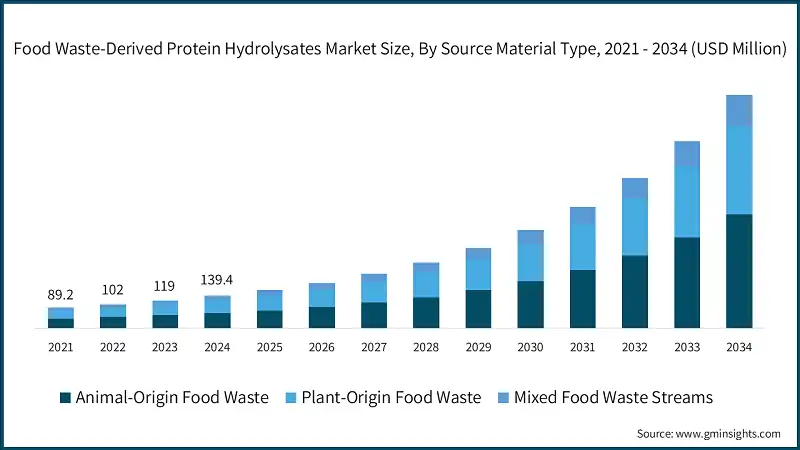
Based on source material type, the market is segmented into animal-origin food waste, plant-origin food waste, and mixed food waste streams. Animal-origin food waste generated USD 65.5 million revenue in 2024 and is anticipated to expand to CAGR of 22.1% during 2025 to 2034, holding a market share of 47% in 2024.
- Animal-origin food waste dominates the food waste-derived protein hydrolysates market due to its superior nutritional profile and high-value bioactive peptide content. The advantages of animal-origin proteins stem from their complete amino acid composition, enhanced biological value, and proven functional properties achieved through processing meat processing waste, seafood byproducts, dairy residues, and egg processing materials. These characteristics make animal-origin hydrolysates particularly suitable for nutraceutical applications, animal feed fortification, and functional food formulations where nutritional completeness and bioactivity are critical requirements.
- Animal-origin food waste has established leadership through its versatility in meeting diverse application requirements across multiple end use industries. By utilizing specific enzymatic hydrolysis techniques, manufacturers can extract bioactive peptides with targeted health benefits such as antioxidant activity, blood pressure regulation, and immune support to match exact customer specifications. This customization capability has enabled animal-origin hydrolysates to capture approximately 47% of the total market, significantly outperforming plant-based alternatives in premium nutraceutical and specialized nutrition applications.
Learn more about the key segments shaping this market
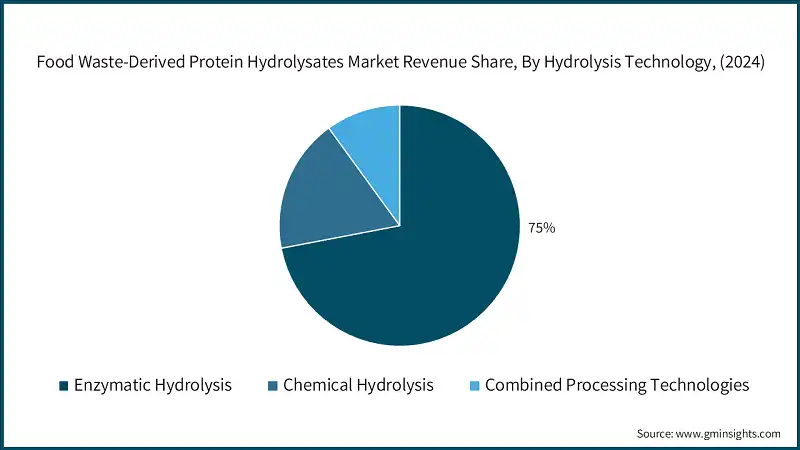
Based on hydrolysis technology, the market is segmented into enzymatic hydrolysis, chemical hydrolysis, and combined processing technologies. Enzymatic hydrolysis generated USD 100.4 million revenue in 2024 and is anticipated to expand to CAGR of 22.4% during 2025 to 2034, holding a market share of 72% in 2024.
- Enzymatic hydrolysis dominates the food waste-derived protein hydrolysates market due to its superior product quality and precise control over functional properties. The advantages of enzymatic processing stem from its ability to produce specific peptide profiles, maintain bioactive compound integrity, and achieve targeted molecular weight distributions through controlled proteolytic enzyme application under mild temperature and pH conditions. These characteristics make enzymatic hydrolysis particularly suitable for food-grade applications, nutraceutical formulations, and functional ingredient production where product safety and bioactivity preservation are critical requirements.
- Enzymatic hydrolysis has established market leadership through its versatility in meeting diverse quality and functionality requirements across multiple end use industries. By selecting specific enzyme types (proteases, peptidases) and optimizing reaction parameters, manufacturers can tailor hydrolysate properties such as solubility, emulsification capacity, and bioactive peptide concentration to match exact customer specifications. This customization capability has enabled enzymatic hydrolysis to capture approximately 72% of the total market, significantly outperforming chemical processing alternatives in premium food and nutraceutical applications.
Based on end use industry, the market is segmented into food & beverage industry, animal feed industry, nutraceutical industry, agricultural industry, and other end-use industries. Food & beverage industry generated USD 59.2 million revenue in 2024 and is anticipated to register at a CAGR of 22.6% during 2025 to 2034, holding a market share of 42.5% in 2024.
- Food & beverage industry dominates the food waste-derived protein hydrolysates market due to the essential role of functional protein ingredients in product fortification, texture modification, and nutritional enhancement across sports nutrition, functional foods, and health-focused product categories. The advantages of protein hydrolysates in food applications stem from their superior solubility, enhanced bioavailability, and clean-label appeal that supports the global food manufacturing ecosystem's sustainability commitments. Despite increasing ingredient options, the food sector maintains strong demand for waste-derived proteins through reformulation initiatives, plant-based product development, and functional beverage innovations that align with circular economy principles.
- Food & beverage industry has established market leadership through the sector's growing emphasis on sustainable ingredient sourcing and regulatory compliance requirements that favor waste valorization practices. The industry benefits from protein hydrolysates' proven functional properties including emulsification, foaming capacity, and water-binding characteristics, enabling efficient product development cycles that reduce costs and environmental impact. This end use segment leverages waste-derived proteins' comparable performance characteristics to conventional sources while meeting increasingly stringent corporate sustainability targets and regulatory mandates for circular economy practices.
- Food applications comprise protein fortification for sports nutrition products, functional beverage formulations, bakery and snack enrichment, meat alternative development, and infant nutrition ingredients. The sports nutrition segment represents the largest consumption area, utilizing protein hydrolysates for manufacturing performance-enhancing products serving the global health and wellness market exceeding USD 400 billion. Functional food applications include protein-enriched beverages, nutritional bars, ready-to-drink shakes, and specialized dietary products where waste-derived hydrolysates provide superior digestibility and amino acid delivery under demanding nutritional requirements.
Looking for region specific data?
The food waste-derived protein hydrolysates market in North America will grow at a CAGR of approximately 20.7% between 2025 and 2034.
- Rising awareness at the corporate level about sustainable ingredient sourcing and circular bioeconomy principles influences the regional drive for waste-derived proteins in food manufacturing, nutraceutical formulations, and animal nutrition applications. At the same time, increasing concerns for food waste reduction have been commencing optimistic trends for advanced protein extraction technologies to gradually replace conventional protein sources and traditional ingredient procurement methods.
- Unique bioprocessing systems and enzymatic innovations epitomize the technical evolution into enhanced efficiency of protein recovery processes together with quality control and cost-saving benefits, making the industrial future of sustainable food production, e.g., in the upcoming era of functional foods, plant-based nutrition, and clean-label ingredient applications.
The food waste-derived protein hydrolysates market in Europe, especially in a few countries like Germany, is expected to grow with a rapid pace in the coming years, especially from 2025 to 2034, with CAGR of 23%.
- Stringent environment-friendly regulations along with established knowledge of sustainable waste valorization methods have observed an incline in food waste-derived protein preference; such incline further augurs well for the protein hydrolysates market.
- R&D explorations of better enzymatic hydrolysis technologies and process optimization in biorefinery and fermentation modes have surged forth with admittable efficiency and expanded protein hydrolysate applications, especially in functional foods and nutraceutical formulations.
- The European market propagated by the circular economy action plan only certifies waste-derived proteins in sustainable food manufacturing formulations and in the process widens market opportunities in a broad spectrum of sectors. Higher investment in R&D and in food waste infrastructure development is expanding the product applications of protein hydrolysate materials.
The food waste-derived protein hydrolysates market in China and India is expected to have lucrative growth between 2025 and 2034, with CAGR of 22.3% in the Asia Pacific region.
- Demand is fueled with a burgeoning food processing sector and spurt in nutraceutical manufacturing, looking for high-quality protein hydrolysate materials produced through advanced enzymatic technology.
- On-going government policies toward zero-waste initiatives and sustainable food production practices further pour in capital investment for the clean production methods with protein extraction facilities.
- Due to the increasing functional food consumption and health supplement markets, Asia Pacific continues utilizing such technologies, with counting on classes in the ingredient manufacturing and nutraceutical applications.
Between 2025 and 2034, the market for food waste-derived protein hydrolysates in the Middle East is projected to grow significantly during this period with CAGR of 22.1%.
- The high rate of food security initiatives, nutraceutical sector growth, and functional food manufacturing demands for high-quality, sustainable, and cost-effective ingredients using the protein hydrolysate processing methods.
- It rides upon regional government programs, which will recommend sustainable development and food waste reduction, thus integrating protein hydrolysates with the food manufacturing, animal nutrition, and health supplement markets.
Between 2025 and 2034, a promising expansion of the food waste-derived protein hydrolysates sector is foreseen in the Latin America with CAGR of 22%.
- High food processing industry growth already enjoys their consideration for sustainable and cost-effective protein ingredients as interest-worthy, encouraging the use of protein hydrolysate technology.
- Awareness is multiplying for the benefits of circular bioeconomy through protein extraction technology, and it is now gaining considerable industrial understanding, much in functional food manufacturing and animal feed production.
- The tremendous boost to protein hydrolysate technology by laws aimed at encouraging sustainable food production and eco-friendly methods of ingredient sourcing, everything appears to be nothing but optimism in the development for that technology in Latin America.
Between 2025 and 2034, the Middle East & Africa (MEA) food waste-derived protein hydrolysates sector is projected to grow strongly, with a CAGR of around 21.8%, driven by rising interest in sustainable ingredient solutions.
- The Middle East & Africa region is experiencing rising pressure on local protein supply due to high reliance on imports, pushing governments and industries to explore alternative domestic protein sources such as food waste-derived hydrolysates.
- Fast-growing poultry, dairy, and aquaculture sectors, especially in Saudi Arabia, Egypt, and South Africa, are driving demand for functional, digestible proteins that enhance feed efficiency—making hydrolysates increasingly relevant.
- Chronic food waste generation, particularly from large urban centers and wholesale markets, is motivating investment in waste-valorization technologies to improve sustainability performance and reduce landfill burdens.
- National sustainability agendas—such as Saudi Arabia’s Vision 2030 and UAE’s circular economy policies—are encouraging industries to adopt eco-efficient ingredient sourcing, supporting early-stage adoption of protein hydrolysate technologies across feed and functional food segments.
Food Waste-Derived Protein Hydrolysates Market Share
In 2024, the global food waste-derived protein hydrolysates market was led by a diverse group of marine biotech companies, dairy ingredient processors, and specialty protein extraction firms, where the top five companies collectively accounted for approximately 38.5% of the market share in 2024, including Hofseth Biocare ASA, Copalis Sea Solutions, Scanbio Marine Group, Arla Foods Ingredients, Ingredia, Frieslandcampina Ingredients and Agropur. These companies hold strong market positions due to their advanced enzymatic processing technologies, integrated waste collection systems, precision hydrolysis capabilities, and strategic partnerships with food processors, enabling efficient protein recovery, bioactive peptide production, and functional ingredient optimization.
- Hofseth Biocare ASA is a leading Norwegian biotech company headquartered in Ålesund, specializing in marine-derived protein hydrolysates with proprietary enzymatic processing technology that converts salmon byproducts into high-value bioactive ingredients. The company operates advanced biorefinery facilities producing hydrolyzed marine proteins, calcium compounds, and omega-3 rich oils while maintaining clinical documentation for health benefits including bone health and muscle recovery, positioning itself as a pioneer in sustainable marine waste valorization and functional ingredient innovation.
- Copalis Sea Solutions operates specialized marine protein extraction facilities in France, focusing on enzymatic hydrolysis of fish processing waste with annual processing capacity handling diverse marine species including cod, haddock, and shellfish byproducts. The company recently expanded its bioactive peptide portfolio with targeted hydrolysates for nutraceutical applications and maintains integrated supply chain operations from coastal processing facilities, serving as a critical supplier to the European functional food and animal nutrition sectors with established customer relationships across pharmaceutical, cosmetic, and dietary supplement industries.
- Scanbio Marine Group is a premier Nordic marine ingredient company based in Norway, processing fish waste from regional seafood industries through specialized enzymatic hydrolysis systems. The company focuses exclusively on sustainable marine protein recovery operations, maintaining advanced quality control systems and established collection networks with fishing communities that enable efficient closed-loop valorization systems supporting the regional aquaculture feed and pet food markets.
Food Waste-Derived Protein Hydrolysates Market Companies
The major players operating in food waste-derived protein hydrolysates industry include:
- Hofseth Biocare ASA
- Copalis Sea Solutions
- Scanbio Marine Group
- SAMPI
- Bio-Marine Ingredients Ireland
- Diana Aqua (Symrise)
- Triplenine Group
- Janatha Fish Meal & Oil Products
- Agropur
- FrieslandCampina Ingredients
- Ingredia
- Arla Foods Ingredients
Food Waste-Derived Protein Hydrolysates Market Report Attributes
| Key Takeaway | Details |
|---|---|
| Market Size & Growth | |
| Base Year | 2024 |
| Market Size in 2024 | USD 139.4 Million |
| Market Size in 2025 | USD 162.6 Million |
| Forecast Period 2025 - 2034 CAGR | 22.3% |
| Market Size in 2034 | USD 997.2 Million |
| Key Market Trends | |
| Drivers | Impact |
| Circular economy and zero-waste mandates | The food processing and ingredient sectors commitment to waste valorization drives steady consumption of protein hydrolysates, supported by conversion efficiency rates exceeding 85% for protein recovery |
| Environmental regulations & sustainability | Stringent environmental policies favoring food waste biorefining over disposal accelerate adoption, as valorization generates 70% fewer emissions and diverts 85% of organic waste from landfills |
| Functional food innovation initiatives | Growing corporate sustainability commitments and government circular bioeconomy policies promote closed-loop food systems, ensuring consistent supply and competitive pricing for sustainable protein ingredients |
| Pitfalls & Challenges | Impact |
| Feedstock composition variability | Fluctuating food waste characteristics and seasonal availability affect processing consistency and product quality, creating uncertainty for standardization and scale-up planning |
| Collection infrastructure gaps | Inefficient segregation systems for food waste in developing regions limit feedstock quality and increase contamination risks, raising operational costs and processing complexity |
| Opportunities: | Impact |
| Nutraceutical and bioactive peptide expansion | Growing demand for health-promoting peptides with antioxidant, antimicrobial, and immunomodulatory properties creates premium market segments for specialized hydrolysates from food waste sources |
| Advanced bioprocessing technologies | Implementation of AI-driven enzymatic systems and hybrid hydrolysis processes enhance protein recovery rates and functional properties, improving economic viability and product differentiation |
| Market Leaders (2024) | |
| Market Leaders |
Market share approximately 13% |
| Top Players |
Collective market share in 2024 is Collective market share approximately 38.5% |
| Competitive Edge |
|
| Regional Insights | |
| Largest Market | Asia Pacific |
| Fastest Growing Market | Europe |
| Emerging Country | Germany, UK, France, Italy |
| Future Outlook |
|
What are the growth opportunities in this market?
Food Waste-Derived Protein Hydrolysates Industry News
- In April 2025, Bel Group and French biotech Standing Ovation announced a major breakthrough in dairy innovation through a precision-fermentation technology that converts under-utilized acid whey into functional bovine casein proteins. The collaboration applies a circular-economy model that reduces waste, optimizes dairy resources, and lowers the carbon footprint. The partnership aims to accelerate industrial-scale production, develop new food applications, and strengthen food sovereignty by creating a sustainable, resource-efficient alternative to traditional dairy protein supply chains.
- In May 2024, Biotech company Enifer has raised (USD 39 million) to build a food-grade mycoprotein factory in Kirkkonummi, Finland. The facility, set to be the world’s first commercial plant producing fungi-based Pekilo protein from food-industry side streams, will cost (USD 35.7 million) and produce up to 3,000 tons annually—enough to feed 40,000 people. Construction, executed as a brownfield project within an existing industrial site, will be completed by the end of next year, supporting Enifer’s mission to scale sustainable mycoprotein production globally.
The food waste-derived protein hydrolysates market research report includes in-depth coverage of the industry with estimates & forecast in terms of revenue (USD Million) & (Kilo Tons) from 2021 to 2034, for the following segments:
Market, By Source Material Type
- Animal-origin food waste
- Plant-origin food waste
- Mixed food waste streams
Market, By Hydrolysis Technology
- Enzymatic hydrolysis
- Chemical hydrolysis
- Combined processing technologies
Market, By End Use Industry
- Food & beverage industry
- Functional foods
- Bakery & confectionery
- Beverages & fortified drinks
- Other
- Animal feed industry
- Poultry feed
- Aquaculture feed
- Livestock feed (cattle, swine)
- Others
- Nutraceutical industry
- Protein supplements
- Amino acid supplements
- Sports & performance nutrition
- Dietary supplements
- Others
- Agricultural industry
- Biofertilizers
- Biostimulants
- Soil conditioners
- Others
- Other end use industries
The above information is provided for the following regions and countries:
- North America
- U.S.
- Canada
- Europe
- UK
- Germany
- France
- Italy
- Spain
- Rest of Europe
- Asia Pacific
- China
- India
- Japan
- South Korea
- Australia
- Rest of Asia Pacific
- Latin America
- Brazil
- Mexico
- Argentina
- Rest of Latin America
- MEA
- UAE
- Saudi Arabia
- South Africa
- Rest of Middle East and Africa
Frequently Asked Question(FAQ) :
What is the market size of food waste-derived protein hydrolysates in 2024?
The market size was USD 139.4 million in 2024, with a CAGR of 22.3% expected through 2034 driven by rising importance in the circular bioeconomy to convert food waste into high-value protein ingredients.
What is the projected value of the food waste-derived protein hydrolysates market by 2034?
The food waste-derived protein hydrolysates market is expected to reach USD 997.2 million by 2034, propelled by sustainability mandates, zero-waste initiatives, and expanding applications across food, feed, and nutraceutical sectors.
What is the current food waste-derived protein hydrolysates market size in 2025?
The market size is projected to reach USD 162.6 million in 2025.
How much revenue did the animal-origin food waste segment generate in 2024?
Animal-origin food waste generated USD 65.5 million in 2024, leading the market with 47% share due to superior nutritional profile and high-value bioactive peptide content.
What was the valuation of enzymatic hydrolysis segment in 2024?
Enzymatic hydrolysis held 72% market share and generated USD 100.4 million in 2024.
What is the growth outlook for the food & beverage industry segment from 2025 to 2034?
The food & beverage industry is projected to grow at a 22.6% CAGR till 2034, fueled by functional food innovation, sustainability commitments, and superior solubility and bioavailability of protein hydrolysates.
Which region leads the food waste-derived protein hydrolysates market?
The North America food waste-derived protein hydrolysates market is set to grow at over 20.7% CAGR from 2025 to 2034, supported by increasing corporate focus on sustainable sourcing and circular bioeconomy practices
What are the upcoming trends in the food waste-derived protein hydrolysates market?
Key trends include advancement in multi-enzyme hydrolysis techniques, AI-driven quality control, hybrid bioprocessing technologies, and expanding applications in nutraceutical and agricultural biostimulant sectors for enhanced protein recovery and functional properties.
Who are the key players in the food waste-derived protein hydrolysates market?
Key players include Hofseth Biocare ASA, Copalis Sea Solutions, Scanbio Marine Group, SAMPI, Bio-Marine Ingredients Ireland, Diana Aqua (Symrise), Triplenine Group, Janatha Fish Meal & Oil Products, Agropur, FrieslandCampina Ingredients, Ingredia, and Arla Foods Ingredients.
Food Waste-Derived Protein Hydrolysates Market Scope
Related Reports