Summary
Table of Content

Food Phosphate Market
Get a free sample of this report
Form submitted successfully!
Error submitting form. Please try again.
Thank you!
Your inquiry has been received. Our team will reach out to you with the required details via email. To ensure that you don't miss their response, kindly remember to check your spam folder as well!
Request Sectional Data
Thank you!
Your inquiry has been received. Our team will reach out to you with the required details via email. To ensure that you don't miss their response, kindly remember to check your spam folder as well!
Form submitted successfully!
Error submitting form. Please try again.
Food Phosphate Market Size
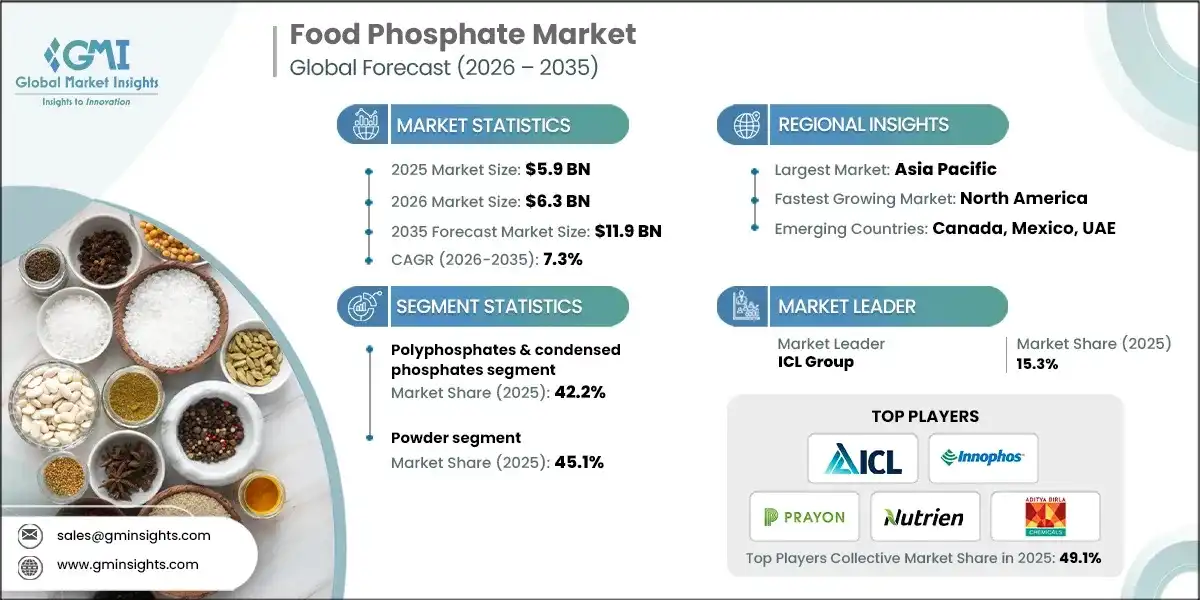
The global food phosphate market size was valued at USD 5.9 billion in 2025. The market is expected to grow from USD 6.3 billion in 2026 to USD 11.9 billion in 2035, at a CAGR of 7.3% according to latest report published by Global Market Insights Inc.
Food Phosphate Market Key Takeaways
Market Size & Growth
- 2025 Market Size: USD 5.9 Billion
- 2026 Market Size: USD 6.3 Billion
- 2035 Forecast Market Size: USD 11.9 Billion
- CAGR (2026–2035): 7.3%
Regional Dominance
- Largest Market: Asia Pacific
- Fastest Growing Region: North America
Key Market Drivers
- Rising demand for processed & convenience foods.
- Growing meat & seafood processing industry.
- Expansion of bakery & confectionery sector.
Challenges
- Health concerns & negative perception of phosphate additives.
- Clean-label movement & consumer preference shift.
Opportunity
- Development of clean-label phosphate solutions.
- Calcium-based phosphate alternatives for health-conscious consumers.
Key Players
- Market Leader: ICL Group led with over 15.3% market share in 2025.
- Leading Players: Top 5 players in this market include ICL Group, Innophos, Inc, Prayon, Nutrien Ltd, Aditya Birla Chemicals, which collectively held a market share of 49.1% in 2025.
Get Market Insights & Growth Opportunities
- Food phosphates, which mainly include sodium phosphate, potassium phosphate, and calcium phosphate, are widely used in the food industry as additives to improve texture, stabilize ingredients, and prolong shelf life. The global market of food phosphates is being propelled by the rising demand for processed foods and convenience foods, which include stabilizers, emulsifiers, and leavening agents derived from phosphates.
- Currently, Asia-Pacific continues to dominate in terms of volume share in the food phosphate market, which increases mainly from the proliferation of processed foods within the urban demographic and its ever-expanding population, increasing the demand for ready-to-eat and packaged foods. North America, however, is the fastest-growing market; it is attributed mainly to the rising demand for processed meat, seafood, bakery, and confectionery products.
- Processed meats and seafood account for the higher proportions of use of food phosphates, often expanding in the convenience segment, and further development in bakery and confectionery, where they play a significant role as leavening agents and dough conditioners.
- The combined scenario of increasing processed food consumption and development in the meat and seafood processing and bakery industries creates a vibrant atmosphere on the global stage for the fortifying food phosphate market. With these industries changing with innovations in technology and consumer trends shifting toward healthier and cleaner-label alternatives during that time, the market is bound to evolve by inventing innovative phosphate solutions.
- The interconnected growth of these processed foods, meat, seafood, and baked goods signifies the importance of food phosphates in sustaining product quality and safety, thereby assuring the on-going global demand variables for such in the food industry.
To get key market trends
Food Phosphate Market Trends
- Innovations in manufacturing technologies to include precise control in chemical synthesis and green extraction methods will optimize food phosphate production for efficiency and sustainability, improving waste reduction, energy savings, and product quality, in line with cleaner, more sustainable manufacturing methods advocated by industries.
- The consumer trend will influence product formulation, compelling manufacturers to innovate using natural mineral sources or bio-based stabilizers. Hence, companies investing in eco-friendly, non-synthetic phosphates probably meet with new-age consumers and regulatory expectations more effectively.
- Global trends of increasingly stringent regulations around food safety and sustainability may or may not be directly from government data sources, but the regulatory environment will influence the market trend by encouraging environmentally friendly methods and safer ingredients for the production of foods. Such legislative shifts will encourage responsible sourcing and manufacturing practices, which require innovations and higher standards by companies, ultimately affecting product development and market competitiveness.
- This development brings quality control and supply chain management of the food phosphate industry into the digital world, using digital technologies such as IoT sensors, AI, and data analytics in manufacturing processes. This technology would enable real-time monitoring of parameters during production to ensure that quality matches the safety standard. Digitalization reduces risks and recalls while creating further transparency, reinforcing confidence between consumers and regulators.
- Concentrating R&D on producing multifunctional phosphates that would serve as stabilizers and indeed provide some additional benefits such as enhanced nutritional value or improved bioavailability means targeting more health-conscious consumers or functional food markets, thereby creating exciting routes for innovation and expansion in markets.
Food Phosphate Market Analysis
Learn more about the key segments shaping this market
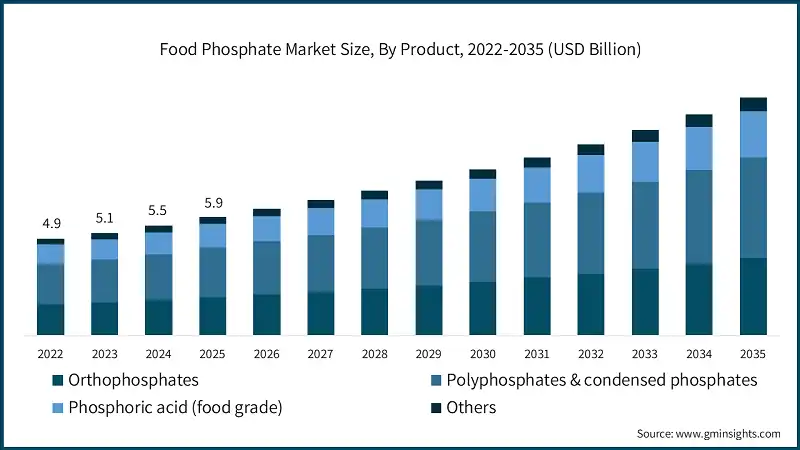
Based on product, the food phosphate market is segmented into orthophosphates, polyphosphates & condensed phosphates, phosphoric acid (food grade) and others. Polyphosphates & condensed phosphates dominated the market with an approximate market share of 42.2% in 2025 and is expected to grow with a CAGR of 7.1% till 2035.
- Polyphosphates & condensed phosphates dominates due to their versatile functionalities, such as water retention, sequestration, and their ability to emulsify, making them appropriate for use in processed foods, meat products, and dairy. The improved texture stability and extension of shelf life entailed drive high demand across multiple applications. Polyphosphates and condensed phosphates, if used as meat processing and seafood preservation, further multiply their applications. Also, cost-effectiveness and ease of use complements their leading position in the industry.
- Orthophosphates are used as the buffering agents or acidity regulators for food products such as those in baking, beverages, and dairy products. Their application is very easy, thus making them preferred in a wide variety of food matrices. Compared to other acids, orthophosphates are mostly classified as acidifiers.
- Phosphoric acid (food grade) finds its application around soft drinks, dairy, and processed foods such as acidity regulators, flavor enhancers, and preservatives. Most demand has sprung from the beverage industry; however, phosphoric acid is reserved for specific applications, like cola formulations, rather than being widely applicable to segments of the food industry.
Learn more about the key segments shaping this market
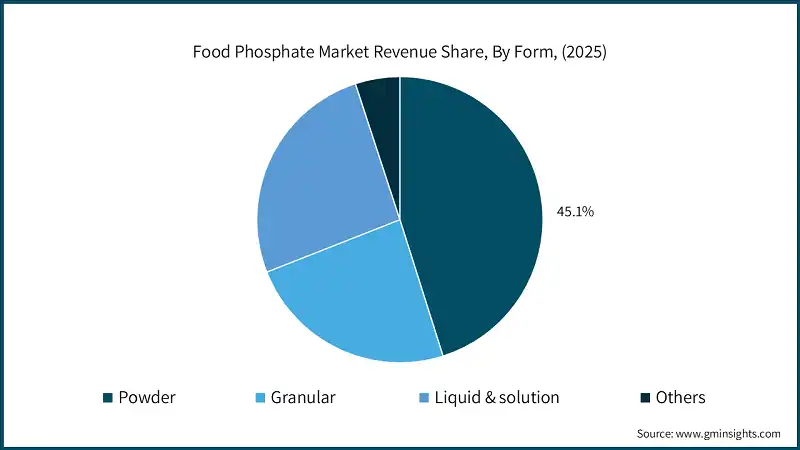
Based on form, the food phosphate market is segmented into powder, granular, liquid & solution, and others. Powder held the largest market share of 45.1% in 2025.
- Powder form leads the market as it is generally easy to handle, stable for storage, and have several applications in different food processes. With the real factor of usage in baked goods, dairy, and meat products, they enhance manufacturing efficiency in making them the preferred ingredients in large-scale industrial productions and contribute very significantly to market growth.
- When it comes to instant beverage-type products and processed meats, granular food phosphates are preferred because of their controlled solubility characteristics. The convenience of dosing and uniformity of mixing support certain niche applications. Liquid and solution forms are growing rapidly into specialized uses such as liquid fortification and immediate-use food products.
- The other category is in pastes or specialized encapsulated phosphates which are being included into some niche markets focusing more on targeted nutrient delivery or innovations in functional foods.
Based on application, the food phosphate market is segmented into meat & seafood processing, bakery, dairy, beverages, processed & convenience foods, confectionery and others.
- Phosphates are a major contributor to meat and seafood processing applications owing to the need for improved texture, moisture retention, and preservation. Thus, this segment drives innovation within functional additives, the demand for which increases with the rising consumption of processed meat products and seafood; thus, helping to spur the growth of the market by adding quality value and shelf life to products.
- Bakery applications use phosphates primarily for dough conditioning, leavening, and extending shelf life to ensure consistent quality and texture of products. Market growth in this bakery segment is essentially propelled by the growing convenience of baked goods.
- Phosphates are used in the dairy industry for stabilization and emulsification, which are essential for products such as cheese, yogurt, and milk-based drinks. Phosphates are used in beverages, especially in functional and dairy-based drinks, to stabilize minerals and electrolyte balance.
- The processed and convenience foods are a vast segment that uses phosphates for texture, moisture retention, and preservation. The growth of this segment corresponds with the trends of the fast-paced lifestyle, thus leading manufacturers to come out with phosphate-based solutions for improved shelf life and product functionality, fueling innovation.
Looking for region specific data?
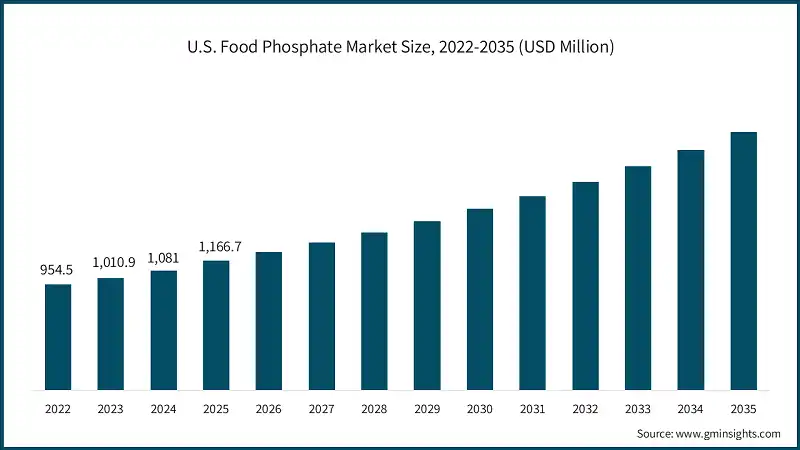
The North America food phosphate market will grow at a CAGR from approximately 7.2% between 2026 and 2035.
- Technological advances include sustainable and efficient methods of manufacturing phosphates such as greener synthesis methods, minimization of wastes during production, and all of these create an expanding environment inculcated by increasing preference by consumers towards environmental responsibility in both product and production practices.
- Adoption of clean label and natural formulations drives the trend toward the use of bio-based alternatives for phosphates, which leads companies to adopt organic and non-synthetic alternative approaches to meet regulatory and consumer expectations.
- Convenience foods, ready-to-eat meals, and functional food products sweep the market, bringing along demand for phosphate-based ingredients in texture, stability, and shelf life: more market boosting.
The food phosphate markets in Europe, especially in a few countries like Germany, are expected to grow with a rapid pace in the coming years.
- Stringent food safety and environmental regulations and circular economy principles increasingly result in the adoption of sustainable methods for sourcing and producing phosphates. The trend in consumer preferences toward environmentally friendly manufacturing influences product development.
- As such, there have been demands for organic, vegan and allergen-free products, pushing investments into cleaner phosphate technologies, such as hypoallergenic sudden-from-hypoallergenic-to-less-allergenic products, and increasing product transparency.
The food phosphate market in China and India is expected to have lucrative growth between 2026 and 2035, with CAGR 7.4% in the Asia Pacific region.
- Rapid urbanization and escalating disposable incomes have been major drivers in the economy for a creating increasing demand for processed foods, bakery, and dairy products, which need phosphate items for textural stability and shelf life.
- Increasing healthcare and wellness markets in such nations drive bio-based phosphate ingredients even for pharmaceuticals, dietary supplements, and functional foods, and reveal health-conscious consumer trends.
Between 2026 and 2035, the market for food phosphate in the Middle East is projected to grow significantly during this period.
- Requirements in hospitality, tourism, and wellness sectors have increased demands for high-quality, eco-friendly solutions in food processing, with phosphate-based stabilizers and preservatives.
- Such government initiatives promote sustainable lifestyles recognized as healthier and encouraged in the region towards incorporating "green" processes of phosphates into the food, supplement, and cosmetic industries. Technological innovations are expected to lower costs while improving safety.
Between 2025 and 2034, a promising expansion of the food phosphate sector is foreseen in the Latin America.
- Increased environmental awareness and concern with sustainable agriculture lead to the application of phosphate-based inputs in practice of eco-friendly farming and in organic production.
- Trade legislation permitting green extraction techniques and sustainable farming practices will be an additional development catalyst in the market for phosphate-based ingredients in natural and functional foods. Income increases and research in bio-based ingredients have informed the development of more ecologically conscious processed foods, supplements, and cosmetics, thus contributing to the overall market growth in the region.
Food Phosphate Market Share
Food phosphate industry is moderately consolidated with players like ICL Group, Innophos, Inc, Prayon, Nutrien Ltd and Aditya Birla Chemicals accounts for 49.1% market share in 2025.
The food phosphate market consists of such leading companies operating mostly in their regional areas. Their long years of experience with food phosphate allow these companies to maintain a strong market position worldwide. Their product offerings are diverse and majorly supported by production capacities and distribution networks, which can serve the increasing demand for food phosphate in various regions.
Food Phosphate Market Companies
Major players operating in the food phosphate industry includes:
- Aditya Birla Chemicals
- FBC Industries, Inc
- Fosfa A.S
- ICL Group
- Innophos, Inc
- Nippon Chemical Industrial Co., Ltd.
- Nutrien Ltd
- Prayon
- Sulux Phosphates
- TKI Hrastnik
- Xingfa Group
ICL Group – One of the top three suppliers of specialty food phosphates worldwide, ICL has vertically integrated operations from rock extraction to food formulations. Meat, bakery, dairy, and beverage applications are served by the company’s “Essential Minerals” and “Specialty Solutions” pillars.
Innophos Inc. – Targeting the food, health, and nutrition phosphates with technical service and application development as the mainstay. Calcium phosphates were recently approved by the FDA in 2025; hence, Innophos cites use as a color additive for defined applications in poultry and confectionery; ~10% yield gain plus improved purge for optimized meat blends was also highlighted by Innophos .
Prayon – A European company with global aspirations, integrated production, and application support to meat, dairy, and bakery. Certification and quality systems distinguish a fair number of the audited supply chains.
Nutrien Ltd. – It uses upstream phosphate assets to supply food-grade streams along with fertilizer and industrial markets. Competitive play remains on scale, resource access, and reliability of supply.
Aditya Birla Chemicals – Major player in Asia with growing international presence; competes on cost advantage, regional proximity, and increasing domestic demand for processed foods.
Food Phosphate Market Report Attributes
| Key Takeaway | Details |
|---|---|
| Market Size & Growth | |
| Base Year | 2025 |
| Market Size in 2025 | USD 5.9 Billion |
| Market Size in 2026 | USD 6.3 Billion |
| Forecast Period 2026-2035 CAGR | 7.3% |
| Market Size in 2035 | USD 11.9 Billion |
| Key Market Trends | |
| Drivers | Impact |
| Rising demand for processed & convenience foods | Driving increased consumption and application of food phosphates globally |
| Growing meat & seafood processing industry | Expanding the market for phosphate-based preservatives and stabilizers worldwide |
| Expansion of bakery & confectionery sector | Boosting the use of phosphates as leavening agents and dough conditioners on a global scale. |
| Pitfalls & Challenges | Impact |
| Health concerns & negative perception of phosphate additives | Pose significant challenges, potentially limiting market growth and innovation |
| Clean-label movement & consumer preference shift | Create a demand for safer, natural, and transparent phosphate solutions in the global market |
| Opportunities: | Impact |
| Development of clean-label phosphate solutions | Offers opportunities for industry players to meet consumer demands and expand their market share internationally |
| Calcium-based phosphate alternatives for health-conscious consumers | Present a strategic opportunity to capture new segments within the global food phosphate market |
| Market Leaders (2025) | |
| Market Leaders |
15.3% |
| Top Players |
|
| Competitive Edge |
|
| Regional Insights | |
| Largest Market | Asia Pacific |
| Fastest growing market | North America |
| Emerging countries | Canada, Mexico, UAE |
| Future outlook |
|
What are the growth opportunities in this market?
Food Phosphate Industry News
- In July 2025, Innophos exposed VersaCal Bright as the newly launched clean label whitening alternative of titanium dioxide. It got approval by FDA as a safe color additive with the calcium phosphate in a new product that could be included in food applications for manufacturers looking for a more nutrient-rich and safer product.
- In May 2024, Budenheim established a facility for high purity mineral phosphates, which would increase its capacity for food and nutrition ingredients by 4,400 tonnes per year. The facility, named "House of Nutrition", produces an ultra-pure range of calcium, magnesium, and iron phosphates for sensitive markets such as infant formula and medical nutrition.
This food phosphate market research report includes in-depth coverage of the industry, with estimates & forecasts in terms of revenue (USD Billion) and volume (Kilo Tons) from 2022 to 2035, for the following segments:
Market, By Product
- Orthophosphates
- Sodium orthophosphates
- Potassium orthophosphates
- Calcium orthophosphates
- Magnesium phosphates
- Ammonium phosphates
- Polyphosphates & condensed phosphates
- Pyrophosphates (diphosphates)
- Tripolyphosphates
- Hexametaphosphates
- Trimetaphosphates
- Phosphoric acid (food grade)
- Others
Market, By Form
- Powder
- Granular
- Liquid & solution
- Others
Market, By Application
- Meat & seafood processing
- Fresh & frozen meat
- Processed & cured meats
- Poultry products
- Seafood & fish products
- Others
- Bakery
- Breads & rolls
- Cakes & pastries
- Biscuits & cookies
- Baking powders & mixes
- Others
- Dairy
- Ice cream & frozen desserts
- Processed cheese & cheese spreads
- Yogurt & cultured products
- Others
- Beverages
- Fruit juices & nectars
- Carbonated soft drinks
- Sports & energy drinks
- Coffee creamers & whiteners
- Others
- Processed & convenience foods
- Ready meals
- Soups & sauces
- Instant noodles
- Others
- Confectionery
- Candies & sweets
- Chewing gum
- Others
- Others
The above information is provided for the following regions and countries:
- North America
- U.S.
- Canada
- Europe
- Germany
- UK
- France
- Spain
- Italy
- Rest of Europe
- Asia Pacific
- China
- India
- Japan
- Australia
- South Korea
- Rest of Asia Pacific
- Latin America
- Brazil
- Mexico
- Argentina
- Rest of Latin America
- Middle East and Africa
- Saudi Arabia
- South Africa
- UAE
- Rest of Middle East and Africa
Frequently Asked Question(FAQ) :
What was the market size of the food phosphate in 2025?
The market size was valued at USD 5.9 billion in 2025, growing at a CAGR of 7.3% till 2035. The market is driven by the increasing demand for processed and convenience foods that utilize phosphate-based additives.
What is the projected value of the food phosphate market by 2035?
The market is poised to reach USD 11.9 billion by 2035, fueled by advancements in manufacturing technologies and rising consumer demand for sustainable and functional food products.
What is the expected size of the food phosphate industry in 2026?
The market size is expected to reach USD 6.3 billion in 2026.
What was the market share of polyphosphates and condensed phosphates in 2025?
Polyphosphates and condensed phosphates held a market share of approximately 42.2% in 2025 and are expected to grow at a CAGR of 7.1% through 2035.
What was the market share of the powder form segment in 2025?
The powder form segment dominated the market with a 45.1% share in 2025, attributed to its ease of handling, storage stability, and wide application in baked goods, dairy, and meat products.
What is the growth outlook for the North American food phosphate sector?
The North American market is projected to grow at a CAGR of approximately 7.2% up to 2035. The market is led by technological advancements in sustainable manufacturing and increasing consumer preference for environmentally responsible products.
What are the upcoming trends in the food phosphate market?
Key trends include advances in green manufacturing, increased use of IoT and AI for quality control, development of multifunctional nutritional phosphates, and a shift toward eco-friendly, non-synthetic phosphate products.
Who are the key players in the food phosphate industry?
Major players include Aditya Birla Chemicals, FBC Industries, Inc., Fosfa A.S, ICL Group, Innophos, Inc., Nippon Chemical Industrial Co., Ltd., Nutrien Ltd, Prayon, Sulux Phosphates, TKI Hrastnik, and Xingfa Group.
Food Phosphate Market Scope
Related Reports