Summary
Table of Content

Food-grade Excipients Market
Get a free sample of this report
Form submitted successfully!
Error submitting form. Please try again.
Thank you!
Your inquiry has been received. Our team will reach out to you with the required details via email. To ensure that you don't miss their response, kindly remember to check your spam folder as well!
Request Sectional Data
Thank you!
Your inquiry has been received. Our team will reach out to you with the required details via email. To ensure that you don't miss their response, kindly remember to check your spam folder as well!
Form submitted successfully!
Error submitting form. Please try again.
Food-grade Excipients Market Size
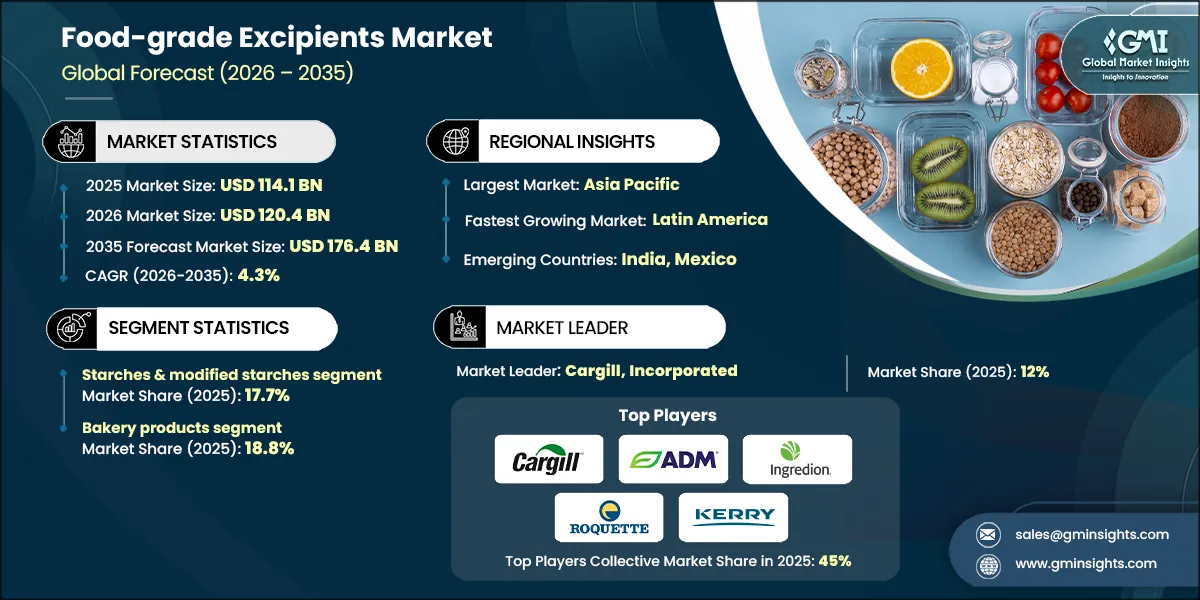
The global food-grade excipients market was valued at USD 114.1 billion in 2025. The market is expected to grow from USD 120.4 billion in 2026 to USD 176.4 billion in 2035, at a CAGR of 4.3% according to latest report published by Global Market Insights Inc.
Food-grade Excipients Market Key Takeaways
Market Size & Growth
- 2025 Market Size: USD 114.1 Billion
- 2026 Market Size: USD 120.4 Billion
- 2035 Forecast Market Size: USD 176.4 Billion
- CAGR (2026–2035): 4.3%
Regional Dominance
- Largest Market: Asia Pacific
- Fastest Growing Region: Latin America
Key Market Drivers
- Rising demand for processed & convenience foods.
- Growth of plant-based food industry.
- Clean label & natural ingredient trends.
Challenges
- Stringent regulatory requirements & approval delays.
- Consumer skepticism toward synthetic additives.
Opportunity
- Microencapsulation for controlled release applications.
- Bio-based & fermentation-derived excipients.
Key Players
- Market Leader: Cargill, Incorporated led with over 12% market share in 2025.
- Leading Players: Top 5 players in this market include Cargill, Incorporated, Archer Daniels Midland (ADM), Ingredion Incorporated, Roquette Frères, Kerry Group plc, which collectively held a market share of 45% in 2025.
Get Market Insights & Growth Opportunities
- The food-grade excipients market is shifting its strategic direction because food processing and nutraceuticals and functional ingredients sectors demand cleaner and safer and more stable formulation elements. Excipients which manufacturers used to view as non-essential substances now serve as vital components for product differentiation and regulatory compliance and formulation performance. Food-grade excipients serve as essential elements that manufacturers use to enhance product quality standards because they help create product stability and texture improvement and controlled release and better processing performance.
- The innovation of formulation science enables excipients to achieve new functional capabilities which drive the market towards products that enable advanced food engineering and next-generation product development. The design of modern excipients enables scientists to develop products that match special ingredient requirements through their capability to function in multiple roles. The industry is now choosing excipients which provide clean-label characteristics and enhanced traceability and complete ingredient transparency to meet brand requirements for building consumer trust and product quality.
- The food-grade excipients market has transformed sustainability into a core component of its competitive business strategies. Companies are increasingly prioritizing excipients sourced from renewable inputs, produced through low‑impact processing, or designed to support waste‑reduction initiatives. The adoption of environmentally sustainable production methods enables supply chains to achieve stronger operational resilience while helping excipient producers reach their corporate sustainability objectives. The transition supports a wider movement towards using materials which deliver excellent performance while protecting environmental interests.
To get key market trends
Food-grade Excipients Market Trends
- Food-grade excipients are changing contemporary food production methods because they bring new standards that require better performance and safer products with sustainable materials. The auxiliary ingredients which were once used for structural support and processing simplicity have become essential elements that enable companies to create cleaner product labels with better nutrition and extended product shelf life. Their role has evolved into a strategic asset which assists manufacturers in meeting strict regulations while providing customers with information about product origins and authenticity of natural ingredients.
- The current market development accelerates because advanced ingredient engineering technologies progress at a fast pace. The development of plant-based polymers and the optimized starch systems and fermentation-derived functional materials has transformed the methods used by formulators to create textures and control solubility and moisture levels while enhancing sensory experiences.
- The incorporation of smart functionalities into sealant systems is yet another paradigm shift. Self-healing technologies and sensor enabled sealants are gathering momentum owing to the predictive maintenance capabilities they offer at extending service life. In conjunction with the digital performance management platforms of vessels, these create new value propositions for operators that seek efficiency and reliability in extremely harsh offshore environments.
- The use of Food-grade Excipients not merely as commodities, but as strategic enablers of performance, safety and environmental stewardship in a maritime operation of the next generation, has enlarged their scope to include structural integrity, fire and emission standard compliance, plus compatibility with renewable infrastructure such as foundations for offshore wind.
Food-grade Excipients Market Analysis
Learn more about the key segments shaping this market
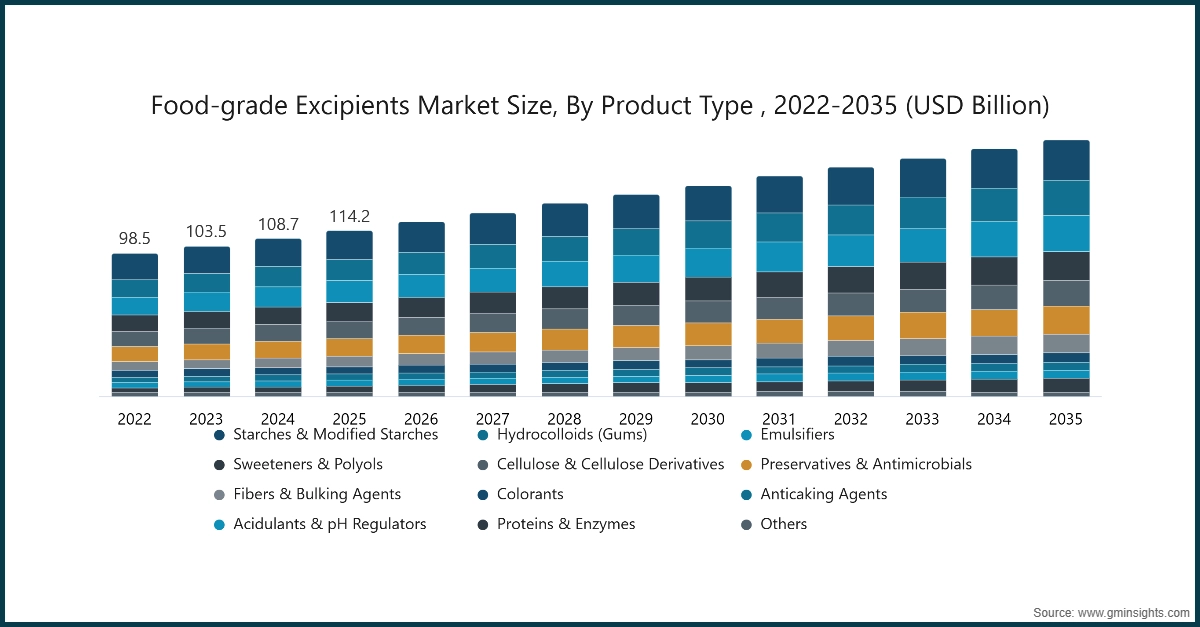
Based on product type, the market is segmented into starches & modified starches, hydrocolloids (gums), emulsifiers, sweeteners & polyols, cellulose & cellulose derivatives, preservatives & antimicrobials, fibers & bulking agents, colorants, anticaking agents, acidulants & Ph regulators, proteins & enzymes, others. Starches & modified starches dominated the market with an approximate market share of 17.7% in 2025 and is expected to grow with a CAGR of 3.1% by 2035.
- Starches and modified starches, along with hydrocolloids, anchor the category by providing viscosity and binding strength and texture refinement across diverse applications which extend from bakery products to ready meals and dairy alternatives. The formulation capabilities of sweeteners and polyols and cellulose derivatives and emulsifiers reach new heights because these ingredients stabilize complex food matrices while they manage moisture and enhance mouthfeel and maintain product uniformity in both traditional and reformulated product lines.
- The market now demands excipients which provide clean-label solutions and environmentally friendly products and raw materials sourced from natural origins as both consumer preferences and regulatory requirements undergo transformation. Manufacturers rely on fibers and bulking agents and natural colorants and plant-derived stabilizers to support their move towards synthetic additive elimination which allows them to keep product performance at its required level.
Learn more about the key segments shaping this market
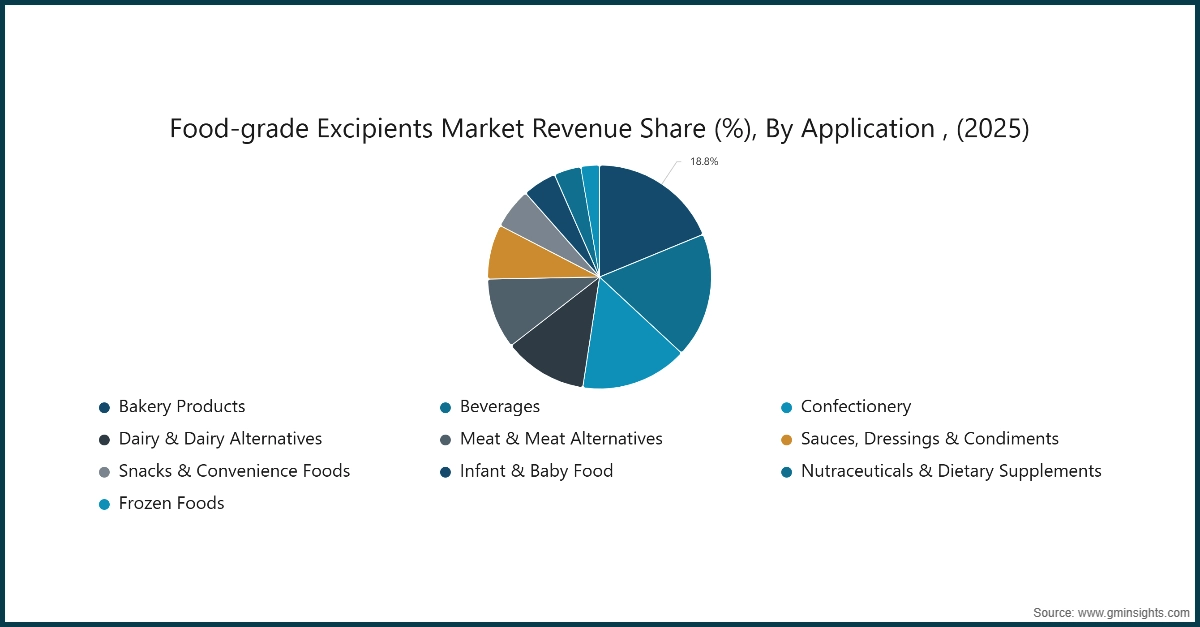
Based on application, the food-grade excipients market is segmented into bakery products, beverages, confectionery, dairy & dairy alternatives, meat & meat alternatives, sauces, dressings & condiments, snacks & convenience foods, infant & baby food, nutraceuticals & dietary supplements, frozen foods. Bakery products held the largest market share of 18.8% in 2025 and is expected to grow at a CAGR of 4% during 2026-2035.
- The baking, confectionery, beverage, and snack industries use excipients which include starches and gums and emulsifiers and sweeteners to create product structures that maintain stability and produce aerated textures and uniform mouthfeel throughout various processing challenges. Producers use these ingredients to deliver traditional dairy product standards through plant-based products which help maintain product balance between emulsification and creaminess and freeze-thaw stability and protein system maintenance.
- Excipients function as essential elements which enable product safety and bioactive availability and food nutrient enhancement and active ingredient output control in baby food and nutraceuticals and dietary supplements. The system achieves its function by providing micronutrient stability and taste protection through bitterness and increased active ingredient dispersibility and degradation protection of sensitive materials throughout processing and storage.
Looking for region specific data?
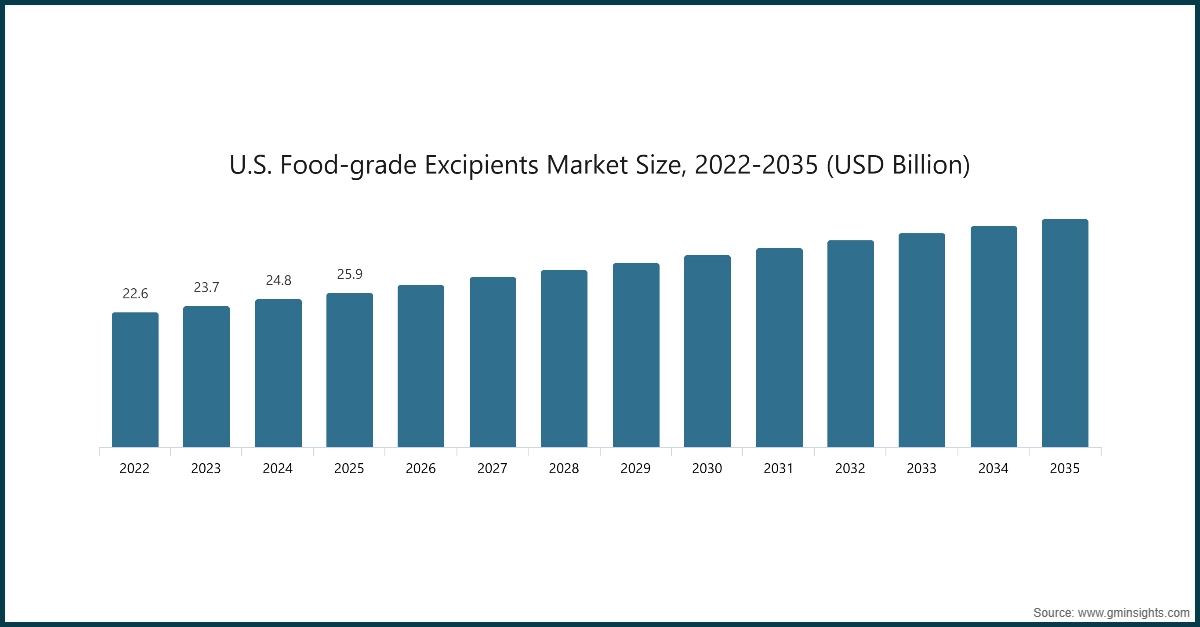
The North America food-grade excipients industry is growing rapidly on the global level with a market share of 27.7% in 2025.
- The region's companies operate in an established regulatory system which prioritizes safety and product quality and ingredient traceability to protect consumers according to required standards which depend on high-performance excipients to fulfill its needs. As brands reformulate to meet evolving dietary preferences, regional manufacturers are increasingly relying on excipients that help optimize texture, stability, flavor release, and product consistency across a diverse range of applications.
Europe food-grade excipients market growing in the industry with revenue of USD 29.3 Billion in 2025 and is anticipated to show lucrative growth over the forecast period.
- The region maintains advanced excipient solutions as mandatory requirements because it enforces strict regulations that control ingredient safety and ingredient purity and ingredient traceability. The situation creates a need for excipients that improve formulation effectiveness and product reformulation processes and fulfill the rising demand for clean-label products and naturally derived materials and sustainable components in both mainstream products and specialty food items.
The Asia Pacific food-grade excipients market is anticipated to grow at a CAGR of 5% during the analysis timeframe.
- Asian Pacific manufacturers use food-grade excipients to solve the challenges which arise from process changes that require product reformulation with less sugar and less fat and with plant-based ingredients. The industry now requires excipients which enhance mouthfeel and support protein structuring and boost emulsification and increase freeze-thaw stability because these materials help produce products which match local dietary patterns while meeting international quality requirements.
Latin America food-grade excipients accounted for 7.1% market share in 2025 and is anticipated to show highest growth over the forecast period.
- The Latin American Food‑grade Excipients market is gaining strategic importance as the region’s food and beverage industry becomes increasingly sophisticated and innovation‑driven. The market for excipients is expanding because consumers now demand processed and fortified and convenient food products which require excipients to achieve their stability and texture and clean label requirements.
Middle East & Africa Food-grade Excipients accounted for 3.9% market share in 2025 and is anticipated to show lucrative growth over the forecast period.
- The Middle East and Africa food-grade excipients market experiences growth because the region improves its food processing technology and develops new product lines while consumers demand better packaged food products. Manufacturers from both local and international markets turn to excipients in order to stabilize their product designs which helps them maintain product quality during extreme weather conditions and meet the region's demand for easy-to-use healthy traditional food products.
Food-grade Excipients Market Share
The top 5 companies in Food-grade Excipients industry include Cargill, Incorporated, Archer Daniels Midland (ADM), Ingredion Incorporated, Roquette Frères, Kerry Group plc. These are prominent companies operating in their respective regions covering approximately 45% of the market share in 2025. These companies hold strong positions due to their extensive experience in food-grade excipients market. Their diverse product portfolios, backed by robust production capabilities and distribution networks, enable them to meet the rising demand across various regions.
- Cargill, Incorporated functions as a worldwide organization that provides diverse services to food production and agricultural and industrial supply sectors. The organization operates through its entire process which starts with obtaining raw materials and goes through commodity processing and risk handling and ends with delivering starches and sweeteners and oils and cocoa and other food ingredients to manufacturers across the globe.
- Archer Daniels Midland (ADM) operates as a primary agricultural commodity processor who supplies food and beverage and nutritional products. The company handles all operations required to transform raw agricultural materials into finished products that include sweeteners and starches and oils and proteins and specialized nutrition products.
- Ingredion Incorporated provides solutions that deliver ingredient materials which include starches and sweeteners and texturizers and plant-based proteins and nutrition ingredients that come from corn and tapioca and potatoes and pulses. The company offers its portfolio to food and beverage and brewing and pharmaceutical and industrial sectors which require manufacturers to address their functional requirements for texture and sweetness and stability and formulation efficiency.
- Roquette Frères produces plant-based ingredients and excipients which are used in food and nutrition and pharmaceutical and industrial products. The company produces solutions which contain starches and fibers and polyols and proteins and specialty excipients that serve both consumer food products and health-related items through its use of raw materials which include corn and wheat and potatoes and peas.
- Kerry Group plc delivers taste and nutritional and functional ingredient solutions to markets that serve food and beverage and pharmaceutical industries. The company offers a product range which includes flavors and enzymes and proteins and nutritional lipids and various functional systems to enhance sensory attributes and nutritional content and product effectiveness.
Food-grade Excipients Market Companies
Major players operating in the food-grade excipients industry include:
- Cargill, Incorporated
- Ingredion Incorporated
- Kerry Group plc
- Archer Daniels Midland Company (ADM)
- DuPont de Nemours, Inc.
- DSM-Firmenich
- Ashland Global Holdings Inc.
- BENEO GmbH (Südzucker Group)
- Roquette Frères
- Corbion N.V.
- Jungbunzlauer Suisse AG
- J. Rettenmaier & Söhne GmbH + Co KG (JRS)
- Palsgaard A/S
- CP Kelco (J.M. Huber Corporation)
- TIC Gums (Ingredion)
- Silvateam S.p.a.
Food-grade Excipients Market Report Attributes
| Key Takeaway | Details |
|---|---|
| Market Size & Growth | |
| Base Year | 2025 |
| Market Size in 2025 | USD 114.1 Billion |
| Market Size in 2026 | USD 120.4 Billion |
| Forecast Period 2026-2035 CAGR | 4.3% |
| Market Size in 2035 | USD 176.4 Billion |
| Key Market Trends | |
| Drivers | Impact |
| Rising demand for processed & convenience foods | Higher demand for excipients which serve as vital elements that help maintain product stability and improve its texture and extend the duration of its storage according to product development needs |
| Growth of plant-based food industry | The growth of plant-based food products through their development process requires more excipients which improve their sensory qualities and their ability to be processed through manufacturing |
| Clean label & natural ingredient trends | Demand for natural-based excipients that undergo minimal processing which forces manufacturers to update their product lines toward transparent and pure solutions |
| Pitfalls & Challenges | Impact |
| Stringent regulatory requirements & approval delays | Delayed market entry for products while raising costs for regulatory compliance which interferes with research and development schedules |
| Consumer skepticism toward synthetic additives | Customers demand safe materials which they can identify through product labels |
| Opportunities: | Impact |
| Microencapsulation for controlled release applications | Enables precise delivery of flavors and nutrients and active substances which creates new business opportunities in controlled release products |
| Bio-based & fermentation-derived excipients | Advanced environmentally friendly ingredients to establish product differences in their offerings |
| Market Leaders (2025) | |
| Market Leader |
12% Market Share |
| Top Players |
Collective Market Share of 45% in 2025 |
| Regional Insights | |
| Largest Market | Asia Pacific |
| Fastest growing market | Latin America |
| Emerging countries | India, Mexico |
| Future outlook |
|
| Companies covered: | 16 |
| Tables, Charts & Figures: | 205 |
| Countries covered: | 18 |
| No of Pages: | 190 |
What are the growth opportunities in this market?
Food-grade Excipients Industry News
- In December 2025, ICL has entered an agreement to acquire Bartek Ingredients, a global supplier of food-grade malic and fumaric acid to industries such as food, beverage, confectionery and baked foods. The ingredients are used to enhance flavor profiles, extend shelf life and improve overall quality in end products.
- In May 2025, Roquette, a global player in plant-based ingredients and pharmaceutical excipients for the health and nutrition sectors, announced the successful completion of its acquisition of IFF Pharma Solutions. This strategic milestone marks a significant step forward in its ambifion to become a leader in support of the global pharma markets.
These food-grade excipients market research report includes in-depth coverage of the industry, with estimates & forecasts in terms of revenue (USD Billion) and volume (Kilo Tons) from 2022 to 2035, for the following segments:
Market, By Product Type
- Starches & modified starches
- Hydrocolloids (gums)
- Emulsifiers
- Sweeteners & polyols
- Cellulose & cellulose derivatives
- Preservatives & antimicrobials
- Fibers & bulking agents
- Colorants
- Anticaking agents
- Acidulants & ph regulators
- Proteins & enzymes
- Others
Market, By Application
- Bakery products
- Beverages
- Confectionery
- Dairy & dairy alternatives
- Meat & meat alternatives
- Sauces, dressings & condiments
- Snacks & convenience foods
- Infant & baby food
- Nutraceuticals & dietary supplements
- Frozen foods
The above information is provided for the following regions and countries:
- North America
- U.S.
- Canada
- Europe
- Germany
- UK
- France
- Spain
- Italy
- Rest of Europe
- Asia Pacific
- China
- India
- Japan
- Australia
- South Korea
- Rest of Asia Pacific
- Latin America
- Brazil
- Mexico
- Argentina
- Rest of Latin America
- Middle East and Africa
- Saudi Arabia
- South Africa
- UAE
- Rest of Middle East and Africa
Frequently Asked Question(FAQ) :
What is the food-grade excipients market size in 2025?
The market size for food-grade excipients is valued at USD 114.1 billion in 2025. The rising demand for processed and convenience foods, coupled with the growth of plant-based food products, is driving market expansion.
What is the market size of the food-grade excipients industry in 2026?
The market size for food-grade excipients is projected to reach USD 120.4 billion in 2026, reflecting steady growth driven by clean-label trends and increasing demand for natural ingredients.
What is the projected value of the food-grade excipients market by 2035?
The market size for food-grade excipients is expected to reach USD 176.4 billion by 2035, growing at a CAGR of 4.3%. This growth is fueled by advancements in bio-based excipients and the adoption of microencapsulation technologies for controlled release applications.
Which product type dominated the food-grade excipients industry in 2025?
Starches and modified starches dominated the market in 2025, holding a 17.7% share. This segment is expected to grow at a CAGR of 3.1% during the forecast period, driven by its widespread use in various food applications.
What was the largest application segment in the food-grade excipients market in 2025?
Bakery products held the largest market share of 18.8% in 2025. This segment is anticipated to grow at a CAGR of 4% from 2026 to 2035, supported by increasing consumer demand for baked goods and convenience foods.
What is the growth outlook for the North American food-grade excipients market?
North America accounted for 27.7% of the global market in 2025, making it a key regional player. The region's growth is driven by advancements in food processing technologies and the rising demand for clean-label products.
What are the key trends shaping the food-grade excipients industry?
Key trends include the rising demand for natural and minimally processed excipients, the growth of plant-based food products, and the adoption of bio-based and fermentation-derived excipients. Additionally, microencapsulation for controlled release applications is creating new opportunities in the market.
Who are the key players in the food-grade excipients market?
Key players include Cargill, Incorporated; Archer Daniels Midland (ADM); Ingredion Incorporated; Roquette Frères; Kerry Group plc; DuPont de Nemours, Inc.; DSM-Firmenich; Ashland Global Holdings Inc.; BENEO GmbH (Südzucker Group); Corbion N.V.; and Jungbunzlauer Suisse AG.
Food-grade Excipients Market Scope
Related Reports