Summary
Table of Content

Food Enzymes Market
Get a free sample of this report
Form submitted successfully!
Error submitting form. Please try again.
Thank you!
Your inquiry has been received. Our team will reach out to you with the required details via email. To ensure that you don't miss their response, kindly remember to check your spam folder as well!
Request Sectional Data
Thank you!
Your inquiry has been received. Our team will reach out to you with the required details via email. To ensure that you don't miss their response, kindly remember to check your spam folder as well!
Form submitted successfully!
Error submitting form. Please try again.
Food Enzymes Market Size
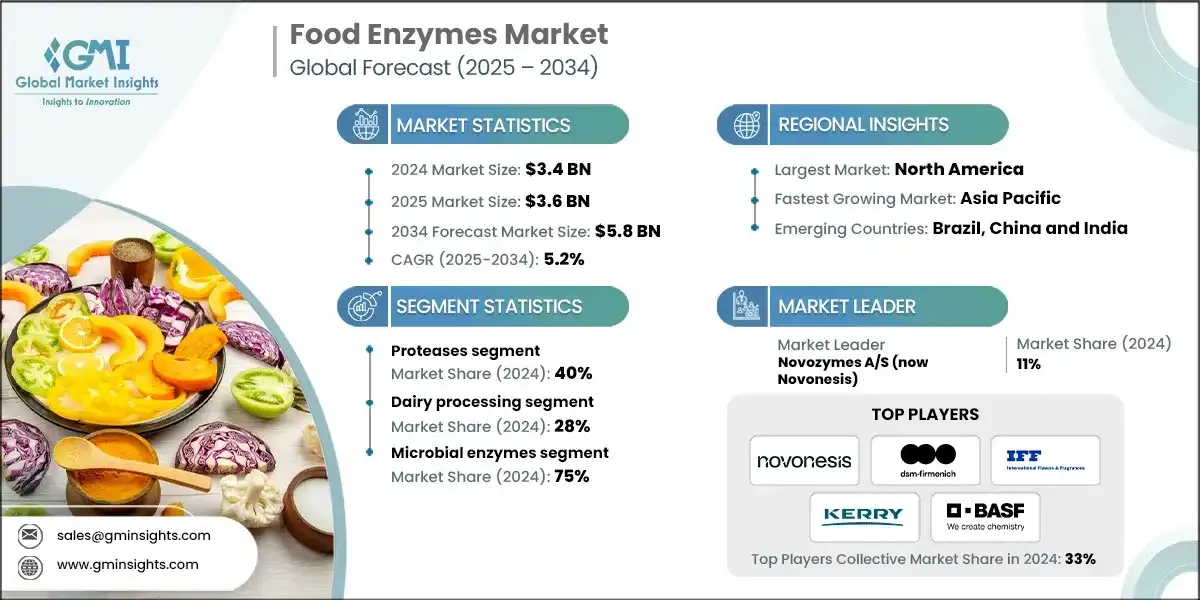
The global food enzymes market size was estimated at USD 3.4 billion in 2024. The market is expected to grow from USD 3.6 billion in 2025 to USD 5.8 billion in 2034, at a CAGR of 5.2% according to latest report published by Global Market Insights Inc.
To get key market trends
- The food enzymes market is predicted to continue gradually progressing through the coming decade. The key factors which support the underlying strength of markets have been responsible for this rising trend.
- The rising demand from the food processing sector for enzyme-based solutions has created a huge and growing market. Enzymes help in improving productivity, reducing costs, and enhancing the quality of products among a plethora of food categories.
- The growth of this sector is further supported by the increasing scale of industrial food processing all over the world. A demand for processing aids like enzymes increases with increased food production. Besides, the high demand for processed and convenience foods in emerging regions creates new fronts for applications of enzymes.
- The R&D investments for enzyme technologies have never been so high as now, with leading companies investing huge amounts for innovations. Continuous investments in research and development keep the influx of new solutions and maintain long-term sustainable market growth. These investments further demonstrate the ability of the market to remain resilient through economic cycles-gaining all along, for the very socio-economic nature of food processing operations.
Food Enzymes Market Report Attributes
| Key Takeaway | Details |
|---|---|
| Market Size & Growth | |
| Base Year | 2024 |
| Market Size in 2024 | USD 3.4 Billion |
| Market Size in 2025 | USD 3.6 Billion |
| Forecast Period 2025 - 2034 CAGR | 5.2% |
| Market Size in 2034 | USD 5.8 Billion |
| Key Market Trends | |
| Drivers | Impact |
| Growing demand for clean label products | Use of natural ingredients is indeed spurring the adoption of enzyme-based processing solutions rather than the synthetic ones |
| Increasing food processing efficiency requirements | Improvement in yield, processing time, and product quality is needed in industrial food production |
| Rising health & wellness consciousness | Digestive health and functional food properties applied to benefits widens the horizon for enzyme applications |
| Pitfalls & Challenges | Impact |
| Regulatory compliance complexity | Different countries food safety standards and approval processes represent barriers for manufacturers of enzymes |
| High R&D investment requirements | Enormous capital input is needed for development, testing, and commercialization of enzymes |
| Opportunities: | Impact |
| Emerging applications in plant-based foods | New specialized enzymes bringing textures, flavors, or nutritional profiles within reach of meat substitutes, dairy alternatives, and plant proteins are becoming increasingly required by the substitution for animal-based diets within new applications of plant-based diet consumption |
| Biotechnology innovation pipeline | Enzyme solutions for more efficient, stable, and cost-effective food processing |
| Market Leaders (2024) | |
| Market Leaders |
11% |
| Top Players |
Collective Market Share of 33% in 2024 |
| Competitive Edge |
|
| Regional Insights | |
| Largest Market | North America |
| Fastest Growing Market | Asia Pacific |
| Emerging Country | Brazil, China and India |
| Future Outlook |
|
What are the growth opportunities in this market?
Food Enzymes Market Trends
- The food enzymes industry is evolving, owing to changes in consumer preferences, evolving technologies, and standards. Emerging trends in the industry is plant-based food that has branched into enzymes, wherein the demand for finely crafted enzymes came about. The use of proteases helps to improve the functionalities of plant proteins, improving texture and contribute to mouth as well as bite sensations to simulate meat alternatives. Transglutaminase enzymes are being increasingly used in binding plant proteins and creating meat-like textures, and lipases are being used as flavor improvers for plant-based dairy products.
- Food enzymes have thus become fundamental tools for the development of low-cost and nourishing plant-based lines that deliver consumer acceptability. Technology is transforming the market for food enzymes. More advanced biotechnologies like directed evolution or protein engineering are employed to develop more stable, active, and specific enzymes suitable for various applications in food, thereby significantly speeding up the demand for catalyzed variant-development processes.
- For the development of enzyme candidate variants for industrial conditions, the accelerated path shortened by gene editing technology through CRISPR-Cas9 makes it feasible to have an edge in discovering the most optimal of many adapters for two to seven enzyme variants. Integration of AI and machine learning into the process of enzyme discovery further adds value to predictive capabilities and savings with a reduction in development costs.
- Furthermore, synthetic biology platforms used in secondary metabolite synthesis-based strategies are a way forward for expanded enzyme production by modifying microbial hosts and alternative novel systems to support the reconstitution of enzymes considered to be hard to synthesize so far. As they continually develop, one cannot overlook how the fast-changing enzymes have contributed to sustainability and scalability in the food industry.
Food Enzymes Market Analysis
Learn more about the key segments shaping this market
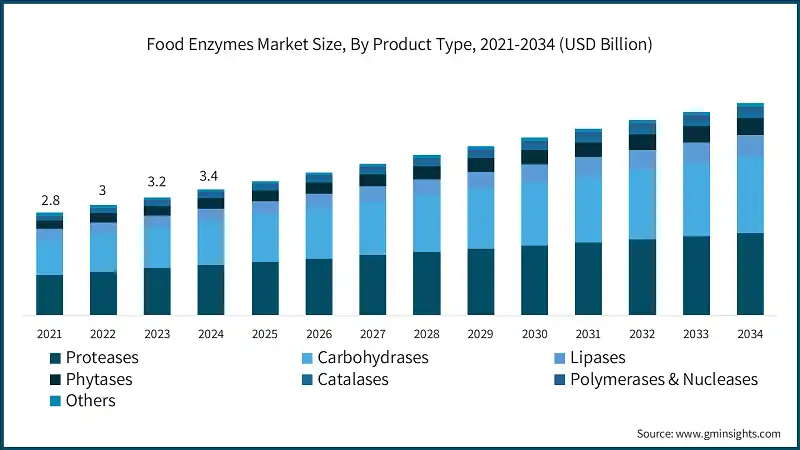
Based on product type, the food enzymes market is segmented into proteases, carbohydrases, lipases, phytases, catalases, polymerases & nucleases, other. Proteases dominated the market with an approximate market share of 40% in 2024 and is expected to grow with a CAGR of 4.9% by 2034.
- Proteases dominate the market due to their wide-ranging usefulness in applications such as meat tenderization, dairy processing, baking, and brewing. Proteases are important for improving the texture, digestibility, and even taken into complete account the overall product quality, particularly in both traditional and plant-based formulations. Proteases as ever when the demand for protein-rich and functional foods continues to increase.
- Carbohydrases constitute the strongest segment for starch conversion, baking, and brewing. Enzymes like alpha-amylases and glucoamylases are crucial for the conversion of complex carbohydrates to simple sugars, which can then be used in various food applications. The taste of the consumers grows toward clean-label sweeteners and functional carbohydrates that make using carbohydrases even more popular. In modern food manufacture, the three parameters sweetness, texture, and nutrition are made indispensable by consumers of a healthier and more natural food alternative.
- More specialized niches are lipases, phytases, and catalases that are coming into prominence day by day based on their unique functionalities. People prefer lipases mostly for modifying fats and giving taste benefits in dairy products and baking items. Phytase is in accordance with the increasing popularity of plant-based diets and is responsible for better mineral absorption and reduced anti-nutritional factors present in plant foods.
- Catalases, although of less volume of use, have earned quite a significant place in their ability to scavenge hydrogen peroxide and oxidative damage to provide longer shelf life and quality foods. Thus, all these enzymes represent a dot spectrum of the evolving needs of the food industry, where innovation and functionality are responsible for market growth.
Learn more about the key segments shaping this market
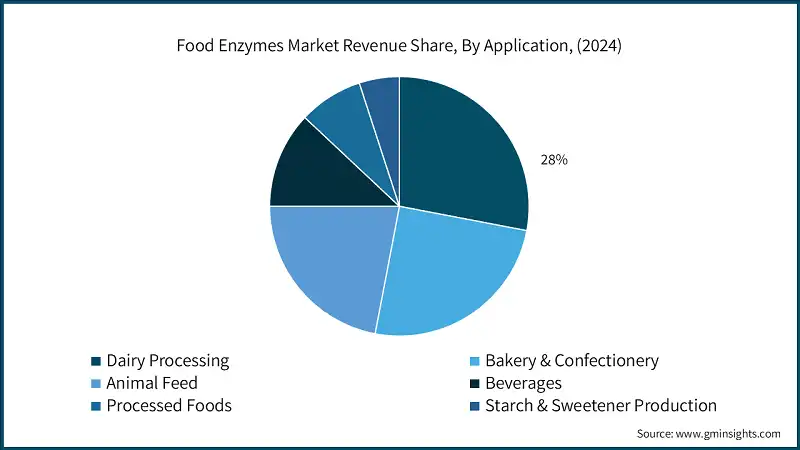
Based on applications, the food enzymes market is segmented into dairy processing, bakery & confectionery, animal feed, beverages, processed foods, starch & sweetener production. Dairy processing holds the largest market share of 28% in 2024 and is expected to grow at a CAGR of 4.9% during 2025 to 2034.
- Dairy processing is the dominant, because enzymes are of utmost importance to produce cheese by means of coagulating agents such as rennet, and it is becoming a very significant substance in lactase-hydrolyzed milk product development due to the widely increasing demand from consumers for inclusive nutritional options. Also, specialized enzyme systems enhance flavor, texture, and lifetime in much more advanced dairy processing today. Proteases and lipases are used to affect proteins and fats, respectively, to produce premium dairy products like artisanal cheeses and functional dairy products combing health-conscious consumers.
- Bakery and confectionery applications are another major segment in the food enzymes market, where high demand from texture, shelf life, and clean label formulations saw enzymes such as alpha-amylases perform actions like using starch-modifying phenomena in dough handling and creating freshness in baked goods. Increasing special bakeries and artisanal products have been an impetus to the increased consideration of enzymes in consistency and quality.
- Furthermore, xylanases and hemicellulases have increased in propulsion, where modern-day applications aim to speed up the textural and machinability improvement of dough, especially for whole grain and high-fiber products. These can help overcome challenges resulting from increased fiber content, yet they still retain the being of desirable sensory attributes.
- Animal feed applications contribute a hundred percent to the food enzymes market due to demand from feeds for optimizing efficiency and productivity in livestock and contributing to environmental sustainability in livestock production. Phytase is a major enzyme used in this section, as it influences the improvement of phosphorus usage and resultant reduction of the use of inorganic supplements.
- It also has the proper mechanism through which mineral bioavailability could be enhanced and waste output minimized. This is part of the general movement toward sustainable agriculture by the industries. Enzyme solutions, therefore, form a central theme towards better feeding and the lowest possible negative environmental effects as the pressure on responsible animal nutrition further intensifies.
Based on sources, the food enzymes market is segmented into microbial enzymes, genetically modified enzymes, plant-derived enzymes, animal-derived enzymes. Microbial enzymes segment dominated the market with an approximate market share of 75% in 2024 and is expected to grow with the CAGR of 4.9% by 2034.
- Microbial enzymes are widely used across food sectors due to their for flavor, texture, and shelf life improvement across a vast range of products, including dairy and baked products, enzymes are generated from bacteria, fungi, and yeasts. Bulk industrial production would best capture their additional qualities, particularly for the clean label grocery market, which is on the rise.
- Due to their enhanced performance and flexibility, TCGM enzymes are now gaining immense favor. In this modern age, the enzymes obtained upwards some significant features like tolerance against extremities of temperatures, pH, and other harsh conditions concerning the food processing, engineered with recent biotechnological procedures. Their scope is widening in terms of applications in enhancing efficiency, reducing production costs, and innovating fermentation and baking. Although the regulatory issues will be there against them and consumer perceptions shall provide hindrances, using these enzymes represents the best way for most manufacturers to enhance food quality and sustainability by virtue of their precision and effectiveness.
- Plant enzymes and animal enzymes are niche enzymes, but they still have their place in some applications. For example, plant-based enzymes from fruits, vegetables, or legumes are becoming more popular among consumers as demands for natural or organic ingredients increase. Aside from aiding digestibility of the food product, they are also found in numerous bakery and beverage formulations to enhance sensory traits. Traditionally, animal-based enzymes like rennet and pepsin are used for processing almost all forms of dairy and meat products, especially traditional and premium products. However, the sources of the enzymes and dietary restrictions are gradually changing to microbial and plant-based sources, reflecting a general trend toward more ethical and sustainable food sourcing.
Looking for region specific data?
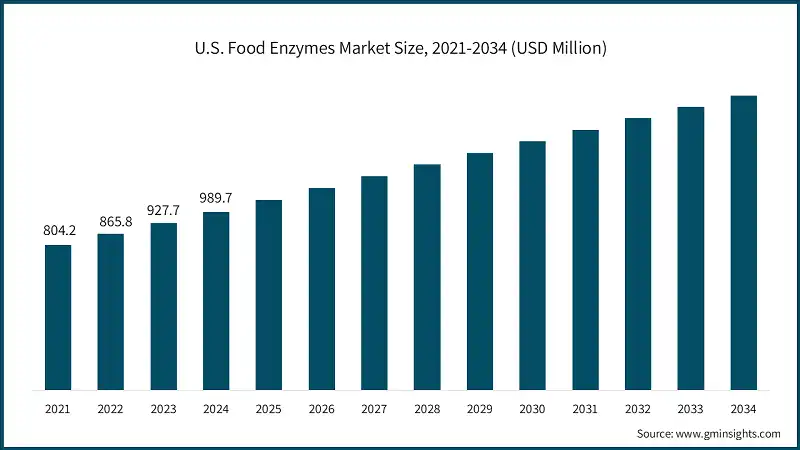
The North America food enzymes market dominated around 25% of the revenue share in 2024.
- North America remains with large regional market share during 2024, supported by the developed food processing structures, strong regulatory frameworks, and highly aware consumers concerning the enzyme benefits. Advanced food processing infrastructure together with strong regulatory frameworks and consumer awareness of enzyme benefits further support the regional market loudness on account of the presence of key enzyme manufacturers, innovation, and R&D-led market development.
U.S. dominates the North America food enzymes market, showcasing strong growth potential.
- Approximately 83% of North American consumption in 2024 is propelled by the large-scale food processing industries and organized supply chain networks within the region of the U.S., which represents the country markets.
Europe food enzymes accounted for USD 1 billion in 2024 and is anticipated to show lucrative growth over the forecast period.
- Europe has a stronghold in second position, accounting for 30% of the market, growing at a 4.9% CAGR, maintaining strong food processing traditions, stringent quality standards, and increasing consumer demand for natural food ingredients. The market in this region features sophisticated applications and premium product segments, where enzymes support the production of high-value specialty foods and beverages.
Germany dominates the European food enzymes market, showcasing strong growth potential.
- Germany, France, and the United Kingdom represent the largest country markets in the region, with each country exhibiting unique patterns of application and growth drivers. The European Union regulatory environment is convoluted, yet it provides extensive safety assessment measures to instill consumer confidence in enzyme-processed food. The strong concerns regarding sustainability and environmental aspects in this region have prompted enzyme solutions that reduce energy consumption, waste generation, and enhance resource utilization in food processing operations..
The Asia Pacific food enzymes market is anticipated to grow at a CAGR of 5.8% during the analysis timeframe.
- Asia Pacific is driven by rapid industrialization in food processing, population growth in the middle class, and steadily rising consumption of processed foods and convenience foods.
China food enzymes is estimated to grow with a significant CAGR in the Asia Pacific Food Enzymes materials.
- Among the countries, China is increasingly emerging as the largest market, as it has domestic enzyme production capabilities and increasing demand from many food processing sectors. India and Japan are also pretty large markets, but they have different application patterns and unique growth opportunities at the same time, contributing to the regional market growth.
Latin America food enzymes market accounted for 5.7% market share in 2024 and is anticipated to show lucrative growth over the forecast period.
- The Latin America market is appearing for a wide variety of food enzymes. Its commercialization, changing eating habits, and demand for processed and functional foods keep evolving with time. The region's food industry applies these enzyme technologies in bakery, dairy, beverages, and meat processing with a view to enhancing the quality, shelf life, and nutrition of food products. Recently, there has been an increased consumer shift toward clean-label and natural ingredients, thereby urging manufacturers to adopt enzyme-based solutions for health and sustainability.
Brazil leads the Latin American food enzymes market, exhibiting remarkable growth during the analysis period.
- Brazil alone seems to dominate the region in food enzyme innovation, powered this way by solid agro-industrial infrastructure and the developing food processing sector. The country sees vigorous development of enzymes in bakery applications-due to carbohydrases-and dairy, where proteases help in holding dough stability, texture, and flavor. In Brazil, manufacturers are actively investigating enzyme formulations for products that fulfill personalized nutrition trends.
Middle East & Africa food enzymes market accounted for 3% market share in 2024 and is anticipated to show lucrative growth over the forecast period.
- Urbanization, growing health consciousness, and development in the food and wellness sectors are the key factors boosting interest in food enzymes across the Middle East and Africa. In the Middle East, consumers are increasingly attracted to clean-label products and functional nutrition. In turn, food manufacturers have been prompted to explore enzyme solutions that improve the quality, shelf life, and nutritional value of food products. Enzymes are used across several food categories, such as bakery goods, dairy, beverages, and processed foods, where they enhance texture, digestibility, and flavor.
Saudi Arabia food enzymes market to experience substantial growth in the Middle East and Africa market in 2024.
- Saudi Arabia is an important growth market in the region, with the food processing, healthcare, and hospitality sectors promoting an uptake of enzymes. The country is using enzyme technologies to develop fortified and functional foods suited for changing dietary lifestyles. Enzymes are used in convenient forms-as powders and pastes-for snacks, beverages, and supplements for busy and health-savvy consumers.
Food Enzymes Market Share
The top 5 companies in food enzymes industry include Novozymes A/S (now Novonesis), DSM-Firmenich, International Flavors & Fragrances Inc. (IFF), Kerry Group plc, BASF SE. These are prominent companies operating in their respective regions covering 33% of the market share in 2024. These companies hold strong positions due to their extensive experience in food enzymes market. Their diverse product portfolios, backed by robust production capabilities and distribution networks, enable them to meet the rising demand across various regions.
- Novozymes A/S, now operating as Novonesis following its merger with Chr. Hansen, is a Denmark-based biotechnology company specializing in industrial enzymes and microbial solutions. The company serves sectors including agriculture, food and beverage, bioenergy, and household care.
- DSM-Firmenich is a Swiss-based company formed through the merger of DSM and Firmenich. It operates across nutrition, health, and beauty sectors, offering ingredients and solutions for food, supplements, fragrances, and personal care and a portfolio that includes vitamins, enzymes, probiotics, and flavor compounds.
- International Flavors & Fragrances Inc. (IFF) is a U.S.-based specialty chemicals company that develops and markets products in taste, scent, nutrition, and biosciences. It operates through segments such as Nourish, Health & Biosciences, Scent, and Pharma Solutions.
- Kerry Group plc is an Ireland-based company that provides taste and nutrition solutions to the food, beverage, and pharmaceutical industries. Its operations span functional ingredients, enzymes, flavors, and bioactives. The company serves both retail and foodservice channels across multiple regions, including Europe, the Americas, and Asia-Pacific.
- BASF SE is a German multinational chemical company with operations in chemicals, materials, industrial solutions, surface technologies, nutrition & care, and agricultural solutions. It offers products ranging from petrochemicals and plastics to crop protection and food ingredients.
Food Enzymes Market Companies
Major players operating in the food enzymes industry include:
- Novozymes A/S (now Novonesis)
- DSM-firmenich
- International Flavors & Fragrances Inc. (IFF)
- Kerry Group plc
- BASF SE
- Chr. Hansen Holding A/S
- Associated British Foods plc
- Advanced Enzyme Technologies Ltd
- Kemin Industries Inc
- Amano Enzyme Inc
- Biocatalysts Ltd
- Enzyme Development Corporation
- Maps Enzymes Ltd
- Creative Enzymes
- Prozomix Ltd
- Nagase ChemteX Corporation
- Enzyme Solutions Inc
- Biocon Ltd
Food Enzymes Industry News
- In January 2025, the expansion of Novozymes' enzyme production facility in Denmark at a whopping investment of USD 150 million would up-scale 40% of its food-grade enzymes capacity essentially to meet the rapidly growing international demands of plant-based food manufacturers only.
- In December 2024, DSM-Firmenich launched its thermostable amylases, aimed specifically at high-temperature baking applications to improve process efficiency and extend shelf life in industrial bakery operations.
- In November 2024, IFF (International Flavors & Fragrances Inc.) received FDA GRAS approval for its novel transglutaminase-enzyme system for plant-based meat alternatives, thereby beginning to open up application opportunities in this rapidly growing alternative-protein market.
This food enzymes market research report includes in-depth coverage of the industry, with estimates & forecasts in terms of revenue (USD Billion) and volume (Kilo Tons) from 2025 to 2034, for the following segments:
Market, By Product Type
- Proteases
- Rennet & chymosin
- Pepsin & trypsin
- Papain & bromelain
- Microbial proteases
- Carbohydrases
- Alpha-amylase
- Glucoamylase & pullulanase
- Cellulase & hemicellulase
- Pectinase & xylanase
- Lipases
- Animal lipases
- Microbial lipases
- Plant-derived lipases
- Phytases
- Microbial Phytases
- Genetically modified phytases
- Catalases
- Bovine liver catalase
- Microbial catalases
- Polymerases & Nucleases
- DNA polymerases
- RNA processing enzymes
- Other
- Transglutaminases
- Glucose oxidase
- Invertase & lactase
Market, By Application
- Dairy processing
- Cheese production & coagulation
- Milk processing & modification
- Whey processing & protein recovery
- Lactose-free product development
- Bakery & confectionery
- Dough conditioning & strengthening
- Anti-staling & shelf-life extension
- Texture & volume improvement
- Acrylamide reduction
- Animal feed
- Phytase applications
- Carbohydrase applications
- Protease applications
- Multi-enzyme complexes
- Beverages
- Juice clarification & processing
- Brewing & fermentation
- Wine production & quality enhancement
- Sports & functional beverages
- Processed foods
- Protein modification & texturization
- Fat replacement & reduction
- Flavor enhancement
- Nutritional fortification
- Starch & sweetener production
- Glucose syrup production
- High fructose corn syrup (HFCS)
- Maltodextrin & modified starches
- Specialty sweeteners
Market, By Source
- Microbial enzymes
- Bacterial sources
- Fungal sources
- Yeast sources
- Genetically modified enzymes
- Recombinant chymosin
- Gm microbial enzymes
- Engineered enzyme variants
- Plant-derived enzymes
- Papain from papaya
- Bromelain from pineapple
- Ficin from fig
- Animal-derived enzymes
- Pancreatin
- Pepsin
- Animal Rennet
The above information is provided for the following regions and countries:
- North America
- U.S.
- Canada
- Europe
- Germany
- UK
- France
- Spain
- Italy
- Rest of Europe
- Asia Pacific
- China
- India
- Japan
- Australia
- South Korea
- Rest of Asia Pacific
- Latin America
- Brazil
- Mexico
- Argentina
- Rest of Latin America
- Middle East and Africa
- Saudi Arabia
- South Africa
- UAE
- Rest of Middle East and Africa
Frequently Asked Question(FAQ) :
What are the upcoming trends in the food enzymes market?
Trends include advanced biotechnologies, CRISPR-based enzyme development, AI-driven discovery, synthetic biology, and sustainability in plant-based foods.
Who are the key players in the food enzymes industry?
Major players include Novozymes A/S, DSM-firmenich, International Flavors & Fragrances Inc. (IFF), Kerry Group plc, BASF SE, Chr. Hansen Holding A/S, Advanced Enzyme Technologies Ltd, Kemin Industries Inc, and Amano Enzyme Inc.
What is the growth outlook for the dairy processing segment from 2025 to 2034?
The dairy processing segment, which held the largest market share of 28% in 2024, is anticipated to showcase around 4.9% CAGR up to 2034.
Which region leads the food enzymes sector?
North America leads the market, accounting for approximately 25% of the revenue share in 2024. This dominance is attributed to advanced food processing infrastructure, strong regulatory frameworks.
What was the market share of proteases in 2024?
Proteases dominated the market with an approximate share of 40% in 2024 and is expected to witness over 4.9% CAGR till 2034.
What is the market size of the food enzymes in 2024?
The market size was estimated at USD 3.4 billion in 2024, with a CAGR of 5.2% expected through 2034. The growth is driven by advancements in biotechnology, increasing demand for plant-based foods, and evolving consumer preferences.
What is the projected value of the food enzymes market by 2034?
The market is poised to reach USD 5.8 billion by 2034, supported by innovations in enzyme development, rising adoption of plant-based diets, and sustainability initiatives in the food industry.
What is the expected size of the food enzymes industry in 2025?
The market size is projected to reach USD 3.6 billion in 2025.
What was the valuation of the microbial enzymes segment in 2024?
The microbial enzymes segment accounted for approximately 75% of the market share in 2024 and is set to expand at a CAGR of 4.9% through 2034.
Food Enzymes Market Scope
Related Reports