Summary
Table of Content

Food Cans Market
Get a free sample of this report
Form submitted successfully!
Error submitting form. Please try again.
Thank you!
Your inquiry has been received. Our team will reach out to you with the required details via email. To ensure that you don't miss their response, kindly remember to check your spam folder as well!
Request Sectional Data
Thank you!
Your inquiry has been received. Our team will reach out to you with the required details via email. To ensure that you don't miss their response, kindly remember to check your spam folder as well!
Form submitted successfully!
Error submitting form. Please try again.
Food Cans Market Size
The market expands owing various factors to create higher demand which includes increase in shelf-stable packaging solutions, rising demand for sustainable packaging, growth in the ready-to-eat (RTE) food segment, increasing demand for processed and canned foods, & technological advancements in can design.
Food Cans Market Key Takeaways
Market Size & Growth
- 2025 Market Size: USD 115.9 Billion
- 2026 Market Size: USD 119.6 Billion
- 2035 Forecast Market Size: USD 158.4 Billion
- CAGR (2026–2035): 3.2%
Regional Dominance
- Largest Market: Asia Pacific
- Fastest Growing Region: Asia Pacific
Key Market Drivers
- Increase in shelf-stable packaging solutions.
- Rising demand for sustainable packaging.
- Growth in the ready-to-eat (RTE) food segment.
- Increasing demand for processed and canned foods.
- Technological advancements in can design.
Challenges
- Competition for alternative packaging.
- Fluctuating raw material prices.
Opportunity
- Expansion in emerging markets.
- Innovations in smart packaging.
Key Players
- Market Leader: Conagra Brands led with over 12% market share in 2025.
- Leading Players: Top 5 players in this market include Conagra Brands, Campbell Soup Company, Kraft Heinz Company, Hormel Foods Corporation, Nestlé S.A., which collectively held a market share of 40% in 2025.
Get Market Insights & Growth Opportunities
The food cans industry is experiencing growth as consumers prefer shelf-stable can packaging which provides them with extended product durability and extended storage time. For instance, in January 2023, Israeli food tech company Vgarden, Ltd introduced its fish-free canned tuna alternative which consists of pea protein. Vgarden product meets and surpasses consumer expectations by closely matching the texture and nutritional attributes of traditional tuna.
Additionally, the rise in processed and canned food demand drives market expansion as consumers require products which provide them with easy access and extended product durability and simple storage solutions. According to the USDA reports that American citizens consumed 35.5 lbs of corn products which included flour meal and starch in 2022. The growth demonstrates how consumers now prefer to purchase ready-to-eat meals and snacks. Canned foods provide this trend because they deliver fresh products which retain their nutritional content and use environmentally friendly affordable packaging.
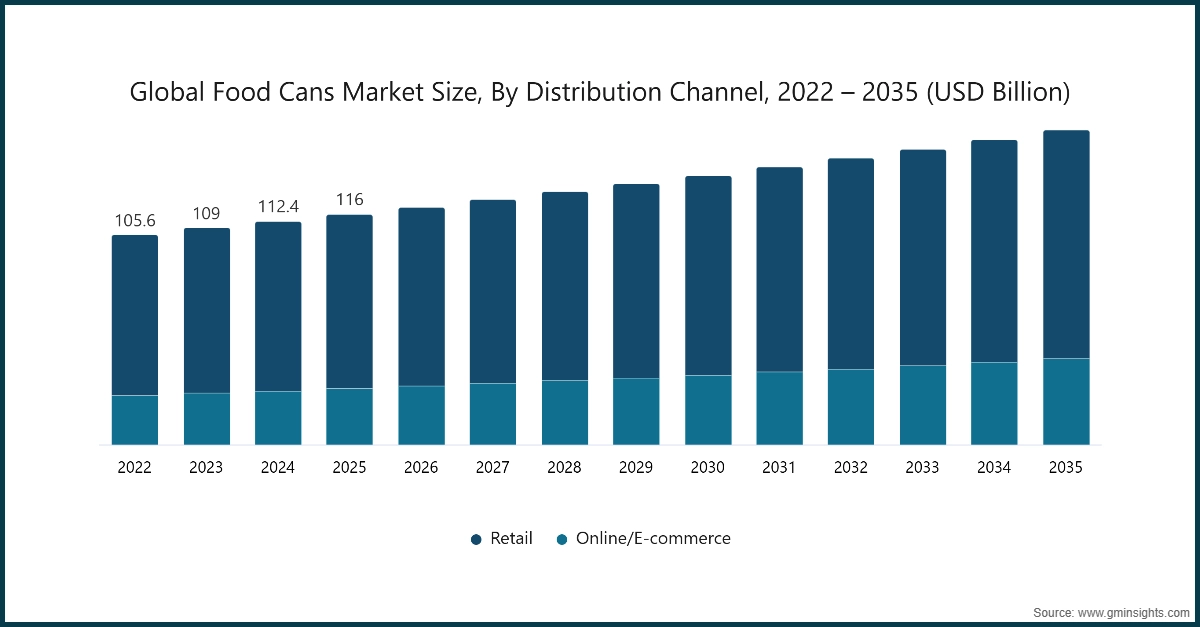
The food cans market witnessed considerable growth, increasing from USD 105.6 billion in 2022 to USD 112.4 billion in 2024. The market is growing as consumers now prefer sustainable packaging solutions which create increasing demand for eco-friendly products. The ready-to-eat (RTE) food segment experiences growth which drives this market expansion because it provides customers with easy-to-use products that remain fresh for extended periods. The development of better materials and preservation methods through technological progress in can design enables products to achieve increased durability and visual attractiveness and operational capabilities which result in market expansion.
The global food cans market was valued at USD 115.9 billion in 2025. The market is expected to grow from USD 119.6 billion in 2026 to USD 158.4 billion in 2035, at a CAGR of 3.2% during the forecast period according to the latest report published by Global Market Insights Inc.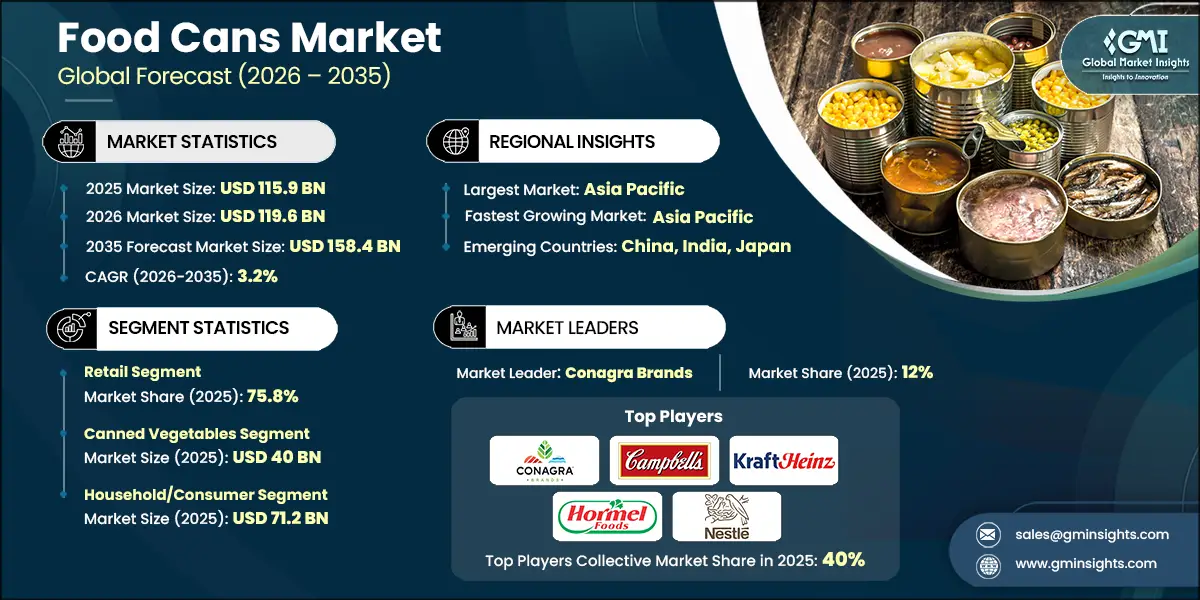
To get key market trends
Food Cans Market Trends
- The food cans industry is experiencing growth as people become more aware of food preservation methods. Manufacturers use sustainable materials and designs to decrease their carbon emissions while reducing food waste and improving product recyclability. For Instance, in June 2023, a special food can called Ecopeel was introduced in Spain and Italy. The closure system completely replaces ring pulls which leads to lower carbon emissions using lighter materials and refined materials instead of foil body materials.
- The food cans market began moving toward premium and organic products since consumers developed health awareness about their dietary choices and wanted to eat sustainable food options which contained fewer artificial ingredients. The trend has been becoming more popular since 2010 as people learn about food and nutrition and prefer products that contain few artificial ingredients. The organic high-quality clean-label canned foods market at its highest point will reach its peak between 2025 and 2030 when more brands introduce their products.
- The market began to offer more plant-based options as people started to adopt plant-based diets and environmental issues became more important during the middle of 2010. Food can producers develop plant-based food products because consumers prefer vegan and vegetarian diets for health and environmental reasons. The number of people who want ethical and sustainable food options continues to grow, which will make this trend reach its peak around 2028 to 2030.
Food Cans Market Analysis
Learn more about the key segments shaping this market
By distribution channel, the food cans market is segmented into retail, & online/E-commerce.
- The retail segment dominated the market in 2025, accounting for 75.8% market share. Supermarkets and hypermarkets provide widespread product availability which allows customers to access goods easily while businesses conduct promotional activities which results in more customers preferring to shop at one location. Retail channels also support bulk purchases and brand visibility, making them the primary distribution choice for canned food products.
- The online/E-commerce segment is anticipated to grow at a CAGR of 4.4% during the forecast period. Online/E-commerce exists as more people access the internet while more people use smartphones and customers prefer to receive their food cans through home delivery services. E-commerce platforms attract busy and tech-savvy consumers as they provide extensive product options and competitive prices which customers can easily compare. The combination of promotions and subscriptions with contactless delivery services has resulted in increased online sales of canned food products.
Based on product type, the food cans market is segmented into canned vegetables, canned fish & seafood, canned fruits, canned meat, ready-to-eat meals, others.
- The canned vegetables segment dominated the market in 2025 and was valued at USD 40 billion. Canned vegetables exist as customers want food products that are both nutritious and easy to prepare and that remain fresh for extended periods.
- Manufacturers need to create products that combine fresh taste with superior quality and nutrient content while developing packaging solutions that maintain product quality and allow customers to access products from various locations.
- The ready-to-eat meals segment is the fastest growing segment growth at a CAGR of 4.5% during the forecast period. Increasing consumer demand for ready-to-eat meals exists as individual want food solutions that save them time and provide convenience for eating. The need for nutritious and portable meals together with urban development and busy lifestyles has led to increased popularity and market expansion of canned RTE meals.
- Manufacturers must develop products that offer nutrition and taste while providing simple preparation methods and attractive packaging for easy access to their products by busy consumers who want to drive market expansion.
Learn more about the key segments shaping this market
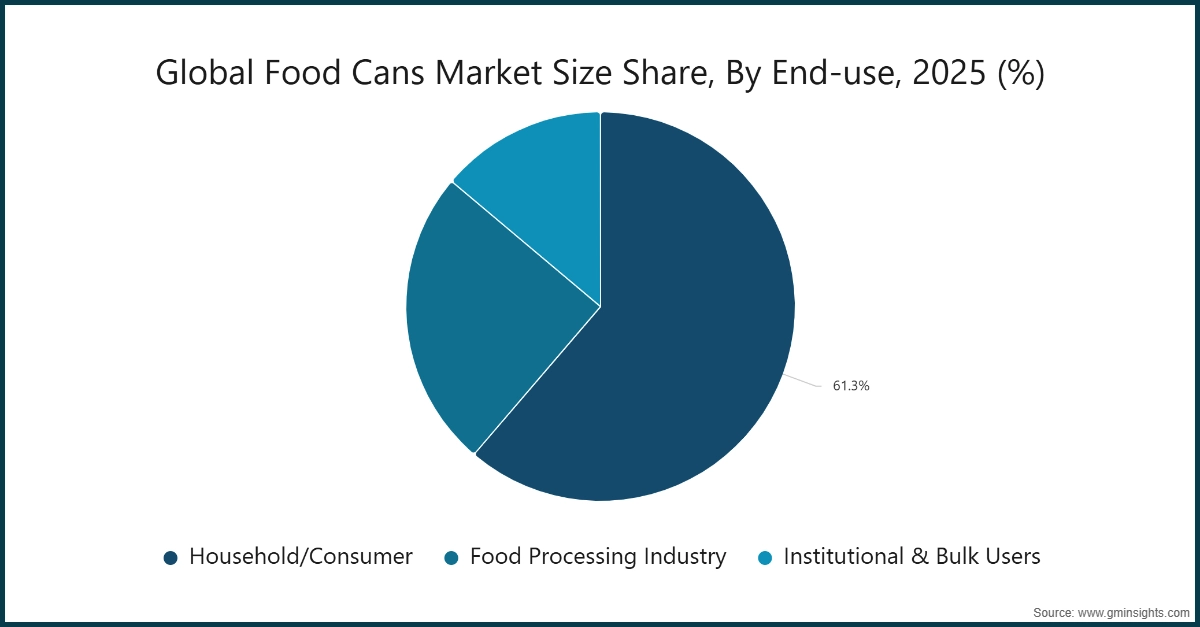
Based on end use, the food cans market is segmented into household/consumer, food processing industry, institutional & bulk users.
- The household/consumer segment dominated the market in 2025 and valued at USD 71.2 billion. Product demand grew as consumers wanted food items that provided both immediate use and extended shelf life. The market growth and product sales increased because households adopted canned food products as their primary meal option during times of busy schedules and urban development.
- The food processing industry segment is the fastest growing segment growth at a CAGR of 3.9% during the forecast period. The increasing demand for packaged and processed foods together with the requirement for products with extended shelf life and the implementation of efficient durable and convenient canned food manufacturing solutions drive market growth.
Looking for region specific data?
North America Food Cans Market
North America food cans industry market share of 31.4% in 2025.
- The North American market experiences growth as the retail and food processing and ready-to-eat meal industries expand their operations. The market experiences growth as consumers seek packaging solutions which offer convenience and shelf-stable products and environmentally friendly options for their home and business needs.
- The food cans market in North America functions through two main forces which include consumer demand for packaged foods that provide convenience and extended shelf life and nutritional value and the growing e-commerce market and sustainable packaging methods.
- North American manufacturers must develop canned products which combine convenience and nutrition and environmental sustainability while they use e-commerce platforms to meet consumer needs for premium products which maintain quality over extended periods.
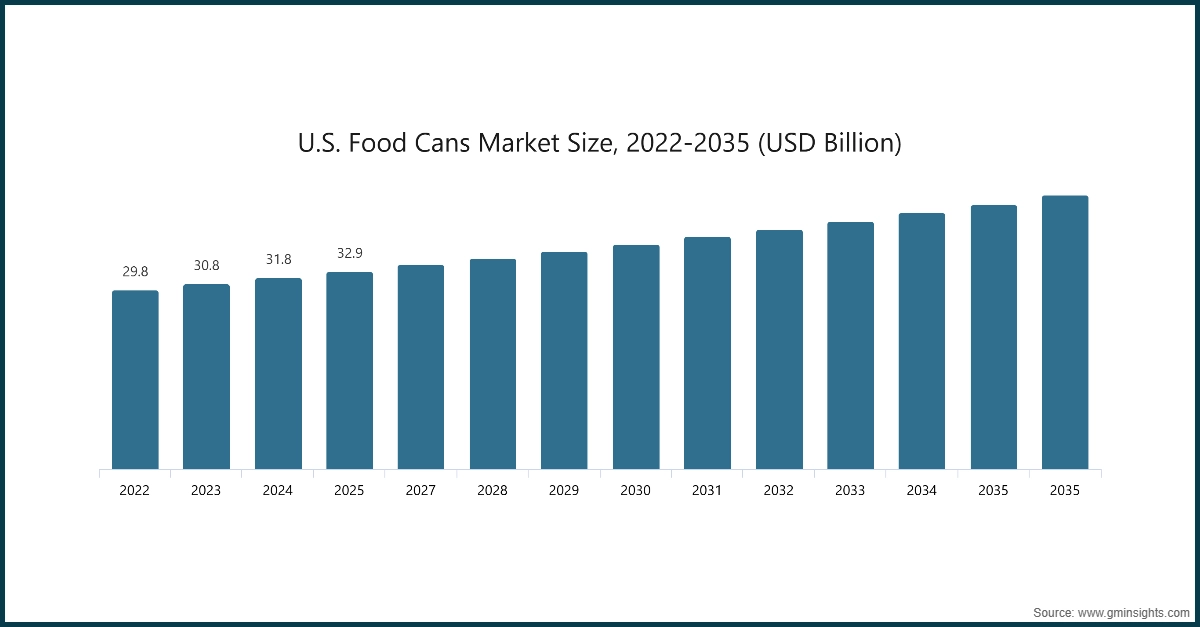
The U.S. food cans market was valued at USD 29.8 billion and USD 30.8 billion in 2022 and 2023, respectively. The market size reached USD 32.9 billion in 2025, growing from USD 31.8 billion in 2024.
- U.S. food cans industry experiences growth as consumers demand organic canned foods and single-serve packaging becomes more popular and online grocery sales increase and people choose protein-rich foods and BPA-free can linings become standard for safe product consumption. According to the USDA, total U.S. organic retail sales reached USD 69.7 billion in 2023, reflecting growing consumer demand for organic products.
- U.S. manufacturers must produce organic canned foods which contain protein and provide consumers with single-serve packaging and use BPA-free linings while they operate through online grocery channels to satisfy changing customer demands.
Europe Food Cans Market
Europe food cans industry accounted for USD 30.3 billion in 2025 and is anticipated to show lucrative growth over the forecast period.
- The European market experiences growth as consumers increasingly prefer food products that are both convenient and sustainable and can be stored for extended periods. The market is expanding because consumers demand ready-to-eat meals and organic products and eco-friendly packaging solutions in both the retail and food processing industries.
- European manufacturers focus on producing high-quality sustainable canned food products which combine modern packaging technology with consumer demand for convenient organic products and eco-friendly solutions to enhance their market position.
Germany dominated the Europe food cans market, showcasing strong growth potential.
- Germany controls the European food cans industry as its advanced manufacturing system and strong food processing sector and high consumer demand for sustainable products and its leadership in packaging technology innovation create essential market driving forces.
- Manufacturers develop sustainable and innovative products through their production of quality canned foods which contain convenient and long-lasting products that use eco-friendly packaging to satisfy customer needs and build their business through new technological capabilities.
Asia Pacific Food Cans Market
The Asia Pacific food cans industry is the largest and fastest growing market and is anticipated to grow at the CAGR of 3.8% during the analysis timeframe.
- The Asia Pacific food cans industry experiences growth as three factors benefit the region which includes its young population and increasing food safety awareness and rising use of sustainable packaging solutions.
- Additionally, the Asia Pacific food cans market develops production facilities which deliver high-quality output together with advanced packaging solutions and economical manufacturing methods and environmentally friendly operations to satisfy increasing customer needs and drive business growth in the local market.
China food cans market is estimated to grow with a CAGR of 4.3% during the forecast period, in the Asia Pacific market.
- The food cans industry in China experiences demands from urban population growth and rising consumer spending power together with increasing popularity of ready-to-eat meals and the development of modern retail and e-commerce platforms and heightened consumer awareness of food safety and quality standards.
- Chinese companies need to develop safe and high-quality canned food products which offer customers convenience while using sustainable packaging solutions through e-commerce and modern retailing methods to satisfy the increasing needs of Chinese consumers.
Latin American Food Cans Market
Brazil leads the Latin American food cans industry, exhibiting remarkable growth during the analysis period.
- Brazil’s market experiences growth as consumers demand shelf-stable and ready-to-eat foods while urban areas expand and disposable incomes rise and retail and e-commerce channels grow, and consumers prefer nutritious canned products with long shelf life.
- The market operates under strict food safety regulations and quality control standards and labeling rules which provide protection to consumers and improve the trustworthiness of products and drive manufacturers to produce superior canned food products.
- Manufacturers in Brazil need to comply with rigorous food safety rules while creating high-quality shelf-stable canned products and using environmentally friendly packaging materials and establishing retail and e-commerce distribution networks to satisfy increasing customer demand.
Middle East and Africa Food Cans Market
South Africa food cans industry to experience substantial growth in the Middle East and Africa market in 2025.
- The market in South Africa experiences growth as consumers want convenient and long-lasting and healthy canned food products which are currently available in both retail and online stores.
- The South African market receives support from government initiatives which promote food safety and public awareness of nutrition and the increasing use of environmentally friendly packaging materials.
- South African manufacturers need to create nutritious shelf-stable canned products while using sustainable packaging methods and following food safety standards and building retail and e-commerce distribution networks to fulfill increasing customer needs.
Food Cans Market Share
The food cans industry is dominated by leading players who hold 40% of the global market share in 2025 through their combined presence in the industry which includes Conagra Brands, Campbell Soup Company, Kraft Heinz Company, Hormel Foods Corporation, and Nestlé S.A. Companies maintain their worldwide market dominance as of their powerful brand identity and extensive product distribution and their ability to create new products and their dedication to providing high-quality and user-friendly products.
The leading companies, including Conagra Brands, Campbell Soup Company, Kraft Heinz Company, Hormel Foods Corporation, and Nestlé S.A., drive the food cans market through innovation, strong distribution, brand recognition, and consumer trust.
Food Cans Market Companies
Prominent players operating in the food cans industry are as mentioned below:
- Conagra Brands
- Del Monte Foods
- Campbell Soup Company
- Kraft Heinz Company
- Hormel Foods Corporation
- Nestlé S.A.
- Dole Food Company
- B&G Foods
- General Mills
- Grupo Calvo
- Danish Crown
- JBS S.A.
- Dongwon Industries
- Rhodes Food Group
- Bolton Group
- Ayam Brand
- Bonduelle Group
- Conagra Brands
Conagra Brands uses its extensive range of successful canned food items and its effective distribution systems and its dedication to developing new products to maintain its position as the top player in the market. The company maintains customer loyalty while expanding its market share because it develops products which meet customers' needs for high-quality items that are easy to access.
Campbell Soup Company gains advantages through its strong brand recognition together with its wide range of products and its leadership role in the canned soup industry. The company maintains a competitive advantage in the global canned foods market as it maintains quality standards together with innovative products and active customer outreach programs which create stable product demand and build customer loyalty.
Kraft Heinz Company establishes its identity through its reliable brands together with its extensive product selection and its ongoing innovations in packaging design. Kraft Heinz builds customer trust while developing brand loyalty through its product adaptations which appeal to modern consumer demands for easy-to-use items that provide health benefits and environmentally friendly features.
Hormel Foods establishes its reputation through its top-quality products which include canned meats and snacks and items which contain high protein content. Hormel maintains its market position through its dedication to sustainable practices and its development of premium products while building consumer trust through its continuous delivery of high-quality products which meet the growing global demand for convenient and healthy ready-to-eat canned foods.
Nestlé uses its worldwide operations and wide product range and dedication to environmental responsibility to compete in the canned food industry. The company creates strong consumer interest through its development of ready-to-eat meals and nutritious products and its innovative packaging which leads to successful market entry and continuous business expansion in various worldwide markets.
Food Cans Market Report Attributes
| Key Takeaway | Details |
|---|---|
| Market Size & Growth | |
| Base Year | 2025 |
| Market Size in 2025 | USD 115.9 Billion |
| Market Size in 2026 | USD 119.6 Billion |
| Forecast Period 2026-2035 CAGR | 3.2% |
| Market Size in 2035 | USD 158.4 Billion |
| Key Market Trends | |
| Drivers | Impact |
| Increase in shelf-stable packaging solutions | Drives market growth by 28% as the demand for long-lasting, convenient food products increases. Shelf-stable packaging ensures food safety, extends shelf life, and minimizes waste. |
| Rising demand for sustainable packaging | Contributes 24% growth as consumers and brands prioritize eco-friendly and recyclable packaging solutions. This shift boosts the appeal of food cans in environmentally conscious markets. |
| Growth in the ready-to-eat (RTE) food segment | Supports 21% growth due to increasing consumer preference for quick, easy-to-prepare meals. Canned foods are a prominent choice in the RTE segment, offering convenience and nutritional value. |
| Increasing demand for processed and canned foods | Contributes 15% growth as busy lifestyles drive the consumption of convenient, pre-packaged food. Canned foods offer time-saving meal solutions. |
| Technological advancements in can design | Drives 12% growth as innovations in can design enhance product durability, functionality, and aesthetic appeal. Advanced materials and preservation techniques ensure improved freshness and safety. |
| Pitfalls & Challenges | Impact |
| Competition for alternative packaging | Increases market pressure as consumers and brands explore alternatives like glass, plastic, and biodegradable materials. These options may offer perceived benefits such as lighter weight or sustainability, limiting food cans' market share. |
| Fluctuating raw material prices | Affects production costs and pricing stability, as volatility in the cost of materials like steel, aluminum, and tinplate can squeeze profit margins. This may result in higher consumer prices or reduced market competitiveness. |
| Opportunities: | Impact |
| Expansion in emerging markets | Increased urbanization and rising disposable incomes in emerging markets create a growing demand for packaged foods, driving food cans market growth. |
| Innovations in smart packaging | Advances in smart packaging, like QR codes and temperature-sensitive labels, provide consumers with enhanced product information, improving food safety. |
| Market Leaders (2025) | |
| Market Leader |
12% market share in 2025 |
| Top Players |
Collective market share is 40% in 2025. |
| Competitive Edge |
|
| Regional Insights | |
| Largest Market | Asia Pacific |
| Fastest growing market | Asia Pacific |
| Emerging countries | China, India, Japan |
| Future outlook |
|
What are the growth opportunities in this market?
Food Cans Industry News
- In June 2024, Sonoco completed its acquisition of Eviosys for USD 3.9 billion, which operates as a European metal packaging supplier. The acquisition enables Sonoco to maintain its position as the top manufacturer of metal food cans and aerosol packaging.
- In April 2024, Canovation launched CanReseal as an environmentally friendly can design that allows for multiple openings. The new design uses a twist-top closure system which helps to decrease food waste while providing an alternative to single-use plastic items. Canovation wants to expand its operations while making people more aware about environmental sustainability practices.
- In 2023, Dole introduced 11 new canned fruit beverages which included Light Pineapple Juice Drink and Pineapple Mango Juice and Digestive Bliss to its canned product line which offers healthier fruit-based beverages that meet current consumer demands.
The food cans market research report includes in-depth coverage of the industry with estimates and forecast in terms of revenue in (USD Billion) and volume (Kilo Tons) from 2022 – 2035 for the following segments:
Market, By Product Type
- Canned vegetables
- Tomatoes
- Corn
- Beans
- Peas
- Mixed vegetables
- Mushrooms
- Others
- Canned fish & seafood
- Tuna
- Salmon
- Sardines
- Mackerel
- Anchovies
- Shellfish
- Others
- Canned fruits
- Peaches
- Pineapple
- Mixed fruits
- Others
- Canned meat
- Chicken
- Beef
- Pork
- Others
- Ready-to-eat meals
- Soups
- Stews
- Pasta
- Others
- Others
Market, By Distribution Channel
- Retail
- Supermarkets and hypermarkets
- Convenience stores
- Specialty food stores
- Online/E-commerce
- Foodservice
- Restaurants
- Hotels & catering
- Institutional
Market, By End Use
- Household/consumer
- Food processing industry
- Institutional & bulk users
The above information is provided for the following regions and countries:
- North America
- U.S.
- Canada
- Europe
- Germany
- UK
- France
- Spain
- Italy
- Netherlands
- Asia Pacific
- China
- India
- Japan
- Australia
- South Korea
- Latin America
- Brazil
- Mexico
- Argentina
- Middle East and Africa
- South Africa
- Saudi Arabia
- UAE
Frequently Asked Question(FAQ) :
What was the market size of the food cans in 2025?
The market size was USD 115.9 billion in 2025, growing at a CAGR of 3.2% through 2035, driven by demand for shelf-stable packaging, sustainability, and improved can designs.
What is the projected value of the food cans market by 2035?
The market is poised to reach USD 158.4 billion by 2035, fueled by rising demand for processed foods, ready-to-eat meals, and sustainable packaging solutions.
What is the expected size of the food cans industry in 2026?
The market size is expected to reach USD 119.6 billion in 2026.
What was the market share of the retail segment in 2025?
The retail segment held 75.8% of the market in 2025, supported by strong distribution through supermarkets, promotions, and bulk purchasing.
What was the valuation of the canned vegetables segment in 2025?
The canned vegetables segment was valued at USD 40 billion in 2025, driven by demand for nutritious and long-lasting food options.
What was the market size of the household/consumer segment in 2025?
The household/consumer segment reached USD 71.2 billion in 2025, supported by urbanization and busy lifestyles increasing reliance on convenient foods.
Which region led the food cans sector in 2025?
North America led the market with a 31.4% share in 2025, driven by strong retail, food processing, and ready-to-eat meal demand.
What are the upcoming trends in the food cans market?
Key trends include sustainable materials, premium and organic canned products, plant-based options, and innovations like lightweight low-carbon packaging (e.g., Ecopeel).
Who are the key players in the food cans industry?
Key players include Conagra Brands, Del Monte Foods, Campbell Soup Company, Kraft Heinz Company, Hormel Foods Corporation, Nestlé S.A., Dole Food Company, B&G Foods, General Mills, Grupo Calvo, Danish Crown, and JBS S.A..
Food Cans Market Scope
Related Reports