Summary
Table of Content

Food Bleaching Agent Market
Get a free sample of this report
Form submitted successfully!
Error submitting form. Please try again.
Thank you!
Your inquiry has been received. Our team will reach out to you with the required details via email. To ensure that you don't miss their response, kindly remember to check your spam folder as well!
Request Sectional Data
Thank you!
Your inquiry has been received. Our team will reach out to you with the required details via email. To ensure that you don't miss their response, kindly remember to check your spam folder as well!
Form submitted successfully!
Error submitting form. Please try again.
Food Bleaching Agent Market Size
- The global market has become an essential element of contemporary food processing because it enables food industries to create products which maintain their visual appeal while delivering better texture and processing performance. Food manufacturers who need to improve their production operations use bleaching agents to create uniform raw material quality which allows them to produce consistent products across different product lines. The current value proposition of whitening agents has expanded to include product enhancement capabilities, which enable manufacturers to achieve better product results during complex processing operations.
- Market progress depends on manufacturers use advanced chemical and natural formulations to create new products which meet both regulatory needs and consumer expectations while maintaining their needed performance standards.
- The market experiences its current trends because of shifting consumer preferences. To meet their needs for high-quality packaged foods which look appealing, producers need to develop formulations which deliver consistent results and meet their changing requirements for healthfulness and minimal processing demands. The market is experiencing a gradual shift towards natural and plant-based bleaching methods which occurs most rapidly in areas that have stringent regulatory processes and high consumer expectations.
The global food bleaching agent market was valued at USD 325.5 million in 2025. The market is expected to grow from USD 339.4 million in 2026 to USD 548.2 million in 2035, at a CAGR of 5.5% according to latest report published by Global Market Insights Inc.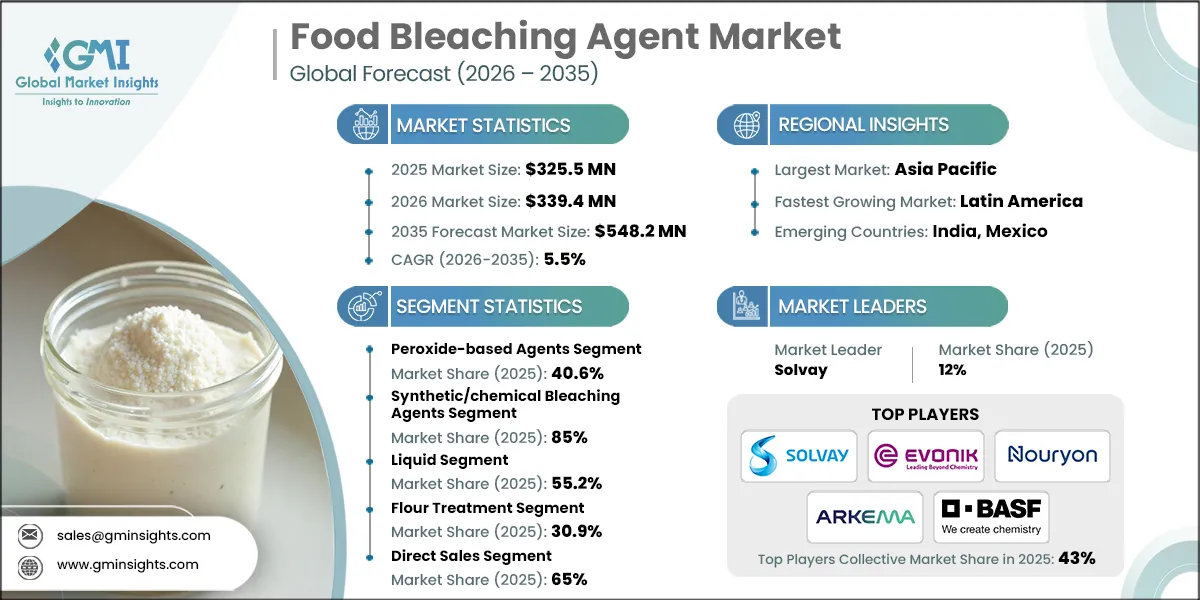
Food Bleaching Agent Market Key Takeaways
Market Size & Growth
- 2025 Market Size: USD 325.5 Million
- 2026 Market Size: USD 339.4 Million
- 2035 Forecast Market Size: USD 548.2 Million
- CAGR (2026–2035): 5.5%
Regional Dominance
- Largest Market: Asia Pacific
- Fastest Growing Region: Latin America
Key Market Drivers
- Rising demand for processed and packaged food products requiring visual enhancement.
- Increasing adoption of bleaching agents in bakery and confectionery applications.
- Technological advancements in natural and synthetic food bleaching agents.
Challenges
- Growing consumer preference for clean-label and natural ingredients.
- Potential health concerns related to synthetic bleaching agents affecting market growth.
Opportunity
- Development of natural & plant-based alternatives.
- Enzymatic bleaching technology commercialization.
Key Players
- Market Leader: Solvay led with over 12% market share in 2025.
- Leading Players: Top 5 players in this market include Solvay, Evonik, Nouryon, Arkema, BASF, which collectively held a market share of 43% in 2025.
Get Market Insights & Growth Opportunities
To get key market trends
Food Bleaching Agent Market Trends
- The global market for food bleaching agents is growing because more people are buying processed and packaged foods. As consumers prefer convenient food options, manufacturers are working to make these products look more attractive. Bleaching agents help by making food products like flour, sugar, and oils look uniform and visually appealing.
- In the bakery and confectionery industries, bleaching agents are especially important. They help create lighter and more attractive products like bread, cakes, and pastries. This is becoming more popular as people increasingly look for high-quality baked goods.
- The global food bleaching agents industry is changing due to consumer preferences and new regulations. More people now want clean-label products, which has led to a move toward natural and plant-based bleaching agents. Consumers prefer food that is less processed and free from chemicals. Additionally, there is a growing interest in bleaching agents that do more than just improve the look of food. These agents also help improve the texture and make the food last longer.
- Sustainability is becoming very important in this market. Manufacturers are working on eco-friendly ways to produce these agents and are using raw materials that are sourced responsibly. At the same time, enzymatic bleaching processes are becoming more popular because they help reduce harm to the environment.
Food Bleaching Agent Market Analysis
Learn more about the key segments shaping this market
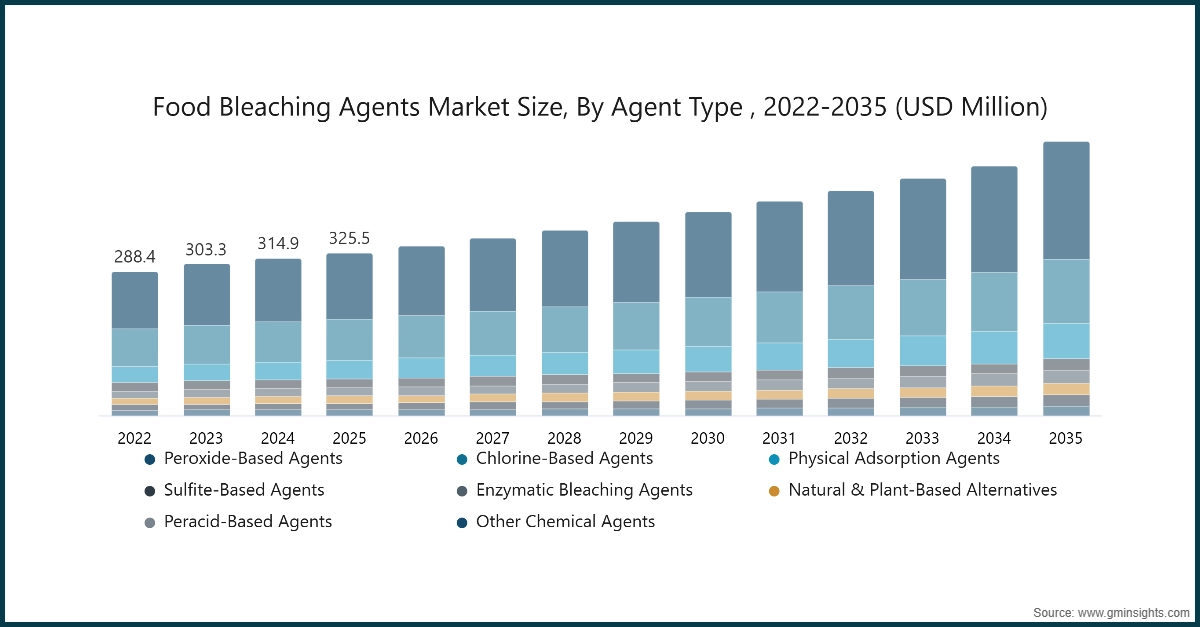
Based on agent type, the market is segmented into peroxide-based agents, chlorine-based agents, physical adsorption agents, sulfite-based agents, enzymatic bleaching agents, natural & plant-based alternatives, peracid-based agents, other chemical agents. Peroxide-based agents dominated the market with an approximate market share of 40.6% in 2025 and is expected to grow with a CAGR of 6.1% by 2035.
- The industry continues to use peroxide-based agents as the standard processing solution because these agents provide strong oxidative power and reliable performance for flour oil and bakery products which require high-volume processing with their stable operation and compatibility with multiple processing systems. Chlorine-based agents maintain their relevance where rapid whitening and high reactivity are required, particularly in operations that prioritize fast throughput, although their use becomes increasingly restricted by evolving regulatory and consumer standards.
- Sulfite-based agents maintain their essential role in controlled bleaching and preservation processes, particularly for products that require minimal oxidative damage. The search for bio-based natural processing solutions that fulfill operational requirements while supporting cleaner ingredient systems with transparent labeling controls industrial interest in enzymatic bleaching agents for industrial applications.
Learn more about the key segments shaping this market
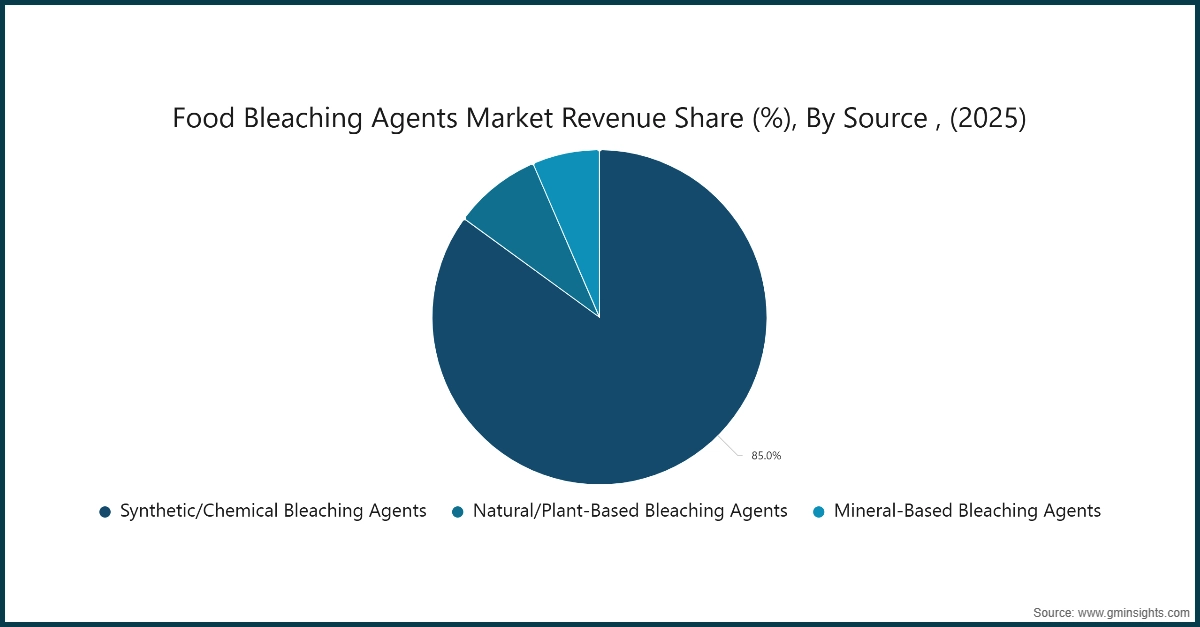
Based on source, the food bleaching agent market is segmented into synthetic/chemical bleaching agents, natural/plant-based bleaching agents, mineral-based bleaching agents. Synthetic/chemical bleaching agents held the largest market share of 85% in 2025 and is expected to grow at a CAGR of 5.1% during 2026-2035.
- Synthetic bleaching agents maintain their strongest market position, they deliver high reactivity and predictable results which match the requirements of industrial food processing. The agents maintain their essential role in fields where instant color correction and powerful oxidative performance and dependable results are essential requirements. The synthetic agents deliver essential reliability to food manufacturers who need to meet urgent production schedules while sustaining consistent product performance across all product lines.
- The industry is turning to natural and plant-based bleaching agents as their primary solution which meets the growing need for cleaner and less processed ingredients which customers can easily identify.
Based on form, the food bleaching agent market is segmented into liquid, powder, and granular. Liquid segment dominated the market with an approximate market share of 55.2% in 2025 and is expected to grow with the CAGR of 5.6% by 2035.
- The primary product for the company remains liquid formulations because processors prefer these products which enable them to achieve rapid dispersal and precise delivery of materials while their manufacturing processes remain active. The technology serves essential functions in applications which need uniform bleaching and fast reaction times and precise process regulation because it supports automated systems and both wet-mix and inline processing methods.
- The use of powder bleaching agents continues in fields which require permanent shelf life combined with specific activation control and convenient storage and transportation capabilities. The solid state of this material makes it suitable for batch processing operations at specialized bakeries and formulas which need protection from moisture and require gradual bleaching effects.
Based on application, the food bleaching agent market is segmented into flour treatment, edible oils & fats, bakery & confectionery products, dairy products, starch & sugar products, beverages, aseptic packaging, meat & poultry processing, egg products, spices & herbs, others. Flour treatment segment dominated the market with an approximate market share of 30.9% in 2025 and is expected to grow with the CAGR of 6.5% by 2035.
- Flour treatment as its main application category because it helps achieve constant white color and enhances baking results and enables flour quality control across all industrial milling processes. The agents help to speed up natural aging processes which results in better dough performance and consistent dough quality for large-scale bakery production. Manufacturers need these elements for their production because they depend on them to create products which maintain consistent performance while their processing methods produce reliable outcomes and their final products achieve attractive visual standards.
- Bleaching agents in edible oils and fats serve to eliminate pigments and impurities which enables the products to maintain both visual clarity and good taste. Bakeries and confectionery makers use bleaching inputs to improve their product texture while creating visually better products that maintain their batch quality throughout the entire production process.
Based on distribution channel, the food bleaching agent market is segmented into direct sales, distributors & wholesalers, online channels. Direct sales dominated the market with an approximate market share of 65% in 2025 and is expected to grow with the CAGR of 5.3% by 2035.
- The market maintains its direct sales method as core business operations for food processing companies and ingredient production companies who depend on their direct suppliers to achieve dependable product quality and uninterrupted supply delivery and complete product recipe management. The technical partnerships established through this channel enable businesses to develop customized solutions which they can use to create new products while they rapidly change their processing methods to meet their new requirements.
- Distributors and wholesalers build essential distribution networks which support mid-sized processors and specialized production units to achieve product availability through their distribution services which also provide essential logistical support to reach market demand and deliver products to remote areas.
Looking for region specific data?
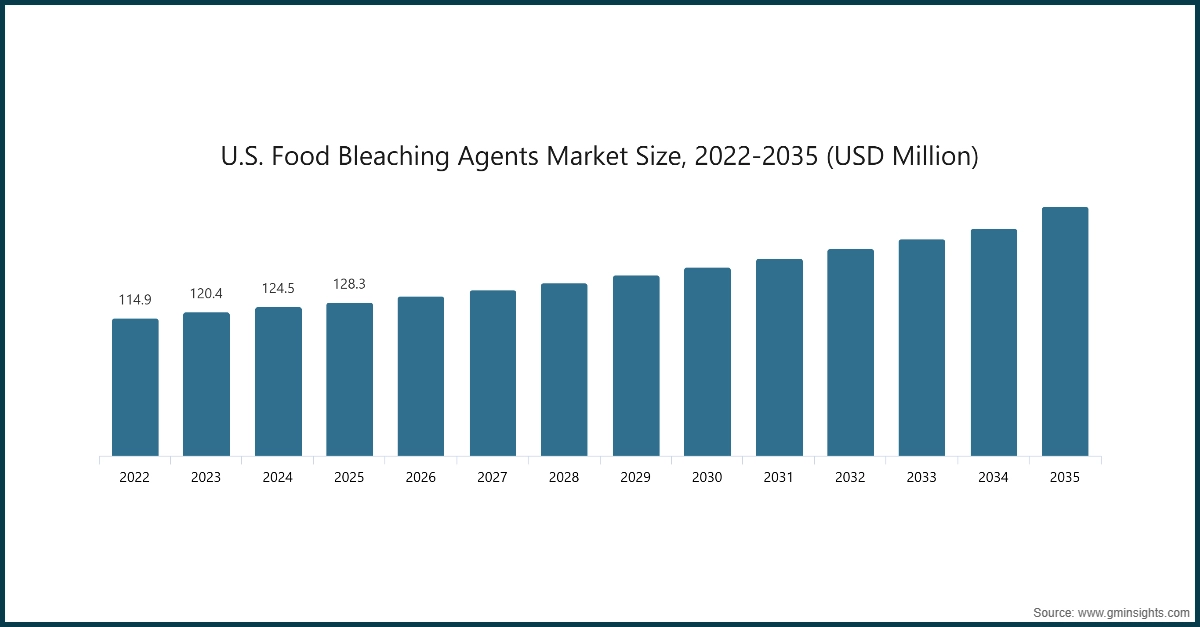
The North America food bleaching agent market is growing rapidly on the global level with a market share of 47.4% in 2025.
- The North America market has developed into a key strategic area because of its established food processing system and its strong food safety regulations and its requirement for continuous product quality control. The region’s advanced manufacturing capabilities enable rapid adoption of technologically refined bleaching solutions that support large‑scale bakery dairy beverage and packaged food operations.
Europe food bleaching agent industry leads the industry with revenue of USD 67.3 million in 2025 and is anticipated to show lucrative growth over the forecast period.
- European countries which maintain strict control of ingredient safety requirements, combined with their established food processing industry, drive manufacturers to create bleaching products which offer better transparency and advanced functional performance. The existing regulatory system promotes fast implementation of newly developed agents which help products maintain their quality and meet new consumer demand for natural and unprocessed food items.
The Asia Pacific food bleaching agent market is anticipated to grow at a CAGR of 6.6% during the analysis timeframe.
- The Asia Pacific market establishes itself as a highly active growth sector because of its fast developing food processing industry and its ongoing manufacturing capacity modernization. The region increases its use of advanced bleaching agents which provide efficient and reliable performance and enhance product quality because consumers demand visually identical packaged products that meet standardized food processing requirements.
Latin America accounted for 5.1% market share in 2025 and is anticipated to show highest growth over the forecast period.
- The Latin American food manufacturing sector is developing because of improved processing facilities and enhanced food quality standards which are driving the demand for Food Bleaching Agents in the region. As consumers choose packaged foods and bakery products and dairy items and refined oils, processors are using advanced bleaching solutions to create products with consistent visual appeal which meets changing market and regulatory requirements.
Middle East & Africa accounted for 3.8% market share in 2025 and is anticipated to show lucrative growth over the forecast period.
- The Middle East and Africa market experiences growth because food processing capabilities develop and supply chains modernize and manufacturing technologies receive increased investment. The region requires effective and stable bleaching agents to maintain consistent product quality while meeting international quality standards as it expands its food industry to accommodate both domestic and export market growth.
Food Bleaching Agent Market Share
The top 5 companies in Food Bleaching Agent industry include Solvay, Evonik, Nouryon, Arkema, BASF. These are prominent companies operating in their respective regions covering approximately 43% of the market share in 2025. These companies hold strong positions due to their extensive experience in market. Their diverse product portfolios, backed by robust production capabilities and distribution networks, enable them to meet the rising demand across various regions.
- Solvay operates from its base in Brussels, provides essential chemical products through its extensive product range that includes soda ash and bicarbonate and peroxides and silica and other chemical intermediates. The company provides its services to several different sectors, which include food production and car manufacturing and electronic device creation and resource extraction and industrial machine operation.
- Evonik is a specialty chemicals company based in Essen, operating worldwide across segments such as custom solutions, advanced technologies, and infrastructure. The company offers specialized additives and chemical intermediates and materials that serve different industries, including consumer goods and automotive and healthcare and industrial applications.
- Nouryon operates as an international specialty chemicals corporation, which has its main office in the Netherlands and supplies vital chemical products for multiple industries, including personal care and cleaning and agriculture and food and coatings and industrial applications.
- Arkema functions as a chemical company that specializes in materials production and operates from its headquarters in France. The company creates materials that need special design for use in mobility and construction and electronics and resource management fields. Arkema operates worldwide while it focuses on sustainable innovation areas, which include circular materials and bio-based solutions, to match its research and development and production capabilities with present-day industrial and environmental needs.
- BASF operates from its headquarters in Germany to provide customers with a wide range of products that include chemicals and materials and industrial solutions and nutrition and care products and agricultural solutions and surface technologies. The company maintains its operations in over 90 countries to achieve two goals, which involve economic progress and environmental and social responsibility.
Food Bleaching Agent Market Companies
Major players operating in the food bleaching agent industry include:
- Solvay
- Evonik Industries AG
- BASF SE
- AkzoNobel N.V.
- Arkema S.A.
- Nouryon
- Aditya Birla Chemicals
- Kemira Oyj
- Clariant AG
- Imerys S.A.
- Kemin Industries
- DSM-Firmenich
Food Bleaching Agent Industry News
- In September 2024, New research revealed widespread human exposure to food-contact chemicals (FCCs), many lacking crucial safety data. A study published in The Journal of Exposure Science & Environmental Epidemiology found 25% of known FCCs present in humans, emphasizing the need for stricter regulations.
- In August 2024, Ghana implemented a ban on the import and sale of skin bleaching products, enforced by the Food and Drugs Authority. Hydroquinone-containing products were deregistered, and a sensitization program against their sale was launched earlier this year.
This food bleaching agent market research report includes in-depth coverage of the industry, with estimates & forecasts in terms of revenue (USD Million) and volume (Kilo Tons) from 2022 to 2035, for the following segments:
Market, by Agent Type
- Peroxide-based agents
- Chlorine-based agents
- Physical adsorption agents
- Sulfite-based agents
- Enzymatic bleaching agents
- Natural & plant-based alternatives
- Peracid-based agents
- Other chemical agents
Market, by Source
- Synthetic/chemical bleaching agents
- Natural/plant-based bleaching agents
- Mineral-based bleaching agents sealing
Market, by Form
- Liquid
- Powder
- Granular
Market, by Application
- Flour treatment
- Edible oils & fats
- Bakery & confectionery products
- Dairy products
- Starch & sugar products
- Beverages
- Aseptic packaging
- Meat & poultry processing
- Egg products
- Spices & herbs
- Others
Market, by Distribution Channel
- Direct Sales
- Distributors & Wholesalers
- Online Channels
The above information is provided for the following regions and countries:
- North America
- U.S.
- Canada
- Europe
- Germany
- UK
- France
- Spain
- Italy
- Rest of Europe
- Asia Pacific
- China
- India
- Japan
- Australia
- South Korea
- Rest of Asia Pacific
- Latin America
- Brazil
- Mexico
- Argentina
- Rest of Latin America
- Middle East and Africa
- Saudi Arabia
- South Africa
- UAE
- Rest of Middle East and Africa
Frequently Asked Question(FAQ) :
What is the market size of the food bleaching agent market in 2025?
The global market size for food bleaching agent was valued at USD 325.5 million in 2025, driven by rising demand for processed and packaged foods requiring consistent color, texture, and visual appeal.
What is the projected value of the food bleaching agent market by 2035?
The market is expected to reach USD 548.2 million by 2035, growing at a CAGR of 5.5% from 2026 to 2035, supported by increasing applications in flour treatment.
What is the market size of the food bleaching agent market in 2026?
The market is estimated to grow to USD 339.4 million in 2026, reflecting steady expansion fueled by demand for high-quality packaged foods and improved processing efficiency.
Which source segment held the largest share in 2025?
Synthetic/chemical bleaching agents accounted for around 85.1% of the market share in 2025, supported by their high reactivity, predictable performance, and suitability for large-scale food manufacturing.
Which application segment held the largest share in 2025?
Flour treatment led the market with approximately 30.9% share in 2025 and is projected to grow at a CAGR of 6.5% through 2035, as bleaching agents help accelerate flour aging.
Which distribution channel dominates the market?
Direct sales accounted for approximately 65% of the market share in 2025, as large food processors rely on direct supplier partnerships for consistent quality, technical support, and customized formulations.
Which region leads the food bleaching agent market?
North America led the global market with a 47.4% share in 2025, driven by advanced food processing infrastructure, stringent food safety regulations, and high demand for quality-controlled packaged foods.
Who are the key players in the food bleaching agent market?
Key players include Solvay, Evonik Industries AG, BASF SE, Arkema S.A., Nouryon, AkzoNobel N.V., Kemira Oyj, and Clariant AG.
Food Bleaching Agent Market Scope
Related Reports