Summary
Table of Content

Folding Carton Packaging Market
Get a free sample of this report
Form submitted successfully!
Error submitting form. Please try again.
Thank you!
Your inquiry has been received. Our team will reach out to you with the required details via email. To ensure that you don't miss their response, kindly remember to check your spam folder as well!
Request Sectional Data
Thank you!
Your inquiry has been received. Our team will reach out to you with the required details via email. To ensure that you don't miss their response, kindly remember to check your spam folder as well!
Form submitted successfully!
Error submitting form. Please try again.
Folding Carton Packaging Market Size
The growth of the market is attributed to stricter global regulations promoting recyclable fiber-based packaging, rising demand for secondary and retail-ready formats in e-commerce, increasing substitution of rigid plastics with paperboard cartons, expanding pharmaceutical and healthcare packaging compliance requirements, and growing premiumization trends in cosmetics and personal care packaging.
Folding Carton Packaging Market Key Takeaways
Market Size & Growth
- 2025 Market Size: USD 210.3 Billion
- 2026 Market Size: USD 220.9 Billion
- 2035 Forecast Market Size: USD 377.3 Billion
- CAGR (2026–2035): 6.1%
Regional Dominance
- Largest Market: Asia Pacific
- Fastest Growing Region: Asia Pacific
Key Market Drivers
- Regulatory push toward fiber-based recyclable packaging.
- Growth of e-commerce secondary packaging demand.
- Shift from plastic clamshells to paperboard cartons.
- Pharmaceutical serialization and compliance requirements.
- Premiumization in cosmetics and personal care cartons.
Challenges
- Volatility in virgin pulp and paperboard prices.
- High capital costs for advanced die-cutting equipment.
Opportunity
- Adoption of barrier-coated recyclable paperboard.
- Smart packaging integration with QR/NFC features.
Key Players
- Market Leader: Smurfit Kappa Group led with over 12.7% market share in 2025.
- Leading Players: Top 5 players in this market include Smurfit Kappa Group, Graphic Packaging International, Stora Enso Oyj, DS Smith Plc, Mayr-Melnhof Karton AG, which collectively held a market share of 4.7% in 2025.
Get Market Insights & Growth Opportunities
The folding carton packaging market is driven by regulatory push toward fiber-based recyclable packaging as governments tighten packaging waste laws and circularity goals. For example, in Feb 2026 the European Commission adopted a Delegated Act under the EU’s Packaging and Packaging Waste Regulation (PPWR) which established packaging format reuse and recyclability requirements that include 40 % reuse targets by 2030 and mandatory recyclability standards. The rules will create a market need for recyclable folding cartons because they impose a recyclable requirement which will decrease plastic usage while increasing circular supply chain compliance throughout European Union markets.
Additionally, the increase in secondary packaging materials in the e-commerce industry is driving the folding carton industry due to the introduction of sustainable packaging guidelines from governments. For instance, Singapore's National Environment Agency introduced "New Guidelines to Reduce E-Commerce Packaging" in Mar 2025 which offers 3R (Reduce, Re-use, Recycle) solutions for cardboard boxes and mailers to decrease waste while promoting optimized packaging. This government-backed initiative reduces excess material use, improves recyclability, and pushes brands toward efficient folding carton formats that lower environmental impact across the entire fulfillment network.
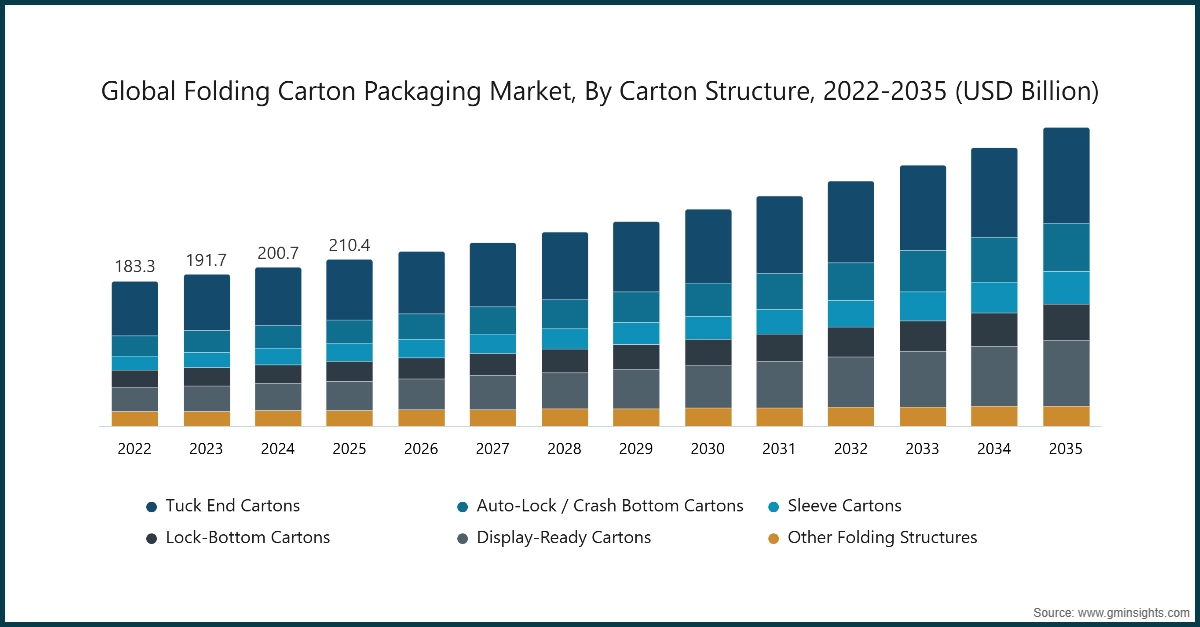
The folding carton packaging market increased steadily from USD 183.4 billion in 2022 and reached USD 200.6 billion in 2024, supported by accelerating plastic reduction mandates and higher adoption of recyclable paperboard formats across food and consumer goods sectors. Increasing investments in high-quality printing, lightweighting initiatives, and automation in carton converting strengthened market penetration. Additional growth during this period was driven by expanding organized retail, rising pharmaceutical packaging demand, and brand-led sustainability commitments across North America, Europe, and Asia-Pacific.
The global folding carton packaging market was valued at USD 210.3 billion in 2025. The market is expected to grow from USD 220.9 billion in 2026 to USD 290.9 billion in 2031 & USD 377.3 billion in 2035, at a CAGR of 6.1% during the forecast period according to the latest report published by Global Market Insights Inc.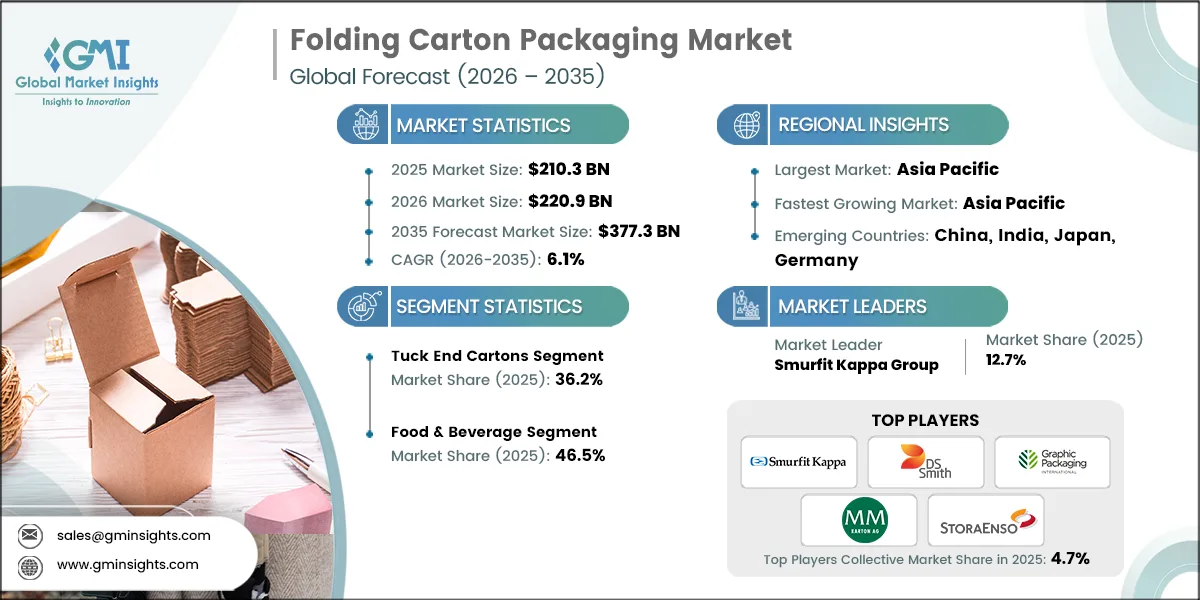
To get key market trends
Folding Carton Packaging Market Trends
- Sustainable lightweighting of folding cartons is changing the way material optimization is approached in the food, personal care, and household products industries. This trend is expected to build momentum around 2021, driven by efforts to reduce material consumption in response to increasing fiber costs and carbon reporting initiatives. The process will continue until after 2030 because organizations will increase their use of lifecycle assessments and Scope 3 emission disclosures. This trend improves cost efficiency while strengthening environmental performance metrics.
- Digital printing adoption in folding carton production creates new opportunities for short-run customization which enables faster product delivery to customers. The time between 2020 and 2022 experienced rapid adoption because companies needed to create more SKUs during their promotional packaging efforts for e-commerce and seasonal product launches. Through 2028, improvements in press speeds, color consistency, and cost models are expected to expand adoption. This trend is creating cost efficiency and inventory waste reduction.
- Retail-ready and shelf-ready packaging formats are gaining prominence in modern trade and organized retail channels. This trend has gained momentum after 2019 with the emphasis on labor efficiency in supermarkets and discount stores. The market will continue to grow until 2030 because Asia-Pacific and Eastern European markets will develop their large-format retail business.
- Mono material-based paper packaging is in the development phase to simplify the recycling process and eliminate the complexity of laminate materials. This has gained momentum after 2020 with the issues of recycling infrastructure and brand recyclability becoming more prominent. This is likely to gain momentum over the next ten years to 2030 with governments tightening the definition of recyclability and scorecards for material compliance.
Folding Carton Packaging Market Analysis
Learn more about the key segments shaping this market
Based on carton structure, the folding carton packaging market is divided into tuck end cartons, auto-lock/crash bottom cartons, sleeve cartons, lock-bottom cartons, display-ready cartons, and other folding structures.
- The tuck end cartons segment led the market in 2025, holding a 36.2% share. This is because the tuck end cartons are compatible for use in the food, personal care, pharmaceutical, and household product industries, where cost efficiency and scalability of the product are of critical concern. Tuck end cartons have a simple locking mechanism, making them light and suitable for printing, which ensures a continued market dominance of the product, especially in the emerging and developing markets.
- The display-ready cartons segment is anticipated to grow at a CAGR of 8.6% over the forecast period. This growth can be attributed to the high growth rate of the organized retail sector, discount retailers, and hypermarkets, where the use of display-ready cartons has the potential for reducing the cost of operations, including the cost of labor, associated with the handling of the products in the retail sector. These cartons have the ability to serve as transport packaging and display cartons, which ensures a high growth rate of the product in the market, especially because of the emphasis being laid on the merchandising appeal of the product.
Based on paperboard grade, the folding carton packaging market is divided into solid bleached sulfate (SBS), coated unbleached kraft (CUK), coated recycled paperboard (CRB), and uncoated paperboard.
- The coated recycled paperboard (CRB) segment dominated the market in 2025 and valued at USD 69.9 billion, supported by its cost competitiveness and high recycled fiber composition. CRB is widely used in dry food packaging, household goods, and personal care cartons where premium whiteness is not mandatory. Growing regulatory pressure to increase recycled content in packaging materials, particularly in North America and Europe, has strengthened its demand. Additionally, brand owners seeking to improve sustainability metrics without significantly increasing packaging costs continue to prioritize CRB, reinforcing its leading position in volume-driven segments.
- The coated unbleached kraft (CUK) segment is expected to witness growth at a CAGR of 6.7% during the forecast period due to its high strength-to-weight ratio and moisture resistance. Coated unbleached kraft is increasingly being adopted for beverage carriers, frozen food cartons, and higher weight multipack applications. This is due to their high strength requirements. With the rise in demand for strong yet recyclable packaging alternatives to plastic-based secondary packaging materials, coated unbleached kraft is expected to grow at a higher rate.
Learn more about the key segments shaping this market
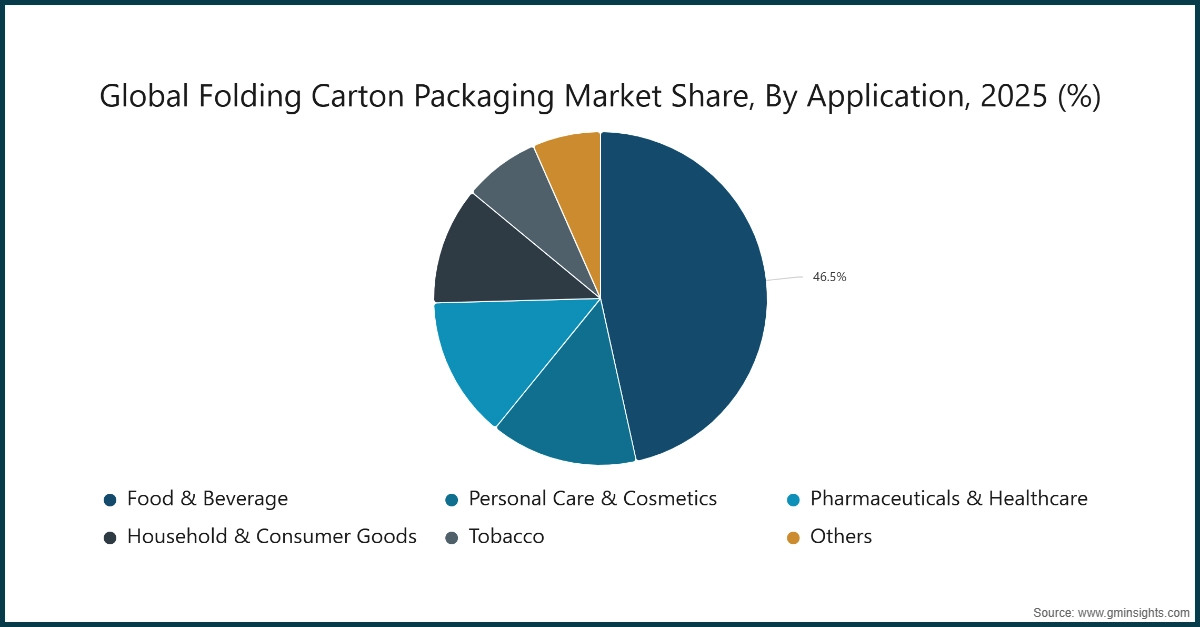
Based on application, the global folding carton packaging market is divided into food & beverage, personal care & cosmetics, pharmaceuticals & healthcare, household & consumer goods, tobacco, and others.
- The food & beverage segment led the market in 2025 with a market share of 46.5%, owing to the sustained demand for packaged foods, frozen foods, cereals, dairy products, and beverage multipacks. Folding cartons provide excellent printing capabilities for branding, nutritional information, and regulatory compliance. At the same time, the product remains lightweight and recyclable. Improvements in barrier coatings provide better moisture and grease resistance. This has enabled the expansion of folding cartons to include ready-to-eat and takeaway foods. This segment will thus continue to lead in mature and emerging markets.
- The pharmaceuticals & healthcare segment is expected to grow at a CAGR of 7.8% during the forecast period. This segment is driven by the expansion of drug manufacturing worldwide. There is also an increased demand for stricter serialization regulations and tamper-evident and anti-counterfeit packaging solutions. Folding cartons play a critical role in protecting high-value pharmaceutical products. At the same time, the product provides accurate printing capabilities for dosage information and regulatory requirements. This segment is expected to grow due to an increase in biologics production and healthcare access in emerging markets.
Looking for region specific data?
North America Folding Carton Packaging Market
North America held a share of 29.1% of folding carton packaging industry in 2025.
- In North America, the folding carton packaging industry is expanding driven by stringent packaging sustainability requirements, retailer-driven recyclable packaging initiatives, and the need for fiber-based packaging alternatives in food, beverage, and healthcare end-use industries. In the region, there is a high rate of adoption of high recycled content paperboard and lightweight carton packaging to meet the requirements of extended producer responsibility initiatives that are being introduced in various states in the United States and provinces in Canada.
- Investments in advanced converting automation, digital printing, and recyclable barrier coatings are strengthening production efficiency and customization capabilities. North America is expected to remain a technology and innovation leader, with premium packaging, pharmaceutical compliance requirements, and organized retail expansion driving stable growth through 2035.
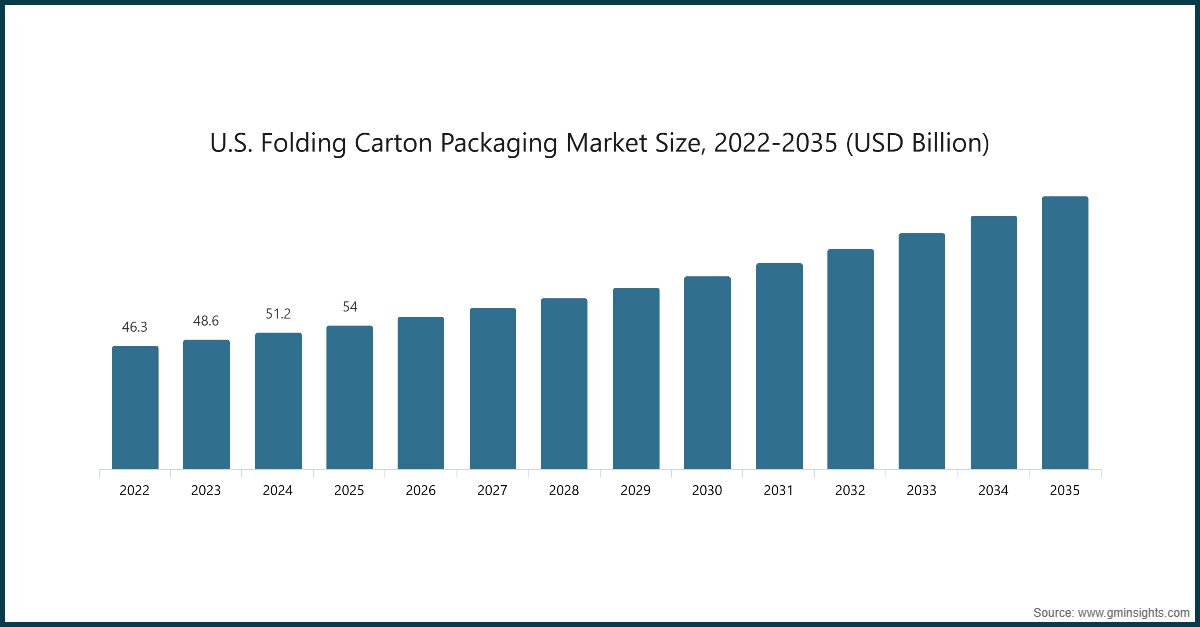
The U.S. folding carton packaging market was valued at USD 46.3 billion and USD 48.6 billion in 2022 and 2023, respectively. The market size reached USD 54 billion in 2025, growing from USD 51.2 billion in 2024.
- The folding carton packaging industry in the United States is experiencing strong growth driven by sustainability policies and recycling dynamics that favor fiber-based packaging. U.S. industry data reported that 60–64% of paper and 69–74% of cardboard available for recovery were recycled in 2024, underscoring widespread domestic recycling infrastructure and consumer participation in paperboard recovery.
- At the same time, many states are advancing Extended Producer Responsibility (EPR) frameworks for packaging that push brands to adopt recyclable formats and increase recycled content, shifting demand away from harder-to-recycle plastics toward paperboard folding cartons. These combined regulatory and infrastructure factors are positioning the U.S. as a leading market for sustainable folding carton adoption, especially across food, beverage, and consumer goods sectors.
Europe Folding Carton Packaging Market
Europe folding carton packaging industry accounted for USD 44.9 billion in 2025 and is anticipated to show lucrative growth over the forecast period.
- Europe’s folding carton packaging industry is expanding under a clearly defined regulatory transition toward circular packaging systems. The implementation phase of the EU Packaging and Packaging Waste Regulation (PPWR) is driving the development of new packaging formats that meet the requirements of the regulation for the recyclability of the packaging by design, as well as minimizing the use of packaging materials. In parallel, the EU Single-Use Plastics Directive continues to restrict certain plastic formats, accelerating substitution toward fiber-based cartons, particularly in foodservice and multipack beverage applications.
- European retailers are increasingly applying packaging scorecards that prioritize mono-material and high-recycled-content paperboard solutions, prompting converters to invest in recyclable barrier coatings and lightweight carton engineering. Strong institutional alignment between regulators, retailers, and brand owners is creating a structurally stable demand environment for compliant folding carton formats across Western and Northern Europe.
Germany dominates the Europe folding carton packaging market, showcasing strong growth potential.
- Germany represents the most structurally advanced folding carton market in Europe due to its stringent packaging compliance framework and highly organized recycling infrastructure. The German Packaging Act (VerpackG) mandates registration in the LUCID Packaging Register and strict reporting obligations for producers placing packaging on the market, directly influencing material selection toward recyclable paperboard formats.
- Additionally, strong domestic food processing, pharmaceutical manufacturing, and premium cosmetics production drive high demand for precision-printed, regulation-compliant folding cartons. The country’s emphasis on recyclability labeling transparency and material reduction strategies continues to position it as a key growth engine for advanced, sustainable carton formats in Europe.
Asia Pacific Folding Carton Packaging Market
The Asia Pacific folding carton packaging industry is anticipated to grow at the highest CAGR of 7.2% during the forecast period.
- The Asia Pacific market for folding carton packaging is witnessing growth owing to changes in the structure of retail modernization, export-oriented manufacturing bases, and the evolution of packaging waste regulations. Some of the Southeast Asian countries are implementing national action plans on plastic waste reduction, which indirectly supports the use of fiber-based packaging.
- The Southeast Asian market for folding carton packaging is witnessing rapid expansion in terms of organized retail outlets and convenience stores. At the same time, multinational companies operating in the FMCG and pharmaceutical industries are establishing their production bases in India, Vietnam, and Indonesia.
China folding carton packaging market is estimated to grow with a significant CAGR, in the Asia Pacific market.
- China’s folding carton packaging industry is being shaped by industrial restructuring policies and packaging waste control measures under its circular economy framework. The country’s intensified inspection mechanisms for packaging reduction in e-commerce and express delivery sectors are pushing brands to adopt optimized, right-sized paperboard cartons. China’s “dual carbon” targets are also influencing manufacturers to prioritize lightweight fiber-based materials that reduce carbon intensity per packaged unit.
- Furthermore, the rapid growth of domestic pharmaceutical manufacturing and health supplement production is increasing demand for precision-printed, regulation-compliant folding cartons. Strong domestic paperboard production capacity and integration of automated converting lines are enhancing supply reliability, positioning China as a structurally competitive and high-volume folding carton market within Asia Pacific.
Middle East and Africa Folding Carton Packaging Market
Saudi Arabia folding carton packaging industry to experience substantial growth in the Middle East and Africa.
- Saudi Arabia’s environmental sensors market is being driven by regulatory enforcement under the National Center for Environmental Compliance (NCEC), which mandates continuous emissions monitoring systems (CEMS) for cement, petrochemical, and power generation facilities. Large-scale industrial clusters such as Jubail and Yanbu are deploying fixed air-quality and stack monitoring networks to meet national environmental performance standards.
- Mandatory environmental impact assessments (EIAs) for new industrial and infrastructure projects are further accelerating demand for calibrated, compliance-grade monitoring equipment. These structured regulatory mechanisms and infrastructure-scale deployments position Saudi Arabia as a high-investment environmental sensing market within the Middle East & Africa region.
Folding Carton Packaging Market Share
The folding carton packaging industry is led by players such as Smurfit Kappa Group, Graphic Packaging International, Stora Enso Oyj, DS Smith Plc, and Mayr-Melnhof Karton AG. These five companies cumulatively accounted for 12.7% share of the global market in 2025, supported by their integrated cartonboard production, advanced converting capabilities, and strong geographic presence across Europe and North America.
The strength of these companies can be attributed to their vertically integrated fiber sourcing capabilities, sustainable packaging innovation, and high-precision printing technologies catering to the food and beverage sector, healthcare sector, and personal care segment. These companies maintain their leadership position through their investment in recyclable packaging solutions, weight reduction strategies, automation of their converting capabilities, and their compliance with the circular economy regulations. Their expansion into emerging markets and their diversification into premium and retail-ready cartons will enable them to capture the increasing demand for folding carton packaging.
Folding Carton Packaging Market Companies
Prominent players operating in the folding carton packaging industry are as mentioned below:
- All Packaging Company
- American Carton Company
- August Faller GmbH & Co. KG
- Diamond Packaging
- DS Smith Plc
- Georgia-Pacific LLC
- Graphic Packaging International
- Green Bay Packaging Inc.
- Huhtamaki Oyj
- Mayr-Melnhof Karton AG
- Meyers
- Oji Holdings Corporation
- Plastech Group Ltd.
- Rengo Co., Ltd.
- Schur Pack Germany GmbH
- Seaboard Folding Box Company Inc.
- Smurfit Kappa Group
- Stora Enso Oyj
- Wynalda Packaging
- Smurfit Kappa Group
Smurfit Kappa Group offers paper-based packaging solutions which they develop through their complete production process of cartonboard and their recycling facilities. The company develops its products through circular design principles, shelf-ready packaging and lightweight folding carton formats which serve food, beverage and FMCG markets. The company achieves its competitive advantage in fiber-based packaging markets through its dedication to sustainable solutions and its extensive manufacturing facilities across Europe.
Graphic Packaging International serves the food, beverage and foodservice sectors through its coated recycled board and solid bleached sulfate carton products. The company develops automated systems which use high-impact graphic printing and paperboard-based multipack carriers to substitute plastic materials. The company achieves cost savings and market dominance in North American consumer goods through its ability to control all production steps and its extensive manufacturing capacity.
Stora Enso Oyj supplies renewable cartonboard materials to customers worldwide while developing recyclable barrier-coated solutions and plastic replacement technologies. The company invests heavily in R&D to enhance moisture resistance and food safety compliance in folding cartons. The company has a strong position in sustainable packaging through its effective raw material acquisition and its development of innovative fiber-based packaging solutions.
DS Smith Plc provides fiber-based folding cartons which it develops through its extensive knowledge of retail-ready packaging and e-commerce packaging solutions. The company uses circular design methods together with supply chain optimization tools to achieve waste reduction and better logistics performance. The company designs packaging solutions which enable major retailers and FMCG brands to shift toward recyclable packaging options.
Mayr-Melnhof Karton AG offers high-quality virgin and recycled board solutions. The company creates packaging solutions which meet the needs of pharmaceutical, food and premium consumer goods industries that require both exact printing and compliance with industry regulations. The company improves its capacity to operate in fast-paced markets which require strict compliance standards through its ongoing funding of conversion automation technologies and environmentally friendly board production methods.
Folding Carton Packaging Market Report Attributes
| Key Takeaway | Details |
|---|---|
| Market Size & Growth | |
| Base Year | 2025 |
| Market Size in 2025 | USD 210.3 Billion |
| Market Size in 2026 | USD 220.9 Billion |
| Forecast Period 2026-2035 CAGR | 6.1% |
| Market Size in 2035 | USD 377.3 Billion |
| Key Market Trends | |
| Drivers | Impact |
| Regulatory push toward fiber-based recyclable packaging | Drives 24% growth by accelerating the shift toward fiber-based recyclable packaging, as extended producer responsibility (EPR) regulations in Europe, North America, and parts of Asia push brands to replace non-recyclable formats with paperboard folding cartons to meet sustainability and compliance targets. |
| Growth of e-commerce secondary packaging demand | Supports 19% growth by expanding demand for secondary and retail-ready cartons in e-commerce fulfillment, where brands increasingly require lightweight, printable, and damage-resistant folding cartons to enhance shelf visibility and last-mile protection. |
| Shift from plastic clamshells to paperboard cartons | Contributes 21% growth as consumer goods companies replace rigid plastic clamshells with paperboard cartons to reduce plastic usage, improve recyclability rates, and align with retailer sustainability mandates, particularly in electronics, food, and personal care categories. |
| Pharmaceutical serialization and compliance requirements | Adds 17% growth by mandating pharmaceutical serialization, tamper-evident features, and regulatory labeling compliance, increasing demand for high-precision printed folding cartons in regulated healthcare markets across North America, Europe, and emerging Asia. |
| Premiumization in cosmetics and personal care cartons | Accounts for 19% growth through premiumization in cosmetics and personal care, where luxury finishes such as embossing, foil stamping, soft-touch coatings, and high-definition printing drive higher-value carton consumption per unit. |
| Pitfalls & Challenges | Impact |
| Volatility in virgin pulp and paperboard prices | Restrains market growth as volatility in virgin pulp and paperboard prices directly impacts production margins for converters. Fluctuating raw material costs, influenced by global pulp supply-demand imbalances and energy pricing, create pricing instability and long-term contract risks for folding carton manufacturers. |
| High capital costs for advanced die-cutting equipment | Limits growth as advanced die-cutting, digital printing, and high-speed gluing equipment require substantial capital investment. Small and mid-sized converters face financial barriers in upgrading machinery, reducing competitiveness in high-precision, short-run, and premium carton segments. |
| Opportunities: | Impact |
| Adoption of barrier-coated recyclable paperboard | Presents significant growth potential by enabling barrier-coated recyclable paperboard solutions that replace plastic laminates in food, frozen meals, and takeaway packaging. Advances in water-based and dispersion coatings improve moisture and grease resistance while maintaining recyclability, supporting circular economy targets. |
| Smart packaging integration with QR/NFC features | Offers opportunity by integrating QR codes, NFC tags, and connected packaging features into folding cartons, enhancing consumer engagement, supply chain traceability, and anti-counterfeiting protection. Increasing brand focus on digital marketing and transparency strengthens adoption across pharmaceuticals, cosmetics, and premium food segments. |
| Market Leaders (2025) | |
| Market Leader |
12.7% market share in 2025 |
| Top Players |
Collective Market Share is 4.7% in 2025 |
| Competitive Edge |
|
| Regional Insights | |
| Largest Market | Asia Pacific |
| Fastest growing market | Asia Pacific |
| Emerging countries | China, India, Japan, Germany |
| Future outlook |
|
What are the growth opportunities in this market?
Folding Carton Packaging Industry News
- In December 2025, Graphic Packaging International launched its next-generation Boardio multipack machine with enhanced multi-footprint capability, enabling scalable production of sustainable paperboard multipack solutions for brands and co-packers. This innovation improves packaging efficiency, reduces waste, and enhances retail shelf impact.
- In October 2025, Georgia-Pacific LLC completed its acquisition of Anchor Packaging, adding significant food service and rigid container capabilities to its portfolio and expanding its packaging solutions footprint. This acquisition broadens its food & beverage substrate offerings and enhances cross-segment capabilities.
- In September 2025, Stora Enso introduced Ensovelvet, a premium uncoated solid bleached sulfate (SBS) paperboard designed for luxury packaging in cosmetics and fragrances, offering velvety smooth texture and high printability to enhance brand appeal. Ensovelvet supports rising demand for premium, sustainable folding cartons in high-end consumer goods.
The folding carton packaging market research report includes in-depth coverage of the industry with estimates and forecast in terms of revenue (USD Million) from 2022 – 2035 for the following segments:
Market, By Carton Structure
- Tuck end cartons
- Auto-lock / crash bottom cartons
- Sleeve cartons
- Lock-bottom cartons
- Display-ready cartons
- Other folding structures
Market, By Paperboard Grade
- Solid bleached sulfate (SBS)
- Coated unbleached kraft (CUK)
- Coated recycled paperboard (CRB)
- Uncoated paperboard
Market, By Printing Technology
- Offset lithography
- Flexographic printing
- Digital printing
- Gravure
Market, By Application
- Food & beverage
- Personal care & cosmetics
- Pharmaceuticals & healthcare
- Household & consumer goods
- Tobacco
- Others
The above information is provided for the following regions and countries:
- North America
- U.S.
- Canada
- Europe
- Germany
- UK
- France
- Spain
- Italy
- Netherlands
- Asia Pacific
- China
- India
- Japan
- Australia
- South Korea
- Latin America
- Brazil
- Mexico
- Argentina
- Middle East and Africa
- South Africa
- Saudi Arabia
- UAE
Frequently Asked Question(FAQ) :
What was the market size of the folding carton packaging in 2025?
The market size was valued at USD 210.3 billion in 2025, growing at a CAGR of 6.1% till 2035. The market is driven by the demand for recyclable fiber-based packaging, e-commerce growth, and premiumization trends in cosmetics and personal care packaging.
What is the projected value of the folding carton packaging market by 2035?
The market is expected to reach USD 377.3 billion by 2035, fueled by sustainability regulations and the substitution of rigid plastics with paperboard cartons.
What is the expected size of the folding carton packaging industry in 2026?
The market size is projected to reach USD 220.9 billion in 2026.
How much revenue did the tuck end cartons segment generate in 2025?
The tuck end cartons segment led the market in 2025, holding a 36.2% share, due to its compatibility with food, personal care, pharmaceutical, and household product industries.
What was the valuation of the coated recycled paperboard (CRB) segment in 2025?
The CRB segment was valued at USD 69.9 billion in 2025, supported by its cost competitiveness and high recycled fiber content, particularly in dry food packaging and personal care cartons.
Which end-use segment dominated the market in 2025?
The food & beverage segment dominated the market in 2025 with a 46.5% share, led by demand for packaged foods, frozen items, cereals, dairy products, and beverage multipacks.
Which region held the largest share of the folding carton packaging sector in 2025?
North America held a 29.1% share of the market in 2025, propelled by stringent sustainability requirements, retailer-driven recyclable packaging initiatives.
What are the key trends in the folding carton packaging market?
Key trends include lightweight sustainable cartons, digital printing for short-run customization, retail-ready packaging formats, recyclable mono-material paper packaging, and improved barrier coatings for food protection.
Who are the key players in the folding carton packaging industry?
Key players include All Packaging Company, American Carton Company, August Faller GmbH & Co. KG, Diamond Packaging, DS Smith Plc, Georgia-Pacific LLC, Graphic Packaging International, Green Bay Packaging Inc., Huhtamaki Oyj, Mayr-Melnhof Karton AG, and Meyers.
Folding Carton Packaging Market Scope
Related Reports