Summary
Table of Content

Foldable Inflatable Boats Market
Get a free sample of this report
Form submitted successfully!
Error submitting form. Please try again.
Thank you!
Your inquiry has been received. Our team will reach out to you with the required details via email. To ensure that you don't miss their response, kindly remember to check your spam folder as well!
Request Sectional Data
Thank you!
Your inquiry has been received. Our team will reach out to you with the required details via email. To ensure that you don't miss their response, kindly remember to check your spam folder as well!
Form submitted successfully!
Error submitting form. Please try again.
Foldable Inflatable Boats Market Size
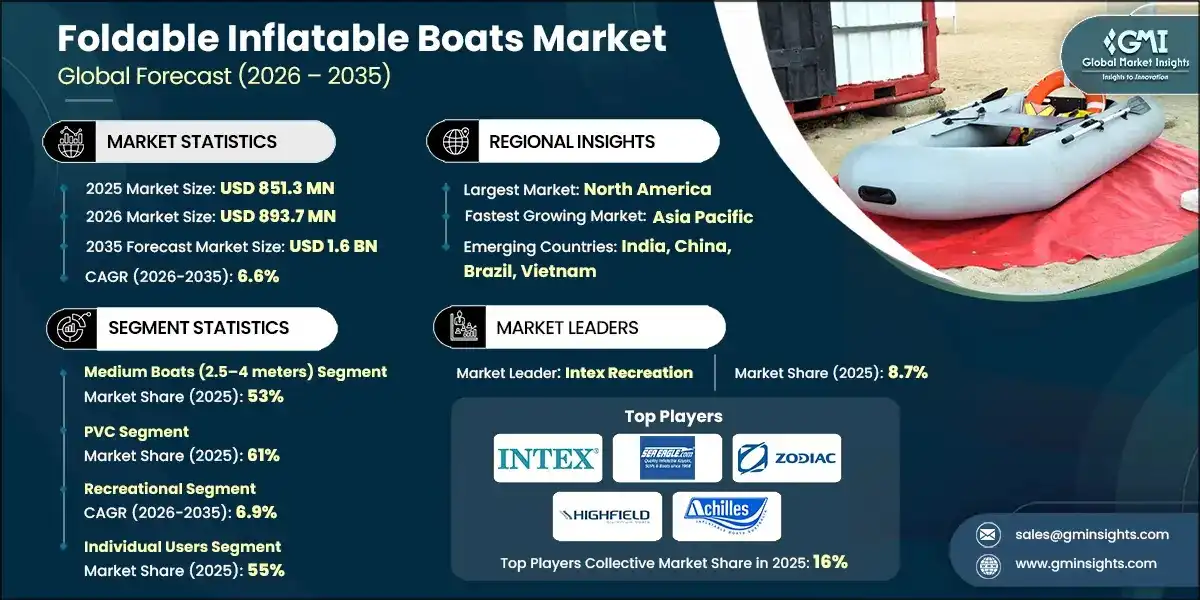
The global foldable inflatable boats market size was estimated at USD 851.3 million in 2025. The market is expected to grow from USD 893.7 million in 2026 to USD 1.6 billion in 2035, at a CAGR of 6.6% according to latest report published by Global Market Insights Inc.
To get key market trends
Foldable inflatable boats are increasingly popular across recreational, commercial, and emergency response sectors. These portable vessels offer the durability of rigid boats while ensuring compact storage and easy transport, making them suitable for activities ranging from leisure boating to rescue operations.
The foldable inflatable boats industry is embracing advanced polyurethane-coated fabrics due to their superior abrasion resistance. Industry benchmarks reveal that these materials are approximately 10 times more resistant to abrasion than traditional rubber or PVC alternatives.
In 2023, coastal and marine tourism contributed USD 1.5 trillion globally and supported 52 million jobs. This robust growth in the marine tourism sector is fueling substantial demand for foldable inflatable boats.
In 2024, the U.S. recreational boating market generated USD 56.7 billion in sales of boats, marine products, and services. Boating activities significantly contributed to the outdoor recreation economy, which accounted for 2.3% (USD 639.5 billion) of the U.S. GDP in 2023.
The International Council of Marine Industry Associations (ICOMIA), in its 2025 Recreational Boating Industry Statistics Report, highlighted the global expansion of recreational boating. Growth in Asia-Pacific markets is driven by government support, improved water access infrastructure, and rising middle-class affluence.
Emergency response applications are boosting demand for high-performance inflatable boats that comply with strict safety and durability standards. The U.S. Coast Guard's 2024 report recorded 556 boating fatalities, with 76% due to drowning, and 87% of drowning victims were not wearing life jackets.
The growth of marine tourism is driving demand for foldable inflatable boats among commercial tour operators, diving centers, and adventure sports providers. In 2023, coastal and marine tourism contributed USD 1.5 trillion to global GDP, with nearly 50% of global tourist spending attributed to tourism expenditures.
Foldable Inflatable Boats Market Report Attributes
| Key Takeaway | Details |
|---|---|
| Market Size & Growth | |
| Base Year | 2025 |
| Market Size in 2025 | USD 851.3 Million |
| Market Size in 2026 | USD 893.7 Million |
| Forecast Period 2026-2035 CAGR | 6.6% |
| Market Size in 2035 | USD 1.6 Billion |
| Key Market Trends | |
| Drivers | Impact |
| Growing popularity of recreational boating and water sports | Increasing participation boosts demand for easy-to-use, lightweight foldable boats for leisure activities. |
| Demand for portable and affordable watercraft | Consumers favor compact, budget-friendly boats that require minimal storage and can be transported easily. |
| Increased use in emergency and rescue operations | Increased use in emergency and rescue operations |
| Expanding marine tourism and adventure sports industry | Growth in coastal and inland tourism drives higher adoption by rental operators, resorts, and tour companies. |
| Durability and wear-and-tear issues | Material degradation and puncture risks can limit long-term consumer confidence and slow repeat purchases. |
| Pitfalls & Challenges | Impact |
| Durability & wear-and-tear issues | Material degradation, punctures, and shorter product lifespan reduce user confidence and increase maintenance costs. |
| Price sensitivity in the consumer segment | Budget-conscious buyers hesitate to invest in higher-quality models, limiting premium product adoption and market growth. |
| Opportunities: | Impact |
| Rising demand from recreational boating and adventure tourism | Expanding leisure participation boosts sales of portable, easy-to-launch foldable inflatable boats. |
| High growth potential in emerging markets (Asia-Pacific & Latin America) | Growing disposable incomes and tourism expansion create strong new demand pockets for inflatable boats. |
| Increasing adoption by rescue, disaster-response, and government agencies | Need for rapid deployment craft drives institutional purchases of durable foldable inflatables. |
| Growing interest in eco-friendly and electric-propulsion boating options | Rising environmental awareness accelerates adoption of lightweight inflatable boats paired with e-motors. |
| Market Leaders (2025) | |
| Market Leaders |
8.7% Market Share |
| Top Players |
Collective market share in 2024 is Collective Market Share is 16% |
| Competitive Edge |
|
| Regional Insights | |
| Largest Market | North America |
| Fastest Growing Market | Asia Pacific |
| Emerging Country | India, China, Brazil, Vietnam |
| Future Outlook |
|
What are the growth opportunities in this market?
Foldable Inflatable Boats Market Trends
The foldable inflatable boats industry is witnessing advancements in material science and construction methods, driving changes in product performance and market segmentation. The transition from traditional PVC to polyurethane-coated fabrics and enhanced Hypalon compounds is improving durability, lifespan, and cost efficiency.
Polyurethane (PU) coated fabrics are the preferred choice for professional and commercial applications. As per ISO 15372:2000 testing protocols, they offer approximately 10 times the abrasion resistance of traditional PVC or Hypalon alternatives.
Foldable inflatable boats are being transformed into advanced platforms through the integration of marine electronics, satellite communications, and IoT technologies. This shift enhances safety, navigation, and efficiency but poses challenges like power supply, waterproofing, and retrofit compatibility with compact designs.
GPS chart plotters, fish finders, and depth sounders are now standard on medium and large inflatable boats, catering to recreational fishing and commercial tours. Multi-function displays integrate navigation, fish finding, radar, and AIS data into a single screen, offering situational awareness previously limited to large yachts and commercial vessels.
Environmental sustainability has become a core focus in the foldable inflatable boats market, driven by regulations, evolving consumer preferences, and marine conservation goals. Key advancements include recyclable materials, electrified propulsion systems, and waste-reducing manufacturing processes.
Government agencies and international humanitarian organizations are increasingly procuring foldable inflatable boats due to their proven effectiveness in flood rescues, tsunami responses, and maritime emergencies. This demand drives stable, multi-year procurement cycles, prioritizing durability, regulatory compliance, and operational reliability over cost.
The Federal Emergency Management Agency (FEMA) established comprehensive standards for Urban Search & Rescue task force water rescue capabilities, mandating each of the 28 national US&R teams maintain two inflatable rescue boats as core equipment within water rescue mission ready packages.
Foldable Inflatable Boats Market Analysis
Learn more about the key segments shaping this market
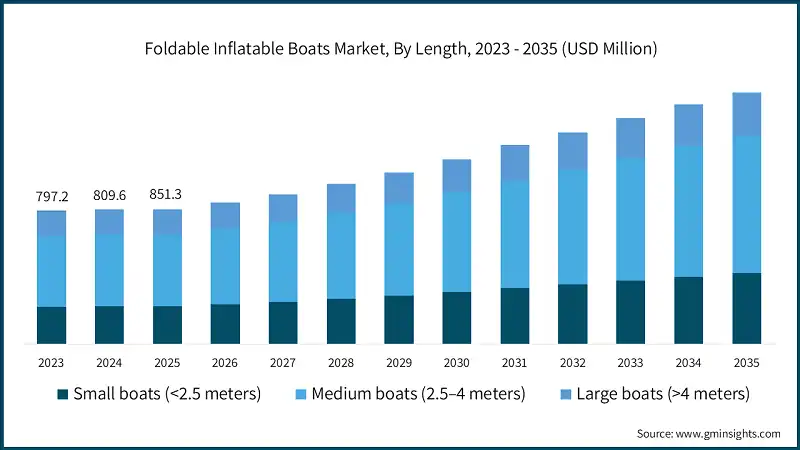
Based on length, the foldable inflatable boats market is segmented into small boats (<2.5 meters), medium boats (2.5–4 meters), large boats (>4 meters). The medium boats (2.5–4 meters) segment dominates the market with 53% share in 2025, and the segment is expected to grow at a CAGR of 6.9% from 2026 to 2035.
- This size range offers portability for two-person crews with trailers, a 4-6 passenger capacity, and compatibility with 10-40 horsepower outboards, achieving planning speeds of 20-30 knots.
- Recreational cruising, fishing operations, tourism transport, and emergency rescue deployments drive a diversified demand across various end-use segments, mitigating the risks associated with reliance on a single application.
- Vessels feature beam widths of 1.4-1.8 meters for enhanced stability, integrated rigid floor systems for standing operations, and motor mount transoms supporting outboard engines up to 30-40 horsepower, subject to regulations.
- In 2025, the small boats segment is expected to hold a 28% market share, growing at a 6.6% CAGR. It primarily serves recreational users seeking ultra-portable watercraft for casual paddling, shore fishing, and yacht tender applications.
- The product's deflated package, measuring 40-60 cm x 30-40 cm x 20-30 cm and weighing 8-15 kg, includes a boat, oars, pump, and accessories. Its compact design ensures easy transport in car trunks, storage in small spaces, and suitability for airline baggage.
- Market adoption is driven by entry-level recreational users, apartment dwellers without boat storage, RV travelers needing portable water access, and yacht owners requiring compact tenders for ship-to-shore transport.
- In 2025, the large boats segment is expected to account for 19% of the market share, growing at a 5.8% CAGR during forecast period, slower than the overall market due to diminishing size advantages compared to rigid-hull alternatives.
- Intense competition from traditional rigid-hull boats, high price points during industry downturns, and complex regulations discourage investments in inflatable vessels within this size range.
Learn more about the key segments shaping this market
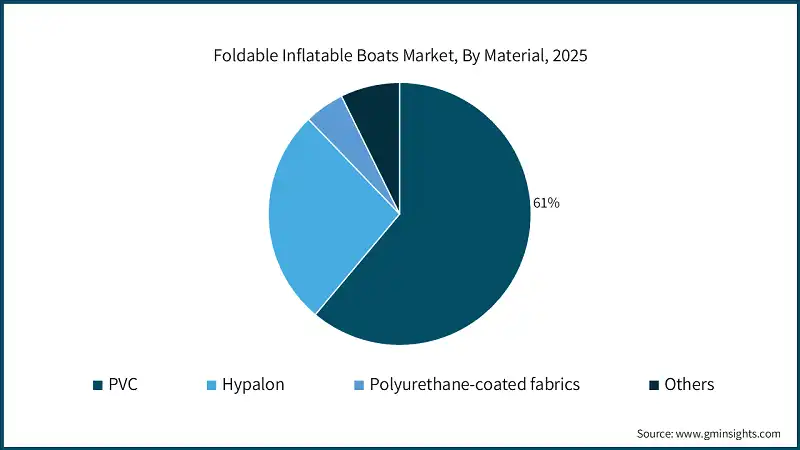
Based on material, the foldable inflatable boats market is divided into PVC, Hypalon, Polyurethane-coated fabrics and Others. The PVC segment dominates with 61% market share in 2025 and is growing at the fastest rate of 5.9% CAGR from 2026 to 2035.
- Modern marine-grade PVC fabrics, featuring advanced UV stabilizers and protective coatings, address historical degradation issues and come with 10-year UV warranties on premium formulations. These fabrics consist of PVC coating layers laminated over high-tenacity polyester scrim (typically 1000 deniers), ensuring tensile strength and creating waterproof, airtight barriers.
- This material segment leads the market due to its cost-performance balance, ease of manufacturing via thermal welding, and a strong global supply chain.
- Marine-grade PVC features a tensile strength of 2700 N (warp) and 2500 N (weft) per 5 cm, tear strength of 500 N, and waterproofing exceeding a 2000mm hydrostatic head. It operates effectively in temperatures from -30°C to 70°C, suitable for inflatable applications.
- PVC materials improve manufacturing efficiency by using high-frequency thermal welding to fuse layers, creating seams as strong as the original fabric and ensuring durability.
- The Hypalon segment, recognized for its premium durability in foldable inflatable boats, is projected to hold a 26% market share in 2025, growing at a strong 8% CAGR, surpassing overall market growth.
- This synthetic rubber material, with a 15–25-year lifespan under proper maintenance, resists UV radiation, saltwater, chemicals, and extreme temperatures, making it suitable for entities prioritizing total cost of ownership.
- Hypalon's inherent UV resistance ensures it remains flexible and structurally sound, even in harsh environments like tropical marine settings, where conventional PVC degrades rapidly.
- In 2025, polyurethane-coated fabrics in foldable inflatable boats are projected to hold a 5% market share, growing at a robust 10.2% CAGR during 2026 and 2035, reflecting strong premium segment dynamics.
- This high-performance material offers 10 times the abrasion resistance of rubber or PVC, exceptional air retention, lightweight construction, and seam strength equivalent to the parent material through thermal welding.
- Polyurethane coating is applied to polyamide (nylon) or polyester base fabrics, with polyamide preferred for inflatable applications due to its 50% greater elasticity, which improves impact resistance and burst pressure tolerance.
- The material demonstrates excellent airtightness, supported by independent tests, and offers high abrasion resistance, making it suitable for vessels in rocky coastal or beaching environments.
- Alternative polymer coatings, including thermoplastic polyurethane (TPU), vulcanized rubber, and neoprene-based constructions, account for 7% of the market share in 2025, with a CAGR of 4.2% from 2026 to 2035.
- This category caters to specialized applications and emerging material technologies, meeting performance and sustainability needs that conventional PVC, Hypalon, or polyurethane cannot fully address.
Based on application, the foldable inflatable boats market is segmented into recreational, rescue & emergency, tourism & adventure sports, commercial use and others. The recreational segment dominates with 38% market share in 2025 and expanding at 6.9% CAGR till 2035, driven by sustained growth in water-based leisure activities.
- This segment caters to individual consumers and families, offering affordable access to a variety of recreational activities such as cruising, fishing, watersports, and family outings.
- In 2023, the U.S. recreational boating industry made waves with a USD 230 billion economic impact, bolstering over 812,000 jobs. Notably, outdoor recreation contributed a significant 2.3% to the national GDP, which stood at USD 639.5 billion, underscoring a solid economic foundation for sustained growth.
- In 2022, NOAA Fisheries reported over 200 million recreational angling trips, with anglers catching an estimated 1.1 billion fish. The recreational boating market remained resilient in 2024, generating USD 55.6 billion in retail expenditure despite a 2.6% decline from 2023.
- Recreational boating appeals to various age groups, with males aged 35-65 being key decision-makers. Family boating experiences further drive multi-generational participation, supporting long-term market growth.
- In 2025, the rescue and emergency application segment is projected to hold a 23% market share, growing at a 6.7% CAGR due to the institutionalization of water rescue capabilities in government emergency response organizations globally.
- Rapidly deployable watercraft are essential for flood rescues, tsunami responses, maritime emergencies, swift water rescues, and disaster relief, especially in challenging conditions with compromised infrastructure.
- Institutions are allocating larger budgets for water rescue capabilities due to climate change impacts, including intensified storms, expanded flood zones, and more frequent weather-related disasters.
- In 2025, the tourism and adventure sports segment is expected to hold an 18% market share, growing at a 6.5% CAGR from 2026 to 2035, due to rising demand for experiential tourism and outdoor activities.
- Applications are utilized by commercial tour operators, resort properties, and adventure sports providers for activities such as diving expeditions, island hopping, snorkeling, eco-tourism, fishing charters, and water sports like wakeboarding and water skiing.
- In 2023, the global marine tourism sector showcased its robust fundamentals, contributing a staggering USD 1.5 trillion. This vibrant sector not only supported 52 million jobs but also generated an impressive USD 820 billion in direct tax revenue.
Based on end use, the foldable inflatable boats market is divided into individual users, commercial operators, and government & NGO agencies. Individual users dominate with 55% market share in 2025, expanding at modest 5% CAGR during forecast period, as commercial and government segments capture disproportionate growth.
- Private recreational boat owners purchase inflatable vessels for activities such as fishing, cruising, watersports, and family outings. This consumer market is driven by discretionary spending and price sensitivity.
- Approximately 75% of boat purchasers are male, though female participation is rising, particularly among younger buyers. The key purchasing age of 35-65 aligns with peak earning years and family recreation priorities.
- Consumers base purchase decisions on the value proposition, balancing price with quality and longevity, while brand reputation, reviews, and peer recommendations play key roles.
- Price sensitivity varies by income and experience, with first-time buyers being more price-conscious than experienced boaters, who prefer premium products for better performance.
- In 2025, the commercial operators segment is projected to hold a 27% market share, supported by a robust 7.9% CAGR from 2026 to 2035, due to fleet expansion among tour operators, dive centers, and rental services.
- This end-use category encompasses businesses generating revenue through vessel deployment, driving purchasing decisions based on return-on-investment analysis rather than discretionary consumer preferences.
- Businesses in this space include tour operators offering packaged experiences, rental operations providing vessels, fishing charters targeting sport fishing, dive operations supporting underwater tourism, and marine services like piloting and aquaculture support.
- Fleet economics favor durable materials to optimize total cost of ownership despite higher initial costs. Hypalon holds 50% of the commercial operator market, while polyurethane accounts for 10-15%, driven by lifecycle value priorities.
- In 2025, government and NGO agencies are expected to hold an 18% market share, growing at the fastest CAGR of 8.9% during forecast period, driven by the institutionalization of emergency response and humanitarian relief programs globally.
- This category includes federal and national emergency management agencies, state and provincial emergency services, municipal fire and rescue departments, law enforcement agencies, military forces, and international humanitarian organizations like the Red Cross, UN agencies, and development NGOs in disaster-prone regions.
Looking for region specific data?
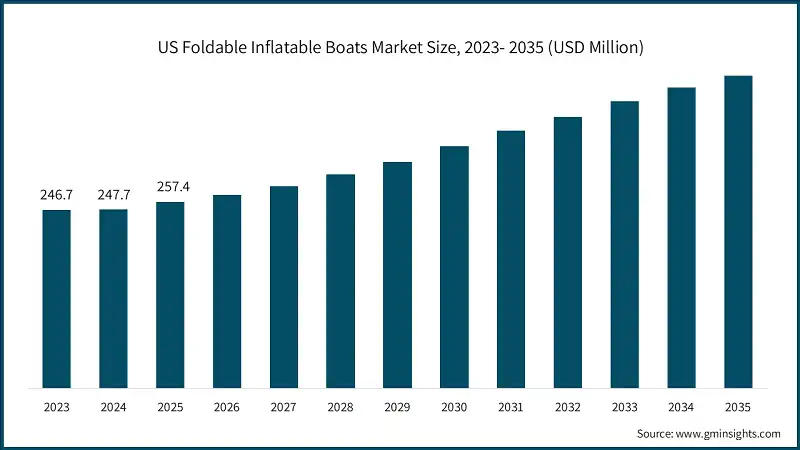
North America region dominated the foldable inflatable boats market with a market share of 34% in 2025, which is anticipated to grow at a CAGR of 5.3% during the analysis timeframe. In 2025, US generated majority of the market share in North America and generates revenue of USD 257.4 million.
- North America leads the foldable inflatable boat market, driven by its advanced marine infrastructure, extensive marina networks, and strong dealer ecosystems. A deep-rooted boating culture and favorable regulatory policies further support consistent demand and market growth.
- The market's maturity is evident with over 12 million registered boats and diverse distribution channels, including marine dealers, mass retailers, and online platforms.
- In 2023, the outdoor recreation economy contributed USD 639.5 billion to the national GDP, with inflatable boats gaining popularity as portable and versatile options for various waterways.
- Shifting demographics are altering demand dynamics. While Baby Boomers sustain a solid user base, Millennials and Generation Z prefer affordable, portable, and low-maintenance options like foldable inflatable boats over traditional powerboats.
- Economic conditions, marked by high interest rates and reduced consumer confidence, are curbing discretionary purchases like marine vessels. With new powerboat sales declining by 8.9% through July 2025, foldable inflatable boats are gaining traction as affordable, low-maintenance alternatives.
- Canada holds a significant share of North America's foldable inflatable boats market, driven by its outdoor recreation culture, abundant freshwater resources, and growing maritime tourism.
- Despite a shorter boating season and smaller population compared to the U.S., demand remains supported by the rising preference for compact, transportable boating solutions.
The foldable inflatable boats market in US is expected to experience significant and promising growth from 2026 to 2035.
- The US dominates the North American foldable inflatable boats market due to a strong recreational boating culture, established marina networks, and a mature dealer ecosystem.
- Manufacturers cater to leisure, fishing, and utility sectors through well-developed distribution channels, including specialty marine dealers and mass-market retailers.
- Federal and state regulations, safety standards, and boating guidelines promote the responsible use of foldable inflatables, driving market growth through water safety programs and outdoor recreation initiatives.
- The US ecosystem supports the integration of foldable inflatables into recreational and professional uses through product development, certification standards, and service networks, ensuring reliability and user confidence.
- Shared boating operators, rescue organizations, and outdoor programs are expanding fleets to meet rising demand, while municipalities and tourism operators implement safety and maintenance frameworks.
Asia Pacific is the fastest growing foldable inflatable boats market, which is anticipated to grow at a CAGR of 8.5% during the analysis timeframe.
- Asia Pacific leads as the fastest-growing regional market, fueled by a burgeoning middle class, advancements in marine tourism infrastructure, and proactive government initiatives championing recreational marine activities.
- China dominates the Asia-Pacific foldable inflatable boats market, driven by government support, favorable policies, and investments in marine tourism. Coastal provinces like Hainan and Guangdong have seen infrastructure upgrades, boosting market growth.
- Rising domestic tourism, urbanization, and a growing middle class are boosting the recreational segment, with operators expanding water-based activities in key coastal destinations. Government initiatives for emergency response further drive institutional procurement in disaster-prone regions.
- India's recreational boating market is growing rapidly, driven by marine tourism infrastructure, government promotions, and rising domestic tourism. Established hubs like Kerala and Goa are expanding offerings, while emerging coastal regions are developing infrastructure.
- The Asia-Pacific market, including Indonesia, Thailand, Vietnam, the Philippines, Australia, and smaller Southeast Asian nations, is expanding rapidly.
- Archipelagic geographies drive waterborne transport demand in Indonesia and the Philippines, while Thailand's tourism hubs and Australia's mature boating culture support commercial and premium segments.
The China is fastest growing country in Asia Pacific foldable inflatable boats market growing with a CAGR of 7.8% from 2026 to 2035.
- China's foldable inflatable boats market is growing rapidly, driven by rising demand for recreational boating, coastal tourism, and emergency response. It offers a range of models, from leisure inflatables to professional rescue boats.
- Government policies are driving growth by promoting marine tourism, recreational industry development, and investments in coastal infrastructure, such as marinas and boating zones.
- China's coastal provinces offer advanced marine infrastructure with marina networks, launch facilities, and service support, ensuring accessibility for recreational and institutional users.
- Commercial operators and government agencies increasingly use foldable inflatable boats for tourism, fishing, and emergency responses, leveraging their standardized designs and rapid deployment features.
- Domestic manufacturers are increasing production by utilizing local supply chains and adopting lightweight materials, modular designs, and digital platforms to enhance efficiency and user experience.
- China leads the Asia-Pacific foldable inflatable boats market, driven by government initiatives, advanced infrastructure, and growing demand for coastal tourism, leisure activities, and emergency responses.
Europe foldable inflatable boats market accounted for USD 262.2 million in 2025 and is anticipated to show growth of 6.8% CAGR over the forecast period.
- In Europe, the market for foldable inflatable boats is on the rise, fueled by a passion for recreational boating, a booming tourism sector, and a surging appetite for portable, versatile watercraft. Germany, the Netherlands, France, and Italy stand out as pivotal markets in this trend.
- Germany dominates the European market due to its strong marina networks, domestic boating industry, and demand for premium recreational watercraft.
- In Southern Europe, coastal tourism and leisure boating drive demand for foldable inflatables, while in the UK, clear regulations and government initiatives boost portable boat adoption.
- Spain, Italy, and Greece in the Mediterranean are fueling demand for inflatable boats, primarily for island tours, diving, and beach resort activities.
- European regulations and safety standards drive market confidence among recreational users, rental operators, and rescue agencies.
- Collaborations among manufacturers, marine service providers, tourism operators, and local authorities are driving the adoption of foldable inflatables, increasing accessibility and participation in boating across countries like the Netherlands, Germany, and Scandinavia.
Germany dominates the Europe foldable inflatable boats market, showcasing strong growth potential, with a CAGR of 7.1% from 2026 to 2035.
- Germany's foldable inflatable boats market is driven by manufacturers and marine technology firms specializing in lightweight materials, modular designs, and rapid-deployment inflatables, fostering innovation in watercraft.
- Government policies, such as safety regulations and recreation incentives, are boosting foldable inflatable boat adoption in leisure, tourism, and institutional sectors.
- German engineering and marine technology firms are advancing hull materials, inflation systems, and portability, driving the development of foldable inflatables for recreation, rental fleets, and emergency response.
- Leading manufacturers are developing modular, durable, and transportable boat platforms, reinforcing Germany's position as a key hub for foldable inflatable boats in Europe.
Brazil leads the Latin American foldable inflatable boats market, exhibiting remarkable growth of 3.5% during the forecast period of 2026 to 2035.
- In Brazil, cities like Rio de Janeiro, São Paulo, and Brasília are witnessing a surge in interest for recreational boating, coastal tourism, and water-based leisure activities, fueling the growth of the foldable inflatable boats market.
- Government initiatives are bolstering market adoption through the promotion of boating safety programs, investments in marinas and public launch facilities, and the formulation of policies that foster participation in water-based recreation and bolster emergency preparedness.
- In Brazil, manufacturers, tourism operators, and rescue organizations are teaming up with global inflatable boat producers. Their goal is to create tailored solutions for recreational boating, commercial rental fleets, and emergency waterborne responses.
- As marine infrastructure expands and public access points, along with maintenance and service networks, grow, foldable inflatable boats are becoming increasingly practical and scalable for recreational, commercial, and institutional use.
UAE to experience substantial growth in the Middle East and Africa foldable inflatable boats market in 2025.
- Government initiatives in Dubai, Abu Dhabi, and Sharjah are rapidly propelling the growth of the UAE's market, emphasizing maritime tourism, water-based recreation, and emergency preparedness.
- Government funding, smart city marine projects, and investments in marinas are boosting the adoption of foldable inflatables for recreational, rental-related, and institutional use.
- In the UAE, global and regional marine product providers, from specialty inflatable boat manufacturers to local startups, are rolling out portable, durable, and versatile foldable boats. These boats cater to leisure, tourism, and water rescue operations.
- By adopting rapid-deployment designs, modular platforms, and digital fleet management tools, the UAE is boosting operational efficiency and establishing itself as a regional center for portable, emergency-ready inflatable boats.
- Across GCC nations, supportive regulations, government incentives, and urban coastal development plans are fueling the adoption of compact, versatile, and sustainable watercraft solutions.
Foldable Inflatable Boats Market Share
The top 7 companies in the foldable inflatable boats industry are Zodiac Nautic, AB Inflatables, Achilles Inflatable Boats, Intex Recreation, Sevylor, Sea Eagle Boats and Highfield Boats contributed around 17% of the market in 2025.
- Since 1896, Zodiac Nautic has leveraged its rich brand heritage, boasting a diverse product portfolio that caters to both recreational and professional applications. With a robust global distribution network spanning over 50 countries, the company firmly holds its position as a market leader.
- AB Inflatables, renowned for its high-performance recreational and professional inflatables, delivers durable and lightweight designs tailored for water sports, fishing, and rescue operations. With a strong reputation for quality engineering and bespoke solutions, the company solidifies its foothold in both European and North American markets.
- Achilles Inflatable Boats caters to leisure, rental, and institutional needs with its versatile inflatable offerings. Ranging from entry-level recreational boats to sturdy professional-grade models, the company prioritizes affordability and reliability while serving markets across Asia, North America, and Europe.
- Intex Recreation leads the market by targeting mass-market recreational segments, employing aggressive pricing strategies, and ensuring widespread distribution through major retailers like Walmart and Target, as well as e-commerce giants such as Amazon.
- Sevylor, with its lightweight and easily transportable inflatable boats and kayaks, is making waves in the recreational and leisure segments. The brand's innovative designs, coupled with accessible pricing and a global retail presence, resonate with newcomers and urban dwellers in search of compact and portable watercraft solutions.
- Sea Eagle Boats carved out a unique niche by highlighting its portability features, adopting a direct-to-consumer sales approach to cut distribution costs, and strategically positioning its prices in the mid-market to strike a balance between quality and affordability.
- Highfield Boats has carved a niche in the rigid-inflatable boat (RIB) segment, spotlighting its offshore capabilities, robust commercial-grade construction, and a dealer network that offers expert consultation and service support.
Foldable Inflatable Boats Market Companies
Major players operating in the foldable inflatable boats industry are:
- AB Inflatables
- Achilles Inflatable Boats
- BRIS
- Highfield Boats
- Intex Recreation Corp.
- Sea Eagle Boats
- Sevylor
- Walker Bay
- Zodiac Nautic
- AB Inflatables and Achilles Inflatable Boats lead innovation in high-performance inflatables, with AB focusing on lightweight, modular designs for leisure and emergency use, while Achilles offers versatile, cost-effective options for recreational and institutional users globally.
- Highfield Boats targets premium markets with durable, high-performance inflatables for enthusiasts, rental operators, and institutions, while Walker Bay focuses on modular, user-friendly designs for coastal resorts, tour operators, and recreational boating.
- Intex Recreation, Sea Eagle Boats, and Sevylor target the mass-market and casual recreational segments. Intex offers affordable family inflatables, Sea Eagle provides versatile boats for various uses, and Sevylor focuses on portable inflatables for convenience.
Foldable Inflatable Boats Industry News
- In July 2025, Hibiscus Boats clinched a significant contract, set to deliver a fleet of cabin RIBs to a prominent charter operator in the Caribbean. The deliveries, slated to span through 2026, will bolster the operator's fleet across various resort destinations.
- In May 2025, Aqua Marina introduced a lightweight carbon-fiber cabin RIB series for premium charter and research use, reducing weight by 25-30% compared to fiberglass while maintaining strength and durability.
- In March 2025, Brunswick Corporation partnered with Zodiac Nautic to co-develop cabin rigid inflatable boat (RIB) platforms, combining Brunswick's marine expertise with Zodiac's manufacturing legacy for leisure and professional markets.
- In September 2024, FunAir, a US-based superyacht inflatables specialist, introduced the FunFlex system a modular waterpark comprising interlocking, interchangeable modules such as sea pools, climbing walls, and jet ski docks. This innovative product aims to enhance the recreational experience on superyachts by expanding usable space at sea level.
The foldable inflatable boats market research report includes in-depth coverage of the industry with estimates & forecasts in terms of revenue ($ Mn/Bn) & shipment (Units) from 2022 to 2035, for the following segments:
Market, By Material
- PVC
- Hypalon
- Polyurethane-coated fabrics
- Others
Market, By Length
- Small boats (<2.5 meters)
- Medium boats (2.5–4 meters)
- Large boats (>4 meters)
Market, By Application
- Recreational
- Rescue & emergency
- Tourism & adventure sports
- Commercial use
- Others
Market, By End Use
- Individual users
- Commercial operators
- Government & NGO agencies
Market, By Distribution Channel
- OEM/direct sales
- Marine dealers & retailers
- E-commerce/online
- Distributors
The above information is provided for the following regions and countries:
- North America
- US
- Canada
- Europe
- Germany
- UK
- France
- Italy
- Spain
- Russia
- Nordics
- Benelux
- Asia Pacific
- China
- India
- Japan
- Australia
- South Korea
- Singapore
- Thailand
- Indonesia
- Vietnam
- Latin America
- Brazil
- Mexico
- Argentina
- Colombia
- MEA
- South Africa
- Saudi Arabia
- UAE
Frequently Asked Question(FAQ) :
What are the upcoming trends in the foldable inflatable boats market?
Key trends include durable polyurethane fabrics, IoT-enabled marine electronics, electrified propulsion, recyclable materials, and low-waste manufacturing.
Who are the key players in the foldable inflatable boats industry?
Key players include AB Inflatables, Achilles Inflatable Boats, BRIS, Highfield Boats, Intex Recreation Corp., Sea Eagle Boats, Sevylor, Walker Bay, and Zodiac Nautic.
What was the market share of the PVC segment in 2025?
The PVC segment held a 61% market share in 2025 and is set to expand at a CAGR of 5.9% till 2035.
What is the growth outlook for the recreational segment through 2035?
The recreational segment, which held a 38% market share in 2025 and is anticipated to witness over 6.9% CAGR through 2035.
Which region leads the foldable inflatable boats sector?
North America leads the market with a 34% share in 2025, led by advanced marine infrastructure, extensive marina networks, and favorable regulatory policies. The region is projected to grow at a CAGR of 5.3% during the forecast period.
How much market share did the medium boats segment hold in 2025?
The medium boats segment (2.5–4 meters) dominated the market with a 53% share in 2025 and is expected to grow at a CAGR of 6.9% from 2026 to 2035.
What is the expected size of the foldable inflatable boats industry in 2026?
The market size is projected to reach USD 893.7 million in 2026.
What is the projected value of the foldable inflatable boats market by 2035?
The market is poised to reach USD 1.6 billion by 2035, driven by advancements in material science, integration of marine electronics, and growing adoption in rescue operations.
What is the market size of the foldable inflatable boats in 2025?
The market size was USD 851.3 million in 2025, with a CAGR of 6.6% expected through 2035. Increasing demand across recreational, commercial, and emergency response sectors is driving market growth.
Foldable Inflatable Boats Market Scope
Related Reports