Summary
Table of Content

Flow Meters Market
Get a free sample of this report
Form submitted successfully!
Error submitting form. Please try again.
Thank you!
Your inquiry has been received. Our team will reach out to you with the required details via email. To ensure that you don't miss their response, kindly remember to check your spam folder as well!
Request Sectional Data
Thank you!
Your inquiry has been received. Our team will reach out to you with the required details via email. To ensure that you don't miss their response, kindly remember to check your spam folder as well!
Form submitted successfully!
Error submitting form. Please try again.
Flow Meters Market Size
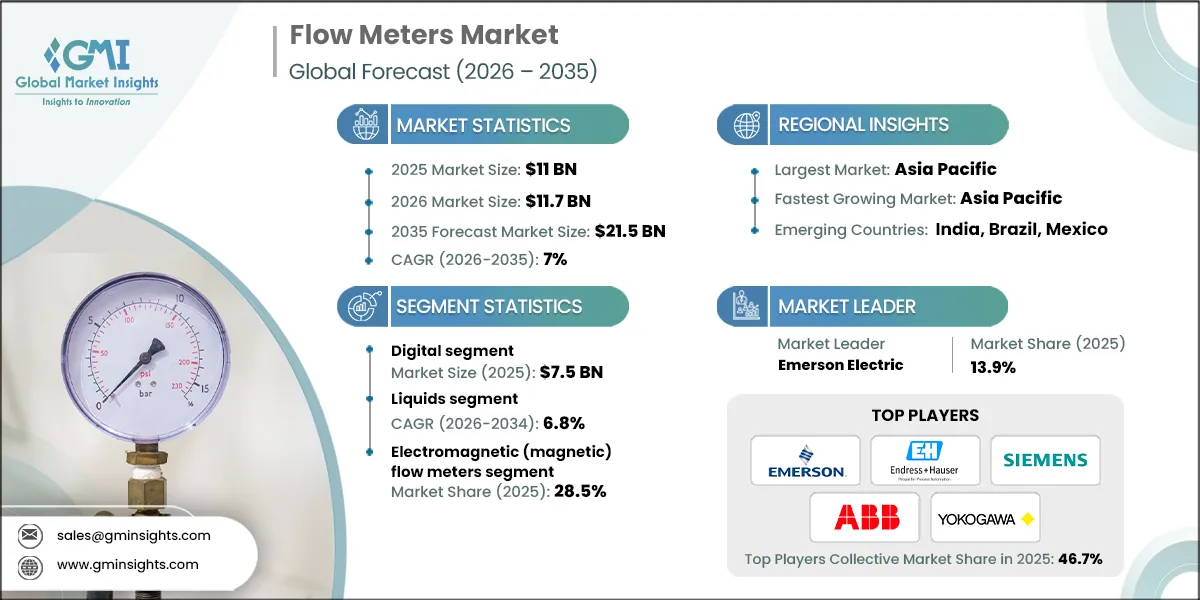
The global flow meters market was valued at USD 11 billion with 2.3 million units in 2025. The market is expected to grow from USD 11.7 billion in 2026 to USD 16.6 billion in 2031 and USD 21.5 billion in 2035 and 3.9 million units, growing at a value CAGR of 7% during the forecast period according to the latest report published by Global Market Insights Inc.
Flow Meters Market Key Takeaways
Market Size & Growth
- 2025 Market Size: USD 11 Billion
- 2026 Market Size: USD 11.7 Billion
- 2035 Forecast Market Size: USD 21.5 Billion
- CAGR (2026–2035): 7%
Regional Dominance
- Largest Market: Asia Pacific
- Fastest Growing Region: Asia Pacific
Key Market Drivers
- Expansion of process industries and infrastructure investments.
- Increasing automation and digitalization of industrial operations.
- Stringent regulatory requirements for custody transfer, safety, and emissions monitoring.
- Growing water and wastewater treatment capacity worldwide.
- Rising demand for high-accuracy measurement in energy and chemical processing.
Challenges
- High initial cost of advanced flow meter technologies.
- Complex installation and calibration requirements in legacy and harsh operating environments.
Opportunity
- Replacement of aging installed base with smart and digital flow meters.
- Rapid capacity expansion in semiconductor, LNG, and hydrogen infrastructure.
Key Players
- Market Leader: Emerson Electric led with over 13.9% market share in 2025.
- Leading Players: Top 5 players in this market include Emerson Electric, Endress+Hauser, Siemens AG, ABB Ltd, Yokogawa Electric Corporation, which collectively held a market share of 46.70% in 2025.
Get Market Insights & Growth Opportunities
The growth of the flow meters market is attributed to expansion of process industries and infrastructure investments, increasing automation and digitalization of industrial operations, growing water and wastewater treatment capacity worldwide and rising demand for high-accuracy measurement in energy and chemical processing.
Expansion of core process industries such as chemicals, energy, water treatment, and manufacturing drives demand for flow metering solutions by increasing industrial throughput, new project buildouts, and capacity upgrades. This growth results from higher industrial output, new projects, and capacity upgrades. The rapid rise in global industrial activity leads to more installations of measurement tools, including flow meters for monitoring, control, and compliance. For instance, according to Plastic Europe, world plastics production grew from 400.4 million tons in 2022 to 430.9 million tons in 2024, reflecting broader industrial expansion that intensifies demand for process monitoring and instrumentation in downstream sectors.
The global water and wastewater treatment market is growing rapidly due to increasing urbanization, industrialization, and stringent environmental regulations. The flow meter is an important tool in the management of water and wastewater treatment. The flow meter ensures quality standards in water treatment. According to ABB, the UN Sustainable Development Goals call for the treatment of an additional 8.56 billion cubic meters of wastewater per year, highlighting the critical need for accurate, reliable flow measurement solutions throughout municipal and industrial wastewater infrastructure.
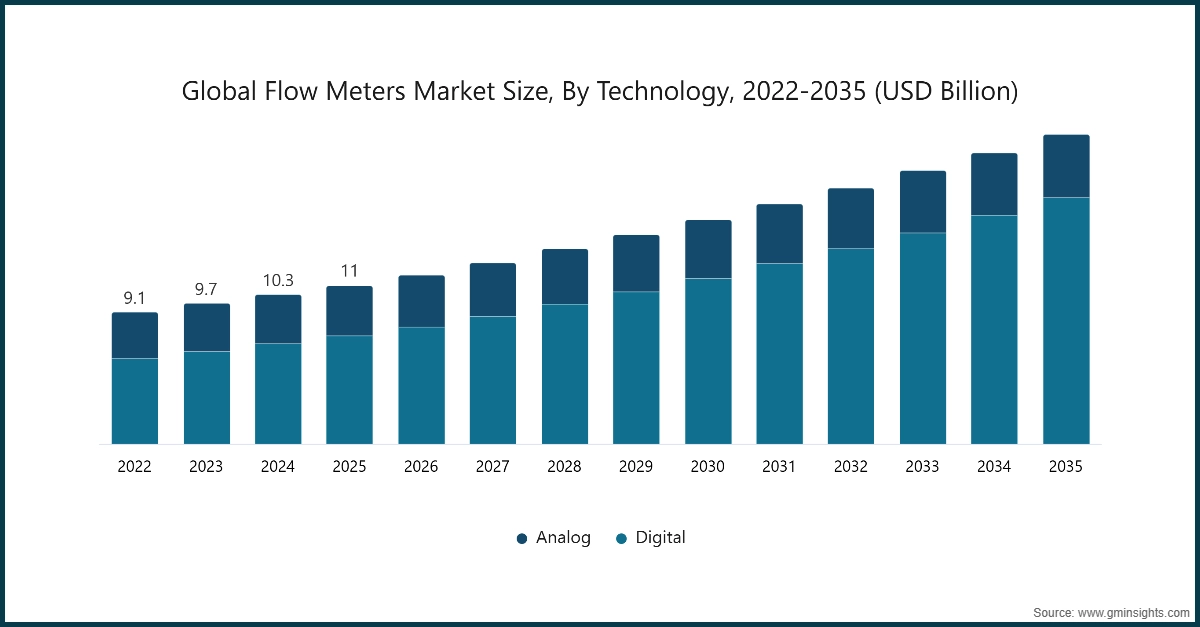
Between 2022 and 2025, the market witnessed considerable growth, increasing from USD 9.1 billion in 2022 to USD 11 billion in 2025 due to rising demand for accurate custody transfer in oil & gas, rapid expansion of water and wastewater infrastructure, modernization of aging industrial plants, increased adoption of compact and high-precision meters, and growth in semiconductor and chemical manufacturing capacities.
To get key market trends
Flow Meters Market Trends
- Industrial plants are increasingly adopting smart, IoT-enabled flow meters for real-time monitoring, predictive maintenance, and integration with SCADA, cloud, and digital twin systems. The increasing adoption of digitalization strategies in the oil & gas, water, chemical, and power sectors is driving the adoption of smart flow meters. This shift occurs because data-driven strategies in these sectors can improve the overall efficiency of the plants.
- Non-intrusive flow measurements, such as ultrasonic clamp-on flow meters, is also gaining traction in the flow meters market. The increasing adoption of non-intrusive flow meters is mainly attributed to the low disruption in plant operations, lower maintenance, and the ability to measure fluids in harsh environments. The adoption of non-intrusive flow meters is increasing in the industrial sector, particularly in plants where the traditional flow meters could not be installed. The adoption of non-intrusive flow meters is improving the overall efficiency of the plants, thereby increasing the overall efficiency of the industrial sector.
- Flow meters are changing from single-function devices to integrated solutions that can measure multiple parameters, such as flow, density, temperature, and pressure, at the same time. The use of multi-parameter flow meters enables the provision of consolidated information for process optimization, energy savings, and regulatory compliance. This is in line with the objectives of Industry 4.0 projects, where facilities aim to use compact and intelligent flow meters that can be easily interfaced with analytics tools, artificial intelligence models, and digital twins to improve predictive maintenance, cost savings, and operational insights in different end-user industries.
Flow Meters Market Analysis
Learn more about the key segments shaping this market
Based on technology, the market is segmented into analog and digital.
- The digital segment dominated the market in 2025 and was valued at USD 7.5 billion owing to the increasing adoption of smart, connected industrial systems where accurate, real-time measurements are available through the usage of digital flow meters. Reliability, low maintenance, and integration of the meter with the internet of things and predictive maintenance are the factors that increased the demand for the digital flow meters.
- The analog segment is expected to reach USD 4.4 billion by 2035, driven by steady demand from cost-sensitive end markets, retrofitting of existing infrastructure, and applications favoring simplicity and ruggedness. The analog meters are used in many small plants, basic process control, and regions that lack digital infrastructure, thereby providing steady growth as the newer industrial infrastructure expands.
Learn more about the key segments shaping this market
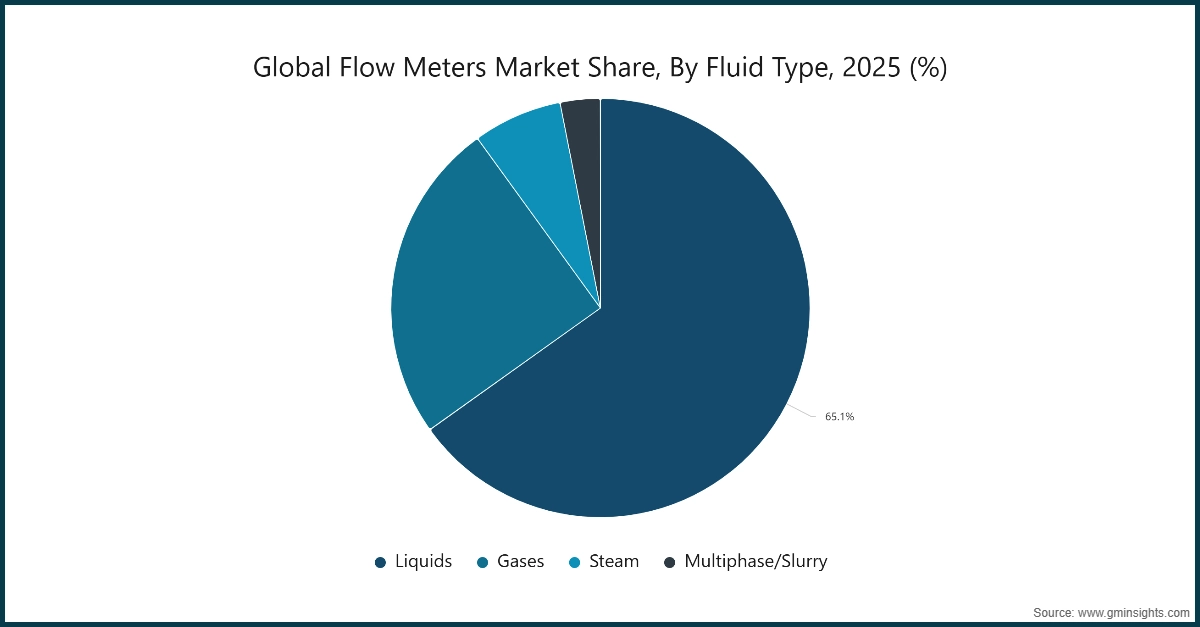
Based on the fluid type, flow meters market is classified into liquids, gases, steam, and multiphase/slurry.
- Liquids segment is expected to grow at a CAGR of 6.8% during the forecast period due to the increasing demand for water and wastewater treatment, chemical processing, and food and beverage. Liquid flow measurement is critical to the optimization of processes and the achievement of regulatory and efficiency standards. Moreover, the increased use of smart and IoT-based meters is also contributing to the growth of the liquid segment.
- The gases segment held a market share of 24.9% in 2025, driven by extensive use in oil & gas, power generation, and industrial gas distribution. Coriolis, thermal mass, and ultrasonic flow meters provide precise measurements for custody transfer, process control, and energy monitoring, making gas applications a significant contributor to overall market revenue.
Based on the type, the global flow meters market is divided into electromagnetic (magnetic) flow meters, coriolis flow meters, ultrasonic flow meters, vortex flow meters, differential pressure flow meters, thermal mass flow meters, turbine flow meters, positive displacement flow meters, and others.
- The electromagnetic (magnetic) flow meters segment accounted for 28.5% of the market share in 2025, driven by their high accuracy, reliability, and wide applicability across water and wastewater, chemical, and power industries. These flow meters are highly efficient in handling corrosive and conductive liquids with low maintenance and digital integration capabilities.
- The ultrasonic flow meters segment is anticipated to grow at a CAGR of 9.1% during the forecast period due to the increasing demand for non-intrusive clamp-on flow meters, ease of installation, and suitability for large-diameter pipes. The increasing use of ultrasonic flow meters in water treatment plants, oil & gas industries, and chemical plants with IoT-enabled monitoring systems will fuel the market growth.
Looking for region specific data?
North America Flow Meters Market
North America held a market share of 26.8% in 2025.
The North American flow meter market is growing due to the need to modernize old infrastructure, particularly in the water, oil and gas, and power sectors. More smart and digital flow meters are being installed to improve process efficiency, meet regulations, and support maintenance efforts. Retrofit projects in existing plants are increasing demand.
- The adoption of IoT and cloud-based monitoring solutions is improving real-time data visibility across different industries. Investments in industrial automation, especially in chemical, pharmaceutical, and semiconductor plants, are driving the demand for advanced flow measurement technologies like Coriolis and ultrasonic meters. This creates growth opportunities in the industrial and municipal markets.
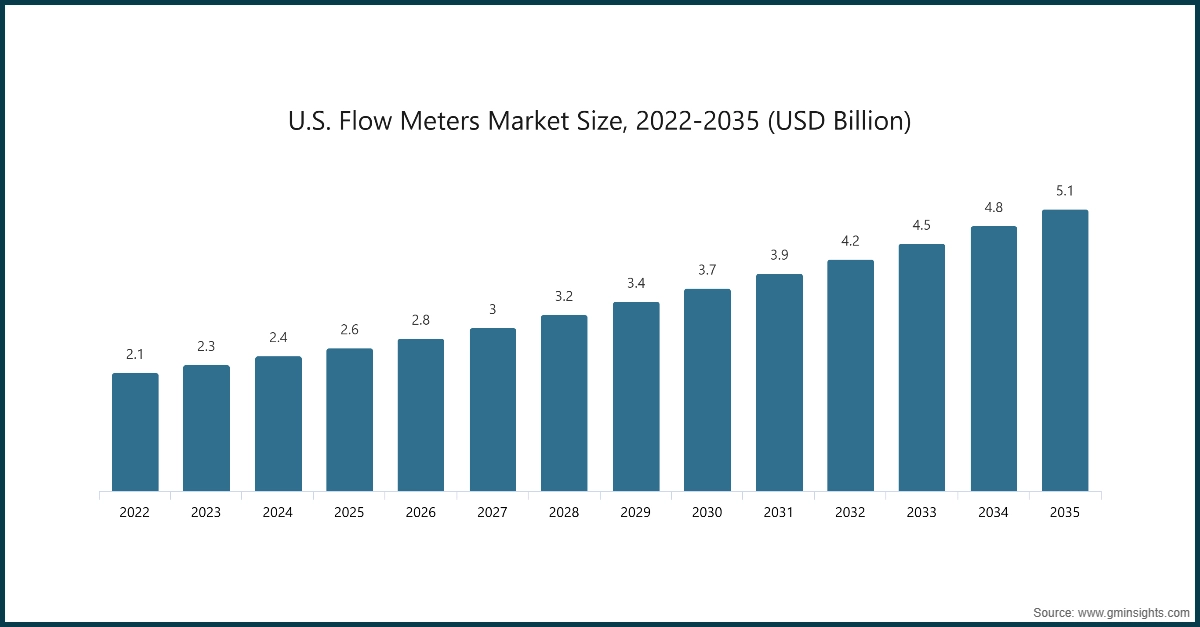
The U.S. flow meters market was valued at USD 2.1 billion and USD 2.3 billion in 2022 and 2023, respectively. The market size reached USD 2.6 billion in 2025, growing from USD 2.4 million in 2024.
- The US market focuses on high-precision flow measurement for custody transfer in oil and gas, along with compliance in wastewater management. Coriolis and magnetic flow meters are popular because of their accuracy, reliability, and fit for critical applications. Strong industrial automation efforts and federal rules on emissions and water treatment are pushing the use of smart meters.
- Investment in modernizing water and wastewater infrastructure also contributes to the demand for smart water and wastewater meters with IoT technology. Large industries with high concentrations of chemicals, power plants, and semiconductor plants are investing in smart metering solutions.
Europe Flow Meters Market
Europe flow meters accounted for USD 2.5 billion in 2025 and is anticipated to show lucrative growth over the forecast period.
- The market in Europe is driven by the need for stringent environmental regulations and energy efficiency standards, particularly in Germany, France, and the UK. The flow meters are increasingly being integrated with technology for the optimization of industrial processes, wastewater treatment, and energy monitoring. Smart and digital technology are becoming the norm in new installations.
- Adoption is high in the water and wastewater, chemical, and power industries, where retrofit projects are replacing old meters. There is also growing adoption of multi-parameter and IoT-connected meters as industries strive to meet Industry 4.0 targets. Industry 4.0 targets include predictive maintenance and minimizing the carbon footprint, thus driving the market in Western and Northern Europe.
Germany dominates the Europe flow meters market, showcasing strong growth potential.
- Germany, as Europe’s industrial hub, is witnessing high adoption of advanced flow measurement technologies in chemicals, automotive, and energy sectors. The need to comply with European Union environmental regulations on water and emissions is boosting the use of smart, digital, and multiparameter flowmeters.
- Integration of flow meters with predictive maintenance, Industry 4.0, and digital twin projects improves the efficiency of plant operations. The retrofit market in water treatment plants and chemical processing plants is also boosted, driven by high investments in R&D and technology-driven manufacturing sector modernization.
Asia Pacific Flow Meters Market
The Asia Pacific dominated the flow meters industry with a market share of 39.9% in 2025.
- Asia Pacific is experiencing rapid industrialization, especially in countries like China, India, and Southeast Asia. Growing infrastructure development and process automation in the oil and gas, power, chemical, and water treatment industries with an emphasis on smart and IoT-enabled devices are driving the demand for flow meters.
- The emerging economies are investing in water treatment, energy efficiency, and industrial safety segments, offering opportunities for both domestic and international players. The retrofit and greenfield projects are gaining momentum, and advanced ultrasonic, Coriolis, and electromagnetic flow meters are being used in urban water management and industrial projects.
China flow meters market is estimated to grow with a significant CAGR, in the Asia Pacific market.
- The expansion of China’s industrial and municipal sectors is driving the demand for flow meters in the water treatment industry, chemicals, and power generation. Smart meters and IoT-enabled flow meters are increasingly being used to achieve sustainability objectives and improve industrial processes. Increasing investments in the LNG industry, petrochemicals, and semiconductors are driving the demand for precision flow measurement.
- Urban water and wastewater infrastructure projects are creating strong demand for magnetic and ultrasonic flow meters. In addition, retrofit projects and growing demand for digital monitoring and predictive maintenance solutions are helping the market grow rapidly, while government initiatives focus on energy efficiency and environmental compliance to drive the demand for advanced metering solutions.
Latin American Flow Meters Market
Brazil leads the Latin American market, exhibiting significant growth during the 2026-2035.
- The expansion of the mining and chemical industries, the development of urban water infrastructure, and the growth of oil and gas production are the main factors propelling the Brazil market. Increasing use of smart flow meters ensures both regulatory compliance and effective operations.
- Investment in wastewater treatment plants, along with the modernization of industrial process control systems, generates strong demand for electromagnetic, Coriolis, and ultrasonic meters. Digitalization trends and the adoption of predictive maintenance also boost the growth of the market, especially in major industrial clusters like Sao Paulo and Rio de Janeiro.
Middle East and Africa Flow Meters Market
UAE market to experience substantial growth in the Middle East and Africa flow meters.
- UAE is witnessing strong adoption of advanced flow meters in oil and gas, water desalination, and power sectors. Large-scale industrial projects, as well as smart city projects, are increasing the demand for digital flow meters and IoT flow meters.
- Regulatory compliance for water conservation, safety regulations for industries, renewable energy investments, and petrochemical plants are increasing the demand for coriolis, electromagnetic, and ultrasonic flow meters. The integration of flow meters with SCADA systems and digital twins is increasing efficiency and reducing maintenance costs.
Flow Meters Market Share
The key companies in the flow meter industry include Emerson Electric, Endress+Hauser, Siemens AG, ABB Ltd, and Yokogawa Electric Corporation. These companies collectively accounted for a market share of 46.7% in the year 2025. These companies dominate the market due to their broad range of flow measurement solutions, which include coriolis, electromagnetic, ultrasonic, vortex, and differential pressure flow meters and serve industries such as oil and gas, chemicals, water and wastewater, power, and semiconductors.
These companies’ continuous investments in R&D, digitalization, smart meters, and predictive maintenance provide them with a competitive edge. Their focus on developing high-growth applications like industrial automation, renewable energy, and smart water management, as well as their extensive global manufacturing footprint and customer relationships, all contribute to their continued success in the flow meter market.
Flow Meters Market Companies
Prominent players operating in the flow meters industry are as mentioned below:
- ABB Ltd
- Alicat Scientific Inc
- Azbil Corporation
- Badger Meter Inc
- Bronkhorst
- Brooks Instrument
- Christian Bürkert GmbH and Co. KG
- Emerson Electric Co
- Endress+Hauser Group
- Hitachi High-Tech Corporation
- Honeywell International Inc
- Höntzsch GmbH and Co. KG
- KROHNE Group
- McCrometer Inc
- McMillan Flow Products
- OMEGA Engineering inc.
- SICK AG
- Siemens AG
- Sierra Instruments Inc
- Yokogawa Electric Corporation
- Emerson Electric: Emerson Electric is the industry leader due to its extensive selection of flow meters, which includes Coriolis, electromagnetic, and ultrasonic models. The company maintains its leadership position by supporting the oil and gas, chemicals, water, and power sectors because of its strong process automation integration, high accuracy, and global service support.
- Endress+Hauser: Endress+Hauser is known for its expertise in high-precision and reliable flow measurement solutions with advanced diagnostic functions. Its strategic emphasis on the process industry, including the chemical, pharmaceutical, and water industries, combined with its global engineering service support, customer focus, and innovation in smart and IoT-enabled products, helps it maintain a competitive advantage.
- Siemens AG: Siemens maintains leadership owing to its smart, digital, and IoT-enabled flow meters, along with its automation and predictive maintenance solutions. Its global manufacturing presence, industrial sector support, and innovation in multi-parameter and high accuracy flow meters are responsible for its strong presence in the energy, water, and manufacturing sectors.
- ABB Ltd: ABB is a leader in the electromagnetic, Coriolis, and ultrasonic flow meter market. The company has a strong focus on reliability, precision, and digital integration. ABB has experience in the oil & gas industry, the chemical industry, the power industry, and the water industry. Predictive analytics and smart metering solutions also provide the company with a competitive edge in the industry.
- Yokogawa Electric Corporation: Yokogawa excels in leadership through its robust, precise, and reliable flow meters used in industrial automation, water, and energy sectors. Its emphasis on digital integration, multi-parameter measurement, predictive maintenance, and service network makes it highly used, thereby creating its competitive advantage.
Flow Meters Market Report Attributes
| Key Takeaway | Details |
|---|---|
| Market Size & Growth | |
| Base Year | 2025 |
| Market Size in 2025 | USD 11 Billion |
| Market Size in 2026 | USD 11.7 Billion |
| Forecast Period 2026-2035 CAGR | 7% |
| Market Size in 2035 | USD 21.5 Billion |
| Key Market Trends | |
| Drivers | Impact |
| Expansion of process industries and infrastructure investments | Drives 20% growth as new industrial plants, refineries, chemical facilities, and municipal projects increase demand for accurate flow measurement. |
| Increasing automation and digitalization of industrial operations | Supports 18% growth through deployment in process control, predictive maintenance, and smart factory applications, improving operational efficiency. |
| Stringent regulatory requirements for custody transfer, safety, and emissions monitoring | Adds 19% growth as flow meters ensure compliance in oil & gas, chemicals, power, and water treatment sectors. |
| Growing water and wastewater treatment capacity worldwide | Contributes 21% growth due to rising municipal and industrial wastewater projects, including the treatment of 8.56 billion cubic meters per year per UN goals. |
| Rising demand for high-accuracy measurement in energy and chemical processing | Accounts for 15% growth as precision measurement is critical for process optimization, cost reduction, and energy efficiency. |
| Pitfalls & Challenges | Impact |
| High initial cost of advanced flow meter technologies | Restrains growth as Coriolis, ultrasonic, and multiphase meters require significant upfront investment, limiting adoption in price-sensitive segments. |
| Complex installation and calibration requirements in legacy and harsh operating environments | Limits growth due to additional labor, downtime, and maintenance costs, especially in brownfield plants and extreme conditions. |
| Opportunities: | Impact |
| Replacement of aging installed base with smart and digital flow meters | Contributes 19% growth as brownfield upgrades enhance measurement accuracy, efficiency, and connectivity. |
| Rapid capacity expansion in semiconductor, LNG, and hydrogen infrastructure | Adds 17% growth with new facilities driving demand for high-precision flow measurement solutions. |
| Market Leaders (2025) | |
| Market Leader |
13.9% market share |
| Top Players |
Collective market share of 46.70% in 2025 |
| Competitive Edge |
|
| Regional Insights | |
| Largest Market | Asia Pacific |
| Fastest growing market | Asia Pacific |
| Emerging countries | India, Brazil, Mexico |
| Future outlook |
|
What are the growth opportunities in this market?
Flow Meters Industry News
- In August 2024, ABB unveils next generation of electromagnetic flowmeters, streamlining the portfolio into two key models: ProcessMaster for industrial and utility plant applications, and AquaMaster for water transportation, distribution, and billing.
- In August 2024, SICK and Endress+Hauser launched a strategic partnership focused on process automation, particularly gas analysis and flow measurement technologies. The collaboration integrates SICK's expertise into Endress+Hauser's portfolio to enhance customer access and support decarbonization efforts.|
- In June 2024, Yokogawa Electric Corporation completed the acquisition of Adept Fluidyne Pvt. Ltd., a major Indian manufacturer of magnetic flowmeters based in Pune, providing Yokogawa with a local manufacturing base to produce high-performance flowmeters aligned with global standards.
The flow meters market research report includes in-depth coverage of the industry with estimates and forecast in terms of revenue (USD Million) and volume (Units) from 2022 – 2035 for the following segments:
Market, By Type
- Electromagnetic (magnetic) flow meters
- Coriolis flow meters
- Ultrasonic flow meters
- Vortex flow meters
- Differential pressure flow meters
- Thermal mass flow meters
- Turbine flow meters
- Positive displacement flow meters
- Others
Market, By Technology
- Analog
- Digital
Market, By Fluid Type
- Liquids
- Gases
- Steam
- Multiphase/slurry
Market, By End-use Industry
- Oil and gas
- Chemical and petrochemical
- Water and wastewater
- Power generation and energy
- Food and beverage
- Pharmaceutical and biotechnology
- Semiconductor and electronics manufacturing
- Mining, minerals and metals
- Others
The above information is provided for the following regions and countries:
- North America
- U.S.
- Canada
- Europe
- Germany
- UK
- France
- Spain
- Italy
- Netherlands
- Asia Pacific
- China
- India
- Japan
- Australia
- South Korea
- Latin America
- Brazil
- Mexico
- Argentina
- Middle East and Africa
- South Africa
- Saudi Arabia
- UAE
Frequently Asked Question(FAQ) :
What is the market size of the flow meters in 2025?
The market size was USD 11 billion with 2.3 million units in 2025, with a CAGR of 7% expected through 2035 driven by expansion of process industries, increasing automation and digitalization.
What is the projected value of the flow meters market by 2035?
The flow meters market is expected to reach USD 21.5 billion and 3.9 million units by 2035, propelled by IoT-enabled smart meters adoption, multi-parameter integrated solutions, and industrial automation expansion.
What is the current flow meters market size in 2026?
The market size is projected to reach USD 11.7 billion in 2026.
What was the valuation of digital segment in 2025?
Digital segment dominated the market and was valued at USD 7.5 billion in 2025, driven by increasing adoption of smart, connected industrial systems with accurate real-time measurements and IoT integration capabilities.
What was the market share of electromagnetic flow meters in 2025?
Electromagnetic (magnetic) flow meters accounted for 28.5% of the market share in 2025, driven by high accuracy, reliability, and wide applicability across water and wastewater, chemical, and power industries.
What is the growth outlook for the ultrasonic flow meters segment from 2026 to 2035?
Ultrasonic flow meters are anticipated to grow at a CAGR of 9.1% till 2035, due to increasing demand for non-intrusive clamp-on meters, ease of installation, suitability for large-diameter pipes, and IoT-enabled monitoring systems.
Which region leads the flow meters market?
North America around 26.8% share of flow meters market in 2025, due to the need to modernize old infrastructure, particularly in the water, oil and gas, and power sectors
What are the upcoming trends in the flow meters market?
Key trends include increasing use of non-intrusive ultrasonic clamp-on meters for low disruption and harsh environment applications, shift from single-function devices to multi-parameter integrated solutions measuring flow.
Who are the key players in the flow meters market?
Key players include Emerson Electric, Endress+Hauser Group, Siemens AG, ABB Ltd, Yokogawa Electric Corporation, Alicat Scientific, Azbil Corporation, Badger Meter, Bronkhorst, Brooks Instrument, Christian Bürkert, Hitachi High-Tech Corporation, Honeywell International.
Flow Meters Market Scope
Related Reports