Summary
Table of Content

Flow Chemistry Market
Get a free sample of this report
Form submitted successfully!
Error submitting form. Please try again.
Thank you!
Your inquiry has been received. Our team will reach out to you with the required details via email. To ensure that you don't miss their response, kindly remember to check your spam folder as well!
Request Sectional Data
Thank you!
Your inquiry has been received. Our team will reach out to you with the required details via email. To ensure that you don't miss their response, kindly remember to check your spam folder as well!
Form submitted successfully!
Error submitting form. Please try again.
Flow Chemistry Market Size
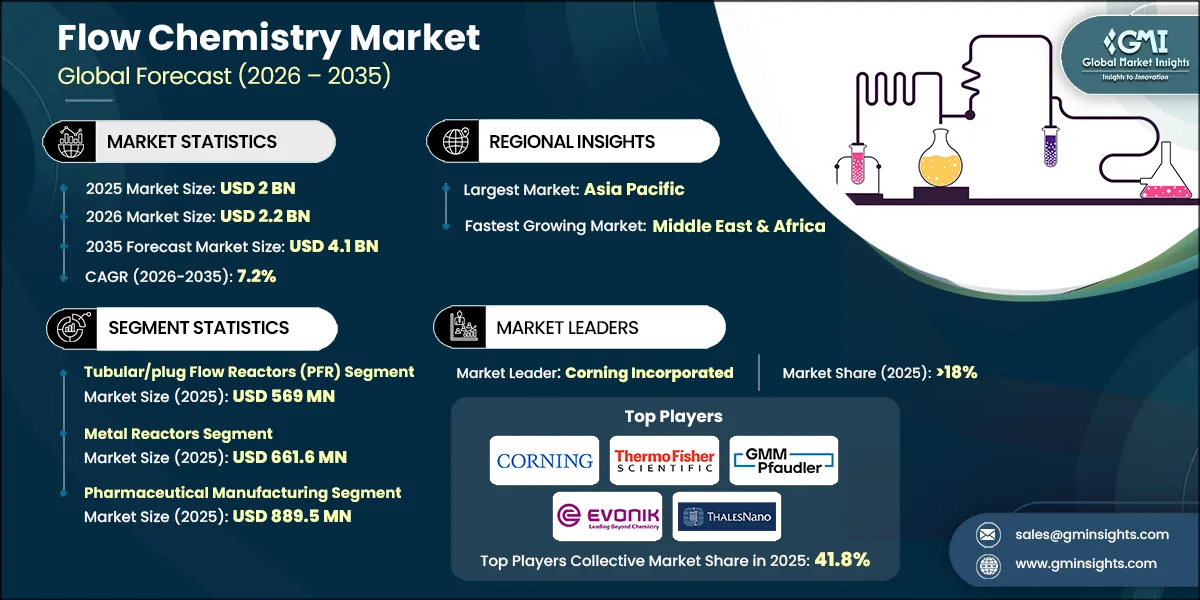
The global flow chemistry market was estimated at USD 2 billion in 2025. It is expected to grow from USD 2.2 billion in 2026 to USD 4.1 billion by 2035, at a CAGR of 7.2%, according to latest report published by Global Market Insights Inc.
Flow Chemistry Market Key Takeaways
Market Size & Growth
- 2025 Market Size: USD 2 Billion
- 2026 Market Size: USD 2.2 Billion
- 2035 Forecast Market Size: USD 4.1 Billion
- CAGR (2026–2035): 7.2%
Regional Dominance
- Largest Market: Asia Pacific
- Fastest Growing Region: Middle East & Africa
Key Market Drivers
- Increasing adoption of continuous manufacturing in pharmaceuticals.
- Strong push for green and sustainable chemistry.
- Technological advancements in microreactors and modular systems.
Challenges
- High Initial Capital Investment.
- Integration Issues with Legacy Infrastructure.
Opportunity
- Expansion in Emerging Applications like Photochemistry & Electrochemistry.
- Growing Demand for Custom, Modular, and Skid‑Mounted Systems.
Key Players
- Market Leader: Corning Incorporated led with over 18% market share in 2025.
- Leading Players: Top 5 players in this market include Corning Incorporated, Thermo Fisher Scientific, GMM Pfaudler, Evonik, ThalesNano Inc., which collectively held a market share of 41.8% in 2025.
Get Market Insights & Growth Opportunities
- The increasing trend towards continuous production in the drug market is also aiding the market to grow. Regulatory authorities like the U.S FDA have promoted continuous processing because it enhances the quality of products produced, increase control of processes and reduce manufacturing schedules. Flow chemistry also facilitates work with highly reactive intermediates safely and allows real-time monitoring, which fits the purpose of Quality by Design and process optimization. With the modernization of the production infrastructure by pharmaceutical companies, the need in flow-based systems is increasing.
- Increased attention to green and sustainable chemistry is driving the growth in the utilization of flow chemistry in chemical production. The continuous processes facilitate use of less solvent consumption and less waste production and also use less energy than the traditional batch processes. Manufacturers are turning to cleaner technologies of production due to global sustainability programs and environmental compliance schemes. Flow chemistry can achieve these goals by allowing harsher reactions with reduced environmental impact, which adds to its capabilities in sustainable manufacturing solutions.
- The development of microreactor design and modular flow systems are enhancing market growth, through the increase in scalability and responsiveness to operation. Increased heat and mass transfer rates can enable accurate control of reactions and predictable production of even complicated chemistries. Modular platforms enable quicker expansion out of laboratory to production with decreased risk of implementation. With these technological advances, flow chemistry is becoming more accessible and is more commercially viable in pharmaceuticals and specialty chemicals.
To get key market trends
Flow Chemistry Market Trends
- One of the major tendencies in the market is the growing incorporation of digital tools, sensors, and real-time analytics into the continuous processing systems. Organizations are implementing inline monitoring, data-driven process control and automation so as to improve reproducibility and minimize manual intervention. This trend is making decision-making better in a scale-up and also facilitating rapid troubleshooting. The flow platforms made digital are joining larger programs of smart manufacturing.
- The increased cooperation between flow chemistry equipment providers and contract development and manufacturing organizations (CDMOs) is another trend. These alliances are focused on speeding up technology development by providing end to end solutions on development and production to pharmaceutical and specialty chemical customers. Flow chemistry is an added value service offering that CDMOs are positioning to differentiate service offerings. This tendency is increasing commercial application other than in-house production.
- Manufacturers are developing an interest in hybrid processing models that integrate batch and flow processes into one processing structure. This is a technique that enables companies to maintain flexibility in batches and to take advantage of the benefits of continuous processing of certain stages in a reaction. The multi-step syntheses and variable product portfolios are of particular interest to hybrid systems. The trend is more of a realistic approach to transition strategy instead of complete replacement of legacy infrastructure.
Flow Chemistry Market Analysis
Learn more about the key segments shaping this market
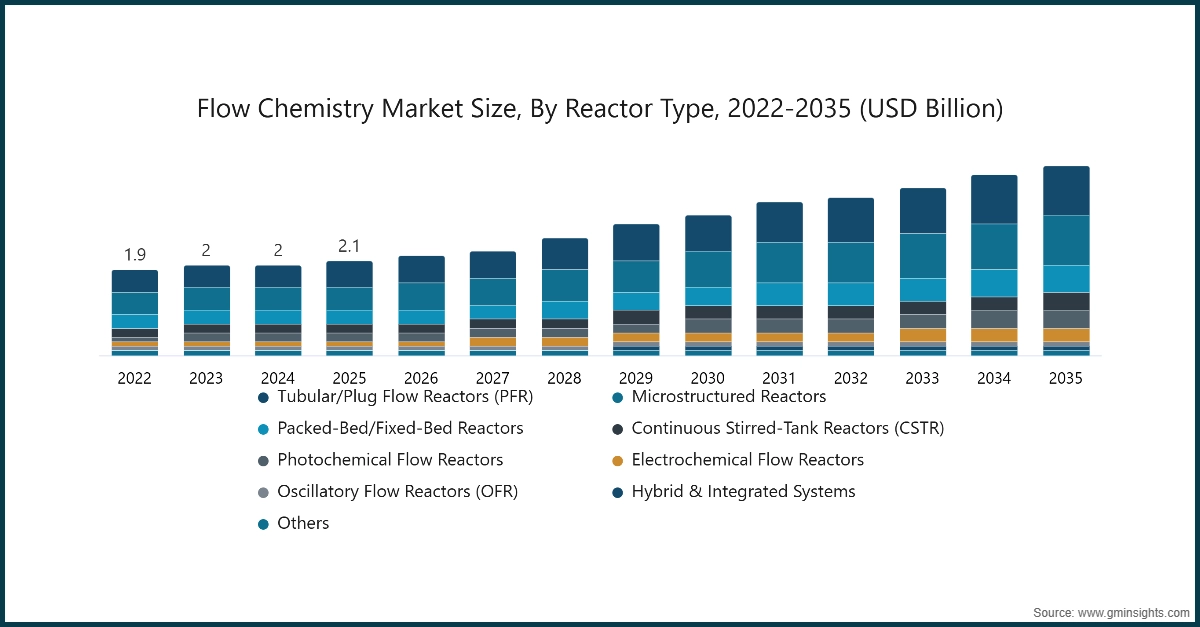
- The reactor type segmentation indicates a progressive move in preferences of chemical processing as the manufacturers strike a balance between flexibility, scalability and operational efficiency. The batch reactors remain popular because of their flexibility in producing multiple products and controlling processes in small to middle scale processes. Nevertheless, the growth of chemical production technology and stricter safety and environmental considerations are motivating corporations to reconsider the conventional batch-based designs, especially when high heat transfer or dangerous intermediate is needed in the reaction.
- Flow/continuous reactors and hybrid system are receiving even greater attention because companies are seeking to achieve a better consistency, optimal yield, and decreased downtimes between production cycles. Systems between batches and continuous are under consideration as a way to become much smoother in transitioning between processes and reliability in scale-up. Further gains in reactor design, automation and process analytics are further facilitating wider adoption in specialty chemicals and pharmaceuticals, enhancing overall market adoption in all reactor designs.
Based on material type, the flow chemistry market is segmented into polymer-based reactors, metal reactors, glass/quartz reactors, ceramic/silicon reactors, and other materials. Metal reactors hold a significant share at a valuation of USD 661.6 million in 2025.
- The market shows increasing reactor type specialization through its various chemical applications that use continuous processing technologies. The industry maintains its preference for Tubular/Plug Flow Reactors (PFR) and Continuous Stirred-Tank Reactors (CSTR) because these technologies provide both operational ease and effective scaling capabilities. The catalytic industry increasingly adopts packed-bed and fixed-bed reactors because these systems deliver advanced surface contact between catalysts and improved reaction performance. Microstructured reactors currently attract growing interest from researchers who need precise synthesis capabilities because these devices deliver better heat and mass transfer performance in compact system designs.
- The advanced reactor formats including photochemical, electrochemical, and oscillatory flow reactors expand their application range by providing researchers with capacity to direct chemical reactions while achieving both energy-efficient transformations and superior mixing performance. The adoption of hybrid and integrated systems has increased because these systems enable organizations to execute multiple reaction processes within a continuous operational framework and this approach enhances productivity while minimizing time lost during transitions between different operational stages.
Learn more about the key segments shaping this market
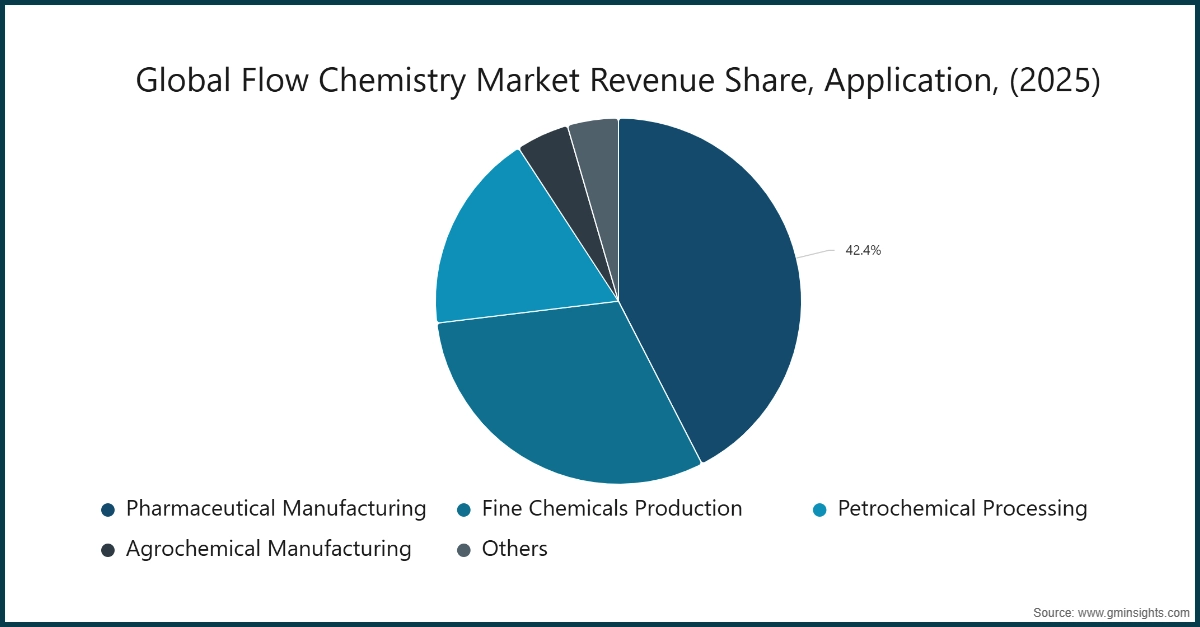
Based on application, the flow chemistry market is segmented into pharmaceutical manufacturing fine chemicals production, petrochemical processing, agrochemical manufacturing, and others. Pharmaceutical manufacturing is estimated to grasp a value of USD 889.5 million in 2025.
- The market shows material-based segmentation because chemical compatibility and thermal resistance and mechanical durability have become essential factors for selecting reactors. Industrial-scale operations still use metal reactors because these systems provide both structural strength and their ability to operate under extreme pressure and temperature conditions. Laboratory and pharmaceutical technicians continue to use glass and quartz reactors because these materials provide chemical inertness and transparency and corrosion resistance which are essential for their work.
- Specialty applications which need extreme thermal stability and protection against hazardous chemicals now use ceramic and silicon reactors. These materials enable high-precision reactions to occur in microstructured designs which require performance consistency. Researchers are evaluating other advanced materials to improve durability while enhancing heat transfer efficiency and meeting the needs of continuous processing systems.
Looking for region specific data?
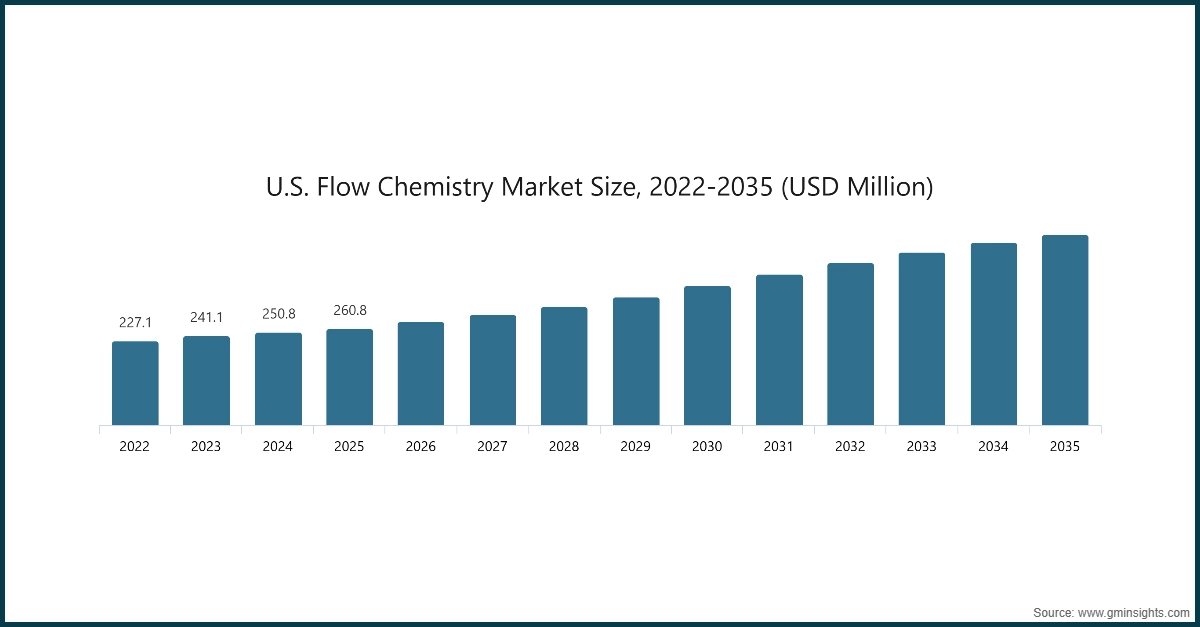
North America flow chemistry market accounted for USD 299.5 million in 2025 and is anticipated to show lucrative growth over the forecast period.
- The North American market is experiencing a profitable growth, as the application of continuous manufacturing continues to rise in pharmaceuticals, specialty chemicals, and biotechnology. The United States has a greater regional share because of high amounts of investment in process innovation, extensive application of advanced technologies in synthesis, and a well-established system of research organizations and CDMOs. Flow chemistry is becoming popular with manufacturers and are trying to enhance the efficiency of reactions, safety of processes, and regulatory compliance, especially in complex reactions and hazardous reactions.
- Further development in the area is driven by the regulatory support of continuous processing as well as the sustainability goal of energy efficiency and reduction of wastes. Firms are adopting flow systems in development and pilot processes to make time-to-market faster and achieve scalability. Also, the continued integration of suppliers of equipment, academic research labs and industrial users is enabling quicker commercialization of flow-based processes which may contribute to consistent regional impetus.
Europe flow chemistry market accounted for USD 409.9 million in 2025 and is anticipated to show lucrative growth over the forecast period.
- Europe gives good opportunities to the market, due to the growing focus on sustainable production and process intensification. The countries of Germany, the UK, and France are characterized by a large proportion due to the presence of powerful chemical and pharmaceutical manufacturing and early introduction of highly developed processing technologies. Flow chemistry is now being used to optimise multi-step syntheses, minimise the usage of solvents and to enhance the sense of operational consistency between production lines.
- The presence of stringent environmental laws and policies that shape the practices of manufacturing chemicals in the region is favouring the growth of the region. Businesses are taking the initiative to implement continuous flow solutions to meet the emission cut-down objectives and operational efficiency objectives. Simultaneously, close cooperation of players in the industry and research institutions drives the innovation of reactor design, automation, and digital process monitoring that promote the growth of the market in the long term.
Asia Pacific flow chemistry market accounted for USD 1.1 billion in 2025 and is anticipated to show lucrative growth over the forecast period.
- The Asia Pacific market has been growing fast due to the increased pharmaceutical production, increased demand on specialty chemicals and industrial modernization projects. Much of the contribution comes in China and India owing to massive manufacturing processes, affordable production factors and rising use of more sophisticated synthesis technologies. Flow chemistry is becoming a relevant concept since manufacturers explore better yields, increased safety, and international quality standards.
- The development in the region is strengthened by the fact that the government supports local chemical manufacturing, increasing contract manufacturing operations, and increasing foreign investments in chemical infrastructure. Japan and South Korea are other countries that contribute to the development of the region by having good R&D capability and manufacturing based on technology. The move toward continuous systems is increasing at a faster rate because companies seek to improve scalability, minimize the level of environmental effects, and improve global competitiveness.
Latin America flow chemistry market accounted for 7.7% market share in 2025 and is anticipated to show steady growth over the forecast period.
- The market in Latin America is rapidly emerging because companies are concerned about enhancing production efficiency and process reliability. Brazil and Mexico are the major contributors who are backed by increasing pharmaceutical and fine chemical manufacturing activities. Flow chemistry is now actively utilized to provide safer reaction handling and to promote higher value chemical production to domestic and export markets.
- Gradual industrial modernization enhanced regulatory systems, and collaborations with foreign technology suppliers are some of the factors promoting regional development. Although adoption is still selective because of capital and technical limitations, there is growing interest in continuous processing especially in APIs and agro chemicals as well as specialty ingredients. Flow chemistry is becoming a long-term strategic instrument to the operation of companies as they struggle to modernize manufacturing capacities and lessen the reliance on older batch processes.
Middle East and Africa flow chemistry market accounted for 5% market share in 2025 and is anticipated to show steady growth over the forecast period.
- The market of the Middle East & Africa is being accelerated with the nations investing in the diversification of their industries and the overall development of chemical manufacturing. A significant regional share of Saudi Arabia has been achieved with support in downstream chemicals and specialty processing capabilities. Flow chemistry is under consideration to be used in applications with the need of higher efficiency, heat regulation, and process control.
- The national strategies in the region are the cause of growth as it seeks to enhance chemical value chains, local production and embrace advanced manufacturing technologies. The penetration in the market is only at its initial phase though the growing cooperation with the global technology providers, as well as pilot-scale applications, are creating awareness and technical knowledge. The increase in investment in pharmaceuticals and specialty chemicals in the long term is likely to open up more opportunities of using continuous flow chemistry.
Flow Chemistry Market Share
The market of flow chemistry globally is moderately concentrated where the top five companies cumulatively occupy an estimated 41.8% market share in 2025 as a measure of their high level of adoption in pharmaceuticals and specialty chemicals and research. Key forces include Corning Incorporated, Thermo Fisher Scientific, GMM Pfaudler, Evonik, ThalesNano Inc. that have strong market share due to differentiated reactor technology and extensive geographic reach. Such companies have an advantage over smaller companies because of superior microreactor platforms, modular continuous systems and integrated process solutions that respond to the need to have scalable, efficient continuous synthesis. Strategic collaboration and co-development activities that have extended the reach to the high growth regions such as North America, Europe and Asia-Pacific also influence market concentration.
Innovation, strategic alliances, and increased capability are some of the aspects that companies in the flow chemistry environment are placing high priority to remain competitive. The focus on R&D advances the next generations of reactor designs, in-line analytics, and automation capability that enhance reaction control, safety, and reproducibility. These are joint projects with pharmaceutical companies, contract manufacturing organizations and university centers to fast track technology testing and implementation, and strategic acquisitions to diversify products and increase capacity. Companies are also seeking geographic growth and service models such as training, customisation and integrated solutions as a way of enhancing customer interaction and capitalising on increasing demand of continuous processing technologies.
Flow Chemistry Market Companies
Major players operating in flow chemistry industry are:
- Thermo Fisher Scientific
- YMC CO., LTD
- ThalesNano Inc.
- AM Technology
- Sulzer Ltd.
- Corning Incorporated
- Syrris Ltd.
- Vapourtec Ltd.
- Chemtrix BV
- Evonik
- Zibo Taiji Industrial Enamel Co.,Ltd
- GMM Pfaudler
Corning Incorporated operates as a materials science company in the United States which manufactures Advanced-Flow™ Reactors (AFR) that function as continuous flow reactor systems for industrial chemical production. Corning’s AFR technology enhances heat and mass transfer and improves safety and enables stable continuous synthesis for pharmaceuticals specialty chemicals and fine chemicals. The company provides a collection of glass and silicon carbide fluidic modules together with training services which help customers worldwide to adopt flow chemistry while they develop processes from laboratory experiments to plant operations.
The American company Thermo Fisher Scientific Inc. provides scientific instruments and analytical equipment and laboratory solutions which enable research and process development and manufacturing operations in life sciences and chemical industries. The company offers multiple analytical systems and process tools which help flow chemistry workflows through their usage in continuous synthesis environments for reaction monitoring and process control and quality assurance operations. The global presence of Thermo Fisher together with its vast product range and ongoing research development funding strengthens its position as a technology partner for pharmaceutical companies and specialty chemical manufacturers.
GMM Pfaudler is an Indian engineering company specializing in corrosion-resistant equipment and systems for chemical processing, including glass-lined reactors and auxiliary equipment that support flow chemistry adoption in harsh chemical environments. The company’s offerings help manufacturers maintain product purity and equipment longevity, particularly in specialty chemicals and pharmaceuticals where material compatibility is critical. With a global service network and engineering expertise, GMM Pfaudler supports custom process solutions and integration of continuous flow systems into existing plants. Its presence in emerging markets also strengthens localized support for industrial flow chemistry applications.
Evonik is a major German specialty chemicals company that supplies advanced catalyst systems and tailored process solutions enabling efficient continuous synthesis in flow chemistry environments. Its catalysts and high-performance materials support improved reaction selectivity, yield, and operational stability in pharmaceutical and fine chemical applications. Evonik leverages deep R&D capabilities and collaboration with industrial partners to advance continuous processing methods and intensify chemical reactions. The company’s focus on customized solutions and technical service enhances its role in facilitating flow chemistry transitions across complex syntheses.
ThalesNano Inc. is a technology developer focused on flow chemistry and continuous processing solutions, particularly known for its microfluidic reactor technologies that accelerate reaction screening and process development. Its products support rapid optimization of complex chemistries, including catalytic and photochemical reactions, enabling researchers and manufacturers to scale from lab to pilot operations more effectively. ThalesNano’s platforms are widely adopted in pharmaceutical R&D and specialty chemistry settings where precision and reproducibility are priorities. The company also collaborates with academic and industrial users to expand application-specific continuous synthesis capabilities.
Flow Chemistry Market Report Attributes
| Key Takeaway | Details |
|---|---|
| Market Size & Growth | |
| Base Year | 2025 |
| Market Size in 2025 | USD 2 Billion |
| Market Size in 2026 | USD 2.2 Billion |
| Forecast Period 2026-2035 CAGR | 7.2% |
| Market Size in 2035 | USD 4.1 Billion |
| Key Market Trends | |
| Drivers | Impact |
| Increasing adoption of continuous manufacturing in pharmaceuticals | Boosts demand for flow reactors as pharma companies prioritize higher throughput, regulatory compliance, and safer processing. |
| Strong push for green and sustainable chemistry | Drives market expansion as industries shift toward low‑waste, energy‑efficient production enabled by continuous flow systems. |
| Technological advancements in microreactors and modular systems | Accelerates adoption by lowering operational barriers and enabling faster scale‑up with high‑precision, automated equipment. |
| Pitfalls & Challenges | Impact |
| High Initial Capital Investment | Slows market penetration as many companies hesitate to replace existing batch setups with costly continuous systems. |
| Integration Issues with Legacy Infrastructure | Creates implementation delays due to compatibility challenges between modern flow systems and outdated plant configurations. |
| Opportunities: | Impact |
| Expansion in Emerging Applications like Photochemistry & Electrochemistry | Unlocks new revenue streams as flow technology enables reactions previously impractical or unsafe in batch processes. |
| Growing Demand for Custom, Modular, and Skid‑Mounted Systems | Accelerates market growth as industries prefer flexible, plug‑and‑play solutions that reduce installation time and CAPEX. |
| Market Leaders (2025) | |
| Market Leader |
Market Share Approximately 18% |
| Top Players |
Collective Market Share Approximately 41.8% |
| Competitive Edge |
|
| Regional Insights | |
| Largest Market | Asia Pacific |
| Fastest growing market | Middle East & Africa |
| Emerging countries | Brazil, Argentina, Mexico |
| Future outlook |
|
| Companies covered: | 12 |
| Tables, Charts & Figures: | 150 |
| Countries covered: | 18 |
| No of Pages: | 210 |
What are the growth opportunities in this market?
Flow Chemistry Industry News
- In October 2025, Shilpa Medicare said it had operationalized a Flow Chemistry Centre of Excellence (CoE) on its Bengaluru premises. R&D, process development, technology transfer and commercial continuous manufacturing are all merged in the CoE.
- In December 2023, AGI Group (based in Japan) had acquired Chemtrix B.V. (Netherlands), a scalable flow reactor technology provider that is efficient, to enter the large-scale market to support pilot and commercial production processes.
Flow chemistry market research report includes in-depth coverage of the industry with estimates & forecast in terms of revenue (USD Million) & volume (Tons) from 2022 to 2035, for the following segments:
Market, By Reactor Type
- Tubular/Plug Flow Reactors (PFR)
- Microstructured Reactors
- Packed-Bed/Fixed-Bed Reactors
- Continuous Stirred-Tank Reactors (CSTR)
- Photochemical Flow Reactors
- Electrochemical Flow Reactors
- Oscillatory Flow Reactors (OFR)
- Hybrid & Integrated Systems
- Others
Market, By Material Type
- Polymer-Based Reactors
- Metal Reactors
- Glass/Quartz Reactors
- Ceramic/Silicon Reactors
- Other materials
Market, By Application
- Pharmaceutical manufacturing
- Fine chemicals production
- Petrochemical processing
- Agrochemical manufacturing
- Others
The above information is provided for the following regions and countries:
- North America
- U.S.
- Canada
- Europe
- UK
- Germany
- France
- Italy
- Spain
- Rest of Europe
- Asia Pacific
- China
- India
- Japan
- South Korea
- Australia
- Rest of Asia Pacific
- Latin America
- Brazil
- Mexico
- Argentina
- Rest of Latin America
- MEA
- UAE
- Saudi Arabia
- South Africa
- Rest of Middle East and Africa
Frequently Asked Question(FAQ) :
What is the market size of the flow chemistry market in 2025?
The global market size for flow chemistry was valued at USD 2 billion in 2025, driven by the rising adoption of continuous manufacturing in pharmaceuticals.
What is the projected value of the flow chemistry market by 2035?
The market is expected to reach USD 4.1 billion by 2035, growing at a CAGR of 7.2% from 2026 to 2035, supported by regulatory encouragement for continuous processing.
What will be the flow chemistry market size in 2026?
The market is projected to grow to USD 2.2 billion in 2026, reflecting increased investments in digitalized continuous processing systems and pharmaceutical manufacturing modernization.
Which material type dominates the flow chemistry industry?
The metal reactors segment accounted for a leading valuation of USD 661.6 million in 2025, owing to their structural strength and ability to operate under high pressure.
Which application segment holds the largest share?
The pharmaceutical manufacturing segment was valued at USD 889.5 million in 2025, driven by regulatory support for continuous manufacturing.
How large is the North America market?
North America accounted for USD 299.5 million in 2025, driven by regulatory support from the U.S. Food and Drug Administration for continuous processing and strong collaboration between equipment suppliers and CDMOs.
Who are the key players in the flow chemistry market?
Leading companies include Corning Incorporated, Thermo Fisher Scientific, GMM Pfaudler, Evonik, and ThalesNano Inc., collectively accounting for a significant share of the global market through advanced reactor technologies and strategic collaborations.
Flow Chemistry Market Scope
Related Reports