Summary
Table of Content

Flooring Chemicals Market
Get a free sample of this report
Form submitted successfully!
Error submitting form. Please try again.
Thank you!
Your inquiry has been received. Our team will reach out to you with the required details via email. To ensure that you don't miss their response, kindly remember to check your spam folder as well!
Request Sectional Data
Thank you!
Your inquiry has been received. Our team will reach out to you with the required details via email. To ensure that you don't miss their response, kindly remember to check your spam folder as well!
Form submitted successfully!
Error submitting form. Please try again.
Flooring Chemicals Market Size
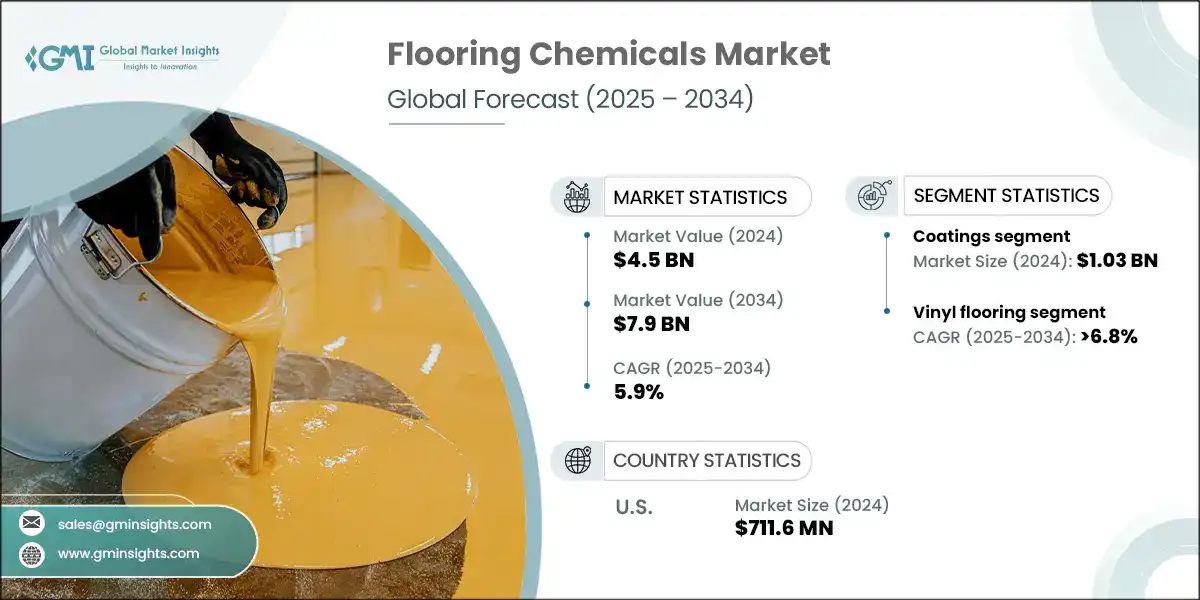
The global flooring chemicals market was estimated at USD 4.5 billion in 2024. The market is expected to grow from USD 4.7 billion in 2025 to USD 7.9 billion in 2034, at a CAGR of 5.9%.
To get key market trends
- The flooring chemicals market is undergoing significant technical advancement and changing market parameters. The increasing emphasis on sustainable materials and environmentally friendly formulations has led to the birth of several innovative products. Companies are practicing smart manufacturing and digital tools to optimize their processes and improve product quality. The sustainability drive is reflected in the introduction of flooring chemicals that are low in VOCs (volatile organic compounds) and bio-based, thus meeting growing consumer demand for greener products and staying compliant with stringent environmental regulations (Holm, 2018).
- In addition to this, advanced analytics and real-time monitoring of data are proving to be game changers for operational efficiencies in the flooring chemicals sector where companies are looking to optimize their supply chains and cut costs. This digitalization allows companies to gain a better understanding of end-user behavior, and thereby manufacturers can feel far more effective in tailoring their offerings to specific market needs. This digital work environment is particularly attractive to young people who are eager to embrace technology in their work practices, hence improving the sector's efforts at recruitment and training.
- Worldwide gain in the flooring chemicals market comprises a growing demand for flooring solutions that are durable yet aesthetic and sustainable in residential, commercial, and industrial sectors. These chemicals, along with coatings and resins, are vital to flooring performance, durability, and wear resistance against environmental loads. Increased population and infrastructure development in emerging economies are sources of increased demand for flooring systems that withstand heavy foot-traffic and adverse conditions.
- North America tops the list in the market segment with very stringent building codes, a developed construction industry, and an increasing emphasis on green building practices. More specifically, sustainability initiatives by the region concentrate on low-VOC and environmentally friendly flooring chemicals.
- Asia-Pacific region is mainly driven by an ever-urbanizing population, government-supported smart city initiatives, and vigorous construction activities in China, India, and Southeast Asia.
Flooring Chemicals Market Report Attributes
| Key Takeaway | Details |
|---|---|
| Market Size & Growth | |
| Base Year | 2024 |
| Market Size in 2024 | USD 4.5 Billion |
| Forecast Period 2025 – 2034 CAGR | 5.9% |
| Market Size in 2034 | USD 7.9 Billion |
| Key Market Trends | |
| Drivers | Impact |
| Urbanization and infrastructure development | Flooring chemicals like adhesives, sealants, and coatings are essential for ensuring durability and aesthetic appeal in commercial and residential buildings. |
| Sustainability and green building initiatives | Increasing focus on eco-friendly construction practices is pushing manufacturers to develop low-VOC, non-toxic, and recyclable flooring chemicals. |
| Technological advancements in flooring systems | Self-leveling compounds, antimicrobial coatings, and quick-curing adhesives are improving installation efficiency and floor performance. |
| Pitfalls & Challenges | Impact |
| Regulatory compliance challenges | Market access restrictions if products fail to meet local regulations from non-compliance or environmental concerns. |
| Raw material price volatility | Fluctuations in crude oil prices or supply chain disruptions. |
| Opportunities: | Impact |
| Growing demand for sustainable and eco-friendly products | Rising demand for low-VOC, non-toxic, and biodegradable flooring chemicals. |
| Expansion in emerging markets and infrastructure projects | Driving demand for flooring solutions in residential, commercial, and industrial sectors. Strategic partnerships with local distributors and construction firms. |
| Market Leaders (2024) | |
| Market Leaders |
12% Market Share |
| Top Players |
Collective market share in 2024 is Collective Market Share is 46% |
| Competitive Edge |
|
| Regional Insights | |
| Largest Market | Asia Pacific |
| Fastest Growing Market | Middle East and Africa |
| Emerging Countries | India, Vietnam, Philippines, Indonesia, Brazil, Egypt |
| Future outlook |
|
What are the growth opportunities in this market?
Flooring Chemicals Market Trends
- Modern adhesives speedily set and bond better across laminate and hardwood surfaces. Sealants and coatings are now more resistant to chemicals, moisture, and abrasion, especially in industrial and healthcare environments. Surface preparation compounds and underlayments will be more optimized for ease of installation with better acoustic insulation, while floor finishes increasingly work on anti-slip and antimicrobial properties for safety and hygiene.
- Flooring chemical training programs are developing a modular and role-specific application. Installers, site engineers, and quality inspectors are being taught through a planned approach from the point of view of material compatibility, safety standards, and performance optimization. Certification programs, largely sponsored by chemical manufacturers and construction associations, are going to be the key indicators of technical competence. Consistent application quality across geography is ensured through these certifications, which further the development of the workforce in a fast-growing global market.
- No-code and low-code platforms are now steadily gaining an increasingly important reputation for the flooring diagnostics for the less technically inclined. Facility teams can, through a simple dashboard interface, track curing times, humidity levels, and chemical interactions with zero programming knowledge. Such platforms then enable end-users to set alerts, create compliance reports, and make changes to application parameters, making flooring maintenance and planning a truly participative affair. This democratization becomes more beneficial in commercial and residential segments where frontline operational personnel would have little, if any, technical background.
- The market of flooring chemicals is inclined now toward the sustainable and bio-based system, encouraged by niche environmental regulations and green building certifications, such as LEED and BREEAM. Some of these low-VOC adhesives, recyclable coatings, and plant-based primers are slowly finding their way into residential and commercial applications. Specialized and high-end applications, like anti-static coatings for data centers or chemical resistant sealants for labs, are at the same time increasing into industrial applications. Such innovations are too much regulatory responses but rather highly strategic differentiators in a competitive market. For instance, in December 2023, Lloyd's Register instituted a "Digital Twin Ready" certification program that focuses on platform readiness and user competence. The certification is a requirement for marine professionals deploying digital engine platforms, which formalize structured training and credentialed hiring.
Flooring Chemicals Market Analysis
Learn more about the key segments shaping this market
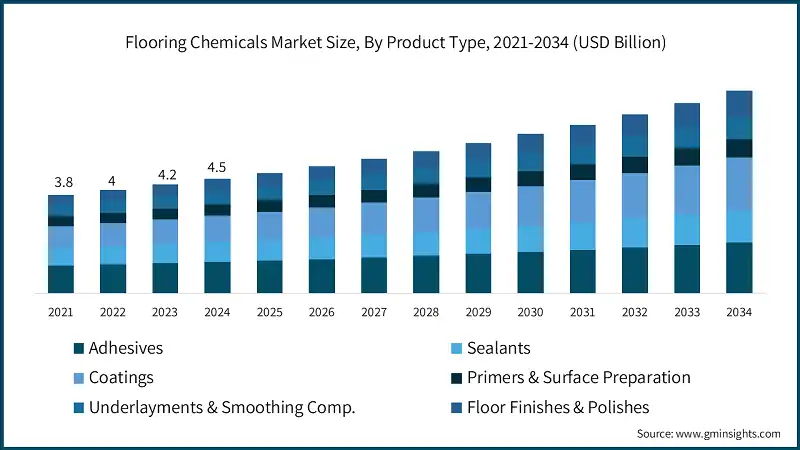
Based on product type, the market is divided into adhesives, sealants, coatings, primers & surface preparation, underlayments & smoothing comp., floor finishes & polishes. The coatings segment dominated the flooring chemicals industry, accounting for around USD 1.03 billion in 2024 and is expected to grow at a CAGR of over 7.2% through 2034.
- Adhesives are the essential aspects mainly while flooring installations nowadays, ensuring proper adhesion with several materials such as wood, vinyl, laminate, and tiles. Manufacturers are developing products rapidly, focusing on those chemicals with low VOC and high-strength values that can cure quickly for both commercial and residential projects. Applicators would be able to integrate adhesive solutions to a range of floor types. Improvements on water-based and bio-based technology are another way of sustaining low environmental impact in terms of adhesives. The demand for urbanization and infrastructure development has continued driving glue as one of the key aspects of flooring chemicals.
- Sealants are hugely responsible for keeping flooring systems free from moisture, chemical attack, and mechanical wear. Their application is weighed heavily towards industrial floors or healthcare settings, where durability and hygiene are key concerns. These days, however, manufacturers are moving toward hybrid and silicone sealants that will maintain extra flexibility and durability. An ever-increasing interest in green building practices has led to the formulation of sealants meeting strict criteria for indoor air quality and sustainability.
- It's required to add coatings for the enhancement of surface performance of flooring systems. Coatings make a protective layer that increases the life of the flooring system-from wear resistance to aesthetic enhancement. Primarily, it is epoxy and polyurethane coatings that dominate this segment, particularly used in commercial- and industrial areas. Recent developments in coatings include anti-slip, antimicrobial, and UV-resistant coatings, which are highly applicable to high-traffic areas like retail, hospitality, and healthcare facilities. These advancements allow the facilities to comply with safety regulations while maintaining visual beauty.
- The whole landscape of the flooring chemicals market is inclusive of things such as primers, chemicals, underlayments, and polishes-things that must occur together for flooring installation to be successful. Primarily for surface preparation chemical products, these improve adhesion and surface evenness. Water-based and low-VOC have gradually raised their demand in the market because of environmental regulations. Floor finishes and polishes contribute to the final appearance and functionality by protecting surfaces and enhancing gloss; again, the commercial and hospitality sectors prompt the growth. Innovation and technology have also included a contribution to industry, as green polishing technology and smart polishing systems have been introduced to further augment the performance in work with less labor cost. Such innovations come in line with present sustainable construction practices integrated with maintenance efficiency requirements across various sectors.
Learn more about the key segments shaping this market
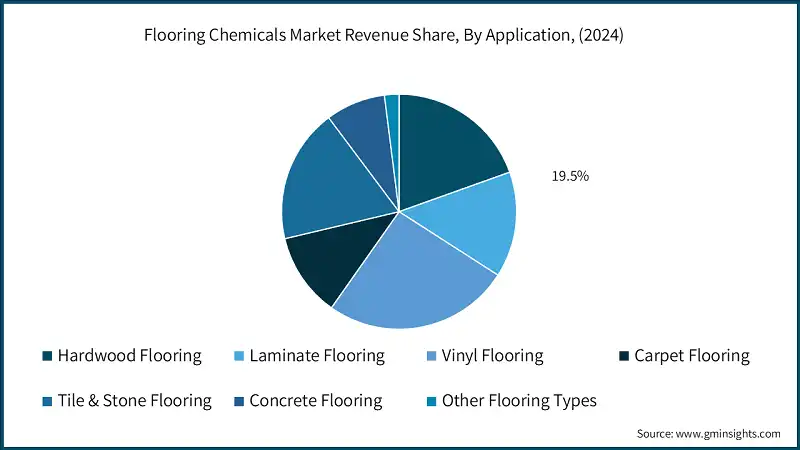
Based on application, the flooring chemicals market is segmented into hardwood flooring, laminate flooring, vinyl flooring, carpet flooring, tile and stone flooring, concrete flooring, other flooring types. The vinyl flooring segment dominates the market and is expected to grow at a CAGR of over 6.8% from 2025 to 2034.
- Hardwood flooring segment in floor chemicals is one of the premium grades and among the most durable. High-performance adhesives, sealants, and finishes are key for the maintenance of beauty and integrity of hardwood flooring. Such spaces, including residential premises and upscale commercial interiors, are well recognized as places where long-lasting aesthetics are sought. Chemical formulations are used for hardwood to improve resistance against moisture, UV exposure, and wear, hence making noteworthy stability along with accompanying maturity concerning demand.
- Laminate flooring is the newest and still the fastest growing segment, mainly due to cheaper prices, its installation convenience, and its ongoing increasingly versatile design. Flooring chemicals relating to laminate, especially adhesives and coatings will be improved in terms of faster curing, better bonding, and better scratch resistance. Also, with advancements in digital printing and embossing technologies, laminate flooring takes a greater resemblance to actual hardwood or stones. This will bring about increased demand in both residential and commercial usage.
- Vinyl flooring is a rapidly growing and highly expandable category of flooring, which stands out as quite versatile and resilient. It has benefited from chemical innovations in adhesives, underlayments, and surface finishes that improve flexibility, water resistance, and acoustic performance. Carpet flooring is a common choice of flooring in residential to offices and incorporates innovations in antimicrobial and low VOC formulations for modern health and sustainable standards.
- Concrete flooring is one of the important applications in the industrial and commercial segments. Chemicals such as hardeners, sealants, and epoxy coatings resist abrasion, chemicals, and thermal stress. The strengthened and durable concrete floors produce a burgeoning market for those demanding polished concrete finishes and self-leveling compounds. Eco-friendly formulations are thus increasing in popularity as regulations are tightening on emissions of VOCs. Cork, bamboo, and rubber were other minor but fast-growing segments of flooring developed on highly sustainable design.
Based on end use, the flooring chemicals market is segmented into residential, commercial, and industrial. The commercial segment is dominating the market due to rapid urbanization.
- Homeowners and builders are traditionally inclined to install flooring pains that are durable and easy to maintain while still beautiful and eco-friendly. Many specialty flooring chemicals, such as low-VOC adhesives, waterborne sealants, and decorative coatings, are now used heavily for hardwood, vinyl, and laminate installations. The ongoing increase in home renovations and remodels, especially in urban and suburban developments, continues to accentuate volume growth.
- Commercial spaces, which include offices, retail outlets, healthcare facilities, and schools, demand high-performance flooring chemical products that can take the huge foot traffic, frequent cleaning, and strict hygiene requirements. As a result, the segment is rapidly evolving towards modular flooring systems and smart coatings with properties such as anti-slip, antimicrobial, and stain resistant.
- Industrial segment largely depends on epoxy and polyurethane coatings, high-strength adhesives, and tailored sealants capable of withstanding extreme conditions like heavy machinery, chemical spillage, and thermal stress.
Based on technology, the flooring chemicals market is segmented into conventional chemical systems, advanced chemical technologies, sustainable & bio-based systems, specialty & high-performance systems. The conventional chemical systems segment dominated the market due to its performance, cost-effectiveness, and ease of application.
- In the flooring chemicals industry, conventional chemical systems occupy the largest share. These include the traditional formulations of adhesives, sealants, coatings, and primers, which have been put into widespread use over the years for residential, commercial, and industrial purposes. Their popularity is due to performance, low price, and ease of use.
- Advanced chemical technologies make up the fastest growing segment of the industry. Such innovations as nanotech, self-leveling compounds, and smart coatings, which react to environmental parameters, are being used in these systems to enhance key performance characteristics such as abrasion resistance, thermal insulation, and acoustic dampening.
- The tighter regulations and the greener preferences of consumers are making sustainability and bio-based products very popular. Thus, renewable raw materials or low-VOC formulations and recyclable packages will help to lower the environmental impact of such systems. In this way, the systems are embraced by more and more green building projects as well as developers looking for certification of buildings, such as LEED or BREEAM.
- Specialty and high-performance systems cater to highly specific applications, but each of these applications is not so much critical that standard flooring chemicals will not suffice. Such applications include uses such as anti-static coatings for data centers, chemical-resistant sealants for laboratories and antimicrobial finishes for healthcare environments.
Looking for region specific data?
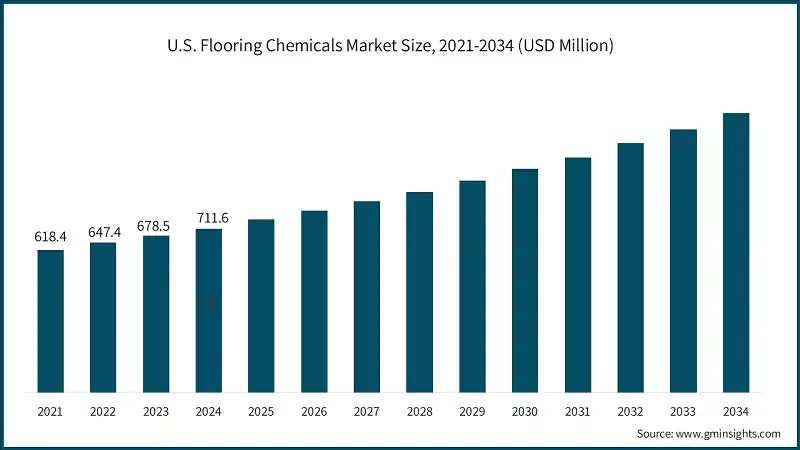
U.S. dominated the flooring chemicals market in North America with around 80% share and generated USD 711.6 million in revenue in 2024.
- The U.S. market leads the global flooring chemicals industry as a result of its expanded residential and commercial construction sectors and strong renovation activity with an increasing demand for high-performance and sustainable flooring solutions. The various climatic zones and divergent regional building codes in the USA in turn promote innovations in adhesives, sealants, coatings, and surface preparation chemicals, particularly those custom-designed for specific environmental or structural requirements.
- Advances in chemical technology have also been more widely applied across the United States as manufacturers and contractors respond to changing consumer expectations about durability, aesthetics, and indoor-air quality.
- The application of digital tools and smart technologies will create growth opportunities for the flooring chemicals market in the USA. The other technologies such as augmented reality for visualizing designs, digital measuring tools, and self-leveling compounds are there to elevate precision, efficacy, and customization at the job site for flooring projects. Quickening innovation and deployment of best solutions are additionally enabled by prominent chemical manufacturers and flooring system integrators in the country, including low-VOC adhesives and antimicrobial coatings that align with sustainability goals and regulatory standards.
- In addition, U.S. flooring chemicals are boosted by the presence of quality labor and increasing qualified certified installers, thus providing assurance for consistently quality output as well as adherence to standards across projects.
The flooring chemicals market in the Germany is expected to experience significant and promising growth from 2025 to 2034.
- Germany is the dominating nation in the market in Europe, due to the construction sector, the advanced development of its manufacturing sector, and the emphasis on sustainability. This ensures a good and sufficient network of chemical producers and flooring system integrators within the flooring industry, which includes most of the main players, such as Tarkett, Forbo, and BASF1. Germany is amongst the frontrunners in adopting green flooring solutions based on recycled materials and low VOC adhesives paired with automated installation technologies. the advanced development of its manufacturing sector, and the emphasis on sustainability. This ensures a good and sufficient network of chemical producers and flooring system integrators within the flooring industry, which includes most of the main players, such as Tarkett, Forbo, and BASF1. Germany is amongst the frontrunners in adopting green flooring solutions based on recycled materials and low VOC adhesives paired with automated installation technologies.
- The UK flooring chemicals market is one of the most growing markets in Europe, which is propelled by various large housing projects, commercial upgrading of buildings, and the very strong urge toward sustainability. This prima facie demand for aesthetics and performance in flooring solutions has been generated by the construction sector within the UK, especially in Greater London.
- Manufacturers are adapting to the development of cutting-edge adhesives, antimicrobial coatings, and bio-based sealants designed for both residential and commercial applications. Digital transformation focus in UK is also affecting the flooring market. Increasingly, the commercial sector of offices and healthcare facilities adopts flooring chemicals designed for low-emission hygiene standards.
- The flooring sector in the country has been spreading horizontally, covering residential, commercial, and industrial aspects, as demands for durable, sustainable, and cost-efficient products grow. The second-largest exporting sector in Spain's economy, the chemical industry is also the largest in R&D investments, hence directly benefiting flooring chemicals.
The flooring chemicals market in China is expected to experience significant and promising growth from 2025 to 2034.
- Urbanization, infrastructure development, and changing tastes in modern living and working spaces across China, India, South Korea, and Southeast Asia propel the demand for specific chemicals in construction. The construction boom in the region translates into the high-volume requirement of adhesives, sealants, coatings, and surface preparation chemicals customized for diverse conditions and building codes. Local manufacturers and global suppliers' interest lies in developing scalable, cost-effective alternatives that meet both performance and sustainability ends.
- China thus leads the flooring chemicals market in the region, given the significant support from the construction industry and the government's green building policy initiatives to encourage very strong domestic manufacturing capabilities. Energy efficiency and smart urban development have aided low-VOC adhesives, antimicrobial coatings, and advanced surface treatments to be more utilized. In turn, the large-scale residential and commercial projects provide an excellent test for the latest hybrid underlayments and self-leveling compounds, often serving as examples to be copied. This local presence by the major chemical manufacturers and flooring brands provides the missing link of uninterrupted synergy between product innovation and market development.
- The fastest-growing flooring chemicals market in the Asia-Pacific region, India, has a construction boom in residential housing, commercial real estate, and industrial infrastructure as its major driver. The government programs such as "Housing for All" and "Smart Cities Mission" have generated a huge need for flooring solutions that are durable, cost-effective, and sustainable. Indian manufacturers are teaming up with international chemical companies to create localized formulations compatible with the climate or construction practices of their respective regions.
- The growing penetration of advanced chemical technologies, including anti-slip coatings, acoustic underlayments, and bio-based adhesives, in these markets is noteworthy.
The flooring chemicals market in UAE is expected to experience significant and promising growth from 2025 to 2034.
- Infrastructure development and urbanization, coupled with modernization of commercial and industrial establishments, are propelling the Middle East and Africa into smaller but gradually growing regions in global flooring chemicals.
- Most of the construction is occurring in the GCC countries, especially in these ambitious construction and sustainability initiatives in the UAE and Saudi Arabia, which are set to reconfigure the demand for advanced flooring solutions. Smart cities and green buildings are gathering momentum in the region, providing flooring chemicals manufacturers opportunities to develop low-VOC, high-performance, and climate-adapted products.
- The UAE's leadership in smart construction is also nurturing the demand for flooring systems that are integrated with digital building management platforms that offer performance monitoring and life cycle optimization. Another fast-growing flooring chemicals market is South Africa, driven by industrial expansion, port modernization, and commercial real estate development.
- Local manufacturers are collaborating with international suppliers to provide customized solutions tailored to the operational and environmental problem peculiar to the South African industries.
- Saudi Arabia is emerging as a player in MEA flooring chemicals, especially with Vision 2030, accompanied by major investments from infrastructure to tourism to housing.
The flooring chemicals market in Brazil is expected to experience significant and promising growth from 2025 to 2034.
- Latin America is developing heterogeneously through infrastructures modernization, urban development, and high demand for strong, cheap, long-lasting flooring solutions, gradually leading to growth in the flooring chemicals market as it continues to develop. Various challenges exist that the market has to contend with, such as uneven development of digital infrastructures in the different countries and economic conditions. Government and private developer investments in residential, commercial, and industrial construction drive demand in the market and, therefore, attic ceiling space for flooring chemicals, adhesives, sealants, and coatings.
- Brazil has the largest share of flooring chemicals at a regional level, with a very strong construction segments and expansion industrial base and large-scale infrastructure development projects. Industrial environments such as warehouses, manufacturing plants, and logistics centers drive high demand for epoxy and polyurethane flooring systems, prized for their chemical resistance, durability, and maintenance efficiency. Proper investment, public or private, in housing and commercial real estate ensures that the flooring chemicals market remains buoyant despite challenges from the wider economy.
- Argentina is the fastest growing market in Latin America. Growth is boosted, above all, by infrastructure programs implemented by the government and by an invigorated construction industry. Already, activities in the residential and commercial constructions translate to high demand for flooring compounds, sealants, and adhesives. In line with the sustainability worldwide trends, local construction chemical producers add bio-based and low-VOC products to their portfolios.
Flooring Chemicals Market Share
- The top 5 companies in the flooring chemicals industry BASF SE, Sika AG, Henkel AG & Co. KGaA, The Dow Chemical Company, and 3M Company contributing around 46% of the market in 2024.
- BASF produces chemical solutions for flooring applications under its brand names, ACROFLOR® and HYDROPALAT®. They provide long-lasting, excellent gloss finishes with lower VOC formulation in commercial and industrial settings. Alternatives to fluorosurfactants and zinc-based coatings are being developed by the company to aid in reducing adverse impacts on the environment for its customers.
- Sika AG supplies construction chemicals with flooring systems, which typically include epoxy coatings, polyurethane, adhesives, primers, and concrete solutions. Sika flooring products serve commercial, industrial, and sports energy flooring applications. Such sectors, as healthcare, logistics, and education, would be supported with global present technical services for high-performance standards and compliance requirements in all dimensions.
- Under its LOCTITE® brand, Henkel AG & Co.KGaA has industrial flooring adhesives and coatings that concentrate more on safety, durability, and convenience when used. Their epoxy and acrylic anti-slip coatings are the ideal coatings for high traffic environments, like manufacturing plants and warehouses. Apart from that, these products meet characteristics of chemical resistance, fire safety, and VOC-free options that can be used indoors or outdoors.
- Dow manufactures various underlayments, waterproofing systems, tile adhesives, and carpet backing technologies. ELVALOY™ copolymers and REVOLOOP™ recycled resins offered by them support circular economy initiatives. Further, Dow continues to develop solutions for long-lasting luxury vinyl tile (LVT) durability with environmental benefits for concrete and sports surfaces.
- 3M categories floors under maintenance and aesthetic enhancement as well as lowered maintenance operation costs and environmentally credible solutions. The Scotchgard™ and Scotch-Brite families comprise protective coatings, polishing pads, and maintenance products for resilient, stone, and concrete floors. These products serve the retail, health care, and education sectors where cleanliness and safety are paramount.
Flooring Chemicals Industry News
- June 2025 - The Aditya Birla Group acquired Cargill's specialty chemicals manufacturing plant in Dalton, Georgia. This acquisition will enhance the product portfolio and will increase the production capacity of the company.
- March 2025 - BASF has recently joined forces with Sika for the formulation of a new amine base for the curing of liquid epoxy resins. The new product is marketed under BASF's Baxxodur EC 151 brand and will be applied in flooring systems of industrial installations, warehouses, assembly halls, and parking garages.
- November 2024 - Covestro has entered into Asia-Pacific by moving part of its local and sustainability initiatives through the manufacture of partly bio-based raw materials for coatings that will be used in construction and infrastructure projects at this time.
- 2024 - Flowcrete Group Ltd. launched an electrostatic discharge (ESD) flooring treatment to protect sensitive electronic components from static electricity damage.
The flooring chemicals market research report includes in-depth coverage of the industry with estimates & forecasts in terms of revenue ($Bn) and volume (Units) from 2021 to 2034, for the following segments:
Market, By Product Type
- Adhesives
- Water-based adhesives
- Solvent-based adhesives
- Urethane-based/moisture-cure adhesives
- Powder adhesives
- Hot-melt adhesives
- Sealants
- Silicone sealants
- Polyurethane sealants
- Acrylic sealants
- Butyl sealants
- Coatings
- Epoxy coatings
- Polyurethane coatings
- Polyaspartic coatings
- Acrylic coatings
- Antimicrobial coatings
- Primers and surface preparation
- Epoxy primers
- Acrylic primers
- Polyurethane primers
- Surface preparation chemicals
- Underlayments and smoothing compounds
- Self-leveling compounds
- Moisture barriers
- Sound dampening underlayments
- Floor finishes and polishes
- Water-based finishes
- Solvent-based finishes
- Uv-cured finishes
- Maintenance polishes
Market, By Application
- Hardwood flooring
- Laminate flooring
- Vinyl flooring
- Carpet flooring
- Tile and stone flooring
- Concrete flooring
- Other flooring types
Market, By End Use
- Residential
- Single-family homes
- Multi-family residential
- Renovation and remodeling
- Commercial
- Office buildings
- Retail spaces
- Hospitality
- Healthcare facilities
- Educational institutions
- Industrial
- Manufacturing facilities
- Warehouses and distribution centers
- Food processing plants
- Pharmaceutical facilities
- Chemical processing plants
Market, By Technology
- Conventional chemical systems
- Traditional epoxy systems
- Standard polyurethane formulations
- Conventional acrylic systems
- Advanced chemical technologies
- Nanotechnology-enhanced formulations
- Smart and functional coatings
- Self-healing materials
- Antimicrobial technologies
- Sustainable and bio-based systems
- Bio-based polyurethanes
- Plant-based adhesives
- Recycled content formulations
- Low-VOC and zero-VOC systems
- Specialty and high-performance systems
- Chemical-resistant formulations
- High-temperature resistant systems
- Anti-static and conductive systems
- Decorative and aesthetic systems
The above information is provided for the following regions and countries:
- North America
- U.S.
- Canada
- Mexico
- Europe
- Germany
- United Kingdom
- France
- Italy
- Spain
- Rest of Europe
- Asia Pacific
- China
- India
- Japan
- Australia
- South Korea
- Philippines
- Southeast Asia
- Rest of Asia-Pacific
- Latin America
- Brazil
- Chile
- Argentina
- Rest of Latin America
- Middle East & Africa
- South Africa
- Saudi Arabia
- UAE
- Rest of Middle East & Africa
Frequently Asked Question(FAQ) :
Who are the key players in the flooring chemicals market?
Key players include BASF SE, Sika AG, Henkel AG & Co. KGaA, The Dow Chemical Company, and 3M Company, collectively accounting for 46% of the market in 2024.
Which country held the largest market share in North America in 2024?
The U.S. held 80% of North America's market, generating USD 711.6 million in 2024. Growth was driven by strong construction and demand for sustainable flooring.
What are the emerging trends in the flooring chemicals industry?
Key trends include digital tools for diagnostics, low-code platforms for application tracking, and smart coatings with antimicrobial and anti-slip properties.
Which application dominated the flooring chemicals market in 2024?
Vinyl flooring led the market and is expected to grow at a CAGR of 6.8% through 2034.
What is the market size of the flooring chemicals in 2024?
The market size was USD 4.5 billion in 2024, with a CAGR of 5.9% expected through 2034 driven by urbanization and infrastructure development.
How much revenue did the coatings segment generate in 2024?
The coatings segment generated around USD 1.03 billion in 2024.
What is the projected value of the flooring chemicals market by 2034?
The market size for flooring chemicals is expected to reach USD 7.9 billion by 2034, fueled by demand for sustainable, durable, and aesthetic flooring solutions.
Flooring Chemicals Market Scope
Related Reports