Summary
Table of Content

Floating Solar PV Market
Get a free sample of this report
Form submitted successfully!
Error submitting form. Please try again.
Thank you!
Your inquiry has been received. Our team will reach out to you with the required details via email. To ensure that you don't miss their response, kindly remember to check your spam folder as well!
Request Sectional Data
Thank you!
Your inquiry has been received. Our team will reach out to you with the required details via email. To ensure that you don't miss their response, kindly remember to check your spam folder as well!
Form submitted successfully!
Error submitting form. Please try again.
Floating Solar PV Market Size
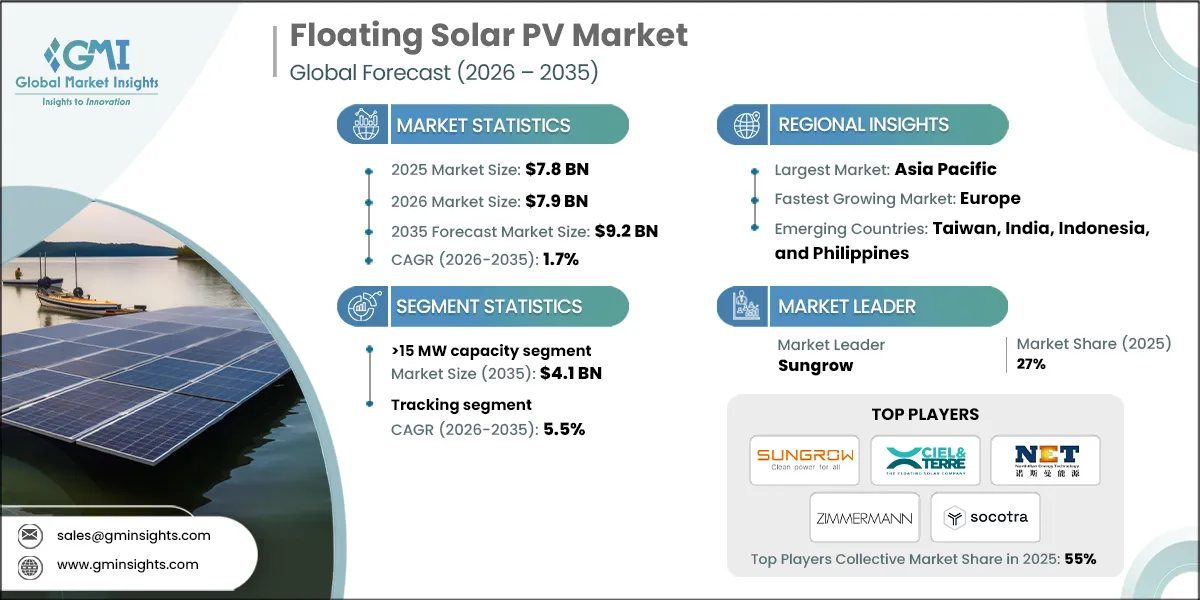
The floating solar PV market size was valued at USD 7.8 billion in 2025. The market is expected to grow from USD 7.9 billion in 2026 to USD 9.2 Billion by 2035, at a CAGR of 1.7%, according to Global Market Insights, Inc.
Floating Solar PV Market Key Takeaways
Market Size & Growth
- 2025 Market Size: USD 7.8 Billion
- 2026 Market Size: USD 7.9 Billion
- 2035 Forecast Market Size: USD 9.2 Billion
- CAGR (2026–2035): 1.7%
Regional Dominance
- Largest Market: Asia Pacific
- Fastest Growing Region: Europe
Key Market Drivers
- Increasing adoption across Southeast Asian countries.
- Synergy with existing water infrastructure.
Challenges
- High capital costs.
Opportunity
- Hybridization with hydropower plants.
- Land scarcity solution in densely populated regions.
Key Players
- Market Leader: Sungrow led with over 27% market share in 2025.
- Leading Players: Top 5 players in this market include Sungrow, Ciel & Terre, Northman Energy Technologies, Zimmermann, Scotra, which collectively held a market share of 55% in 2025.
Get Market Insights & Growth Opportunities
- A floating solar photovoltaic system is a solar power installation mounted on the body of water, comprising of a lake, reservoir, or ocean. They are installed on floating platforms instead of placing the solar panels on land, thereby allowing the system to generate electricity from sunlight while floating on the water's surface. Growing utilization of solar PV systems installed on reservoirs linked to hydropower plants coupled with innovations in design and material including advances in mooring technology and durable floating structures, will stimulate the product adoption.
- Growing potential to increase panel efficiency through cooling and reduce water evaporation are key drivers of product penetration. Enhanced use in regions prone to high temperatures and water scarcity, will lead to market growth. Increasing deployment across island nations and coastal areas where land resources are scarce will strengthen the floating solar PV market landscape.
- Modern floating platforms are being designed with more robust materials like high-density polyethylene (HDPE), which is UV-resistant, weatherproof, and resistant to corrosion and algae growth. These materials ensure the longevity and stability of the solar system, especially in harsh marine environments. Further, various floating solar systems use modular platforms which can be expanded allowing for scalable solutions that can grow with energy demand, making them ideal for both small-scale and large-scale projects, driving the business scenario.
- Various growth ventures between hydropower plants and floating solar PV systems is emerging as a highly complementary and efficient renewable energy solution which will influence the business statistics. This hybrid approach allows for the efficient use of existing hydropower infrastructure, thereby increasing the energy output and grid stability.
- Key advantages including the ability to leverage the existing infrastructure, comprising of substations and grid connections will drive the business scenario. In addition, maintenance teams for hydropower plants can often manage both the floating solar and hydropower components, thereby lowering the operational costs by reducing the need for additional personnel or resources.
To get key market trends
Floating Solar PV Market Trends
- Countries including China, India, Indonesia, and Thailand are at the forefront, driven by favorable geographic conditions and supportive government policies. Ongoing market expansion in Europe and North America, along with growing interest in integrating the FPV systems with the existing hydropower infrastructure is set to augment the floating solar PV market growth.
- Floating solar systems offer a viable solution by utilizing the water bodies such as the reservoirs, lakes, and ponds, to conserve the valuable land resources. This is specifically evident in densely populated regions with intense land competition. For instance, in April 2024, Thailand had a 31 MW demonstration floating solar PV plant using 670 W vertex modules. The power station further comprises of integrating water-surface photovoltaics, four water surface photovoltaic arrays, clean hydroelectricity, a high-efficiency energy storage system, along with an intelligent energy management system.
- FPV systems benefit from the natural cooling effect of water, which helps maintain optimal operating temperatures for solar panels. This cooling effect can then lead to higher energy yields compared to land-based installations, especially in hot climates, leading to system adoption. The reduced need for land and the potential for increased efficiency make the systems an attractive option for regions seeking to maximize renewable energy output.
- Increasing government support through introduction of policies and incentives will enhance the adoption of floating solar systems. Shifting focus of countries on the use of floating solar to meet their renewable energy targets and implement frameworks to facilitate the product deployment will continue to drive the floating solar PV market momentum.
- The synergy water reservoirs with the FPV plants allows for the dual use of water bodies, thereby optimizing the energy production without any additional land use. For instance, Ocean Sun collaborated with NHPC Limited, in India to develop a 2 MW demonstration project on a hydropower reservoir showcasing the potential of combining solar and hydroelectric power generation.
Floating Solar PV Market Analysis
Learn more about the key segments shaping this market
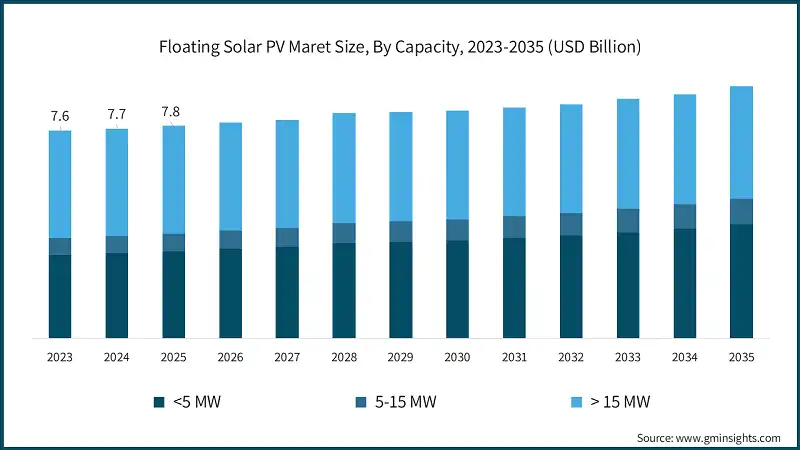
- Based on capacity, the market is segmented into <5 MW, 5-15 MW and >15 MW. The >15 MW capacity segment is anticipated to reach USD 4.1 billion by 2035, driven by large-scale project developments, advancements in technology, and supportive policies.
- Rising demand for large floating systems in countries including India, China, and South Korea, to generate large amount of electricity will contribute to the national energy grids, which will foster the product adoption. Ongoing installation of large-scale floating solar projects on hydropower reservoirs, where the combination of hydroelectric and solar power enhances energy output and grid reliability. Moreover, large floating solar projects can utilize the existing grid infrastructure utilized by hydropower plants, thereby lowering the cost connecting to the power grid. This synergy additionally makes projects more financially viable and attractive to investors.
- The <5 MW floating solar PV systems will grow more than CAGR 2.5% by 2035, driven by their suitability for small-scale, decentralized applications. These compact systems are particularly helpful for integration with the existing infrastructure comprising of the reservoirs, wastewater treatment plants, and agricultural ponds. Growing adoption in regions including the Southeast Asia equipped with abundant water bodies will stimulate the floating solar PV market growth.
- 5-15 MW systems amount to 8% market share in 2025 and will grow to over 10% share by 2035, owing to their suitability for medium-scale deployments on water bodies including the wastewater treatment facilities, reservoirs, and other sources. These mid-sized systems offer a balance between manageability and scalability, making them attractive to the local governments and utilities seeking to enhance their renewable energy capacity, which will drive the business growth.
Learn more about the key segments shaping this market
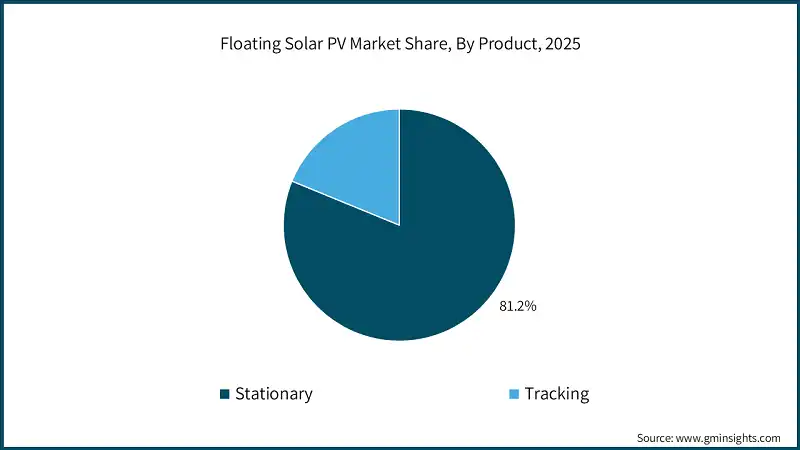
- Based on product, the floating solar PV market is segmented into tracking and stationary. Tracking segment is anticipated to grow more than CAGR 5.5% by 2035. Increasing focus on tracking technology to enhance the energy generation efficiency will complement the market landscape.
- Growing interest in tracking floating solar systems, particularly in countries including Spain and Portugal, where maximizing solar efficiency is important owing to high demand for renewable energy and land demand will drive the market outlook. In addition, technological innovations in these systems will make them more suitable for floating solar applications, thereby stimulating the floating solar PV market growth.
- Additionally, the developers are introducing various hybrid systems that combine the benefits of solar tracking and floating solar PV, which are designed to be adaptable and flexible, with a few of them using self-powered motors for adjusting the position and angle of panels, which will drive the business scenario.
- Stationary floating solar PV systems will grow more than USD 6.4 billion by 2035 on account of their capability to utilize water bodies including the lakes, ponds and reservoirs, conserving various valuable land resources. Additionally, they support to mitigate water evaporation, thereby providing environmental benefits in regions facing water scarcity, leading to floating solar PV market growth.
- Modern technological advancements coupled with growing innovations in floating platform materials, including the high-density polyethylene (HDPE), is set to enhance the resistance to environmental factors and durability, reducing the maintenance costs. Moreover, integration of stationary systems with the existing hydropower infrastructure providing economic advantages, coupled with shared grid connection and maintenance will reduce the operational expenses, accelerating the product adoption.
Looking for region specific data?
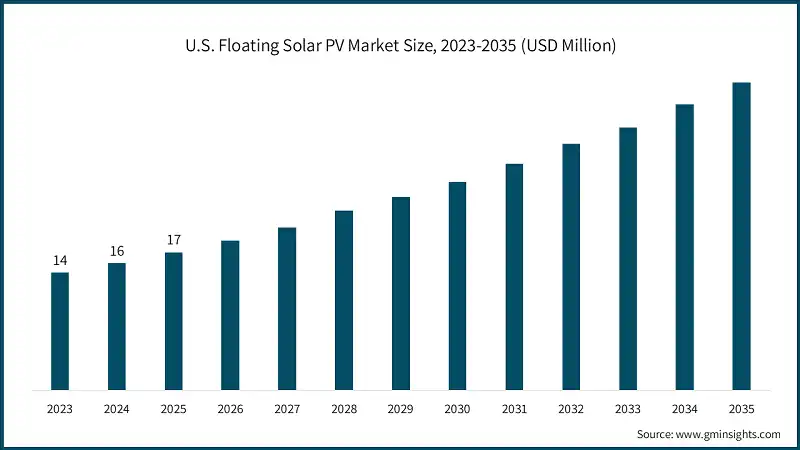
- The U.S. floating solar PV market recorded a valuation of USD 14 million in 2023, reached USD 26 million in 2024 and reach USD 17 million by 2025. North America accounted for 0.3% of the global market share in 2025.
- Ongoing integration into broader renewable energy strategies and introduction of incentives by states like California and New Jersey is set to augment the market growth. Manufacturers comprising of Sungrow among others will develop various floating solar modules personalized for the regional climates. For instance, in August 2025, Third Pillar along with Diamond Infrastructure Solutions initiated to develop 500 MW of utility floating solar in the water reservoirs of the U.S.
- Europe floating solar PV market is set to reach more than USD 700 million by 2035, on account of introduction to multiple floating solar projects on reservoirs, thereby contributing to the region’s renewable energy goals. Modern advancements in mooring technologies, enhanced panel efficiency and floating structures, will improve the feasibility, thereby stimulating the product growth.
- For instance, in June 2025, Velto Renewables and Q ENERGY inaugurated the largest floating solar park, Les Ilots Blandin, France. The 74.3 MW park includes more than 135,000 PV modules installed on state-of-the-art floating platforms and is set to prevent 18,000 tons of CO? emissions each year.
- Asia Pacific floating solar PV market is set to grow more than USD 7.4 billion by 2035 on account of land scarcity, increasing energy demand, and enhanced government support for renewable energy. Many economies in the region are exploring hydropower and hybrid floating solar systems, where solar panels are installed on existing reservoirs which will foster the business landscape.
- Lucrative energy markets and strong policy frameworks will attract private investment, especially in China, India, and Southeast Asian countries, contributing to the business momentum. Furthermore, countries including India, China, Thailand and Vietnam are establishing large-scale projects, with market growth anticipated as more nations adopt floating solar to meet their sustainability goals and energy demands.
- Latin America and Middle East & Africa represent rapidly growing markets with 2.3% and 1.9% market shares respectively owing to the growing requirement for renewable energy solutions that optimize the land use and integrate with existing infrastructure. In addition, many economies are piloting various small-scale floating solar systems, focusing on integrating the technologies with existing hydropower plants to improve energy reliability, driving the business outlook.
- For example, in August 2025, the African Export-Import Bank announced financing for a 1 GW hybrid floating solar PV project in Zimbabwe. The initiative is planned in two stages, beginning with a 500 MW pilot phase. Additionally, the consortium will obtain the project capacity at a cost-reflective tariff through a 20-year power purchase agreement (PPA).
Floating Solar PV Market Share
- The top five players operating in the industry include Sungrow Power Supply, Ciel & Terre, Zimmermann, Scotra and Floatex Solar by increasing interest in technological innovations and renewable energy, along with the growing need for conservation.
- Key participants in the industry comprise both established solar companies entering the floating solar space and specialized firms dedicated to floating PV technologies. As the market expands, supported by favorable policies, declining costs, and ongoing technological improvements competitive activity is anticipated to accelerate, especially across the Europe, Asia Pacific and emerging markets.
- Ciel & Terre International is well known for its Hydrelio floating platform and has played a key role in deploying large-scale FPV projects worldwide. The company operates in over 30 countries, collaborating with partners across Asia, North America, and Europe. By 2025, it has launched more than 250 floating photovoltaic projects, representing a total installed capacity of 1.2 GW.
- Canadian Solar operates manufacturing facilities across several countries including the United States, Canada, China, Indonesia, Vietnam, and Brazil where it produces solar modules and cells. Through its subsidiary Recurrent Energy, the company has developed and delivered more than 10 GW of solar power projects and 3.3 GWh of battery energy storage projects worldwide.
Floating Solar PV Market Companies
Eminent players operating in the floating solar PV industry are:
- Amoy Solar Tech
- China Three Gorges New Energy
- Ciel & Terre International
- Eni Energy Solutions
- First Solar
- Floatex Solar
- Intech Clean Energy
- Jinko Solar
- Kyocera Corporation
- Longi Solar
- Ocean Sun
- Scotra
- SolarDeck
- Sungrow Group
- Statkraft
- Swimsol
- Sharp Corporation
- Vikram Solar
- Yingli Solar
- Zimmermann PV
- Sungrow Power Supply is actively engaged in numerous FPV projects, primarily in Southeast Asia and China, where it focuses on integrating its inverters with floating solar platforms. The company reported revenues of USD 11.2 billion by Q3 2025 and is also developing energy storage solutions specifically designed for FPV applications.
- LONGi one of the world’s largest producers of monocrystalline silicon solar modules, reported revenues of USD 2.56 billion in Q3 2025. The company is increasingly exploring opportunities in the floating solar market, particularly in regions with constrained land availability. In addition, LONGi is working to integrate its high-efficiency modules with floating platforms to further enhance energy output.
- Trina Solar is a global provider of smart solar solutions and a major manufacturer of photovoltaic modules. The company has been actively expanding its presence in the floating solar segment, particularly across the Asia-Pacific and European regions. In 2025 Q3, it reported revenues of USD 2.68 billion. The company has also participated in several large-scale FPV initiatives, including a 500 MW battery energy storage project in Victoria, Australia.
- Kyocera Corporation is a diversified technology company with a significant footprint in the solar energy sector. The company reported revenues of USD 3.29 billion in 2025 Q3 and has participated in multiple FPV projects in Japan, with a focus on integrating its solar modules into floating platform systems.
Floating Solar PV Market Report Attributes
| Key Takeaway | Details |
|---|---|
| Market Size & Growth | |
| Base Year | 2025 |
| Market Size in 2025 | USD 7.8 Billion |
| Market Size in 2026 | USD 7.9 Billion |
| Forecast Period 2026 - 2035 CAGR | 1.7% |
| Market Size in 2035 | USD 9.2 Billion |
| Key Market Trends | |
| Drivers | Impact |
| Increasing adoption across Southeast Asian countries | Various Southeast Asian countries have hydropower reservoirs and dams. FPV can be co-located with these plants to share grid connection transmission infrastructure. Introduction of set targets by the government to include FPV explicitly in energy plans will enhance the product landscape. Improvements in module supply and local production will drive the market outlook. |
| Synergy with existing water infrastructure | Installing FPV on the existing surfaces will avoid additional land acquisition and use idle water areas effectively, thereby creating dual-use infrastructure. The projects can further plug into this infrastructure directly, lowering the project CAPEX and reducing time for grid integration, thereby augmenting the business growth. |
| Pitfalls & Challenges | Impact |
| High capital costs | High capital costs act as a major challenge to FPV market as they directly affect the investor confidence, project bankability, and scalability. Water-based O&M, specialized floating structures, risk-adjusted financing, anchoring, and lack of economies of scale make the project developers cautious, leading to slow adoption in the cost-sensitive markets. |
| Opportunities: | Impact |
| Hybridization with hydropower plants | Adoption of FPV systems in countries equipped with large dams and reservoirs will support increase the grid stability, reduce curtailment, and maximize the renewable output without any additional land use, thereby contributing to the business growth. |
| Land scarcity solution in densely populated regions | FPV unlocks solar deployment potential without competing with agriculture, or forests, especially in economies with limited land availability, leading to market growth. Furthermore, floating solar on reservoirs, lakes, and industrial ponds provides a scalable pathway for renewable expansion in land constrained economies. |
| Market Leaders (2025) | |
| Market Leaders |
27% market share |
| Top Players |
|
| Competitive Edge |
|
| Regional Insights | |
| Largest Market | Asia Pacific |
| Fastest Growing Market | Europe |
| Emerging Countries | Taiwan, India, Indonesia, and Philippines |
| Future outlook |
|
What are the growth opportunities in this market?
Floating Solar PV Industry News
- In October 2025, Indonesia’s state-owned utility, Perusahaan Listrik Negara (PLN), began construction of a 92 MW floating solar power plant in West Java, marking a significant step in the country’s renewable energy expansion. Indonesia aims to add 42.6 GW of renewable energy capacity by 2034, with solar expected to account for approximately 17.1 GW of that total.
- In December 2025, Brazil’s environmental agency, Ibama, issued a preliminary license for a 100 MW floating PV complex at the Anta Hydroelectric reservoir, operated by Furnas. The project will consist of 20 floating solar units of 5 MW each, spread across 110 hectares of the reservoir. At present, the site generates 28 MW and operates alongside the Simplício plant, which adds a further 305.7 MW to the regional grid.
- In December 2025, KPI Green Energy secured an EPC contract from GSECL for a 142 MW DC floating solar project. The agreement further positions the company to play a key role in advancing FPV deployment in Gujarat, contributing to India’s growing interest in floating solar.
- In November 2025, South Korea commissioned its largest floating PV installation, a 47.2 MW solar power plant at Imha Dam. It includes integrating floating solar with the existing hydropower system, the facility enables dual utilization generating solar power during the day and hydropower at night, thereby optimizing overall resource use.
- In October 2025, SINN Power commissioned the 1.8-1.9 MW, the world’s first vertical floating solar PV system in Bavaria. It is further engineered for improved wave load stability and storm resistance, marking a different design approach in floating solar deployment.
This floating solar PV market research report includes an in-depth coverage of the industry with estimates & forecast in terms of volume and revenue in “USD Million & MW” from 2022 to 2035, for the following segments:
Market, By Capacity
- <5 MW
- 5-15 MW
- >15 MW
Market, By Product
- Stationary
- Tracking
The above information has been provided for the following regions and countries:
- North America
- U.S.
- Canada
- Europe
- Germany
- France
- Netherlands
- Italy
- Norway
- Asia Pacific
- China
- Japan
- South Korea
- India
- Indonesia
- Middle East & Africa
- Morocco
- UAE
- Latin America
- Brazil
- Chile
Frequently Asked Question(FAQ) :
What is the market size of the floating solar PV in 2025?
The market size was USD 7.8 billion in 2025, with a CAGR of 1.7% expected through 2035 driven by increasing adoption across Southeast Asian countries, synergy with existing water infrastructure, and land scarcity solutions in densely populated regions.
What is the projected value of the floating solar PV market by 2035?
The floating solar PV market is expected to reach USD 9.2 billion by 2035, propelled by hybridization with hydropower plants, technological advancements in floating platform materials, and growing deployment across island nations and coastal areas.
What is the current floating solar PV market size in 2026?
The market size is projected to reach USD 7.9 billion in 2026.
How much revenue is the >15 MW capacity segment expected to generate by 2035?
The >15 MW capacity segment is anticipated to reach USD 4.1 billion by 2035, driven by large-scale project developments in countries like India, China, and South Korea, along with integration with hydropower reservoirs.
What was the market share of the 5-15 MW capacity segment in 2025?
The 5-15 MW segment held 8% market share in 2025 and is expected to grow to over 10% share by 2035, owing to suitability for medium-scale deployments on wastewater treatment facilities, reservoirs, and other water bodies.
What is the growth outlook for tracking floating solar PV systems from 2026 to 2035?
Tracking systems are anticipated to grow at over 5.5% CAGR through 2035, driven by increasing focus on enhancing energy generation efficiency, particularly in countries like Spain and Portugal where maximizing solar efficiency is critical.
Which region leads the floating solar PV market?
The U.S. floating solar PV market recorded a valuation of USD 17 million in 2025, attributed to renewable energy strategies and state incentives from regions such as California and New Jersey
What are the upcoming trends in the floating solar PV market?
Key trends include hybridization with hydropower plants for dual energy generation, advancements in floating platform materials like high-density polyethylene (HDPE), modular and scalable platform designs, integration of tracking technology for enhanced efficiency, and natural cooling effects from water bodies improving panel performance in hot climates.
Who are the key players in the floating solar PV market?
Key players include Sungrow Power Supply, Ciel & Terre International, Northman Energy Technologies, Zimmermann, Scotra, Floatex Solar, Amoy Solar Tech, China Three Gorges New Energy, Eni Energy Solutions, First Solar, Intech Clean Energy, Jinko Solar, Kyocera Corporation, Longi Solar, Ocean Sun, SolarDeck, Statkraft, Swimsol, Sharp Corporation, Vikram Solar, Yingli Solar, and Trina Solar.
Floating Solar PV Market Scope
Related Reports