Summary
Table of Content

Fish Sauce Market
Get a free sample of this report
Form submitted successfully!
Error submitting form. Please try again.
Thank you!
Your inquiry has been received. Our team will reach out to you with the required details via email. To ensure that you don't miss their response, kindly remember to check your spam folder as well!
Request Sectional Data
Thank you!
Your inquiry has been received. Our team will reach out to you with the required details via email. To ensure that you don't miss their response, kindly remember to check your spam folder as well!
Form submitted successfully!
Error submitting form. Please try again.
Fish Sauce Market Size
- The increasing worldwide popularity of Thai and Vietnamese and Filipino dishes from Southeast Asia is driving fish sauce industry expansion. The growing number of international restaurants and quick-service outlets and fusion dining establishments throughout developed and developing markets is driving up the need for genuine flavoring components. Fish sauce serves as a fundamental Asian condiment because it appears in traditional dishes and marinades and dipping sauces, which fuels continuous market demand growth.
- The fish sauce market size has experienced growth because the global food processing industry has expanded at a fast rate. Food manufacturers have started to use fish sauce as an ingredient for packaged foods and ready-to-eat meals and seasoning blends and processed sauces to produce natural umami flavor enhancements. The global market for fish sauce is expanding because of rising demand for convenience foods which drives its usage as an industrial food production ingredient.
- The fish sauce industry is expanding because consumers now prefer natural food products that undergo traditional fermentation methods. People now recognize that fermented condiments offer both enhanced flavor and potential health advantages to their consumers. The market demand for natural ingredients without processing is pushing manufacturers to use traditional fermentation methods alongside clean-label product development. The fish sauce seasoning product has gained traction among consumers who want authentic seasoning products which are made from natural ingredients.
The global fish sauce market was estimated at USD 3.1 billion in 2025. It is expected to grow from USD 3.2 billion in 2026 to USD 5.1 billion by 2035, at a CAGR of 5.3%, according to latest report published by Global Market Insights Inc.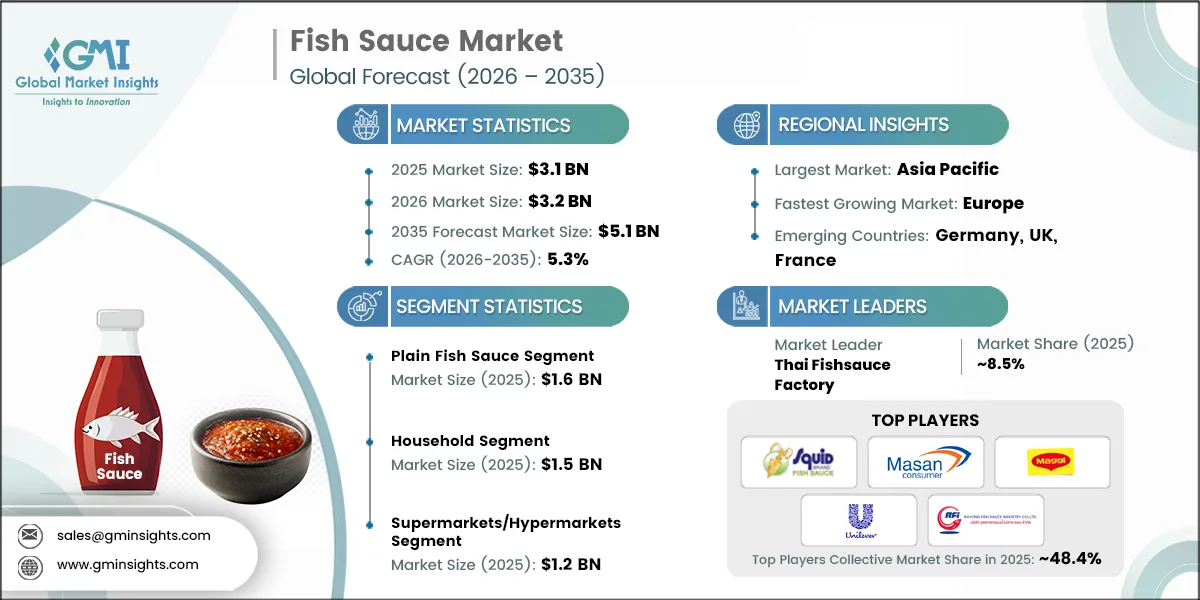
Fish Sauce Market Key Takeaways
Market Size & Growth
- 2025 Market Size: USD 3.1 Billion
- 2026 Market Size: USD 3.2 Billion
- 2035 Forecast Market Size: USD 5.1 Billion
- CAGR (2026–2035): 5.3%
Regional Dominance
- Largest Market: Asia Pacific
- Fastest Growing Region: Europe
Key Market Drivers
- Rising Popularity of Asian Cuisine Globally.
- Expansion of the Food Processing Industry.
- Growing Consumer Interest in Fermented and Natural Condiments.
Challenges
- Strong Odor and Limited Consumer Acceptance in Some Regions.
- Supply Volatility of Raw Materials.
Opportunity
- Rising Demand for Premium and Artisanal Products.
- Growth of E-Commerce and Global Food Retail Networks.
Key Players
- Market Leader: Thai Fishsauce Factory led with over 8.5% market share in 2025.
- Leading Players: Top 5 players in this market include Thai Fishsauce Factory, Masan Consumer Corporation, Nestle (Maggi Fish Sauce), Uniliver PLC, Rayong Fish Sauce Industry Co. Ltd, which collectively held a market share of 48.4% in 2025.
Get Market Insights & Growth Opportunities
To get key market trends
Fish Sauce Market Trends
- The richer flavor and perceived health benefits of traditionally fermented fish sauce which uses natural anchovies and sea salt make it the preferred choice for consumers. The rise of authentic production methods forces manufacturers to demonstrate their commitment to traditional fermentation processes and clean-label product development.
- Retail and foodservice markets show increasing demand for premium fish sauce products which undergo extended fermentation periods. The worldwide popularity of Southeast Asian cuisines such as Thai, Vietnamese, and Filipino has led to increased fish sauce usage in both restaurants and commercial kitchens. Foodservice operators are incorporating fish sauce into their marinades and sauces, as well as their fusion dishes, to enhance the umami flavor profile of their dishes. The trend helps push demand into new market territories while establishing itself as an essential part of diverse culinary traditions across the globe.
- The modern consumer market drives manufacturers to create distinct products through two main pathways which include premium packaging and organic product lines along with specialized product formulas. The following innovations introduce three new product options which include low-sodium fish sauce, blended seasoning sauces, and ready-to-use dipping sauces. Brand development through these new product offerings enables companies to establish control over their market position while expanding their existing product range.
Fish Sauce Market Analysis
Learn more about the key segments shaping this market
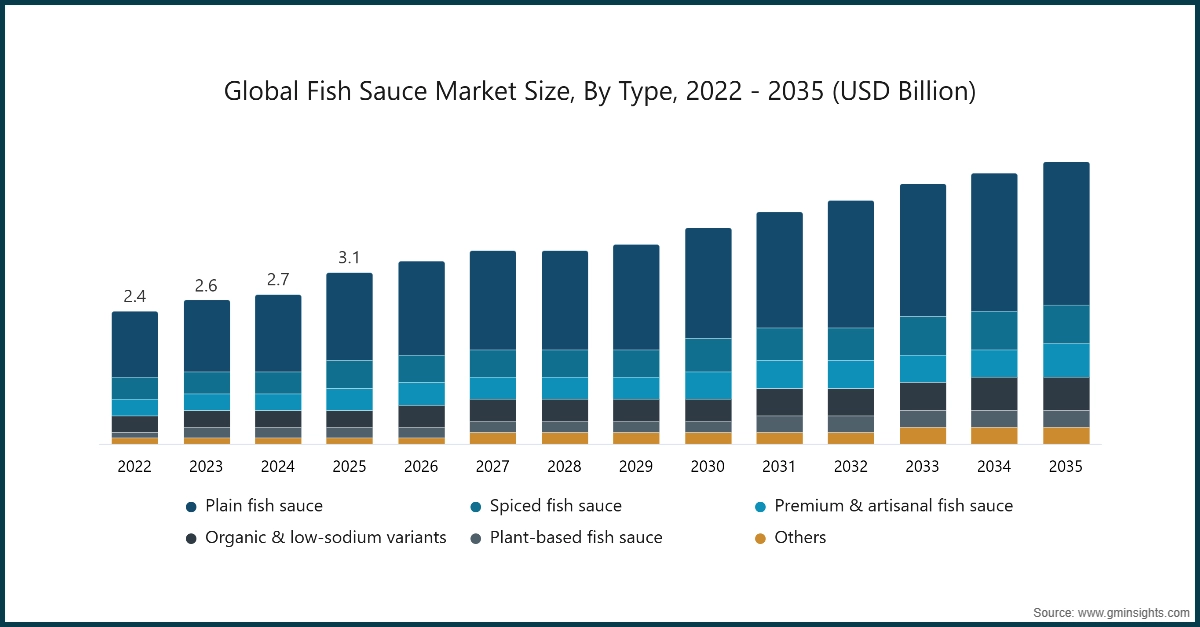
Based on type, the fish sauce market is segmented into plain fish sauce, spiced fish sauce, premium & artisanal fish sauce, organic & low-sodium variants, plant-based fish sauce, and others. Plain fish sauce holds a significant share at a valuation of USD 1.6 billion in 2025.
- Retail and foodservice markets experience rising demand for unique fish sauce products because consumers want distinct tastes and easy-to-use seasonings that match contemporary cooking methods and international food trends.
- The condiment industry now shows greater product innovation development through premiumization processes and health-focused product development which experts use to classify product types. Manufacturers establish value-added product lines to attract consumers who desire authentic products which contain specialty ingredients and better nutritional benefits. The availability of multiple product formats across supermarkets specialty food stores and online platforms enhances market penetration while companies use this expansion to reach niche customer segments and grow their international presence.
Based on application, the fish sauce market is segmented into food service, industrial, household, and others. Household holds a significant share at a valuation of USD 1.5 billion in 2025.
- The fish sauce industry demonstrates multiple demand streams which stem from its ability to enhance flavors and its various culinary applications. The demand for fish sauce increases because it serves as a basic seasoning component for all types of dining establishments, where it gets used in cooking and marinades and sauces. The rising popularity of Asian cuisine together with modern food preparation which uses umami-rich condiments has led to increased fish sauce adoption in different places where people consume food.
- The market experiences growth because the food processing industry expands which uses fish sauce in packaged foods and ready-to-eat meals and seasoning blends for flavor enhancement. Retail sales grow because people cook more at home and want to experience authentic international dishes. The market maintains steady demand through commercial and industrial and household product usage which gives manufacturers a chance to expand their product lines.
Learn more about the key segments shaping this market
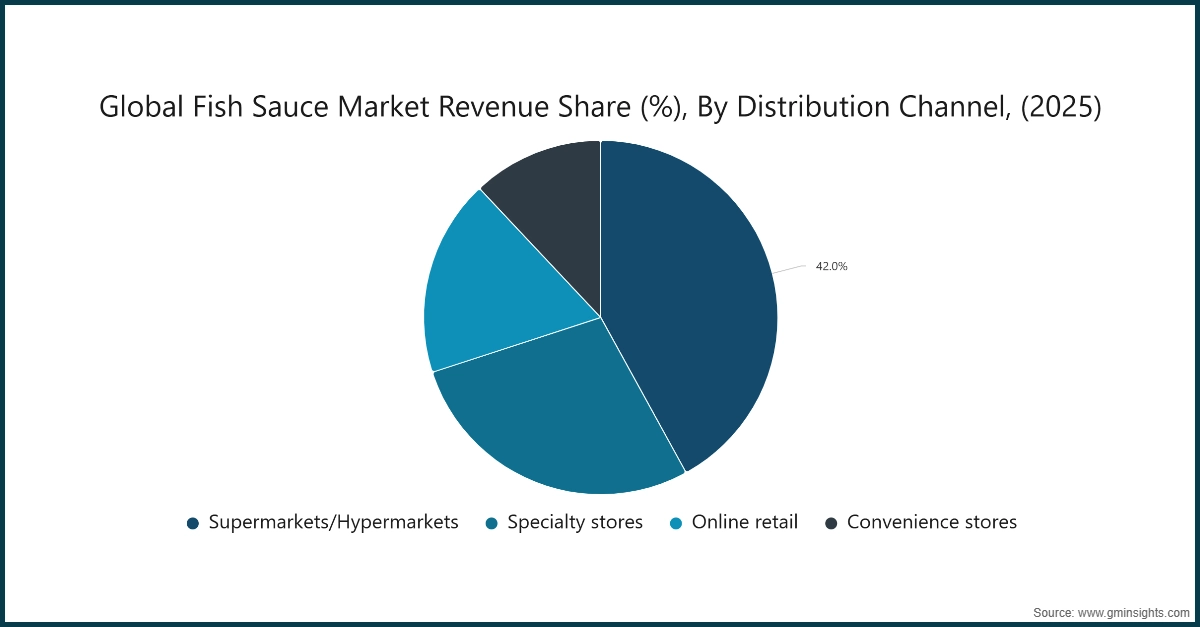
Based on distribution channel, the market is segmented into supermarkets/hypermarkets, specialty stores, online retail, and convenience stores. Supermarkets/hypermarkets is estimated to grasp a value of USD 1.2 billion in 2025.
- The fish sauce market develops through its various distribution networks which enable manufacturers to sell their products to customers who shop at both traditional and modern retail stores. The organized retail outlets in the market provide essential functions which allow customers to see and access products from international and domestic condiment brands. The sales performance of structured retail formats shows improvement because customers now prefer shopping environments that offer them multiple product choices.
- Digital commerce platforms are experiencing rapid growth it holds onthe customer preferences and upgrade as per the needs. The online retail channels are becoming more popular because they enable customers to access a wider range of products while they can easily compare prices and receive their orders at home. People in the neighborhood can still use the local retail shops to make their regular purchases because these stores provide easy access to their needs. The fish sauce market benefits from both physical retail stores and digital platforms which help businesses reach more customers and achieve consistent growth.
Looking for region specific data?
North America accounted for USD 549 million in 2025 and is anticipated to show lucrative growth over the forecast period.
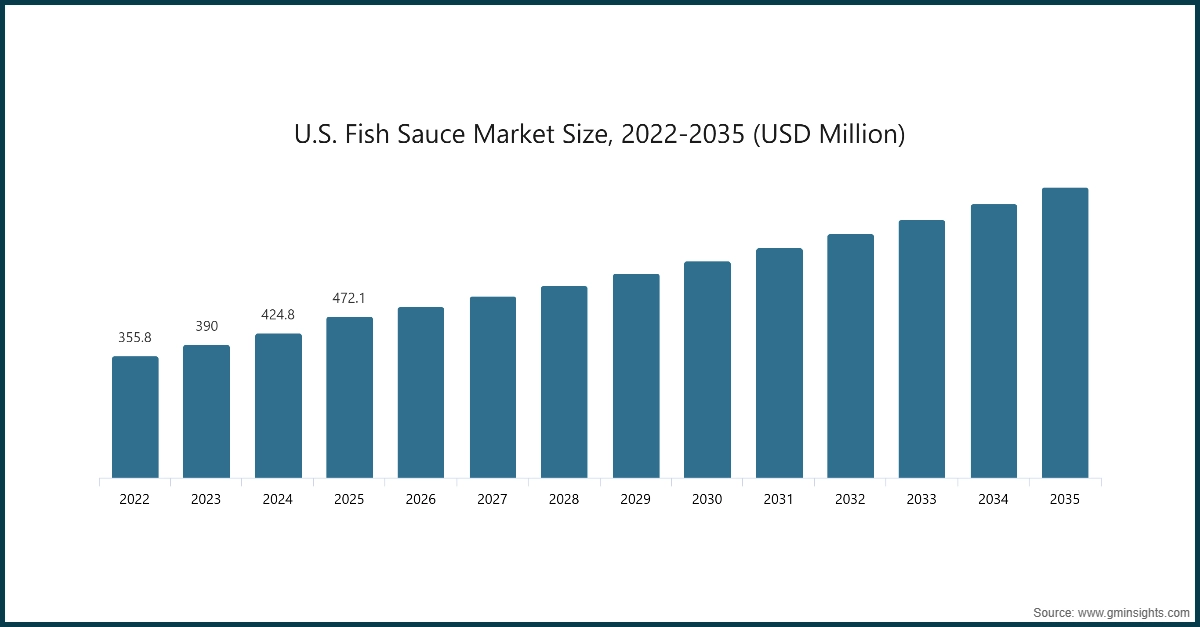
- The United States accounts for a significant share of the North American fish sauce market due to the increasing popularity of Asian cuisine and the strong presence of multicultural populations. The Canadian market shows consistent growth because more Asian food retail outlets and foodservice establishments are being established throughout the country. The rising demand for authentic cooking ingredients together with the increasing popularity of Southeast Asian cooking methods is driving fish sauce consumption growth in these countries.
- The North American fish sauce industry is experiencing profitable growth because consumers are increasingly choosing international flavors and fermented sauces as their preferred food options. The product becomes more accessible because it is now available at supermarkets and specialty Asian stores and through online grocery shopping. Manufacturers use fish sauce in their products as an ingredient to create umami flavor in their marinades and sauces and ready-to-eat meals. Asian restaurant chains are expanding their operations while consumers are choosing to cook at home which creates new market opportunities throughout the entire region.
Europe accounted for USD 610 million in 2025 and is anticipated to show lucrative growth over the forecast period.
- The United Kingdom holds a notable share of the European fish sauce market due to strong demand from Asian restaurants and increasing consumer interest in international cuisines. German and French retail chains currently enhance their product range through the introduction of additional Asian condiments which includes imported Asian products. Multicultural populations are increasing while people gain access to global culinary methods which leads them to try authentic Southeast Asian cooking ingredients.
- The European fish sauce industry is growing steadily because people are changing their eating habits which leads to increased international food retail business development. Home chefs are choosing authentic and naturally fermented condiments to improve their cooking. The growth of specialty grocery stores and online retail platforms together with premium imported sauce brands is improving product availability. Foodservice establishments drive the need for fish sauce in their operations which leads to increased consumption throughout the area.
Asia Pacific market accounted for USD 1.3 billion in 2025 and is anticipated to show lucrative growth over the forecast period.
- The fish sauce market in Asia Pacific depends heavily on China because the country has both a big population and a rapidly growing processed food sector. The fish sauce production of Vietnam and Thailand stems from its essential role in their traditional dishes and their daily cooking methods. The countries establish their capacity to produce fish sauce for local markets while operating their fish sauce production plants and export networks to serve worldwide markets.
- The fish sauce industry throughout Asia Pacific shows fast growth because of its strong culinary traditions and its high per-person consumption rates. The demand for products increases because of three main factors which include more people moving to cities, higher average incomes, and the development of new shopping methods. The regional market growth receives a boost from two factors which include the rising packaged food segment and the use of fish sauce in producing seasoning blends and processed food items.
Latin America market accounted for 12% market share in 2025 and is anticipated to show steady growth over the forecast period.
- The Latin American fish sauce market sees Brazil occupying a major position because more people discover Asian food through international dining establishments which serve both Asian cuisine and other culinary options. Mexican consumers are now showing interest in international cuisine because they want to experience different eating patterns and fused cooking techniques. The availability of imported Asian condiments through specialty stores and international retail chains is supporting the gradual expansion of fish sauce consumption in these markets.
- The fish sauce industry in Latin America experiences continuous development because urban areas expand and dining customs change. The public now shows greater acceptance of Asian cooking which uses international ingredients. The global restaurant chain system together with tourism and cultural exchange increases people’s willingness to try different types of food. The modern retail channels and online grocery platforms now provide better distribution which helps the market development of this region.
Middle East and Africa market accounted for 8% market share in 2025 and is anticipated to show steady growth over the forecast period.
- The fish sauce market in the Middle East & Africa region receives support from the United Arab Emirates which has a large number of expatriates and a well-developed hospitality industry. Saudi Arabia experiences growing demand because of its expanding network of international dining establishments and high-end retail stores. The two urban areas of Dubai and Riyadh show increasing people adopting traditional Southeast Asian food by exposing them to Asian cuisine.
- The fish sauce industry in the Middle East & Africa region shows slow business growth which results from two factors consumer food choices and the growth of international dining sectors. The global restaurant chain system improves product visibility through its growing number of specialty food retailers. The demand for Asian condiments which include fish sauce grows as more people move to cities and show interest in international culinary traditions.
Fish Sauce Market Share
The global fish sauce industry shows slight fragmentation because the top five companies which include Thai Fishsauce Factory, Masan Consumer Corporation, Nestlé (Maggi brand), Unilever PLC, and Rayong Fish Sauce Industry Co., Ltd. control approximately 48.4% of the market share in 2025. The market contains various regional and local manufacturers throughout Southeast Asia, which compete against these companies who hold a significant market share because of their strong brand recognition and established distribution networks and their ability to produce products on a large scale. The competitive landscape remains fragmented because traditional producers and small-scale fermentation facilities continue to operate in the market.
Fish sauce market companies focus on developing new products while creating distinct product qualities and expanding into new markets to maintain their competitive edge. Key players are investing in modern production facilities and advanced packaging systems and improved fermentation techniques to achieve consistent product quality and extended shelf life. Manufacturers now provide premium fish sauce products which use natural fermentation methods and clean-labeling standards to satisfy changing consumer tastes.
Fish Sauce Market Companies
Major players operating in fish sauce industry are:
- Ogawa & Co., Ltd.
- Masan Consumer Corporation
- Red Boat Fish Sauce
- Nestle (Maggi Fish Sauce)
- Teo Tak Seng Fish Sauce Factory
- Rungroj Fish Sauce Co., Ltd.
- Thaipreeda Group
- Ocean's Halo (Plant-based)
- Roland Foods
- Kimlan Foods
- Sozye
- Uniliver PLC
- Rayong Fish Sauce Industry Co. Ltd
- Thai Fishsauce Factory
Thai Fishsauce Factory operates as the top Thai fish sauce producer which started its operations in 1944 and gained fame through its main product known as "Squid Brand." The company exports fish sauce to more than 70 countries which makes it one of the biggest fish sauce exporters in Thailand. The production process uses natural fermentation of anchovies and sea salt for an 18-month period to preserve authentic flavor and quality. The company operates ISO and HACCP-certified facilities to create premium products which it uses for expanding into international markets.
Masan Consumer Corporation operates as one of the biggest FMCG companies in Vietnam while its Nam Ngu and CHIN-SU brands make it a leading fish sauce producer in the country. The company which started its operations in 1996 and established its headquarters in Ho Chi Minh City produces multiple condiment products which include fish sauce, soy sauce, and chili sauce. The company controls the Vietnamese fish sauce market through its fish sauce brands which include Nam Ngu that holds a significant portion of national fish sauce consumption. The company uses its strong distribution network to enhance its product visibility in both domestic and international markets.
Nestlé enters the fish sauce market by using its Maggi brand which provides Asian-style seasoning products. The Maggi fish sauce serves as a versatile flavoring product which customers use to prepare meals and create dipping sauces for Southeast Asian dishes. The Nestlé worldwide distribution system combined with Maggi brand recognition enables the products to achieve widespread retail distribution while meeting established quality requirements. The company develops new products with local flavor profiles to compete with regional condiment products.
Unilever PLC operates as a worldwide consumer goods business which sells ASian food brands that focus on seasoning and sauce products. The company produces cooking sauces and condiments which it distributes for use in both home kitchens and commercial food service environments. Unilever built its strong presence in Southeast Asian flavoring and condiment markets through its powerful marketing capabilities which enable product distribution to retail stores while creating local product offerings for fish sauce-based seasoning products in certain markets.
Rayong Fish Sauce Industry Co., Ltd. established its traditional fish sauce production business in 1954 at Rayong Province Thailand which uses fermentation methods to produce its fish sauce products. The company produces several fish sauce brands such as Hoi Pao Hae (Abalone Brand), which are widely distributed in both domestic and international markets. The company maintains product quality and food safety by using traditional production methods together with contemporary manufacturing practices. The company exports its products to various regions which include the U.S., Europe, Australia, and Asia.
Fish Sauce Market Report Attributes
| Key Takeaway | Details |
|---|---|
| Market Size & Growth | |
| Base Year | 2025 |
| Market Size in 2025 | USD 3.1 Billion |
| Market Size in 2026 | USD 3.2 Billion |
| Forecast Period 2026-2035 CAGR | 5.3% |
| Market Size in 2035 | USD 5.1 Billion |
| Key Market Trends | |
| Drivers | Impact |
| Rising Popularity of Asian Cuisine Globally | Increasing global consumption of Southeast Asian dishes is expanding the demand for fish sauce as a key flavoring ingredient. |
| Expansion of the Food Processing Industry | Growing utilization of fish sauce in packaged foods, ready-to-eat meals, and seasoning blends is supporting consistent market growth. |
| Growing Consumer Interest in Fermented and Natural Condiments | Rising preference for naturally fermented products is enhancing the market appeal of traditionally produced fish sauce. |
| Pitfalls & Challenges | Impact |
| Strong Odor and Limited Consumer Acceptance in Some Regions | The distinctive aroma and taste profile may restrict adoption among consumers unfamiliar with Asian condiments. |
| Supply Volatility of Raw Materials | Fluctuations in anchovy supply and marine resource availability can impact production stability and pricing dynamics. |
| Opportunities: | Impact |
| Rising Demand for Premium and Artisanal Products | Increasing consumer willingness to pay for high-quality, traditionally fermented variants is creating opportunities for premium product segments. |
| Growth of E-Commerce and Global Food Retail Networks | Expanding online grocery platforms and international retail chains are improving product accessibility and enabling broader market penetration. |
| Market Leaders (2025) | |
| Market Leader |
Market Share Approximately 8.5% |
| Top Players |
Collective Market Share Approximately 48.4% |
| Competitive Edge |
|
| Regional Insights | |
| Largest Market | Asia Pacific |
| Fastest growing market | Europe |
| Emerging countries | Germany, UK, France |
| Future outlook |
|
What are the growth opportunities in this market?
Fish Sauce Industry News
- In year 2024, Vietnamese company Seagull Co. Ltd. introduced its fish sauce products to the United States market. The company provides traditional fish sauce products together with vegan fish sauce products which use fragrant fruits and soybeans and Japanese Shiitake mushrooms as their vegan fish sauce base.
- In March 2023, The fish sauce 'Huong Lang Co' (Ancient Village Savour) made its debut at a Tokyo exhibition when the Nam O fishing village in Da Nang City Lien Chieu district launched the product . The event showcased Da Nang-based fish sauce products together with hand-made fish sauce which local villagers created from their own production. The Japan-Vietnam Gastronomy Association (JVGA) established the display to showcase Vietnamese food and beverage products at an international exhibition which took place in Tokyo.
Fish Sauce market research report includes in-depth coverage of the industry with estimates & forecast in terms of revenue (USD Billion) & volume (Units) from 2022 to 2035, for the following segments:
Market, By Type
Plain fish sauce
- Spiced fish sauce
- Premium & artisanal fish sauce
- Organic & low-sodium variants
- Plant-based fish sauce
- Others
Market, By Application
Food service
- Restaurants
- Catering services
- Hotels
- Cloud kitchens & delivery platforms
- Industrial
- Processed foods
- Sauces and marinades
- Ready-to-eat meals
- Packaged snacks
- Plant-based food manufacturing
- Household
- Premium household
- Health-conscious consumers
- Others
Market, By Distribution Channel
- Supermarkets/Hypermarkets
- Specialty stores
- Online retail
- E-commerce platforms
- Direct-to-consumer channels
- Convenience stores
- Others
The above information is provided for the following regions and countries:
- North America
- U.S.
- Canada
- Europe
- UK
- Germany
- France
- Italy
- Spain
- Rest of Europe
- Asia Pacific
- China
- India
- Japan
- South Korea
- Australia
- Rest of Asia Pacific
- Latin America
- Brazil
- Mexico
- Argentina
- Rest of Latin America
- MEA
- UAE
- Saudi Arabia
- South Africa
- Rest of Middle East and Africa
Frequently Asked Question(FAQ) :
What is the market size of the fish sauce in 2025?
The market was valued at USD 3.1 billion in 2025 and is expected to grow at a CAGR of 5.3% through 2035, driven by the rising popularity of Southeast Asian cuisines and demand for umami-rich condiments.
What is the projected value of the fish sauce market by 2035?
The market is poised to reach USD 5.1 billion by 2035, supported by the expansion of the global foodservice industry and increasing demand for authentic Asian flavors.
What is the expected size of the fish sauce industry in 2026?
The market is expected to surpass USD 3.2 billion in 2026.
How much revenue did the plain fish sauce segment generate in 2025?
The plain fish sauce segment generated approximately USD 1.6 billion in 2025, due to its widespread use in both traditional and commercial cooking.
What was the valuation of the household segment in 2025?
The household segment accounted for USD 1.5 billion in 2025, led by increasing home cooking trends and demand for convenient seasoning ingredients.
What was the valuation of the supermarkets/hypermarkets segment in 2025?
Supermarkets/hypermarkets accounted for USD 1.2 billion in 2025, supported by strong product visibility, organized retail growth, and wide availability of brands.
Which region leads the fish sauce sector?
North America leads the market with USD 549 million in 2025, with the U.S. holding a significant share due to growing adoption of Asian cuisine and multicultural food trends.
What are the upcoming trends in the fish sauce market?
Key trends include premium and traditionally fermented fish sauce, clean-label products, plant-based alternatives, and increasing use in fusion cuisine and foodservice applications.
Who are the key players in the fish sauce industry?
Key players include Ogawa & Co., Ltd., Masan Consumer Corporation, Red Boat Fish Sauce, Nestle (Maggi Fish Sauce), Thaipreeda Group, Ocean's Halo, Roland Foods, Kimlan Foods, Sozye, Unilever PLC, Rayong Fish Sauce Industry Co. Ltd, and Thai Fishsauce Factory.
Fish Sauce Market Scope
Related Reports