Summary
Table of Content

Fish Farming Equipment Market
Get a free sample of this report
Form submitted successfully!
Error submitting form. Please try again.
Thank you!
Your inquiry has been received. Our team will reach out to you with the required details via email. To ensure that you don't miss their response, kindly remember to check your spam folder as well!
Request Sectional Data
Thank you!
Your inquiry has been received. Our team will reach out to you with the required details via email. To ensure that you don't miss their response, kindly remember to check your spam folder as well!
Form submitted successfully!
Error submitting form. Please try again.
Fish Farming Equipment Market Size
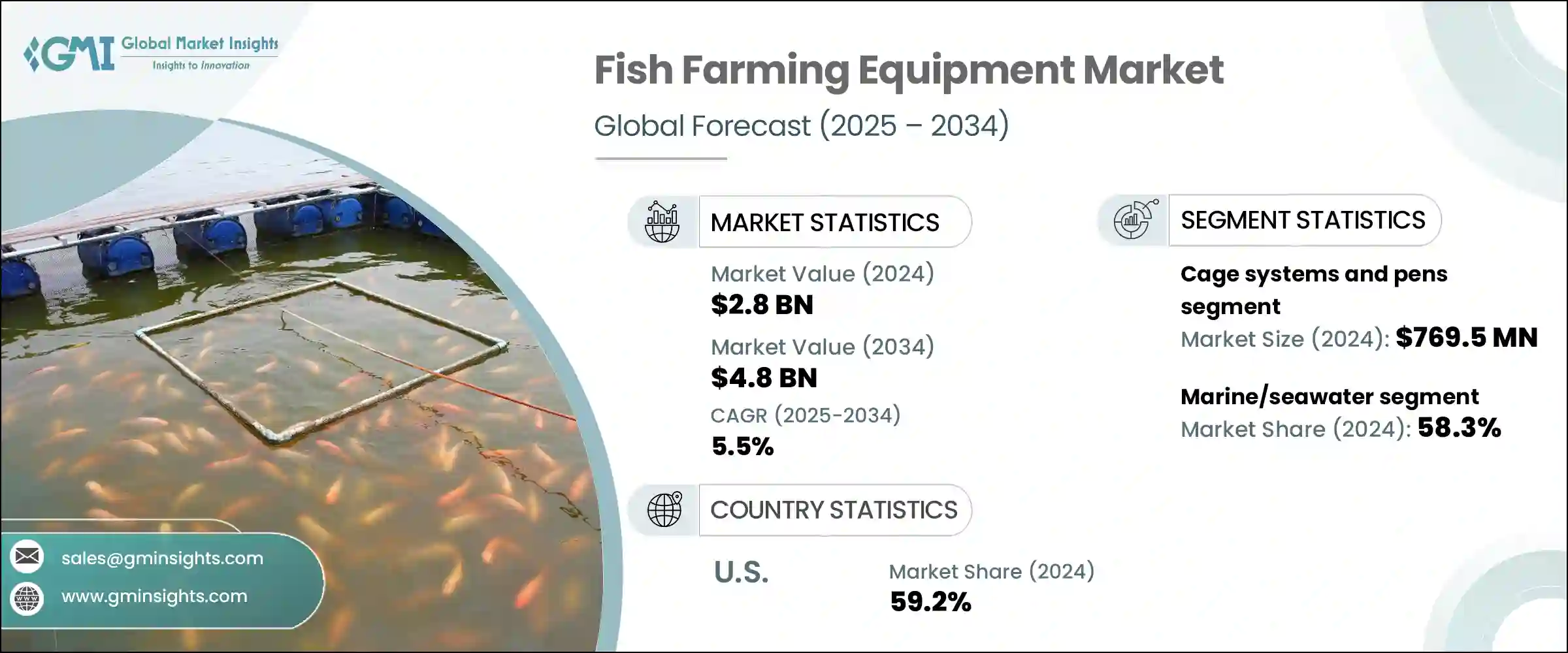
The global fish farming equipment market was estimated at USD 2.8 billion in 2024. The market is expected to grow from USD 2.9 billion in 2025 to USD 4.8 billion in 2034, at a CAGR of 5.5%.
Fish Farming Equipment Market Key Takeaways
Market Size & Growth
- 2024 Market Size: USD 2.8 Billion
- 2034 Forecast Market Size: USD 4.8 Billion
- CAGR (2025–2034): 5.5%
Key Market Drivers
- Growing demand for seafood.
- Rising investments in fish farming.
- Technological advancements.
Challenges
- High capital and operating costs.
- Slow adoption rate of innovative technologies.
Opportunity
- Expansion in emerging markets.
- Increasing investment and policy support.
Get Market Insights & Growth Opportunities
- The growth in the fish farming equipment market aims to meet rising seafood demand and address food security. The sector includes various products such as tanks, cages, feeding systems, water quality monitoring equipment, aeration systems, filtration units, and other monitoring devices.
- The increasing requirement for efficient and sustainable equipment drives demand for fish farming equipment, which helps optimize fish health, growth rates, and operational efficiency while reducing the impact on environment.
- Innovations such as automated feeding systems, real-time water quality monitoring, and biosecurity measures are gaining traction from the past few years. These advancements boost productivity and lower the labor costs.
- Asia-Pacific leads the market due to prevalence of large-scale aquaculture activities in countries such as China, India, and Vietnam, followed by Europe and North America, focusing on sustainable practices and eco-friendly equipment.
- As per the report by Food and Agriculture Organization, in 2024, aquaculture surpassed capture fisheries in aquatic animal production worldwide. The global aquaculture production reached 130.9 million tonnes, of which 94.4 million tonnes are aquatic animals, 51% of the total aquatic animal production.
- China, Indonesia, India, Vietnam, Bangladesh, the Philippines, Republic of Korea, Norway, Egypt, and Chile accounted for more than 89.8% of the total aquaculture production.
- Government regulations that promote sustainable aquaculture practices and investments in modern infrastructure also impact market growth. Additionally, the rise in recirculating aquaculture systems (RAS) and offshore cage farming offers new opportunities for equipment suppliers.
To get key market trends
Fish Farming Equipment Market Trends
- The integration of automation, IoT sensors, and data analytics is changing fish farming operations and aquaculture systems. Smart equipment allows for real-time monitoring of water quality, fish health, and environmental conditions. This improves efficiency and productivity of fish farming equipment.
- The increased focus on environmentally friendly practices is driving the development of eco-friendly equipment that uses less water, reduces waste, and decreases environmental impact. This aligns with global sustainability goals, further appealing fish farmers and regulatory bodies.
- The transition toward Recirculating Aquaculture System technology is gaining popularity as it recycles water and creates a controlled environment for fish farming. This technology is efficient and can produce high-quality fish in various locations.
- The market reports significant growth in the Asia-Pacific, Latin America, and Africa, fueled by increasing seafood demand, government efforts and investments in the development of fish farming infrastructure.
Fish Farming Equipment Market Analysis
Learn more about the key segments shaping this market
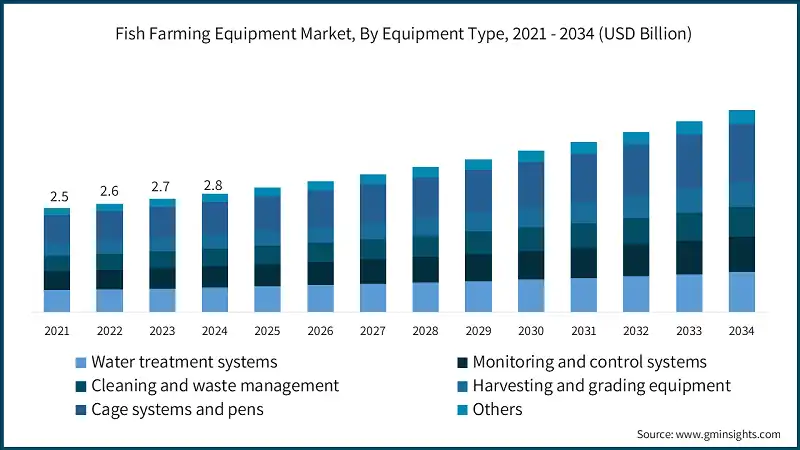
Based on equipment type, the market is segmented into water treatment systems, monitoring and control systems, cleaning and waste management, harvesting and grading equipment, cage systems and pens, and others. In 2024, the cage systems and pens segment held the major market share, generating a revenue of USD 769.5 million.
- Cage systems and pens held the largest market share due to several factors such as cost-effectiveness, scalability, versatility, adaptability and ease of installation. Cage systems are versatile and used in distinct water environments, including freshwater, brackish, and saltwater.
- Cage systems and pens work well with various fish species and farming situations. These systems support high-density fish farming, maximizing space use and boosting overall yield. This approach is appealing to producers looking for efficient production methods. The development of fish monitoring sensors and anti-predator features has made cage and pen systems safe and productive, further driving the market growth.
Learn more about the key segments shaping this market
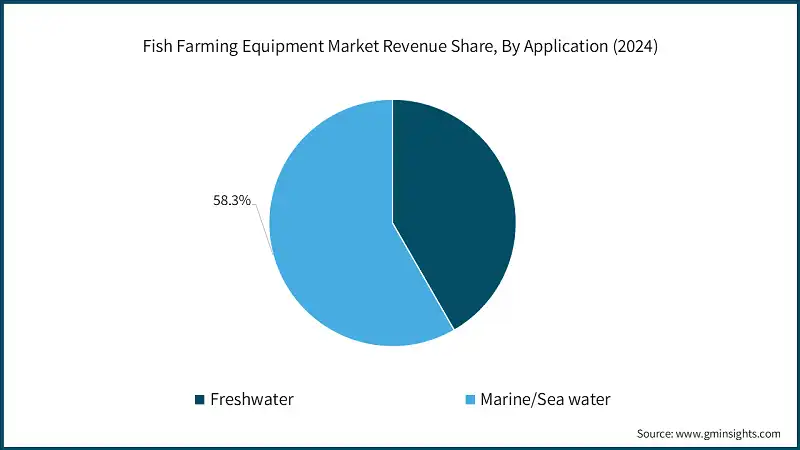
Based on application, the fish farming equipment market is segmented into freshwater and marine/seawater. In 2024, the marine/seawater segment held 58.3% share, valued at USD 1.6 billion in the global market.
- Marine/seawater held the largest market share due to utilization of strategic location and demand for high-value species. Marine fish farming can be combined with environmental management practices. Offshore farming reduces the pressure on freshwater resources and land.
- Many governments support offshore marine fish farming with policies and infrastructure development, which encourages market growth. Some species such as salmon and high market value species, thrive in seawater environments. This makes marine systems vital for their cultivation.
Looking for region specific data?
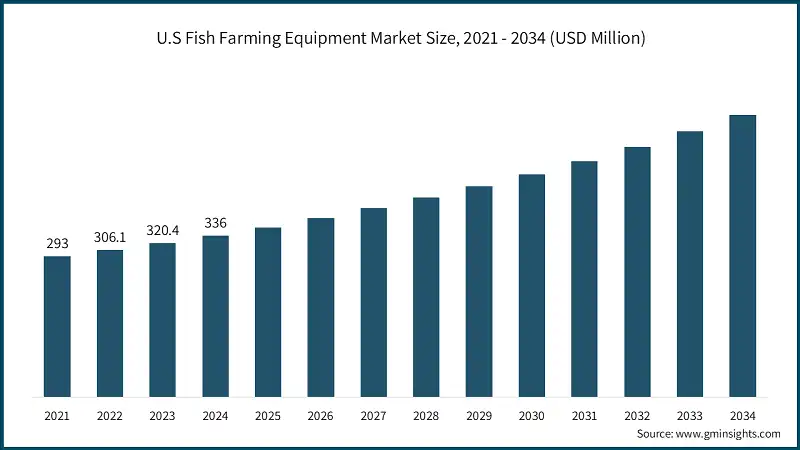
In 2024, the U.S. contributed significantly to the fish farming equipment market growth in North America, accounting for 59.2% share.
- The fish farming equipment industry in the U.S. is characterized by a transition towards sustainability practices, accompanied by the growing demand for seafood. The market is characterized by the development of automated and sensor-based monitoring equipment.
- According to the USDA, NASS 2023 Census of Aquaculture, total sales of U.S. aquaculture products increased to USD 1.908 billion (more than $1.964 billion in 2024 dollars), reporting 3,453 aquaculture farms in the U.S. In 2023, about 50% of the aquaculture farms were in the southeastern region of the U.S., with Florida recording the second-highest number of aquaculture farms.
North America is a significant contributor to the fish farming equipment market, valued at USD 567.3 million in 2024, driven by sustainable practices and technological innovation.
- There are increasing investments in both offshore and land-based fish farming operations. Government and private funding back sustainable projects. Shellfish and finfish farming is expanding, especially in coastal areas and regions with suitable water bodies.
- The aquaculture industry in North America in characterized by finfish production, which is dominated by salmon and catfish, and shellfish production, primarily of oysters, mussels and clams. Culture methods include marine net-pens for salmon, freshwater ponds for channel catfish, and a variety of on and off-bottom techniques for shellfish.
Asia Pacific is the largest and fastest-growing region in the fish farming equipment market, growing at the CAGR of 5.7%.
- The growing population and cultural preferences drive the demand for seafood consumption. Shrimp, carp, tilapia, and other freshwater species are prevalent, and marine aquaculture development is increasing.
- According to the Food and Agriculture Organization, in 2023, Asia accounted for 167.1 million tonnes of global fisheries and aquaculture production, 75% of the global total production and leading all other regions by producing 70% of the total global aquatic animals and 97% of global algae.
Fish Farming Equipment Market Share
- The top companies in the fish farming equipment industry include AKVA Group, Morenot, Grundfos Holding A/S, PentairAES, and Xylem, collectively hold an approximately 15-20% share in the market. These prominent players are proactively involved in strategic endeavors, such as mergers & acquisitions, facility expansions & collaborations, to expand their product portfolios, extend their reach to a broad customer base, and strengthen their market position.
- The fish farming equipment market is fragmented, featuring a combination of global leaders, regional companies, and emerging startups. Competition focuses on technology, cost, sustainability, and customization for different aquaculture methods.
- Pentair offers improved aeration, filtration, and water treatment systems designed for aquaculture. Xylem Inc provides water management solutions, such as pumps and aeration systems.
Fish Farming Equipment Market Companies
Major players operating in the global market are:
- ABB
- AKVA Group
- Asakua
- CPI Equipment
- eWater Aquaculture Equipment Technology Limited
- Frea Aquaculture Solutions
- Grundfos Holding A/S
- Innovasea
- INVE Aquaculture
- LINN Gerätebau
- Merck & Co. Inc.
- Morenot
- PentairAES
- Pioneer Group
- Xylem
ABB is a global leader in power and automation technologies. It offers a variety of solutions across different industries, including aquaculture. ABB is recognized for its electrical, automation, and robotics solutions, yet its role in fish farming equipment focuses on automation, water quality management, and energy-efficient systems.
AKVA Group is a supplier of technology and services for the fish farming industry, focused on fish farming equipment. The company offers fish cage systems & pens, and net systems designed for offshore, onshore, and land-based fish farming. The company also offers automated feeding solutions to improve feed efficiency and decrease waste.
Fish Farming Equipment Market Report Attributes
| Key Takeaway | Details |
|---|---|
| Market Size & Growth | |
| Base Year | 2024 |
| Market Size in 2024 | USD 2.8 Billion |
| Forecast Period 2025 - 2034 CAGR | 5.5% |
| Market Size in 2034 | USD 4.8 Billion |
| Key Market Trends | |
| Drivers | Impact |
| Growing demand for seafood | The growing human population and expanding middle class in many regions are increasing the demand for seafood, making aquaculture an essential source of seafood supply. |
| Rising investments in fish farming | Government policies and financial incentives support aquaculture development and encourage investment in innovative technologies. |
| Technological advancements | Improvements in automation, sensor technology, and data analysis are enhancing the efficiency and productivity of fish farms. |
| Pitfalls & Challenges | Impact |
| High capital and operating costs | High capital investment is required to set up modern aquaculture systems, creating a major barrier, especially for small-scale farmers or in developing regions. |
| Slow adoption rate of innovative technologies | The slow adoption of innovative technologies, due to resistance to change among traditional fish farmers, can hinder the market growth. |
| Opportunities | Impact |
| Expansion in emerging markets | Countries in Asia-Pacific, Africa, and Latin America are growing their aquaculture industries, driving the need for affordable and scalable fish farming equipment. |
| Increasing investment and policy support | Governments around the world are encouraging aquaculture with policies, grants, and infrastructure development to secure food supplies. Public-private partnerships and international funding create new opportunities for equipment suppliers. |
| Market Leaders (2024) | |
| Market Leader |
|
| Top Players |
Collective market share in 2024 is 17.6% |
| Competitive Edge |
|
| Regional Insights | |
| Largest Market | Asia-Pacific |
| Fastest growing market | Asia-Pacific |
| Emerging countries | UAE, US, Canada |
| Future outlook |
|
What are the growth opportunities in this market?
Fish Farming Equipment Industry News
- In May 2025, Guoxin Development Group launched an improved deep-sea aquaculture vessel with 150,000-metric-ton (MT) capacity. It features the 100,000 MT Guoxin 1 model including six more aquaculture compartments, a 16,000-cubic-meter increase to its water-holding capacity, and a solar photovoltaic system.
- In June 2025, Mexico launches global center for applied aquaculture innovation, the Center for Applied Aquaculture Innovation, offering state-of-the-art facilities including laboratories, hatchery, technology, and open-ocean projects.
- In April 2025, Kawasaki Heavy Industries Ltd developed a sustainable aquaculture system focused on reinforcing food security.
- In October 2024, Deep Trekker and Underwater Contracting Ltd announced the global partnership to advance aquaculture operations.
The fish farming equipment market research report includes in-depth coverage of the industry with estimates & forecast in terms of revenue (USD Billion) and volume (Thousand Units) from 2021 to 2034, for the following segments:
Market, By Equipment Type
- Water treatment systems
- Aerators
- Pumps
- Filtration systems
- UV sterilizers
- Monitoring and control systems
- Cleaning and waste management
- Harvesting and grading equipment
- Cage systems and pens
- Others
Market, By Fish Type
- Salmon
- Catfish
- Trout
- Carp
- Others
Market, By Application
- Freshwater
- Marine/Seawater
Market, By End Use
- Commercial fish farms
- Research & academic institutes
- Government fisheries
- Small-scale farms
The above information is provided for the following regions and countries:
- North America
- U.S.
- Canada
- Europe
- Germany
- UK
- France
- Spain
- Italy
- Asia Pacific
- China
- Japan
- India
- Australia
- South Korea
- Latin America
- Brazil
- Mexico
- Argentina
- MEA
- South Africa
- Saudi Arabia
- UAE
Frequently Asked Question(FAQ) :
What is the market size of the fish farming equipment market in 2024?
The market size was USD 2.8 billion in 2024, with a CAGR of 5.5% expected through 2034 driven by growing seafood demand and sustainable aquaculture practices.
What is the projected value of the fish farming equipment industry by 2034?
The market for fish farming equipment is expected to reach USD 4.8 billion by 2034, supported by innovations in automation, biosecurity, and offshore farming systems.
How much revenue did the cage systems and pens segment generate in 2024?
Cage systems and pens generated USD 769.5 million in 2024.
What was the valuation of the marine/seawater application segment in 2024?
The marine/seawater segment held 58.3% share and generated USD 1.6 billion in 2024.
What is the growth outlook for the Asia-Pacific region from 2025 to 2034?
Asia-Pacific is projected to grow at a 5.7% CAGR through 2034. The growth is driven by expanding aquaculture operations, rising seafood consumption, and strong government support in countries like China, India, and Vietnam.
What are the upcoming trends in the fish farming equipment market?
Key trends include adoption of smart aquaculture systems, use of IoT sensors and automation, and the shift toward Recirculating Aquaculture Systems (RAS) for eco-efficiency.
Who are the key players in the fish farming equipment industry?
Key players include AKVA Group, Morenot, Grundfos Holding A/S, PentairAES, Pioneer Group, Xylem, ABB, Innovasea, LINN Gerätebau, and CPI Equipment.
Fish Farming Equipment Market Scope
Related Reports