Summary
Table of Content

Fire Truck Market
Get a free sample of this report
Form submitted successfully!
Error submitting form. Please try again.
Thank you!
Your inquiry has been received. Our team will reach out to you with the required details via email. To ensure that you don't miss their response, kindly remember to check your spam folder as well!
Request Sectional Data
Thank you!
Your inquiry has been received. Our team will reach out to you with the required details via email. To ensure that you don't miss their response, kindly remember to check your spam folder as well!
Form submitted successfully!
Error submitting form. Please try again.
Fire Truck Market Size
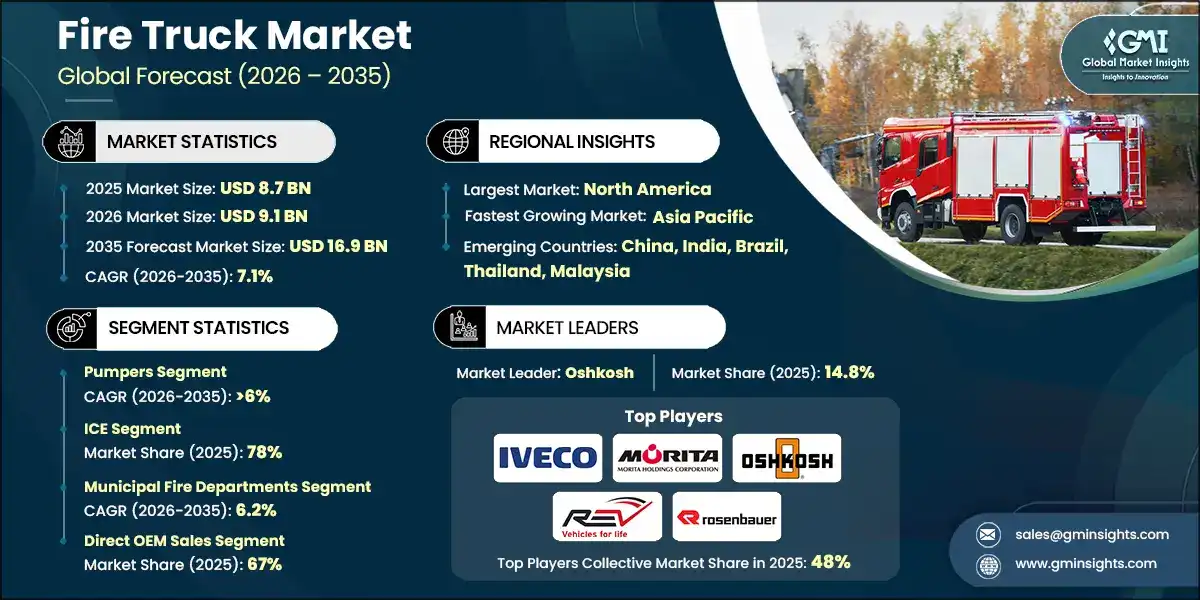
The global fire truck market was valued at USD 8.7 billion in 2025. The market is expected to grow from USD 9.1 billion in 2026 to USD 16.9 billion in 2035, at a CAGR of 7.1%, according to latest report published by Global Market Insights Inc.
To get key market trends
With rapid urban growth, the number of buildings generating increased fire risk and requiring advance emergency response vehicle fleets is growing equally fast. Many municipalities and commercial/industrial areas have invested heavily in new fire apparatus to protect their growing populations, tall buildings, and complex industrial processes.
Authorities are forced to invest in new vehicles to comply with enhanced safety codes and environmental regulations. As such, many fire departments must replace outdated and unsafe vehicles with new apparatuses that is compliant with modern emissions, safety, and performance standards. To meet current and future needs, fire departments are upgrading to more capable fire apparatus, which includes upgraded pumps, greater ladder reach, and improved environmental controls. For instance, Europe’s transition toward Euro VII emission standards by July 2025 accelerated interest in lower?emission fire truck models.
Many fire agencies still operate vehicles that are well beyond their useful life cycle; therefore, fire departments regularly replace aging vehicles. The advantages of upgrading from an outdated to a modern fire apparatus include improved operational reliability, safety, and technology integration, as well as better risk management for the communities they serve. For instance, In August 2024, Watertown, NY, received a modern pumper, replacing a 28?year?old unit.
fire agencies are exploring new technology, such as telematics, AI, improved pumps, and electric vehicles. These technologies improve operational performance and increase fire fighter safety. Fire departments are adopting these technologies to increase mission capability, operational efficiency, and situational awareness.
Fire Truck Market Report Attributes
| Key Takeaway | Details |
|---|---|
| Market Size & Growth | |
| Base Year | 2025 |
| Market Size in 2025 | USD 8.7 Billion |
| Market Size in 2026 | USD 9.1 Billion |
| Forecast Period 2026 - 2035 CAGR | 7.1% |
| Market Size in 2035 | USD 16.9 Billion |
| Key Market Trends | |
| Drivers | Impact |
| Urbanization & infrastructure expansion | Increases demand for firefighting fleets in growing cities. |
| Stringent fire safety regulations | Forces governments and industries to upgrade or expand fire truck fleets. |
| Fleet modernization & replacement cycles | Boosts new vehicle sales and OEM revenue. |
| Technological advancements in firefighting equipment | Enhance efficiency, safety, and operational capability. |
| Pitfalls & Challenges | Impact |
| High vehicle & maintenance costs | Limits procurement by budget-constrained buyers. |
| Long OEM lead times & budget constraints | Slows fleet expansion and delays delivery schedules. |
| Opportunities: | Impact |
| Electrification & hybrid fire trucks | Opens new market segments for eco-friendly vehicles. |
| Airport & industrial firefighting demand | Drives adoption of specialized high-capacity fire trucks. |
| Telemetry & telematics integration | Enables predictive maintenance and fleet optimization. |
| Aftermarket upgrades & retrofitting | Creating recurring revenue streams beyond new truck sales. |
| Market Leaders (2025) | |
| Market Leaders |
14.8 % market share |
| Top Players |
|
| Competitive Edge |
|
| Regional Insights | |
| Largest Market | North America |
| Fastest growing market | Asia Pacific |
| Emerging countries | China, India, Brazil, Thailand, Malaysia |
| Future outlook |
|
What are the growth opportunities in this market?
Fire Truck Market Trends
The transition to electric and hybrid fire trucks aligns with changing emissions reduction goals, as well as growing demand for more sustainable fleets. They demonstrate a quieter operation, reduced lifetime emissions, and compliance with stricter environmental policies, although upfront costs are still significant. For instance, in January 2024, the Mesa Fire Department received its new E-ONE Vector electric fire truck.
The development of connected fire trucks utilizing Internet of Things (IoT) sensors and telematics creates new opportunities for real-time monitoring, predictive maintenance, GPS tracking, and performance analytics. These capabilities will reduce the time fire trucks are out of service, which will, in turn, help improve overall fleet efficiency and safety.
Modular chassis and bodies allow for the creation of customized configurations based upon operational purposes, i.e., urban, industrial, airport, and wildland. This is enabling departments to create optimal equipment configurations for specific mission requirements, thus allowing customization time to be shortened.
Demand is rising for specialty fire trucks configured for specific applications such as airports, industrial complexes, and wildland-urban interface areas. Specialty units often possess increased foam capability, extended aerial reach and better durability than standard firefighting apparatus. As part of ongoing safety and certification upgrades to comply with new Federal Aviation Administration (FAA) regulations, many international airports ordered ARFF vehicles in 2024-2025. Currently, over 200 international airports have made commitments to upgrade their ARFF fleet.
Fire Truck Market Analysis
Learn more about the key segments shaping this market
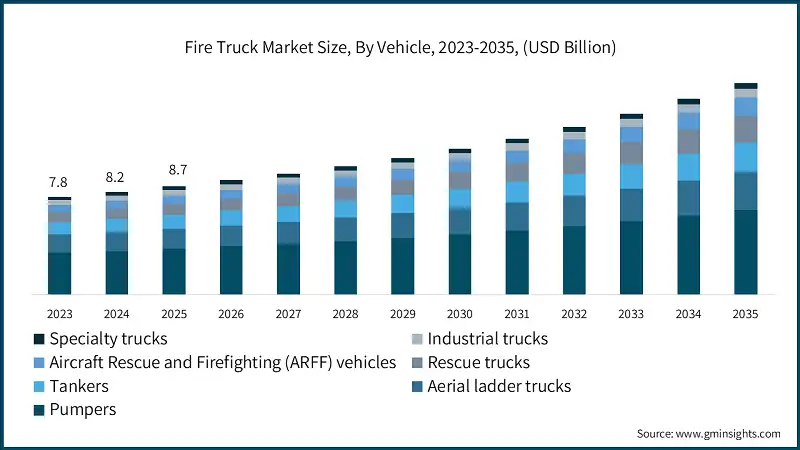
Based on vehicle, the market is divided into pumpers, aerial ladder trucks, tankers, rescue trucks, aircraft rescue and firefighting (ARFF) vehicles, industrial trucks and specialty trucks. The pumpers segment accounted for over 43% share in 2025 and is expected to grow at a CAGR of over 6% through 2026 to 2035.
- Pumpers are dominating with the introduction of higher-capacity pumps, more efficient engines and efficient maneuverability for urban firefighting. Smart sensors and telematics allow for the real-time monitoring of water flow and system performance. The modernization of fleets is driving a large demand for the replacement of older equipment, and the need for economic, flexible solutions is driving emerging markets to seek new pumper options.
- Aerial ladders have come equipped with longer-reaching ladders, lightweight materials, hybrid or electric drive options and enhanced control systems & stabilized platforms, all of which enhance the safety of firefighters and increase the possibility of precision fire operations. The growing trend of urbanization and the number of high-rise buildings being constructed around the world has created an increasing demand for advanced, modular, custom-configurable ladder trucks.
- Tankers are trending toward larger volumes of water and foam to allow for support of rural, industrial and wildfire activity, in addition to using telematics technology to optimize routing and manage water supply. Lightweight chassis in addition to modular designs allows for greater maneuverability of tankers, while electric vehicle trials are being conducted to meet the environmental standards associated with the municipal and industrial fleets.
- Rescue trucks are focusing on multifunctional designs, incorporating hydraulic tools, high-tech stabilization systems and advanced medical support systems, which allow for improved readiness and predictive maintenance. With the frequency of natural disasters increasing, as well as the need for urgent assistance from both industrial and urban situations, there is increasing demand for highly specialized, adaptable, and technologically integrated rescue vehicles.
Learn more about the key segments shaping this market
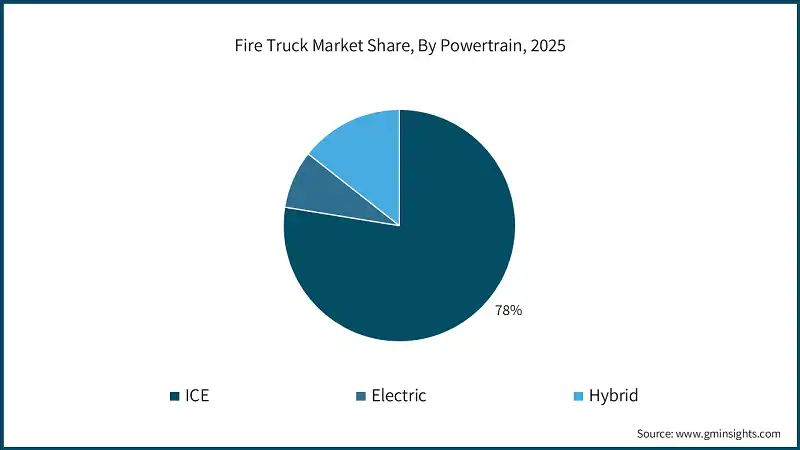
Based on powertrain, the fire truck market is segmented into ICE, electric and hybrid. The ICE segment dominates the market with 78% share in 2025 and is expected to grow at a CAGR of 6.6% from 2026 to 2035.
- ICE fire trucks dominate world markets due to current technology, dependable support chain, and universal availability of distributed fuel. The availability of diesel engines with high torque allows for powering heavy fire-fighting equipment over long periods and distances. To comply with environmental policies, new telematics and emissions control was added within ICE fire trucks. Urban growth and fleet replacement have created a substantial demand for ICE fire trucks.
- Electric fire trucks are entering the fire truck market to decrease emissions, decrease noise, decrease cybernetic upkeep cost, all aligning with corporate objectives of sustainability. Electric fire trucks use battery-powered drivetrains that provide less noisy operation and lower lifetime costs of cybernetic upkeep than ICE fire trucks; however, charging platforms and range distance continue to be obstacles.
- Hybrid fire trucks are equipped with an ICE engine in combination with electric motors to provide improved fuel economy through increased efficiency, providing operational flexibility in environmentally sensitive areas. They offer operational flexibility in urban routes and environmentally sensitive areas. Several municipalities in North America and Europe deployed hybrid units in 2024–2025, balancing sustainability with reliability.
Based on application, fire truck market is segmented into municipal fire departments, airport fire services, industrial fire services, wildfire management and others. The municipal fire departments segment dominates the market with 49% share in 2025 and is expected to grow at a CAGR of 6.2% from 2026 to 2035.
- Municipal Fire Departments are the largest segment of municipal end-users due to urbanization and increased population growth along with the need to replace an aging fleet. Municipal Fire Departments is mainly for pumpers, aerial ladders and rescue trucks which have enhanced safety and communication systems. There are multiple criteria driving purchasing cycles and technology adoptions, including budgetary allocations, public bid processes, and regulatory compliance.
- Airport Fire Services use specialized ARFF vehicles that are designed specifically for the needs of airports. These vehicles are characterized by high foam capacity, rapid acceleration and excellent off-road performance. The growth of Airport Fire Services is reflective of the need as airports continue to expand, air traffic is increasing, and aviation industry’s safety standards are becoming more regulated. To remain environmentally sustainable, Electric and Hybrid ARFF Vehicles are gaining featured in industry visibility.
- Industrial Fire Services are used in high-risk energy producing facilities, such as Oil and Gas, Chemical processing facilities, Power Generation Stations and Refineries. The users of Industrial Fire Vehicles typically have specific requirements for these trucks, including substantial water and foam capacities, hazardous material response capabilities, and explosion-resistant functionality. Demand resulting from Industrial Safety Regulations and Asset Protection strategies are the primary factors creating ongoing demand for Industrial Fire Vehicles.
- Wildfire Management Agencies use rugged, off-road type fire trucks that can operate effectively in remote and difficult-to-access terrains. Wildfire Management Agencies are experiencing increasing demand for fire vehicle products due to climate change and increasing incidents of Wildfires and Extended Fire Seasons, requiring the use of Lightweight Tankers, Brush Trucks and High-Capacity Water Carriers as critical-response tools for the rapid response and effective control of Wildfires.
Based on sales channel, the market is segmented into direct OEM sales and authorized dealers/ distributors. The direct OEM sales segment dominates the market with a share of 67% in 2025.
- The fire truck market is driven by OEM Sales, by providing customized fire trucks with features like advanced telematics and safety features, as well as alternative powertrains. Large municipal and airport buyers want to deal directly with the OEM to ensure that they comply with the required technical specifications, regulatory standards, and their long-term fleet strategy.
- OEMs have entered into multi-year framework agreements (contracts) with governments and large institutions to create stable order pipelines. This type of agreement also reduces procurement risk; it allows for a more streamlined process for tendering; and it helps support fleet modernization efforts while providing OEMs with the ability to effectively plan their production capacity.
- Authorized dealers are beginning to expand their regional footprint to offer faster delivery times, localized customization, and onsite maintenance. The need to expand their footprint is particularly strong in emerging markets, where the presence of a dealer will help those dealers navigate the associated regulatory requirements, financing practices, and the availability of after-sales support, thereby creating a more relevant dealer in the local market and accelerating their penetration into the market.
- Authorized dealers are becoming more focused on aftermarket services, including the retrofitting, refurbishing, and technology updating of vehicles otherwise utilized by fire departments, as fire departments are extending the vehicle's life cycle due to cost concerns. Therefore, the dealers have a growing revenue source associated with the contracts they write with fire departments, parts supply, and performance optimization services for fire truck fleets.
Looking for region specific data?
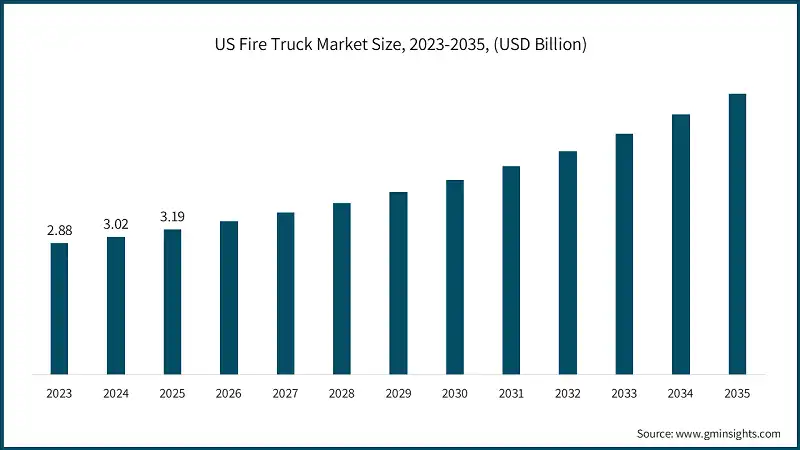
The U.S. fire truck market reached USD 3.19 billion in 2025, growing from USD 3.02 billion in 2024.
- Aging fleets of vehicles provide inadequate safety for today's firefighters due to outdated technology, rising maintenance costs, and other pressing concerns. Fire departments across the country are addressing this issue through both state and federal funding programs that support the purchase of modern pumper trucks, aerial ladder trucks and rescue vehicles.
- As a result, replacement cycles for these vital emergency response vehicles are accelerating with an increased emphasis on reliability, firefighter safety and meeting or exceeding updated NFPA (National Fire Protection Association) standards.
- Several municipalities in the US are piloting electric and hybrid fire trucks as part of overall sustainability and emission reductions. The most active jurisdictions are in urban areas, where fire department routes are typically predictable and charging infrastructure is available. Although currently low in volume, early successes are contributing to increasing interest in additional electrification of US fire fleets over the next ten years.
- US fire departments adopt telematics, vehicle diagnostics, and digital fleet management systems, the efficiencies gained in these technologies will enable improved response times, accurate predictive maintenance and better use of assets. Increasingly, OEMs (original equipment manufacturers) are promoting telematics and connected solutions for fire departments as standard features. This enables departments to leverage data better for decision-making and realize greater long-term cost savings.
North America dominated the fire truck market with USD 3.86 billion in 2025.
- Customized fire apparatus manufactured specifically based on end-user performance requirements are a hallmark of North American fire departments. Nearly all departments are requesting the addition or modification of equipment configurations/bodies, equipment mounting layouts, safety enhancements, etc. Fire truck manufacturers (OEM) and their dealers benefit from this trend through their ability to offer flexible manufacturing options, modular designs and close cooperation with fire departments in developing specifications during the purchase process.
- The increase in wildfires occurring in Canada and the US has led to an increased demand for wildland/wildland-urban interface (WUI) fire trucks. Light-weight, high-capacity water-carrying, off-road vehicles are being procured more often to assist with immediate response to fires in rural areas and areas of higher wildfire risk.
- Additionally, many authorized fire truck dealers throughout North America are expanding their aftermarket services to provide refurbishment, retrofitting and technology upgrade services. Due to budgetary constraints, many fire departments are extending the life span of their apparatus by utilizing dealer provided maintenance contracts and upgrading that enhances their performance.
Europe fire truck market accounted for a share of 29.6% and generated revenue of USD 2.57 billion in 2025 and is anticipated to show lucrative growth over the forecast period.
- To meet climate-smart goals, European fire services are rolling out low-emission & alternative fuel fire trucks, including hybrid and electric vehicles in addition to new fire truck models. Urban areas are proving to be the primary market for hybrid and electric models.
- Aerial Ladder/Platform vehicles are also on the rise and will see rapid growth with urbanization and high-rise construction. Urban areas have many vertical structures that are compact but need high reach for fire operations in narrow streets; this demand creates new opportunities for high-tech materials and stabilization systems.
- EC harmonized regulations and standards for public safety and firefighting create opportunities for cross-border procurement and standard vehicle specifications throughout Europe. The consistent development and manufacturing by OEMs from all over Europe benefits have enabled them to operate with Pan-European manufacturing and distribution networks.
Germany dominates the fire truck market, showcasing strong growth potential, with a CAGR of 6.7% from 2026 to 2035.
- Germany is considered the leader of high-tech development in aerial ladder/turntable fire trucks. Fire Services want fire trucks with superior performance, advanced automation/safety control systems, and precision engineering. the current high domestic demand in Germany allows German OEMs to continue to supply their technologically advanced fire apparatus to the global market.
- Germany has an Established Industrial Base and is driving the demand for specialized fire trucks for chemical plants, manufacturing, and logistics hubs for these facilities. As a result of increasing Subsidies and environmental policies, municipalities in Germany were initially at the forefront of electric fire truck implementation. demonstration projects are proving the performance and reliability as well as the life cycle cost savings of electric vehicles.
- German municipalities are among early adopters of electric fire trucks, supported by government incentives and environmental policies. Pilot projects in urban areas are validating performance, reliability, and lifecycle cost benefits of electric firefighting vehicles.
The Asia Pacific market is anticipated to grow at the highest CAGR of 8.8% from 2026 to 2035.
- As APAC's urban areas grow due to fast-paced development, the municipal fire truck market is also starting to expand due to increased investment from the local and national governments in modern firefighting infrastructure to protect the rapidly growing cities, commercial zones, transportation networks.
- Airport expansion and industrial development are increasing demand for ARFF and industrial fire trucks. Countries across APAC are upgrading emergency response capabilities to meet international safety standards and protect critical infrastructure.
- OEMs increasingly rely on authorized dealers and distributors across APAC to manage sales, customization and after-sales support. Local partnerships are essential for navigating regulations, financing, and service requirements in diverse regional markets.
China fire truck market is estimated to grow with a CAGR of 9.2% from 2026 to 2035.
- China is investing in building fire safety infrastructure as a component of the growth of cities and industries. Central/local governments drive the purchase of municipal and industrial fire trucks through large-scale procurement.
- Local manufacturers compete with lower prices by producing fire trucks that meet the local requirements and delivering an equal standard of quality. Increased technological capabilities and support from the government continue to build the domestic ecosystem for fire apparatus in China.
- The rapid expansion of the petrochemical, manufacturing, and logistics industries has created significant demand for high-capacity industrial fire trucks. All types of specialized vehicles with foam systems and capabilities for handling hazardous materials are being utilized increasingly.
Latin America fire truck market shows lucrative growth over the forecast period.
- In LATAM, countries are replacing and modernizing fire trucks due to the large number of aging fleets within their borders. Municipalities and the government are investing in new pumps (whose sole purpose is to pump water) as well as tankers, and rescue vehicles.
- There is a huge reliance on international OEMs and imported fire trucks because many LATAM countries do not have a sufficient manufacturing base. Therefore, forming partnerships with these international suppliers and having dealers in-country to support them as they enter LATAM is a critical success factor for the development of this market.
- The dealers will continue to grow as they offer financial means to municipalities, provide maintenance services, and offer localized support to fire departments. As municipalities look for more cost-effective ways of purchasing their fire trucks, this is also driving the expansion of this dealer network.
Brazil fire truck market is estimated to grow with a CAGR of 3.2% from 2026 to 2035 and cross USD 189.3 million by 2035.
- Brazil is experiencing a huge increase in demand for specialized fire trucks due to new industrial hubs, port facilities, and energy installations, where they are focusing heavily on high-capacity foam systems and sturdy vehicles used for large-scale responses to industrial fires.
- There are many municipalities in Brazil still utilizing older fleets of fire trucks, but with funding being made available, municipalities will begin strategically replacing their older fleets with new pumpers and rescue vehicles that can be utilized in urban and semi-urban settings.
- By utilizing local assembly and customization processes, OEMs are reducing costs and lead times, consequently improving access to the market and enhancing domestic supply chains.
The Middle East and Africa fire truck market accounted for USD 341.5 million in 2025 and is anticipated to show lucrative growth over the forecast period.
- The oil, gas, and petrochemical industry in the MEA region have created huge demand for industrial fire trucks. These trucks provide critical protection to oil, gas, and petrochemical industries due to their high water and foam capacity.
- The expansion and construction of airports in the MEA region have generated demand for ARFF vehicles as airports must comply with international aviation safety standards and regulations
- Firefighters in the MEA region need rugged, high-capacity vehicles that will perform well in extreme heat and rugged terrain. Durability and reliability are the most important factors fire departments are looking for when purchasing these vehicles.
Saudi Arabia market is expected to experience substantial growth in the Middle East and Africa market, with a CAGR of 3.3% from 2026 to 2035.
- Saudi Arabia's Vision 2030 are driving large amounts of investment in fire safety and infrastructure for urban, industrial and transportation developments, which creates a high demand for advanced fire trucks.
- High capacity ARFF and industrial fire trucks make up the majority of the purchases made by the oil and gas industry, refineries and airports for specialized vehicles.
- Firefighters in Saudi Arabia are now beginning to purchase more technologically advanced fire trucks equipped with telematics, automated functions, and advanced safety features to help improve operational efficiency and readiness in emergency situations.
Fire Truck Market Share
- The top 7 companies in the fire truck industry are Oshkosh, REV, Rosenbauer, Morita, IVECO, Ziegler and Bronto Skylift contributing 53% of the market in 2025.
- Oshkosh has a projected 2025 share of 14.8%, benefitting from Pierce Manufacturing's dominant presence in the U.S. market for both municipal pumpers and aerials. The Striker ARFF platform enhances Oshkosh's penetration into the North American airport sector. Oshkosh has built its leadership position through years of strong customer relationships along with innovation in the development of hybrid powertrains, custom chassis, comprehensive safety systems, and an extensive dealer and after-sales support network.
- REV is famous for their E-ONE and Ferrara brands, ambulance and specialty vehicles. E-ONE is established as the leader in the U.S. municipal and industrial market for aerial ladder and pumper trucks while Ferrara provides customization and very competitive pricing. The multi-brand strategy provides diversification of revenues and increased efficiency in manufacturing although integrating acquired brands presents challenges.
- Rosenbauer, an Austrian company focuses on providing RT electric fire trucks with premium quality and made-to-order customization. The ARFF and industrial segments of their business compete worldwide with their European success. This is the result of a strong reputation across the industry, a large dealer network, and conformity with regulatory and operational requirements.
- Morita is focused on Japan as well as expanding ARFF and municipal markets throughout the Asia-Pacific region. In addition to its ARFF operations at major airports worldwide, Morita's acquisition of Bronto Skylift allows it to be more competitive in aerial ladder operations in Europe. Although Morita has gained recognition for its engineering excellence and product quality, the company's international expansion is slower than that of most Western competitors except for its core business in ARFF.
- IVECO via Magirus is leading due to its strong presence in Europe (especially Germany and Italy) and its ongoing export activity. IVECO-Magirus is renowned for providing complete fire station solutions, as well as producing pumpers, aerial trucks, ARFF vehicles, and specialized apparatus. Its advanced rotary aerials and cost-effective pricing combined with high-quality commercial truck chassis make it very competitive in both established and emerging fire service markets.
- Ziegler operates as an independent German manufacturer specializing in rescue vehicles, ARFF vehicles, and customized firefighting solutions. With a focus on engineering excellence and customer-oriented vehicle design, Ziegler produces vehicles with precise specifications to meet individual operational needs. Ziegler's airport ARFF vehicles are supplied to many major international airports, including installations throughout the Middle East, Asia, and Europe.
Fire Truck Market Companies
Major players operating in the fire truck industry are:
- Bronto Skylift
- HME Ahrens
- IVECO (Magirus)
- KME Fire Apparatus
- Metz Fire & Rescue
- Morita
- Oshkosh
- REV
- Rosenbauer
- Ziegler
- Oshkosh and Rosenbauer lead globally as both are dominant players. Through its Pierce Manufacturing subsidiary, Oshkosh dominates the North American municipal pumpers and aerial ladder segments, with strong ARFF presence from its Striker platform; this is achieved with hybrid powertrains, custom chassis, and advanced integrated safety systems, as well as an extensive network of dealers and after-sales support. Conversely, Rosenbauer's focus is on developing innovative technology through its RT electric fire truck platform, premium quality build, and customization options to meet unique customer needs for industrial and airport fire-fighting sectors around the world.
- The REV and Morita have developed multi-branded strategies that have enabled both to gain significant shares of the fire truck market. REV's E-ONE and Ferrara brand fire trucks provide U.S. municipalities, as well as industrial and aerial segments with competitively pricing, custom build-ups, along with a shared manufacturing and parts commonality, all of which support the production of high volume and low-cost units. Meanwhile, Morita’s market position in Japan is dominant, and expanding into the APAC region for both municipal and ARFF markets through the acquisition of Bronto Skylift for enhanced aerial ladder capabilities, combining strong engineering and manufacturing quality with a gradual expansion of Morita into international
markets. - IVECO (Magirus) and KME Fire Apparatus are well-known for their strong European and North American presence within fire truck market. IVECO’s Magirus brand brings to market turnkey fire station solutions, pumpers, aerial ladder trucks, ARFFs, and specialized apparatus using commercial truck chassis to allow for economical and efficient performance.
Fire Truck Industry News
- In February 2024, Rosenbauer International is expanding production of its Revolutionary Technology (RT) electric fire trucks in Austria as a response to increased demand within Europe. The company has secured orders from fire departments in Germany and the Netherlands for a total of 15 RT fire truck platforms.
- In January 2024, Pierce Manufacturing (Oshkosh) introduced the Next Generation Enforcer pumper chassis platform. The platform offers a new, redesigned chassis, improved ergonomics, improved crew and passenger safety and hybrid powertrain options. The Next Generation Enforcer is the highest-volume platform offered by Pierce, and its new design represents a monumental moment in the fire service industry.
- In December 2023, KME Fire Apparatus partnered with an electric vehicle manufacturer to create battery-electric chassis specifically for fire trucks used in municipalities. This partnership addresses the challenges associated with range and power limitations of electric fire trucks, as well as enhancing power management capabilities of a battery-electric fire truck.
- In November 2023, The Chinese government announced a five-year USD 2.5 billion program to upgrade provincial-level departments in western and central China. The focus of the program is to fund the purchase of new fire rescue equipment and provide training for personnel in the use of this equipment, and it is expected that only domestic manufacturers will be able to capture the majority of the procurement volume because of this program.
The fire truck market research report includes in-depth coverage of the industry with estimates & forecasts in terms of revenue ($ Mn/Bn) and shipments (units) from 2022 to 2035, for the following segments:
Market, By Vehicle
- Pumpers
- Aerial ladder trucks
- Tankers
- Rescue trucks
- Aircraft Rescue and firefighting (ARFF) vehicles
- Industrial trucks
- Specialty trucks
Market, By Powertrain
- ICE
- Electric
- Hybrid
Market, By Application
- Municipal fire departments
- Airport fire services
- Industrial fire services
- Wildfire management
- Others
Market, By Capacity
- Below 1,000 gallons
- 1,000–2,000 gallons
- Above 2,000 gallons
Market, By Sales channel
- Direct OEM sales
- Authorized dealers / distributors
The above information is provided for the following regions and countries:
- North America
- US
- Canada
- Europe
- Germany
- UK
- France
- Italy
- Spain
- Russia
- Nordics
- Poland
- Romania
- Asia Pacific
- China
- India
- Japan
- South Korea
- ANZ
- Vietnam
- Indonesia
- Latin America
- Brazil
- Mexico
- Argentina
- MEA
- South Africa
- Saudi Arabia
- UAE
Frequently Asked Question(FAQ) :
Who are the key players in the fire truck market?
Key players include Bronto Skylift, HME Ahrens, IVECO (Magirus), KME Fire Apparatus, Metz Fire & Rescue, Morita, Oshkosh, REV, Rosenbauer, and Ziegler.
What are the key trends in the fire truck market?
Key trends include fleet modernization, adoption of advanced telematics, integration of emissions control systems, and the development of alternative powertrains.
What was the market share of the ICE segment in 2025?
The ICE segment held a 78% market share in 2025, supported by established technology, reliable fuel availability, and compliance with environmental policies.
What is the growth outlook for the municipal fire departments segment from 2026 to 2035?
The municipal fire departments segment is projected to grow at a CAGR of 6.2% through 2035, driven by urbanization, population growth, and the need to replace aging fleets.
Which sales channel leads the fire truck market?
Direct OEM sales dominate the market with a 67% share in 2025, as buyers prefer customized solutions and direct dealings with OEMs to meet technical and regulatory requirements.
How much revenue did the pumpers segment generate in 2025?
The pumpers segment accounted for over 43% of the market share in 2025, driven by advancements in pump capacity, engine efficiency, and urban firefighting needs.
What is the current fire truck market size in 2026?
The market size is projected to reach USD 9.1 billion in 2026.
What is the projected value of the fire truck market by 2035?
The fire truck market is expected to reach USD 16.9 billion by 2035, propelled by urbanization, fleet modernization, and advancements in firefighting technologies.
What was the market size of the fire truck 2025?
The market size was USD 8.7 billion in 2025, with a CAGR of 7.1% expected from 2026 to 2035, driven by increasing demand for firefighting fleets in urban areas.
Fire Truck Market Scope
Related Reports