Summary
Table of Content

Finishing Chemicals Market
Get a free sample of this report
Form submitted successfully!
Error submitting form. Please try again.
Thank you!
Your inquiry has been received. Our team will reach out to you with the required details via email. To ensure that you don't miss their response, kindly remember to check your spam folder as well!
Request Sectional Data
Thank you!
Your inquiry has been received. Our team will reach out to you with the required details via email. To ensure that you don't miss their response, kindly remember to check your spam folder as well!
Form submitted successfully!
Error submitting form. Please try again.
Finishing Chemicals Market Size
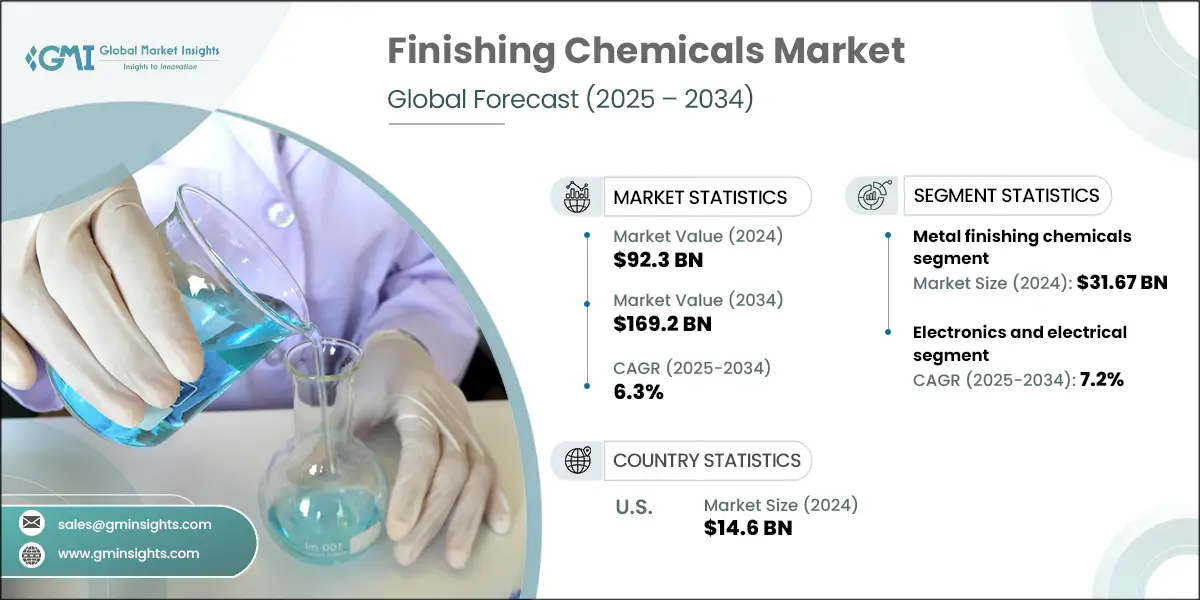
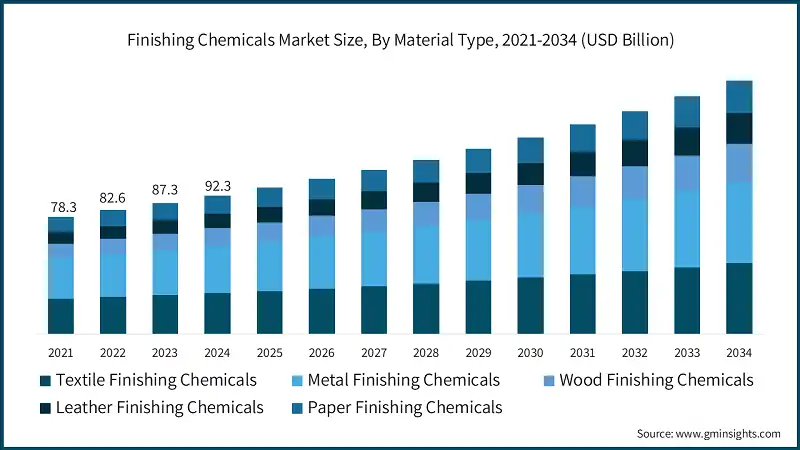
The global finishing chemicals market was valued at USD 92.3 billion in 2024. The market is expected to grow from USD 97.6 billion in 2025 to USD 169.2 billion in 2034, at a CAGR of 6.3%.
To get key market trends
- Finishing chemicals are likely to see steady yet diverse growth owing to the expansion of major end-use industries and increasing demand for high-performance surfaces for various applications. Advancement in technology, increased performance specifications, and the key driving point of sustainability are factors that support this growth.
- The automotive sector is the major growth driver for finishing chemicals, which are applied for corrosion resistance, wear, durability, and aesthetic properties of metals and textiles. The shift to lightweight material is fast becoming a norm in the automotive and aerospace sectors, and hence the demand is projected for advanced chemical treatments that can strengthen and protect surfaces of aluminum, magnesium, and technical textiles while not unduly compromising integrity and weight.
- Textile finishing chemicals enhance the appearance, handling, soiling, and wear resistance of fabrics while assisting in end-of-life scenarios like anti-bacterial, flame-retardant, or wrinkle-free properties for manufacturers to help address fast-changing consumer needs and demand for regulation.
- The Asia Pacific region has been considered one of the major regions for growth in finishing chemicals, driven by rapid industrialization and urbanization, coupled with development in automotive, electronics, and infrastructure, especially in both China and India.
- North America and Europe are significant markets mainly because of their established industrial base, focusing on improvement in quality and implementation of sustainable practices. Investment in doing research and development, digital transformations, and automation in manufacturing is generating huge momentum in the global reach towards new and customized finishing chemical solutions.
Finishing Chemicals Market Report Attributes
| Key Takeaway | Details |
|---|---|
| Market Size & Growth | |
| Base Year | 2024 |
| Market Size in 2024 | USD 92.3 billion |
| Forecast Period 2025 - 2034 CAGR | 6.3% |
| Market Size in 2034 | USD 169.2 billion |
| Key Market Trends | |
| Drivers | Impact |
| Rising demand from end-use industries such as automotive, electronics, aerospace, and construction | Heavily rely on finishing chemicals to improve durability, performance, and aesthetics. |
| Rising demand for high-performance & functional finishes | Encourages industries to shift towards greener binding solutions. |
| Shift towards sustainable and eco-friendly chemicals | Boosting demand for low-toxicity and biodegradable products that meet environmental standards, thereby positively impacting market growth despite compliance challenges. |
| Pitfalls & Challenges | Impact |
| Increasingly strict global environmental regulations | Slow product development cycles, increase operational expenditures, and create barriers for new entrants, affecting overall market growth rates. |
| Volatile raw material prices and supply chain disruptions | Lead to unpredictable production costs and margin pressure, particularly for price-sensitive segments. |
| Opportunities: | Impact |
| Expansion into emerging markets with growing eco-conscious consumer bases | Demand for finishing chemicals used in automotive plating, electrical components, and industrial machinery, presenting a substantial market opportunity. |
| Increasing adoption of bio-based, sustainable, and eco-friendly finishing chemicals | Growing environmental awareness and stringent regulations are accelerating the shift from traditional hazardous chemicals to greener alternatives. |
| Market Leaders (2024) | |
| Market Leaders |
15% Market Share |
| Top Players |
Collective market share in 2024 is Collective Market Share is 43% |
| Competitive Edge |
|
| Regional Insights | |
| Largest Market | Asia Pacific |
| Fastest growing market | Middle East and Africa |
| Emerging country | India, Brazil, Mexico, Indonesia, Vietnam |
| Future outlook |
|
What are the growth opportunities in this market?
Finishing Chemicals Market Trends
- The finishing chemicals industry has become a dynamic and challenging scenario as there is an increasing demand for more surface solutions that are intelligent, sustainable, and application-oriented by industries. The rising consumer expectations of functional apparel and technical textiles have increased the demand for the development of high-performance textile finishing chemicals such as UV protection, flame retardants, and antimicrobial finishes to be used across automotive interiors, aerospace, and home furnishings, among others.
- The different treatments are in high demand today; especially considered in home textiles and performance wear, water- and stain-repellent treatments enhance comfort with functionality.
- In the metal finishing segment, the focus is shifting towards conversion coatings, corrosion inhibitors, and advanced surface treatments applied toward construction, automotive, and electronics applications. As electric vehicles and high-efficiency electronics become more commonplace, these treatments assume critical importance in the long-term durability and performance requirements of under-the-hood components, PCBs, and semiconductor surfaces.
- Thus, construction and infrastructure projects increasingly demand fire-retardant and protective coatings that promote the safety of structures but also adhere to green building norms. Innovations in industrial coatings and sealers in this regard are driven by requirements for durability and energy efficiency in residential, commercial, and public infrastructure.
- The market is heading towards tailor-made, eco-conscious, and high-performance finishing solutions that will comply with shifting end-user requirements across different industries-from textiles and construction to electronics and packaging.
Finishing Chemicals Market Analysis
Learn more about the key segments shaping this market
The market by product type is segmented into textile finishing chemicals, metal finishing chemicals, wood finishing chemicals, leather finishing chemicals, paper finishing chemicals. Metal finishing chemicals generated USD 31.67 billion in 2024.
- Metal-finishing chemicals holds major share in market of their bearing on optimum protection and advancement of metal surfaces-metal corrosion resistance, smooth surface quality, and aesthetics. Significant industries such as automotive, aerospace, and electronics use these chemicals. The advanced plating solutions, rust inhibitors, and passivation agents are mainly selected on the grounds that they provide long-lasting protection and durability of metal components, thus fulfilling the stringent industry quality standards demanded by manufacturers efficiently.
- The demand for textile finishing chemicals increases with the need for soft, wrinkle-resistant, and durable fabrics. Most of the development advances are creating water-based and environmentally friendly coatings. To address environmental concerns with bio-based technology, leather finishing emphasizes the benefits of the leather's appearance, feel, and water resistance. This allows manufacturers of leather goods to match performance with green credentials.
- Wood finishing materials play a crucial role in pollution control as they elucidate the natural beauty of wood and provide protection against moisture and wear, as well as from pests, especially for furniture and construction applications. While paper finishing products enhance printability, surface smoothness, and durability of paper products, such as those necessary in the packaging and publishing industries.
Learn more about the key segments shaping this market
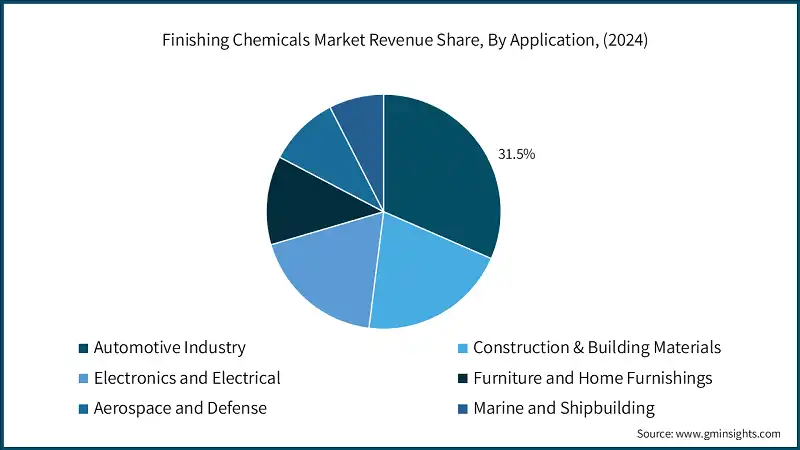
Based on application, the finishing chemicals market is segmented into automotive industry, construction & building materials, electronics and electrical, furniture and home furnishings, aerospace and defense, marine and shipbuilding. Electronics and electrical is growing at 7.2% CAGR.
- The finishing chemicals for the automotive industry are backed up by the constant demand for the impartation of durable and pleasing surfaces for performance or aesthetic visibility of any vehicle. Other than wear protection and color vision retention of metal and plastic components, these finishing chemicals provide corrosion resistance promoting light designs that can fuel efficiency. Therefore, as quickly as manufacturers dive into electric vehicles and advanced materials so have the finishing solutions started to evolve with greater demands for a higher level of customization.
- In building construction, basic light and heavy finishes may be an equally important concern in securing durability, weathering resistance, and good appearance for such construction building materials as metals, timber, concrete, and composites. This means that protective coatings, water repellents, and decorative finishes will prolong the life of the structure and support green trends in building. These solutions will benefit new constructions as well as renovations while lowering the maintenance cost and fulfilling various regulations concerning safety and environmental aspects.
- In the electronics and electrical industry to enhance the conductivity, corrosion resistance, and insulation of fragile components within systems. Finishing chemicals find a great application in the furniture and home furnishing products to impart surface protection and enlivening of texture and color, while doing so in an ecological manner. Finishing chemicals needed for the aerospace and defense segments are performance-based, spanning extreme environments, while further enhancing the life expectancy of components. Interestingly, like shipbuilding applications, these external coatings are saltwater-corrosion-resistant, resulting in the formation of a durably built vessel.
Based on end use industry, the finishing chemicals market is segmented into textiles and apparel, automotive and transportation, construction and infrastructure, electronics and semiconductors, packaging industry. Automotive and transportation leads the market in 2024 due to it’s ability of protection from corrosion resistance, wear, and environmental effects.
- Textile finishing chemicals have become key constituents in clothing products that come up with advanced characteristics, such as stain-proof, wrinkle-free, and comfort. It is these aspects that match the requirements of consumers regarding eco-friendly and water-based finishes that fit the sustainable quest of the consumers involved in this field. These have made sure that their products have high quality, long-lasting, and environmentally friendly characters, adapting to ever-changing trends and requirements for regulations.
- The finishing chemicals have a major contribution to the coatings that are prevalent in industries as things to mitigate corrosion, wear, and environmental ravage on parts of the automotive subject. Modern coatings and surface treatments could maximize the lifecycle of products while entailing more memory in their beautification. The developments in electric and autonomous vehicles currently bring about new challenges in the development of finishing chemicals for novel material, lightweighting efforts, and stringent safety and performance requirements.
- In construction, create more durable, moisture-resistant, and appealing composites of cement, metals, wood, and others. Sustainable but high-performance, this line of advances in chemistry lives to meet the demands for eco-friendly construction and long-lasting infrastructures. Finishing chemicals improves the performance and durability of items from different end-use industries while promising sustainability from manufacturers.
Looking for region specific data?
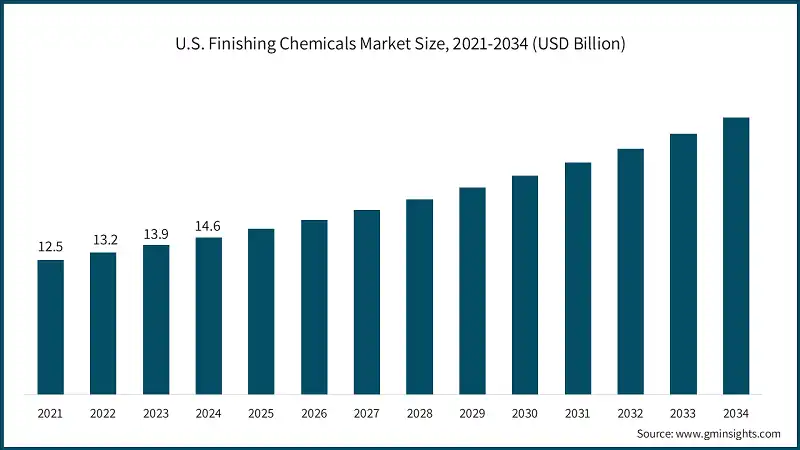
U.S. finishing chemicals market was accounted for USD 14.6 billion in 2024.
- North America is primarily influenced by USA with its major consumers being textile, automotive, and construction industries. The region has an established manufacturing base coupled with a highly developed R&D in support of sustainable performances in chemical formulations. Big players are investing on smart finishing technologies, focusing on fabric properties such as durability, water resistance, and antimicrobial properties to keep up with the consumer market and regulatory requirements.
- While relatively smaller, Canadian markets are growing steadily by focusing on the development of green, eco-friendly, and low-VOC (volatile organic compounds) chemical solutions. Initiatives from the government to support green manufacturing and sustainable textile production have started to convince local players to push the boundaries where innovative finishing chemicals are concerned. The country is also promoting practices that support the circular economy; all of these contribute to the demand for biodegradable and non-toxic alternatives, especially in apparel and home textiles.
- A strong region-wide trend toward multifunctional finishing chemicals offering performance properties such as UV protection, wrinkle resistance, and flame retardancy has developed in parallel with increasing demand for technical textiles and smart fabrics, which are niche markets. The collaboration between chemical manufacturers and the end-use industries to develop customized solutions with specific performance and environmental criteria is the real driver behind this innovation.
- The North American finishing chemicals market is fast-changing, with the U.S. taking the lead in innovations while Canada is steadily gaining momentum via multiple sustainability-driven initiatives. Future growth in the region will circumscribe performance, cost-effectiveness, and environmental stewardship, thus proving to be a fertile ground for next-gen chemical solutions.
The market in the Germany is expected to experience significant and promising growth from 2025 to 2034.
- Germany and the UK boast robust industrial bases as well as sustainability strategies that easily put them in the forefront of the finishing chemicals market in Europe. Germany's drive toward eco-conscious manufacture is very evident in its advocacy for bio-based and low-impact alternatives of chemical formulations, with the greatest application being in textiles and automotive coatings.
- In the UK, applications of several industries to the use of finishing chemicals are being changed through efforts such as digital twins and predictive analysis as part of the digitalization and smart manufacturing movements. Safety and sustainability have become two main drivers for seeking non-toxic fire-retardant and UV-resistant chemical finishes. These advances take particular importance in construction, aerospace, and technical textiles where durability and compliance are key.
The finishing chemicals market in China is expected to experience significant and promising growth from 2025 to 2034.
- China is one of the rapid growth markets for finishing chemicals in APAC, as per the current survey. Most of the massive investments made by the government towards smart manufacturing and sustainable industrial practices are concentrated there. Huge textile and construction industries in China drive advanced chemical finishing needs for improving durability with water-proofing and environmental safety.
- India is slowly catching up with much more government support towards modernizing its textile and infrastructure sectors. It is a nation where most cost-efficient and scalable solutions will be found, and thus it is the major market for finishing chemicals that offer serviceability at no extra cost. Local manufacturers are fast adopting eco-friendly and multifunctional finishes that can comply with the domestic and international standards, especially for garments, home textiles, and industrial applications.
UAE market is expected to experience significant and promising growth from 2025 to 2034.
- UAE holds the top position in the Middle East finishing chemicals market through smart city projects and sustainability goals. The construction and textile industries use BIM and digital twin technologies for chemical finishing processes that reduce environmental impact and improve material durability. The market shows growth in fire-retardant, anti-microbial, and UV finishing applications, mainly in infrastructure and hospitality projects.
- The Middle East finishing chemicals market is growing due to urbanization, infrastructure development, and sustainability needs. Qatar and Oman use eco-friendly chemical applications in textiles and coatings that meet international standards. The region's high temperatures and UV exposure increase demand for finishing chemicals that provide protection in extreme conditions.
Brazil is expected to experience significant and promising growth from 2025 to 2034.
- Brazil is becoming a regional leader in Latin America's finishing chemicals market. The market growth is driven by demand for sustainable and affordable coating in housing, textiles, and industrial applications. Government initiatives support the use of recycled materials and bio-based chemical formulations to meet national environmental objectives.
- Latin America exhibits moderate growth in the finishing chemicals market, influenced by economic conditions and infrastructure requirements. Colombia, Chile, and Peru are adopting advanced chemical finishes in construction and textiles, with affordability remaining a primary factor. The region's growth depends on developing practical, cost-effective solutions that combine performance requirements with environmental responsibilities.
Finishing Chemicals Market Share
- The market for finishing chemicals is also moderately consolidated, such as BASF SE, The Dow Chemical Company, Clariant AG, Huntsman Corporation, and Evonik Industries AG. It constitutes nearly 43% of this market share.
- Thus, the companies in this sector have already made investments and spent a substantial amount of research and development in manufacturing high-performance and environmentally viable chemical formulations conforming to regulatory standards and industry requirements, such as low-VOC coatings, biodegradable finishes, and multifunctional treatments. These all improve durability and safety along with environmental compatibility across textiles, building, and industrial applications.
- Global alliances are being formed by industry participants with worldwide manufacturers and producers in the textile and infrastructure manufacturing arena. The above would create a focused approach to developing a specific class of chemicals pertaining to different usage areas, such as antimicrobial finishes for healthcare textiles and weatherproof coatings for construction materials.
Finishing Chemicals Market Companies
Major players operating in the finishing chemicals industry are:
- BASF SE
- The Dow Chemical Company
- Clariant AG
- Huntsman Corporation
- Evonik Industries AG
- Nouryon (formerly AkzoNobel Specialty Chemicals)
- LANXESS AG
- Arkema S.A.
BASF SE is an international chemical company, operates in markets and countries with different requirements and conditions. Global chemicals leader with €4.3 billion coatings division revenue, extensive finishing chemicals portfolio.
The Dow Chemical Company collaborates across the entire materials ecosystem from waste management infrastructure to diversifying feedstocks to designing innovative applications. It is a major specialty chemicals manufacturer with comprehensive finishing solutions.
Clariant AG s adding value with innovative and sustainable solutions to its customers in multiple industries. The company has a specialty chemicals focus with significant finishing chemicals presence.
Huntsman Corporation was composed of polyurethanes, advanced materials, performance products.
These companies are collectively transforming the finishing chemicals market, where innovation, collaboration, and sustainability together allow the development of better, safer, and more adaptable solutions for global industries.
Finishing Chemicals Industry News
- March 2025 – BASF in collaboration with Sika launched the low-emission epoxy hardener, Baxxodur® EC 151, which cuts volatile organic compounds (VOCs) emissions by up to 90 percent. This product will cure rapidly at low temperatures to result in extremely durable and high-gloss flooring coatings, thereby addressing the sustainable building solutions.
- June 2025 - DKSH Performance Materials opens its latest renovated and superbly developed Specialty Chemicals Innovation Center at Bangkok ever to renew its commitment to providing cutting-edge solutions for partners in the chemical industry.
- December 2022 - Saudi Arabia-based Industrial Investments Company, Dussur, announced that it had entered into a definitive agreement to acquire a stake in Italmatch Chemicals (B) S.p.A., a global specialty chemical additive manufacturer.
- June 2021 – The opening of the BASF plant for hexamethylene diamine at Seal Sands, near Middlesbrough in North-Eastern England, resulted in the loss of 390 jobs. Since then, BASF has relocated the production of the plastic ingredient to France.
The finishing chemicals market research report includes an in-depth coverage of the industry with estimates and forecast in terms of revenue in USD Million and volume in terms of Kilo tons from 2021–2034 for the following segments:
Market, By Product Type
- Textile finishing chemicals
- Softeners and conditioners
- Water and stain repellents
- Flame retardants
- Antimicrobial finishes
- UV protection chemicals
- Anti-static agents
- Metal finishing chemicals
- Plating chemicals
- Cleaning and degreasing agents
- Surface treatment chemicals
- Conversion coatings
- Corrosion inhibitors
- Wood finishing chemicals
- Stains and dyes
- Sealers and primers
- Protective coatings
- Fire retardant treatments
- Leather finishing chemicals
- Dyes and pigments
- Finishing agents
- Surface treatments
- Paper finishing chemicals
- Coating chemicals
- Surface sizing agents
- Calendering chemicals
Market, By Application
- Automotive industry
- Interior components
- Exterior parts
- Under-the-hood applications
- Construction and building materials
- Architectural coatings
- Industrial coatings
- Protective coatings
- Electronics and electrical
- Printed circuit boards
- Electronic components
- Semiconductor applications
- Furniture and home furnishings
- Upholstery and fabrics
- Wood furniture
- Decorative items
- Aerospace and defense
- Aircraft components
- Defense equipment
- Space applications
- Marine and shipbuilding
- Hull coatings
- Deck applications
- Interior finishes
Market, By End Use Industry
- Textiles and apparel
- Cotton textiles
- Synthetic textiles
- Technical textiles
- Home textiles
- Automotive and transportation
- Passenger vehicles
- Commercial vehicles
- Two-wheelers
- Railway applications
- Construction and infrastructure
- Residential construction
- Commercial construction
- Industrial construction
- Infrastructure projects
- Electronics and semiconductors
- Consumer electronics
- Industrial electronics
- Telecommunications equipment
- Packaging industry
- Food and beverage packaging
- Pharmaceutical packaging
- Industrial packaging
The above information is provided for the following regions and countries:
- North America
- U.S.
- Canada
- Europe
- Germany
- UK
- France
- Spain
- Italy
- Rest of Europe
- Asia Pacific
- China
- India
- Japan
- Australia
- South Korea
- Rest of Asia Pacific
- Latin America
- Brazil
- Mexico
- Argentina
- Rest of Latin America
- Middle East and Africa
- Saudi Arabia
- South Africa
- UAE
- Rest of Middle East & Africa
Frequently Asked Question(FAQ) :
What are the upcoming trends in the finishing chemicals industry?
Key trends include the adoption of bio-based and eco-friendly chemicals, advancements in multifunctional finishes like UV protection and antimicrobial coatings, and increased use of digital manufacturing for customized solutions.
Who are the key players in the finishing chemicals market?
Key players include BASF SE, The Dow Chemical Company, Clariant AG, Huntsman Corporation, Evonik Industries AG, Nouryon, LANXESS AG, and Arkema S.A.
What is the growth outlook for electronics and electrical applications from 2025 to 2034?
Electronics and electrical applications are projected to grow at a 7.2% CAGR through 2034.
What was the market size of the U.S. finishing chemicals market in 2024?
The U.S. market was valued at USD 14.6 billion in 2024. Growth is driven by increasing demand from the textile, automotive, and construction industries for high-performance surface treatment solutions.
What is the market size of the finishing chemicals in 2024?
The market size was USD 92.3 billion in 2024, with a CAGR of 6.3% expected through 2034, driven by rising demand for high-performance and sustainable finishes across industries.
What is the projected value of the finishing chemicals market by 2034?
The market size for finishing chemicals is expected to reach USD 169.2 billion by 2034, due to advancements in eco-friendly formulations and demand from automotive, textiles, and construction sectors.
How much revenue did the metal finishing chemicals segment generate in 2024?
Metal finishing chemicals segment generated USD 31.67 billion in 2024.
Finishing Chemicals Market Scope
Related Reports