Summary
Table of Content

Filtration Market
Get a free sample of this report
Form submitted successfully!
Error submitting form. Please try again.
Thank you!
Your inquiry has been received. Our team will reach out to you with the required details via email. To ensure that you don't miss their response, kindly remember to check your spam folder as well!
Request Sectional Data
Thank you!
Your inquiry has been received. Our team will reach out to you with the required details via email. To ensure that you don't miss their response, kindly remember to check your spam folder as well!
Form submitted successfully!
Error submitting form. Please try again.
Filtration Market Size
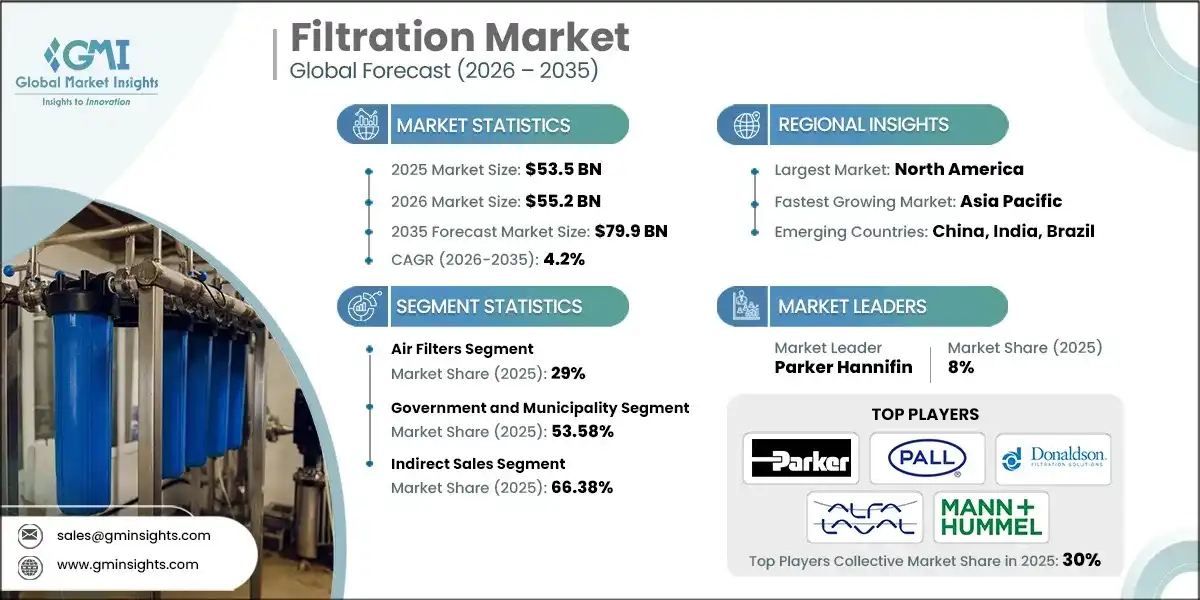
The filtration market was estimated at USD 53.5 billion in 2025. The market is expected to grow from USD 55.2 billion in 2026 to USD 79.9 billion in 2035, at a CAGR of 4.2% according to latest report published by Global Market Insights Inc.
Filtration Market Key Takeaways
Market Size & Growth
- 2025 Market Size: USD 53.5 Billion
- 2026 Market Size: USD 55.2 Billion
- 2035 Forecast Market Size: USD 79.9 Billion
- CAGR (2026–2035): 4.2%
Regional Dominance
- Largest Market: North America
- Fastest Growing Region: Asia Pacific
Key Market Drivers
- Rapid Urbanization & Industrial Development.
- Growth in Healthcare & Pharmaceuticals.
- Stricter Environmental Sustainability & Regulations.
Challenges
- High Initial Investment and Replacement Costs.
- Operational Complexity and Need for Skilled Labor.
Opportunity
- Smart Technology & IoT Integration.
- Expansion of the Replacement & Aftermarket Media.
Key Players
- Market Leader: Parker Hannifin led with over 8% market share in 2025.
- Leading Players: Top 5 players in this market include Parker Hannifin, Pall (Danaher), Donaldson Company, Alfa Laval, Donaldson Company, MANN+HUMMEL, which collectively held a market share of 30% in 2025.
Get Market Insights & Growth Opportunities
The demand for advanced filtration systems is largely driven by environmental sustainability concerns and the need to comply with regulations, because of a surge in mergers and acquisitions among industry leaders. With the consolidation of major players in the business, the market experiences increased innovation, broadened product portfolios, and strengthened market presence. Conventional ways of handling waste and controlling emissions, such as simple dilution or chemical neutralization, are not so friendly to the environment. Contemporary filtration systems provide a more environmentally friendly way since they separate contaminants from air and water both physically and chemically, thus reducing the environmental impact. The adoption of this green technology is in line with the industrial sector's preference for sustainable practices and is, therefore, contributing to the filtration market growth.
The increasing demand for industrialization and urban infrastructure development in North America along with the rising municipal and environmental protection budgets in Europe and some parts of the Asia Pacific region, are the main factors that create the commercial viability for this equipment. Both consumers and professionals are increasingly inclined to choose efficient and mechanized solutions for process purification and wastewater treatment, thus abandoning the older methods that are time consuming, such as batch settling or manual chemical dosing. Membrane and air filtration, which is capable of turning polluted streams into reusable resources or clean exhaust, is generally accepted as a cleaner, faster, and more environmentally friendly alternative.
One of the most important factors defining the market for air and water purification systems is the use of HEPA and RO filtration units that have gained significant traction because of their proven benefits such as cutting health hazards and minimizing the risk of pathogen transmission from contaminated environments. There is no doubt that the market of these devices is very much dependent on the awareness of the long, term benefits of high, efficiency particle removal, which in turn results in a wider acceptance of these potent devices. Besides that, ongoing improvements in filter media and housing design are going to elevate user safety and ease of operation. The market's positive financial performance is being supported by this interplay of infrastructure readiness, an industry, wide focus on sustainable resource management, and a demand for high, efficiency convenience.
Advancements in filter media technology represent one of the fundamental elements that underpin the market's gradual expansion and drive the transformation of basic screening tools into highly durable, application, specific machinery. The industry is witnessing a pronounced shift towards nanofiber membranes and high, porosity activated carbon that enhance efficiency and media durability when dealing with a broader range of contaminant concentrations and chemical compositions. Producers are very active in improving user experience by incorporating features such as IoT, enabled performance monitoring for enhanced safety, automated self, cleaning systems for better manoeuvrability in high, load environments.
The biggest factor leading to the filtration market to be the urbanization and industrial infrastructure projects that are increasing at a very fast pace and at the same time the professional and the homeowner desire for clean and pollutant, free water and air. Industrial filters, unlike conventional removal methods, forcibly catch or neutralize harmful particulates that are just under the micro, level in a mechanical way, thus effectively removing the obstacle while generating a purified output and greatly reducing the time spent on regulatory reporting and waste disposal.
This efficiency has been very attractive to both municipal utility providers who are looking for more throughput and pharmaceutical and food processing firms that are demanding product purity that is consistent and timely. The choice of this technology has a direct impact on the composition of the market: the Liquid and Air Filtration segments are consistently recording the largest revenue share and thus they are accounting for most of the total filtration equipment market revenue in recent years. The major share of this segment is directly related to the machines' strong performance, long life, and high scalability; thus, they are a perfect match to the modern professional's requirement of versatility and quick deployment. In addition, technology is becoming more important and there are features like digital pressure sensors that are offering a more personalized and precise filtration experience. These mutually dependent trends reveal not only the market's liveliness but also its ability to meet the environmental management needs of a wide range of clients.
Additionally, market players in the filtration industry are emphasizing the development of cartridges and membranes that incorporate cutting-edge technology, such as the creation of more durable synthetic fibres, innovative pleated designs, and enhanced multi-stage systems that facilitate faster and more effective contaminant removal.
All demonstrated in the market signs of growing further as technology develops and the respective demand continues.
To get key market trends
Filtration Market Trends
The filtration industry is seeing dynamic trends fuelled by a surge of new product launches and technological advancements from industry leaders. Leading companies are unveiling cutting, edge filtration units with upgraded features such as nanofiber membranes, high, efficiency particulate air (HEPA) technologies, and smart technologies. These innovations are aimed at users who are continuously evolving and seeking efficient and user, friendly solutions for contaminant and pollutant removal. The industry's response to these trends is a clear indication of their commitment to continuous innovation, thereby providing users with advanced tools that enhance performance, reduce operational downtime, and contribute to a more productive and streamlined purification process.
- Technology advancement and product innovation: More advanced and efficient machines are the focus of the shift, which also involves the incorporation of IoT, enabled sensors and AI, driven monitoring systems for enhanced safety and performance. To make filtration more effective and increase the lifespan of filters, companies are working on the development of energy, efficient, low, pressure, drop systems and durable filter media.
- Expansion of industrial processing and manufacturing services: The overall health of the pharmaceutical, food & beverage, and chemical industries has been the major factor of the rise of the demand. Industrial manufacturing companies represent the largest subsector, which is about 28% of the total market. The need for highly efficient filtration systems remains quite stable, as it is mainly driven by requirements for process purity, sterile manufacturing, and hazardous waste management. The growth, thus, comes from both industrial and commercial expansions, as facilities are increasingly investing in cleanroom environments.
- Sustainable environmental management: Proper filtration is a measure that prevents the release of pollutants and gases into the atmosphere coming from industrial exhausts, thereby, contributing to the restoration of ecosystems and making it easier for purification of water resources or air quality improvement to take place. This is in line with the implementation of environmentally friendly ESG (Environmental, Social, and Governance) goals and carbon neutrality schemes all over the world
- Environmental and health crises happening more frequently: Increasing pollution levels and associated health problems are resulting in extreme air and water quality challenges in a variety of locations. Consequently, there is a dramatic rise in pathogen and micro particle contamination. This situation is generating an almost continuous purification and environmental remediation effort, which is thus increasing the need for advanced filters among healthcare providers, disaster recovery organizations, and municipalities.
- Focus on public health and urban air quality: The management of properties through management companies and the local governments are more and more committed to the proactive maintenance of the safety and aesthetics of the indoor and outdoor environments. This means that airborne allergens, toxic gases, or industrial particulates are regularly removed from private properties, public buildings, and streets. The endless requirement for municipal water and air maintenance is resulting in a continuous demand for commercial grade filtration and dust collection systems throughout the year
Filtration Market Analysis
Learn more about the key segments shaping this market
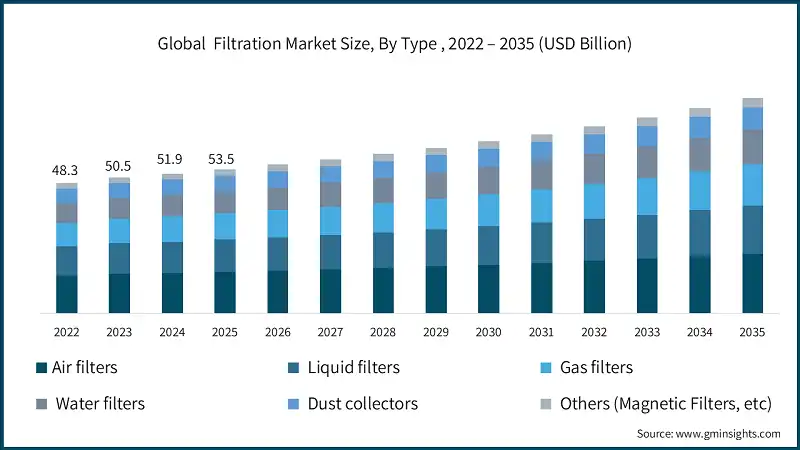
Based on the type, the market is divided into air filters, liquid filters, gas filters, water filters, dust collectors, and others. The air filters segment accounted for over 29% of the market share in 2025.
- The need for stringent air quality standards and the reduction of industrial emissions is encouraging segment growth.
- Air filters hold a significant portion of the market value and exhibit strong growth, indicating a continued professional preference for high-efficiency HVAC and cleanroom filtration units.
- Liquid and water filters segments show a healthy growth rate, suggesting consistent demand from the municipal water treatment sector and industrial users who prioritize purity and reuse over traditional disposal methods.
- Compact and modular, portable water filtration units are ideal for tackling contamination in remote locations and small-scale industrial setups. Landowners and facility managers appreciate the convenience of point-of-use (POU) options for specialized purification tasks.
Based on the application, the filtrations market is segmented into Industrial and Government and Municipality. In 2025, government and municipality held a major market share of 53.58%, generating a revenue of USD 28.6 billion.
- The Government and Municipality segment represents the largest portion of the market, driven by large-scale public water treatment projects and urban air quality initiatives.
- The Industrial segment, while currently smaller, is the fastest-growing area with a CAGR of 4.8% through 2035, reflecting the industry's shift towards advanced manufacturing processes and stricter environmental compliance in factories.
- This trend is consistent with a market that is increasingly prioritizing industrial efficiency and waste reduction, gradually increasing the industrial sector's contribution to the total market value.
Learn more about the key segments shaping this market
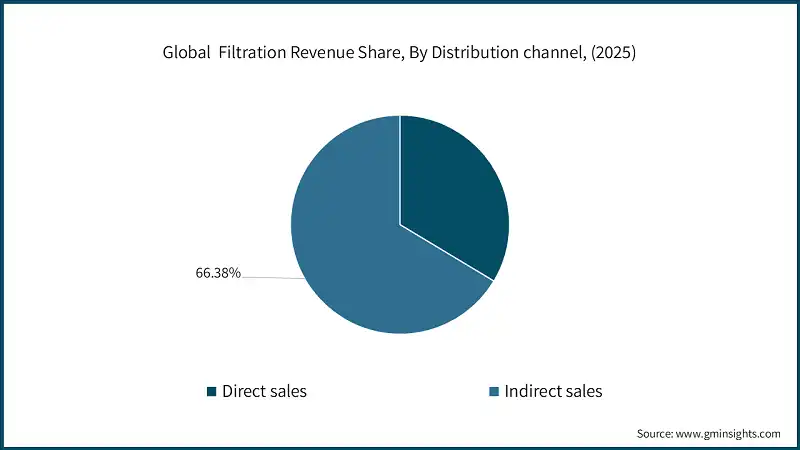
Based on the mode of distribution, the filtration market is segmented into direct sales and indirect sales. In 2025, indirect sales held the major market share of 66.38%, reflecting the industry’s reliance on distributors and specialized service providers.
- Indirect sales represent the largest portion of the market and show the highest projected growth rate through 2035.
- This dominance is driven by the critical role of specialized distributor networks and authorized service partners. For high-value filtration infrastructure, end-users (manufacturing plants, municipalities) often prefer indirect channels for localized technical support, rapid aftermarket media replacement, and comprehensive maintenance contracts.
- Direct sales typically involve transactions straight from the Original Equipment Manufacturer (OEM) to the end-user. This channel is primarily utilized for large-scale infrastructure projects, government contracts, or major global accounts that have the internal capacity for system integration and routine maintenance.
Looking for region specific data?
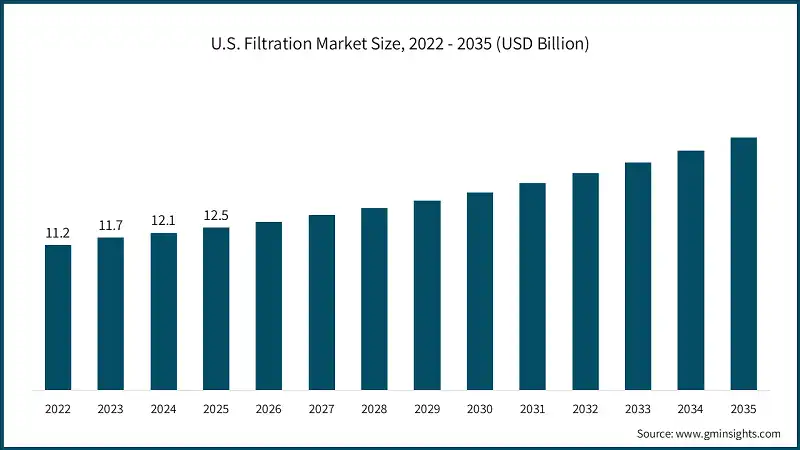
In 2025, North America filtration market is estimated at around USD 15.7 billion and is set to grow at a CAGR of 4.3% during 2026 to 2035.
- The U.S. leads the region by showing a strong growth rate of 4.6%. This growth comes from a mature market with active construction activities and stringent environmental regulations.
- Filtrations are essential tools for maintaining air and water quality standards in rapidly expanding urban areas and industrial zones.
- The North American market meets this need by offering various high-efficiency filtration solutions that support large-scale infrastructure and residential development projects across the continent.
- The strong industrial base in the region also increases demand for specialized gas and liquid filters, serving a broader range of consumers and large-scale businesses.
Europe is filtration market the third-largest market estimated at USD 13.7 billion in 2025 with a projected growth rate of 3.9%. Germany leads the region with the highest sub-regional growth rate of 4.8% and the largest market value of USD 2.6 billion in 2025 due to its strong industrial manufacturing and automotive sectors.
- The European market benefits from sustainability efforts and a focus on operational efficiency, encouraging the adoption of low-emission and high-purity filtration equipment.
- These efforts make Europe a competitive landscape for new technologies and sustainable practices. Countries like France and Italy experience steady growth driven by municipal water upgrades and utility maintenance needs.
- The larger European market benefits from Green Deal initiatives to drive operational efficiency, minimize environmental impact, and promote innovation in membrane and media technologies.
Asia Pacific filtration market was estimated USD 17.1 billion in 2025 with a projected growth rate of 4.7% from 2026 to 2035.
- India has the highest sub-regional growth rate expecting a growth rate of 5.3%, followed by China at 4.9%. China also holds the largest market share in the region valued at USD 5.5 billion in 2025.
- The rapid growth in Asia Pacific results from rapid urbanization, significant infrastructure projects, and increased investment in industrial manufacturing.
- Rising awareness about environmental pollution and the quest for better operational efficiency significantly influence the growth of the Asia Pacific filtration market, promoting innovation and competition.
- Countries like Australia and Japan are also important players needing reliable equipment for high-tech cleanroom environments and municipal water security.
Latin America filtration market expected to reach USD 3.7 billion by 2025, growing at a rate of 3.1% from 2026 to 2035.
- Brazil is the main driver in the region projecting a growth rate of 3.5% with the largest market value of USD 1.58 billion in 2025.
- Overall growth is modest due to varying levels of infrastructure spending and economic fluctuations across different countries.
- However, increasing urbanization and industrialization in Mexico and Brazil are boosting demand for professional water and air filtration services.
- Market players are focusing on durable and cost-effective equipment to take advantage of this market, with demand often stemming from agricultural processing and public works projects.
Filtration Market Share
Parker Hannifin is leading the market with approximately 8% market share. Top players including Parker Hannifin, Pall (Danaher), Donaldson Company, Alfa Laval, and MANN+HUMMEL collectively hold around 30%, indicating a moderately consolidated yet competitive landscape. These prominent players are proactively involved in strategic endeavors, such as mergers & acquisitions, facility expansions, and collaborations, to expand their product portfolios, extend their reach to a broad customer base, and strengthen their market position.
In November 2025, Parker Hannifin entered into a definitive agreement to acquire Filtration Group Corporation for USD 9.25 billion. This strategic move significantly expanded Parker's high-margin aftermarket presence (expected to be 85% of sales) and added complementary proprietary media technologies. The acquisition enhances Parker's footprint in critical sectors like Life Sciences, HVAC/R, and Industrial market verticals.
In 2024, Donaldson Company continued its aggressive expansion by opening a new 50,000-square-foot manufacturing facility in Pune, India. This expansion aimed to improve production capacity for advanced air filters and liquid filtration systems to serve the growing South Asian industrial hub. This follows their recent integration of Univercells Technologies, which bolstered their position in the Life Sciences and Bioprocessing sectors.
Filtration Market Companies
Major players operating in the filtration industry are:
- 3M Company
- Ahlstrom-Munksjö
- Camfil Group
- Clarcor
- Cummins Filtration
- Donaldson Company, Inc.
- Eaton Corporation
- Koch Filter Corporation
- Lydall, Inc.
- MANN+HUMMEL
- Pall Corporation
- Parker Bioscience Filtration
- Parker Hannifin Corporation
- Pentair
- Porvair Filtration Group
Ahlstrom expanded its range of sustainable specialty materials with the 2025 launch of an enhanced water-filtration range based on its patented Disruptor technology. Engineered for optimal contaminant removal and precise flow control, the Disruptor media is designed to reduce PFAS concentrations to as low as 5 parts per trillion. Unlike standard carbon blocks, this fiber-based solution offers higher flow rates while maintaining high chlorine removal. Unveiled at major 2025 industry events, its multifunctional design allows for simultaneous capture of biological contaminants, providing a significant advantage for municipal and residential point-of-use systems.
Filtration Market Report Attributes
| Key Takeaway | Details |
|---|---|
| Market Size & Growth | |
| Base Year | 2025 |
| Market Size in 2025 | USD 53.5 Billion |
| Market Size in 2026 | USD 55.2 Billion |
| Forecast Period 2026-2035 CAGR | 4.2% |
| Market Size in 2035 | USD 79.9 Billion |
| Key Market Trends | |
| Drivers | Impact |
| Rapid Urbanization & Industrial Development | Ongoing expansion of manufacturing clusters, chemical plants, and municipal utilities require mandatory, large-scale air and water purification systems. This drives consistent demand for powerful, high-production liquid and gas filtration units. |
| Growth in Healthcare & Pharmaceuticals | Increasing global investment in drug manufacturing and biotech research necessitates ultra-pure cleanroom environments. This boosts sales of HEPA/ULPA filters and specialized membrane filtration for sterile processing. |
| Stricter Environmental Sustainability & Regulations | Modern filtration is an environmentally superior alternative to simple waste discharge or chemical dilution. Regulatory mandates (e.g., Clean Air Act, Euro VI) promote the use of advanced dust collectors and wastewater filters, aligning with ESG goals. |
| Pitfalls & Challenges | Impact |
| High Initial Investment and Replacement Costs | The substantial upfront capital for advanced membrane or electrostatic systems, combined with recurring costs for specialized media (e.g., activated carbon, PTFE membranes), limits adoption among SMEs. |
| Operational Complexity and Need for Skilled Labor | Operating high-powered industrial filtration involves managing differential pressures and chemical compatibility. This necessitates stringent monitoring protocols and specialized training, increasing total cost of ownership. |
| Opportunities: | Impact |
| Smart Technology & IoT Integration | Developing smart filters with integrated sensors allows for real-time air/liquid quality monitoring and predictive maintenance. This significantly boosts system uptime and operational efficiency for industrial plants. |
| Expansion of the Replacement & Aftermarket Media | As the installed base of filtration hardware grows, the demand for replacement cartridges and bags offers a high-margin, recurring revenue stream for manufacturers, mitigating the volatility of new equipment sales. |
| Market Leaders (2025) | |
| Market Leaders |
8% market share |
| Top Players |
|
| Competitive Edge |
|
| Regional Insights | |
| Largest market | North America |
| Fastest growing market | Asia Pacific |
| Emerging countries | China, India, Brazil |
| Future outlook |
|
What are the growth opportunities in this market?
Filtration Market News
- In November 2025, Donaldson Company introduced two new high-efficiency solutions: the Industrial Solutions IFS platform (featuring a redesigned side-mounted drive system to simplify maintenance) and a high-production Mobile Solutions air filter unit designed for extreme-dust environments. These units eliminate traditional belt maintenance by utilizing direct-drive or gearbox-driven systems, significantly reducing operational downtime.
- In September 2025, Vermeer (Environmental Division) introduced the redesigned HG4000 horizontal grinder for wood waste recycling. While serving the land-clearing sector, the unit features an advanced Series III duplex drum and C13B Stage V engine, addressing the industrial need for high-throughput material processing with reduced emissions and noise levels (112 decibels)
- In July 2025, Ahlstrom launched the Disruptor PFAS-reduction media, a gravity-flow filtration system that meets NSF 42 standards. The system automatically maintains high flow rates even as it captures heavy metal and biological contaminants, maximizing filter life and user convenience.
- In 2025, Alfa Laval expanded its strategic partnership with EDF to accelerate high-density fermentation and nuclear energy projects. This focuses on their Bactofuge technology and Hermetic Design, which provide a multi-million-dollar efficiency boost for pharmaceutical giants by enhancing recovery performance in sterile environments.
- In 2024, MANN+HUMMEL continued to emphasize its powerful HEPA H14 and bifunctional cabin filters. These incorporate their Smart Air digital monitoring, which uses IoT sensors to adjust filtration rates based on real-time air quality data, ensuring optimal performance in automotive and cleanroom applications without the need for manual inspection.
The filtration market research report includes in-depth coverage of the industry with estimates & forecasts in terms of revenue (USD Billion) and volume (Thousand Units) from 2021 to 2034, for the following segments:
Market, By Type
- Air Filters
- Liquid Filters
- Gas Filters
- Water Filters
- Dust Collectors
- Others (Magnetic Filters, etc)
Market, By Filter
- HEPA Filters
- Electrostatic Precipitators
- Reverse Osmosis
- Ultraviolet
- Mechanical Filtration
- Membrane Filtration
- Media Filtration
- Others (Polymeric Filters, etc)
Market, By Filter Media
- Activated Carbon
- Fiberglass
- Nonwoven Fabrics
- Paper
- Metal
- Others
Market, By Application
- Industrial
- Cement Industry
- Water & Wastewater Treatment
- Chemical Processing
- Food & Beverage Processing
- Pharmaceutical Manufacturing
- Automotive
- Oil & Gas
- Power Generation
- Consumer Appliances Manufacturing
- Others (Mining, Marine, etc)
- Government and Municipality
- Water Treatment Plants
- Air Quality Management
- Solid Waste Management Facilities
- Sewage Treatment Plants
- Others (Public Swimming Pools, etc.)
Market, By Distribution Channel
- Direct
- Indirect
The above information is provided for the following regions and countries:
- North America
- U.S.
- Canada
- Europe
- Germany
- UK
- France
- Italy
- Spain
- Asia Pacific
- China
- India
- Japan
- Australia
- South Korea
- Latin America
- Brazil
- Mexico
- Argentina
- Middle East and Africa
- South Africa
- Saudi Arabia
- UAE
Frequently Asked Question(FAQ) :
What is the market size of the filtration in 2025?
The market size was USD 53.5 billion in 2025, with a CAGR of 4.2% expected through 2035 driven by rising investments in drug manufacturing, biotech research requiring ultra-pure cleanroom environments, and stricter environmental regulations.
What is the projected value of the filtration market by 2035?
The filtration market is expected to reach USD 79.9 billion by 2035, propelled by rapid urbanization, industrial development, growth in healthcare and pharmaceuticals, and environmental sustainability initiatives.
What is the current filtration market size in 2026?
The market size is projected to reach USD 55.2 billion in 2026.
What was the market share of air filters segment in 2025?
Air filters segment accounted for over 29% of the market share in 2025, driven by stringent air quality standards and the reduction of industrial emissions.
What was the valuation of government and municipality application segment in 2025?
Government and municipality segment held a major market share of 53.58% in 2025, generating revenue of USD 28.6 billion, driven by large-scale public water treatment projects and urban air quality initiatives.
What is the growth outlook for the industrial application segment from 2026 to 2035?
The industrial segment is the fastest-growing area with a CAGR of 4.8% expected through 2035, reflecting the industry's shift towards advanced manufacturing processes and stricter environmental compliance in factories.
Which region leads the filtration market?
North America is the largest market with USD 15.7 billion in 2025 and is set to grow at a CAGR of 4.3% during 2026 to 2035. Asia Pacific is the fastest growing market at 4.7% CAGR, supported by rapid urbanization and infrastructure projects.
What are the upcoming trends in the filtration market?
What are the upcoming trends in the filtration market?
Who are the key players in the filtration market?
Key players include Parker Hannifin, Pall (Danaher), Donaldson Company, Alfa Laval, MANN+HUMMEL, 3M Company, Ahlstrom-Munksjö, Camfil Group, Clarcor, Cummins Filtration, Eaton Corporation, Koch Filter Corporation, Lydall Inc., Parker Bioscience Filtration, Pentair, and Porvair Filtration Group.
Filtration Market Scope
Related Reports