Summary
Table of Content

Fiber Ingredients for Sugar Reduction Market
Get a free sample of this report
Form submitted successfully!
Error submitting form. Please try again.
Thank you!
Your inquiry has been received. Our team will reach out to you with the required details via email. To ensure that you don't miss their response, kindly remember to check your spam folder as well!
Request Sectional Data
Thank you!
Your inquiry has been received. Our team will reach out to you with the required details via email. To ensure that you don't miss their response, kindly remember to check your spam folder as well!
Form submitted successfully!
Error submitting form. Please try again.
Fiber Ingredients for Sugar Reduction Market Size
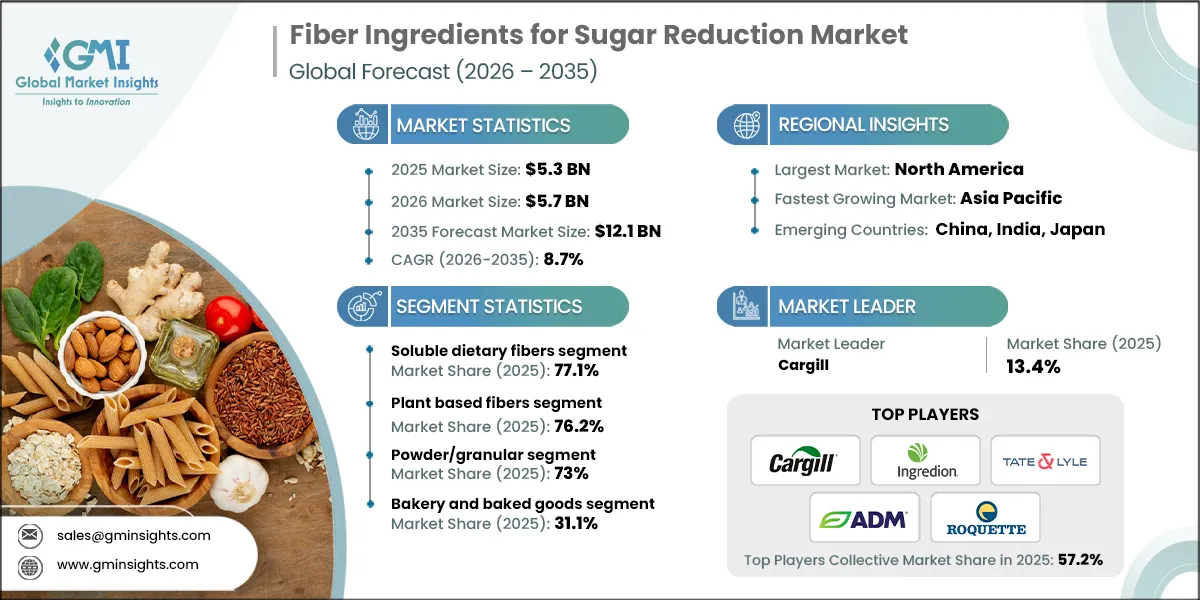
The global fiber ingredients for sugar reduction market was valued at USD 5.3 billion in 2025. The market is expected to grow from USD 5.7 billion in 2026 to USD 12.1 billion in 2035, at a CAGR of 8.7%, according to latest report published by Global Market Insights Inc.
Fiber Ingredients for Sugar Reduction Market Key Takeaways
Market Size & Growth
- 2025 Market Size: USD 5.3 Billion
- 2026 Market Size: USD 5.7 Billion
- 2035 Forecast Market Size: USD 12.1 Billion
- CAGR (2026–2035): 8.7%
Regional Dominance
- Largest Market: North America
- Fastest Growing Region: Asia Pacific
Key Market Drivers
- Rising health awareness.
- Regulatory pressure.
- Innovation in fiber sources.
Challenges
- Taste and texture challenges.
- Cost implications.
Opportunity
- Product innovation.
- Functional benefits marketing.
Key Players
- Market Leader: Cargill led with over 13.4% in 2025.
- Leading Players: Top 5 players in this market include Cargill, Ingredion, Tate & Lyle, ADM, Roquette, which collectively held a market share of 57.2% in 2025.
Get Market Insights & Growth Opportunities
The fiber ingredients market for sugar reduction is experiencing significant growth because consumers increasingly demand healthier low-sugar products. Dietary fibers such as inulin and oat fiber and resistant starches function as natural sugar substitutes and bulking agents which drive this developing market. The food and beverage industry uses these products because they replicate sugar's mouthfeel and sweetness while offering health advantages.
Fiber ingredients function as sugar reduction agents by improving product texture and sweetness and sensory profile evaluation without adding any calories or glycemic impact. Functional foods which people want to eat exist because of their ability to improve digestive function and blood sugar regulation and weight control. Inulin and other fibers function as prebiotics which support gut health and improve immune capacity.
The advantages of adding fiber ingredients to products enable weight loss while enhancing nutritional quality and supporting digestive health. The ingredients assist food manufacturers in satisfying both regulatory standards and consumer preference for products which contain no artificial sweeteners or sugars. Fiber-based sugar substitutes enhance the sensory experience and health benefits of baked goods and dairy products and beverages and confectionery items and snack foods.
To get key market trends
Fiber Ingredients for Sugar Reduction Market Trends
The market for fiber ingredients which serve to reduce sugar content has experienced strong expansion because three main factors drive its growth. The extraction, formulation, and functional properties of fiber ingredients like inulin and resistant starch and & fiber have improved through technological advancements. The development of new enzymatic processing methods and fermentation technologies has resulted in better fiber yield and improved functional properties which now allow fibers to function as effective sugar substitutes that reproduce both sweetness and texture. Researchers developed customized fiber solutions for food applications through these technological advances which improved fiber product versatility.
Regulatory frameworks now recognize fiber ingredients as natural additives which provide health benefits to consumers. Governments worldwide establish guidelines which promote reduced sugar levels in food products to fight obesity and diabetes while encouraging fiber-based product adoption. Dietary fibers are acknowledged by multiple countries as beneficial components which enable their inclusion in various food products while supporting health claims that increase consumer trust.
Product innovation drives market growth as companies creates new fiber products which deliver better taste and texture and functional benefits. The market is experiencing rising demand for novel products which include fiber-enriched sweeteners and clean-label fiber ingredients and prebiotic fibers. Innovations empower food producers to create products which lower sugar content while delivering nutritional advantages and functional benefits which include support for gut health and immunity, matching consumer preferences for healthier options.
The market demonstrates a business trend which shows a gradual transition to natural sugar reduction methods based on fiber which results from both technological advances and regulatory support and product development, which drive continuous industry expansion through new market opportunities.
Fiber Ingredients for Sugar Reduction Market Analysis
Learn more about the key segments shaping this market
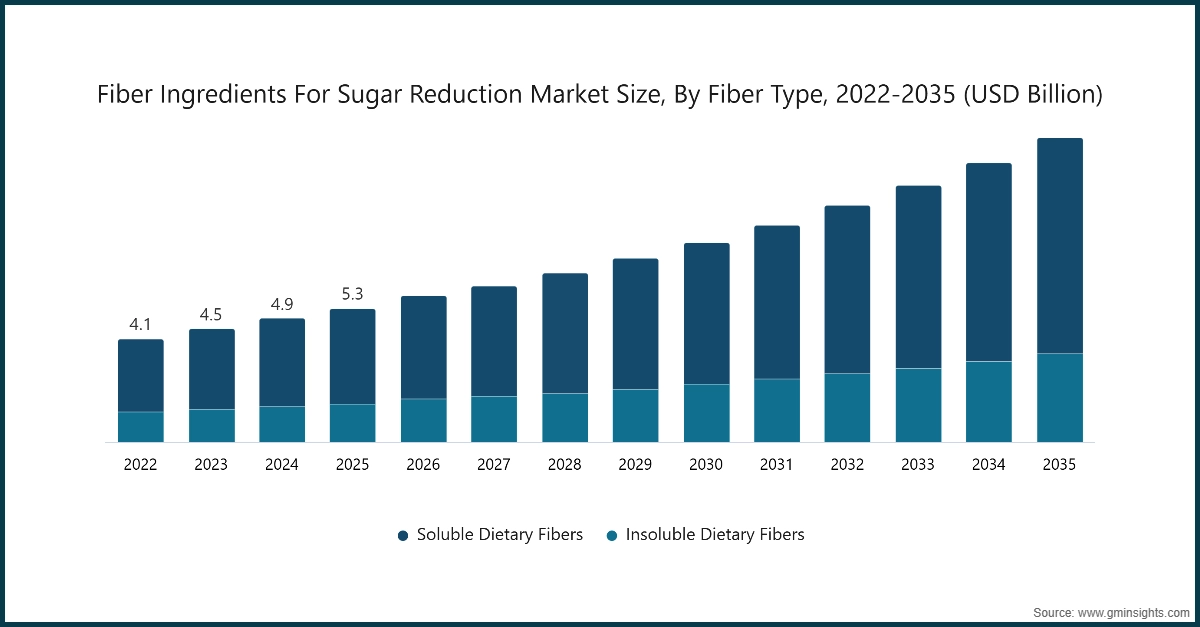
Based on fiber type, the market is segmented into soluble dietary fibers, and insoluble dietary fibers. Soluble dietary fibers dominated the market with an approximate market share of 77.1% in 2025 and is expected to grow with a CAGR of 8.7% by 2035.
The market for dietary fibers, including soluble and insoluble types, is experiencing robust growth driven by increasing consumer awareness of health and wellness. Soluble dietary fibers, which oats and fruits and legumes contain, provide multiple health benefits because they help to lower cholesterol and control blood sugar and support gut health. The functional benefits of these ingredients create a strong demand for their use in functional food products and beverage items and dietary supplement products.
Insoluble dietary fibers function as essential components that help to maintain digestive health while protecting against constipation and assisting with weight control. The demand for insoluble fibers increases because consumers focus on digestive health and prefer to eat natural foods that contain few processing steps.
The market trend shows that consumers prefer clean-label plant-based ingredients, which leads manufacturers to develop new products that satisfy their needs. The fiber extraction process together with its implementation in various food products and the increasing knowledge of dietary fiber health advantages will continue to drive market expansion.
Learn more about the key segments shaping this market
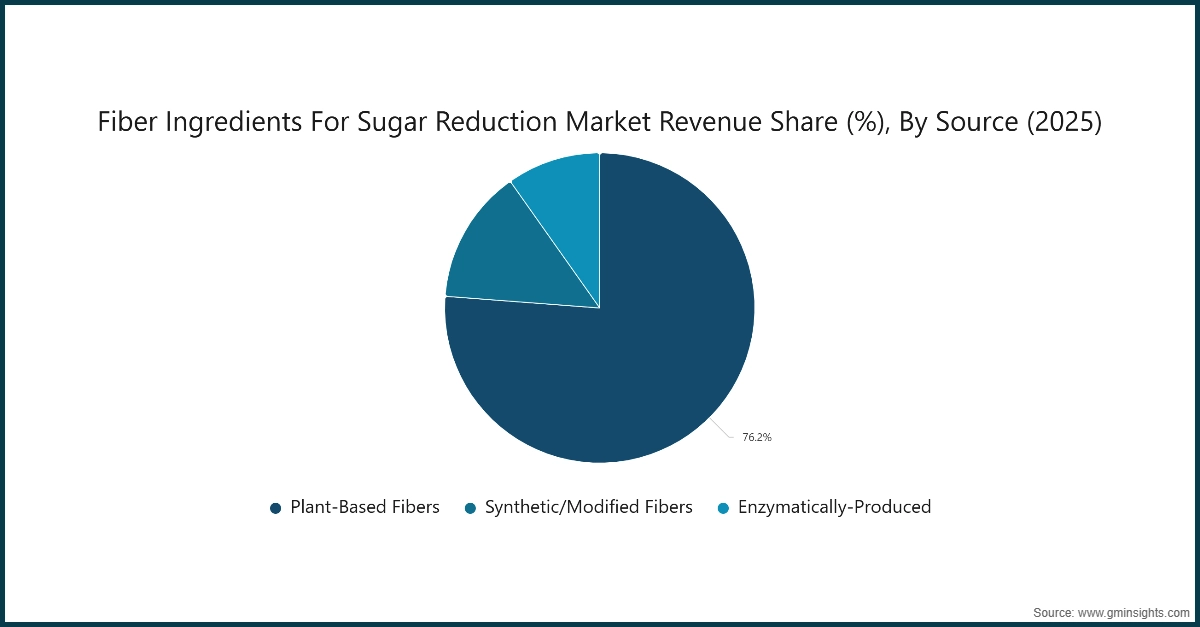
Based on source, the fiber ingredients for sugar reduction market is segmented into plant-based fibers, synthetic/modified fibers, and enzymatically produced. Plant based fibers held the largest market share of 76.2% in 2025 and is expected to grow at a CAGR of 8.8 during 2026-2035.
The market maintains its dominance through the ongoing use of plant-based fibers which show preference for cereal-derived fibers from corn wheat oats barley and rice because of their easy availability and useful characteristics. People increasingly choose legume-derived fibers which come from peas and soybeans and chickpeas and lentils because they provide high amounts of protein and fiber. The market for root and tuber-derived fibers which include chicory and Jerusalem artichoke and agave and tapioca continues to grow because these fibers contain prebiotic benefits. The natural sweetness alongside health advantages of fruit-derived fibers from citrus and apple and sugarcane make them popular among consumers.
The market increasingly adopts synthetic or modified fibers which include polydextrose and resistant maltodextrin because these materials offer both stable performance and diverse functional capabilities that processors need in their products. Galactooligosaccharides (GOS) and fructooligosaccharides (FOS) which are produced through enzymes now receive growing attention because of their prebiotic advantages which enhance gut health and immune function.
Based on form, the fiber ingredients for sugar reduction market is segmented into powder/granular, and liquid/syrup. Powder/granular segments dominated the market with an approximate market share of 73% in 2025 and is expected to grow with a CAGR of 8.6% by 2035.
The fiber ingredients for the sugar reduction market are projected to grow steadily from 2024 to 2034, with notable shifts in form preferences driven by application needs and consumer demand. Powder/granular forms lead the market because they allow easy use in food products which include baked goods and cereals and snack items. Manufacturers use these products because their stability and portability and convenience allow fiber content improvements without changing product texture or taste.
Liquid/syrup forms are also gaining traction particularly in beverages, dairy products, and functional drinks. The product works well in formulas which need fast mixing and targeted thickness, because of its fast-dissolving capacity, and simple blending process. The application of liquid fibers occurs primarily in cases where a smooth texture is required.
Based on application, the fiber ingredients for sugar reduction market is segmented into bakery & baked goods, beverages, dairy & frozen desserts, confectionery, and specialized nutrition. Bakery and baked goods segments dominated the market with an approximate market share of 31.1% in 2025 and is expected to grow with a CAGR of 8.9% by 2035.
The application of fibers for sugar reduction spans a wide range of food and beverage categories, reflecting their versatility and health benefits. Fiber content in baked products depends on the application of fibers which manufacturers use to create healthy snacks and bread products that meet health-conscious consumer demands. Smoothies, functional drinks, and sports beverages establish their content using soluble and insoluble fibers while these beverages help with digestion and create a full feeling in consumers.
Frozen desserts and dairy products use fibers ingredients for sugar reduction to create better product texture and stability while increasing nutritional content to make yogurt and ice cream and dairy-free products more appealing to health-conscious customers. The growing demand for functional sweets has led confectionery products to use fibers to create indulgent treats that provide health advantages.
The specialized nutrition segment uses it in products such as meal replacements and protein powders and baby foods to help people maintain digestive health and weight control and overall wellness. The application of fibers ingredient for sugar reduction in cereals and snack bars and pet foods functions is to improve the dietary value and functional advantages of these products. The increasing use of fibers across these categories demonstrates their significance in creating new health-oriented products which companies need to compete in the market.
Looking for region specific data?
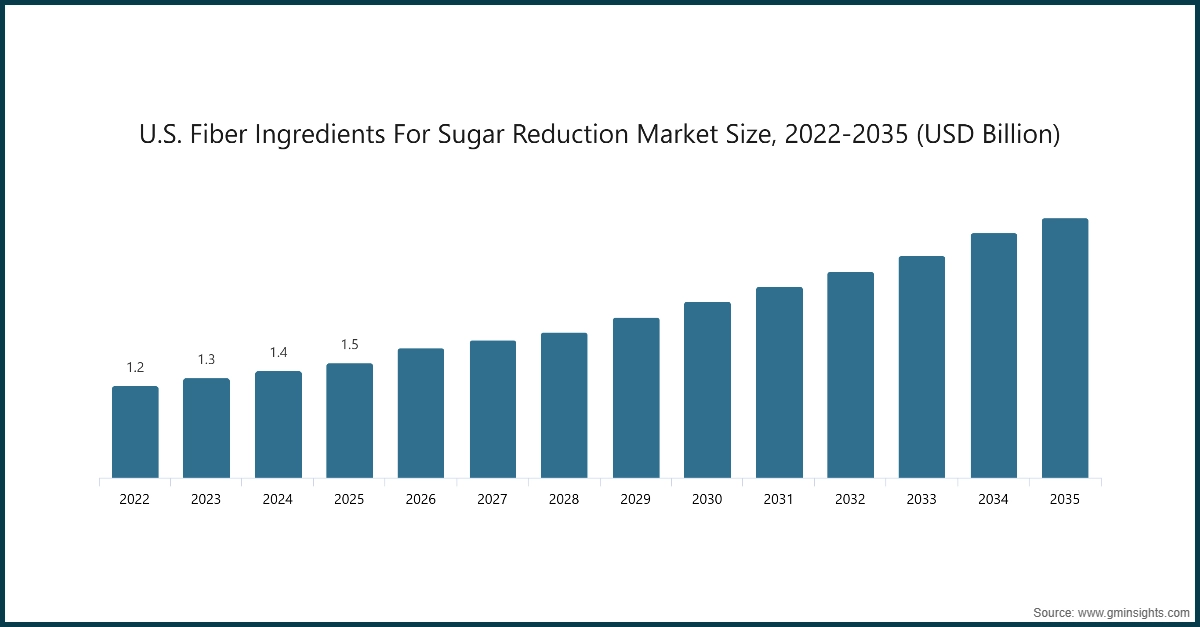
The North America fiber ingredients for sugar reduction industry is growing rapidly on the global level with a market share of 36% in 2025.
- The North American market is a leading region in the dietary fiber industry because consumers demonstrate high knowledge of health and wellness. The U.S. and Canada have strong functional food demand which includes fiber-enriched products because their food processing industry has developed and continues to create innovations. The region's market growth stems from consumer demand for healthy foods that contain high fiber content in bakery products and beverages and dairy items.
Europe fiber ingredients for sugar reduction market leads the industry with revenue of USD 1.7 billion in 2025 and is anticipated to show lucrative growth over the forecast period.
- Europe has developed into a mature market which emphasizes the use of natural ingredients and clean-label products. Dietary fiber consumption in Germany and the UK and France shows high levels of usage. The combination of strict food regulations and health-focused consumers and preventive healthcare measures lead to increased demand for products that contain high levels of fiber. The region uses natural ingredients as its focus which makes dietary fibers a vital market for its economy.
The Asia Pacific fiber ingredients for sugar reduction market is anticipated to grow at a CAGR of 8.9% during the analysis timeframe.
- The Asia Pacific region is experiencing rapid growth because people are becoming more health conscious and cities are growing and their eating habits are changing. The people of China and India and Japan now prefer to consume foods that have high fiber content. The food processing industry in these countries is growing because it needs dietary fibers to produce healthier food products which creates a high-growth market for this region.
Latin America fiber ingredients for sugar reduction accounted for 5% market share in 2025 and is anticipated to show steady growth over the forecast period.
- The Latin American market for fiber ingredient for sugar reduction has grown because people now know more about health risks from their modern lifestyle and they are choosing to eat healthier. The main markets in Brazil and Mexico show customers who are interested to buy products which contain low sugar. The region experiences growth from two main factors which are market innovation and the growth of retail business operations.
Middle East & Africa fiber ingredients for sugar reduction accounted for USD 155.3 million market size in 2025 and is anticipated to show lucrative growth over the forecast period.
- The Middle East and Africa are emerging markets for fiber because people now understand the nutritional advantages of fiber and they increasingly value their health. Urban areas and retail systems create demands which require people to consume healthy foods that contain dietary fiber. The market holds major potential for growth though it remains in its developing stage.
Fiber Ingredients for Sugar Reduction Market Share
The top 5 companies in fiber ingredients for sugar reduction industry include Cargill, Ingredion, Tate & Lyle, ADM, and Roquette. These are prominent companies operating in their respective regions covering approximately 57.2% of the market share in 2025. These companies hold strong positions due to their extensive experience in fiber ingredients for sugar reduction industry. Their diverse product portfolios, backed by robust production capabilities and distribution networks, enable them to meet the rising demand across various regions.
Cargill provides fiber ingredients which include resistant starches and soluble fibers through its research and development capabilities and its worldwide distribution network. The company develops functional fibers which include Fibersol to improve sweetness perception while decreasing sugar content. The company establishes itself as a top competitor through its substantial market share and ability to drive product innovation.
Ingredion develops functional fibers and resistant starches and soluble fibers. The company supports two health benefits which include glycemic control and digestive health to meet the wellness demands of consumers. The research and development capabilities of Ingredion combined with their acquisition strategy create a competitive advantage.
Tate & Lyle delivers soluble fibers through resistant starches to support sugar reduction and transparent label requirements. The company establishes itself as a top partner for food producers who want to reduce sugar content while maintaining product taste through their formulation expertise and taste profile development skills.
ADM provides soluble fibers as their fiber product line. The company ADM operates strong production facilities which enable their business to serve both large-scale food and beverage customers while providing cost-efficient solutions for sugar reduction and better nutritional value.
Roquette Frères offers a wide selection of fibers which includes soluble fibers. Their development of plant-based and clean-label fibers enables health-conscious consumers to reduce sugar intake.
Fiber Ingredients for Sugar Reduction Market Companies
Major players operating in the Fiber ingredients for sugar reduction industry include:
ADM
BENEO
BioNeutra
Cargill
Ingredion
Kerry Group
Nexira
Roquette
Sensus
Tate & Lyle
Fiber Ingredients for Sugar Reduction Market Report Attributes
| Key Takeaway | Details |
|---|---|
| Market Size & Growth | |
| Base Year | 2025 |
| Market Size in 2025 | USD 5.3 Billion |
| Market Size in 2026 | USD 5.7 Billion |
| Forecast Period 2026-2035 CAGR | 8.7% |
| Market Size in 2035 | USD 12.1 Billion |
| Key Market Trends | |
| Drivers | Impact |
| Rising health awareness | Increasing consumer awareness about the health risks associated with high sugar intake, such as obesity and diabetes, is driving demand for natural, low-sugar alternatives like fiber ingredients. |
| Regulatory pressure | Governments and regulatory bodies are imposing stricter limits on added sugars in food and beverages, encouraging manufacturers to incorporate fiber-based sugar replacers to comply with new standards. |
| Innovation in fiber sources | Advances in extraction and formulation technologies have enabled the development of diverse, functional fiber ingredients that can effectively replace sugar in various applications, expanding market opportunities. |
| Pitfalls & Challenges | Impact |
| Taste and texture challenges | Replacing sugar with fiber ingredients can sometimes alter the sensory attributes of products, leading to consumer rejection if the taste or texture is compromised. |
| Cost implications | High-quality fiber ingredients can be expensive to produce and process, potentially increasing the overall cost of reformulated products and affecting profit margins. |
| Opportunities: | Impact |
| Product innovation | Developing new formulations that mimic the sweetness and mouthfeel of sugar more accurately opens avenues for broader application across diverse food categories. |
| Functional benefits marketing | Highlighting additional health benefits of fibers, such as improved digestion and prebiotic effects, can enhance product appeal and consumer loyalty. |
| Market Leaders (2025) | |
| Market Leader |
13.4% |
| Top Players |
Collective Market Share of 57.2% in 2025 |
| Competitive Edge |
|
| Regional Insights | |
| Largest Market | North America |
| Fastest growing market | Asia Pacific |
| Emerging countries | China, India, Japan |
| Future outlook |
|
| Companies covered: | 10 |
| Tables, Charts & Figures: | 205 |
| Countries covered: | 18 |
| No of Pages: | 190 |
What are the growth opportunities in this market?
Fiber Ingredients for Sugar Reduction Industry News
- In July 2025, Tate & Lyle augmented ingredient lines such as fiber fortification and mouthfeel solutions at the IFT FIRST conference, revealing prototype items which incorporated fiber fortification with clean-label and texture targeted innovation. This showed the ability of fiber-based foods to compete to the indulgence and taste with clean-label and functional requirements, driving broader mainstream food and beverage categories.
- In April 2025, the curve-processing facility in Germany, operated by BENEO GmbH, which is a company of the Südzucker Group, became operational, giving the company an additions enhancement to its pulse-processing capacity of fibers, protein, and other functional ingredients. This growth endorses the growth of high-fiber and plant-based food, bucking the trend toward plant-based sources of fiber and clean-label formulations in both food and feed markets.
This fiber ingredients for sugar reduction market research report includes in-depth coverage of the industry, with estimates & forecasts in terms of revenue (USD Billion) and volume (Kilo Tons) from 2026 to 2035, for the following segments:
Market, By Fiber Type
Soluble dietary fibers
Insoluble dietary fibers
Market, By Source
Plant-based fibers
Cereal-derived fibers
Legume-derived fibers
Root & tuber-derived fibers
Fruit-derived fibers
Others
Synthetic/modified fibers
Polydextrose
Resistant maltodextrin
Enzymatically-produced fibers
Galactooligosaccharides (GOS)
Fructooligosaccharides (FOS)
Others
Market, By Form
Powder/granular
Liquid/syrup
Market, By Application
Bakery & baked goods
Breads & rolls
Cakes & pastries
Cookies & biscuits
Cereal bars & snack bars
Beverages
Dairy & frozen desserts
Confectionery
Chocolate & chocolate confectionery
Sugar confectionery & gummies
Specialized nutrition
Dietary supplements
Medical nutrition
Sports nutrition
Weight management products
Others
The above information is provided for the following regions and countries:
North America
U.S.
Canada
Europe
Germany
UK
France
Spain
Italy
Rest of Europe
Asia Pacific
China
India
Japan
Australia
South Korea
Rest of Asia Pacific
Latin America
Brazil
Mexico
Argentina
Rest of Latin America
Middle East and Africa
Saudi Arabia
South Africa
UAE
Rest of Middle East and Africa
Frequently Asked Question(FAQ) :
What was the market size of the fiber ingredients for sugar reduction market in 2025?
The market size was USD 5.3 billion in 2025, driven by advancements in fiber extraction, formulation, and functional properties.
What is the projected value of the fiber ingredients for sugar reduction industry by 2035?
The market is expected to reach USD 12.1 billion by 2035, growing at a CAGR of 8.7%, fueled by technological innovations and increasing regulatory support for sugar reduction initiatives.
What is the projected size of the fiber ingredients for sugar reduction market in 2026?
The market is expected to grow to USD 5.7 billion in 2026.
What was the market share of soluble dietary fibers in 2025?
Soluble dietary fibers dominated the market with an approximate share of 77.1% in 2025 and are projected to grow at a CAGR of 8.7% through 2035.
What was the market share of plant-based fibers in 2025?
Plant-based fibers held the largest market share of 76.2% in 2025 and are expected to grow at a CAGR of 8.8% during the forecast period of 2026-2035.
Which region leads the fiber ingredients for sugar reduction market?
North America led the market in 2025, accounting for 36% of the global market share, driven by strong consumer demand for sugar reduction and regulatory support.
Who are the key players in the fiber ingredients for sugar reduction market?
Major players include ADM, BENEO, BioNeutra, Cargill, Ingredion, Kerry Group, Nexira, and Roquette.
Fiber Ingredients for Sugar Reduction Market Scope
Related Reports