Summary
Table of Content

Fast Fashion Market
Get a free sample of this report
Form submitted successfully!
Error submitting form. Please try again.
Thank you!
Your inquiry has been received. Our team will reach out to you with the required details via email. To ensure that you don't miss their response, kindly remember to check your spam folder as well!
Request Sectional Data
Thank you!
Your inquiry has been received. Our team will reach out to you with the required details via email. To ensure that you don't miss their response, kindly remember to check your spam folder as well!
Form submitted successfully!
Error submitting form. Please try again.
Fast Fashion Market Size
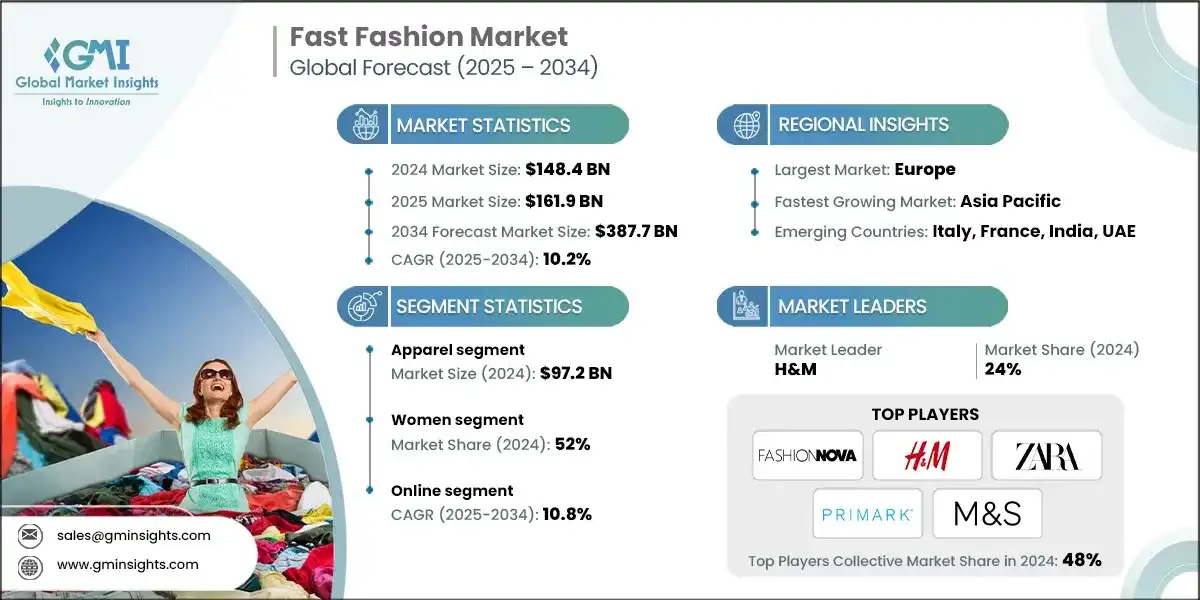
The global fast fashion market was estimated at USD 148.4 billion in 2024. The market is expected to grow from USD 161.9 billion in 2025 to USD 387.7 billion in 2034, at a CAGR of 10.2%, according to Global Market Insights Inc.
Fast Fashion Market Key Takeaways
Market Size & Growth
- 2024 Market Size: USD 148.4 billion
- 2034 Forecast Market Size: USD 387.7 billion
- CAGR (2025–2034): 10.2%
Key Market Drivers
- Rapidly changing fashion trends and consumer preferences.
- Increased adoption of e-commerce platforms.
Challenges
- Growing concerns over environmental sustainability.
- Intense competition among fast fashion brands.
Opportunity
- Integration of sustainable practices and eco-friendly materials.
- Expansion into emerging markets.
Key Players
- Market Leader: H&M led with over 24% market share in 2024.
- Leading Players: Top 5 players in this market include Fashion Nova, H&M, Zara, Primark, Marks and Spencer, which collectively held a market share of 48% in 2024.
Get Market Insights & Growth Opportunities
- The fast fashion market is expanding due to the changing trends fashion along with consumer behavior and surging e-commerce platform facilitates easy access for a wide range of brands.
- Growing demand for fashionable clothing at lower prices has propelled the demand for fast fashion that responds to dynamic consumer demands. Brands operating in the fast fashion industry emphasize producing and delivering fast fashion collections at a rapid pace so as not to be uncoordinated with current trends. Such flexibility in design and manufacturing has become a major selling point for winning over a wide customer base, especially among youth who value style at affordable prices.
- The ease of shopping on online websites, combined with the convenience of being able to view numerous products, has widely impacted on customer purchasing behavior. Brands operating into the fast fashion market are addressing the evolving trend by creating strong online presences, providing easy shopping experiences, and using digital marketing solutions to target the global population.
- Moreover, environmental impact such as high water and energy consumption, rising pollution from dyes and chemical and increasing textile waste are the factors posing challenges for fast fashion industry. The fast fashion industry is responsible for 10% of the annual global carbon footprint, which is more than the emissions from all international flights and maritime shipping combined.
- According to the UN Framework Convention on Climate Change, emissions from textile manufacturing alone are projected to increase by 60% by 2030. Consumers across the globe produce 92 million tons of textile waste every year. This textile waste eventually ends up in landfills.
- The US throws away an estimated 11.3 million tons of textile waste. Around 85% of this textile waste ends up in landfills. Factories usually release untreated wastewater into oceans and rivers in countries like Bangladesh, India, and Vietnam. This results in pollution of water sources and damage to the ecosystem. Textile factories in Dhaka, Bangladesh, release 22,000 tons of toxic waste into rivers every year. Fast fashion industry requires the use of energy-focused synthetic materials like polyester. Around 70 million barrels of oil are used each year to make polyester fiber. The fiber also takes more than 200 years to break down.
- Europe holds a significant market share in the fast fashion market and is driven by several influential regional fast fashion brands such as Zara, H&M, Bershka etc. whose clothing sells at a fast rate due to their attractive designs. These businesses supply everyday items, evening party dresses, and seasonal novelties even during recession periods.
To get key market trends
Fast Fashion Market Trends
- Fashion-forward consumers, especially millennials and Gen Z consumers, are looking for products at affordable prices, compelling brands to reduce lead times and introduce new collections more quickly. Competition among brands has been heightened, driving them to innovate and adapt quickly to shifting trends.
- The rise of e-commerce websites has changed customer behavior with regards to shopping for clothing. The convenience, variety, and affordability which online retailers are able to offer ensure they are most desirable for a wide range of consumers. Companies are utilizing digital technologies like artificial intelligence and data analytics to deliver tailored experiences for buyers and make inventory management better.
- Sustainability is one of the major factors creating awareness among the customers regarding the environmental impact due to fast fashion. As a result, customers are more inclined towards secondhand fashion or clothing to reduce carbon footprint.
- Brands are embracing environmentally friendly practices, including the use of eco-friendly material, minimizing waste, and applying circular economy strategies. Recycling initiatives by key brands and ecofriendly transportation are some of the efforts being increasingly adopted by brands, who promise to be aligned with consumer values as well as comply with legislation. Partnerships with sustainable fashion influencers and trade associations are assisting firms in establishing credibility and reaching environmentally aware consumers.
- Established brands such as Gap introduce 12,000 new products each year while H&M unveiled 25,000 products. Shein introduces the highest 1.3 million products each year.
- Beyond Retro partnership with Save the Children to launch a seasonal pop-up shop in London. The pop-up highlighted a specially curated range of vintage Christmas jumpers, holiday clothing, and recycled festive items, including festive Christmas jumpers for pets.
- Technological advances are also gaining momentum in transforming the fast fashion industry. Virtual reality (VR) and augmented reality (AR) technology are changing the behavior of customers to browse the clothing, allowing them to virtually see the items before purchasing them.
- Social networking platforms remain a major force behind consumerism, with companies using such social media platforms for brand promotions, customer interactions, and forecasting trends. Influencer marketing and user-generated content are becoming strong tools for developing brand loyalty and awareness.
Fast Fashion Market Analysis

Learn more about the key segments shaping this market
Based on the product type, the market is divided into apparel, footwear, and accessories. In 2024, apparel dominated the market generating revenue of USD 97.2 billion and projected to grow at a CAGR of 10.4% during the forecast period.
- Consumers are more inclined towards brands using ecofriendly materials, minimizing waste, and transparency about the supply chain. Digital transformation is also changing the apparel segment in fast fashion market, with technologies such as artificial intelligence and augmented reality making the shopping experience more immersive through virtual try-on, personalized suggestions, and effective stock management.
- The average European citizen bought 19 kilograms (kg) of clothing, footwear, and household textiles up from 17 kg. The combination of increased online shopping, social media influencers and cheap production costs for synthetic textiles has been instrumental in the growth of fast fashion. This has allowed retailers to offer consumers new styles at low prices. The EEA briefing notes that digital technologies like 3D printing can reduce waste in production and can be used to reduce the environmental and climate pressures from textiles by improving efficiency.
- Fast fashion companies are sustaining their competitive advantage by streamlining production cycles to respond rapidly to upcoming trends and consumer needs. In addition, local preferences influence product ranges, as brands adjust designs to meet local preference and cultural sensitivities.
Learn more about the key segments shaping this market
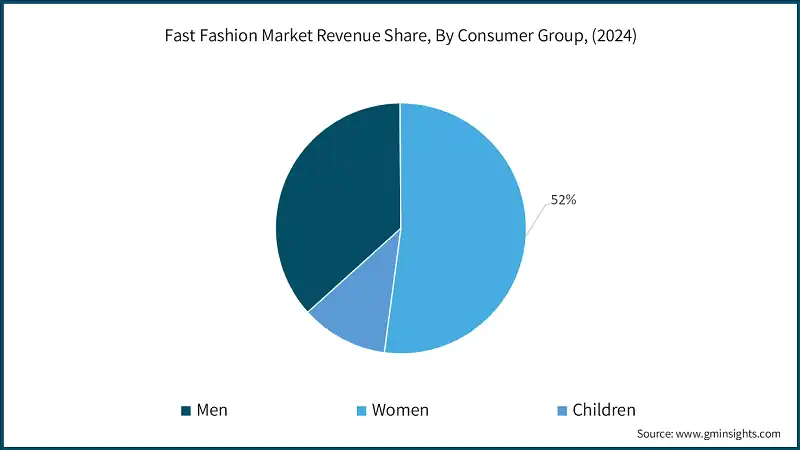
Based on consumer group, the fast fashion market is segmented into men, women, and children. In 2024, women segment dominates the market with 52% market share and the segment is expected to grow at a CAGR of 10.5% from 2025 to 2034.
- As per the U.S. Bureau of Labor Statistics, in 2023, household spending on women's apparel averaged $655, compared with $406 for men's apparel. Spending on girls' and boys' apparel was $87 and $96, respectively. Households spent an average of $208 on women's footwear, and $147 for men's, in 2023.
- As per the report published by Public Desire, an average Indian is spending $2500 per annum on just clothes. On average, each person in South Korea is projected to contribute 15 pieces in volume to the Women's Apparel market in 2025.
Based on the distribution channel, the fast fashion market is segmented into online and offline. In 2024, the online segment is projected to grow at a CAGR of 10.8% from 2025 to 2034.
- Physical stores become experiential hubs, which allow consumers to evaluate products, connect with the brand, and experience them better. Fast fashion brands, Zara, H&M, and Shein, have also made a big investment in flagship stores that even feature workout spaces, and interactive displays. This is an experiential format of retailing that attracts consumers and keeps them engaged inside the physical retail environment.
- The online sale of fast fashion has been booming with the advantage of convenience, variety, and personalization. The digital environment for fashion across the globe is rapidly changing. E-commerce websites are embracing more personalized experiences such as AI-driven product recommendations based on browsing behavior or purchasing history. Virtual fitting rooms, in which customers can try on clothes using AR technology, are used to bridge the gap between online and physical shopping.
Looking for region specific data?
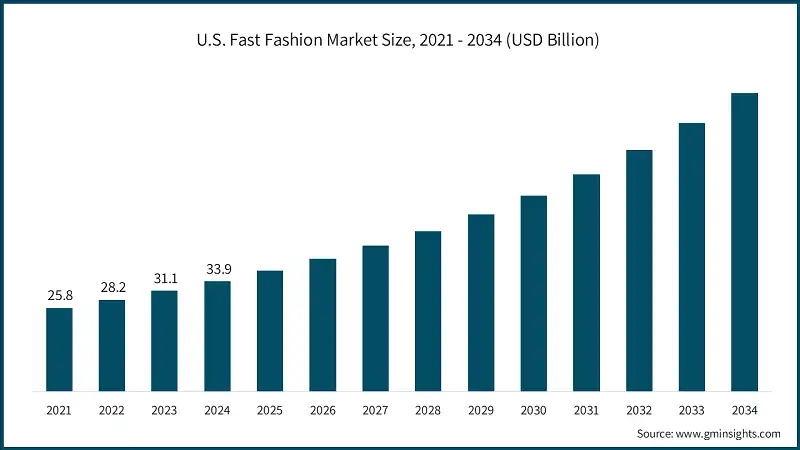
In terms of country, the United States led the fast fashion market with 77% of the North American market share and estimated USD 33.9 billion in revenue during 2024.
- The expansion of the U.S. fast fashion industry is primarily driven by changing trends fashion along with consumer behavior and surging e-commerce platform facilitates easy access for a wide range of brands.
- As per the U.S. Bureau of Labor Statistics, in 2023, household spending on women's apparel averaged USD 655, compared with USD 406 for men's apparel. Spending on girls' and boys' apparel was USD 87 and USD 96, respectively. Households spent an average of $208 on women's footwear, and USD 147 for men's, in 2023.
- U.S. peoples invest heavily on their outfits or clothing. California came in at USD 1,148 per person, while Texas narrowly beat California with USD 1,289. Hawaii, with only USD 547 per person, spent the least on clothing. Other low-spending states included Nevada with USD 653, New York with USD 764, and Florida with $947.
The Europe fast fashion market was valued at USD 34.1 billion in 2024 and is projected to grow at a CAGR of 10% between 2025 and 2034.
- Europe is one of the leading apparel markets globally and is home to the largest apparel brands worldwide. Europe's apparel import market was estimated to be worth USD 191.5 billion in 2023. Suppliers from developing countries accounted for 44.4% of all clothing imported into the EU in value terms, having fallen from 48.4% in 2018. From 2018 to 2023, the European apparel market grew by an average annual growth rate of 4.1%. The largest European importing markets are Germany, France, Spain, Italy, the Netherlands, and Poland.
The Asia Pacific fast fashion market was valued at USD 52.1 billion in 2024 and is projected to grow at a CAGR of 10.6% between 2025 and 2034.
- The Asia Pacific market is growing significantly and driven by rising demand for affordable apparel. Buyers across the region are highly inclined towards online purchasing of apparel which leads to e commerce growth across the region.
- As per the report published by Public Desire, an average Indian is spending $2500 per annum on just clothes. On average, each person in South Korea is projected to contribute 15 pieces in volume to the Women's Apparel market in 2025.
The Middle East and Africa fast fashion market was valued at USD 8.3 billion in 2024 and is projected to grow at a CAGR of 9.2% between 2025 and 2034.
- The fashion industry contributes 2.5 percent to the overall GDP; a significant increase compared to the 1.4 percent in 2021-2022. The majority of this GDP share still comes from domestic final consumption, in retail and wholesale segments of the value chain.
- As 56 percent of fashion consumption relies on imported goods, there is a large opportunity to boost domestic production to improve balance of trade, and the industry’s economic impact.
- Vision 2030 also seeks to enrich the social landscape in Saudi, improving quality of life for both citizens and expats. The introduction of new high-quality brands, both local and international, is also enriching the opportunity for self-expression, as Saudi citizens, and expats style themselves in their evolving daily social and professional lives.
Fast Fashion Market Share
- The top 5 companies in the fast fashion industry are Fashion Nova, H&M, Zara, Primark, Marks and Spencer, contributing around 48% of the market in 2024.
- These companies continue to acquire and merge with others, expand facilities, and make various collaborations to increase their product offerings, access customer bases, and secure their market positions.
- H&M Group and Gap are using strategic actions to capture the market share in the global retail sector. H&M Group has made a strong commitment to expanding its product range and customer experience, which has led it to grow steadily. The investment by the company in digital platforms and e-commerce has helped it reach more people, especially in developing markets. By incorporating sustainability in its operations and product range, H&M has also attracted eco-conscious consumers, reinforcing its market position even further. The 28 percent year-to-year operating profit growth, ex-associate, and joint venture contributions, testifies to the strength of such measures in profitability as well as increasing market share.
- Gap has aim to consolidate its market position and stake out a greater share of the market for retailing. The company's omnichannel retailing strategy has been the big growth contributor with sales online up 4 percent and contributing to 38 percent of net sales in Fiscal Year 2024. Gap has benefited from this move to digital channels with more ability to serve the increasing demand for shopping online and at the same time building a stronger store base. With its strong international presence operating 3,569 stores in 40 countries, including 2,506 company-owned stores, Gap has continued to sustain its strong international presence. In addition, Gap's success in flat store sales but driving growth in other categories indicates that the company has weathered the tough retail climate. The operating profit of $1.1 billion and the operating margin of 7.4 percent depict operational efficiency, and the profitability focus of the company.
Fast Fashion Market Companies
Major players operating in the fast fashion industry are:
- Arcadia
- Asos
- Bershka
- Boohoo
- Fashion Nova
- Gap
- H&M
- Mango
- Marks and Spencer
- Primark
- Roadster
- Shein
- Uniqlo
- Urban Outfitters
- Zara
To improve the product and market share key players are constantly investing in technological activities and are also entering into partnerships to provide improved and better solutions for the customers. These investments are benefiting both companies and customers as they help develop and offer solutions as per the changing technological trends and thus the customer requirements.
Mango announced the Sustainable 2030 strategy, which aims to move towards the full traceability and transparency of its value chain, in order to continue with the process of auditing its suppliers and ensuring that appropriate working conditions are being fulfilled for the workers in the factories the company works with around the world.
H&M has announced strategic initiatives to address the environmental and ethical challenges of fast fashion. The company is progressively adopting recycled materials, expanding its garment collection, and recycling programs, signaling a shift toward a circular fashion model. These efforts aim to capture the growing eco-conscious customer base while reinforcing H&M's position as a leader in sustainable retail practices.
Fast Fashion Market Report Attributes
| Key Takeaway | Details |
|---|---|
| Market Size & Growth | |
| Base Year | 2024 |
| Market Size in 2024 | USD 148.4 billion |
| Forecast Period 2025 - 2034 CAGR | 10.2% |
| Market Size in 2034 | USD 387.7 billion |
| Key Market Trends | |
| Drivers | Impact |
| Rapidly changing fashion trends and consumer preferences | Rapidly changing fashion trends and consumer preferences significantly boost the demand for fast fashion products, as brands strive to meet the evolving tastes of their target audience. |
| Increased adoption of e-commerce platforms | The increased adoption of e-commerce platforms has further increased this demand by providing consumers with easy access to a wide range of fast fashion options. |
| Pitfalls & Challenges | Impact |
| Growing concerns over environmental sustainability | Environmental sustainability and ethical labor practices have become critical concerns, posing significant challenges for the fast fashion market. |
| Intense competition among fast fashion brands | Intense competition among fast fashion brands has led to price wars, which often result in reduced profit margins. |
| Opportunities: | Impact |
| Integration of sustainable practices and eco-friendly materials | The integration of sustainable practices and the use of eco-friendly materials present a significant opportunity for fast fashion brands to attract environmentally conscious consumers. |
| Expansion into emerging markets | Expanding into emerging markets, where disposable incomes are rising, offers substantial growth potential for the industry. |
| Market Leaders (2024) | |
| Market Leaders |
24% market share |
| Top Players |
Collective market share in 2024 is 48% |
| Competitive Edge |
|
| Regional Insights | |
| Largest Market | Europe |
| Fastest Growing Market | Asia Pacific |
| Emerging Country | Italy, France, India, UAE |
| Future Outlook |
|
What are the growth opportunities in this market?
Fast Fashion Industry News
- In May 2025, H&M has announced plans to open its first store in Venezuela by the end of 2025, in collaboration with its franchise partner Hola Moda. The company also confirmed that it will launch stores and an online shopping platform in Brazil during the second half of 2025. Furthermore, H&M is preparing to open its first store in El Salvador within the same year.
- In May 2025, Gap and DOEN announced the launch of their second collection, inspired by California's vintage classics and celebrating timeless femininity. This new collection introduces fresh silhouettes and prints, while also expanding into baby and men's apparel. Significantly, it marks DOEN's debut in offering men's products, highlighting the brand's evolving portfolio.
- In July 2024, Boohoo unveiled its 'boohoo brands' marketplace, enabling consumers to shop directly from a curated selection of fashion, lifestyle, and beauty brands on its website. The marketplace debuts with 150 prominent brands, such as Ray-Ban, L’Oréal Paris, Garnier, Marc Jacobs, Michael Kors, Revolution Beauty, Alexander McQueen, Balenciaga, Gucci, Valentino, Off White, Urban Bliss, Hunter, Puma, and Crocs, with more brands set to join weekly.
- In October 2023, Shein has announced its acquisition of Missguided, a struggling fashion brand headquartered in Manchester, U.K., from Fraser Group for an undisclosed amount. This strategic investment highlights Shein's expanding dominance and signals a significant shift in the competitive dynamics of the fast fashion industry.
The fast fashion market research report includes in-depth coverage of the industry with estimates & forecasts in terms of revenue (USD Billion) and volume (Million Units) from 2021 to 2034, for the following segments:
Market, By Product Type
- Apparel
- Top wear
- Shirts & T-shirts
- Coats & jackets
- Sweatshirts
- Others (pullover & cardigans etc.)
- Bottom wear
- Trousers & jeans
- Skirts & shorts
- Other (joggers & leggings etc.)
- Others (innerwear etc.)
- Top wear
- Footwear
- Boots
- Flats
- Loafers
- Sleepers
- Sneakers
- Others (high heel sandals etc.)
- Accessories
- Jewelry
- Bags
- Hats
- Scarves and shawls
- Others (belts etc.)
Market, By Customer Group
- Men
- Women
- Children
Market, By Price
- Low
- Medium
- High
Market, By Distribution Channel
- Online
- E-commerce
- Company websites
- Offline
- Supermarkets
- Specialty stores
- Others (big box retailers, etc.)
The above information is provided for the following regions and countries:
- North America
- U.S.
- Canada
- Europe
- Germany
- UK
- France
- Spain
- Italy
- Netherlands
- Asia Pacific
- China
- Japan
- India
- Australia
- South Korea
- Latin America
- Brazil
- Mexico
- Argentina
- MEA
- South Africa
- Saudi Arabia
- UAE
Frequently Asked Question(FAQ) :
What is the market size of the fast fashion industry in 2024?
The market size was USD 148.4 billion in 2024, with a CAGR of 10.2% expected through 2034 driven by rapidly changing fashion trends and evolving consumer preferences.
What is the current fast fashion market size in 2025?
The market size is projected to reach USD 161.9 billion in 2025.
What is the projected value of the fast fashion market by 2034?
The global fast fashion industry is expected to reach USD 387.7 billion by 2034, fueled by e-commerce expansion, social media influence, and demand for affordable trendy clothing.
How much revenue did the apparel segment generate in 2024?
The apparel category dominated the market with USD 97.2 billion revenue in 2024, accounting for the largest industry share.
What was the valuation of the women’s apparel segment in 2024?
The women’s apparel segment held 52% share of the market in 2024 and is projected to grow at a 10.5% CAGR from 2025 to 2034.
What is the growth outlook for online distribution from 2025 to 2034?
The online sales channel is projected to grow at a 10.8% CAGR through 2034, supported by digital retail adoption, AI-driven recommendations, and virtual try-on technologies.
Which region leads the fast fashion market?
The U.S. led the fast fashion industry in North America with USD 33.9 billion revenue in 2024. Growth is driven by e-commerce adoption and high household spending on apparel.
What are the upcoming trends in the fast fashion industry?
Key trends include sustainable practices, eco-friendly materials, circular fashion models, digital transformation with AI/AR, and influencer-driven marketing strategies.
Who are the key players in the fast fashion market?
Major players include H&M, Zara, Shein, Fashion Nova, Primark, Marks & Spencer, Gap, Uniqlo, Boohoo, Mango, Bershka, Urban Outfitters, and Asos
Fast Fashion Market Scope
Related Reports