Summary
Table of Content

Farm Equipment Rental Market
Get a free sample of this report
Form submitted successfully!
Error submitting form. Please try again.
Thank you!
Your inquiry has been received. Our team will reach out to you with the required details via email. To ensure that you don't miss their response, kindly remember to check your spam folder as well!
Request Sectional Data
Thank you!
Your inquiry has been received. Our team will reach out to you with the required details via email. To ensure that you don't miss their response, kindly remember to check your spam folder as well!
Form submitted successfully!
Error submitting form. Please try again.
Farm Equipment Rental Market Size
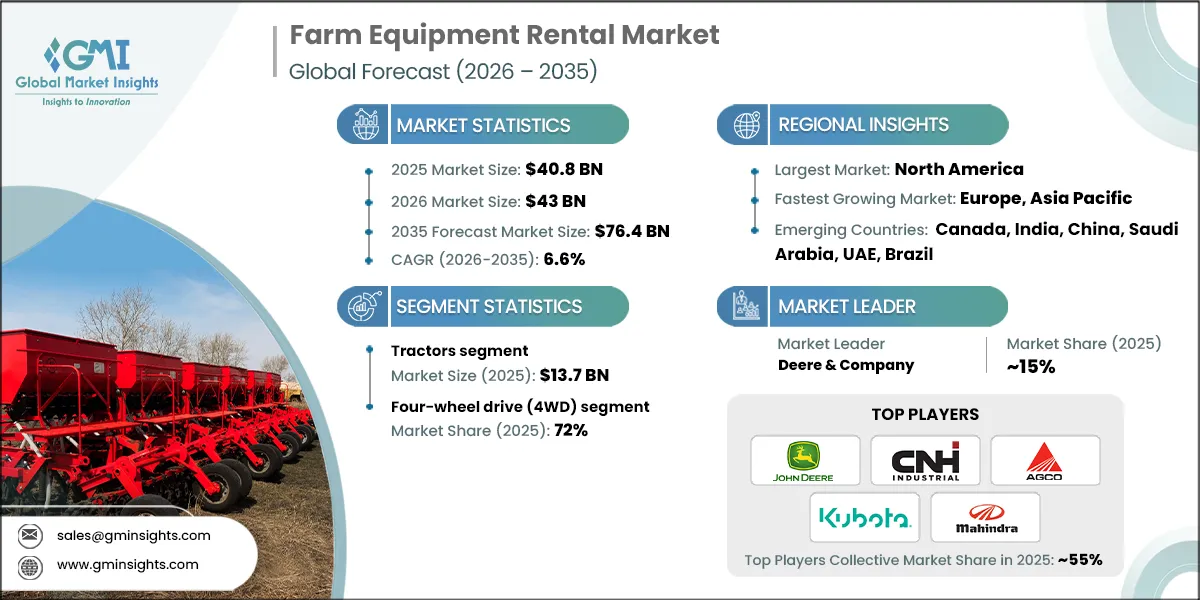
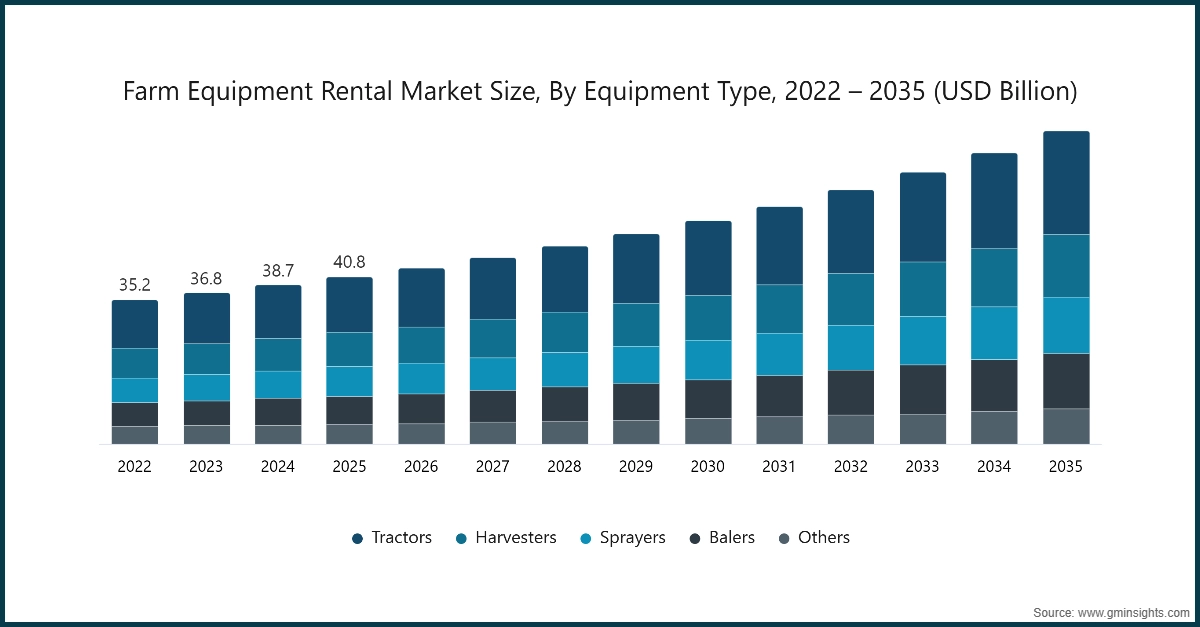
The farm equipment rental market was estimated at USD 40.8 billion in 2025. The market is expected to grow from USD 43 billion in 2026 to USD 76.4 billion in 2035, at a CAGR of 6.6% according to latest report published by Global Market Insights Inc.
Farm Equipment Rental Market Key Takeaways
Market Size & Growth
- 2025 Market Size: USD 40.8 Billion
- 2026 Market Size: USD 43 Billion
- 2035 Forecast Market Size: USD 76.4 Billion
- CAGR (2026–2035): 6.6%
Regional Dominance
- Largest Market: North America
- Fastest Growing Region: Europe, Asia Pacific
Key Market Drivers
- High cost of new farm equipment.
- Diverse equipment offerings by rental companies.
- Increasing need to reduce the financial burden on farmers across the globe.
- Growing demand for productivity and operational efficiency.
Challenges
- Growing government initiatives and subsidies for purchasing new farm equipment.
- Problems related to lack of safety-related regulation in developing countries.
Opportunity
- Rising adoption of precision agriculture creates demand for advanced rental machinery.
- Expansion of digital rental platforms and on-demand services.
Key Players
- Market Leader: Deere & Company led with over 15% market share in 2025.
- Leading Players: Top 5 players in this market include Deere & Company, CNH Industrial, AGCO Corporation, Kubota Corporation, Mahindra & Mahindra, which collectively held a market share of 55% in 2025.
Get Market Insights & Growth Opportunities
- The farm equipment rental market is experiencing significant growth, driven by the prohibitive costs of purchasing new agricultural machinery. Modern tractors, harvesters, sprayers, and other advanced equipment now feature precision-farming technologies, automation, and high-horsepower capabilities, which have substantially increased their prices. For instance, the cost of a new combine harvester can range from USD 300,000 to USD 500,000, making ownership financially unfeasible for many farmers. As a result, renting has become a preferred alternative, allowing farmers to avoid heavy upfront capital investments, long-term depreciation, and high maintenance expenses. This trend is particularly evident among small and medium-sized farmers, who often operate on limited budgets and cannot justify purchasing expensive machinery that is only used during specific seasons.
- The growing availability of diverse equipment offerings from rental companies is further fueling market expansion. Rental providers now offer a wide range of machinery tailored to specific crop types, field conditions, and agricultural activities. Farmers can choose from basic tractors to specialized harvesters and precision sprayers, gaining access to advanced tools that would otherwise be unaffordable. According to the United States Department of Agriculture (USDA), the adoption of precision agriculture technologies, often integrated into rental equipment, has been shown to increase crop yields by 10-15% while reducing input costs. Additionally, the proliferation of digital rental platforms, dealer-backed rental programs, and on-demand machinery services has simplified the rental process, making advanced equipment more accessible to farmers worldwide.
- The need to reduce financial burdens on farmers is another key driver of the rental market. Farmers face income volatility due to unpredictable weather, fluctuating commodity prices, rising input costs, and labor shortages. Renting equipment eliminates the need for substantial investments, enabling farmers to allocate resources toward essential inputs such as seeds, fertilizers, and labor. This flexibility is particularly critical in developing economies, where limited access to credit often forces farmers to rely on affordable machinery solutions. For example, in India, the government’s Sub-Mission on Agricultural Mechanization (SMAM) promotes farm equipment rentals to improve mechanization rates among smallholder farmers.
- Moreover, the rising demand for higher productivity and operational efficiency in agriculture is accelerating the growth of the farm equipment rental market. With global food demand projected to increase by 70% by 2050, according to the Food and Agriculture Organization (FAO), farmers are under pressure to enhance yields and optimize operations. Renting advanced equipment allows them to adopt modern farming practices, improve field operations, and complete tasks with greater speed and precision. This access to state-of-the-art machinery, used only when needed, helps farmers maximize resources and achieve higher output, driving sustained growth in the farm equipment rental industry.
To get key market trends
Farm Equipment Rental Market Trends
The farm equipment rental industry is witnessing robust growth, driven by rapid advancements in technology and the increasing adoption of flexible, digital service models. A key trend shaping the market is the integration of precision agriculture technologies into rental fleets. These technologies include GPS-enabled tractors, automated harvesters, smart sprayers, and drones equipped with advanced imaging systems. By incorporating such high-tech machinery, rental companies enable farmers to access state-of-the-art equipment without the financial burden of significant capital investments.
Additionally, the proliferation of digital platforms and mobile-based rental applications is transforming the market landscape. These platforms allow farmers to seamlessly browse available equipment, compare pricing options, schedule rentals, and arrange for doorstep delivery. This digital transformation enhances transparency, streamlines operations, and encourages broader adoption, particularly among small and mid-sized farmers who often face resource constraints. Furthermore, rental companies are diversifying their offerings by including specialized machinery designed for crop-specific requirements, such as rice transplanters, sugarcane harvesters, and cotton pickers. This diversification ensures that farmers can select precise tools tailored to each stage of the cultivation process, improving efficiency and productivity.
- The market is also experiencing a shift toward shared-economy and pay-per-use rental models, which provide farmers with greater financial flexibility and cost-efficiency. In regions characterized by fragmented land holdings, agricultural cooperatives and community-based machinery sharing pools are gaining significant traction. These collaborative approaches allow multiple farmers to benefit from access to high-value equipment without the need for individual ownership, reducing financial strain and promoting resource sharing. Sustainability considerations are further influencing market trends, as renting equipment minimizes redundant ownership, reduces idle machinery, and promotes optimal utilization of resources.
- Moreover, the growing labor shortages in the agricultural sector, coupled with the increasing demand for faster and more efficient farming operations, are driving the need for high-capacity rental equipment during peak agricultural seasons. This demand is particularly evident in the case of large-scale machinery such as combine harvesters, ballers, and multi-row planters, which are essential for time-sensitive farming activities. Collectively, these trends highlight a broader transition toward cost-effective, technology-driven, and efficiency-focused farming practices.
Farm Equipment Rental Market Analysis
 Learn more about the key segments shaping this market
Learn more about the key segments shaping this market
Based on equipment type, the market is categorized into tractors, harvesters, sprayers, balers and others. The tractors accounted for revenue of around USD 13.7 billion in 2025 and is anticipated to grow at a CAGR of 6.4% from 2026 to 2035.
- Their ability to perform multiple tasks including plowing, tilling, hauling, planting, and land preparation significantly increases their rental demand, particularly for small and medium‑sized farmers who cannot justify the high cost of ownership. Renting tractors also allows farmers to access modern, high‑horsepower, fuel‑efficient, and technologically advanced models without committing to maintenance, storage, or depreciation costs.
Moreover, seasonal farming cycles create peak periods where temporary access to tractors becomes critical for timely operations, further boosting rental activity. The rise of precision agriculture and the need for compatible machinery capable of supporting digital tools and advanced implements also encourage farmers to rent updated tractors instead of buying older or less efficient ones.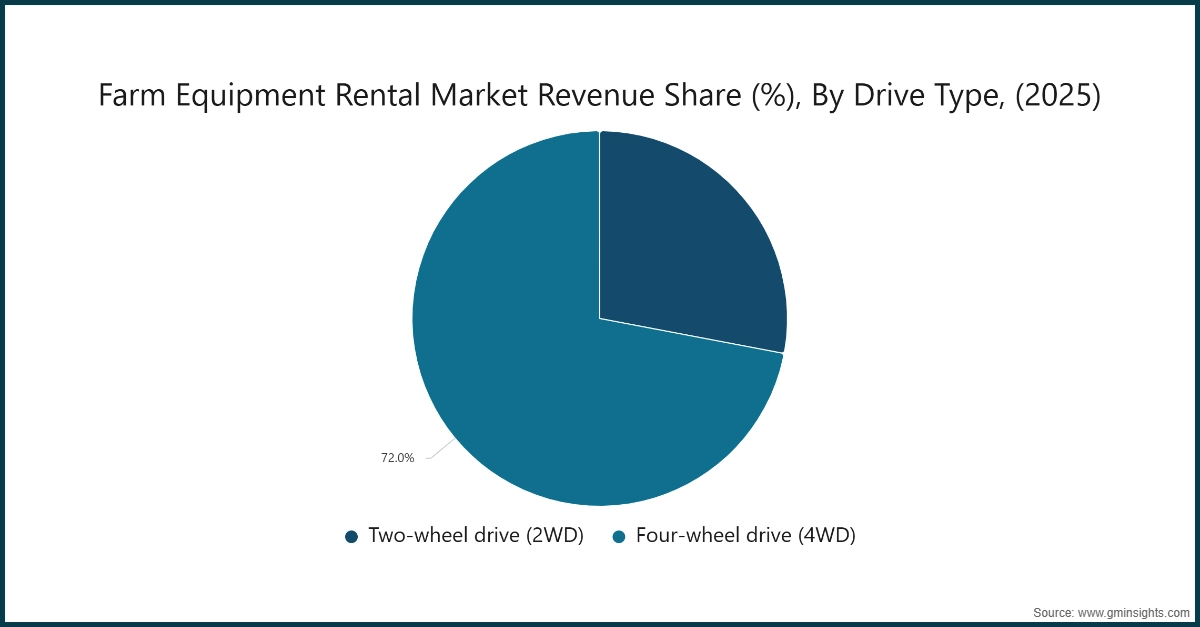
Learn more about the key segments shaping this market
Based on drive type, the farm equipment rental market consists of two‑wheel drive (2WD) and four‑wheel drive (4WD). The four‑wheel drive (4WD) emerged as leader and held 72% of the total market share in 2025 and is anticipated to grow at a CAGR of 6.7% from 2026 to 2035.
- Farmers increasingly prefer 4WD machines because they offer higher traction, better stability, and stronger pulling power, making them ideal for heavy‑duty tasks such as deep tillage, large‑scale plowing, and handling advanced attachments. As farms expand and mechanization intensifies, the need for powerful equipment capable of operating efficiently on uneven, soft, or challenging terrains becomes more critical driving demand for 4WD rentals over traditional two‑wheel drive models.
- Additionally, 4WD equipment supports greater fuel efficiency and productivity in large-scale commercial operations, reducing labor time and operational costs. The rising adoption of precision farming technologies also favors 4WD machinery, as these modern implements often require higher horsepower and robust drivetrains to function optimally.
North America Farm Equipment Rental Market
 Looking for region specific data?
Looking for region specific data?
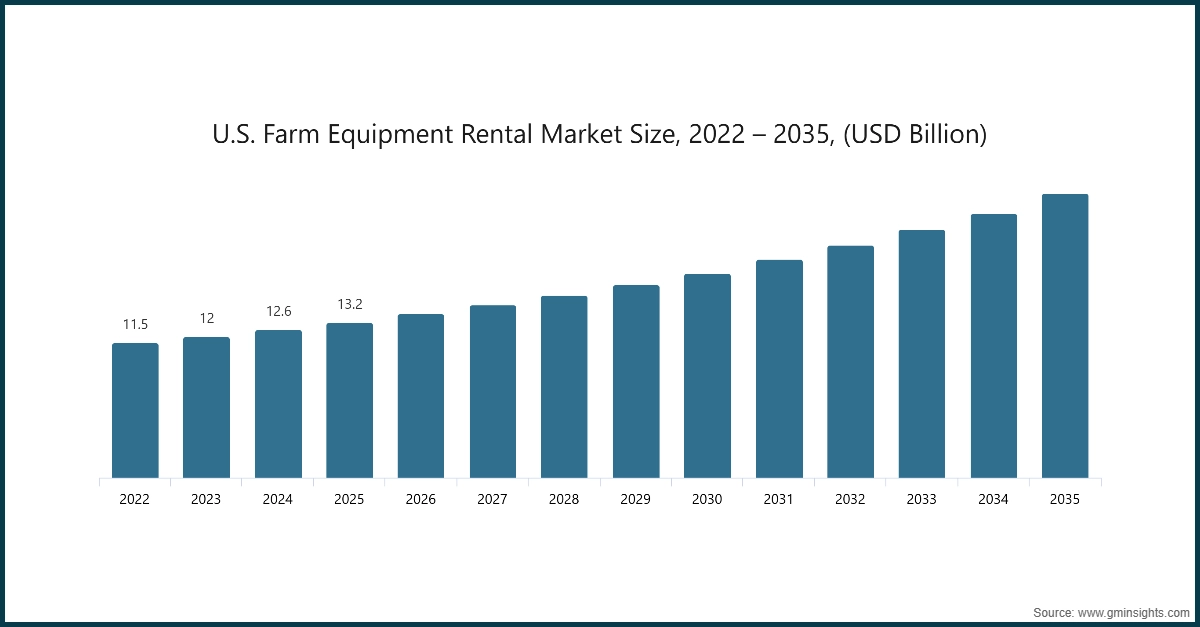
The U.S. dominates the overall North America farm equipment rental market and valued at USD 13.2 billion in 2025 and is estimated to grow at a CAGR of 6.3% from 2026 to 2035.
- Farmers across the country are increasingly turning to rental services to reduce the high upfront capital costs associated with purchasing modern, technologically advanced equipment, which often requires significant investment and ongoing maintenance. Rising input costs, unpredictable commodity prices, and climate‑related uncertainties are further pushing farmers, especially small and mid‑sized operators to adopt more flexible and cost‑efficient models like renting. At the same time, rapid advancements in precision agriculture, automation, and smart machinery mean that buying equipment outright can quickly lead to technological obsolescence, making rental a more attractive option for staying updated without long-term financial commitments.
Europe Farm Equipment Rental Market
In the European market, Germany is expected to experience significant and promising growth from 2026 to 2035.
- The nation’s farming landscape is characterized by a large population of small and medium‑sized farms that increasingly prefer renting machinery to avoid the heavy financial burden of purchasing advanced equipment outright. As Germany continues its shift toward highly mechanized and precision‑based agriculture, farmers are seeking access to modern technologies such as GPS‑guided tractors, smart harvesting systems, and automated implements without committing to long‑term ownership or costly maintenance.
- Additionally, rising labor shortages, higher operational expenses, and stringent environmental regulations are pushing farmers to seek more efficient, flexible, and sustainable equipment solutions, which rental models can provide. Seasonal variability in crop cultivation also makes rentals more attractive, as farmers can access specialized machinery only when required, optimizing costs and productivity.
Asia Pacific Farm Equipment Rental Market
In the Asia Pacific market, the China held 34% share in 2025 and is anticipated to grow at a CAGR of 7.4% from 2026 to 2035.
Rapid mechanization, coupled with ongoing consolidation of farmland through cooperative farming models, is creating a higher demand for advanced machinery that many small and mid‑sized farmers cannot afford to purchase outright. Renting equipment allows these farmers to access modern technologies such as high‑horsepower tractors, precision sprayers, and specialized harvesting machines without bearing the burden of high capital investment or maintenance costs.
- Additionally, China’s rural labor shortage, driven by continued urbanization, is accelerating the shift toward machinery-based farming, further boosting reliance on rental services. Government initiatives that promote agricultural modernization and support shared‑use farming services are also playing a key role, as local service centers and cooperatives increasingly offer machinery rentals to improve productivity and efficiency.
Middle East and Africa Farm Equipment Rental Market
In the Middle East and Africa market, Saudi Arabia held 32% market share in 2025.
- The country’s strategic focus on enhancing food security and reducing dependence on imports is encouraging farmers to adopt advanced machinery, yet the high upfront cost of purchasing such equipment makes renting a far more practical option especially for small and medium‑sized farms operating in arid conditions. Government-backed initiatives supporting mechanization, sustainable farming, and water‑efficient agricultural techniques are also driving greater demand for specialized and modern equipment that many farmers prefer to access through rental services rather than ownership.
- Additionally, the rise of large-scale farming projects and the expansion of agribusinesses are creating seasonal and project-based machinery needs, which further increases reliance on flexible rental solutions.
Farm Equipment Rental Market Share
- In 2025, the prominent manufacturers in farm equipment rental industry are Deere & Company, CNH Industrial, AGCO Corporation, Kubota Corporation and Mahindra & Mahindra collectively held the market share of ~55%.
- Deere & Company stays competitive by aggressively transforming itself from a traditional machinery manufacturer into a technology‑driven, AI‑centric agricultural solutions provider. Its innovations include advanced precision agriculture systems like See & Spray, which uses machine learning, robotics, and high‑speed cameras to precisely target weeds, significantly cutting chemical usage. The company also leads in autonomous equipment, highlighted by its fully autonomous 8R tractor capable of independent operation across large fields.
- AGCO stays competitive through its “Farmers First” innovation strategy, offering both high‑tech machinery and retrofit precision upgrades. Its brands introduce breakthrough technologies such as OutRun autonomous grain cart systems, RowPilot AI‑powered weeding, and SymphonyVision smart spraying, enabling farms to achieve higher efficiency and lower input dependency. AGCO leads in sustainability and electrification with products like the Fendt e100 V Vario, a fully electric tractor, and its Future Battery Concept, supporting the shift toward low‑carbon farming.
Farm Equipment Rental Market Companies
Major players operating in the farm equipment rental industry include:
- AGCO Corporation
- Bobcat Company
- Case IH
- Caterpillar (CAT)
- Claas
- CNH Industrial
- Deere & Company
- Fendt
- JCB
- Kubota Corporation
- Mahindra & Mahindra
- Massey Ferguson
- New Holland Agriculture
- SDF Group (Same Deutz-Fahr)
- Yanmar
CNH Industrial, through its renowned brands such as New Holland and Case IH, maintains its competitive edge by prioritizing the development of advanced smart farming technologies. The company continues to expand its diverse equipment portfolio, which includes tractors, harvesters, and specialized machinery designed to meet the evolving needs of modern agriculture. CNH Industrial places a strong emphasis on automation, electrification, and connected farming solutions, ensuring its offerings remain at the forefront of innovation.
Kubota Corporation strengthens its market position by focusing on compact machinery and advanced precision technologies tailored to meet the diverse requirements of global farming conditions. The company invests heavily in the development of fuel-efficient engines that reduce environmental impact, lightweight tractors that offer enhanced maneuverability, and autonomous machinery designed to optimize productivity on small to medium-sized farms. These segments are particularly significant as they dominate the demand for equipment rentals in many regions worldwide.
Farm Equipment Rental Market Report Attributes
| Key Takeaway | Details |
|---|---|
| Market Size & Growth | |
| Base Year | 2025 |
| Market Size in 2025 | USD 40.8 Billion |
| Market Size in 2026 | USD 43 Billion |
| Forecast Period 2026-2035 CAGR | 6.6% |
| Market Size in 2035 | USD 76.4 Billion |
| Key Market Trends | |
| Drivers | Impact |
| High cost of new farm equipment | The high purchase price of tractors, harvesters, and advanced implements pushes farmers toward rentals as a cost effective alternative. |
| Diverse equipment offerings by rental companies | A broader fleet ranging from basic tractors to specialized implements attracts more farmer segments with varied cultivation needs. |
| Increasing need to reduce the financial burden on farmers across the globe | Rentals help farmers operate efficiently without incurring ownership costs such as maintenance, storage, and insurance. |
| Growing demand for productivity and operational efficiency | Farmers are increasingly renting modern, high capacity equipment to complete tasks faster and with greater precision. |
| Pitfalls & Challenges | Impact |
| Growing government initiatives and subsidies for purchasing new farm equipment | Subsidies make ownership more affordable, reducing reliance on rentals in regions with strong government support. |
| Problems related to lack of safety-related regulation in developing countries | Insufficient safety standards lead to improper use, frequent breakdowns, and higher insurance risks for rental companies. |
| Opportunities: | Impact |
| Rising adoption of precision agriculture creates demand for advanced rental machinery | Farmers increasingly seek short term access to GPS enabled, sensor based, and automated machines rather than purchasing them outright. |
| Expansion of digital rental platforms and on-demand services | Mobile apps and online booking systems simplify equipment access, increase transparency, and improve asset utilization. |
| Market Leaders (2025) | |
| Market Leader |
Market share of ~15% |
| Top Players |
Collective market share of ~55% |
| Competitive Edge |
|
| Regional Insights | |
| Largest Market | North America |
| Fastest growing market | Europe, Asia Pacific |
| Emerging countries | Canada, India, China, Saudi Arabia, UAE, Brazil |
What are the growth opportunities in this market?
Farm Equipment Rental Industry News
- In January 2024, Kubota unveiled its fully electric, autonomous New Agri Concept vehicle at CES. The vehicle boasts six independent drive motors for enhanced maneuverability, a three-point hitch compatible with existing implements, and a rapid charging capability, reaching 10 to 80 percent in under six minutes. Additionally, it features integrated systems for real-time monitoring, AI-based diagnostics, and automated water-management support.
- In February 2025, Deere rolled out a suite of upgrades for the 2026 model year. Notably, the upgrades include Deere's next-generation Perception System, which facilitates autonomous tillage. This system employs a network of forward-facing cameras, advanced lighting modules, and a processor suite for real-time environment mapping.
- In September 2025, SNS Insider reported that CNH is set to launch an enhanced tractor lineup in 2026. The revamped specialty tractors, including the New Holland T4F, T4V, and T4F S Series, will feature larger fuel tanks, improved ergonomics, and upgraded hydraulic systems. Additionally, Case IH's Early Riser planters will see enhancements in planting accuracy.
- In June 2025, CNH Industrial announced its plans to unveil a revamped agricultural equipment lineup for the 2026 model year. This lineup will showcase redesigned tractors, spanning from 20 to over 700 horsepower, under both the New Holland and Case IH brands.
The farm equipment rental market research report includes in-depth coverage of the industry, with estimates & forecast in terms of revenue (USD Billion) and volume (Units) from 2022 to 2035, for the following segments:
Market, By Equipment Type
- Tractors
- Harvesters
- Sprayers
- Balers
- Others
Market, By Drive Type
Two‑wheel drive (2WD)
Four‑wheel drive (4WD)
Market, By Power Output
- 30 HP
- 31-70 HP
- 71-130 HP
- 131-250 HP
- >250HP
Market, By Rental Duration
- Short‑term
- Medium‑term
- Long‑term
Market, By Power Source
- Diesel
- Electric
- Hydraulic
- Pneumatic
Market, By Application
- Ploughing & soil preparation
- Sowing & planting
- Plant protection & fertilization
- Harvesting & threshing
- Post‑harvest operations
- Livestock-related applications
- Forest farm activities
Market, By End User
- Individual farmers
- Agricultural cooperatives
- Commercial farms
- Government agencies
- Research institutions
The above information is provided for the following regions and countries:
- North America
- U.S.
- Canada
- Europe
- Germany
- UK
- France
- Italy
- Spain
- Asia Pacific
- China
- Japan
- India
- South Korea
- Australia
- Indonesia
- Malaysia
- Latin America
- Brazil
- Mexico
- Argentina
- MEA
- Saudi Arabia
- UAE
- South Africa
Frequently Asked Question(FAQ) :
What is the market size of the farm equipment rental in 2025?
The market size was USD 40.8 billion in 2025, with a CAGR of 6.6% expected through 2035 driven by high equipment costs, precision agriculture adoption, and the need for financial flexibility among farmers.
What is the projected value of the farm equipment rental market by 2035?
The farm equipment rental market is expected to reach USD 76.4 billion by 2035, propelled by technological advancements, digital rental platforms, and increasing demand for productivity in agriculture.
What is the current farm equipment rental market size in 2026?
The market size is projected to reach USD 43 billion in 2026.
How much revenue did the tractors segment generate in 2025?
Tractors generated USD 13.7 billion in 2025 and are anticipated to grow at a CAGR of 6.4% from 2026 to 2035.
What was the market share of four-wheel drive (4WD) equipment in 2025?
Four-wheel drive (4WD) held 72% market share in 2025 and is anticipated to grow at a CAGR of 6.7% from 2026 to 2035.
What is the growth outlook for the U.S. farm equipment rental market from 2026 to 2035?
The U.S. market valued at USD 13.2 billion in 2025 is projected to grow at a 6.3% CAGR till 2035, due to rising input costs, technological advancements, and flexible rental models.
Which region shows the highest growth rate in the Asia Pacific market?
China held 34% share in 2025 with a projected CAGR of 7.4% from 2026 to 2035. Rapid mechanization, cooperative farming models, and government initiatives drive growth.
What are the upcoming trends in the farm equipment rental market?
Key trends include integration of precision agriculture technologies, proliferation of digital rental platforms, shared-economy models, and sustainability-focused equipment utilization for efficient farming.
Who are the key players in the farm equipment rental market?
Key players include Deere & Company, CNH Industrial, AGCO Corporation, Kubota Corporation, Mahindra & Mahindra, Case IH, New Holland Agriculture, Fendt, Massey Ferguson, JCB, Caterpillar, Bobcat Company, Claas, SDF Group, and Yanmar.
Farm Equipment Rental Market Scope
Related Reports