Summary
Table of Content

Farm Equipment Market
Get a free sample of this report
Form submitted successfully!
Error submitting form. Please try again.
Thank you!
Your inquiry has been received. Our team will reach out to you with the required details via email. To ensure that you don't miss their response, kindly remember to check your spam folder as well!
Request Sectional Data
Thank you!
Your inquiry has been received. Our team will reach out to you with the required details via email. To ensure that you don't miss their response, kindly remember to check your spam folder as well!
Form submitted successfully!
Error submitting form. Please try again.
Farm Equipment Market Size
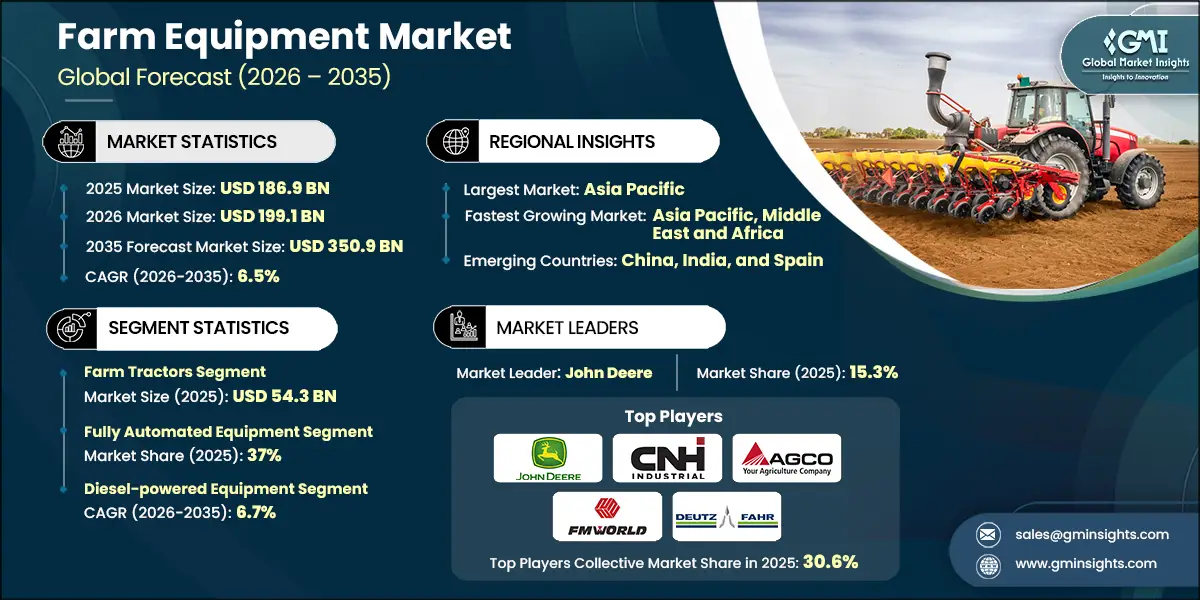
The global farm equipment market was estimated at USD 186.9 billion in 2025. The market is expected to grow from USD 199.1 billion in 2026 to USD 350.9 billion in 2035, at a CAGR of 6.5%, according to latest report published by Global Market Insights Inc.
Farm Equipment Market Key Takeaways
Market Size & Growth
- 2025 Market Size: USD 186.9 Billion
- 2026 Market Size: USD 199.1 Billion
- 2035 Forecast Market Size: USD 350.9 Billion
- CAGR (2026–2035): 6.5%
Regional Dominance
- Largest Market: Asia Pacific
- Fastest Growing Region: Asia Pacific, Middle East and Africa
Key Market Drivers
- Increasing adoption of mechanized farming practices.
- Rising global population driving agricultural output demand.
Challenges
- High initial investment costs.
- Raw material price fluctuations.
Opportunity
- Precision agriculture technologies revolution.
- Automation and Robotics Integration.
Key Players
- Market Leader: John Deere led with over 15.3% market share in 2025.
- Leading Players: Top 5 players in this market include John Deere, CNH Industrial, AGCO Corporation, FMWORLD Agricultural Machinery, Deutz-Fahr, which collectively held a market share of 30.6% in 2025.
Get Market Insights & Growth Opportunities
The strong growth trajectory is indicative of the acceleration that global agriculture is experiencing due to mechanization, technological innovation, and an imperative when it comes to rising food demand from an expanding world population projected to reach 9.7 billion by 2050 according to the United Nations demographic projections.
India’s agriculture and fisheries exports grew from USD 35.16 billion in FY20 to USD 51.23 billion in FY25, recording 7.82% CAGR and reflecting strong demand growth. India targets USD 1 billion in turmeric exports by 2030, with the Turmeric Board supporting farmers, maintaining a 58-66% global market share.
India’s agricultural output has expanded significantly in the past decade, recording 40% growth and achieving surplus capacity for exports. In FY25, the sector grew by 5.4% year-on-year, supported by record production and higher trade volumes. Agricultural exports touched an all-time high of US$ 51.86 billion in FY25, up from US$ 48.15 billion in FY24. Agriculture and allied activities together contributed 17.8% to India’s GDP in 2023-24, reaffirming the sector’s importance to the national economy.
The farm equipment market consists of a wide variety of machinery and tools developed to help improve farming productivity, decrease dependency on labor, and enhance operational efficiency across a wide spectrum of farming activities. From the traditionally used tractors and harvesters to fully integrated precision agricultural systems with GPS guidance, sensors, and artificial intelligence, the industry is undergoing unparalleled technological convergence, says the Food and Agriculture Organization.
The segment caters to different agricultural sectors, like crop production, animal husbandry, and horticulture, and includes basic manual equipment to highly sophisticated totally automated machinery capable of independent operation.
To get key market trends
Farm Equipment Market Trends
- Precision agriculture technologies, such as GPS guidance systems, sensors, and drones, have already assisted farmers in optimizing inputs like seeds, fertilizers, and water. These technologies enable variable rate applications, real-time field monitoring, and data-driven decision-making that considerably enhance crop yields while reducing input costs by 15-20%, according to the United States Department of Agriculture.
- Satellite imagery, soil sensors, and analytics of weather data are making traditional farming a data-intensive industry. By using such analytics, farmers are able to create detailed field maps that show variations in soil composition, moisture content, and nutrient levels, thus allowing site-specific management to maximize productivity, according to NASA agricultural research programs.
- Automation and robotics are increasingly being integrated into agricultural equipment to overcome acute labor shortages that have been affecting farms worldwide. According to the International Labor Organization, the global agricultural sector faces a shortage of more than 3.5 million workers every year, which fuels urgent demand for automated solutions.
- Autonomous tractors, robotic harvesters, and automated irrigation systems are enabling 24/7 operations without human supervision, while substantially improving productivity. Advanced computer vision, machine learning algorithms, and sensor fusion technologies have been used in these systems to provide the aforementioned capabilities such as navigation of fields, identification of crops versus weeds, and selective harvesting with precision beyond human capability.
- Manufacturing and farming are now open to using greener alternatives in the form of machines that reduce environmental impact, dependence on fossil fuel, and result in resource efficiency.
- There's growing electric and hybrid farm equipment on the market, while leading manufacturers have introduced electric tractors with zero direct emissions and significantly lower noise levels than those recommended by the Environmental Protection Agency.
- Regulatory frameworks, like the European Union's Farm to Fork Strategy, coupled with various national agricultural sustainability programs, are accelerating this transition through financial incentives to adopt cleaner technologies in conformance with the European Commission agricultural policy.
- The increased mainstream acceptance of regenerative agriculture is showing up as greater conservation tillage equipment usage, which reduces soil disturbance, and equipment designed for cover crop management.
Farm Equipment Market Analysis
Learn more about the key segments shaping this market
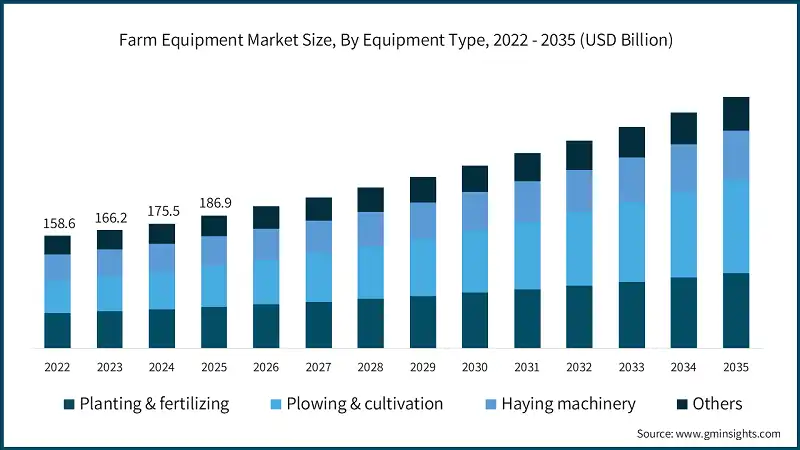
Based on the equipment type, the market is divided into farm tractors, harvesting machinery, planting & fertilizing, plowing & cultivation, haying machinery and others. In 2025, farm tractors dominated the market, generating revenue of USD 54.3 billion and expected to grow at a CAGR of 5.3% during the forecast period.
- Farm tractors’ segment will see steady growth during the forecast period, with growing mechanization in agriculture and adoption of advanced technologies. Compact and utility tractors have seen a growing demand for small and medium-scale farms. Government subsidies and other financial support in purchasing agricultural machinery have also been encouraging the growth in this segment.
- The segment of harvesting machinery will see a robust growth rate owing to the growing need for effective machinery solutions for harvesting with the increasing demand for food products across the globe. The advancements in technology, including automatic and precise harvesting machinery, are driving its adoption by large-scale farmers.
- The segment of planting and fertilizing tools is expected to see significant growth, supported by an increased focus on precision agriculture and sustainable farming practices. Advanced planting and fertilizing equipment are being increasingly adopted by farmers to optimize seed placement and nutrient application, improving crop yields. This is also being furthered by the inclusions of GPS and IoT technologies in the tools.
- The segment of haying machinery is expected to show moderate growth with the rise in demand for animal feed and forage crops. Advanced haying equipment, such as ballers and mowers, are being increasingly adopted by livestock farmers in an effort to enhance efficiency and reduce post-harvest losses.
Learn more about the key segments shaping this market
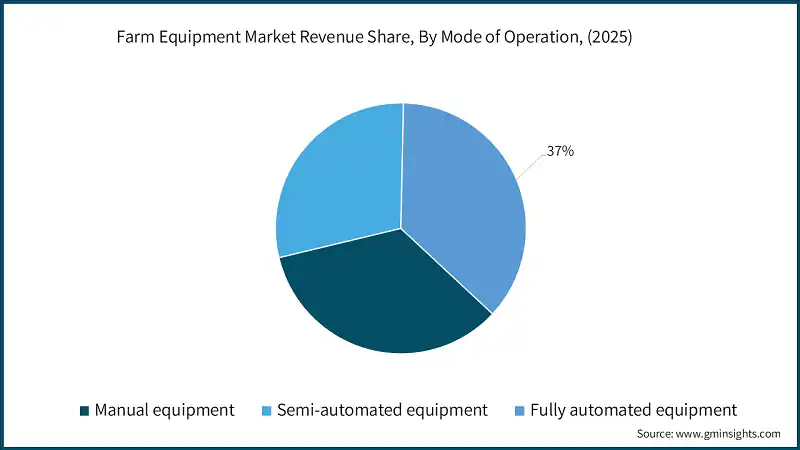
Based on mode of operation, the farm equipment market is segmented into manual equipment, semi-automated equipment and fully automated equipment. In 2025, fully automated equipment segment dominates the market with 37% market share, and the segment is expected to grow at a CAGR of 6.9% from 2026 to 2035.
- The manual equipment segment is expected to see steady growth during the forecast period. This segment's growth is attributed to its affordability and thereby finds extensive application in small-scale farming operations, especially in developing regions. Farmers belonging to the low-income group prefer manual equipment since it is economical and easy to use.
- The semi-automated equipment segment is expected to see a moderate growth rate during the forecast period. This is due to the fact that it strikes a balance between cost and efficiency, thus seeing its wide use in mid-sized farms. Semi-automated equipment offers improved productivity compared to manual tools while being more affordable than fully automated systems.
- It is anticipated that the fully automated equipment segment will grow significantly in the forecast period, driven by advancements in precision agriculture technologies and increasing demand for high-efficiency farming solutions.
Based on power, the farm equipment market is segmented into diesel-powered equipment, electric & hybrid equipment and alternative fuels. In 2025, the diesel-powered equipment segment dominates the market and is expected to grow at a CAGR of 6.7% from 2026 to 2035.
- The diesel-powered equipment segment remains the dominant segment in the farm equipment industry, considering its operation efficiency and availability. Farmers consider diesel engines more durable for heavy workloads; however, increasing emission standards and diesel prices push manufacturers to innovate and further improve fuel efficiency.
- The segment of electric and hybrid equipment is growing very rapidly, owing to rising environmental concerns and government incentives for sustainable farming. This segment is being further enhanced with the development of more advanced battery technology and increased adoption of precision agriculture.
- The alternative fuels segment is gaining momentum, given the industry's seeks to cut carbon emissions and lessen reliance on conventional fossil fuels. Equipment powered with biofuels, natural gas, and hydrogen is increasingly seen as a practical means toward sustainable farming.
Looking for region specific data?
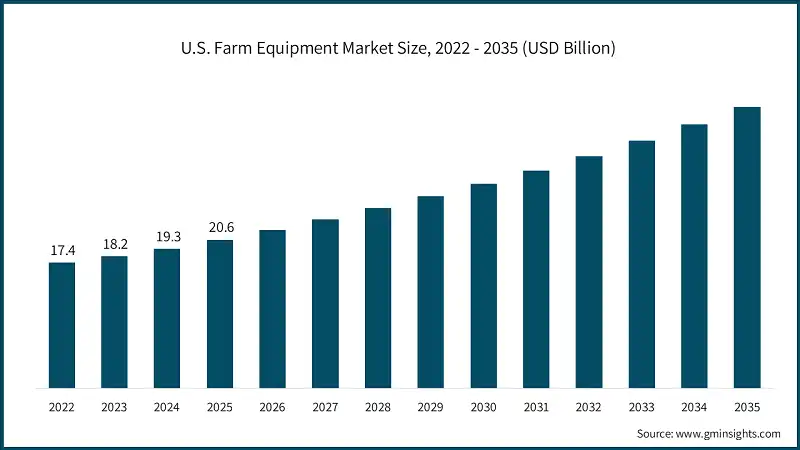
In terms of country, the United States led the farm equipment market with 80% of the North American market share and estimated USD 20.6 billion in revenue during 2025.
- The growth of the U.S. market is mainly driven by technological advancement, increased adoption of precision farming techniques, and demand for efficient and high-capacity machinery.
- Demand for farm machinery that can be used in various farm activities drives the growth in the tractor segment, while increasing awareness for reducing post-harvest losses and increasing operational efficiency drives demand for harvesting equipment.
- The irrigation equipment segment grows with the rising emphasis on water conservation and sustainable farming methods. Additionally, government subsidies and financial support for modernizing agricultural practices further boost market growth across all segments.
The Europe farm equipment market was valued at USD 18.1 billion in 2025 and is projected to grow at a CAGR of 6.1% between 2026 and 2035.
- The main driving factor is the increasing mechanization in agriculture in order to enhance productivity and efficiency. This demand for high-value machinery, such as tractors and harvesters, is driven by the requirement to address labor shortages and improve operational efficiency.
- Government subsidies and other forms of financial aid towards the development and modernization of agricultural practices further fuel market growth. Moreover, the increasing use of precision farming technologies and sustainable farming methods is engaging investments in novel types of equipment. Increasing food security and arable land expansion are also among major contributors to the extension of this market.
The Asia Pacific farm equipment market was valued at USD 112.5 billion in 2025 and is projected to grow at a CAGR of 6.8% between 2026 and 2035.
- Mechanization in agriculture raises productivity and reduces labor dependency, therefore driving the market in the Asia Pacific region. Increasing population levels and the consequent demand for food have pushed farmers to adopt more advanced machinery.
- This is further supported by government initiatives in the form of subsidies and financial incentives regarding the purchase of farm equipment. Growing awareness related to farm management, sustainable farming practices, and resource utilization further optimizes the chances of market growth. Increasing agricultural activities in emerging economies like India and China will further support demand for farm equipment.
The Middle East and Africa farm equipment market was valued at USD 16.8 billion in 2025 and is projected to grow at a CAGR of 5.6% between 2026 and 2035.
- Increasing mechanization in agriculture is one of the factors driving the growth of the Middle East and Africa market, as this enhances productivity and efficiency. Increasing population levels and the high demand for food have pushed farmers to adopt advanced machinery.
- The region's focus on reducing dependency on labor and increasing crop yields is also a significant factor. These factors together push the demand for improved and efficient farm equipment across the Middle East and Africa.
Farm Equipment Market Share
- The top 5 companies in the farm equipment industry are AGCO Corporation, CNH Industrial, Deutz-Fahr, FMWORLD Agricultural Machinery and John Deere collectively hold a share of 30.6% in the market.
- These companies continue to acquire and merge with others, expand facilities, and make various collaborations to increase their product offerings, access customer bases, and secure their market positions.
- John Deere continues to dominate the farm equipment market. It is gaining market share by investing deeply in research and development, offering ultra-modern equipment, and maintaining very strong customer relationships. The company is focused on the integration of advanced technologies, such as smart farming and precision agriculture solutions, into its flagship product offerings, with an aim to further improve productivity and efficiency for farmers.
- AGCO Corporation focuses on innovation and sustainability to secure more market share. The company invests in advanced technologies, such as precision agriculture and smart farming solutions, to meet the emerging needs of its customers. In addition, the company is focusing on deepening its global presence by enhancing its dealer network and expanding into emerging markets.
- Using their expertise in advanced engineering and precision farming solutions, Deutz-Fahr continuously gains market share. They have been working on the design and development of high-performance tractors and other agricultural machinery, keeping in mind the demands that farmers face every day. Innovation, quality, and reliability are key competitive advantages of this firm in the market.
Farm Equipment Market Companies
Major players operating in the farm equipment industry are:
- AGCO Corporation
- Bomet
- CLAAS
- CNH Industrial
- Deutz-Fahr
- FMWORLD Agricultural Machinery
- JCB
- John Deere
- Kubota Corporation
- KUHN
- Mahindra & Mahindra
- SDF Group
- Vermeer Corporation
- Yanmar
To improve the product and market share key players are constantly investing in technological activities and are also entering into partnerships to provide improved and better solutions for the customers. These investments are benefiting both companies and customers as they help develop and offer solutions as per the changing technological trends and thus the customer requirements.
Bomet operates in the farm equipment market, manufacturing agricultural machinery that not only makes farming easier but more efficient. Its many products, from plows to seed drills to cultivators, target both small-scale and large-scale farmers. Innovation and durability characterize Bomet machines, which are bound to keep up with the demands of present agriculture.
JCB is an internationally renowned company in the field of construction and farm implements, offering a wide array of machinery tailored for farming applications. It has a reputation for supplying various categories of robust and versatile machinery, which include backhoe loaders, telehandlers, and compact tractors. The company emphasizes the use of innovation with the integration of advanced technology aimed at enhancing productivity and reducing operational costs for farmers.
Japan-based Kubota Corporation is a major manufacturer of agricultural machinery and equipment. The company's well-rounded portfolio includes tractors, combining harvesters, and rice transplanters to meet the needs of farmers around the globe. Their innovations are quite well-recognized, and they have been integrating advanced technologies to make farming more efficient and sustainable.
Mahindra & Mahindra is a flagship company of the Mahindra Group and is among the leading players in the global farm equipment market. The range of tractors and agricultural machinery which the company develops is designed to meet the needs of farmers in various geographies. Mahindra & Mahindra focuses on innovating and offering value-for-money products that provide high performance and are reliable.
Farm Equipment Market Report Attributes
| Key Takeaway | Details |
|---|---|
| Market Size & Growth | |
| Base Year | 2025 |
| Market Size in 2025 | USD 186.9 Billion |
| Market Size in 2026 | USD 199.1 Billion |
| Forecast Period 2026 - 2035 CAGR | 6.5% |
| Market Size in 2035 | USD 350.9 Billion |
| Key Market Trends | |
| Drivers | Impact |
| Increasing adoption of mechanized farming practices | The increasing adoption of mechanized farming practices to enhance productivity and efficiency represents the most significant growth driver |
| Rising global population driving agricultural output demand | With population growth concentrated in developing regions where agricultural productivity remains below global averages, the need for equipment that can increase yields per hectare is critical. |
| Pitfalls & Challenges | Impact |
| High initial investment costs | High initial investment costs associated with advanced farm equipment represent the most significant market restraint |
| Raw material price fluctuations | Farm equipment manufacturing is highly dependent on steel, aluminium, copper, rubber, and electronic components, all of which experience significant price volatility. |
| Opportunities: | Impact |
| Precision agriculture technologies revolution | Precision agriculture technologies, such as GPS guidance systems, sensors, and drones, have enabled farmers to optimize inputs like seeds, fertilizers, and water. |
| Automation and Robotics Integration | Automation and robotics are increasingly being integrated into agricultural equipment, addressing critical labour shortages affecting farms worldwide. |
| Market Leaders (2025) | |
| Market Leaders |
15.3% market share |
| Top Players |
Collective market share in 2025 is 30.6% |
| Competitive Edge |
|
| Regional Insights | |
| Largest Market | Asia Pacific |
| Fastest growing market | Asia Pacific, Middle East and Africa |
| Emerging countries | China, India, and Spain |
| Future outlook |
|
What are the growth opportunities in this market?
Farm Equipment Industry News
- In November 2025, AGCO showcase full-line innovation and smart farming technologies at Agritechnica 2025. AGCO showcases its differentiated portfolio including, Fendt debut five new tractor series alongside the harvesting power of the Fendt IDEAL combine and Katana forage harvester, reinforcing the brand's full-line capabilities.
- In November 2025, Claas has unveiled its new Axion 9 large tractor series at Agritechnica, featuring five wheeled models and two Terra Trac crawler variants covering 330 to 450hp. The tractors combine a redesigned premium cab, new electronic infrastructure and advanced assistance systems up to Autonomy Level 2, delivering maximum performance with improved efficiency and economy for large farms and contractors.
- In August 2025, Case IH is enhancing its comprehensive lineup of equipment and technology designed to meet the evolving needs of modern farmers. From the introduction of its most powerful tractor yet, the Steiger 785 Quadtrac, to the return of the Farmall M and more, Case IH is advancing its heritage of power, performance and innovation.
- In November 2025, DEUTZ-FAHR introduced new Series 8 to represent the next generation of high-performance tractors as a symbol of power, precision, and technological leadership. Spacious, quiet, and fully digital, it integrates a 15” iCluster display and 12.8” iMonitor 5 for total control of machine parameters, ISOBUS functions, and Smart Farming applications.
- In September 2025, Escorts Kubota Limited has introduced ‘PRO588i-G’, a new combine harvester under the Kubota brand in Punjab and Haryana. The new harvester cuts the crop’s stalk near its base (unlike conventional full-feed harvesters), reaping the full length of straw which can be collected and reused - the long straw becoming a potential source of additional income, having utility as cattle feed and in biomass plants.
The farm equipment market research report includes in-depth coverage of the industry with estimates & forecasts in terms of revenue (USD Billion) and volume (Thousand Units) from 2022 to 2035, for the following segments:
Market, By Equipment Type
- Farm tractors
- 4-wheel drive (4wd) tractors
- Row crop tractors
- Utility tractors
- Compact utility tractors
- Harvesting machinery
- Combine harvester
- Mower/swather
- Forage harvester
- Haying machinery
- Hay mowers
- Hay tedders
- Planting & fertilizing
- Plowing & cultivation
- Others (Irrigation equipment etc.)
Market, By Mode of Operation
- Manual equipment
- Semi-automated equipment
- Fully automated equipment
Market, By Power Source
- Diesel-powered equipment
- Electric & hybrid equipment
- Alternative fuels
Market, By Application
- Crop production applications
- Tillage & soil health management
- Planting & seeding operations
- Crop protection
- Harvesting & threshing
- Precision agriculture
- GPS-guided auto-steering
- Variable rate technology
- Yield monitoring & mapping
- Section control systems
- Conservation & sustainability
- Conservation tillage practices
- Precision irrigation
- Targeted pesticide application
- Livestock operations
- Dairy farming
- Cattle/hog feeding operations
Market, By End Use
- Commercial operations
- Small & medium farmers
Market, By Distribution Channel
- Direct sales
- Indirect sales
The above information is provided for the following regions and countries:
- North America
- U.S.
- Canada
- Europe
- Germany
- UK
- France
- Spain
- Italy
- Netherlands
- Asia Pacific
- China
- Japan
- India
- Australia
- South Korea
- Latin America
- Brazil
- Mexico
- Argentina
- MEA
- South Africa
- Saudi Arabia
- UAE
Frequently Asked Question(FAQ) :
What is the market size of the farm equipment industry in 2025?
The global market size for farm equipment was valued at USD 186.9 billion in 2025. Rising mechanization, precision agriculture adoption, and increasing food demand are driving industry expansion.
What is the market size of the farm equipment industry in 2026?
The market size reached USD 199.1 billion in 2026, reflecting consistent growth across global agricultural economies. Increasing integration of automation, robotics, and advanced machinery is strengthening market momentum.
What is the projected value of the farm equipment market by 2035?
The market size for farm equipment is expected to reach USD 350.9 billion by 2035, growing at a CAGR of 6.5%. This surge is fueled by precision farming technologies, autonomous machinery, and sustainability-focused modern agricultural practices.
How much revenue did the farm tractors segment generate in 2025?
The farm tractors segment generated USD 54.3 billion in 2025. Growth is supported by increased mechanization, government subsidies, and expanding adoption of compact and utility tractors.
What was the valuation of the fully automated equipment segment in 2025?
Fully automated equipment held 37% market share in 2025, driven by advancements in smart farming, labour shortages, and the need for high-efficiency machinery.
What is the growth outlook for the diesel-powered equipment segment from 2026 to 2035?
The diesel-powered equipment segment is projected to grow at a CAGR of 6.7% from 2026 to 2035. High durability, strong performance for heavy workloads, and continuous improvements in fuel efficiency support its long-term market presence.
Which region leads the farm equipment market?
The U.S. led the North America market with USD 20.6 billion in revenue in 2025, capturing 80% of the regional share. The country’s dominance is driven by precision farming adoption, demand for high-capacity machinery, and rapid integration of automated and GPS-enabled equipment.
What are the upcoming trends in the farm equipment industry?
Key trends include the rise of precision agriculture, integration of automation and robotics, adoption of electric and hybrid farm machinery, and increased use of data-driven farming technologies. Sustainability initiatives, conservation tillage equipment, and autonomous tractors are further transforming the global industry.
Who are the key players in the farm equipment market?
Major players include John Deere, CNH Industrial, AGCO Corporation, FMWORLD Agricultural Machinery, and Deutz-Fahr, collectively holding 30.6% share in 2025. Other key companies include Kubota Corporation, Mahindra & Mahindra, CLAAS, JCB, KUHN, Yanmar, Bomet, Vermeer Corporation, and SDF Group.
Farm Equipment Market Scope
Related Reports