Summary
Table of Content

Europe Window Coverings Market
Get a free sample of this report
Form submitted successfully!
Error submitting form. Please try again.
Thank you!
Your inquiry has been received. Our team will reach out to you with the required details via email. To ensure that you don't miss their response, kindly remember to check your spam folder as well!
Request Sectional Data
Thank you!
Your inquiry has been received. Our team will reach out to you with the required details via email. To ensure that you don't miss their response, kindly remember to check your spam folder as well!
Form submitted successfully!
Error submitting form. Please try again.
Europe Window Coverings Market Size
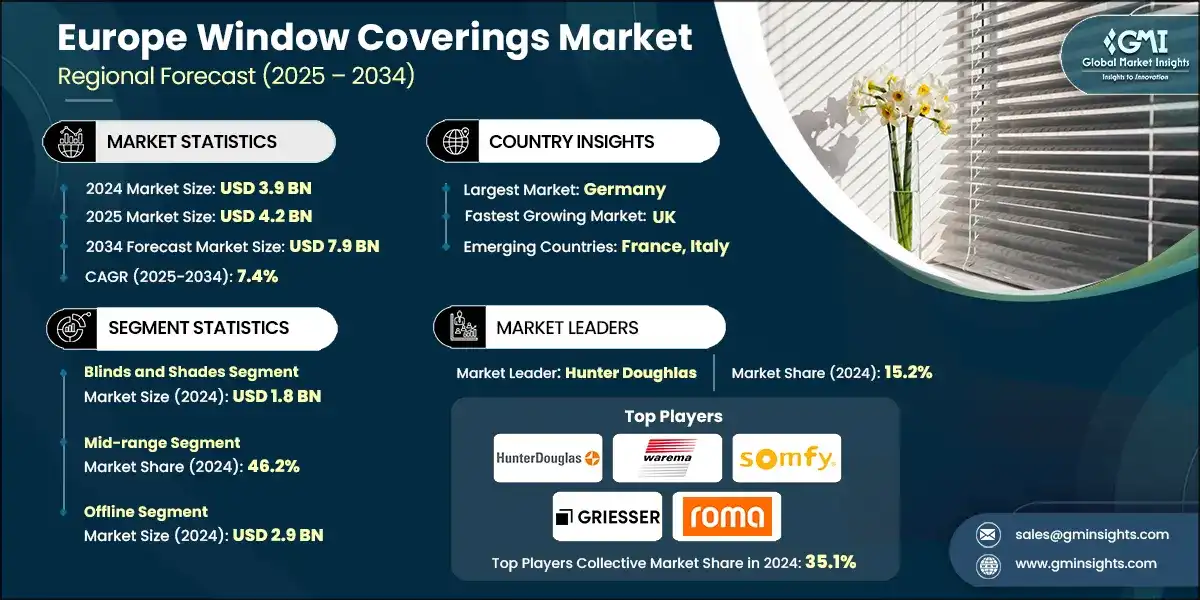
The Europe window coverings market was estimated at USD 3.9 billion in 2024. The market is expected to grow from USD 4.2 billion in 2025 to USD 7.9 billion in 2034, at a CAGR of 7.4%, according to latest report published by Global Market Insights Inc.
Europe Window Coverings Market Key Takeaways
Market Size & Growth
- 2024 Market Size: USD 3.9 Billion
- 2025 Market Size: USD 4.2 Billion
- 2034 Forecast Market Size: USD 7.9 Billion
- CAGR (2025–2034): 7.4%
Regional Dominance
- Largest Market: Germany
- Fastest Growing Country: UK
Key Market Drivers
- Rapid integration of smart home ecosystems.
- Resurgence in residential renovation and urbanization.
- Demand for energy-efficient solutions.
Challenges
- Volatility in raw material prices.
- Stringent safety regulations.
Opportunity
- Expansion into eco-friendly and recycled materials.
- Democratization of motorization.
Key Players
- Market Leader: Hunter Douglas led with over 15.2% market share in 2024.
- Leading Players: Top 5 players in this market include Hunter Douglas, WAREMA Renkhoff SE, Somfy, Griesser AG, Roma KG, which collectively held a market share of 35.1% in 2024.
Get Market Insights & Growth Opportunities
The European market for window coverings is having enormous growth because of the development of smart and connected home products. As more consumers seek out smart homes due mainly to rapid technological advances, demand for modern electrical window coverings has significantly increased as well. Many homes have been using products like Amazon Alexa and Google Home to manage their homes through an automated system, which has encouraged the growth of connected home products across Europe.
There is now a large and growing demand for electrical window coverings as a result of an increase in the number of households acquiring and using smart home devices. Apart from the many new benefits that come with using the newest technology such as, remote access via a mobile device, voice-activated operation, and automated programming, modern window coverings provide additional comfort, greater energy efficiency, and a greater level of security than previous products. For the vast majority of families today, window coverings are one of the prime components necessary to complete the design of a smart home.
Motorized window treatments are no longer seen as luxury items but rather as an integral part of smart homes. These products meet the increasing demand from consumers who want customized and efficient solutions for their living spaces. Besides, the European Union's forward-looking policies on energy efficiency and sustainability have influenced the design and functionality of window shades and blinds. Energy-saving motorized blinds and shades that automatically adjust according to sunlight and temperature further meet the energy efficiency directives of the EU. This not only aligns with environmental goals but also appeals to eco-conscious consumers.
To get key market trends
Europe Window Coverings Market Trends
The integration of IoT sensors and artificial intelligence is transforming the European window coverings market by enabling smart, connected solutions that go beyond traditional manual or motorized systems. These technologies allow real-time monitoring of light, temperature, and energy usage, shifting operations from reactive adjustments to predictive, data-driven strategies.
- The shift toward cordless, child-safe window coverings in the past several years has resulted from heightened safety standards as well as an increase in consumer awareness about the dangers posed by corded window coverings to children and pets. Additionally, leading retailers including Target, IKEA, and Walmart are now only selling cordless window coverings, driving this trend even further. In response, manufacturers are introducing innovative products with upgraded technology, such as spring-loaded mechanisms, motorization, and wand-operated designs.
- Evidence suggests that European consumers prefer minimalist and contemporary window treatment designs that coordinate with the broader modernising of their homes. This is particularly true of millennial and Gen Z consumers, whose focus on clean, functional designs coincides with how many people are updating their homes today.
- Streamlined Hardware and hidden mountings have become increasingly popular for those who want their window treatments to blend in seamlessly with the rest of their contemporary décor. To accommodate this consumer desire, many manufacturers are working to simplify and refine their product offerings by providing clean textures and a more sophisticated simplicity in design.
- Throughout Europe, the move toward greater functionality and versatility has caused homeowners increasingly to select window coverings that are layered and/or dual-functioning to meet their demands for flexibility and optimal functionality. The dual-shade systems of window shades, having two different types of fabric (light-filtering and room-darkening) within the same headrail, are increasingly seen in popularity in Europe. The flexibility to control light and privacy depending on the time of day and user needs is a major benefit of this kind of window covering.
- E-Commerce and DTC brands will increasingly disrupt the traditional retail and custom installation business models for window coverings. The rapid growth of eCommerce means that increasingly, consumers are buying custom-sized window coverings, which get shipped to their homes and installed by themselves, thereby putting additional pressure on traditional brick-and-mortar retailers and driving the need for an enhanced omnichannel approach that links the online and in-store experience.
- Since the start of the COVID-19 pandemic, the role of window coverings in the health and wellness strategy of the European homeowner has increased dramatically. Demand is great for window coverings that offer better indoor air quality and total protection from harmful UV rays, such as products with UV-blocking fabrics, antimicrobial coatings, allergen-resistant materials, among others.
Europe Window Coverings Market Analysis

Learn more about the key segments shaping this market
Based on product type, the market is divided into blinds & shades, curtains & drapes, shutters and others. In 2024, blinds and shades held the major market share, generating a revenue of USD 1.8 billion.
- Blinds and shades have established themselves as the most dominant category in the European window coverings market, driven by their exceptional versatility, aesthetic appeal, and functional benefits. These products seamlessly combine style and practicality, making them a preferred choice across residential, commercial, and institutional applications.
- Their dominance can be attributed to their adaptability to a wide range of interior design themes. Whether it is modern minimalism, industrial aesthetics, or traditional décor, blinds and shades integrate seamlessly, enhancing the overall ambiance of any space. These window coverings offer precise light control and privacy, addressing the diverse needs of consumers. For instance, blackout roller shades are particularly popular in bedrooms and media rooms, while light-filtering Roman shades are favored in living spaces for their ability to diffuse natural light. Additionally, the availability of various materials, such as wood, aluminum, fabric, and PVC, ensures that consumers can select products that align with their preferences and budgets. The market offers a variety of designs, including roller shades, Roman shades, Venetian blinds, and cellular shades, catering to both cost-conscious buyers and premium customers seeking high-end solutions.
- Technological advancements have also played a pivotal role in enhancing the appeal of blinds and shades. Innovations such as motorized and smart blinds have introduced a new level of sophistication and convenience, attracting tech-savvy consumers. Motorized blinds, for example, can be controlled via smartphone apps, remote controls, or voice commands through smart home systems like Amazon Alexa or Google Assistant.
Learn more about the key segments shaping this market
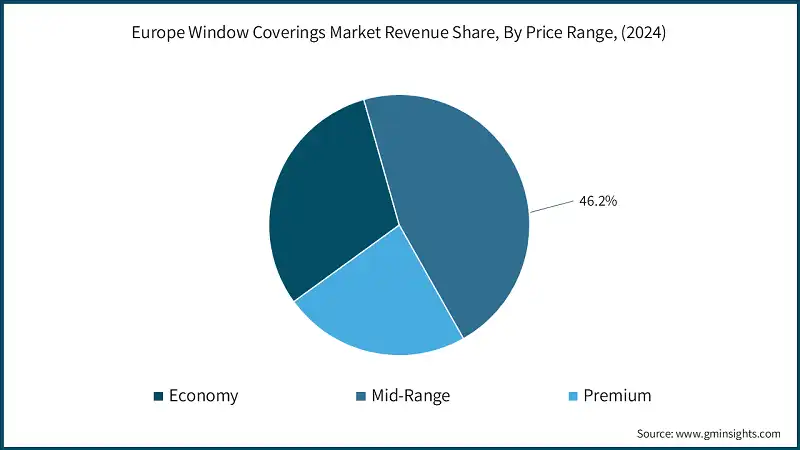
Based on price range, the market is segmented into economy, mid-range, premium. The mid-range segment held the largest share, accounting for 46.2% of the Europe window coverings market in 2024.
- The mid-range price segment continues to dominate the window-covering market, offering an ideal balance between affordability and quality. This segment caters to consumers who seek durable and aesthetically pleasing products without incurring the high costs associated with premium offerings.
- Mid-range products often incorporate advanced features that were once exclusive to high-end categories. For example, motorization, energy-efficient fabrics, and UV protection are now commonly available in this segment, making it an attractive option for cost-conscious yet discerning buyers.
- This segment also appeals to aspirational buyers who prioritize design and functionality. Mid-range offerings often feature contemporary designs and customizable options, allowing consumers to personalize their spaces without overspending. The segment's strong presence in both residential and commercial markets underscores its importance in the overall industry landscape.
Based on the distribution channel, the market is segmented into online and offline. In 2024, offline segment held a major market share, generating a revenue of USD 2.9 billion.
- Despite the rapid growth of e-commerce, offline channels remain the dominant distribution mode in the window covering market. This is largely due to the tactile nature of the products and the need for personalized consultations.
- Offline channels offer a unique advantage by allowing customers to experience the product firsthand. Shoppers can feel fabric textures, evaluate colors, and test mechanisms, which build trust and confidence, especially for high-value or customized products.
- This hands-on approach is particularly important for blinds and shades, where precise measurements and fittings are crucial. Professional guidance and installation services provided by physical retailers further enhance the customer experience, ensuring accuracy and satisfaction.
Looking for region specific data?
Germany Window Coverings Market
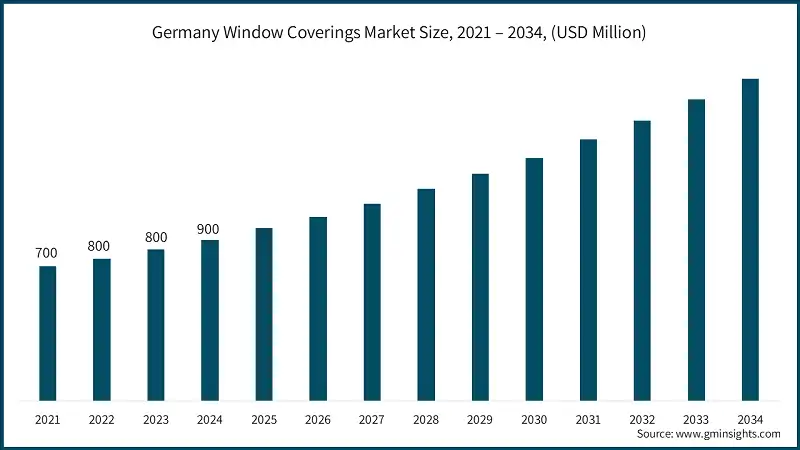
In 2024, the Germany dominated the Europe market, accounting for around 21.9% and generating around USD 900 million revenue in the same year.
- The adoption of motorized and smart window coverings has seen a significant uptick, driven by the rising penetration of smart home systems. Products equipped with features such as remote-control operation, voice command compatibility, and automated scheduling are increasingly preferred by consumers.
- Additionally, energy-efficient solutions have gained substantial traction, with consumers opting for window coverings designed to minimize heat gain during summer and heat loss during winter.
UK Window Coverings Market
UK window coverings market is expected to grow at 7.4% during the forecast period.
- In Germany, the demand for insulated window coverings is also on the rise, driven by the country’s commitment to energy efficiency and sustainability. Germany’s Energy Efficiency Strategy for Buildings (ESG) emphasizes the importance of reducing energy consumption in residential and commercial spaces, with window insulation playing a critical role.
Europe Window Coverings Market Share
Hunter Douglas Inc. is leading with 19.2% market share. Hunter Douglas , WAREMA Renkhoff SE, Somfy, Griesser AG, and Roma KG collectively hold around 35.1%, indicating moderately fragmented market concentration. These prominent players are proactively involved in strategic endeavors, such as mergers & acquisitions, facility expansions & collaborations, to expand their product portfolios, extend their reach to a broad customer base, and strengthen their market position.
Hunter Douglas has a clear competitive edge in window coverings, driven by its innovation in smart and motorized solutions. The company’s strong brand equity and premium positioning allow it to dominate both residential and commercial segments.
WAREMA stands out in the European window coverings market through its strong commitment to sustainability and energy-efficient solutions, aligning with the region’s green building trends. The company combines German engineering precision with innovative sun shading systems, including smart automation and photovoltaic integration. Its reputation for quality and operational resilience, even during economic fluctuations, reinforces its position as a premium brand for eco-conscious and technologically advanced customers.
Europe Window Coverings Market Companies
Major players operating in the Europe window coverings industry are:
- Bandalux
- Bematech s.r.o.
- Coulisse B.V.
- Erfal GmbH & Co. KG
- Griesser AG
- Hunter Douglas Europe B.V.
- Lutron Electronics Europe
- MechoShade Systems
- Norman Window Fashions Europe
- Renson
- ROMA KG
- Somfy
- Springs Window Fashions
- Verosol
- WAREMA Renkhoff SE
Griesser leverages its heritage of Swiss engineering and premium quality to maintain a strong foothold in the European market. Known for durable and aesthetically refined solar shading products, the company emphasizes sustainability and energy efficiency, catering to modern architectural needs. Its pan-European manufacturing and extensive distribution network ensure localized customization and service, positioning Griesser as a trusted choice for high-end residential and commercial projects.
Somfy competitive edge lies in its leadership in motorization and smart home integration. The company specializes in automated window coverings, offering solutions that integrate seamlessly with major smart home ecosystems like Alexa, Google Home, and Apple HomeKit.
Roma KG differentiates itself through specialization in exterior shading systems, including advanced roller shutters, venetian blinds, and textile screens. The company focuses on energy efficiency, thermal insulation, and smart home compatibility, delivering solutions that combine functionality with modern design.
Europe Window Coverings Market Report Attributes
| Key Takeaway | Details |
|---|---|
| Market Size & Growth | |
| Base Year | 2024 |
| Market Size in 2024 | USD 3.9 Billion |
| Market Size in 2025 | USD 4.2 Billion |
| Forecast Period 2025 - 2034 CAGR | 7.4% |
| Market Size in 2034 | USD 7.9 Billion |
| Key Market Trends | |
| Drivers | Impact |
| Rapid integration of smart home ecosystems | The primary technological driver for the market is the surging consumer demand for automated and connected home environments. As smart speakers (like Alexa and Google Home) and home automation hubs become standard in households, there is a corresponding demand for window coverings that integrate into these ecosystems. |
| Resurgence in residential renovation and urbanization | The post-pandemic focus on home improvement has sustained a strong demand for window treatments, as consumers continue to invest in upgrading their living spaces for comfort and aesthetics. |
| Demand for energy-efficient solutions | With rising global energy costs and a heightened awareness of carbon footprints, consumers are increasingly treating window coverings as functional tools for thermal management rather than just decorative items |
| Pitfalls & Challenges | Impact |
| Volatility in raw material prices | Manufacturers face significant headwinds due to the fluctuating costs of essential raw materials, including aluminum, wood, PVC, and polyester fabrics |
| Stringent safety regulations | The industry is currently undergoing a costly transition due to tightening safety standards aimed at preventing child strangulation hazards. |
| Opportunities: | Impact |
| Expansion into eco-friendly and recycled materials | There is a significant untapped opportunity in the "Green" segment, specifically for products made from recycled ocean plastics, rapidly renewable resources (like bamboo or hemp), and non-toxic, VOC-free fabrics. |
| Democratization of motorization | Currently, automated window coverings are often priced at a premium, restricting them to the upper-mid and luxury tires |
| Market Leaders (2024) | |
| Market Leaders |
15.2% market share |
| Top Players |
Collective market share in 2024 is 35.1% |
| Competitive Edge |
|
| Regional Insights | |
| Largest market | Germany |
| Fastest growing market | UK |
| Emerging countries | France, Italy |
| Future outlook |
|
What are the growth opportunities in this market?
Europe Window Coverings Industry News
- In November 2025, MechoShade Systems, LLC launches Ascend sustainability program, partners with Cisco and Legrand for smart building integration.
- In October 2025, Griesser AG completes switch to green aluminum at Nenzing plant, reducing CO2 footprint by 30%.
- In January 2025, Hunter Douglas Inc. launched Aura Illuminated shades integrating LED lighting and smart home compatibility.
The Europe window coverings market research report includes in-depth coverage of the industry with estimates & forecasts in terms of revenue (USD Billion) and volume (Million Units) from 2021 to 2034, for the following segments:
Market, By Product Type
- Blinds & shades
- Curtains & drapes
- Shutters
- Others
Market, By Material
- Natural
- Synthetic
Market, By Technology
- Manual covers
- Smart covers/automatic covers
Market, By Price Range
- Economy
- Mid-range
- Premium
Market, By Opacity Level
- Blackout
- Room darkening
- Light filtering
- Sheer/transparent
Market, By End Use
- Residential
- Commercial
Market, By Distribution Channel
- Online
- E-commerce
- Company websites
- Offline
- Specialty stores
- Retail stores
- Others (interior design studios & boutiques, etc.)
The above information is provided for the following countries:
- UK
- Germany
- France
- Italy
- Spain
- Rest of Europe
Frequently Asked Question(FAQ) :
What is the market size of the Europe window coverings industry in 2024?
The market size was USD 3.9 billion in 2024, with a CAGR of 7.4% expected through 2034 driven by rapid integration of smart home ecosystems.
What is the current Europe window coverings market size in 2025?
The market size is projected to reach USD 4.2 billion in 2025.
What is the projected value of the Europe window coverings market by 2034?
The Europe window coverings industry is expected to reach USD 7.9 billion by 2034, supported by increasing adoption of automated, energy-efficient, and smart shading solutions.
How much revenue did the blinds & shades segment generate in 2024?
Blinds and shades generated USD 1.8 billion in 2024, making them the largest product category. Their dominance is driven by versatility, light-control efficiency, and growing demand for modern, aesthetically aligned window treatments.
What was the valuation of the mid-range price segment in 2024?
The mid-range segment accounted for 46.2% of the Europe window coverings market in 2024. Its leadership is driven by affordability, design flexibility, and wider availability of features like motorization and UV protection.
Which region leads the Europe window coverings market?
Germany leads the regional market with USD 900 million revenue and 21.9% share in 2024. Growth is propelled by strong adoption of motorized coverings, energy-efficient designs, and widespread penetration of smart home systems.
What are the upcoming trends in the Europe window coverings industry?
Key trends include rising demand for smart motorized blinds, increased adoption of child-safe cordless coverings, use of energy-efficient fabrics, growing e-commerce penetration, and preference for minimal, contemporary designs.
Who are the key players in the Europe window coverings market?
Major players include Hunter Douglas, WAREMA Renkhoff SE, Somfy, Griesser AG, ROMA KG, Bandalux, Coulisse B.V., Lutron Electronics Europe, MechoShade Systems, Norman Window Fashions Europe, Verosol, and others.
Europe Window Coverings Market Scope
Related Reports