Summary
Table of Content

Europe Waste to Energy Market
Get a free sample of this report
Form submitted successfully!
Error submitting form. Please try again.
Thank you!
Your inquiry has been received. Our team will reach out to you with the required details via email. To ensure that you don't miss their response, kindly remember to check your spam folder as well!
Request Sectional Data
Thank you!
Your inquiry has been received. Our team will reach out to you with the required details via email. To ensure that you don't miss their response, kindly remember to check your spam folder as well!
Form submitted successfully!
Error submitting form. Please try again.
Europe Waste to Energy Market Size
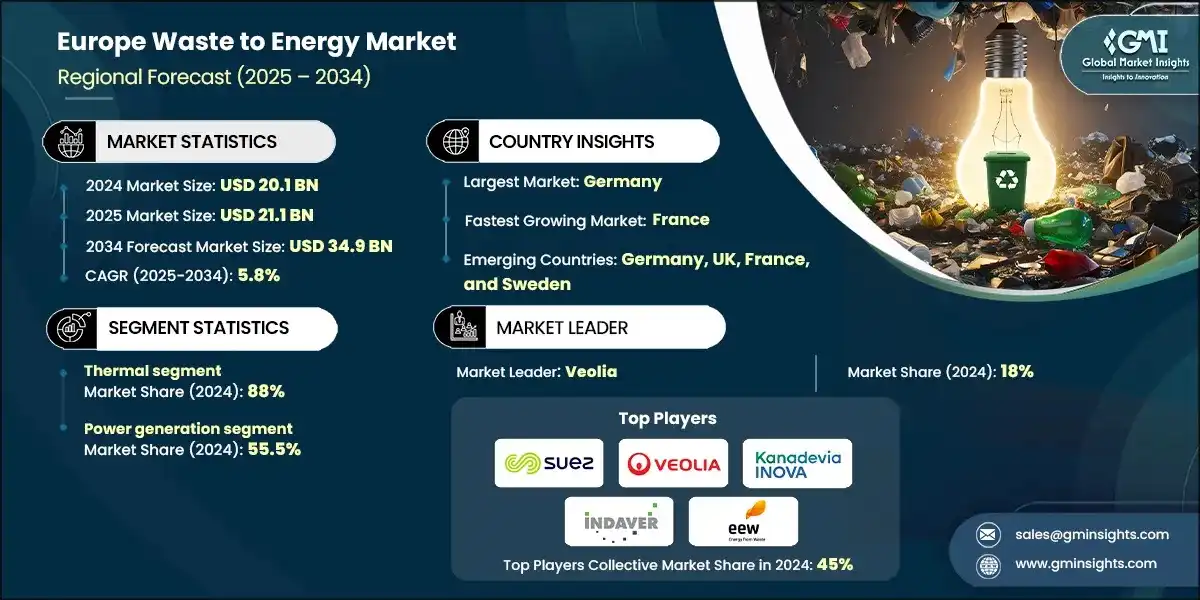
According to a recent study by Global Market Insights Inc., the Europe waste to energy market was estimated at USD 20.1 billion in 2024. The market is expected to grow from USD 21.1 billion in 2025 to USD 34.9 billion in 2034, at a CAGR of 5.8%.
Europe Waste to Energy Market Key Takeaways
Market Size & Growth
- 2024 Market Size: USD 20.1 Billion
- 2025 Market Size: USD 21.1 Billion
- 2034 Forecast Market Size: USD 34.9 Billion
- CAGR (2025–2034): 5.8%
Regional Dominance
- Largest Market: Germany
- Fastest Growing Country: France
Key Market Drivers
- Favorable government initiatives.
- Rapid industrial development.
- Increasing amount municipal solid waste (MSW).
Challenges
- High capital & operational costs.
Opportunity
- Ongoing technological advancements.
- Integration with smart cities.
- Carbon credit and emission trading.
- Electrification potential across remote areas.
Key Players
- Market Leader: Veolia led with over 18% market share in 2024.
- Leading Players: Top 5 players in this market include SUEZ, Veolia, Kanadevia Inova AG, Indaver, EEW Energy from Waste GmbH, which collectively held a market share of 45% in 2024.
Get Market Insights & Growth Opportunities
- Rapid urban growth and rising volumes of municipal solid waste, limited landfill capacity and increasing environmental concerns are prompting cities to seek sustainable alternatives, further driving the adoption of waste-to-energy solutions. Energy recovery systems are integrated into urban infrastructure to manage waste while generating clean power, supporting both resource efficiency and long-term waste management strategies which is set to complement industry landscape.
- Decentralized waste treatment models are gaining significant momentum as they reduce transportation costs and improve operational flexibility. These systems enhance grid stability and minimize emissions associated with waste disposal by converting waste into energy closer to its source. Flourishing investments in advanced technologies that optimize energy output and reduce environmental impact will positively shape the business dynamics.
- For instance, in November 2025, EBRD (European Bank for Reconstruction and Development) along with commercial lenders plan a USD 82.8 million loan for Kosit’s new WtE facility in Kosice, Slovakia. The plant will process 100,000 tonnes of waste annually, generating 50,000 MWh electricity and 53,000 MWh thermal energy. Kosit operates multiple waste assets, and the USD 231.6 million project is pending permits with construction expected over four years.
- Favorable policy initiatives across various economies to reduce landfill dependency and promote waste diversion are boosting investments in sustainable technologies. Introduction of national targets that encourage circular economy practices coupled with governments and corporations increasingly integrating renewable energy into waste management strategies, through cleaner, more efficient energy systems will contribute to the industry growth.
- For instance, in January 2025, the UK Government introduced stricter planning requirements for waste incineration projects to align with national recycling and emissions goals. New energy-from-waste facilities must demonstrate landfill diversion, replace outdated plants, be carbon capture-ready, and utilize generated heat. Projects must also comply with environmental standards and consider future waste capacity, supporting the government’s Clean Energy Superpower strategy and broader circular economy objectives.
- Germany holds a dominant share in the Europe waste to energy industry driven by expanding industrial operations and urbanization requiring scalable and sustainable waste management solutions. Rising energy demand, stringent environmental mandates to reduce emissions and continuous technological advancements will positively augment the industry outlook.
- For instance, in January 2024, Doosan Lentjes secured a USD 111.2 million contract for Wiesbaden WtE plant, reinforcing its European waste-to-energy market presence. As EPC contractor, the company will manage engineering, equipment supply, installation, and commissioning of the advanced municipal waste processing facility. The plant will convert 600 tons of waste daily into 22MW electricity and 40MW district heating, supporting sustainable energy goals.
- France is the fastest growing market in Europe waste to energy industry and is set to witness significant growth owing to stringent environmental norms, increasing industrial activities and energy requirements. Facilities are adopting advanced technological systems and processes along with integration of renewable portfolios including battery energy storage will further complement the industry growth.
- For instance, in October 2025, Veolia launched a pilot carbon capture facility in Le Mans to advance municipal circular economy and decarbonisation strategies. The plant will capture 10 tons of CO2 daily, achieving a 90% efficiency rate through advanced waste-to-energy integration. Captured CO2 will be repurposed locally for industrial applications, supporting Veolia’s USD 13.8 million GreenUp initiative through 2028.
To get key market trends
Europe Waste to Energy Market Trends
- The Europe waste to energy industry is set to witness significant momentum owing to growing inclination toward sustainable urban development, coupled with increasing landfill saturation driven by rapid urbanization and population growth. Several countries are focusing on integrated waste management solutions and renewable energy generation to cater to rising energy demand along with investment in advanced technologies across waste to energy facilities will propel the industry outlook.
- For instance, in September 2025, Greece plans USD 1.15 billion investment in six WtE projects, targeting 1.19 million tons annual waste processing capacity across key regions. Urgency surrounds securing USD 920.8 million in EU funding for these projects and associated recycling infrastructure before deadlines expire. Rodopi and Western Macedonia plants will offer district heating, replacing Ptolemaida 5 lignite facility scheduled for closure by 2028.
- Ongoing adoption of emission control technologies including filtration systems, flue gas treatment, and carbon capture is propelling the industry growth. Introduction of automation and digital monitoring systems to enhance plant efficiency and reducing operational downtime will stimulate industry dynamics. Various governments are actively encouraging private sector investment in waste-to-energy initiatives, aligning with broader sustainability goals and reinforcing circular economy strategies which is set to fuel the business scenario.
- For instance, in January 2025, Meridiam inaugurated the Olsztyn WtE PPP project, converting municipal waste into renewable energy and reducing coal dependency in Poland. The facility processes over 100,000 tons of non-recyclable waste annually, aligning with EU landfill reduction and circular economy goals. It prevents methane emissions and avoids 100,000 tons of CO2 yearly, supporting regional decarbonisation and sustainable urban heating for 170,000 residents.
- The increasing adoption of zero-waste policies by governments and local authorities as part of sustainable waste management strategies is accelerating the deployment of waste-to-energy (WTE) technologies. Growing emphasis on recovering energy from non-recyclable waste along with regulatory mandates aimed at minimizing landfill usage and enhancing energy efficiency are driving the integration of WTE solutions across industrial infrastructures further augmenting industry landscape.
- For instance, in September 2025, Zero Waste Europe coalition urges EU leadership to impose a moratorium on new waste incineration projects across all member states. The group advocates phasing down existing incineration capacity and increasing investment in circular economy infrastructure and recycling technologies. They advise that overcapacity threatens EU waste hierarchy, locking countries into high-emission, linear waste systems that weaken sustainability objectives.
Europe Waste to Energy Market Analysis
Learn more about the key segments shaping this market
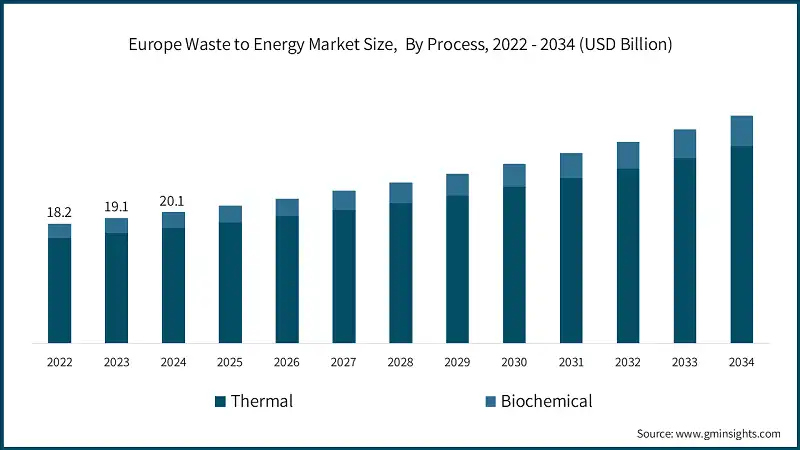
Based on process, the market is segmented into thermal and biochemical. The thermal segment accounted for around 88% of market share in 2024 and is set to grow at a 5.6% CAGR through 2034.
- The thermal waste-to-energy segment is anticipated to witness substantial growth, primarily driven by increasing adoption of advanced incineration systems integrated with combined heat and power (CHP) technologies. These systems significantly enhance energy recovery by concurrently generating electricity and thermal energy for internal consumption, thereby improving operational efficiency and sustainability. Furthermore, capabilities in performance monitoring, operational optimization, and downtime reduction are further accelerating the adoption of thermal processing solutions across the industry.
- For instance, in December 2024, Destinus and UNIVASTUM launched a 24 MW waste-to-energy project using OP16 turbines and WARP gasification technology in Europe. Successful syngas turbine tests were conducted in the Netherlands with customer participation, confirming reliable performance and operational efficiency. Destinus showcased a decade-old turbine site, highlighting long-term success and durability of their energy systems. This partnership marks a major step forward in efficient, scalable energy-from-waste solutions for industrial and municipal applications.
- Biochemical process is set to grow at a CAGR of 7% from 2025 to 2034. Increasing emphasis on renewable energy adoption and the need for efficient organic waste management is complementing industry landscape. Supportive regulatory frameworks, rising environmental awareness, and advancements in anaerobic digestion and bio-methanation technologies, is shaping the business dynamics. Growing inclination toward energy diversification along with focus on converting biodegradable waste into clean energy, reducing landfill dependency and greenhouse gas emissions will contribute to industry growth.
- For instance, in September 2025, West Northamptonshire Council approved a biogas facility converting livestock waste into renewable energy near Brackley, England. The plant will generate electricity for 8,000 homes and offer farmers an additional income stream through sustainable waste utilization. Anaerobic digestion will produce biomethane, transported via tanker for National Grid use, despite local concerns over traffic, odour, and environmental impact.
Learn more about the key segments shaping this market
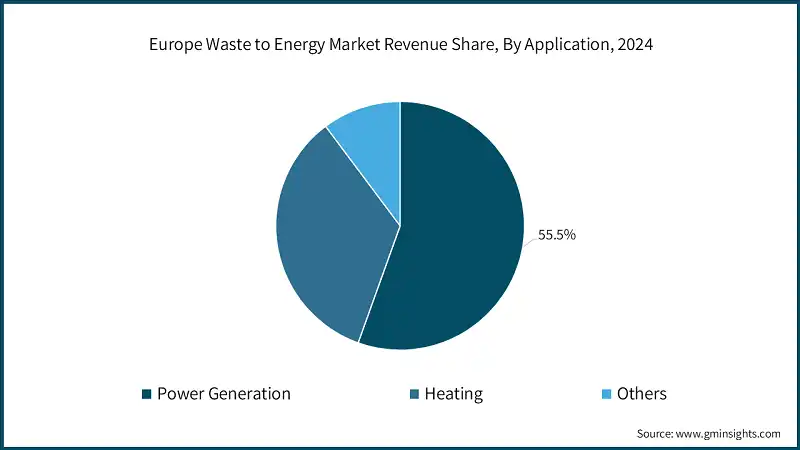
Based on application, the Europe waste to energy market is classified into power generation, heating and others. The power generation segment holds around 55.5% of market share in 2024 and is set to grow at a CAGR of 5.4% through 2034.
- The power generation segment is anticipated to witness significant growth, driven by the increasing integration of waste-fueled cogeneration systems and grid-supporting infrastructure. Urban expansion and increasing solid waste volumes, coupled with growing electricity demand, are accelerating the adoption of waste-to-electricity technologies. Additionally, favorable policy frameworks including renewable energy incentives and supportive regulatory frameworks are further augmenting industry outlook.
- For instance, in May 2024, Gren Group announced to invest over USD 230.1 million in Latvia to construct a modern waste-to-energy facility operational by 2029. The plant will process 150,000–200,000 tons of non-recyclable waste annually, generating 50–70 MW heat and 15–20 MW electricity. Advanced emission controls and closed systems will ensure environmental safety, supporting Latvia’s energy independence and landfill diversion objectives.
- Heating application segment was evaluated at USD 6.8 billion in 2024. increasing investments in district heating networks and industrial energy systems along with adoption of advanced incineration technologies which enhances thermal efficiency and supports sustainable energy goals will stimulate industry outlook. rising urban energy demand, supportive policy frameworks, and the integration of waste heat recovery systems, contribute to the deployment of waste-to-energy solutions in heating applications.
- For instance, in May 2024, MM Kotkamills and Kotka Energy collaborated to utilize waste heat from mill processes for district heating in Kotka, Finland. The heat recovery plant, with a capacity of 10 MW, will generate 65,000-70,000 MWh annually, supplying 15-20% of Kotka’s heating needs. This project will cut emissions by over 8,600 tonnes yearly and replace fossil fuels, supporting Finland’s carbon neutrality goals.
Looking for region specific data?
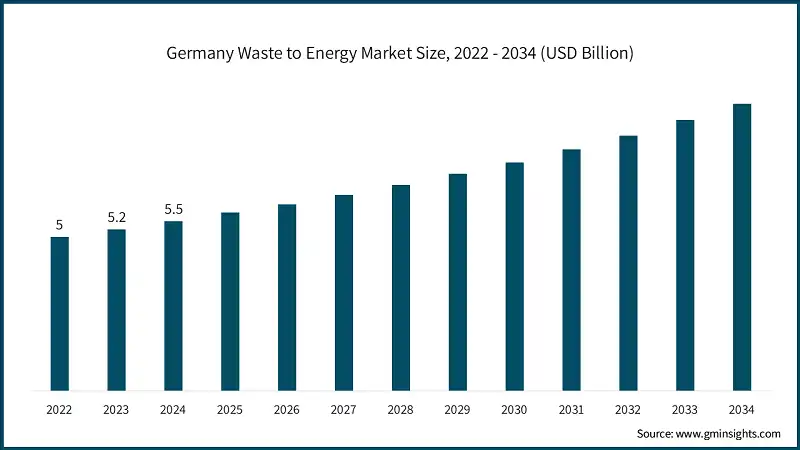
Germany dominated the Europe waste to energy market with around 27.5% share in 2024 and generated USD 5.5 billion in revenue. Rising generation of municipal solid waste, coupled with ongoing development of advanced waste to energy facilities and integration of WtE into smart grid & district heating systems is complementing the industry landscape.
- Germany waste to energy market is anticipated to grow owing to growing inclination to reduce landfill dependency and meet national decarbonization targets is encouraging the adoption of WtE solutions. Favorable incentives, flourishing investments across waste to energy facilities, rising energy & heating demand across various sectors and shifting focus on sustainable waste management practices are further supporting investment in advanced WtE infrastructure.
- For instance, in January 2025, Danpower acquired two WtE plants in Saxony and Brandenburg, expanding its energy infrastructure portfolio within Germany’s waste management sector. The company plans to utilize waste heat from electricity generation to support nearby district heating networks for enhanced energy efficiency. Recovered thermal energy from these facilities could potentially supply sustainable heating to approximately 25,000 residential households in surrounding communities.
- France waste to energy market was evaluated at USD 3.1 billion in 2024. Increasing energy demand, environmental sustainability goals, rising landfill constraints, and supportive regulatory frameworks that promote clean energy adoption and circular economy practices will fuel business scenario. Stringent mandates toward decarbonization, rising municipal and industrial waste have led authorities and private investors to build advanced waste to energy facilities further stimulate business outlook.
- UK waste to energy market is set to witness a CAGR of 6.3% from 2025 to 2034. Stringent decarbonization targets, rising energy demand and focus on sustainable energy transition will positively influence the business dynamics. Increasing landfill levies are encouraging municipalities to adopt greener waste management practices, further supporting industry growth. Moreover, robust public-private collaboration toward innovation along with flourishing investment in advanced waste to energy processes and plants will further augment industry landscape.
- For instance, in December 2024, the UK Government introduced stricter planning rules for incinerators to support waste reduction and sustainability goals. New facilities must divert non-recyclable waste from landfills or replace outdated, inefficient plants to gain approval. Projects must be carbon capture-ready and demonstrate effective heat recovery for district heating or industrial use. They must align with circular economy principles and meet environmental standards regulated by the Environment Agency.
- Sweden accounted for around 6.4% of the market share in 2024. Rapid urbanization and increasing generation of municipal and industrial waste will contribute to industry growth. Government-led initiatives to integrate waste-to-energy systems into national and regional energy strategies driven by rising energy demand and ongoing development of WtE facilities will positively influence business dynamics.
- For instance, in July 2025, Filbornaverket’s carbon capture initiative supports Helsingborg’s goal to achieve climate neutrality by 2030 through advanced waste-to-energy integration. The project exemplifies strategic innovation in municipal energy systems, aligning with Sweden’s broader climate commitments and circular economy objectives.
Europe Waste to Energy Market Share
- The top 5 waste to energy companies operating across the industry are SUEZ, Veolia, Kanadevia Inova AG, Indaver, and EEW Energy from Waste GmbH. These companies contribute a market share of approximately 45% in 2024.
- The Europe waste to energy industry is characterized by intense competition, driven by rapid technological advancements and ongoing innovations in WtE processes. Companies are focusing on delivering high-efficiency solutions, diversify their offerings, and meet evolving environmental standards. Additionally, supportive government policies, such as feed-in tariffs and carbon credits, are encouraging the deployment of WtE facilities.
- Companies operating in Europe waste to energy industry sector are driving significant growth through strategic partnerships, mergers, joint ventures and acquisitions further shaping competitive dynamics, enabling firms to scale operations and enter new markets. Firms are investing heavily in R&D to enhance thermal conversion technologies, improve emissions control, and integrate digital monitoring systems for optimized plant performance to strengthen their footprint across the industry.
- SUEZ provides integrated waste-to-energy solutions for electricity and heat generation from residual waste, supporting energy self-sufficiency, cost reduction, and decarbonization. Its services include waste characterization, engineering, plant construction, CO2 management, and long-term optimization, advancing local renewable energy integration and sustainability goals. Their advanced facilities convert waste into electricity, heat, and steam, supporting district heating and industrial use.
- Veolia delivers diversified WtE technologies and offers cost-effective waste-to-energy solutions including anaerobic digestion, landfill gas recovery, biomass energy, and fuel blending. These technologies convert organic and non-recyclable waste into electricity and heat, helping clients reduce emissions, enhance energy efficiency, and support sustainable resource management.
- Kanadevia Inova specializes in turnkey WtE plants using proprietary grate combustion, flue gas treatment, and dry anaerobic digestion (Kompogas). Their systems recover energy and materials from municipal and organic waste, offering high-efficiency solutions with integrated carbon capture, biogas upgrading, and district heating capabilities, backed by global EPC expertise.
- Indaver specializes in converting non-recyclable waste into usable energy through advanced waste-to-energy facilities. Their process ensures no energy is wasted, generating substantial heat during waste treatment, which is then returned to society as electricity or steam. This approach supports energy self-sufficiency, reduces reliance on fossil fuels, and contributes to the broader energy transition by integrating sustainable energy into public and industrial systems.
Europe Waste to Energy Market Companies
Major players operating in the Europe waste to energy industry are:
- AFRY AB
- Biffa
- China Everbright Environment Group Limited
- China Tianying Inc.
- Danpower GmbH
- EEW Energy from Waste GmbH
- Gren Group
- Indaver NV
- JFE Engineering Corporation
- Kanadevia Inova AG
- Keppel Seghers
- MARTIN GMBH
- Mitsubishi Heavy Industries Environmental & Chemical Engineering Co., Ltd.
- Ramboll
- Suez SA
- Valmet
- Veolia
- Viridor Ltd.
- Wheelabrator Technologies, Inc.
- WOIMA
- Veolia recorded a 6-month revenue in 2025 of USD 25.6 billion and a revenue of USD 52.7 billion for the whole year 2024. The company’s solutions generate renewable electricity and thermal energy while reducing greenhouse gas emissions. Veolia’s global operations emphasize circular economy principles, offering tailored energy recovery systems for municipalities and industries across multiple sectors.
- Kanadevia Inova AG (formerly known as Hitachi Zosen Inova), recorded a revenue of USD 4 billion in the year 2024 and a revenue of around USD 820 million for the first quarter of 2025. The company specialize in designing and delivering turnkey solutions for waste-to-energy and gas systems and its expertise extends to gas upgrading, power-to-gas systems, and dependable after-sales support for operational plants. The company collaborates closely with clients, offering engineering, procurement, and construction services for thermal and biological recovery technologies.
- EEW Energy from Waste GmbH recorded an operating revenue of USD 875.5 million in 2023. EEW’s advanced combustion plants efficiently convert waste into energy while ensuring safety and environmental protection. Their systems use cogeneration to produce electricity and supply steam for district heating and industrial processes. The company collaborates with partners to maximize energy recovery and offers customized energy solutions for industrial clients.
Europe Waste to Energy Market Report Attributes
| Key Takeaway | Details |
|---|---|
| Market Size & Growth | |
| Base Year | 2024 |
| Market Size in 2024 | USD 20.1 Billion |
| Market Size in 2025 | USD 21.1 Billion |
| Forecast Period 2025 – 2034 CAGR | 5.8% |
| Market Size in 2034 | USD 34.9 Billion |
| Key Market Trends | |
| Drivers | Impact |
| Favorable government initiatives | Supportive policies, subsidies, and regulations accelerate waste to energy adoption, encouraging investment, innovation, and infrastructure development to meet sustainability and energy recovery goals. |
| Rapid industrial development | Rapid industrial expansion and urbanization increase energy demand and waste generation, driving the need for efficient waste to energy solutions to manage waste and produce energy. |
| Increasing amount municipal solid waste (MSW) | Rising MSW volumes strain landfills, prompting waste to energy facilities to convert waste into energy, reducing environmental impact and enhancing resource recovery. |
| Pitfalls & Challenges | Impact |
| High capital & operational costs | Requires substantial upfront investment and maintenance, limiting adoption in low-income regions despite long-term environmental and energy benefits. |
| Opportunities: | Impact |
| Ongoing technological advancements | Innovations in thermal gasification, combustion, and anaerobic digestion improve efficiency, reduce emissions, and make WtE systems more scalable across various waste streams. |
| Integration with smart cities | Waste to energy plants support smart city goals by sustainably managing urban waste, generating local energy, reducing dependency on fossil fuels and landfill usage. |
| Carbon credit and emission trading | Waste to energy projects can earn carbon credits by reducing methane emissions from landfills, offering financial incentives through global emission trading schemes and sustainability programs. |
| Electrification potential across remote areas | Growing interest from private investors boosts funding, accelerates project deployment, provides decentralized energy solutions for remote areas, utilizing agricultural and organic waste to generate electricity. |
| Market Leaders (2024) | |
| Market Leaders |
18% market share |
| Top Players |
Collective market share in 2024 is 45% |
| Competitive Edge |
|
| Regional Insights | |
| Largest Market | Germany |
| Fastest growing market | France |
| Enter metric name | Germany, UK, France, and Sweden |
| Emerging countries | Enter metric value |
| Future outlook |
|
What are the growth opportunities in this market?
Europe Waste to Energy Market News
- In October 2025, MARTIN GmbH came into a contract with PAPREC to construct two advanced combustion lines at the Prairie des Mauves, France. The new lines will replace systems operating since 1987, continuing a legacy with modern MARTIN.grate and infrared combustion control. A unique feature includes co-combustion of sewage sludge, enhancing waste treatment capabilities and environmental performance. Commissioning is scheduled for 2029, with MARTIN and PAPREC collaborating closely to ensure reliability and future-readiness.
- In May 2025, Suez secured a 24-year contract to upgrade and operate the Argenteuil waste-to-energy facility, located in France valued at USD 955.5 million. The project follows a competitive tender process and was awarded by Azur after over two years of preparation. The plant processes 206,000 tonnes of municipal waste annually from four local communities, serving approximately 600,000 residents. The upgrades will modernize the facility and ensure long-term waste management and energy recovery for the region.
- In April 2025, Indaver and Rivenhall Greenhouse Limited came into collaboration and are developing a pioneering project to harness waste energy for sustainable agriculture in the UK. They plan to build a CCU plant to capture CO2 from the waste to energy facility’s emissions, boosting greenhouse growth. The project will also supply heat and electricity to support year-round crop production. This innovative approach aims to reduce carbon emissions, promote climate resilience, and strengthen local food security through sustainable practices.
- In March 2025, Kanadevia Inova signed an agreement to acquire Encyclis Ireland Operations Ltd., managing Dublin’s Waste-to-Energy Plant, pending approval, by summer. The deal includes taking over a 38-year O&M contract and expanding waste capacity by 90,000 tonnes annually. The Dublin plant, operational since 2017, currently powers 115,000 homes, with capacity growth expected to further improve energy and heating supply. Processing 600,000 tonnes annually, the Dublin plant supplies power to 115,000 homes and heats 50,000 households, with capacity increases expected.
- In August 2024, Ramboll has acquired Wandschneider + Gutjahr to strengthen its presence in Germany’s waste-to-energy and thermal engineering market. This strategic acquisition enhances Ramboll’s capabilities in sludge incineration, biomass, and district heating through W+G’s specialised expertise and local footprint. Combining global reach with regional proficiency, the company aims to deliver innovative, sustainable energy transition projects across Germany and Europe.
The Europe waste to energy market research report includes in-depth coverage of the industry with estimates & forecasts in terms of revenue (USD Billion) from 2021 to 2034, for the following segments:
Market, By Process
- Thermal
- CHP incineration
- Co-combustion
- Thermal gasification
- Residual derived fuel plant
- Biochemical
Market, By Application
- Power generation
- Heating
- Others
The above information is provided for the following countries:
- Sweden
- Denmark
- Norway
- Italy
- Netherlands
- Germany
- UK
- France
Frequently Asked Question(FAQ) :
What is the market size of the Europe waste to energy in 2024?
The market size was USD 20.1 billion in 2024, with a CAGR of 5.8% expected through 2034 driven by rising municipal waste volumes, limited landfill capacity, and growing demand for sustainable disposal solutions.
What is the projected value of the Europe waste to energy market by 2034?
The Europe waste to energy market is expected to reach USD 34.9 billion by 2034, propelled by climate goals, stricter waste regulations, and integration with renewable energy systems.
What is the current Europe waste to energy market size in 2025?
The market size is projected to reach USD 21.1 billion in 2025.
How much revenue did the thermal segment generate in 2024?
Thermal process held 88% market share in 2024 and is set to grow at a 5.6% CAGR through 2034.
What was the valuation of power generation segment in 2024?
Power generation held 55.5% market share in 2024 and is set to grow at a CAGR of 5.4% through 2034.
What is the growth outlook for biochemical process from 2025 to 2034?
Biochemical process is projected to grow at a 7% CAGR till 2034, due to renewable energy adoption, supportive regulations, and advancements in anaerobic digestion technologies.
Which region leads the Europe waste to energy market?
Germany held 27.5% share with USD 5.5 billion in 2024. Rising municipal waste, advanced WtE facilities, and integration with smart grids fuel the country's dominance.
What are the upcoming trends in the Europe waste to energy market?
Key trends include AI and IoT for operational optimization, integration with solar and wind systems, improved waste sorting technologies, and decentralized energy grids for remote areas.
Who are the key players in the Europe waste to energy market?
Key players include SUEZ, Veolia, Kanadevia Inova AG, Indaver, EEW Energy from Waste GmbH, AFRY AB, Biffa, China Everbright Environment Group Limited, China Tianying Inc., Danpower GmbH, Gren Group, JFE Engineering Corporation, Keppel Seghers, MARTIN GMBH, Mitsubishi Heavy Industries Environmental & Chemical Engineering Co., Ltd., Ramboll, Valmet, Viridor Ltd., Wheelabrator Technologies, Inc., and WOIMA.
Europe Waste to Energy Market Scope
Related Reports