Summary
Table of Content

Europe Underfloor Heating Actuator Market
Get a free sample of this report
Form submitted successfully!
Error submitting form. Please try again.
Thank you!
Your inquiry has been received. Our team will reach out to you with the required details via email. To ensure that you don't miss their response, kindly remember to check your spam folder as well!
Request Sectional Data
Thank you!
Your inquiry has been received. Our team will reach out to you with the required details via email. To ensure that you don't miss their response, kindly remember to check your spam folder as well!
Form submitted successfully!
Error submitting form. Please try again.
Europe Underfloor Heating Actuator Market Size
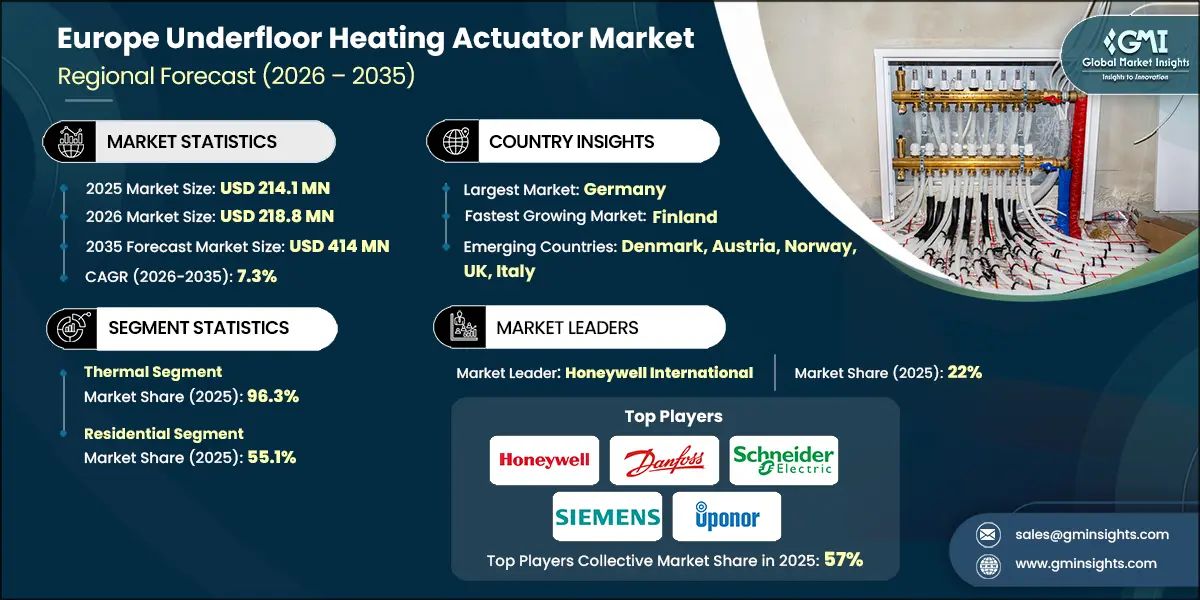
The Europe underfloor heating actuator market size was valued at USD 214.1 Million in 2025. The market is anticipated to grow from USD 218.8 Million in 2026 to USD 414 Million in 2035, at a CAGR of 7.3%.
Europe Underfloor Heating Actuator Market Key Takeaways
Market Size & Growth
- 2025 Market Size: USD 214.1 Million
- 2026 Market Size: USD 218.8 Million
- 2035 Forecast Market Size: USD 414 Million
- CAGR (2026–2035): 7.3%
Regional Dominance
- Largest Market: Germany
- Fastest Growing Country: Finland
Key Market Drivers
- Introduction of energy efficient standards.
- Increasing demand for space heating.
- Growing urbanization & commercialization.
Challenges
- Longer payback period.
- High initial costs and installation complexity.
Opportunity
- Retrofit & Renovation Market Growth.
- Integration with Smart and IoT-Enabled Control.
Key Players
- Market Leader: Honeywell International led with over 22% market share in 2025.
- Leading Players: Top 5 players in this market include Honeywell International, Danfoss, Schneider Electric, Siemens AG, Uponor Corporation, which collectively held a market share of 57% in 2025.
Get Market Insights & Growth Opportunities
- The fast-paced expansion of commercial infrastructure in emerging countries, along with the growing installation of energy-efficient systems driven by stringent government regulations, is expected to propel market growth. Additionally, the increasing demand for dependable and effective space heating, together with the wider adoption of low-emission heating solutions, is set to further bolster the growth of the underfloor heating actuator market.
- The growing consumer emphasis on energy conservation, coupled with rising demand for space heating in regions with extreme climates and the benefits offered by modern heating systems, is expected to drive product adoption. Rapid economic transformation fueled by commercialization and industrialization is likely to further expand the underfloor heating actuator market. Features such as comfort, cost-effectiveness comparable to other heating solutions, and minimal design requirements make these systems a preferred choice over alternatives. Moreover, increased rural-to-urban migration aimed at improving living standards is anticipated to support market growth, thereby boosting demand for actuators.
- The implementation of stringent government regulations promoting energy-efficient heating solutions, combined with a rising preference for clean energy and increased investment in the construction and renovation of new and existing buildings, is expected to drive demand for underfloor heating systems. In addition, the rollout of advanced underfloor heating technologies is likely to accelerate the replacement of traditional systems, which are often associated with higher energy losses and greater operational costs.
- Rising demand for energy-efficient heating solutions, coupled with their capability to optimize the heating process and lower energy consumption, is expected to propel market growth. The increasing preference for energy-saving systems, alongside a shift in consumer focus toward premium and luxury fittings, will further support product adoption. Additionally, technological innovations offering high control precision, smart functionalities, advanced features, and extended service life are set to boost the expansion of the underfloor heating actuator market.
- The expansion of sustainable construction and renovation practices, along with the rising adoption of underfloor heating systems across the region, is expected to strengthen the industry landscape. Furthermore, the introduction of smart actuators that enhance efficiency, comfort, and cost savings is set to drive market growth. Increasing focus on indoor comfort and well-being, due to underfloor heating’s ability to deliver uniform heat distribution and eliminate cold spots and drafts, will positively influence market dynamics. Additionally, the implementation of government energy codes and building standards aimed at reducing carbon emissions and minimizing energy loss in residential and commercial properties will further support the growth of the industry.
- The increasing integration of underfloor heating actuators with building management systems, along with the ongoing renovation of older buildings across Europe to enhance energy efficiency and comfort, is expected to boost product adoption. Government incentives for home upgrades in many countries are making these systems more appealing to homeowners, further supporting market growth. Additionally, the rising demand for advanced heating solutions that enable better energy management is set to strengthen the overall industry landscape.
- For instance, the EU Renovation Wave includes a specific focus on public buildings and social infrastructure, with member states required to renovate at least 3% of the total floor area of public buildings annually under the Energy Efficiency Directive.
To get key market trends
Europe Underfloor Heating Actuator Market Trends
- Government initiatives promoting the use of energy-efficient and sustainable heating solutions are expected to drive demand for underfloor heating actuators. The increasing deployment of low-emission heating systems aimed at reducing greenhouse gas emissions will further enhance the industry landscape. Rising investments in research, design, and development activities are likely to shape market forecasts positively.
- Growing adoption of advanced technologies in smart cities, along with the expanding number of green building projects, will support overall market growth. In addition, intelligent actuator features such as precise control, accurate feedback channels, optimized valve paths, easy installation, and aesthetically appealing designs are anticipated to encourage wider adoption.
- For instance, in June 2025, Danfoss announced the expansion of its Icon2 control system with new wireless room sensors and enhanced integration with third-party smart home platforms including Matter and Thread protocols.
- The European market is experiencing significant transformation toward intelligent, IoT-enabled actuator systems that integrate with building energy management systems (BEMS) and smart home platforms. This regulatory framework is driving demand for connected actuators capable of zonal control, remote monitoring, and demand-response functionality.
- Smart actuators enable precise temperature management in individual rooms or zones, optimizing energy consumption while maintaining occupant comfort. The integration with platforms such as Honeywell's evohome system, Danfoss Icon2 with Ally Gateway, and Uponor's Smatrix Pulse among others demonstrates the industry's pivot toward wireless, app-controlled solutions that support voice assistants and provide real-time performance data.
- According to EUROSTAT, in 2023, heating and cooling account for 77.6% of household final energy consumption in Europe, with space heating representing the largest share.
- Substantial retrofit opportunities for underfloor heating actuators as the building owners upgrade from traditional radiator systems to more efficient low-temperature heating solutions will complement the business landscape. Introduction of renovation programs including France's MaPrimeRénov, Germany's Federal Funding for Efficient Buildings (BEG), and Italy's Ecobonus/Superbonus schemes will support residential upgrades, leading to market growth.
- For instance, the revised Energy Efficiency Directive (EU/2023/1791) mandates an 11.7% reduction in energy consumption by 2030 and establishes annual energy savings obligations that increase progressively from 1.3% to 1.9%. Further, surging demand for comfortable indoor heating remains high across Europe, particularly in northern and central regions with prolonged heating seasons is set to contribute to the business momentum.
Europe Underfloor Heating Actuator Market Analysis
Learn more about the key segments shaping this market
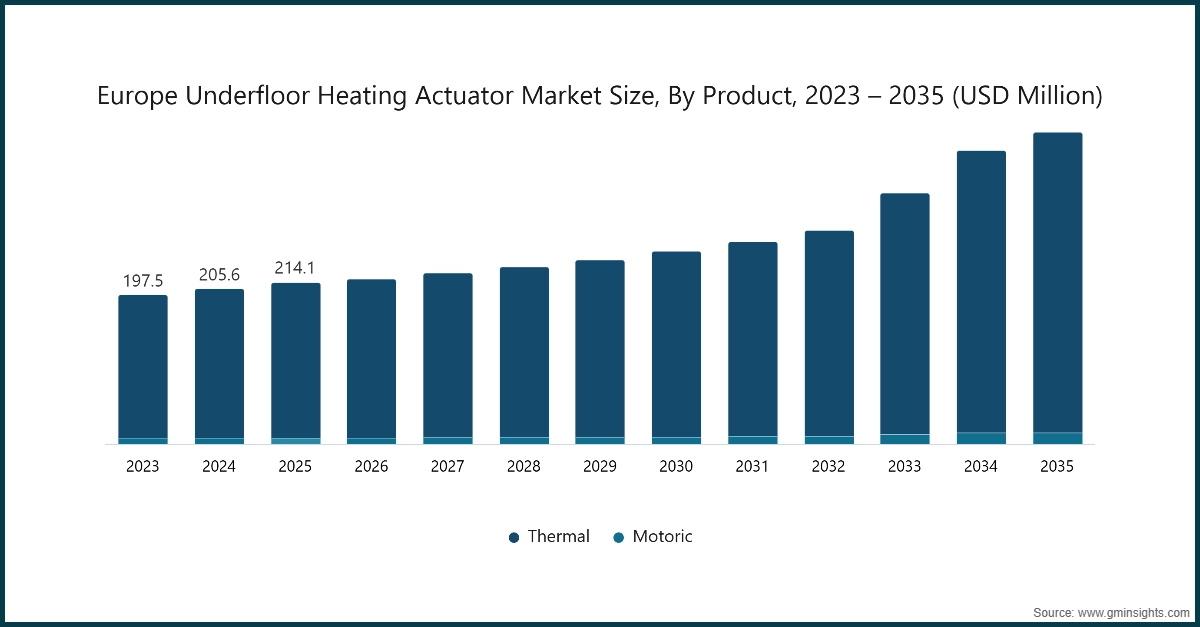
Based on product, the Europe Underfloor Heating Actuator is segmented into thermal and motoric. Thermal accounts for the major share of the market with 96.3% in 2025 and is expected to grow at a CAGR of 7.4% over the forecasted period of 2026-2035 propelled by their simplicity, reliability, silent operation, and low power consumption.
- The thermal underfloor heating actuator market will grow owing to increasing emphasis of key industry players on complying with established heating standards is expected to drive product adoption. Actuators featuring smart controls, wireless connectivity, and compatibility with home automation systems provide homeowners and building managers with greater convenience, flexibility, and energy management capabilities, positively influencing the industry’s growth potential.
- Rising manufacturers’ focus on differentiating their offerings is likely to enhance market share for underfloor heating actuators. Furthermore, the rising preference among consumers for clean, minimalist designs and adaptable interior layouts is anticipated to further support product penetration.
- For instance, the Buildings Energy Act (GEG), amended in 2023, mandates that newly installed heating systems must use at least 65% renewable energy. Further, municipal heat planning requirements are further creating a framework for district heating expansion and building-level heating system upgrades, further supporting actuator demand.
- Motoric will grow over CAGR 7% by 2035 on account of growing regulatory support, ongoing technological innovations, the surge in new construction projects, and the growing adoption of zoning systems. These actuators can be integrated with smart heating systems, enabling homeowners to manage them remotely via tablets, smartphones, or other smart home platforms, thereby boosting market momentum. In addition, commercial developers are increasingly using motorized actuators due to their capability to efficiently control water flow within underfloor heating systems.
Learn more about the key segments shaping this market
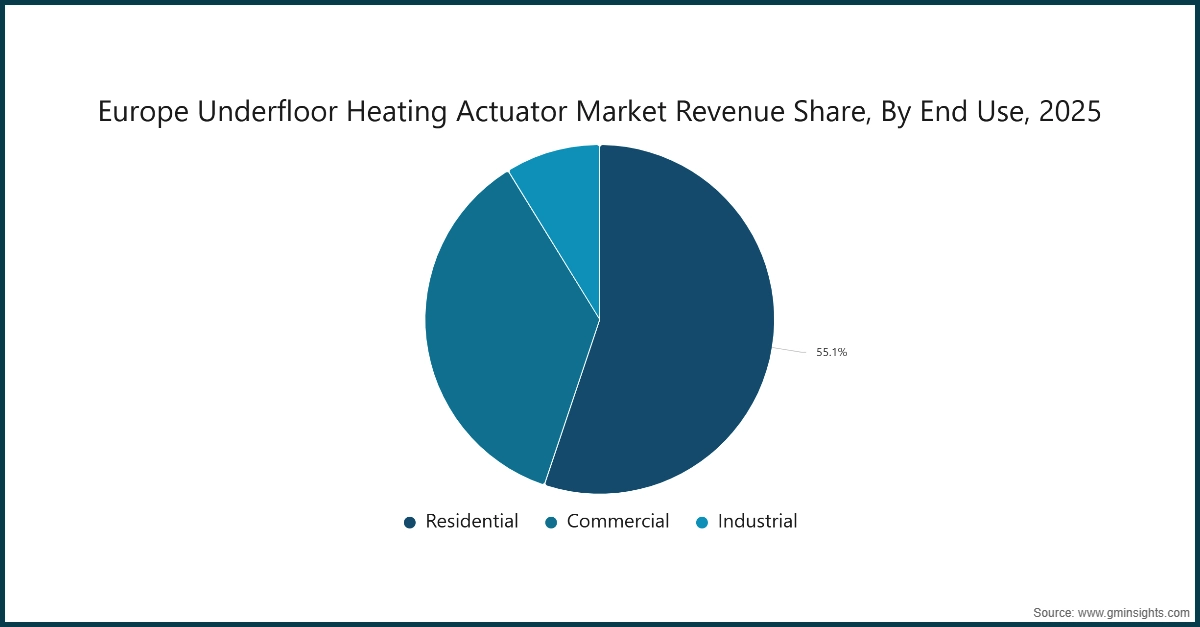
Based on end use, the Europe underfloor heating actuator market is segmented into residential, commercial and industrial. Residential accounts for the major share of the market with 55.1% in 2025 and are expected to grow at a CAGR of 7.5% over the forecasted period of 2026-2035.
- The market is being driven by key factors such as uniform heat distribution and the ability to operate efficiently at moderate temperatures, which contribute to energy savings and reduced power consumption. Ongoing research and development efforts aimed at modular component designs are making it easier to customize products according to customer preferences, further supporting market growth.
- Ongoing smart city initiatives, along with the simplicity of installing underfloor heating systems in new facilities, are expected to positively impact market growth. These systems provide uniform heat distribution, offer energy savings through low power consumption, and operate efficiently at moderate temperatures, thereby boosting demand for actuators. Additionally, when paired with smart thermostats and Wi-Fi-enabled controls, they allow zoned heating, which can result in up to 15% savings on heating bills. Features such as easy scalability across various floor types and safe operation further enhance the market outlook and support wider adoption.
- Commercial underfloor heating actuator market is set to grow owing to continued development of commercial infrastructure, particularly in developing economies, along with rising adoption in offices, restaurants, hotels, and leisure facilities. The expansion of these establishments, combined with the long-term cost savings offered by such systems, will further support industry growth. Additionally, increasing demand from off-grid locations and wider deployment in properties like saunas and spas will accelerate market penetration, thereby boosting the demand for underfloor heating actuators.
- The commercial segment is expected to expand due to the integration of advanced motorized actuators with building management systems. Technological improvements in actuators such as faster response times, greater reliability and durability, real-time energy monitoring, and enhanced overall performance are positively influencing market trends. Additionally, actuator-enabled zoning ensures that heat is delivered only where needed, improving both comfort and operational efficiency.
- Industrial will grow over CAGR 7% by 2035 on account of supported by the introduction of innovative, competitively priced actuators, optimized manufacturing processes, and efficient supply chain logistics. Advanced features, including precise temperature control, improved worker comfort, and lower energy consumption, are particularly valued in industrial applications such as warehousing, manufacturing, and specialized production, driving increased adoption of underfloor heating actuators.
Looking for region specific data?
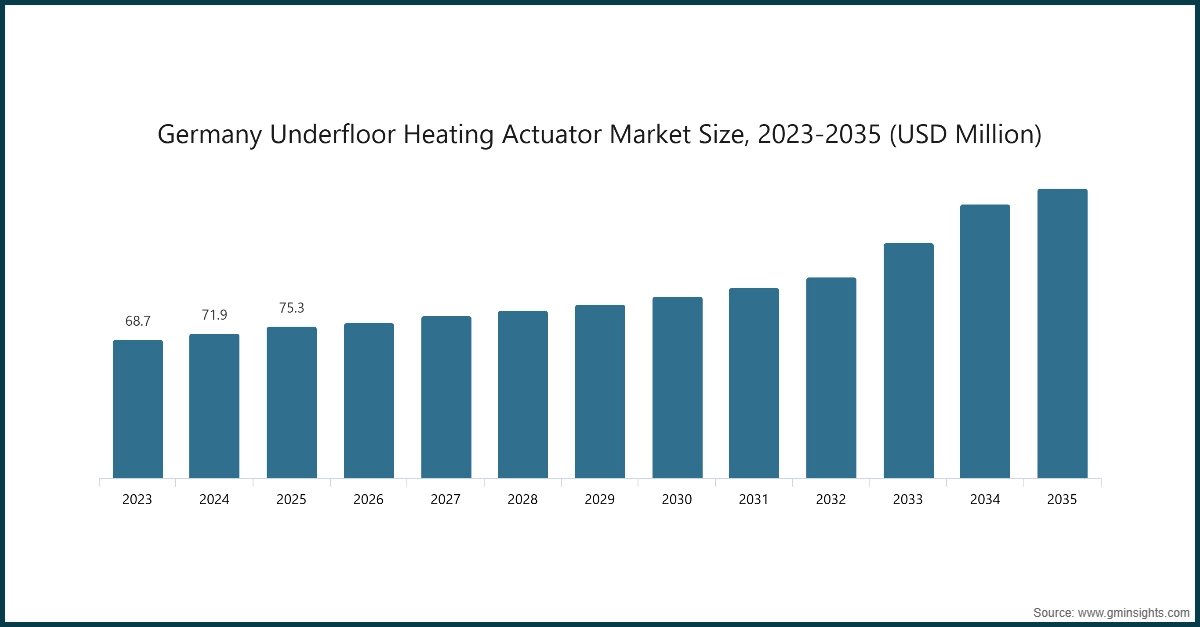
In Germany the Europe underfloor heating actuator market was valued at USD 75.3 Million in 2025 and is projected to grow at a CAGR of 7.1% for the forecast period of 2026-2035.
- Germany amounted to 35.2% market share in 2025 owing to government-backed financial incentives, including tax credits, rebates, and grants at the federal, state, and local levels, are motivating homeowners and businesses to adopt energy-efficient heating solutions, thereby supporting market growth.
- Germany's market leadership is driven by its large building stock, ambitious decarbonization targets, and strong policy support for energy-efficient heating systems. According to IEA, the government's Federal Funding for Efficient Buildings (BEG) program has provided cumulative funding of USD 37.3 billion for 3.8 million houses, directly supporting heat pump and underfloor heating installations.
- For instance, Germany’s Energy Saving Ordinance (EnEV) establishes mandatory standards for energy-efficient buildings, helping the Federal Government meet its national energy policy objectives.
- UK underfloor heating actuators market is anticipated to expand due to the rising construction of new buildings and the renovation of existing structures. Increasing preference for underfloor heating systems, along with the adoption of efficient and unobtrusive actuators, will further strengthen the industry landscape. In addition, stringent regulatory requirements for heating systems in commercial and industrial buildings, coupled with the growing emphasis on energy certifications such as BREEAM, are likely to enhance market growth.
- Denmark market is propelled by extreme climatic conditions, increasing demand for energy-efficient solutions, and a stronger focus on minimizing carbon footprints. Widespread adoption of district heating systems, where underfloor heating is integrated to optimize the overall network, will support market growth. Strict carbon emission standards & building regulations owing to ongoing government mandates to shift to energy efficient heating equipment will drive the market outlook.
- Finland represents the fastest-growing market with an 8.3% CAGR, driven by exceptionally high heat pump penetration and a mature district heating infrastructure. Further, the country’s cold climate and high heating demand create strong incentives for energy-efficient heating solutions, thereby augmenting business growth. Moreover, growing emphasis on renewable energy and energy independence further support the transition to electrified heating systems.
Europe Underfloor Heating Actuator Market Share
- The top five players operating in the market include Honeywell International, Danfoss, Schneider Electric, Siemens AG, and Uponor Corporation. Ongoing shift toward smart, connected actuators is blurring traditional boundaries between component suppliers and systems integrators, with actuator manufacturers will increasingly offer complete control ecosystems.
- Actuator manufacturers and technology firms are partnering to equip heating systems with advanced controls and innovative functionalities. Energy management features such as smart home integration and wireless communication enhance actuator performance, thereby boosting market penetration and sales potential. Additionally, emerging players are entering the market, offering features like wireless control, smart home compatibility, and zoning capabilities, further driving industry growth.
- Mergers and acquisitions activity in the broader building automation and HVAC sectors may lead to further market consolidation. Conversely, private equity investment in mid-tier manufacturers could provide capital for product development, geographic expansion, and channel development, increasing competitive intensity.
Europe Underfloor Heating Actuator Market Companies
Eminent players operating in the Europe underfloor heating actuator industry are:
- Alpha IP
- Belimo Holding AG
- EZ Heating Solutions
- Giacomini S.p.A.
- Homplex
- Hunt Heating
- Intatec
- Johnson Controls
- Kieback&Peter GmbH & Co. KG
- Ningbo Star Win Actuators
- OJ Electronics A/S
- Pentair plc
- REHAU Group
- Salus Controls
- Saswell
- Schneider Electric
- SHANGHAI SMLG Thermostatic Technology Co., Ltd.
- Viega GmbH & Co. KG
- Warmup
- Yuhuan Zhongliang Fluid Intelligent Control Co., Ltd.
- Schneider Electric is a French multinational corporation specializing in energy management and automation solutions. Schneider Electric's Building segment offers building automation systems, HVAC controls, lighting controls, security systems, and energy management platforms under the EcoStruxure brand. Strategic initiatives include enhancing interoperability with third-party systems through open protocols and supporting net-zero building targets through energy performance optimization and renewable energy integration.
- Siemens AG is a German multinational conglomerate with divisions in industry, energy, healthcare, and infrastructure. Siemens's Smart Infrastructure division offers building automation and control systems, HVAC controls, fire safety systems, and energy management solutions under the Desigo and Siemens Xcelerator brands. Strategic initiatives include developing digital twin capabilities for building performance simulation and optimization, and supporting decarbonization through integration of heat pumps, district heating, and renewable energy systems.
- Uponor Corporation is a Finnish company specializing in plumbing and indoor climate solutions, including PEX piping systems, radiant heating and cooling systems, and plumbing manifolds. Strategic initiatives include expanding its radiant heating and cooling systems portfolio to support reversible systems and integration with heat pumps, developing prefabricated manifold stations to simplify installation, and enhancing its LoopCAD design software to support BIM integration and lifecycle performance documentation.
- Johnson Controls is a global building technologies and solutions provider offering HVAC equipment, building automation systems, fire and security solutions, and energy management services. Strategic initiatives include expanding its OpenBlue platform with digital twin capabilities and sustainability reporting, developing integrated solutions that combine HVAC equipment with controls and services, and supporting decarbonization through heat pump integration, district energy solutions, and renewable energy management.
Europe Underfloor Heating Actuator Market Report Attributes
| Key Takeaway | Details |
|---|---|
| Market Size & Growth | |
| Base Year | 2025 |
| Market Size in 2025 | USD 214.1 Million |
| Market Size in 2026 | USD 218.8 Million |
| Forecast Period 2026-2035 CAGR | 7.3% |
| Market Size in 2035 | USD 414 Million |
| Key Market Trends | |
| Drivers | Impact |
| Introduction of energy efficient standards | Governments and regulatory bodies are pushing for lower energy consumption and reduced carbon emissions in both residential and commercial buildings. Underfloor heating systems, when combined with modern actuators, enable precise temperature control, zoning, and optimized energy usage, helping buildings comply with directives such as the EU Energy Performance of Buildings Directive (EPBD). These regulations create demand for advanced, energy-efficient actuators that improve heating performance while minimizing energy waste, thereby accelerating adoption in new construction and retrofit projects. |
| Increasing demand for space heating | Underfloor heating systems offer uniform heat distribution and enhanced indoor comfort compared with conventional radiators. Growing need for actuators that provide reliable, accurate, and responsive control of these systems owing to increasing requirement by homeowners and businesses to improve indoor living and working condition will complement the business growth. This is particularly pronounced in regions experiencing cold winters or fluctuating temperatures, where precise control over heating can significantly enhance comfort while reducing energy consumption, further stimulating actuator adoption. |
| Growing urbanization & commercialization | Europe’s ongoing urbanization and expansion of commercial infrastructure are creating a strong market for underfloor heating solutions integrated with smart actuators. New residential complexes, office buildings, hotels, and public facilities increasingly prioritize energy-efficient, low-maintenance, and user-friendly heating systems. Simultaneously, commercial developers are investing in systems that offer automated zoning, centralized control, and integration with building management systems, further driving the adoption of advanced actuators. |
| Pitfalls & Challenges | Impact |
| Longer payback period | Underfloor heating systems, particularly when paired with modern, energy-efficient actuators, often require a significant upfront investment compared to conventional heating solutions like radiators or baseboard heaters. This initial cost includes not only the actuators themselves but also the manifold, piping, control units, and professional installation services. |
| High initial costs and installation complexity | Underfloor heating systems and advanced actuators often require a larger upfront investment compared with traditional radiators and basic control valves. This can deter budget‑conscious homeowners and smaller contractors. Proper design and installation of underfloor heating with actuators demand skilled professionals. A shortage of trained installers and the complexity of integrating actuators with manifolds and control systems can slow market uptake. |
| Opportunities: | Impact |
| Retrofit & Renovation Market Growth | Europe hosts a substantial number of aging buildings that are gradually being upgraded to enhance energy efficiency and indoor comfort. These renovation projects often include the replacement or modernization of old heating systems with underfloor heating solutions, which rely on contemporary, energy-efficient actuators. Initiatives such as the EU’s Renovation Wave seek to boost the energy performance of millions of structures, driving strong demand for retrofit underfloor heating systems and the accompanying actuator technologies. |
| Integration with Smart and IoT-Enabled Control | The growing adoption of smart home and building automation across Europe is driving demand for underfloor heating actuators with connectivity features, including IoT compatibility, remote control, and integration with building management systems. As a frontrunner in smart building technologies, European homeowners and commercial users are increasingly seeking solutions that provide sophisticated control, energy monitoring, zoning capabilities, and seamless app or automation system connectivity. |
| Market Leaders (2025) | |
| Market Leader |
22% market share |
| Top Players |
Collective market share in 2025 is 57% |
| Competitive Edge |
|
| Regional Insights | |
| Largest Market | Germany |
| Fastest growing market | Finland |
| Emerging countries | Denmark, Austria, Norway, UK, Italy |
| Future outlook |
|
What are the growth opportunities in this market?
Europe Underfloor Heating Actuator Industry News
- In January 2026, the European Commission published its new EU Heating and Cooling Strategy, providing a comprehensive framework to support the implementation of the revised Energy Performance of Buildings Directive and Renewable Energy Directive. The strategy emphasizes integrated planning of energy infrastructure, district heating and cooling development, waste heat recovery, and the acceleration of building decarbonization through heat pump deployment and renewable energy integration.
- In September 2025, the European Commission launched a public consultation on the proposed tradable EU-wide energy efficiency market under the Affordable Energy Action Plan. The consultation sought stakeholder input on market design, eligibility criteria, measurement and verification protocols, and coordination with national energy efficiency obligation schemes. The proposed market aims to create cross-border trading of energy efficiency credits, enabling Member States to meet their Energy Efficiency Directive obligations more cost-effectively and stimulating investment in building retrofits and efficient heating systems including underfloor heating actuators.
- In August 2025, the European Commission published guidance documents to support Member State transposition of the revised Energy Efficiency Directive (EU/2023/1791), including detailed guidance on Article 26 (heating and cooling provisions) and good practices for collective thermal energy systems in multi-apartment buildings.
- In December 2024, Sauter introduced the ADM333 motorised actuators offering constant speed and easy installation. They are particularly designed for the automated operation of HVAC systems and are compatible with all the older models. Further, they will replace the A44 series in SAUTER’s actuator portfolio, strengthening their product offerings.
- In June 2023, Ambiente introduced new solutions, including AmbiEgo, a self-balancing actuator designed to manage both heating and cooling circuits. This innovation simplifies system design by removing the need for detailed knowledge of the original layout. Additionally, the integration of AI in the product accelerates and streamlines underfloor heating installations, further strengthening the company’s presence and offerings in the market.
Europe Underfloor Heating Actuator Market research report includes an in-depth coverage of the industry with estimates & forecast in terms of volume and revenue in “’000 Units & USD Million” from 2022 to 2035, for the following segments:
Market, By Product, 2022 – 2035 (USD Million & ‘000 Units)
- Thermal
- Motoric
Market, By End Use, 2022 – 2035 (USD Million & ‘000 Units)
- Residential
- Commercial
- Industrial
The above information has been provided for the following countries:
- Germany
- France
- Spain
- Austria
- Belgium
- Denmark
- Finland
- Norway
- Sweden
- UK
- Italy
- Russia
- Poland
- Czech Republic
- Switzerland
- Netherlands
Frequently Asked Question(FAQ) :
What was the market size of the Europe underfloor heating actuator market in 2025?
The market size was valued at USD 214.1 million in 2025, with a CAGR of 7.3% expected through 2035, driven by government initiatives promoting energy-efficient heating solutions and the adoption of advanced technologies in smart cities.
What is the projected value of the Europe underfloor heating actuator market by 2035?
The market is expected to reach USD 414 million by 2035, supported by the increasing deployment of low-emission heating systems and the integration of IoT-enabled actuator systems with building energy management systems (BEMS).
What is the projected size of the Europe underfloor heating actuator market in 2026?
The market is expected to reach USD 218.8 million in 2026.
What was the market share of thermal actuators in 2025?
Thermal actuators accounted for 96.3% of the market in 2025 and are projected to grow at a CAGR of 7.4% from 2026 to 2035, driven by their simplicity, reliability, silent operation, and low power consumption.
What was the market share of the residential segment in 2025?
The residential segment held a 55.1% share of the market in 2025 and is expected to grow at a CAGR of 7.5% from 2026 to 2035.
What was the valuation of the Germany underfloor heating actuator market in 2025?
The Germany market was valued at USD 75.3 million in 2025 and is projected to grow at a CAGR of 7.1% during the forecast period of 2026-2035.
What are the upcoming trends in the Europe underfloor heating actuator market?
Key trends include the adoption of intelligent, IoT-enabled actuator systems, integration with smart home platforms, and the development of advanced features such as zonal control, remote monitoring, and demand-response functionality.
Who are the key players in the Europe underfloor heating actuator market?
Key players include Alpha IP, Belimo Holding AG, EZ Heating Solutions, Giacomini S.p.A., Homplex, Hunt Heating, Intatec, Johnson Controls, Kieback&Peter GmbH & Co. KG, Ningbo Star Win Actuators, OJ Electronics A/S, and Pentair plc.
Europe Underfloor Heating Actuator Market Scope
Related Reports