Summary
Table of Content

Europe Two-Wheeler Market
Get a free sample of this report
Form submitted successfully!
Error submitting form. Please try again.
Thank you!
Your inquiry has been received. Our team will reach out to you with the required details via email. To ensure that you don't miss their response, kindly remember to check your spam folder as well!
Request Sectional Data
Thank you!
Your inquiry has been received. Our team will reach out to you with the required details via email. To ensure that you don't miss their response, kindly remember to check your spam folder as well!
Form submitted successfully!
Error submitting form. Please try again.
Europe Two-Wheeler Market Size
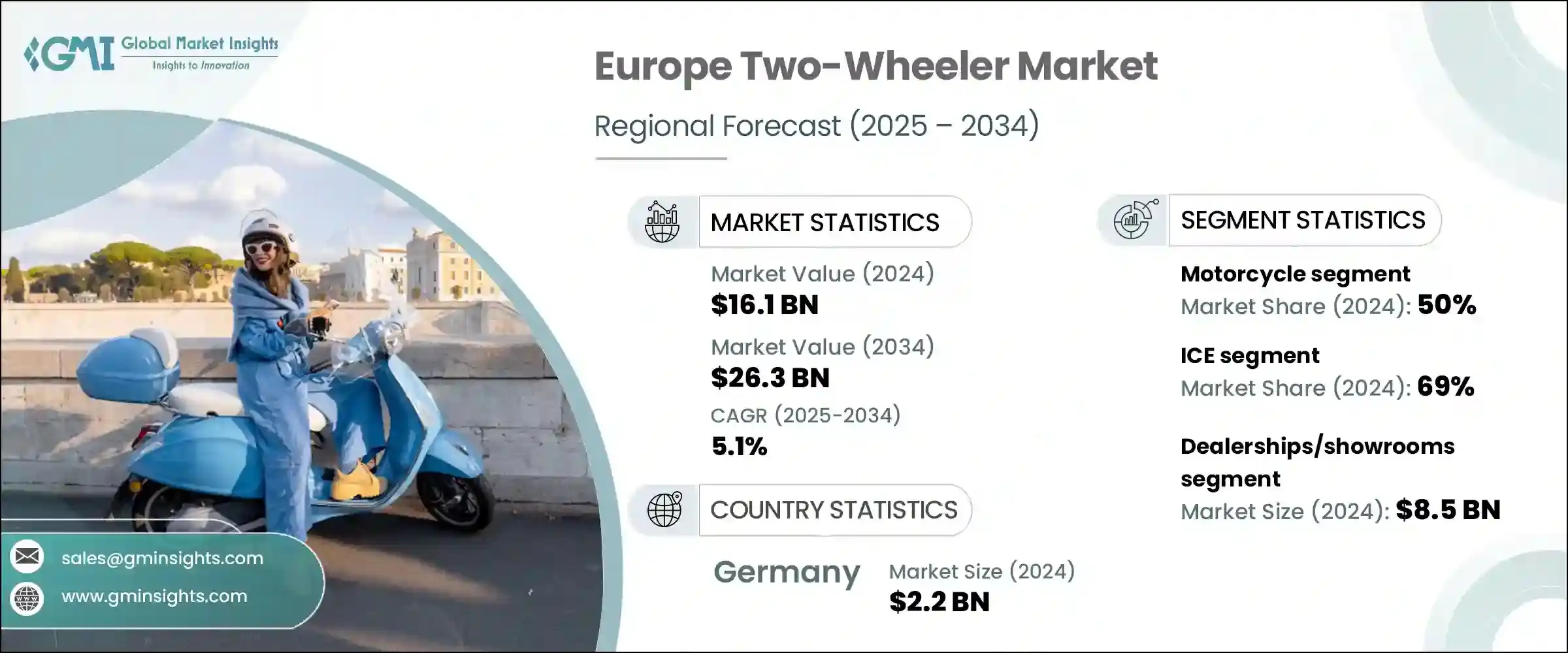
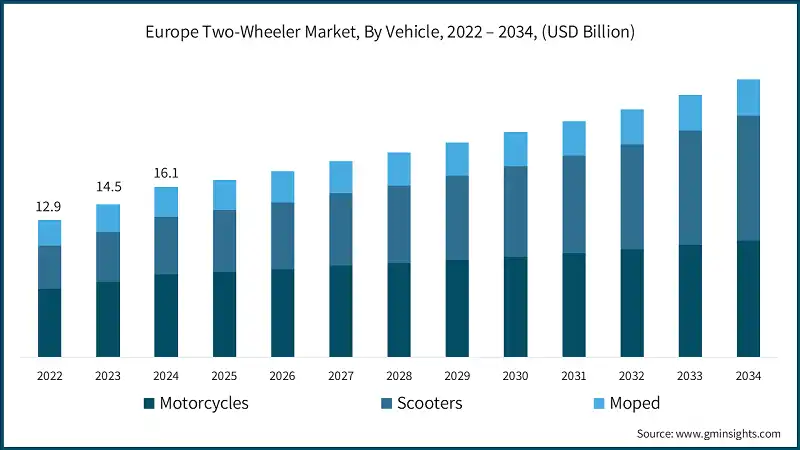
The Europe Two-Wheeler Market was valued at USD 16.1 billion in 2024. The market is expected to grow from USD 16.8 billion in 2025 to USD 26.3 billion in 2034, at a CAGR of 5.1%.
Europe Two-Wheeler Market Key Takeaways
Market Size & Growth
- 2024 Market Size: USD 16.1 Billion
- 2034 Forecast Market Size: USD 26.3 billion
- CAGR (2025–2034): 5.1%
Key Market Drivers
- Growing demand for affordable personal mobility solutions.
- Government incentives for electric two-wheelers adoption.
- Shared Mobility & Micro-Mobility Growth.
Challenges
- Infrastructure gaps for electric two-wheeler charging.
- High upfront cost of electric two-wheelers.
Opportunity
- Rising demand for electric two-wheelers.
- Advancements in battery technology.
- Premium and luxury segments.
- Connected and smart mobility solutions.
Get Market Insights & Growth Opportunities
- The European two-wheeler market is undergoing a shift towards technological changes and urban mobility needs. Competition is growing so rapidly that it drives constant innovation and product launches, especially in the premium and electric segments. Manufacturers of all levels and capabilities are realizing that they must offer smart features, enhanced safety and improved performance that meet changing consumer expectations.
- Consumer expectations are changing toward sustainable and technology-driven two-wheeler options, with smart features such as GPS navigation, anti-theft systems, and smartphone connectivity all becoming typical. Along with the technological changes, there is also a growing audience for unique styling, and customization, allowing brands to tap multiple market segments. The emergence of electric vehicles and luxury products also illustrates a change in perception from simply lending transportation to two-wheeling as a lifestyle.
- For instance, in 2023, Honda entered the European electric two-wheeler market with the launch of the EM1 e, its first electric motorcycle designed specifically for European riders. EM1 is the representative of their commitment to electrification and offers an advanced and sustainable performance, that is designed for the urban commuter.
- The COVID-19 outbreak created disruption in the Europe two-wheeler market as supply chain disrupted and decreased demand due to factory closures and parts shortages limited production and delivery. Shortages in public transportation drove some to the scooter, moped and e-bike market for safer travel and a reliable delivery service while social distancing. In 2021, the two-wheeler market recovered as consumers turned into two-wheeled vehicles, supported by a growing commitment to e-commerce and new state-sponsored electric vehicle (EV) incentives, firmly establishing the two-wheeler market for personal mobility and last-mile logistics.
- Italy experienced a spike in e-bike and scooter sales, especially in cities like Rome and Milan, after COVID-19. The Italian government introduced a scheme called Bonus Mobilità in 2020, as part of the National Emission Reduction Plan, which allowed Italian residents to receive up to $580.5 reimbursement for purchasing a bike or electric scooter. This scheme prompted demand for, and sales of e-bikes increased significantly in and around cities in Italy.
- In Europe, two-wheeler sales were driven by increasing urbanization, new environmental regulations forcing a shift to electric mobility, and two-wheeler OEMs responding to increased demand along with government incentives and growing charging infrastructures. Germany, France, and Italy are all leading the way in adopting electric scooters and motorcycles.
- For instance, in 2023, BMW Motorrad launched the BMW CE 02, a compact electric two-wheeler designed specifically for urban commuters and younger riders. This model reflects the broader market trend in Germany and Europe, combining smart design with sustainable performance to meet the demand for eco-friendly, connected mobility solutions.
To get key market trends
Europe Two-Wheeler Market Trends
- In Europe, demand for electric vehicles has been rising fast, with increased environmental awareness, tougher regulations initiated by governments, and very evident advantages of electric mobility, including fuel efficiency, lower maintenance costs, and no emissions. Incentives to purchase electric vehicles plus subsidies, have expedited the adoption of electric cars and commercial vehicles alike, with electric light trucks gathering more interest as countries go forward with cleaner transportation alternatives.
- For instance, In September 2024, Segway-Ninebot introduced its first off-road electric scooter, the ZT3 Pro, with the intent to capture the expanding European two-wheeler market. The ZT3 Pro has a 1600W motor, 11'' tubeless tires, dual suspension, and additional safety features, including traction control and AirLock. The scooter will go 70 km, with a top speed of 25 km/h. Priced from USD 869.6 and available from October 2024, the ZT3 Pro caters to Europe’s increasing demand for versatile, eco-friendly electric mobility options beyond urban streets.
- One of the important trends that is shaping the European two-wheeler market is Smart Urban Mobility which is the integration of digital technologies with electric scooters and bikes. It involves app-based tools such as GPS integration and navigation, remote diagnostics, ride analytics, and smart-locking systems. Smart Urban Mobility enhances urban commuting in terms of convenience, security, and efficiency, and as a result, connected two-wheelers are becoming increasingly popular in European cities that are focused on sustainable and tech-savvy modes of transportation.
- For example, in 2023, Niu Technologies launched Niu’s KQi Air X with app-based GPS tracking, remote diagnostics, anti-theft tech, and over-the-air updates.The carbon-fiber and light-weight nature, along with smart connectivity and ease of charge makes them favorable for tech-savvy and eco-conscious urban commuters. This shows how connected two-wheelers are changing the situation for urban transport across Europe.
- There has been considerable growth in electric motorcycles in the European two-wheeler segment, where many models satisfy the demand for high performance and a great riding experience. The combination of instant torque and 0-60 manifestation fits with speed lovers and urban riders alike, and the demand for more intelligent and eco-friendly mobility solutions will only grow. As Europe continues to commit to sustainable transport, we expect to see even more of this segment emerge as electric sport bikes gain popularity and represent a fun and active segment of innovation and sustainability.
- In October 2023, Kawasaki launched its electric motorcycles, Ninja e-1 and Z e-1. It first launched in the US but plans to enter the European market shortly. These electric motorcycles have removable 3 kWh batteries offering approximately 65 km of range, smart-charging capabilities and contribute to the rapidly expanding urban mobility offerings in Europe. These motorcycles represent the next generation of sustainable, high-performance urban mobility in Europe. Their innovative aspects highlight the trajectory of electric two-wheelers in Europe towards connected and sustainable two-wheeler offerings.
- Hybrid two-wheelers and motorcycles are rapidly gaining popularity in Europe as awareness of the climate crisis grows and governments introduce proactively supportive measures. Hybrid two-wheelers specifically serve urban commuters by providing lower emissions and engine noise outputs versus older petrol motorbikes. Given the surge of consumers prioritizing sustainable products, the European market for hybrid motorcycles is set to reach elevated growth rates. Manufacturers will respond to consumer priorities with an assessed assessment of investment into cleaner mobility technologies and as adaptability to overall transportation growth changes.
- For example, the newly released Kawasaki Ninja 7 Hybrid. This model combines a 451cc petrol engine and a 9kW electric motor. This newly expanded model will mark an important transition to eco-motorcycles and generate green performance. Kawasaki's movements into hybrids represent a transformative marine entertainment industry category towards sustainable two-wheeler solutions, especially for urban transportation that has large populations.
Europe Two-Wheeler Market Analysis
Learn more about the key segments shaping this market
- The motorcycle category is the largest segment of the European two-wheeler market, providing a great deal of demand from enthusiasts, as well as commuters seeking more performance and distance. This demand is highlighted by the strong leisure riding culture found in Germany, Italy, and France, where qualified leisure riding often combines with practical commuting use. The demand is further supported by the advance of new interests in technology in motorcycles, such as hybrid powertrains that provide improved efficiency and performance.
- In 2024 The MT-09 SP was launched by Yamaha in major European markets like Germany, Italy, and France. This motorcycle aims to provide options to riders who want high performance and flexibility in commuting use. The MT-09 SP aims to appeal to leisure motorcyclists and commuters by offering advanced electronic aids, premium components, and a powerful engine. Yamaha continued focus on performance-oriented motorcycles and investment in new technologies shows the great demand for motorcycles within the motorcycle segment of Europe.
- Scooters are rapidly growing in the European two-wheeler market. Scooters have practical applications in crowded urban environments, are simple to operate, and only recently have comparisons for electric and hybrid types of scooters been emerging. Given that many European cities continue to experience more traffic congestion and are positioning more restrictions related to emissions, the scooters provide a compact, low emissions option for commuters travelling every day. Even accident statistics promote scooters as advantageous, with most problems confined to collisions with other vehicles.
- As an example, in 2024, Gogoro formed a joint venture with Sumitomo Corporation and Sumitomo Mitsui Finance to accelerate Gogoro's growth opportunities, especially in the key European markets. Gogoro remarks on lightweight and automatic transmission 2wheeler vehicles, which obviously renders scooters suited for the latter purpose as the rational idea for younger riders or cost-efficient and suitable transport in urban transport.
Learn more about the key segments shaping this market
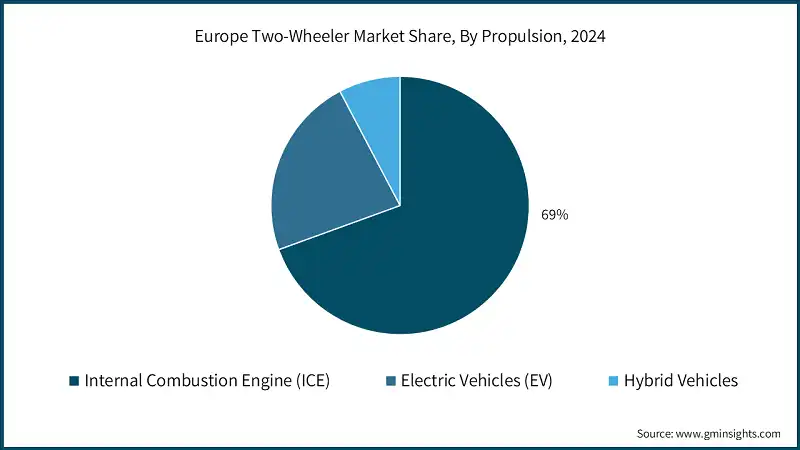
Based on propulsion, the Europe two-wheeler market is segmented into Internal Combustion Engine (ICE), Electric Vehicles (EV), and Hybrid Vehicles. The ICE segment dominates the market with 69% share in 2024, and the segment is expected to grow at a CAGR of 2% from 2025 to 2034.
- The Internal Combustion Engine (ICE) portion of the two-wheeler industry is still the dominant form of propulsion. Accessibility, low cost, and consumer awareness of ICE provides a sizable industry where buyers are still heavily selected to ICE. Because of buyers' ease of use of an ICE vehicle, such fuel availability, and service networks the convenient option is always chosen by consumers from the decade or so long availability of the solutions.
- TVS Motor is capitalizing on this demand by expanding its ICE portfolio in Europe with models like the Jupiter 125 and NTORQ, alongside hybrid options such as iQube S. These offerings cater to diverse consumer needs from urban commuters to performance enthusiasts, while leveraging the existing ICE ecosystem. TVS balancing rideable combustion engines with technology during the EV decade and to assist them toward growth in the future market of infrastructure development reality, ICE will deliver on accessibility and convenience from an operational perspective, or seller and buyer or viewable customer perspective.
- EVs segment is rapidly changing the face of mobility due to more stringent environmental and urban emission regulations, and increased demand from consumers for zero-emission transport options. Various governments across Europe are attempting to incentivize the use of EVs with financial incentives as well as creating infrastructure to make electric scooters and motorcycles available. Various hybrid technologies that include ICE vehicles combining two powertrains, ICE (internal combustion engines) with electric, have getting enhanced interest as a convenience and as a transitional technology improving fuel efficiency and emissions without worries of range realties associated with full electric vehicles.
Based on sales channel, the Europe two-wheeler market is segmented into dealerships/showrooms, multi-brand retailers, and online marketplaces. The dealerships/showrooms segment dominates the market and was valued at USD 8.5 billion in 2024.
- Dealer and showroom sales channels continue to lead in Europe's two-wheeler market, as consumers appreciate the opportunity to inspect the goods, ride the goods and interface with knowledgeable staff in a physical retail setting. This traditional distribution model also provides support for consumer purchases and after-sales service, financing or payment, and brand experience that builds trust. The opportunity to closely physically interact with products before making a purchase continues to translate into heavy use of this channel as a sales option, despite the emergence of more digital options.
- For instance, In February 2025, Europe's largest motorcycle retail complex, Mo-Town, is coming to France. The dealership model will be significantly enhanced with the development of this mega-showroom which integrates the commercial sale, service, and community experience with the manufacturers brand. This more substantial development reinforces the continued importance of bricks and mortar-based retail in an industry where consumers' tactile engagement and sales support remain dominant drivers of purchasing activity.
- Online marketplaces will be the fastest growing sales channel due to the increased digital adoption and the unlimited ease and convenience these marketplaces provide. Both the e-commerce sites and the manufacturer backed sites allow consumers the ability to research, compare and purchase two-wheelers from their homes and at or near the price points of competitive offers. Also, multi-brand retailers will have a considerable impact on the growing market because they have access to many more models and brands providing buyers with lots of options and freedom.
Looking for region specific data?
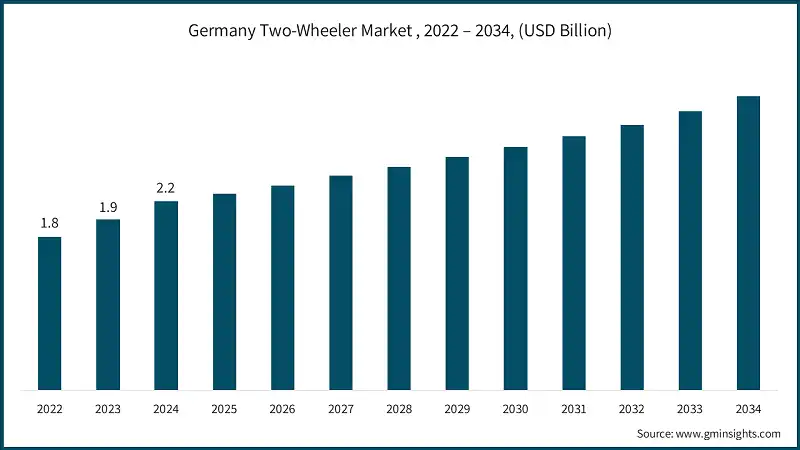
The Germany dominated the Western Europe two-wheeler market with around 30% market share and revenue of USD 2.2 billion in 2024.
- Western Europe holds a 44% share of the market in 2024 with a CAGR of 4%. The region is further positively impacted by combination of very dense urban transportation networks supported by some European governments prioritizing sustainable transport. Western Europe has advanced infrastructure with several governments practically supporting cleaner mobility, which is facilitating growth for both traditional petrol-powered vehicles and electric two-wheelers.
- In Germany, petrol-powered machines are still preferred by users, due to their reliability, performance, and the widespread refueling network across the country. However, incentives, environmental legislation, and the government's push for cleaner transportation will shape demand for electric two-wheelers over time. There will be a gradual uptake in usage driven by incentives, increased awareness of air quality, and the development of charging infrastructure to support the transition. Germany is a key market for both ICE and electric two-wheeled vehicles.
- In October 2024, KTM Freeride E-XC electric off-road motorcycle embodies the adult-oriented shift toward sustainable zero-emission vehicles in Germany's two-wheeler market. It provides confident performance within the environmental goals of the region. However, recent financial challenges placed on KTM have only increased uncertainty about the future of its electric models and heightened demand for clean mobility throughout Europe.
- Netherlands is known for its strong cycling culture and compact urban form, which has helped drive the growth of electric two-wheelers. Combined with extensive investments in charging infrastructure and a supportive set of urban mobility policies, electric scooters and electric mopeds are becoming more popular. This is contributing to congestion and pollution reductions that help the country make progress toward its goals of sustainable and efficient transportation in both urban and rural settings.
- In 2024 BMW Motorrad expanded the CE 04 electric scooter across key Western European countries including Germany, France, and the Netherlands. This expansion aligns with Europe's increased focus on sustainable urban mobility, its stricter emissions regulations, and financial incentives from national or municipal governments. BMW's focus on premium electric scooters highlights a rise in demand by the consumer for clean, efficient, and stylish transportation in the region's increasingly competitive two-wheeler market.
Predictions suggest that from 2025 to 2034, Northern Europe two-wheeler market will grow tremendously.
- Northern Europe’s two-wheeler market is projected to grow at a CAGR of 5.6% from 2025-2034, based on customer policies towards the environment and the prevailing sustainable consumer attitude in that region. Stable infrastructure, broad market offering, and the inclement weather are encouraging users to select durable, and dependable two-wheelers for urban commutes and extended travels onto the countryside.
- Two-wheeler potential in the UK is seen as value- and convenient-based reflecting the overwhelming cost for four-wheel congestion in urban environments when weight and flip made it an effective purchase. Subsidies, low-emission zone, and improved charging offer schemes to help the UK balance historical performance with greener possibilities.
- In 2024, Swifty Scooters launched the first road-legal stand-on electric scooter for the UK. This product inlining with Europe's goal for cleaner urban mobility, where the government is incentivising this transition through subsidies and the provision of charging infrastructure. Swifty Scooters relies on their experience for safety and practicality in order to deliver efficient, sustainable solutions for urban transport in Europe's largest cities, with demand for convenient and cleaner transport options being at an all-time high.
The market in Poland is expected to experience significant and promising growth from 2025 to 2034.
- Eastern Europe accounts for 26% of the Europe two-wheeler market in 2024 with a CAGR of 6.8%. The two-wheeler market in Eastern Europe is rising steadily driven by urban congestion, environmental concerns and the adoption of supportive policies. Countries like Poland are embracing electric scooters and mopeds for their practicality and affordability as urban transport solutions. The continued rollout of charging stations and the development of scootable models for local markets are expanding demand.
- Poland is the strong market in Eastern Europe's transition to sustainable transport. It cited as a growing success in a sustainable transition to transport. Again, as urbanization rises and environmental awareness improves, consumers in Eastern Europe are searching for affordable, practical alternatives that are sustainable, and demand for mobility options is increasing. The adoption and support from government for adequate infrastructure, related to congestion in urban areas, is helping accelerate the interest in using electric two wheelers for utilitarian journeys. As such, we see growth opportunities for Poland as a marketplace of choice for future consumer innovations in electric mobility.
- Yamaha launch NEO's as an urban commuter electric scooter within Poland. The NEO’S has a swappable battery, compact design, designed for urban usage, fits Eastern European Road conditions and supports the emerging EV infrastructure. This model is compatible with Poland and its visions for low-emission transport, in the growing desire for practical and sustainable mobility options for residents.
- In urban centers such as Warsaw, Kraków, and Wrocaw, two-wheeled vehicles are emerging as highly attractive substitutes for motor vehicles due to high fuel prices and lack of parking. Additionally, as the cost of ownership diminishes with social programs such as tax incentives and grants for EVs, more people will adopt two wheelers. E-bikes and scooters will be the cheapest and most convenient way to navigate congested roads.
The market in Italy is expected to experience significant and promising growth from 2025 to 2034.
- Southern Europe accounts for 8% of the Eastern Europe two-wheeler market in 2024 and is the fastest-growing region with a CAGR of 3.6%. The two-wheeler market in Southern Europe is growing fast, driven by urban congestion, environmental concerns, and government support. In countries like Italy and Spain consumer acceptance and interest in electric scooters and mopeds is driven by an affordable form of clean and sustainable transport, particularly in narrow urban centers.
- Italy is emerging as a leader in Southern Europe's transition to sustainable mobility. Elevated urbanization, pollution or air quality challenges compounded by climate issues and supportive government policies are increasing interest in, and use of electric two-wheelers for commutes and leisure mobility needs. Government subsidies, improved infrastructure, and low-emission zones are stimulating adoption and making Italy a center of innovation in electric mobility.
- For example, Italy government launched “Ecobonus” a subsidy program that is part of a broader European push to promote electric two-wheeled vehicles with financial backing. This logical application of reduced-price food while putting e-bikes and e-scooters onto the market, makes perfect sense for Italy's transportation transition enabling urban sustainable mobility the California way and helping to satisfy the expected large increase in demand across Southern Europe.
- Two-wheelers are becoming preferred options as the road traffic situation and parking become a challenge in Spain and Vatican City. Spain's MOVES incentive program, which reduces the initial purchase cost of electric vehicles, is a key driver of adoption. This trend is expected to continue, particularly in urban areas, with Spain projected to become a leading market for electric scooters and motorcycles in Europe.
Europe Two-Wheeler Market Share
The top 7 companies in the market are BMW Motorrad, KTM, Ducati, Yamaha, Harley-Davidson, Honda, and Piaggio. These companies hold around 57% of the market share in 2024.
- BMW Motorrad is known for premium motorcycles. They are quickly becoming a leader in electric motorcycles by combining performance and advanced technology and leaving their mark on urban commuters, leisure riders and motorcycle manufacturers, both in Western Europe and beyond.
- Piaggio Group, who design Vespa's, are in the lead when it comes to scooters, with their popular designs. These vehicles are popular in urban centres in Southern and Western Europe. They have a supportive dealer network and additionally expand the charging infrastructure.
- KTM offers high-performance motorcycles favored by enthusiasts, especially in Central and Western Europe. They are expanding their electric line of motorcycles while still maintaining status in petrol powered sport and off-road two-wheelers.
- Yamaha has positioned itself very well in this market with its extensive range of motorcycles and scooters. Everybody knows Yamaha makes reliable and low-cost motorcycles and scooters, which is why their electric two-wheelers are catching on in certain parts of northern Europe where preference has changed to sustainability.
- Peugeot Motocycles is among the leading producers of electric scooters in Europe. Most of their development is focused on urban mobility. As their small, compact and efficient electric scooters are designed for urban users, they will mostly be rolled out in the metro areas of western Europe.
Europe Two-Wheeler Market Companies
Major players operating in the Europe two-wheeler industry include:
- BMW Motorrad
- KTM
- Ducati
- Royal Enfield
- Harley-Davidson
- Yamaha Motor
- Silence
- Honda Motor
- Kawasaki Motors
- Suzuki Motor
- BMW Motorrad is we for its premium motorcycles and a growing range of electric two-wheelers. The company prioritizes the integration of advanced technology with sustainability, serving both urban commuters and leisure riders throughout Europe.
- BMW commits significant resources to innovation, particularly in smart connectivity and battery technology, to elevate the overall riding experience. Its strong brand heritage and focus on quality continue to attract a loyal customer base across diverse market segments.
- Piaggio Group, famous for iconic brands such as Vespa, dominates the European scooter market. The company focuses on electric mobility and designs tailored for urban environments, supported by a robust dealer network and well-established charging infrastructure, especially in Southern and Western Europe. Piaggio’s commitment to stylish, user-friendly designs helps it maintain a leading position in city mobility solutions.
- KTM specializes in high-performance motorcycles favored by enthusiasts and is expanding its electric vehicle offerings. The brand invests in cutting-edge engineering and lightweight materials to enhance efficiency, maintaining a strong presence in both Central and Western Europe’s sport and off-road segments. KTM’s racing pedigree and innovative approach continue to drive its appeal among younger and performance-oriented riders.
- Yamaha offers a diverse portfolio of motorcycles and scooters known for their reliability and affordability. The company is rapidly advancing its electric two-wheeler lineup, emphasizing eco-friendly technologies and connectivity features that appeal to urban riders in Northern Europe. Yamaha’s focus on balancing performance with sustainability positions it well for future growth in the evolving two-wheeler market.
Europe Two-Wheeler Market Report Attributes
| Key Takeaway | Details |
|---|---|
| Market Size & Growth | |
| Base Year | 2024 |
| Market Size in 2024 | USD 16.1 Billion |
| Forecast Period 2025 - 2034 CAGR | 5.1% |
| Market Size in 2034 | USD 26.3 billion |
| Key Market Trends | |
| Drivers | Impact |
| Increase demand for compact, efficient two-wheelers ideal for city commuting and reducing road congestion. | |
| Growing demand for affordable personal mobility solutions | Increase sales of cost-effective motorcycles, scooters, and e-bikes for daily commuting. |
| Government incentives for electric two-wheelers adoption | Encourages more buyers to choose electric models by lowering purchase costs. |
| Shared Mobility & Micro-Mobility Growth | Expands the market for electric scooters and bikes through rental and sharing platforms. |
| Pitfalls & Challenges | Impact |
| Infrastructure gaps for electric two-wheeler charging | Hinders convenient use and slows electric two-wheeler adoption. |
| High upfront cost of electric two-wheelers | Limits affordability for many buyers, slowing market growth. |
| Opportunities: | Impact |
| Rising demand for electric two-wheelers | Creates chances for more electric models with government support and eco-friendly buyers. |
| Advancements in battery technology | Enables longer rides and quicker charging, boosting electric two-wheeler appeal. |
| Premium and luxury segments | Rising demand for high-performance electric motorcycles and tech-integrated premium scooters |
| Connected and smart mobility solutions | Growth in IoT-enabled two-wheelers driven by 5G and smart city infrastructure. |
| Market Leaders (2024) | |
| Market Leader |
|
| Top Players |
Collective market share in 2024 is 50% |
| Competitive Edge |
|
| Regional Insights | |
| Largest Market | Western Europe |
| Fastest growing market | Eastern Europe |
| Emerging countries | Italy, Spain, Poland, Norway |
| Future outlook |
|
What are the growth opportunities in this market?
Europe Two-Wheeler Industry News
- In March 2024, TVS Motor highlighted its lineup at Lyon’s Salon du Deux Roues and announced a strategic partnership with Swiss distributor Emil Frey to enter the French market. This move strengthens TVS’s presence in Europe, offering both ICE and electric models to meet diverse consumer demands. It reflects the growing influence of Asian manufacturers in Europe’s competitive two-wheeler market, especially as electrification gains momentum.
- In March 2024, DHL partnered with the FIM Enel MotoE World Championship, becoming the official logistics provider for the electric motorcycle racing series. This collaboration highlights Europe’s growing focus on sustainable two-wheeler mobility and supports the development of electric motorcycle infrastructure. It reflects the region’s shift toward cleaner, tech-driven mobility solutions in both sport and urban transport.
- In October 2023, Triumph unveiled the Thruxton Final Edition, an exclusive and striking motorcycle that embodies incredible specification, performance, capability, and timeless style. This final edition pays tribute to a legendary name in motorcycling history and marks the end of an era with a machine that blends classic aesthetics with modern engineering. It stands as a collector’s piece, celebrating decades of café racer heritage.
- In October 2023, Triumph Motorcycles and Akrapovi announced a strategic partnership to jointly develop new exhaust systems for the adventure and roadster segments. The collaboration also extends to special projects, aiming to deliver high-performance solutions that fuse advanced engineering with innovative design. This alliance strengthens their position in the competitive two-wheeler market, where performance, customization, and rider experience are key differentiators.
- In September 2023, Sibros, a leading connected vehicle technology company, revealed a strategic partnership with PIERER Mobility, the parent company behind KTM motorcycles. This collaboration aims to equip KTM’s high-performance motorcycles and off-road bikes including the V-Twin Series, Super Adventure, and Super Duke with advanced connectivity solutions, enhancing the riding experience through real-time data, diagnostics, and over-the-air updates.
The Europe two-wheeler market research report includes in-depth coverage of the industry with estimates & forecasts in terms of revenue (USD Bn) and volume (Units) from 2021-2034, for the following segments:
Market, By Vehicle
- Motorcycles
- Sport Bikes
- Cruisers
- Touring Motorcycles
- Adventure Motorcycles
- Naked/Standard Motorcycles
- Scooters
- Moped
Market, By Propulsion
- Internal Combustion Engine (ICE)
- Up to 100 CC
- 100-200 CC
- Above 200 CC
- Electric Vehicles (EV)
- Up to 5 kWh
- 5-10 kWh
- Above 10 kWh
- Hybrid Vehicles
Market, By End Use
- Personal Use
- Commercial Use
- Delivery Services
- Taxi/Ridesharing
- Tourism and Rental
- Shared Mobility
Market, By Sales Channel
- Dealerships/Showrooms
- Multi-Brand Retailers
- Online Marketplaces
The above information is provided for the following regions and countries:
- Western Europe
- Germany
- France
- Netherlands
- Belgium
- Switzerland
- Austria
- Luxembourg
- Liechtenstein
- Ireland
- Eastern Europe
- Poland
- Czech Republic
- Portugal
- Serbia
- Albania
- Slovakia
- Romania
- Slovenia
- Bulgaria
- Northern Europe
- UK
- Denmark
- Sweden
- Norway
- Iceland
- Faroe Islands
- Southern Europe
- Italy
- Spain
- Vatican City
- San Marino
Frequently Asked Question(FAQ) :
What is the market size of the Europe two-wheeler in 2024?
The market size was USD 16.1 billion in 2024, with a CAGR of 5.1% expected through 2034, driven by technological advancements and increasing urban mobility needs.
What is the projected value of the Europe two-wheeler market by 2034?
The market is expected to reach USD 26.3 billion by 2034, fueled by growth in the premium and electric two-wheeler segments.
What is the projected size of the Europe two-wheeler market in 2025?
The market is expected to reach USD 16.8 billion in 2025.
What was the market share of the motorcycle segment in 2024?
The motorcycle segment accounted for 50% of the market in 2024 and is projected to grow at a CAGR of over 3% from 2025 to 2034.
What was the market share of the ICE segment in 2024?
The ICE segment held a 69% market share in 2024 and is expected to grow at a CAGR of 2% from 2025 to 2034.
Which region leads the Europe two-wheeler market?
Germany led the Western market with a 30% share and USD 2.2 billion in revenue in 2024. Western Europe as a whole accounted for 44% of the market in 2024, supported by dense urban transportation networks and government initiatives for sustainable transport.
What are the upcoming trends in the Europe two-wheeler industry?
Key trends include rising demand for electric vehicles driven by environmental awareness, government regulations, and incentives.
Who are the key players in the Europe two-wheeler market?
Key players include BMW Motorrad, KTM, Ducati, Royal Enfield, Harley-Davidson, Yamaha Motor, and Silence.
Europe Two-Wheeler Market Scope
Related Reports